
Group Health Insurance Cost for Small Business
As an Independent Group Health Insurance Broker, we compare fully insured, level-funded, and self-funded options across carriers to find the lowest cost coverage for your business.
Group Health Insurance Cost for Small Business

Jason Stolz CLTC, CRPC, DIA, CAA
Group health insurance cost for a small business is shaped by a combination of factors that interact in ways most business owners do not fully anticipate until they are already sitting across from a renewal quote that does not match what they budgeted. Understanding what actually drives those costs — and how to influence the variables you can control while managing the ones you cannot — is the foundation of making sound decisions about employee health benefits. At Diversified Insurance Brokers, we help small business owners in all 50 states navigate the group health insurance market, compare options across multiple carriers, and build benefit packages that are both competitive for recruiting and sustainable for the business budget. For context on the broader framework of what a business needs from health insurance, our resource on how much health insurance a business needs covers the needs-assessment process before you start pricing plans.
At a high level, group health insurance costs are driven by four primary factors: the demographics of your workforce, the plan design you choose, your employer contribution strategy, and the insurance carrier underwriting your policy. Each of these elements interacts with the others, which is why two businesses with the same number of employees can have significantly different premiums. A younger, healthier workforce generally results in lower rates, while an older workforce or one with higher historical utilization may produce higher premiums. Plan type — HMO, PPO, EPO, or HDHP — dramatically affects both the premium level and the employee out-of-pocket structure. And the percentage of the premium the employer contributes directly affects employee participation, which in turn affects the carrier’s risk pool and pricing. Our resource on how to get the best group health insurance rates covers the specific levers that produce the most favorable pricing outcomes for small businesses.
Get Small Business Health Insurance Quotes
Compare group health plan options from top-rated carriers for your workforce size and location.
Average Group Health Insurance Cost Benchmarks for Small Businesses
For most small businesses, monthly premiums per employee range from a few hundred dollars for single coverage to well over a thousand dollars for family coverage, depending on plan design, location, and workforce demographics. The table below provides a realistic benchmark range for what small business employers typically see in the market — understanding that actual quotes will vary based on the specific factors that apply to your group.
Average Cost Breakdown for Small Business Health Insurance
| Coverage Type | Average Monthly Premium (Per Employee) | Employer Share (Typical) | Employee Share (Typical) |
|---|---|---|---|
| Single Coverage | $450 – $800 | $250 – $600 | $150 – $300 |
| Family Coverage | $1,200 – $2,000+ | $700 – $1,500 | $400 – $900 |
These ranges reflect national averages and should be treated as orientation benchmarks rather than reliable predictors of what a specific business will be quoted. A 10-person professional services firm in a low-cost metropolitan area with a young workforce may land well below the lower end of the single-coverage range. A 45-person manufacturing business in a high-cost region with an older workforce may comfortably exceed the upper end of the family coverage range. The only way to know what your group will actually cost is to obtain market-rate quotes from multiple carriers — which is where working with an independent broker who has access to the full market produces the most accurate picture.
Plan Types and Their Cost Implications
The plan type chosen for a small business group health program is one of the most consequential cost decisions an employer makes — and one of the most misunderstood. The four primary plan structures available in the small group market are HMO (Health Maintenance Organization), PPO (Preferred Provider Organization), EPO (Exclusive Provider Organization), and HDHP (High-Deductible Health Plan). Each produces a different premium level and a different employee out-of-pocket structure, and the right choice depends on the balance between what the employer can afford on a monthly premium basis and what employees can reasonably absorb in out-of-pocket costs when they use care.
HMOs generally offer the lowest premiums in the small group market, but they restrict coverage to a defined network of providers and typically require a primary care physician referral to access specialty care. For employees who are comfortable staying within a defined network — or who live and work in areas with robust HMO networks — this can be a cost-effective structure that keeps both employer premiums and employee out-of-pocket costs manageable. PPOs provide more flexibility — employees can see out-of-network providers, though at a higher cost share — but that flexibility comes with meaningfully higher premiums. For employers whose workforce includes employees in multiple locations or whose employees strongly value provider choice, a PPO may be necessary to maintain plan satisfaction.
HDHPs are the plan structure that generates the most interest among cost-conscious small business owners and the most caution from HR professionals focused on employee experience. The lower premium makes the monthly employer cost substantially more manageable than a traditional low-deductible plan, but employees bear higher out-of-pocket costs before the plan begins paying. The HDHP structure pairs naturally with a Health Savings Account (HSA), which allows both employer and employee to contribute pre-tax dollars that can be used to offset the higher deductible. Our resource on HSA strategies covers how this tax-advantaged account works alongside high-deductible plan designs. For employers who want to help employees absorb the HDHP’s higher cost-sharing without dramatically increasing the employer’s own premium burden, employer HSA contributions are a commonly used strategy that provides value to employees while keeping total benefits cost competitive. Our resource on how to choose the right group health plan covers the full decision framework for matching plan type to workforce needs.
The Employer Contribution Requirement and Its Effect on Cost
Most insurance carriers that offer small group health insurance require a minimum employer contribution toward employee premiums — typically 50 percent of the employee-only premium — as a condition of offering coverage. This requirement exists to ensure that employee participation in the plan is driven by genuine access to affordable coverage rather than individual health preferences, which is important for maintaining a balanced risk pool. When the employer contribution is high, healthy and sick employees alike tend to enroll, balancing the pool. When the contribution is low, only employees with higher health needs may enroll, creating an adverse selection dynamic that drives up claims and, ultimately, premiums.
For small business owners, the employer contribution decision is both a cost-management lever and a recruiting and retention tool. Contributing 50 percent of employee premiums satisfies most carrier minimums and provides some benefit, but it may still leave employees with premium costs that feel burdensome — potentially reducing plan satisfaction and participation. Contributing 75 or 80 percent of employee premiums increases the employer’s monthly benefit cost significantly but produces higher participation rates, better employee satisfaction, and a more balanced risk pool that can support more stable long-term pricing. Many small businesses that initially set contribution at the minimum to control costs find that raising it modestly over time — to 65 or 70 percent — produces better overall outcomes for both cost and employee engagement.
It is also important to distinguish between contributions toward employee-only coverage and contributions toward dependent coverage. The ACA requires that employers who offer group coverage make it available to employees and their dependents, but it does not require a specific employer contribution toward dependent premiums. Many small businesses contribute 50 to 75 percent of employee-only premiums and nothing toward dependent premiums — which makes family coverage expensive for employees with families, potentially reducing the plan’s attractiveness to that group. Some employers contribute a fixed dollar amount toward dependent coverage rather than a percentage, providing some value while maintaining more predictable total employer cost as premium rates change annually.
Participation Requirements: How They Work and Why They Matter
Insurance carriers that offer fully-insured small group health plans impose participation requirements — minimum percentages of eligible employees who must enroll in the group plan — as a condition of offering and renewing coverage. Typical participation minimums range from 51 to 75 percent of eligible employees, though the specific threshold varies by carrier and state. The purpose of participation requirements is identical to the employer contribution purpose: to ensure the enrolled group represents a mix of health risk levels rather than consisting primarily of employees with above-average health needs.
For small businesses, meeting participation requirements can be more challenging than it appears. Employees who have coverage elsewhere — through a spouse’s employer plan, through Medicare or Medicaid, or through their own marketplace plan — typically do not count against the participation calculation. This is the “waivers” concept: employees who decline the employer’s coverage because they have other qualifying coverage can be excluded from the denominator of the participation calculation. A business with 10 eligible employees where 3 have spousal coverage and 7 are evaluated for participation needs 4 of those 7 to enroll — which is a much more achievable 57 percent of the actual decision-making population. Our resource on minimum employees for group health insurance covers the specific eligibility and participation rules that determine whether a small business qualifies to offer group coverage at all.
Geographic Variation in Small Business Health Insurance Costs
Where a business operates is one of the most significant determinants of group health insurance cost that an employer cannot easily change. Healthcare costs — hospital rates, physician fees, specialist utilization patterns, pharmaceutical costs — vary substantially across geographies, and insurance premiums reflect the underlying cost of care in each market. Small businesses in metropolitan areas with highly concentrated health systems, where hospital networks have significant pricing power, generally face higher premiums than businesses in less concentrated markets. States with more robust insurance regulations, coverage mandates, and rating restrictions also affect the premium environment in ways that vary from state to state.
Geographic variation also interacts with carrier availability and competition. In some markets, a large number of carriers actively compete for small group business, which tends to produce more competitive pricing and more plan variety. In other markets, two or three carriers dominate, with less competitive pressure on pricing. Working with an independent broker who understands the specific carrier landscape in your geographic market — including which carriers price most competitively for your workforce profile and industry — is one of the most direct ways to capture geographic cost advantages that are available but not always obvious from public rate information. Our resource on why to work with an independent group health insurance broker covers how independent brokers access the full market rather than being limited to the carriers of a single company or distribution channel.
How Workforce Age Distribution Affects Small Business Premiums
In the small group market, insurers use the age distribution of the enrolled workforce as a key pricing input. Under current ACA rules, carriers can charge older employees up to three times the premium of the youngest employees for identical coverage — a ratio known as the 3:1 age rating band. This means a small business with an older workforce profile can face premiums that are substantially higher than a business of identical size with a younger workforce, even with identical plan designs and identical employer contribution structures.
For businesses with significant age diversity, composite rating — where all employees pay a single average premium regardless of individual age — can be beneficial for younger employees but may feel less fair to older employees who are paying the same rate. Some states modify or limit the age rating band through state regulations, and the specific rating approach available depends on both carrier and state guidelines. For employers concerned about how their workforce age profile affects pricing, requesting age-banded versus composite pricing from multiple carriers can reveal which approach is more favorable for their specific group. Our resource on small employer group health insurance covers the rating rules and approaches that apply specifically to small groups as defined by each state’s insurance regulations.
Level Funding: A Cost-Management Alternative for Small Businesses
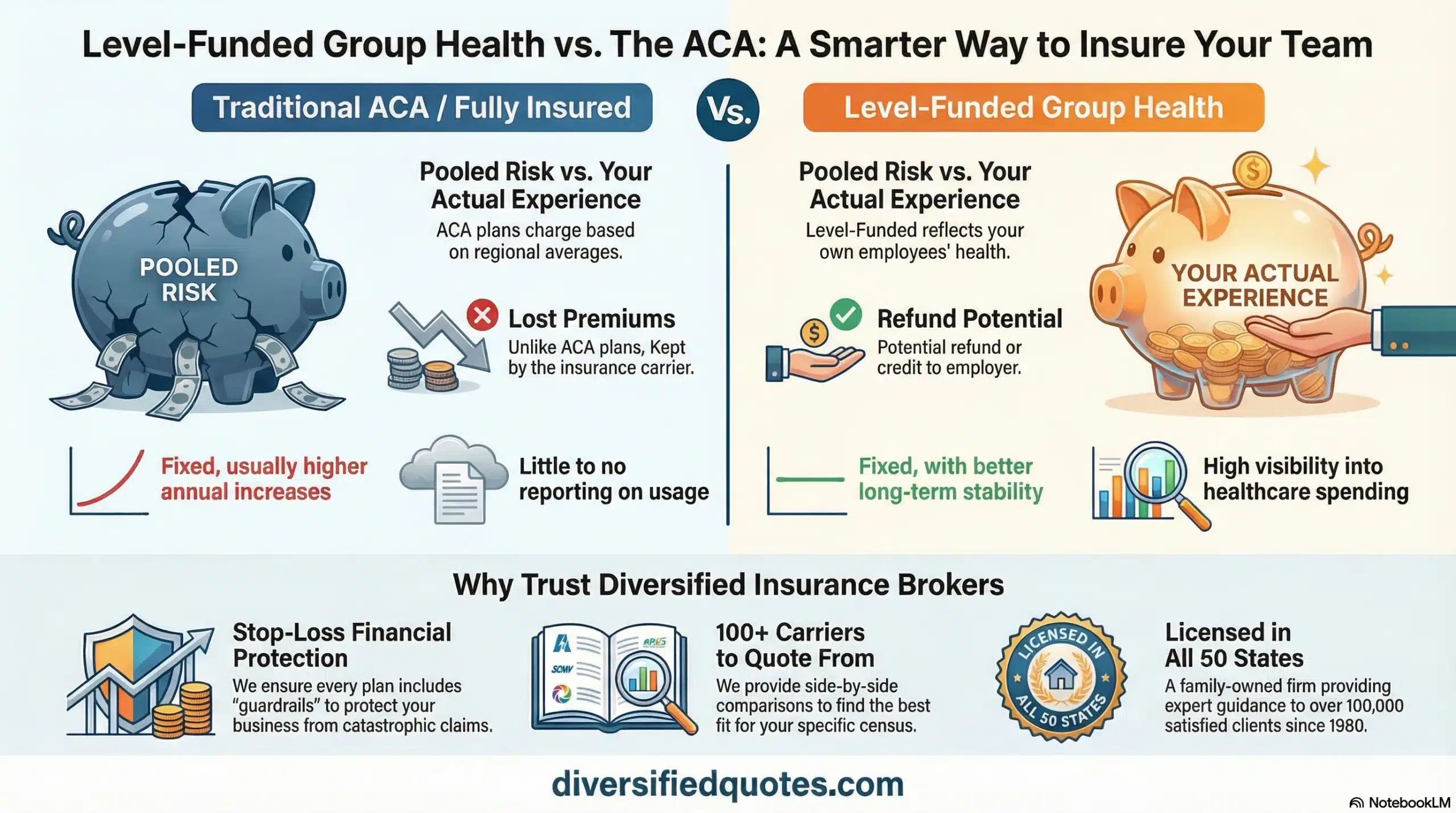
As small businesses grow — typically beyond 10 to 15 employees — level funding becomes an increasingly relevant alternative to traditional fully-insured group health coverage. Level funding is a hybrid approach that combines self-insurance mechanics with the monthly cost predictability that small businesses need for budget planning. Rather than paying a fully-insured premium to a carrier that retains all surplus and absorbs all excess claims, a level-funded employer pays a fixed monthly amount that covers claims up to a defined threshold, administrative costs, and stop-loss insurance that protects against catastrophic individual or aggregate claims above the threshold.
The potential cost advantage of level funding comes from two sources. First, employers who have good claims years pay less than they would under a fully-insured premium because claims savings are partially returned rather than retained by the carrier. Second, level-funded plans typically use the actual claims experience of the specific employer group for renewal pricing rather than pure market-based community rating, which means a group with favorable health experience may see more moderate renewal increases than the market-wide trend. Our resource on why group level funding covers the mechanics of this approach in detail, and our resource on what self-funded group health insurance is covers the broader self-funded framework that level funding builds from.
Level funding is not appropriate for all small businesses. Groups that have a concentrated health risk — a small number of employees with high-cost chronic conditions — may be better protected by fully-insured pricing where the carrier absorbs the claims exposure. Level funding requires some tolerance for claims variability even with stop-loss protection, and employers considering it should have a realistic view of their workforce’s health profile. An experienced group health broker can model both fully-insured and level-funded costs for a specific group and provide the honest comparison needed to determine which approach fits the business best.
The ACA Small Business Tax Credit
Small businesses that meet specific criteria may qualify for the ACA’s Small Business Health Care Tax Credit, which can offset a portion of the employer’s premium contributions. To qualify, a business must generally have fewer than 25 full-time equivalent employees, pay average annual wages below the IRS threshold (adjusted annually), cover at least 50 percent of employee-only premiums, and offer coverage through SHOP (Small Business Health Options Program). The credit can be worth up to 50 percent of the employer’s premium contribution for qualified businesses, and it can be claimed for two consecutive tax years.
In practice, the full 50 percent credit applies only to businesses at the smallest size and lowest wage levels, with the credit phasing out as the number of employees and average wages increase. Many small businesses find they fall in a phase-out range that produces a partial credit rather than the full amount. The tax credit is worth evaluating with a tax advisor who understands the specific business’s structure, but it should not be the sole driver of the decision to offer group health insurance — the recruiting and retention value of providing health benefits typically justifies the cost independently of the tax treatment.
Adding Dental and Vision: What It Costs and Why It Matters
Most small business group health decisions involve not just medical coverage but also dental and vision, which employees frequently rank as highly desirable benefits even when medical coverage is the priority. Dental insurance for employees typically costs an additional $20 to $50 per month per employee for single coverage, with family dental coverage adding $60 to $150 per month per employee depending on the plan design and benefit levels. Vision insurance is typically less expensive, often $5 to $15 per month for single coverage.
The relatively modest per-employee cost of dental and vision coverage relative to the recruiting and retention value they provide makes them some of the most cost-efficient benefits additions available to small businesses. Employees who value dental care — particularly families with children — and who wear glasses or contacts place genuine importance on vision coverage. Adding these benefits to a group health package creates a more complete and competitive total compensation offering without a proportionate increase in total benefits cost. Our resources on national care dental and vision and Ameritas dental and vision insurance cover carrier-specific options for bundling dental and vision with medical group health coverage.
Annual Renewal: What Drives Rate Increases and How to Manage Them
One of the most frustrating experiences for small business owners who offer health insurance is the annual renewal increase — a carrier’s notification, typically 60 to 90 days before the plan year ends, that premiums will increase for the coming year. For most small groups, annual increases of 5 to 15 percent are common, and in difficult claims years or broad market trend years, increases above 20 percent occur. Understanding what drives renewal increases and how to respond to them strategically is essential for long-term cost management.
Renewal increases reflect three main drivers: medical cost trend (the underlying increase in the cost of healthcare services and prescription drugs), the specific group’s own claims experience where that experience is used in rating, and market-level adjustments to the carrier’s overall risk pool. Small businesses have the most control over plan design choices at renewal — adjusting the deductible, out-of-pocket maximum, or copay structure can shift some cost from the employer premium to employee cost-sharing, moderating the premium increase while maintaining the overall benefit package. Switching carriers at renewal is also a legitimate cost-management tool when the incumbent carrier’s renewal pricing is materially above market — an independent broker can quickly determine whether market alternatives offer better pricing for the same or comparable plan design.
Our resource on getting a second opinion on your group health insurance quote covers how to benchmark an existing renewal against market alternatives, and our resource on how to set up group health insurance for employees covers the setup process when switching carriers or implementing coverage for the first time.
Working With an Independent Group Health Broker
For small businesses that do not have dedicated HR staff with deep group health expertise, working with an independent group health insurance broker is one of the highest-value decisions in the benefits design process. An independent broker has contracts with multiple carriers and can objectively compare plan designs, premiums, networks, and service quality across the market — rather than being limited to the products of a single company. Independent brokers are typically compensated through carrier commissions built into the premium rather than fees charged directly to the employer, which means their market access is available without a direct out-of-pocket cost for most small businesses.
Beyond the initial quote and plan selection, an experienced group health broker provides ongoing value through annual renewal benchmarking, compliance guidance on ACA requirements, enrollment support for new employees and during open enrollment periods, and advocacy when claims or administrative issues arise. Small businesses that work with independent brokers consistently report better outcomes on both cost and service compared to purchasing coverage directly through a carrier or SHOP marketplace. Our resource on what the best independent group health broker provides covers what to look for when evaluating broker relationships for group health coverage.
Compare Small Business Health Plans
Get market-rate quotes from top-rated carriers for your workforce size and location. No obligation, no hidden fees.
Related Pages: Group Health Planning for Small Businesses
Plan selection, cost control, broker resources, and group health setup guides for small business owners.
Financial Protection Essentials
Dental and vision resources, disability protection, and supplemental financial planning tools for business owners.
Find Group Health Options for Your Workforce Size
Select your headcount to see plan designs, cost drivers, and strategies that match your group size.
Talk With an Advisor Today
Choose how you’d like to connect—call or message us, then book a time that works for you.
Schedule here:
calendly.com/jason-dibcompanies/diversified-quotes
Licensed in all 50 states • Fiduciary, family-owned since 1980
Frequently Asked Questions: Group Health Insurance Cost for Small Business
How much does group health insurance cost for a small business?
Monthly premiums for small business group health insurance typically range from $450 to $800 per employee for single coverage and $1,200 to $2,000 or more per employee for family coverage, though the actual cost for any specific business depends heavily on workforce demographics, plan type, geographic location, and the employer contribution strategy. These ranges represent national averages — businesses with younger, healthier workforces in lower-cost markets may see premiums well below the lower bound, while businesses with older workforces in high-cost metropolitan areas may regularly see premiums above the upper bound.
The most accurate picture of what your specific business will pay comes from obtaining actual market-rate quotes from multiple carriers through an independent broker. Online premium estimators and industry averages are useful for initial budgeting orientation, but they cannot account for the specific combination of factors that determine your group’s actual pricing. Employers who work with an independent broker who can access the full carrier market — rather than a single-carrier agent or SHOP marketplace — consistently find better pricing outcomes because the broker can identify which carriers are most competitive for the specific group profile.
What percentage of employee premiums do employers usually pay?
Most employers contribute between 50 and 80 percent of the employee-only premium, with 50 percent being the minimum required by most insurance carriers as a condition of offering group coverage. The employer’s choice of contribution percentage is one of the most consequential decisions in benefits design because it directly affects employee participation — which in turn affects the risk pool balance and pricing stability. Higher employer contributions produce higher participation rates and more balanced pools, which tends to support more stable long-term pricing.
For dependent coverage — premiums for employees’ spouses and children — employer contributions are not required beyond making the coverage available. Many small businesses contribute nothing toward dependent premiums, particularly when budgets are tight, though this can make the plan unattractive to employees with families. Some employers use a fixed dollar contribution toward dependent coverage rather than a percentage, providing some value while maintaining more predictable total employer costs as premium rates change annually. The right contribution strategy depends on the workforce profile, the recruiting environment, and the business’s benefit budget.
What factors affect group health insurance costs for small businesses?
Five primary factors shape group health insurance premiums for small businesses: workforce demographics (primarily age distribution), plan type and design, geographic location, employer contribution level (which affects participation), and the specific carrier selected. Of these, the business owner directly controls plan type, employer contribution, and carrier selection — and can influence participation through contribution strategy. Workforce demographics and geography are largely given factors that determine the baseline cost environment.
Age is particularly impactful in the small group market, where ACA rules allow carriers to charge up to three times as much for older employees as for the youngest employees. A business with an employee age distribution concentrated in the 50s and 60s will face meaningfully higher premiums than a comparable business with a workforce in their 30s. Plan type has an equally significant impact — an HMO with a narrow network may cost 20 to 30 percent less than a broad-network PPO with equivalent benefits, and an HDHP may cost 30 to 40 percent less than a traditional low-deductible plan. Understanding how each factor affects pricing helps employers make strategic decisions rather than reactive ones at renewal time.
Can small businesses lower their group health insurance costs?
Yes — multiple levers are available to small businesses that want to manage group health insurance costs more effectively. The most impactful short-term lever is plan design: switching from a broad-network PPO to an HMO or EPO, increasing deductibles or out-of-pocket maximums, or shifting to an HDHP with an employer HSA contribution can reduce premiums significantly while maintaining a benefits package that employees value. These design adjustments shift some cost from employer premium to employee cost-sharing, which requires careful communication to manage employee expectations.
At the carrier level, shopping the market at each annual renewal — rather than automatically renewing with the incumbent carrier — consistently identifies savings opportunities. Carriers compete aggressively for new business, and a business that has not been shopped in several years is likely paying a premium above what a new-business quote would produce. For businesses with 10 or more employees, evaluating level funding as an alternative to fully-insured coverage is another meaningful lever — groups with favorable health experience can capture savings through level funding that fully-insured pricing does not provide. Longer-term cost management strategies include implementing wellness programs that reduce utilization and working with an independent broker who actively benchmarks the group against market alternatives each year rather than passive renewal.
Are there tax advantages for offering group health insurance?
Yes — offering group health insurance provides meaningful tax advantages for both the business and employees. Employer contributions to employee health insurance premiums are generally fully deductible as a business expense, reducing the net cost of offering benefits. Employee premium contributions paid through a Section 125 cafeteria plan (which most group health plans use) are made with pre-tax dollars, reducing employees’ taxable wages and saving both the employee and the employer on payroll taxes — an immediate cost reduction that partially offsets the employer’s premium contribution.
Small businesses that meet specific criteria — generally fewer than 25 full-time equivalent employees, average wages below the IRS threshold, employer contribution of at least 50 percent of employee-only premiums, and coverage offered through SHOP — may also qualify for the ACA Small Business Health Care Tax Credit, worth up to 50 percent of the employer’s premium contribution for the most qualified businesses. The credit phases out as employee count and average wages increase, so many businesses fall in a partial-credit range. Even businesses that do not qualify for the tax credit benefit from the deductibility of employer contributions and the payroll tax savings from employee pre-tax premium contributions.
Do all employees have to enroll in the group health plan?
No — employees can decline the employer’s group health coverage, typically because they have coverage through another source such as a spouse’s employer plan, Medicare, Medicaid, or a marketplace plan. Employees who decline coverage for documented reasons — a process called “waiving” — are generally not counted against the plan’s participation minimum requirement when they have qualifying alternative coverage. This distinction matters because carriers require a minimum participation rate (typically 51 to 75 percent of eligible employees) as a condition of offering small group coverage, and waivers from employees with alternative coverage can significantly reduce the number of enrollments needed to satisfy that minimum.
Employees who decline coverage without a qualifying waiver — those who simply do not want to pay their share of the premium — do count against the participation calculation and can cause a group to fall below the minimum if too many decline. This is why employer contribution strategy directly affects participation: higher employer contributions reduce the employee’s cost share, making enrollment more attractive and reducing the number of employees who decline for financial reasons. Employers who are concerned about meeting participation requirements should evaluate their contribution level in the context of employee affordability before setting the final employer contribution percentage.
Is group health insurance required for small businesses?
Small businesses with fewer than 50 full-time equivalent employees are not required by the ACA to offer health insurance — the employer mandate (Employer Shared Responsibility) applies only to applicable large employers (ALEs) with 50 or more full-time equivalents. This means most small businesses are legally free to offer or not offer group health coverage based on business judgment rather than regulatory obligation.
The practical question for small businesses is not whether coverage is legally required but whether it is strategically necessary for recruiting and retaining competitive talent. In most labor markets, employees at small businesses strongly prefer employers who offer health insurance over those who do not, and the absence of health benefits is a significant recruiting disadvantage in competitive hiring environments. Many small business owners find that the cost of high turnover — recruiting, training, productivity loss — exceeds the cost of providing health insurance, making the business case for offering coverage compelling even when it is not legally mandated. For businesses evaluating whether to establish coverage for the first time, our resource on how to set up group health insurance for employees covers the implementation process from eligibility determination through carrier selection and enrollment.
About the Author:
Jason Stolz, CLTC, CRPC, DIA, CAA and Chief Underwriter at Diversified Insurance Brokers (NPN 20471358), is a senior insurance and retirement professional with more than 25 years of real-world experience helping individuals, families, and business owners protect their income, assets, and long-term financial stability. As a long-time partner of the nationally licensed independent agency Diversified Insurance Brokers, Jason provides trusted guidance across multiple specialties—including fixed and indexed annuities, long-term care planning, personal and business disability insurance, life insurance solutions, Group Health, Travel Medical and Evacuation Insurance, and short-term health coverage. Diversified Insurance Brokers maintains active contracts with over 100 highly rated insurance carriers, ensuring clients have access to a broad and competitive marketplace.
His practical, education-first approach has earned recognition in publications such as VoyageATL, and contributions from his agency featured in Kiplinger and GoBankingRates— highlighting his commitment to financial clarity and client-focused planning. Drawing on deep product knowledge and years of hands-on field experience, Jason helps clients evaluate carriers, compare strategies, and build retirement and protection plans that are both secure and cost-efficient. Visitors who want to explore current annuity rates and compare options across multiple insurers can also use this annuity quote and comparison tool.
Explore More Group Health Insurance Options: Browse our complete guide to Small Business Group Health Insurance — covering getting started, costs, how to set up, best rates & working with a broker from 100+ carriers.
Last Reviewed: May 21, 2026 |
Reviewed by: Jason Stolz, CLTC, CRPC, DIA, CAA
Chief Underwriter, Diversified Insurance Brokers, Inc. | NPN: 20471358 | Diversified Insurance Brokers, Inc. — Licensed in all 50 states
Fact Checked by: Tonia Pettitt, CMIP©
Medicare Specialist, Diversified Insurance Brokers, Inc. | NPN: 14374308 | Diversified Insurance Brokers, Inc. — Licensed in all 50 states
Did you find this content helpful? Leave us a Google review — it helps others find trustworthy guidance too.
Editorial Standards: Diversified Insurance Brokers maintains rigorous editorial standards to ensure accuracy, clarity, and independence in all content. Learn more about our editorial standards and commitment to transparency.
