
Group Health Insurance for over 1,000 Employees
As an Independent Group Health Insurance Broker, we compare fully insured, level-funded, and self-funded options across carriers to find the lowest cost coverage for your business.
Group Health Insurance for over 1,000 Employees

Jason Stolz CLTC, CRPC, DIA, CAA
Group health insurance for over 1,000 employees is an enterprise-scale system that directly impacts operating margins, talent strategy, and long-term financial planning. At this size, healthcare is no longer a line item — it is a managed financial ecosystem. Pricing is fully experience-based, driven by multi-year claims, pharmacy utilization, specialty drug exposure, and care patterns. Plan structure, funding strategy, and governance matter as much as the carrier itself.
Organizations with more than 1,000 employees often discover that legacy approaches — especially fully insured models — become inefficient over time. Premiums can rise regardless of performance, transparency is limited, and leadership lacks actionable insight into what is actually driving cost. The advantage at this scale is leverage: sufficient data, population stability, and buying power to design a program that actively controls costs instead of reacting to renewals. At Diversified Insurance Brokers, we help large employers redesign enterprise health benefits to improve predictability, increase transparency, and support sustainable growth — without reducing benefit quality or disrupting the employee experience.
Enterprise Group Health Strategy Review (1,000+ Employees)
We’ll evaluate your plan design, claims performance, funding structure, and renewal exposure to identify opportunities for long-term cost control and stability.
Request an Enterprise Health Review
Questions? Call 800-533-5969
Why Group Health Insurance for Over 1,000 Employees Is an Enterprise System
Group health insurance for over 1,000 employees behaves differently than coverage for smaller employer groups because the plan is no longer priced on broad market assumptions — it is priced on your organization’s measurable reality. Insurers and administrators can evaluate multi-year utilization trends, chronic condition prevalence, high-cost claimant patterns, pharmacy dynamics, and network usage with far more confidence than they can in a small group. At this size, small inefficiencies that might be invisible at 50 or 100 employees can become material. A few plan design misalignments, weak pharmacy controls, or network leakage can easily translate into seven-figure overspend.
The plan becomes a financial system that requires governance, reporting, and a consistent decision cadence — not just renewal shopping. This is also why employers that move beyond reactive renewals and into intentional plan management often outperform market benchmarks. When leadership treats the plan like a controllable ecosystem rather than a fixed expense, cost trend typically becomes more predictable and the renewal process becomes far less disruptive. For the baseline framing of how employer plans work before layering in enterprise-level levers, our page on group medical insurance provides a useful foundation.
How Enterprise Pricing Is Built and Why It Moves
At 1,000+ employees, pricing is fully experience-based. Your expected cost is heavily influenced by your own historical claims and projected utilization. The plan is still impacted by broader market inflation, but the biggest swing factors are often internal: how claims are trending, how well the network is being used, and whether pharmacy costs are being managed proactively. Because the population is large, underwriters are more confident in trend assumptions and can identify emerging risk drivers earlier — creating both risk and opportunity. If there is unmanaged specialty pharmacy spend, the plan can drift upward quickly. If there is strong care navigation, network discipline, and better plan alignment with actual utilization patterns, the plan can stabilize and improve.
Enterprise leaders often become frustrated because renewal increases feel inevitable. In reality, many renewals reflect a lack of actionable levers. When the plan has limited transparency, leadership cannot identify what is driving cost early enough to adjust. When reporting improves and vendor accountability is established, renewals become the result of decisions rather than an annual surprise. That shift — from reactive to managed — is what separates high-performing enterprise plans from ones that simply absorb cost increases year after year.
Funding Options for Group Health Insurance at 1,000+ Employees
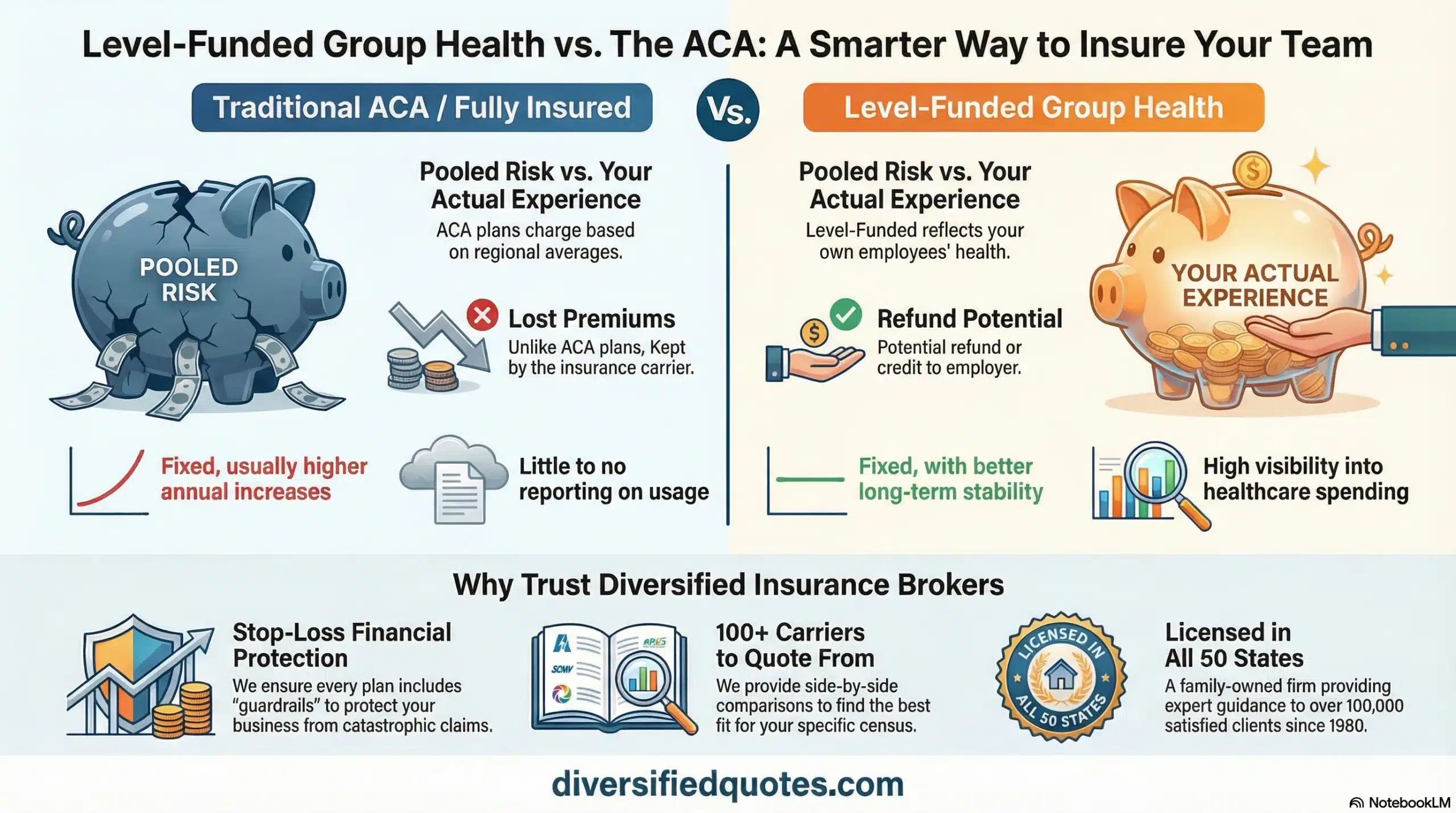
Organizations with more than 1,000 employees typically qualify for every major funding model. Fully insured plans may still be available, but they are rarely the most efficient structure at this size because they include carrier margins, conservative pricing cushions, and limited direct control over the claims engine. Self-funded and partially self-funded plans dominate at this level because they align cost with actual claims while allowing leadership to use reporting and vendor management to influence future outcomes. Many employers review minimum employees for group health insurance to understand why self-funding becomes increasingly standard as scale increases and why the economics shift at each headcount threshold.
Hybrid approaches can also be effective when leadership wants smoother cash flow, defined guardrails, or a transitional structure when moving away from fully insured arrangements. The best fit depends on organizational risk tolerance, financial discipline, cash flow stability, and how much customization and vendor oversight the HR and finance teams can realistically manage. The right funding model is the one that aligns with both the organization’s financial structure and its capacity to govern the plan actively over time.
Self-Funded Group Health Insurance for Over 1,000 Employees
Self-funding is commonly the most efficient structure for employers with over 1,000 employees because it removes the prepaid premium model and replaces it with claims-aligned spend. Claims are paid as they occur — usually through a third-party administrator — while stop-loss protection limits exposure to catastrophic individual claims and aggregate annual volatility. The advantage is control: instead of hoping the carrier prices you favorably at renewal, leadership can see exactly what is driving cost and implement targeted interventions. That often includes pharmacy strategy improvements, network optimization, plan design realignment, and care navigation programs that reduce unnecessary high-cost utilization.
For organizations evaluating this approach, understanding what self-funded group health insurance is clarifies how risk is managed and why data access and reporting are central to the value proposition. Leadership teams also weigh the tradeoffs carefully before committing. Reviewing the pros and cons of self-funded group health helps align plan strategy with risk tolerance and financial objectives so the decision is made with full information rather than assumptions.
Stop-Loss Strategy and Catastrophic Risk Controls
Stop-loss is the enterprise safety net that keeps self-funding predictable. At scale, the goal is not to avoid claims — claims will happen at a large organization. The goal is to structure risk so that high-cost events do not destabilize annual budgeting. A well-designed stop-loss strategy defines the right attachment points, protects against shock claims from individual high-cost cases, and supports stable cash flow even in volatile plan years. Large employers often implement layered protection that separates predictable claims from catastrophic exposure, with specific and aggregate stop-loss working together to bound the employer’s total financial risk.
The best stop-loss structure depends on cash reserves, risk tolerance, historical claimant patterns, and how leadership prefers to manage year-to-year variability. When designed correctly, stop-loss acts as a guardrail that allows the organization to benefit from strong plan performance without taking on unbounded downside. For many employers, this becomes the conceptual bridge between “self-funding sounds risky” and “self-funding is a controlled and measurable system.” The risk of high-cost claims exists under any funding model — self-funding simply makes that risk visible, quantified, and manageable rather than bundled into an opaque premium. For a plain-English breakdown of how stop-loss terms affect the overall structure, see understanding stop-loss insurance in level-funded plans.
Pharmacy and Specialty Drug Management at Enterprise Scale
For many 1,000+ employee plans, pharmacy is the largest controllable cost driver and the category most likely to create renewal surprises. Specialty medications, biologics, and emerging therapies can create rapid cost acceleration even when the rest of the plan looks stable. Enterprise plans that do not manage pharmacy strategically often see renewals spike with little warning because pharmacy trends can move faster than medical trends — and because the dollar amounts per claim are substantially larger than most medical categories.
Effective pharmacy management is not about restricting access to necessary medications. It is about using the plan’s buying power and governance structure to reduce waste, confirm clinical appropriateness, avoid inflated pricing, and ensure specialty drugs are managed intentionally rather than passively. When paired with clean reporting, leadership can identify which categories are driving spend and implement improvements proactively. Enterprise employers often implement pharmacy strategies that align formularies with cost efficiency, improve specialty drug oversight, and ensure employees have support navigating complex therapies. The result is typically improved member experience and improved cost predictability at the same time — both outcomes are achievable when pharmacy is treated as a managed system rather than a pass-through expense.
Network Strategy and Workforce Geography
Network decisions become more strategic as the workforce becomes geographically diverse. A national employer may have employees in multiple states, multiple metro areas, and multiple provider ecosystems. The best network is not the one with the largest brand recognition — it is the one employees can actually use without unintentional network leakage. Network leakage is expensive: when employees go out of network due to poor access, claim costs rise significantly and member satisfaction falls. Enterprise plans often improve performance by selecting networks that align with where employees actually live and work, then reinforcing smart utilization through education, navigation tools, and clear plan design incentives.
For multi-state employers, the plan must also consider local provider availability, regional cost variation, and how networks perform across different markets. A network that is excellent in one metropolitan area may be thin in a secondary market where a significant employee population lives. This is where enterprise leverage matters most — large employers can often structure network choices more intentionally than smaller groups — but the strategy must be actively designed and monitored rather than assumed to be performing well based on historical renewal conversations alone.
Plan Design Levers That Control Cost Without Cutting Benefits
At 1,000+ employees, sustainable savings rarely come from reducing benefits or shifting massive costs onto employees. Those moves often reduce participation, harm engagement, and create turnover pressure that costs the organization far more than the plan savings generated. Instead, cost control typically comes from aligning plan design to actual utilization patterns and removing structural waste that neither the employer nor the employee benefits from. Plan design is fundamentally about incentives: when deductibles, copays, and out-of-pocket limits are calibrated to how employees actually use care, utilization becomes more efficient without creating friction or access barriers.
Many enterprise employers offer multiple plan options so employees can choose the tradeoff that fits their situation — typically one leaner high-deductible option paired with a richer plan — while leadership maintains a predictable cost structure through defined contribution strategies. Plan design is also where modest improvements create large outcomes at scale. A meaningful reduction in unnecessary emergency room visits, improved network utilization rates, or better preventive care engagement can change the plan’s trend meaningfully when applied across a population of thousands. The most effective plan designs are clear, stable, and consistent enough that employees learn how to use them — frequent disruption creates confusion that undermines utilization efficiency.
Vendor Governance: TPA, PBM, and Reporting Accountability
Enterprise plans are not run by a single entity. Even when a carrier is involved, the ecosystem typically includes third-party administrators, pharmacy benefit managers, network partners, wellness vendors, and clinical navigation programs. Governance is how leadership ensures these vendors are accountable, aligned with plan goals, and producing the data outputs needed to make informed decisions. Without governance, vendors operate in silos, reporting is inconsistent, and leadership is forced into reactive decisions at renewal time based on incomplete information.
With governance, the plan has a rhythm: regular reporting reviews, measurable performance goals, structured vendor evaluations, and a continuous improvement cycle that connects data to decisions. This structure is also what improves negotiation leverage over time. When vendors know that performance is being tracked, cost drivers are being analyzed, and alternatives are being benchmarked against current outcomes, the employer is positioned to demand clarity, accountability, and better terms at every contract review. The governance discipline that feels like overhead in year one often produces meaningful cost savings and better plan performance by year three.
Analytics, Transparency, and Continuous Improvement
Enterprise group health insurance unlocks actionable data, but only when that data is organized into decision-useful reporting rather than raw dashboards that overwhelm leadership without creating clarity. The goal is to identify key cost drivers early enough to act — including pharmacy categories, high-cost care patterns, network utilization rates, and recurring utilization patterns that can be influenced by better navigation and plan design adjustments. When reporting is structured around decisions rather than metrics, the entire organization’s approach to benefits management shifts from reactive to proactive.
Transparency creates accountability and focus. When leadership can see what is driving spend, the conversation shifts from “we need a cheaper plan” to “we need to address these specific cost drivers.” That change in framing is often what produces long-term plan stability — because targeted interventions are almost always more effective than broad plan changes that disrupt the employee experience without addressing root causes. Continuous improvement at the enterprise level does not require constant disruption. The best plans make modest, data-informed adjustments, monitor outcomes over 12 to 24 months, and keep employees informed through clear communication. That approach consistently outperforms dramatic annual plan changes that create confusion, reduce utilization efficiency, and undermine employee confidence in the benefit.
Renewal Stability and Long-Term Financial Planning
Fully insured plans offer limited reward for favorable claims experience because pricing includes carrier risk loads and margin, and because transparency into actual cost drivers is restricted by design. In contrast, self-funded and advanced funding models are built to avoid paying for unused risk and to create a clearer connection between plan performance and what the employer actually pays. At enterprise scale, renewal stability is not only about next year’s premium — it is about budgeting confidence and long-term workforce financial planning. When leadership can forecast healthcare expenses with more accuracy, it improves decision-making across the organization including workforce planning, compensation strategy, and overall financial management.
Stable renewals also reduce employee disruption. When a plan does not require major restructuring every year, employees become more confident using their benefits, HR administration becomes more consistent, and the perceived quality of the benefit package improves even without increasing the total dollar spend. That stability supports retention and simplifies the annual benefits communication cycle — two outcomes that benefit the organization well beyond the direct cost of healthcare. Employers seeking a second opinion on their current plan structure or renewal exposure can request a review through our second opinion on group health insurance quote process.
Implementation and Change Management
Enterprise plan improvement is as much an execution project as it is a strategy decision. Even the best plan design will fail to deliver its intended outcomes if the rollout is unclear, vendor integration is incomplete, or employees do not understand how to use the plan effectively. Implementation should be structured to protect continuity of care, minimize disruption at the employee level, and provide clear guidance throughout the enrollment process. Most large employers do best with a structured implementation sequence: confirm workforce demographics and geography, align vendor reporting infrastructure, finalize network strategy, confirm plan options and contribution structure, then build an enrollment communication plan that explains changes in plain language that employees can act on.
After implementation, a structured first-90-days review is best practice. Verify that employees have network access, that payroll deductions match elections, and that key vendors are producing the reporting cadence they committed to during the sales process. Early identification of administrative problems prevents small issues from becoming employee confidence problems that are much harder to reverse. The organizations that handle large plan transitions most smoothly are the ones that treat implementation as a managed project with clear milestones and accountability — not as a series of vendor handoffs with no central coordination.
Compare Enterprise Group Health Options
Compare self-funded, partially self-funded, and hybrid strategies for organizations with over 1,000 employees.
Questions? Call 800-533-5969
Financial Protection Essentials
Carrier reviews, retirement income planning tools, and specialized coverage resources for individuals and businesses.
Related Pages
Explore additional group health resources and plan-structure guides.
Pick Your Company Size
Not the right headcount? Use the buttons below to jump to the group health page that matches your workforce.
Group Health Insurance for 10 Employees
Small-team pricing, participation strategy, and easy rollout.
Group Health Insurance for 20 Employees
Plan design choices that improve cost control and retention.
Group Health Insurance for 30 Employees
Reduce renewal spikes and address pharmacy cost drivers.
Group Health Insurance for 40 Employees
Better plan efficiency as your claims credibility improves.
Group Health Insurance for 50 Employees
Cost containment strategies and scalable benefit design.
Group Health Insurance for 60 Employees
Improve predictability and reduce waste without cutting benefits.
Group Health Insurance for 70 Employees
Funding choices that reduce renewal volatility as you grow.
Group Health Insurance for 80 Employees
Plan design and vendor strategy to control cost trends.
Group Health Insurance for 90 Employees
Prepare for 100+ pricing leverage and stabilize renewals.
Group Health Insurance for 100 Employees
A major transition point: funding options expand and plan design matters more.
Group Health Insurance for 150 Employees
More claims credibility means more leverage — optimize funding and reduce overpaying.
Group Health Insurance for 250 Employees
Advanced funding and transparency strategies for stronger cost control.
Group Health Insurance for 500 Employees
Enterprise approach: analytics, vendor oversight, and smarter funding strategy.
Group Health Insurance for 750 Employees
Scaled cost-control with deeper data visibility and targeted interventions.
Group Health Insurance for Over 1,000 Employees
Enterprise governance, advanced funding, and high-impact cost management.
Talk With an Advisor Today
Choose how you’d like to connect—call or message us, then book a time that works for you.
Schedule here:
calendly.com/jason-dibcompanies/diversified-quotes
Licensed in all 50 states • Fiduciary, family-owned since 1980
FAQ: Group Health Insurance for Over 1,000 Employees
Yes — and at this scale, the options available are significantly more flexible and potentially more cost-efficient than what smaller employers typically access. Organizations with over 1,000 employees qualify for the full range of funding models, including fully insured plans, level-funded designs, partially self-funded arrangements, and fully self-funded programs backed by stop-loss insurance. Most enterprise employers at this headcount work primarily in self-funded or hybrid structures because those models align cost with actual claims experience and provide the transparency needed to manage the plan as a financial system rather than a fixed expense line.
The employer’s leverage also increases significantly at this size. A 1,000+ employee group has sufficient claims credibility that carriers and administrators price based on the organization’s own data rather than broad market pools. That creates both opportunity and responsibility — employers who manage their plan actively tend to outperform market benchmarks, while those who treat the plan passively often absorb renewal increases that could have been prevented with earlier intervention. For a foundational overview of how employer-sponsored plans work before layering in enterprise-specific strategies, our page on group medical insurance provides useful context.
Self-funding is by far the most common funding structure at this size, and for good reason. When a group is large enough to produce statistically credible claims data, the economics of the fully insured model — which includes carrier margins, premium taxes, and conservative pricing cushions built in to protect the carrier’s risk — become increasingly difficult to justify. Self-funding removes those layers and replaces the prepaid premium model with claims-aligned spend, where the employer pays for actual utilization rather than a blend of actual utilization and insurer overhead. Stop-loss insurance then provides the financial guardrails that keep catastrophic individual claims and aggregate plan volatility within acceptable bounds.
The practical result is that self-funded plans at enterprise scale typically provide better transparency, more direct control over cost drivers, and a clearer connection between plan management decisions and actual costs. For organizations evaluating whether to make this transition, reviewing what self-funded group health insurance is clarifies the mechanics, and reviewing the pros and cons of self-funded group health helps align the decision with the organization’s specific risk tolerance, cash flow structure, and governance capacity.
Financial risk in a self-funded enterprise plan is controlled through stop-loss insurance, which caps the employer’s exposure to both individual high-cost claims and total annual plan costs. Specific stop-loss coverage protects against catastrophic individual claims — for example, a single employee with a complex medical event that generates claims far above the attachment point. Aggregate stop-loss coverage protects the plan if total claims across the entire population exceed a defined threshold during the plan year. Together, these two layers create a bounded financial risk profile that allows the organization to self-fund without taking on unlimited downside exposure.
The design of the stop-loss structure — including attachment points, contract basis, and aggregate factors — significantly affects both the premium and the actual risk the employer retains. A stop-loss structure with a low specific attachment point protects more aggressively against individual shock claims but costs more. A higher attachment point reduces the stop-loss premium but retains more risk per individual claim. The right balance depends on the organization’s cash flow stability, tolerance for year-to-year variability, and historical claimant patterns. For a plain-English breakdown of how these terms work in practice, see understanding stop-loss insurance in level-funded plans.
Implementation timelines for enterprise plans vary depending on the complexity of the transition, the number of vendor relationships being established or changed, and how much the new plan structure differs from the existing arrangement. A straightforward renewal with modest design changes can be implemented in 60 to 90 days with a focused project timeline. A more significant transition — such as moving from a fully insured model to a self-funded structure, changing the TPA, or restructuring the pharmacy benefit arrangement — typically requires four to six months of lead time to complete properly without creating disruption for employees or administrative gaps at go-live.
The most successful enterprise implementations are treated as managed projects with clear milestones, defined ownership, and structured employee communication rather than as a series of vendor handoffs. Key phases include data analysis and plan design finalization, vendor contracting and system integration, network access verification across geographic markets, and an enrollment communication campaign that explains changes in plain language employees can act on. After implementation, a structured 90-day review period that verifies payroll deduction accuracy, network access, and vendor reporting compliance prevents small administrative issues from becoming larger employee confidence problems that are much harder to resolve after the fact.
Yes — and enterprise-oriented plan structures are specifically designed to scale efficiently as employee count increases and geographic reach expands. Self-funded and hybrid plan models are inherently scalable because they are built on the employer’s own claims experience rather than market-pool pricing that becomes increasingly inefficient as the group grows. As the population increases, the claims data becomes statistically more credible, stop-loss attachment points can be optimized, and the employer’s leverage with vendors — TPAs, PBMs, network partners, and clinical programs — improves. The plan becomes more refined as it grows, not more complicated.
Geographic expansion is the dimension that typically requires the most active attention as an organization scales. Adding employee populations in new states or metro areas requires verifying that the selected network provides adequate access in those markets, that care navigation and specialty drug management programs extend to new locations, and that plan communication materials are relevant to employees in diverse geographies. Organizations that build a scalable governance infrastructure early — clear reporting cadences, vendor accountability protocols, and defined decision frameworks — find that adding headcount or locations requires refinement rather than restructuring. Our second opinion on group health insurance process is a practical starting point for organizations that want an independent assessment of whether their current plan structure is positioned to scale efficiently.
About the Author:
Jason Stolz, CLTC, CRPC, DIA, CAA and Chief Underwriter at Diversified Insurance Brokers (NPN 20471358), is a senior insurance and retirement professional with more than 25 years of real-world experience helping individuals, families, and business owners protect their income, assets, and long-term financial stability. As a long-time partner of the nationally licensed independent agency Diversified Insurance Brokers, Jason provides trusted guidance across multiple specialties—including fixed and indexed annuities, long-term care planning, personal and business disability insurance, life insurance solutions, Group Health, Travel Medical and Evacuation Insurance, and short-term health coverage. Diversified Insurance Brokers maintains active contracts with over 100 highly rated insurance carriers, ensuring clients have access to a broad and competitive marketplace.
His practical, education-first approach has earned recognition in publications such as VoyageATL, and contributions from his agency featured in Kiplinger and GoBankingRates— highlighting his commitment to financial clarity and client-focused planning. Drawing on deep product knowledge and years of hands-on field experience, Jason helps clients evaluate carriers, compare strategies, and build retirement and protection plans that are both secure and cost-efficient. Visitors who want to explore current annuity rates and compare options across multiple insurers can also use this annuity quote and comparison tool.
Explore More Group Health Insurance Options: Browse our complete guide to Group Health Insurance by Company Size — covering plans for 2, 10, 20, 50, 100, 250, 500, 750 & 1,000+ employees from 100+ carriers.
Last Reviewed: June 1, 2026 |
Reviewed by: Jason Stolz, CLTC, CRPC, DIA, CAA
Chief Underwriter, Diversified Insurance Brokers, Inc. | NPN: 20471358 | Diversified Insurance Brokers, Inc. — Licensed in all 50 states
Fact Checked by: Tonia Pettitt, CMIP©
Medicare Specialist, Diversified Insurance Brokers, Inc. | NPN: 14374308 | Diversified Insurance Brokers, Inc. — Licensed in all 50 states
Did you find this content helpful? Leave us a Google review — it helps others find trustworthy guidance too.
Editorial Standards: Diversified Insurance Brokers maintains rigorous editorial standards to ensure accuracy, clarity, and independence in all content. Learn more about our editorial standards and commitment to transparency.
