
Group Health Insurance for 250 Employees
As an Independent Group Health Insurance Broker, we compare fully insured, level-funded, and self-funded options across carriers to find the lowest cost coverage for your business.
Group Health Insurance for 250 Employees

Jason Stolz CLTC, CRPC, DIA, CAA
Group health insurance for 250 employees places an organization well into the large-group category, where healthcare benefits function as a major financial system rather than a simple employee perk. At this size, healthcare costs directly affect operating margins, workforce stability, and long-term planning. Insurers rely heavily on your company’s own claims history, utilization trends, and risk profile when pricing coverage—which means the structure of your plan matters as much as the carrier behind it. Employers with 250 employees often discover that legacy group health plans become increasingly inefficient over time: fully insured renewals bring meaningful premium increases with limited transparency, while the underlying factors driving cost remain invisible to leadership. The advantage at this scale is leverage. You have enough data, stability, and bargaining power to design a plan that actively controls costs instead of reacting to them. At Diversified Insurance Brokers, we help organizations with 250 employees restructure group health insurance to reduce waste, improve predictability, and support sustainable growth—without sacrificing benefit quality or disrupting the employees who depend on those benefits.
Compare Group Health Options for 250 Employees
We’ll analyze your current plan, claims efficiency, and renewal exposure to uncover opportunities for cost reduction and long-term stability.
Self-Funded Plans
Full claims transparency, maximum cost alignment, and ERISA plan flexibility for large employers.
Level-Funded Options
Predictable monthly costs with performance-linked pricing — the practical first step for many large groups.
Request a Large Group Analysis
We’ll compare funding structures and identify the highest-impact cost-control opportunities for your workforce.
Why Group Health Insurance at 250 Employees Works Differently
At 250 employees, group health insurance is heavily driven by experience and credibility. Underwriters evaluate historical claims, chronic condition prevalence, pharmacy utilization, large-claim history, and year-over-year trend. Your company’s utilization patterns are a core input—at this size, claims experience is nearly fully credible, meaning underwriters rely almost entirely on your group’s actual data rather than pooled assumptions. That creates both opportunity and responsibility. The opportunity is leverage: you can negotiate plan terms, demand deeper reporting, and structure funding in a way that better reflects your group’s actual performance. The responsibility is that passive renewals become expensive over time. When a plan is left untouched year after year, small inefficiencies compound—pharmacy costs drift upward, networks become misaligned with employee geography, and plan design creates behaviors that increase downstream claims. By the time leadership feels the pain, the organization often believes “this is just what healthcare costs now,” when in reality a meaningful portion is design-driven waste that a structured review could address. Understanding how group medical insurance is priced and structured helps clarify what levers are actually available at this size.
What Large Employers Actually Need From a Health Plan
For a 250-employee organization, the plan needs to accomplish four things simultaneously: stay competitive for recruiting, protect employees from catastrophic out-of-pocket exposure, behave predictably for the finance team, and avoid rewarding wasteful utilization patterns. Many plans achieve the first two goals and fail the second two. That’s why large employers frequently experience renewal cycles that feel like a surprise tax rather than a manageable operating expense. A well-designed large-group plan creates predictable cash flow without trapping the company in overpriced risk assumptions. It gives HR a clear, honest story to explain employee contributions, deductibles, and network choices. It gives leadership a way to measure plan performance beyond “our premium went up.” Most importantly, it creates a structure where the company can benefit from positive utilization trends—rather than being locked into premiums that assume worst-case claims every year, regardless of how the plan actually performs.
Funding Model Comparison for Large Employers at 250 Employees
| Feature | Fully Insured | Level-Funded | Self-Funded (ASO) |
|---|---|---|---|
| Claims Credibility Usage | Blended with pooled assumptions; your experience partially drives pricing | Primarily experience-based; refund possible if claims favorable | 100% experience-based; employer pays actual claims; stop-loss caps exposure |
| Reporting Depth | Limited; carrier aggregates data without full transparency | Moderate; claims trend data available but may be limited by program terms | Full visibility; claims by category, provider, individual (within HIPAA) |
| Plan Design Flexibility | Carrier-constrained; limited customization | Moderate flexibility within program parameters | Maximum flexibility; employer controls plan document, design, and vendor selection |
| ERISA Fiduciary Status | Carrier assumes most risk; employer obligations lighter | Moderate fiduciary obligations; depends on program structure | Employer is plan fiduciary; full ERISA obligations apply including prudent expert standard |
| Vendor Control | Bundled; carrier controls network, PBM, and admin | Partial; some vendor choice within program | Full; employer selects TPA, PBM, network, stop-loss independently |
| PCORI Fee | Carrier pays; embedded in premium | Depends on program structure; confirm with TPA | Employer files and pays annually (currently ~$3.22/covered life, indexed annually) |
| Best Fit | Groups prioritizing simplicity over optimization; limited internal benefits capacity | Organizations transitioning from fully insured; want more alignment without full self-funding complexity | Most 250-employee groups with stable enrollment, HR capacity, and interest in long-term cost management |
ERISA Fiduciary Responsibility for Self-Funded Plans
One of the most important governance realities for 250-employee organizations operating a self-funded ERISA health plan is fiduciary responsibility. Under ERISA, the plan sponsor (the employer) is a named fiduciary, which means leadership has legally enforceable obligations to act in the best interests of plan participants—employees and their dependents who rely on the plan. This is not merely a compliance checkbox. It shapes how vendors should be selected, how plan decisions should be documented, and how the plan should be reviewed over time.
ERISA’s “prudent expert standard” requires fiduciaries to act with the care, skill, prudence, and diligence that a knowledgeable person familiar with plan management would exercise. In practical terms, this means employers cannot simply rubber-stamp a TPA’s recommendation or continue with a carrier because “that’s what we always do.” They must be able to demonstrate that plan decisions were made thoughtfully, with appropriate expertise—either internal or through qualified outside advisors. Fiduciary obligation also extends to vendor oversight: fiduciaries must periodically evaluate whether service providers (TPAs, PBMs, network administrators) are delivering appropriate value and acting in participants’ interests. The Department of Labor has increased focus on ERISA fiduciary compliance in recent years, particularly around pharmacy benefit management and plan fees. For organizations operating or considering a self-funded ERISA plan at 250 employees, building a governance process—documented decision-making, vendor benchmarking, annual plan reviews—is as important as the plan design itself.
Level-Funded Plans: A Useful Transition, Not Always the Final Destination
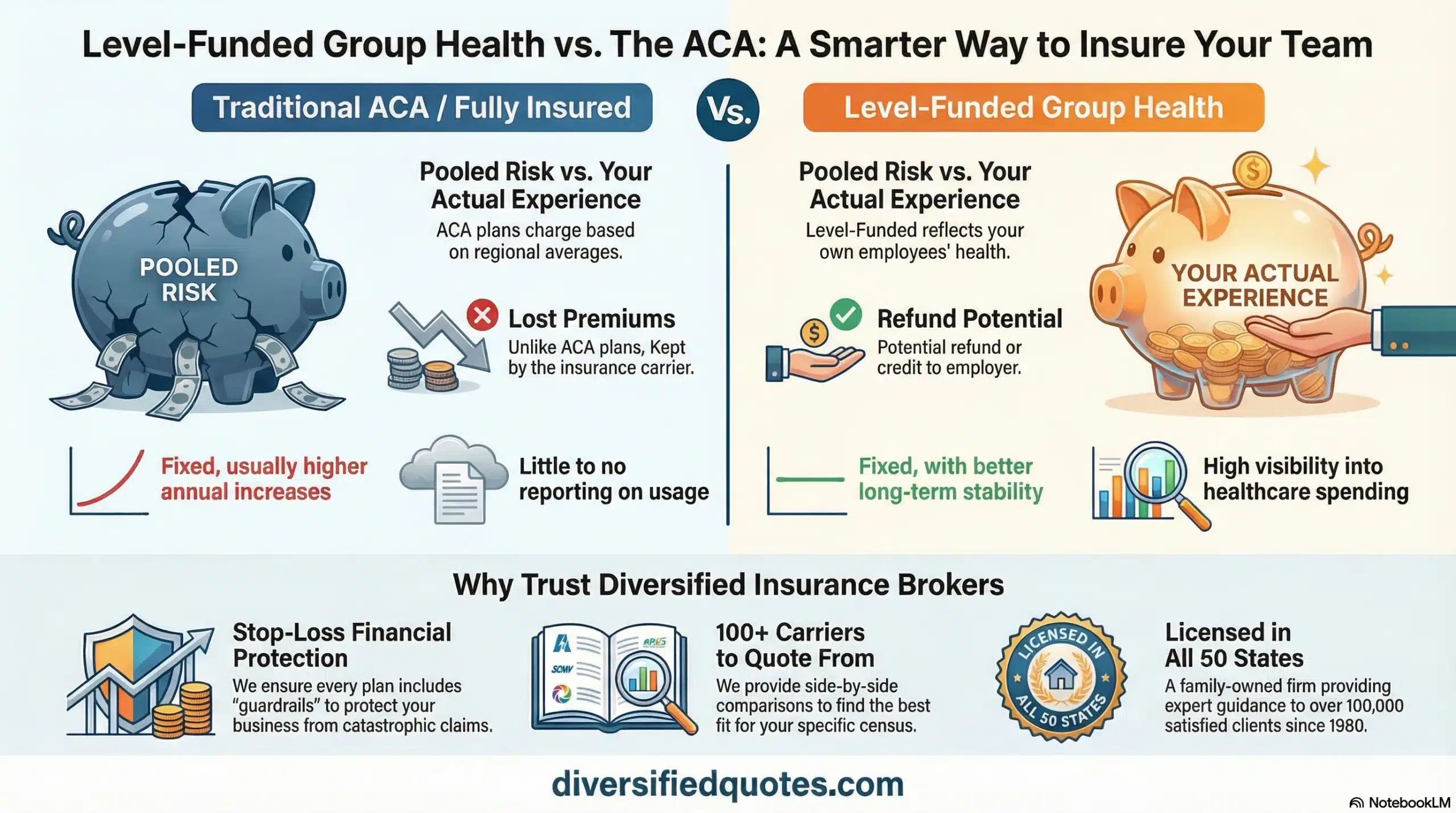
Level-funded group health insurance is sometimes used as a transitional strategy for organizations moving away from fully insured coverage. Under this model, the employer pays a fixed monthly amount that includes estimated claims, administrative fees, and stop-loss protection. This preserves predictable cash flow and feels familiar from a budgeting standpoint, which is why many leadership teams choose it as a first move toward better alignment. If claims are lower than expected, unused claim dollars may be returned at the end of the plan year based on the program’s reconciliation terms—allowing employers to benefit directly from efficient claims experience rather than subsidizing broader risk pools. However, at 250 employees, many organizations ultimately find that a self-funded approach provides more flexibility, better economics, and stronger vendor accountability. Level funding can be a valuable stepping stone. Whether it is the optimal long-term destination depends on the organization’s appetite for claims engagement and the capacity of its HR team to manage a more active benefits governance role.
Self-Funded Plans: Where Large Employers Gain Control
At 250 employees, many organizations are strong candidates for partially self-funded or fully self-funded group health plans under an Administrative Services Only (ASO) arrangement. In these structures, the employer pays claims as they occur instead of prepaying premiums. Stop-loss insurance caps exposure for large individual claims and total annual costs. The employer controls predictable costs, transfers catastrophic risk to stop-loss, and pays closer to the real cost of healthcare rather than an insurer’s conservative assumptions about worst-case scenarios. The primary advantage is transparency. Employers can see where healthcare dollars are spent—by category, by provider type, by geography—which supports targeted cost-containment strategies and meaningful long-term planning. For organizations evaluating this approach, understanding what self-funded group health insurance is provides clarity on how risk controls work and what the administrative flow looks like. Reviewing the pros and cons of self-funded group health helps assess whether the model aligns with your organization’s financial goals and internal capacity.
Multi-Plan Strategy: Offering Tiered Options at 250 Employees
At 250 employees, offering multiple plan options—rather than a single plan for all employees—is a common and often beneficial strategy. A typical structure might include a preferred provider organization (PPO) plan for employees who want broader access with predictable cost-sharing, alongside a high-deductible health plan (HDHP) paired with employer contributions to a Health Savings Account (HSA). This tiered approach allows employees to self-select the structure that fits their health needs, financial situation, and risk tolerance, while the employer can use the HDHP/HSA option to introduce more cost-aware consumer behavior into the plan.
The multi-plan strategy requires thoughtful design to avoid adverse selection—the risk that sicker employees gravitate toward the richer PPO while healthier employees choose the HDHP, effectively concentrating cost in the more expensive plan and making it increasingly unaffordable over time. Managing this risk involves contribution structure, benefit differential design, and communication strategy. When done well, a multi-plan approach often improves overall plan performance because it gives employees meaningful choices while the plan’s total cost reflects a healthier mix of utilization patterns. The employer’s HSA contribution in an HDHP arrangement also creates a tangible benefit that many employees value—a funded account they own—that can improve satisfaction even when the deductible is higher than the alternative PPO.
Stop-Loss Strategy at 250 Employees: Optimizing Protection, Not Just Buying It
Stop-loss is the guardrail that makes self-funding practical. But for large groups, stop-loss selection is not a checkbox—it’s a design decision that can materially affect both cost and volatility. At 250 employees, leadership has real choices about attachment points that fit the company’s financial capacity. Higher attachment points can reduce stop-loss premiums but require more tolerance for variability. Lower attachment points increase premium but create a smoother claims experience. The right approach depends on cash flow stability, reserves, and leadership’s appetite for “noise” in monthly claims results. Stop-loss structure also impacts renewal stability. If attachment points are too aggressive, leadership experiences whiplash when a high-cost claim cluster appears. If too conservative, the plan starts looking like fully insured pricing without the benefits. The goal is balance: transfer catastrophic risk while keeping predictable variability within a manageable range. At 250 employees, stop-loss carriers are competing more actively for your business, which gives experienced brokers more negotiating room on terms, rates, and multi-year commitments than smaller groups typically access.
PCORI Fees and ACA Compliance at This Size
Employers sponsoring self-funded health plans are subject to the Patient-Centered Outcomes Research Institute (PCORI) fee, assessed annually based on the average number of covered lives under the plan. The employer files and remits this fee directly to the IRS by July 31 each year, using Form 720. The fee is modest—currently in the range of a few dollars per covered life per year—but it is a compliance obligation that employers sometimes discover late when moving from fully insured (where the carrier handles it) to self-funded (where the employer assumes direct responsibility). Confirming this requirement with your TPA or benefits advisor before transitioning is a simple step that prevents unnecessary penalties. Beyond PCORI fees, ACA employer mandate compliance (Forms 1094-C and 1095-C, affordability standards, minimum value requirements) remains an ongoing obligation at this size, and self-funded plan administration requires that these reporting functions are coordinated between the employer, TPA, and payroll systems. Building a clear compliance calendar that covers all annual obligations is part of responsible large-group plan governance.
Pharmacy Strategy: The Highest-Impact Lever for Many Large Groups
Pharmacy costs often represent the largest opportunity for cost control at 250 employees, particularly for specialty drugs. Many organizations assume pharmacy spend is fixed and unavoidable. In reality, how the pharmacy benefit is structured—formularies, prior authorization, specialty pharmacy partnerships, copay assistance handling, rebate transparency, and clinical programs—can materially affect total spend without restricting appropriate access. At 250 employees, the plan’s volume is large enough to negotiate better terms, especially in a self-funded arrangement with an independently chosen pharmacy benefit manager. Employers can evaluate carve-out strategies or alternative PBM arrangements when traditional bundled PBM contracts feel opaque. The best outcomes combine transparency with clinical appropriateness: ensuring employees get needed medications while preventing waste and controlling runaway specialty costs that can dominate renewals if left unmanaged.
Network Strategy: Reducing Cost Without Restricting Access
Network selection can materially affect claims costs without limiting provider access, especially when employees are spread across multiple states or metro areas. Many legacy plans stay on the same network year after year, even as employee geography changes—creating hidden inefficiency through out-of-area claims, high-cost hospital outpatient use for services available in lower-cost freestanding centers, and mismatch between where employees seek care and where the plan’s contracts are most favorable. At 250 employees, network strategy becomes more nuanced. Some employers want broad national access for recruiting and employee flexibility. Others want a tighter network that prices more aggressively. The right answer is often a hybrid: preserve broad access while adding plan design incentives that steer employees toward high-value providers and lower-cost sites of care. When employees can access care more efficiently, both plan performance and employee satisfaction tend to improve—the two goals reinforce each other rather than conflict.
Well-Being Programs as a Long-Term Cost Management Tool
At 250 employees, formal well-being programs become practical, measurable, and directly connected to plan performance. Well-being is not simply a recruiting amenity—when structured correctly, it addresses the chronic condition management gaps that drive a significant share of large-group healthcare spend. Diabetes, hypertension, musculoskeletal conditions, and mental health diagnoses collectively account for a substantial portion of claims in most employer populations. When employees have supported access to early intervention, medication adherence programs, lifestyle management resources, and behavioral health services, conditions are caught and managed earlier. That reduces the progression to high-cost inpatient episodes, specialty referrals, and chronic disability that dominates the claims history of many large employers.
Well-being programs also intersect with MHPAEA compliance. When behavioral health benefits are integrated into well-being strategy—not siloed as a separate clinical carve-out—employers often see better mental health outcomes and stronger engagement. At 250 employees, the scale justifies the investment in structured well-being infrastructure that smaller groups cannot economically support. The return on investment shows up over 2-3 years as chronic condition management improves plan performance and reduces the high-cost escalation that otherwise shows up at renewal.
Plan Design: Incentives That Reduce Waste Without Frustrating Employees
Large employers often overestimate how much employees care about plan complexity and underestimate how much they care about clarity and predictability. Employees can handle two or three plan options, copay differences, and site-of-care incentives when the plan is explained clearly and the structure feels fair. What creates frustration is confusion and surprise bills. Plan design at 250 employees can be optimized around real utilization data. If most employees use primary care heavily, a plan that makes primary care predictable and accessible can reduce avoidable ER visits and downstream complications. If chronic conditions are significant drivers, structured disease management programs improve outcomes and reduce high-cost episodes. If high-cost imaging and outpatient surgery are major drivers, benefit design can encourage use of high-value facilities without restricting necessary care. The goal is a plan whose incentives align with good decisions—not a plan that punishes employees for using care or rewards them for avoiding it.
Data and Reporting: From Renewal Shock to Measurable Performance
The moment an employer has credible reporting, healthcare stops being mysterious. At 250 employees, claims volume is sufficient for patterns to be statistically meaningful and actionable. Instead of asking “why did rates go up,” leadership can ask “what changed in utilization, what is driving trend, and which interventions will produce the highest impact?” That shift from reactive to proactive is the most important behavioral change that alternative funding enables. Reporting also supports better vendor accountability—when you can measure network performance, PBM outcomes, and chronic condition program effectiveness, you can negotiate from a position of knowledge. It also supports internal communication: HR can tell a clearer story when leadership understands what the plan is designed to do, why changes are being made, and how this year’s performance compares to prior years. For employers transitioning from fully insured, reporting is often the most valuable “hidden win” of alternative funding—even when year-one savings are modest, the governance infrastructure it creates pays dividends for years.
Renewal Strategy: Stop Accepting the Default
At 250 employees, renewals should not be a once-per-year surprise. A strong renewal strategy is a year-round system with checkpoints. That does not mean constant disruption. It means maintaining visibility into key drivers, monitoring high-level trends quarterly, and making targeted adjustments that improve outcomes without disrupting employees. Many employers make the mistake of waiting until 60-90 days before renewal to evaluate alternatives. At that point, carrier leverage is limited and the organization is forced into reactive decisions. The better approach treats renewal as a process: large-claim trend review in month three, pharmacy performance assessment in month six, network utilization analysis in month nine, and a structured comparison of alternatives in month ten. Even simple in-year steps can prevent the organization from being cornered into accepting undesirable changes under time pressure. When leadership can see why costs changed and how plan adjustments will improve future results, the plan becomes manageable rather than stressful.
Employee Communication: The Most Underrated Cost-Control Tool
At 250 employees, communication matters because small misunderstandings scale significantly. Confusion about urgent care versus ER, telemedicine access, pharmacy rules, HSA mechanics, and in-network versus out-of-network creates unnecessary claims costs that accumulate across a large population. Clear communication reduces waste and improves the employee experience. It also drives engagement with the tools employers pay for but employees often underuse—virtual care, nurse hotlines, cost comparison tools, disease management programs, and HSA portals. Employers don’t need to become health educators. The goal is a simple, repeatable communication rhythm: here is what the plan covers, here is how to use it efficiently, and here is where you go first when you have a question. When employees know how to use the plan, utilization patterns improve and plan performance follows. Many employers also find that clear communication improves retention because employees often value their benefits more when they understand them—and they are more forgiving of plan changes when they understand the reasoning behind them.
Ready to Build a Smarter Group Health Strategy for 250 Employees?
We’ll compare funding structures, identify your highest-impact cost levers, and build a plan designed to produce better long-term results.
Get a 2nd Opinion
Already have a renewal proposal? We’ll show you what alternatives exist and where you may be overpaying.
Group Travel Coverage
Supplemental protection for employees traveling internationally or domestically on company business.
Request a Large Group Analysis
We’ll model your current plan against alternatives and show clear pathways to improve renewals.
Not the Right Headcount?
Use the options below to jump to the group health page that matches your workforce size.
Large-Group Health Insurance Strategy Resources
Industry-specific plans, self-funding guides, and ACA compliance resources for established employers.
Ancillary Benefits and Compliance Essentials
Complement your large-group plan with critical illness, dental, vision, and employee compliance resources.
Talk With an Advisor Today
Choose how you’d like to connect—call or message us, then book a time that works for you.
Schedule here:
calendly.com/jason-dibcompanies/diversified-quotes
Licensed in all 50 states • Fiduciary, family-owned since 1980
FAQs: Group Health Insurance for 250 Employees
What funding options are available for a 250-employee group?
At 250 employees, organizations qualify for the full spectrum of group health funding structures: fully insured, level-funded, partially self-funded, and fully self-funded (ASO) arrangements. The key difference at this size compared to smaller groups is that your claims experience is nearly fully credible—underwriters rely almost entirely on your group’s own data rather than pooled market assumptions. That makes self-funded and level-funded arrangements particularly compelling because pricing reflects your actual performance, not conservative assumptions about the broad market. Most 250-employee employers with stable enrollment and consistent demographics are strong candidates for alternative funding approaches that produce better long-term cost management.
What does ERISA fiduciary responsibility mean for a self-funded employer health plan?
When an employer sponsors a self-funded ERISA health plan, the organization becomes a named plan fiduciary with legally enforceable obligations to act in the best interests of plan participants—employees and their covered dependents. ERISA’s “prudent expert standard” requires fiduciaries to act with the care, skill, and diligence that a knowledgeable person familiar with plan management would exercise. In practical terms, this means plan decisions must be documented and defensible, vendors must be selected and monitored thoughtfully, and the plan must be reviewed regularly to confirm it continues to serve participants appropriately. The Department of Labor has increased fiduciary compliance enforcement—particularly around pharmacy benefit management and plan fees. Building a governance process that includes documented decision-making, annual vendor benchmarking, and regular plan reviews is as important as the plan design itself.
What are PCORI fees and do self-funded employers have to pay them?
PCORI stands for Patient-Centered Outcomes Research Institute. Self-funded plan sponsors are required to pay an annual PCORI fee assessed based on the average number of covered lives under the plan. The employer files and remits this fee directly to the IRS by July 31 each year using Form 720. The fee is modest—currently a few dollars per covered life annually, indexed each year—but it is a compliance obligation that employers sometimes discover for the first time when transitioning from fully insured (where the carrier handles it) to self-funded (where the employer assumes direct responsibility). Confirming this requirement with your TPA or benefits advisor before transitioning prevents an unnecessary compliance gap.
Should a 250-employee company offer multiple plan options?
Many employers at 250 employees offer 2-3 tiered plan options—typically a PPO alongside an HDHP paired with employer HSA contributions—to accommodate different employee preferences and risk tolerance. This approach allows employees to self-select the structure that fits their situation while the HDHP/HSA option introduces more cost-aware behavior into the plan. The key design risk is adverse selection: if sicker employees gravitate heavily toward the richer PPO while healthier employees choose the HDHP, cost concentrates in the most expensive plan and the PPO becomes increasingly unaffordable. Managing this through thoughtful contribution differentials, benefit design, and employee communication is essential. When done well, a multi-plan approach improves overall satisfaction and plan performance simultaneously.
Are refunds possible with group health plans at 250 employees?
Refunds are possible under level-funded plans when claims run below projected levels, and in self-funded arrangements the equivalent benefit is simply that the employer pays actual claims rather than padded premiums—so favorable utilization directly reduces net cost rather than producing a separate refund check. At 250 employees, the claims base is large enough that the refund potential under level funding or the cost savings under self-funding are both meaningful in absolute dollar terms. The more important framing is not “will I get a refund?” but rather “will I finally pay closer to what my group’s healthcare actually costs?” Alternative funding accomplishes this; fully insured plans structurally cannot.
How do well-being programs help control health costs at this size?
At 250 employees, formal well-being programs become practical, measurable, and directly connected to plan performance. Diabetes, hypertension, musculoskeletal conditions, and mental health diagnoses collectively account for a large share of claims in most employer populations. When employees have supported access to early intervention, medication adherence programs, lifestyle management resources, and behavioral health services, conditions are managed earlier—reducing progression to high-cost inpatient episodes and specialty referrals. The return on investment typically appears over 2-3 years as chronic condition management improves plan performance. Well-being programs also support MHPAEA compliance when behavioral health benefits are integrated into the overall employee well-being strategy rather than siloed as a separate carve-out.
What role does pharmacy strategy play in large-group cost management?
Pharmacy—particularly specialty medications—is often the largest single opportunity for cost control at 250 employees. How the pharmacy benefit is structured: formularies, prior authorization thresholds, specialty pharmacy management, copay assistance handling, rebate transparency, and clinical pathways, can materially affect total spend without restricting clinically appropriate access. At 250 employees, plan volume is large enough to negotiate meaningfully better PBM terms, evaluate carve-out strategies, and access specialty management programs that reduce the cost concentration created by a small number of high-cost prescriptions. Pharmacy strategy that is treated as a separate discipline—not just a line item in the benefit summary—consistently produces better long-term cost outcomes than plans that bundle pharmacy with the carrier and ignore the details.
How should a 250-employee employer approach renewal strategy?
At 250 employees, renewals should not be a once-per-year event. A strong renewal strategy is a year-round governance system with quarterly checkpoints: large-claim trend and stop-loss engagement review in month three, pharmacy performance assessment in month six, network utilization analysis in month nine, and structured comparison of alternatives in month ten or eleven. This proactive cadence prevents the organization from being cornered into reactive decisions when the renewal arrives with 60 days’ notice. Employers who treat renewal as a process consistently produce better cost outcomes than those who treat it as an annual negotiation. The goal is not to change carriers every year—it’s to make changes when they are genuinely justified by data, with enough lead time to implement them well.
What does claims credibility mean for a 250-employee group?
Claims credibility refers to how heavily an underwriter relies on a group’s own experience versus pooled market data when setting prices. Smaller groups have low credibility—their pricing is blended significantly with market-wide assumptions because their own data is too limited to be statistically reliable. At 250 employees, a group is approaching or has reached full credibility—meaning underwriters rely almost entirely on the group’s actual historical claims experience. This is a major structural advantage: a healthy, well-managed 250-employee group pays pricing that reflects its own performance, not the performance of a broad market pool that may include much less healthy groups. It also creates accountability: poor plan management or uncontrolled utilization shows up directly in pricing, while improvements show up as renewal stability.
What is the difference between an ASO arrangement and a level-funded plan?
An Administrative Services Only (ASO) arrangement is a fully self-funded structure where the employer pays claims as they occur, contracts separately with a TPA for administration, secures independent stop-loss coverage, and maintains maximum flexibility over plan design and vendor selection. The employer assumes full ERISA fiduciary responsibility. A level-funded plan typically bundles these components into a more turnkey structure with a predictable monthly payment—closer to the administrative experience of a fully insured plan while providing some of the economic benefits of self-funding. Level-funded plans generally offer less flexibility and transparency than true ASO arrangements but are operationally simpler. At 250 employees, many organizations begin with level-funded and transition to ASO as internal HR capacity grows and leadership becomes comfortable with direct claims engagement.
Will a plan built for 250 employees scale efficiently as the company grows?
Yes, when designed with scalability in mind. A self-funded or level-funded plan with strong reporting, intentional vendor selection, and documented plan governance becomes more valuable—not less—as headcount grows. Claims pools become more stable, reporting becomes more statistically meaningful, stop-loss terms improve, and the employer’s leverage with TPAs, PBMs, and network administrators increases. The governance processes established at 250 employees—fiduciary documentation, annual vendor benchmarking, in-year performance reviews—translate directly to 500, 750, and beyond with minimal structural changes. Employers who build this infrastructure at 250 are consistently better positioned as they grow than those who delay and face more complex restructuring at larger sizes.
About the Author:
Jason Stolz, CLTC, CRPC, DIA, CAA and Chief Underwriter at Diversified Insurance Brokers (NPN 20471358), is a senior insurance and retirement professional with more than 25 years of real-world experience helping individuals, families, and business owners protect their income, assets, and long-term financial stability. As a long-time partner of the nationally licensed independent agency Diversified Insurance Brokers, Jason provides trusted guidance across multiple specialties—including fixed and indexed annuities, long-term care planning, personal and business disability insurance, life insurance solutions, Group Health, Travel Medical and Evacuation Insurance, and short-term health coverage. Diversified Insurance Brokers maintains active contracts with over 100 highly rated insurance carriers, ensuring clients have access to a broad and competitive marketplace.
His practical, education-first approach has earned recognition in publications such as VoyageATL, and contributions from his agency featured in Kiplinger and GoBankingRates— highlighting his commitment to financial clarity and client-focused planning. Drawing on deep product knowledge and years of hands-on field experience, Jason helps clients evaluate carriers, compare strategies, and build retirement and protection plans that are both secure and cost-efficient. Visitors who want to explore current annuity rates and compare options across multiple insurers can also use this annuity quote and comparison tool.
Explore More Group Health Insurance Options: Browse our complete guide to Group Health Insurance by Company Size — covering plans for 2, 10, 20, 50, 100, 250, 500, 750 & 1,000+ employees from 100+ carriers.
Last Reviewed: June 1, 2026 |
Reviewed by: Jason Stolz, CLTC, CRPC, DIA, CAA
Chief Underwriter, Diversified Insurance Brokers, Inc. | NPN: 20471358 | Diversified Insurance Brokers, Inc. — Licensed in all 50 states
Fact Checked by: Tonia Pettitt, CMIP©
Medicare Specialist, Diversified Insurance Brokers, Inc. | NPN: 14374308 | Diversified Insurance Brokers, Inc. — Licensed in all 50 states
Did you find this content helpful? Leave us a Google review — it helps others find trustworthy guidance too.
Editorial Standards: Diversified Insurance Brokers maintains rigorous editorial standards to ensure accuracy, clarity, and independence in all content. Learn more about our editorial standards and commitment to transparency.
