
Pros and Cons of Pre-Settlement Funding
Pros and Cons of Pre-Settlement Funding

Jason Stolz CLTC, CRPC, DIA, CAA
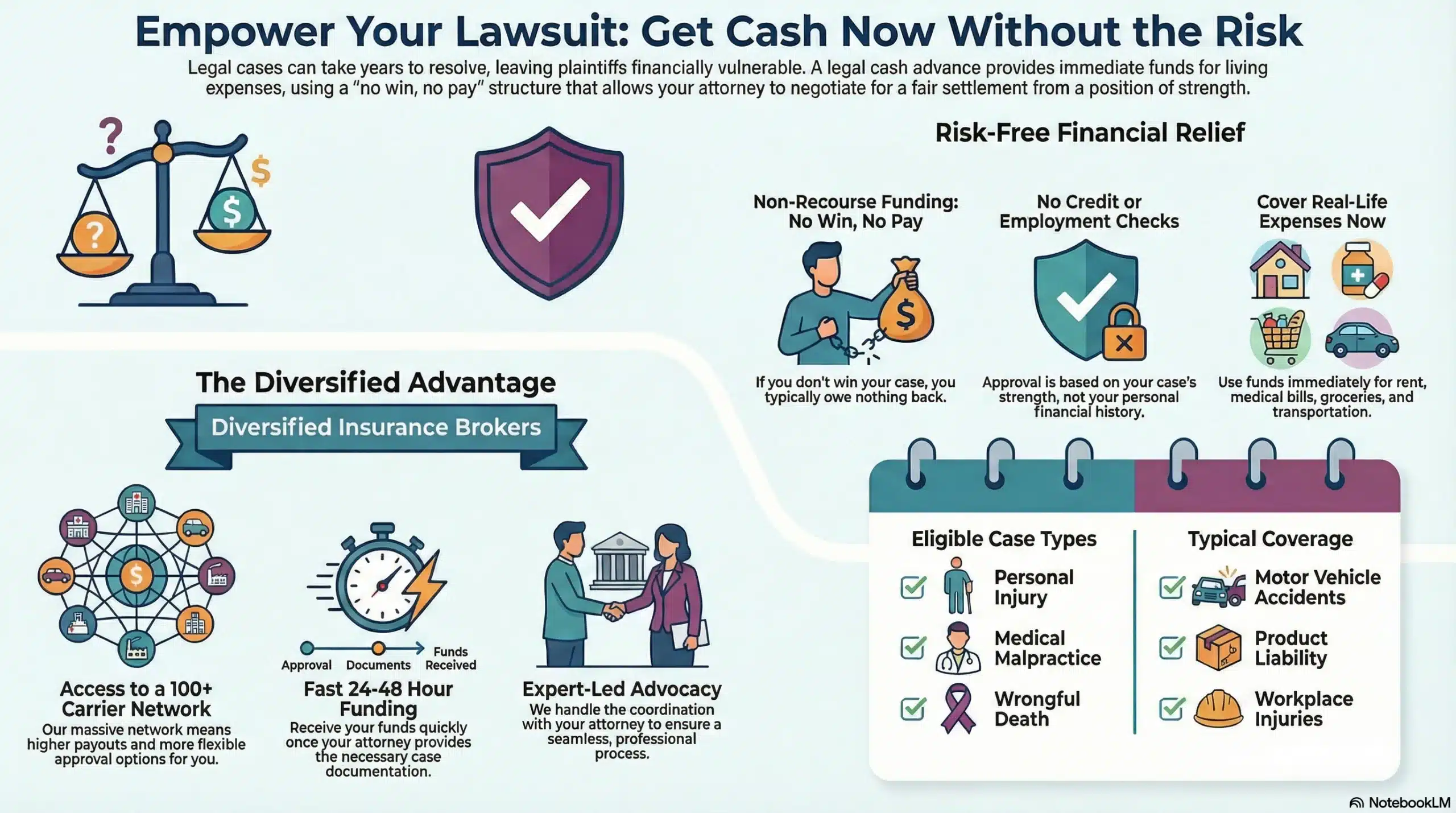
Pre-settlement funding can feel like both a lifeline and a dilemma at the same time. If you are waiting on a lawsuit to resolve — whether it involves a personal injury claim, wrongful termination dispute, medical malpractice case, or another civil matter — you may be facing real financial pressure while the legal process moves at its own pace. Rent does not wait for court dates. Mortgage payments do not pause because negotiations are ongoing. Medical bills, transportation costs, utilities, and groceries continue regardless of how strong your case may be. That is where pre-settlement funding enters the conversation. Also known as lawsuit funding or a legal advance, this financial tool provides plaintiffs with cash upfront in exchange for a portion of their future settlement proceeds. The funding is typically non-recourse, meaning if you lose your case, you generally do not repay the advance. That single feature is one of the most significant advantages, but it is not the entire story. Understanding the true pros and cons requires a deeper look at leverage, cost structures, alternatives, case timelines, and long-term financial outcomes. If you are new to the concept, reviewing how pre-settlement funding works provides the foundational mechanics before weighing its advantages and disadvantages. What is pre-settlement funding covers the terminology and structure for plaintiffs comparing this option to other approaches for managing the financial gap between injury and resolution.
One of the most compelling advantages of pre-settlement funding is financial breathing room that directly affects negotiating leverage. Insurance companies and defense attorneys are well aware that plaintiffs under financial stress may feel compelled to accept lower settlement offers simply to gain immediate access to cash. When a plaintiff is behind on rent, facing collections, or at risk of eviction, the temptation to resolve quickly — even at a significant discount from actual case value — can become overwhelming and difficult to resist. Funding can reduce that pressure and give the attorney additional time to negotiate for full and fair compensation. In that sense, the funding itself can indirectly increase the net recovery by preventing a premature settlement that leaves substantial value on the table. Many plaintiffs ask whether pre-settlement funding is worth it. The answer often hinges on this leverage factor. If funding allows the plaintiff to wait for a significantly stronger offer, the cost of the advance may be more than justified by the improvement in settlement value — but this must be weighed carefully against how fees accumulate over the life of the case, which can substantially reduce the final payout if the case takes longer than expected.
Need Financial Relief While Your Case Is Pending?
Request a fast, no-obligation review to see if you qualify for non-recourse pre-settlement funding.
Apply for Pre-Settlement FundingPros and Cons at a Glance
| Dimension | Pro | Con |
|---|---|---|
| Repayment risk | Non-recourse structure — if you lose your case, you typically owe nothing; funding company assumes case risk | Non-recourse pricing reflects risk taken — cost is typically higher than conventional credit products |
| Settlement leverage | Reduces financial pressure that forces premature, undervalued settlements — gives attorney time to negotiate full value | If case resolves quickly anyway, funding costs reduce net recovery without producing the leverage benefit |
| Accessibility | No credit check, no income verification, no employment requirement — approval based on case strength | Only available to plaintiffs with active, qualifying cases — not a general-purpose financial tool |
| Cost structure | No monthly payments during the case — all costs paid at resolution from settlement proceeds | Costs accumulate over case duration — compounding structures can make extended cases significantly more expensive |
| Immediate relief | Covers essential expenses — housing, utilities, food, medical costs — preventing downstream financial damage | Misused as a long-term solution rather than short-term bridge, funding can significantly erode final net recovery |
| Psychological benefit | Reduces stress from financial pressure that can compromise wellbeing and litigation decision-making | Psychological relief can lead to over-borrowing — taking more than needed because it is available, not because it is necessary |
| Comparison to alternatives | No personal asset risk, no repayment if case fails — advantages over personal loans, retirement account borrowing, and credit cards | More expensive than alternatives that carry personal repayment obligation — cost comparison must account for risk difference |
| Contract transparency | Legitimate providers disclose costs clearly and coordinate through attorney — reputable network approach improves offer quality | Terms vary significantly across providers — contract review with attorney is essential before signing any funding agreement |
The Accessibility Advantage: Case-Based Underwriting
Another major benefit of pre-settlement funding is accessibility that conventional financial products cannot match. Unlike traditional loans, pre-settlement funding does not rely on the plaintiff’s credit score, income level, or employment status. Approval is based primarily on the strength of the legal case — the funding company evaluates liability clarity, damages documentation, available insurance coverage, and the attorney’s assessment of likely recovery. This case-based underwriting model allows plaintiffs who would not qualify for bank loans, credit cards, or most other forms of conventional financing to access capital based on the merits of their legal claim.
For individuals who are out of work because of an injury, who have experienced significant financial disruption as a result of the incident underlying their lawsuit, or whose credit has been damaged by the same financial stress the funding would address, that accessibility is critical. The non-recourse structure further differentiates pre-settlement funding from alternatives that carry personal repayment obligations. Borrowing against retirement accounts triggers taxes and penalties in most cases. Taking personal loans or using credit cards requires full repayment regardless of the case outcome. Selling assets under financial pressure can lock in losses at unfavorable prices. In situations where no affordable alternative is available or sufficient, pre-settlement funding may represent a strategic bridge rather than a burden — provided it is used with discipline and full understanding of the cost structure. How much you can get from pre-settlement funding covers the specific factors that determine funding amounts and provides a framework for realistic expectations before applying. Cash for lawsuit plaintiffs covers the qualification and funding process from the plaintiff’s perspective across different case types and financial situations.
The Cost Structure: The Most Important Drawback
The cost structure represents the most frequently cited and most consequential drawback of pre-settlement funding, and it deserves careful, detailed attention before any funding agreement is signed. Funding fees can accumulate monthly, and in some agreements, costs compound over time — meaning the total repayment amount grows not just by the monthly fee but by an increasing base as previous fees are added to the outstanding balance. The longer a case remains unresolved, the larger the total repayment amount becomes relative to the original advance. Plaintiffs who take larger advances, experience extended litigation timelines, or do not fully understand the difference between simple and compounding cost structures may find that a significant portion of their eventual settlement is consumed by repayment obligations that seemed manageable when the funding was accepted.
This is why conservative borrowing is one of the most important disciplines in pre-settlement funding. Taking only what is genuinely needed to stabilize essential household expenses — rather than the maximum amount available — preserves a larger share of the eventual recovery and limits the cost accumulation risk over an uncertain case timeline. Requesting a written payoff schedule that shows the total repayment obligation at different resolution points — three months, six months, twelve months, eighteen months — before signing any agreement provides the transparency needed to evaluate whether the advance is financially sensible given the expected case duration. Discussing the payoff schedule with the attorney, who understands what the case is realistically worth and how long it is likely to take, provides the context needed to evaluate whether the funding cost makes sense relative to the anticipated net recovery. How lawsuit loans work covers the mechanics and terminology in detail. Lawsuit loan rates and costs covers how different fee structures impact settlement outcomes and what questions to ask when comparing offers across providers.
Psychological Relief: A Real But Underestimated Factor
Beyond the financial mechanics, the psychological benefit of pre-settlement funding deserves serious consideration as both an advantage and a potential risk. Ongoing financial strain — the daily anxiety of watching bills go unpaid, the dread of eviction notices, the stress of watching medical debt mount while treatment continues — takes a documented toll on both personal wellbeing and decision-making quality. Research in behavioral economics consistently demonstrates that financial stress compromises judgment in ways that systematically harm the stressed party in negotiation contexts, which is exactly the dynamic that insurance defense strategies are designed to exploit when dealing with financially vulnerable plaintiffs.
When funding stabilizes housing, utilities, and essential expenses, it can create peace of mind that is difficult to quantify precisely but meaningfully real in its effect on the plaintiff’s ability to participate constructively in the litigation process. A plaintiff who is not in crisis mode can have clearer conversations with their attorney, make more deliberate decisions about settlement offers, and communicate more coherently with medical providers and other parties whose cooperation the case depends on. The psychological benefit of stability should not be dismissed as a soft factor — it has direct, concrete implications for litigation outcomes. However, it also creates a risk: the psychological relief of having money can reduce the discipline needed to borrow conservatively. When the financial pressure is temporarily relieved, the temptation to take slightly more than needed “just in case” can lead to over-borrowing that creates disappointment at settlement when the repayment obligation is larger than anticipated.
Don’t Let Financial Pressure Dictate Your Settlement
Explore whether lawsuit funding can help you pursue full and fair compensation.
Check Your Eligibility NowCase Duration and Its Effect on Funding Value
Case duration is one of the most important variables in evaluating whether pre-settlement funding will produce a net positive outcome. If the attorney anticipates resolution within a relatively short timeframe — a few months — the cost of funding may remain modest and the leverage benefit may be highly meaningful relative to that cost. If the case is likely to involve extensive discovery, multiple depositions, expert witness preparation, or trial preparation stretching over a year or more, cost accumulation becomes a substantially more serious concern that must be evaluated honestly before accepting any advance.
The challenge is that case timelines are inherently uncertain, and attorneys can rarely guarantee resolution within any specific window. A case that appears to be nearing settlement can suddenly be complicated by new liability disputes, defense expert witnesses, additional medical complications that require further treatment, or court scheduling delays that add months to an already extended timeline. These uncertainties argue strongly for conservative borrowing — taking the minimum amount needed for stability rather than the maximum available — because the uncertain variable is always how long the case will take, and that variable directly determines how much the advance will cost by the time it is repaid. Multiple advances against the same case also compound this risk. Some funding companies allow follow-up funding when initial advances are exhausted, but each additional advance increases the total repayment obligation and further reduces the net recovery the plaintiff ultimately receives. Get cash before your case settles covers the process and timing mechanics for plaintiffs considering funding at different case stages. Advance on lawsuit settlement covers how advances are structured against expected proceeds and what repayment looks like at different case timelines.
Evaluating Alternatives Honestly
Alternatives to pre-settlement funding must be evaluated honestly rather than dismissed or embraced without careful analysis of their actual availability and cost in the plaintiff’s specific situation. Emergency savings, assistance from family members, short-term disability benefits, structured payment arrangements with medical providers, or negotiating temporary hardship plans with creditors may reduce or eliminate the need for lawsuit funding in some cases. When these alternatives are genuinely available and sufficient to bridge the financial gap, they will generally produce better net outcomes than pre-settlement funding because their cost structures are typically more favorable and they do not create repayment obligations tied to the lawsuit proceeds.
However, these alternatives are frequently not available or sufficient for plaintiffs who have already exhausted savings, whose family cannot provide meaningful assistance, who do not qualify for disability benefits, or whose creditors are unwilling to offer meaningful hardship accommodations. The honest assessment for many injured plaintiffs is that no adequately sized alternative exists at the moment funding is needed, and the choice is between pre-settlement funding and accepting whatever settlement the insurance carrier offers under financial duress. In that context, pre-settlement funding — used conservatively and with full understanding of the cost structure — can represent the better option despite its higher cost, because the alternative is an undervalued settlement that produces a worse total outcome even though it arrives without funding fees attached. Is lawsuit funding safe covers the evaluation framework plaintiffs should use to assess providers and contract terms before committing. Legal funding companies covers how to evaluate providers across transparency, documentation requirements, and disclosed cost structures to identify the most appropriate funding source for a specific situation.
Contract Review and Attorney Coordination
Not all pre-settlement funding agreements are structured identically, and terms can vary significantly between providers in ways that produce very different outcomes for the plaintiff at settlement. Some providers use simple, transparent fee structures that make the total repayment obligation easy to calculate at any point in the case timeline. Others use more complex structures that compound in ways that are not immediately apparent from a surface reading of the agreement and that become substantially more expensive if the case takes longer than anticipated. The presence of provisions that allow costs to compound, that impose additional fees at specific milestones, or that have different cost structures for different case durations should be identified and fully understood before any agreement is signed.
Reviewing the funding contract with the attorney before signing is not optional — it is a structural requirement for making an informed decision. The attorney understands what the case is worth, how long it is likely to take, what the existing lien landscape looks like, and how the funding repayment obligation will affect the net proceeds at settlement. A funding agreement that looks manageable in isolation may look very different when the attorney explains that medical liens, case costs, and attorney fees will also be satisfied from the same settlement proceeds. Identifying the total expected deductions from gross settlement value before accepting funding provides the context needed to evaluate whether the advance is financially sensible. The attorney’s cooperation in the funding process is also a structural requirement of how legitimate pre-settlement funding works — documentation-based underwriting through the attorney of record is what distinguishes credible funding companies from those whose offers should be approached with caution. Injury lawsuit cash advance covers how funding specifically helps personal injury plaintiffs and what the documentation and coordination process looks like. Medical malpractice lawsuit funding covers the specific documentation and underwriting requirements for this complex and high-value case category where funding costs relative to expected settlement value deserve particularly careful analysis.
Using Funding Responsibly: The Safeguards That Determine the Outcome
Ultimately, the pros and cons of pre-settlement funding come down to trade-offs whose net effect depends almost entirely on how the funding is used. The advantages are real and meaningful: non-recourse protection eliminates the repayment risk that makes conventional borrowing dangerous for financially vulnerable plaintiffs, reduced settlement pressure allows the attorney to negotiate for full case value rather than urgency-driven discounts, accessibility regardless of credit or employment status makes funding available to plaintiffs who have no other viable options, and immediate financial relief can prevent the cascade of downstream consequences — eviction, repossession, collections damage — that compound the financial harm of an already disruptive injury event.
The disadvantages are equally real: potentially high cumulative costs that reduce net settlement proceeds, a cost structure that becomes more burdensome the longer the case takes, significant variation in contract terms across providers that creates risk for plaintiffs who do not review agreements carefully, and the risk of over-borrowing driven by availability rather than genuine need. The safeguards that determine which outcome the plaintiff experiences are education about how the cost structure works, transparency in the form of written payoff schedules reviewed before signing, conservative borrowing limited to what is genuinely necessary for stability rather than what is available, and full coordination with the attorney who understands both the legal and the financial dimensions of the funding decision. Used responsibly with these safeguards in place, pre-settlement funding can preserve negotiating leverage and protect plaintiffs from accepting undervalued settlements — which is its primary purpose and its most meaningful benefit. Used without these safeguards, it can erode recovery amounts and create disappointment at case conclusion that could have been avoided with more disciplined approach. Legal funding fast pre-settlement cash advances covers the process and documentation requirements in detail. Lawsuit settlement loans covers the structural comparison between different legal funding approaches and how they differ in repayment mechanics and cost structure. Pre-settlement funding and fast legal cash advances provide additional resources for plaintiffs comparing the full landscape of legal funding options available during active litigation.
Related Pages to Explore
Talk With an Advisor Today
Choose how you’d like to connect—call or message us, then book a time that works for you.
Schedule here:
calendly.com/jason-dibcompanies/diversified-quotes
Licensed in all 50 states • Fiduciary, family-owned since 1980
Frequently Asked Questions: Pros and Cons of Pre-Settlement Funding
What is the biggest advantage of pre-settlement funding?
The biggest advantage is the combination of non-recourse protection and settlement leverage. The non-recourse structure means that if the case does not result in a recovery, the plaintiff typically owes nothing — which eliminates the repayment risk that makes conventional borrowing dangerous for financially vulnerable plaintiffs with uncertain case outcomes. The settlement leverage advantage means that when financial pressure is removed, the plaintiff and attorney can negotiate based on actual case value rather than the urgency created by unpaid bills and financial desperation. Insurance companies routinely use financial pressure as a negotiating tool against plaintiffs — pre-settlement funding can neutralize that tool and allow the case to resolve at a more representative value than a financially desperate plaintiff would accept.
What is the biggest disadvantage of pre-settlement funding?
The biggest disadvantage is the cost structure — specifically how costs accumulate over case duration and how compounding fee structures can produce substantially larger repayment obligations than plaintiffs anticipate when they accept the initial advance. The longer a case takes to resolve, the more the advance costs, and case timelines are inherently uncertain. A plaintiff who accepts an advance with a compounding cost structure and then experiences a case that extends eighteen months rather than six months may find that a significantly larger portion of the settlement is consumed by repayment than they expected when they signed the agreement. The safeguard against this risk is requesting written payoff examples at multiple case resolution timeframes — three, six, twelve, and eighteen months — before signing any agreement and reviewing those examples with the attorney.
Is pre-settlement funding better than a personal loan for lawsuit plaintiffs?
The comparison depends on what the plaintiff values most. A personal loan will typically have a lower cost than pre-settlement funding — but it requires full repayment regardless of case outcome, involves credit checks and income verification that many injured plaintiffs cannot satisfy, and creates monthly payment obligations that add pressure rather than relieve it during an already financially stressful period. Pre-settlement funding is more expensive in terms of the rate applied to the advance, but it requires no repayment if the case is unsuccessful, carries no monthly payment obligation while the case is pending, and is accessible based on case strength rather than personal financial history. For a plaintiff who cannot qualify for a personal loan at a favorable rate, who cannot afford monthly payments while unemployed due to injury, or who wants to eliminate repayment risk in case the case does not succeed, pre-settlement funding’s higher cost may be justified by the structural advantages it provides.
How can I make sure I use pre-settlement funding responsibly?
Using pre-settlement funding responsibly comes down to four disciplines: borrow only what is genuinely needed for essential expenses rather than the maximum available amount; understand the cost structure fully by requesting written payoff examples at multiple case resolution timelines before signing; review the agreement with your attorney so they understand the repayment obligation and can factor it into the settlement strategy; and treat the funding as a short-term stability tool rather than a long-term financial solution or source of discretionary spending. The plaintiffs who experience the best outcomes from pre-settlement funding are those who use it to preserve negotiating leverage — taking the minimum needed to stay financially stable while the attorney negotiates — rather than those who maximize the advance and then find the repayment obligation disappointing when the case resolves.
Does receiving pre-settlement funding reduce my final settlement amount?
The advance itself does not reduce the gross settlement amount negotiated by the attorney — the settlement is negotiated based on case value independent of whether the plaintiff has accepted funding. However, the repayment obligation is satisfied from the settlement proceeds at disbursement, which reduces the net amount the plaintiff actually receives after all deductions. The key question is whether the improvement in gross settlement value made possible by the funding’s leverage benefit — allowing the attorney to negotiate rather than accept an early undervalued offer — offsets the repayment cost. When the leverage benefit produces a meaningfully larger settlement, the net outcome can be better even after paying the funding cost. When the case would have resolved at the same value regardless of funding, the funding cost reduces the net recovery without producing a corresponding benefit.
About the Author:
Jason Stolz, CLTC, CRPC, DIA, CAA and Chief Underwriter at Diversified Insurance Brokers (NPN 20471358), is a senior insurance and retirement professional with more than 25 years of real-world experience helping individuals, families, and business owners protect their income, assets, and long-term financial stability. As a long-time partner of the nationally licensed independent agency Diversified Insurance Brokers, Jason provides trusted guidance across multiple specialties—including fixed and indexed annuities, long-term care planning, personal and business disability insurance, life insurance solutions, Group Health, Travel Medical and Evacuation Insurance, and short-term health coverage. Diversified Insurance Brokers maintains active contracts with over 100 highly rated insurance carriers, ensuring clients have access to a broad and competitive marketplace.
His practical, education-first approach has earned recognition in publications such as VoyageATL, and contributions from his agency featured in Kiplinger and GoBankingRates— highlighting his commitment to financial clarity and client-focused planning. Drawing on deep product knowledge and years of hands-on field experience, Jason helps clients evaluate carriers, compare strategies, and build retirement and protection plans that are both secure and cost-efficient. Visitors who want to explore current annuity rates and compare options across multiple insurers can also use this annuity quote and comparison tool.
Explore All Lawsuit Loan & Legal Funding Options: Browse our complete guide to Lawsuit Loans & Legal Funding — covering pre-settlement funding, lawsuit cash advances, injury claims & more.
Last Reviewed: June 16, 2026 |
Reviewed by: Jason Stolz, CLTC, CRPC, DIA, CAA
Chief Underwriter, Diversified Insurance Brokers, Inc. | NPN: 20471358 | Diversified Insurance Brokers, Inc. — Licensed in all 50 states
Fact Checked by: Tonia Pettitt, CMIP©
Medicare Specialist, Diversified Insurance Brokers, Inc. | NPN: 14374308 | Diversified Insurance Brokers, Inc. — Licensed in all 50 states
Did you find this content helpful? Leave us a Google review — it helps others find trustworthy guidance too.
Editorial Standards: Diversified Insurance Brokers maintains rigorous editorial standards to ensure accuracy, clarity, and independence in all content. Learn more about our editorial standards and commitment to transparency.
