
Advance on Lawsuit Settlement – Get Fast Legal Funding Now
Advance on Lawsuit Settlement – Get Fast Legal Funding Now

Jason Stolz CLTC, CRPC, DIA, CAA
An advance on a lawsuit settlement addresses a specific and particularly acute financial moment in personal injury litigation: the period when a case is moving toward resolution but has not yet produced usable funds. This is distinct from simply waiting for a case to begin progressing — it is the period when settlement negotiations are actively underway, when liability has often been established, when damages are documented, and when a realistic recovery amount is coming into focus, but when actual cash remains months away because insurance companies, lien holders, courts, and the mechanics of settlement processing all require time that does not pause for the plaintiff’s bills. An advance on a lawsuit settlement converts the expected value of an anticipated settlement into immediate liquidity — allowing the plaintiff to manage real expenses now while the final closing process runs its course.
The settlement stage is, counterintuitively, often when plaintiffs experience the most concentrated financial pressure. Earlier in the case, there may be uncertainty that keeps expectations appropriately conservative. As the case matures and a realistic settlement range becomes clearer, the gap between “what this case is worth” and “what I have access to today” becomes more sharply felt — and insurance companies are well aware of this dynamic. Carriers with experienced claims departments understand that a plaintiff who has been waiting 18 months and is behind on bills is more likely to accept a lower offer quickly than a plaintiff who is financially stable and can afford to wait for a fair outcome. An advance on a lawsuit settlement directly addresses this asymmetry, giving the plaintiff the financial stability to negotiate from strength rather than from desperation. At Diversified Insurance Brokers, Jason Stolz, CLTC, CRPC, DIA, CAA helps plaintiffs navigate legal funding options at the settlement stage, connecting them with reputable funding sources that evaluate cases on merit and structure advances responsibly to protect future net recovery. Our resource on lawsuit settlement loans covers the foundational structure of settlement-stage funding, and our resource on advance on a pending lawsuit covers the earlier-stage funding context for cases not yet approaching settlement.
Request Your Advance on Lawsuit Settlement
We coordinate directly with your attorney, connect your case with reputable funding sources at the settlement stage, and help you access the most cash your case can responsibly support — pre-settlement or post-settlement.
Apply NowPre-Settlement vs. Post-Settlement Advances — The Critical Distinction
Not all advances on a lawsuit settlement are the same, and the stage of the case when funding is requested determines both how the advance is structured and what documentation is required. The two primary categories — pre-settlement advances and post-settlement advances — address different stages of the litigation-to-payment timeline and operate under meaningfully different underwriting conditions.
Pre-settlement advances are requested while the case is still active and negotiations have not yet produced a signed settlement agreement. The outcome is not yet determined, and the funder is evaluating both the probability and likely magnitude of recovery based on available case facts. Because there is still uncertainty about the final settlement amount and timing, pre-settlement underwriting tends to be more conservative — funders advance a portion of what they assess the case may produce net of fees and liens, with the understanding that the actual outcome could differ. Pre-settlement advances are the most commonly requested form of lawsuit settlement advance and apply to the broadest range of plaintiff situations.
Post-settlement advances are requested after a settlement agreement has been signed but before the actual funds have been received. This scenario is more common than many plaintiffs expect — a signed settlement does not mean immediate payment. The period between settlement execution and fund disbursement routinely extends weeks to months due to a variety of processing requirements. Because a signed settlement represents a more defined outcome, post-settlement underwriting can often proceed more quickly and may support higher advance amounts relative to anticipated proceeds than pre-settlement funding. Our resource on need money before settlement covers the post-settlement delay scenarios and funding options in detail.
| Feature | Pre-Settlement Advance | Post-Settlement Advance |
|---|---|---|
| When it applies | Case is active; settlement not yet reached | Settlement signed; funds delayed in processing |
| Outcome certainty at time of advance | Lower — case outcome still uncertain | Higher — recovery amount is defined or estimated |
| Underwriting basis | Case strength, liability, damages, coverage limits, timeline | Settlement agreement amount, lien estimates, disbursement timeline |
| Typical approval speed | Varies — dependent on documentation completeness and case development | Often faster — defined outcome reduces underwriting complexity |
| Advance amount relative to recovery | Conservative portion of anticipated net proceeds | May support higher advance relative to known net proceeds |
| Risk if case does not resolve favorably | Non-recourse: no repayment owed if no recovery | Settlement is signed — recovery is committed; different risk profile |
| Most common reason for need | Living expenses, medical costs, preventing forced early settlement | Lien resolution delays, insurer processing, court approval, structured settlement processing |
| Attorney involvement | Required — case documentation and lien acknowledgment needed | Required — settlement agreement review and fund disbursement coordination |
The table makes clear that both forms of advance on a lawsuit settlement share core structural features — attorney involvement, non-recourse character, and repayment from case proceeds — while differing significantly in timing, underwriting basis, and the financial situations that create the need. Our resource on legal funding structures covers how these agreements are constructed across both stages, and our resource on cash for lawsuit plaintiffs covers funding options specifically as cases approach the settlement stage.
Why the Settlement Stage Creates the Sharpest Financial Pressure
The settlement stage of personal injury litigation is precisely where financial pressure concentrates most intensely — and understanding why illuminates both why an advance on a lawsuit settlement is most commonly sought at this stage and why the timing of that advance matters so much to the final outcome of negotiations.
By the time a case reaches active settlement discussions, the plaintiff has typically been without full income for months or longer, has accumulated medical bills that may not be fully resolved by health insurance, has been making minimum payments on expenses that have grown during the litigation period, and has been waiting with the knowledge that a settlement is coming but with no access to those funds. This accumulated financial pressure creates a compounding problem: just as the plaintiff’s legal position is often strongest — documented injuries, clear liability, established medical treatment records — the financial position is often weakest.
Insurance company claims departments are trained to understand this dynamic. Experienced adjusters know that a plaintiff who has been waiting 18 months, is behind on housing payments, and has creditors calling is more receptive to an early, lower settlement offer than a plaintiff who is financially stable and can wait for the full value of their claim to be recognized. The settlement advance exists precisely to disrupt this asymmetry. When financial pressure is relieved, the plaintiff can take the time needed to reach a fair outcome rather than accepting the first offer that covers immediate needs. The net result — a higher settlement minus funding costs — is often greater than the net result of accepting a rushed settlement under financial duress.
Why Settlement Funds Are Delayed Even After an Agreement Is Signed
Many plaintiffs are surprised to discover that a signed settlement agreement does not translate into immediate payment. Post-settlement delays are common and can extend the gap between agreement and actual fund receipt by weeks or months, creating the specific financial pressure that post-settlement advances address. Understanding why these delays occur helps plaintiffs anticipate them and plan their funding strategy accordingly.
Medical lien resolution is the most common source of post-settlement delay. When healthcare providers have treated the plaintiff on a lien basis — agreeing to defer payment until the case resolves — those providers must be notified of the settlement and must negotiate and agree to their portion of the proceeds before funds can be disbursed. Hospitals, surgery centers, imaging providers, physical therapy practices, and health insurance carriers who paid claims may all hold liens that must be resolved. This negotiation process, particularly when multiple providers are involved, can take weeks to months and must be completed before the attorney can disburse remaining funds to the plaintiff.
Court approval is required for settlement of certain case types — particularly wrongful death cases, cases involving minor plaintiffs, and cases involving certain types of claims — adding judicial processing time to the post-settlement timeline. Workers’ compensation settlements may require agency approval. Structured settlement arrangements, where some or all proceeds are paid through an annuity rather than a lump sum, require additional time to establish the annuity contract and confirm its terms before finalization. Insurer internal processing — particularly for larger settlements — routinely takes additional weeks beyond the execution of the settlement agreement. Our resource on need money before settlement covers the specific delay categories and what plaintiffs should expect in each scenario.
What Determines the Advance Amount at the Settlement Stage
The amount available in an advance on a lawsuit settlement at the pre-settlement stage is determined primarily by the anticipated net recovery — the expected gross settlement amount minus attorney fees (typically 33-40% on contingency), medical liens and unpaid balances, case costs, and any existing advances. Funding companies advance a conservative portion of this anticipated net to ensure the plaintiff still receives meaningful proceeds when the case closes. The gross settlement amount matters, but so does everything that will reduce it before the plaintiff’s net check is written.
Several factors can increase or decrease the advance amount available at the settlement stage. Adequate insurance coverage with realistic policy limits is one of the most important positive factors — cases where the defendant carries sufficient coverage to support a meaningful settlement provide the clearest recovery pathway for both the plaintiff and the funder. Strong medical documentation and a consistent treatment record that clearly supports the claimed damages increases funder confidence in the anticipated settlement value. Conversely, existing medical liens that have grown large relative to the expected settlement can reduce available net proceeds and limit funding. Prior advances that must be repaid from settlement proceeds reduce the remaining net available to support a new advance.
For personal injury cases specifically, our resource on injury lawsuit cash advance covers how personal injury case characteristics interact with funding availability, and our resource on personal injury lawsuit loan covers the funding structure in personal injury contexts specifically. For complex case types like medical malpractice that reach settlement on longer timelines, our resource on medical malpractice lawsuit funding covers the settlement-stage funding dynamics for this more selective category.
How Lien Resolution Affects Both Settlement Timing and Funding Strategy
Lien resolution is simultaneously one of the most important value-creation opportunities in personal injury settlement and one of the primary sources of post-settlement delay — and understanding how liens interact with the advance on a lawsuit settlement helps plaintiffs and their attorneys plan both the funding strategy and the timeline more accurately.
Medical liens represent balances owed to healthcare providers who treated the plaintiff on a lien agreement — deferring payment until the case resolved rather than billing the health insurance or requiring upfront payment. These liens must be paid from settlement proceeds, but they are often negotiable. A skilled attorney may be able to reduce medical liens substantially through negotiation with providers — particularly with hospitals and large provider groups that have standard lien reduction policies. Every dollar of medical lien reduction directly increases the plaintiff’s net recovery and can also increase the amount available in a settlement-stage funding advance.
Health insurance subrogation claims — where a health insurer who paid claims seeks reimbursement from the settlement — represent another category of settlement proceeds reduction that affects both net recovery and available funding. Federal law governs Medicare and Medicaid subrogation claims; ERISA governs employer-sponsored health plan subrogation; state law governs state-regulated plans. The specific rules differ significantly and affect how much of the settlement the health plan can reclaim. Attorneys who are experienced in lien resolution can navigate these complexities to maximize plaintiff net recovery — and the timing of this process is a key driver of post-settlement disbursement delays. Our resource on settlement funding covers how funding interacts with the disbursement process.
Understanding Cost Structure Before Signing a Settlement Advance Agreement
The cost structure of an advance on a lawsuit settlement is one of the most important factors to understand clearly before executing any legal funding agreement. An advance that appears favorable based on the advance amount alone can produce a very different net outcome depending on how costs are structured, how they accrue over time, and what the total payoff looks like at different case resolution timelines.
Legal funding agreements typically include fees and charges that accrue from the date of the advance until repayment. The specific methodology — whether costs are simple or compound, what rate applies, whether there are minimum terms or early repayment credits — varies by funding company and case type. Because costs grow over time, a pre-settlement advance on a case that takes two more years to resolve will produce a higher total repayment than the same advance amount on a case that resolves in six months. The difference between these scenarios can be substantial relative to the plaintiff’s net recovery.
This is why the most responsible approach to any advance on a lawsuit settlement is to request a specific amount that solves a specific problem for a defined period — not to maximize the advance because it is technically available. A plaintiff who needs $6,000 to cover three months of housing, utilities, and transportation while the case settles should request $6,000, not $20,000 because that is the maximum the funder will approve. The $14,000 difference in advance amount translates into a meaningfully smaller net recovery after the advance plus accrued costs are repaid. Our resource on pros and cons of pre-settlement funding covers this cost-benefit analysis in full, and our resource on is pre-settlement funding worth it provides the evaluation framework plaintiffs should apply before committing to any advance.
How to Apply and What to Expect at the Settlement Stage
The application process for an advance on a lawsuit settlement at the pre-settlement stage begins with the plaintiff submitting a request that identifies their case and attorney. The funding company then reaches out to the attorney for the documentation needed to evaluate the claim — case status, liability information, medical records or summaries, insurance coverage details, and any existing lien information. The thoroughness and speed of the attorney’s response is the primary determinant of how quickly the funding review proceeds and a funding decision is made.
For post-settlement advances, the documentation package is different — it centers on the signed settlement agreement, the estimated lien resolution timeline, the expected disbursement date, and the attorney’s calculation of anticipated net proceeds. Because the settlement amount is more defined at this stage, the underwriting review can often be more focused and faster than pre-settlement review. Once the funder issues a funding offer, the plaintiff and their attorney review the proposed advance amount and agreement terms before any documents are signed. After execution, funds are released — typically by ACH or wire — and repayment comes from settlement proceeds when the attorney disburses funds at the conclusion of the matter.
The attorney’s active participation is required throughout this process and is not simply a formality. The attorney provides documentation, acknowledges the funding arrangement, and coordinates repayment from trust funds. Attorneys who are experienced with legal funding arrangements understand this process and can facilitate it efficiently. Attorneys who are less familiar with legal funding may require some orientation to the process from the funding company, which can add time. Our resource on get cash before lawsuit settles covers how attorney coordination functions at the settlement stage specifically.
Protecting Your Net Recovery — The Responsible Settlement Advance Strategy
The single most important principle for any plaintiff considering an advance on a lawsuit settlement is that the goal is to reach the best possible net outcome from the litigation — not to maximize the advance amount. Every dollar advanced must be repaid from settlement proceeds along with accrued costs. Every dollar not advanced is a dollar the plaintiff keeps in full when the case resolves. The advance should solve a specific, defined problem that cannot be resolved any other way — and it should be sized to solve that problem, not padded beyond necessity.
Responsible settlement advance strategy starts with an honest assessment of actual need. What specific expenses cannot be met without funding? What is the shortest realistic timeline in which those expenses will be resolved by the settlement proceeds? A plaintiff who can cover essential expenses through family support, community assistance, or short-term budget adjustments for two or three months while a case concludes should consider whether a settlement advance is actually necessary. A plaintiff who faces housing instability or is being forced to go without medical treatment that is important to their recovery — and thus their case — has a clearer and more defensible need for advance funding.
Some plaintiffs also find that addressing other financial gaps reduces the size of the settlement advance they require. Access to temporary health coverage through our resource on how short-term health insurance can bridge coverage gaps can reduce the out-of-pocket medical expense that drives some settlement advance requests. Access to disability income protection through our resource on why you need disability insurance even if you’re young and healthy can replace income lost to the injury — reducing the financial gap that legal funding must fill. And understanding basic life protection planning through our resource on how to get life insurance can ensure that a spouse or dependents are protected regardless of the litigation outcome. Settlement advances are most powerful when they complement other financial stability strategies rather than serving as the sole response to a broad financial disruption.
Request a Settlement Advance Review
We coordinate directly with your attorney to pursue the strongest available funding option at your specific case stage — pre-settlement or post-settlement — while keeping your future net recovery protected.
Apply NowRelated Pages
Explore settlement funding options, case types, and financial stability strategies while your settlement is processed.
Financial Protection Essentials
High-risk life insurance planning, disability income protection with COLA, and financial institution reviews.
Talk With an Advisor Today
Choose how you’d like to connect—call or message us, then book a time that works for you.
Schedule here:
calendly.com/jason-dibcompanies/diversified-quotes
Licensed in all 50 states • Fiduciary, family-owned since 1980
Frequently Asked Questions: Advance on Lawsuit Settlement
Is a lawsuit settlement advance a loan?
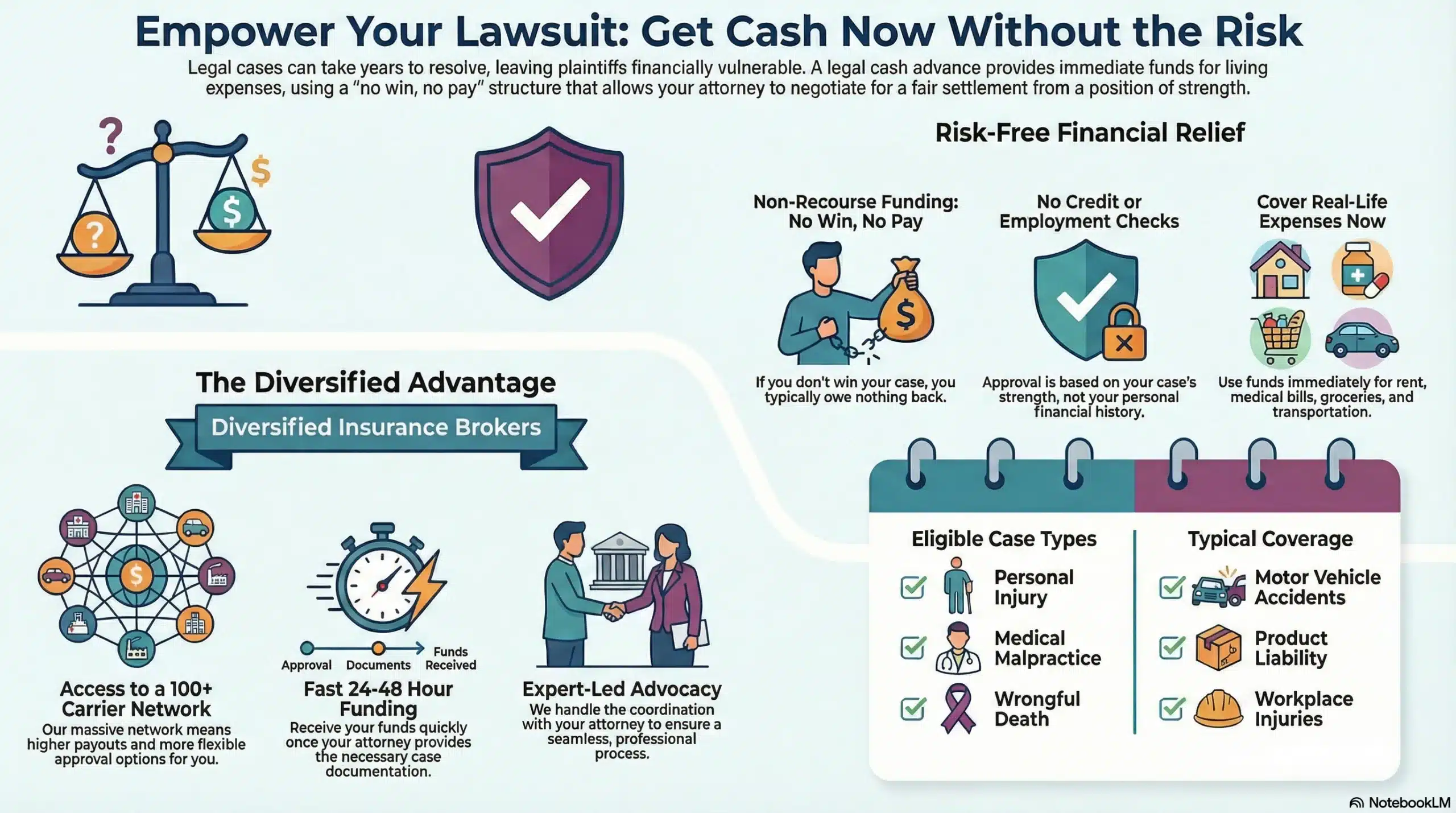
Most lawsuit settlement advances are structured as non-recourse legal funding rather than traditional loans. The defining distinction is that repayment is contingent on recovery — if your case does not produce a settlement or verdict, you generally do not owe repayment. A traditional loan creates an unconditional repayment obligation regardless of case outcome. The non-recourse structure shifts the case risk to the funding company in exchange for fees that accrue during the period the advance is outstanding. Our resource on what is pre-settlement funding covers how this structure works and what “non-recourse” means in the funding agreement.
Are there credit checks or employment requirements?
Generally no. Legal funding underwriting is case-based, not credit-based. The funding company evaluates the strength and expected value of the legal claim — not the plaintiff’s credit score, employment status, or income history. Because repayment comes from settlement proceeds rather than personal income, personal financial profile is not a primary factor in approval decisions. This makes settlement advances accessible to plaintiffs who have been out of work due to their injury and whose credit may have been affected by the financial disruption of litigation. Our resource on how pre-settlement funding works covers the full underwriting process and what case factors matter most.
How fast can I receive money after applying?
For post-settlement advances — where a settlement agreement is already signed and funds are in processing — approvals can often move more quickly because the outcome amount is more defined and underwriting is less complex. For pre-settlement advances, timing depends heavily on how quickly the attorney’s office can provide the documentation the funder needs. Cases with organized files and responsive attorneys can receive approval decisions within days; cases requiring extensive documentation gathering take longer. Funds are typically delivered by ACH or wire after agreement execution. Our resource on lawsuit funding fast legal cash advances covers the timeline factors across different case and funding stages.
How much can I qualify for from a settlement advance?
The available amount depends on the anticipated net recovery — the expected gross settlement minus attorney fees, medical liens, case costs, and any existing advances. Funding companies advance a conservative portion of the anticipated net to ensure the plaintiff still receives meaningful proceeds when the case closes. At the pre-settlement stage, this requires estimating a settlement range; at the post-settlement stage, the amount is more defined. Requesting only what is genuinely needed — rather than the maximum technically available — directly protects your future net recovery since accrued costs reduce net proceeds. Our resource on how much can you get from pre-settlement funding covers the factors that determine advance amounts across different case types and stages.
Does my attorney need to be involved?
Yes — attorney involvement is required and cannot be bypassed. The attorney provides the case documentation the funder needs to evaluate the claim, signs an acknowledgment of the funding arrangement, and coordinates repayment from settlement proceeds held in trust when the case concludes. For post-settlement advances specifically, the attorney’s confirmation of the settlement amount, estimated lien resolution timeline, and expected disbursement date is critical to the underwriting review. The attorney’s active cooperation — not just awareness — is the primary factor that determines how quickly the funding process proceeds. Our resource on get cash before lawsuit settles covers attorney coordination at the settlement stage in practical terms.
What types of cases commonly qualify for a settlement advance?
Most personal injury cases where the plaintiff is represented by an attorney working on contingency are eligible for evaluation — auto accidents, commercial truck accidents, premises liability, product liability, catastrophic injury, and wrongful death cases. Medical malpractice cases may qualify but typically require more selective underwriting due to complexity and longer timelines. Our resource on medical malpractice lawsuit funding covers the settlement-stage funding dynamics for this specific case type. Cases with disputed liability, minimal insurance coverage, or inconsistent medical treatment may have limited funding availability regardless of case type.
How do repayment and fees work on a settlement advance?
Repayment comes from settlement proceeds when the case concludes — typically coordinated through the attorney’s trust account. The repayment amount includes the original advance plus fees and charges that have accrued from the date of the advance to the date of repayment. Fee structures vary by provider and case type, and costs grow the longer the advance is outstanding. Before signing any agreement, request a clear schedule showing total repayment amounts at 12, 24, and 36 months so you understand how the cost changes with different case timelines. Our resource on pros and cons of pre-settlement funding covers the full cost framework and what to look for in an agreement before committing.
What’s the difference between a pre-settlement and post-settlement advance?
A pre-settlement advance is requested while the case is still active and a settlement has not yet been reached — the funder evaluates case strength and anticipated recovery to determine what advance is appropriate. A post-settlement advance is requested after a settlement agreement has been signed but before funds are received, due to delays from lien resolution, court approvals, insurer processing, or structured settlement paperwork. Post-settlement advances typically benefit from faster underwriting since the recovery amount is more defined, while pre-settlement advances require more detailed case evaluation under greater outcome uncertainty. Our resource on legal funding structures covers both structures in full detail.
Can multiple advances reduce my final settlement net proceeds?
Yes — each advance plus its accrued costs must be repaid from settlement proceeds, reducing the net amount the plaintiff receives. Multiple advances compound this effect, and because costs accrue on each advance independently, the cumulative repayment obligation can grow significantly on longer-timeline cases. The most financially protective strategy is to use a single, appropriately sized advance that solves the specific problem rather than stacking advances that collectively consume a large portion of net proceeds. Evaluate whether each additional funding request is genuinely necessary and what the cumulative cost impact will be at realistic case resolution timelines. Our resource on is pre-settlement funding worth it provides the evaluation framework for this decision.
Will getting a settlement advance affect my case negotiations?
Legal funding does not change the facts of your case — liability, damages, and the expected settlement range remain what the evidence supports. However, financial stability that removes pressure to accept a lower offer can indirectly benefit negotiations by allowing your attorney to pursue full case value without urgency created by the plaintiff’s financial distress. The risk runs the opposite direction too: large advances that create a significant repayment obligation can create pressure to settle sooner at a lower amount to preserve sufficient net proceeds after repayment. Responsible, targeted funding amounts that solve a specific need without over-advancing help maintain negotiating flexibility. Our resource on settlement funding covers how to balance these considerations.
About the Author:
Jason Stolz, CLTC, CRPC, DIA, CAA and Chief Underwriter at Diversified Insurance Brokers (NPN 20471358), is a senior insurance and retirement professional with more than 25 years of real-world experience helping individuals, families, and business owners protect their income, assets, and long-term financial stability. As a long-time partner of the nationally licensed independent agency Diversified Insurance Brokers, Jason provides trusted guidance across multiple specialties—including fixed and indexed annuities, long-term care planning, personal and business disability insurance, life insurance solutions, Group Health, Travel Medical and Evacuation Insurance, and short-term health coverage. Diversified Insurance Brokers maintains active contracts with over 100 highly rated insurance carriers, ensuring clients have access to a broad and competitive marketplace.
His practical, education-first approach has earned recognition in publications such as VoyageATL, and contributions from his agency featured in Kiplinger and GoBankingRates— highlighting his commitment to financial clarity and client-focused planning. Drawing on deep product knowledge and years of hands-on field experience, Jason helps clients evaluate carriers, compare strategies, and build retirement and protection plans that are both secure and cost-efficient. Visitors who want to explore current annuity rates and compare options across multiple insurers can also use this annuity quote and comparison tool.
Explore All Lawsuit Loan & Legal Funding Options: Browse our complete guide to Lawsuit Loans & Legal Funding — covering pre-settlement funding, lawsuit cash advances, injury claims & more.
Last Reviewed: May 25, 2026 |
Reviewed by: Jason Stolz, CLTC, CRPC, DIA, CAA
Chief Underwriter, Diversified Insurance Brokers, Inc. | NPN: 20471358 | Diversified Insurance Brokers, Inc. — Licensed in all 50 states
Fact Checked by: Tonia Pettitt, CMIP©
Medicare Specialist, Diversified Insurance Brokers, Inc. | NPN: 14374308 | Diversified Insurance Brokers, Inc. — Licensed in all 50 states
Did you find this content helpful? Leave us a Google review — it helps others find trustworthy guidance too.
Editorial Standards: Diversified Insurance Brokers maintains rigorous editorial standards to ensure accuracy, clarity, and independence in all content. Learn more about our editorial standards and commitment to transparency.
