
Personal Injury Lawsuit Loan – Fast & Risk-Free Funding
Personal Injury Lawsuit Loan – Fast & Risk-Free Funding

Jason Stolz CLTC, CRPC, DIA, CAA
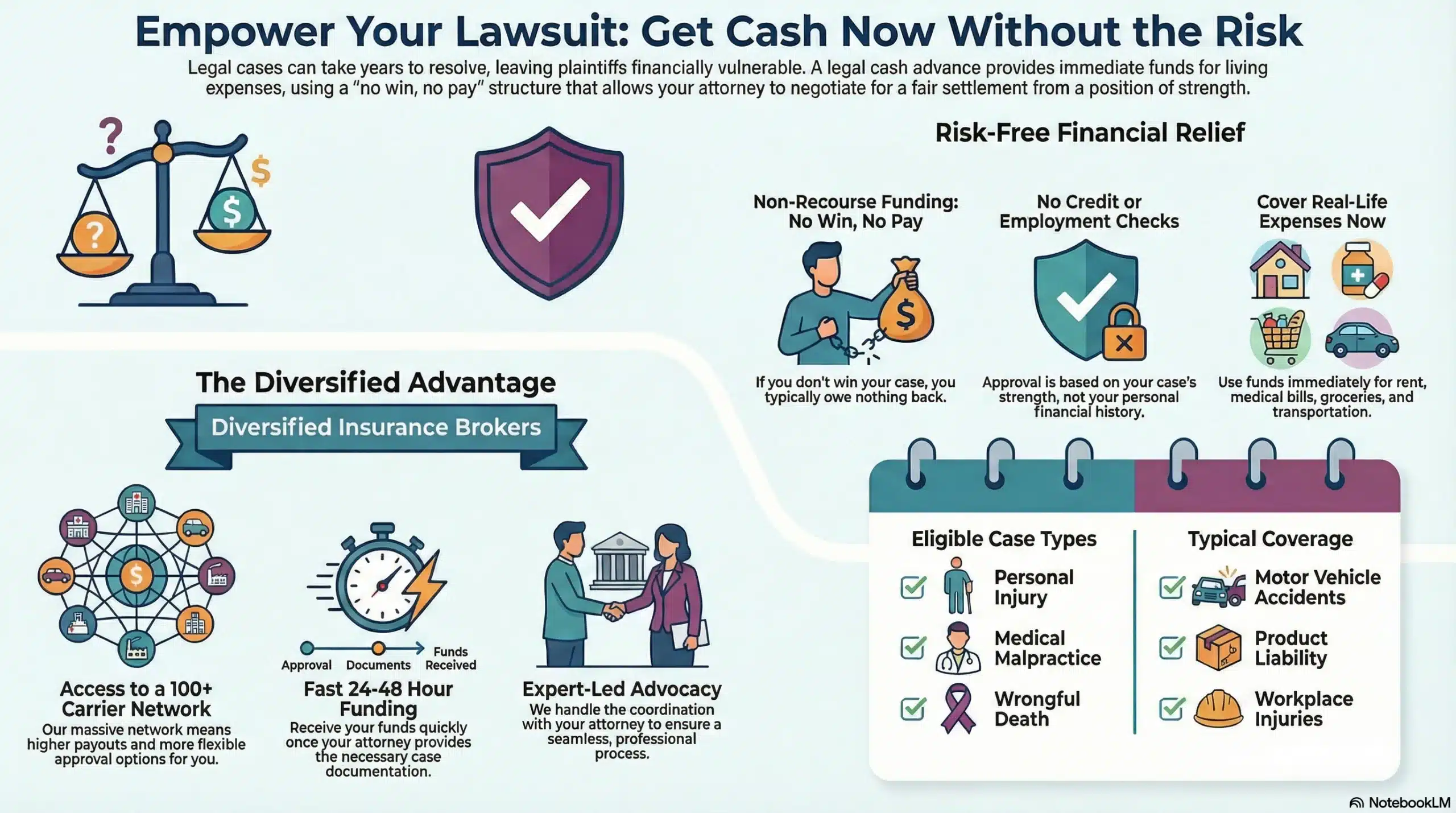
If you’ve been injured in an accident, medical bills, rent, and daily living expenses don’t pause while your attorney builds your case and the legal system takes its time. A personal injury lawsuit loan — more accurately described as pre-settlement funding or a non-recourse cash advance — can provide the financial breathing room you need while you wait for your case to resolve. This type of funding gives you immediate access to a portion of your expected future settlement, typically without monthly payments, credit checks, employment verification, or upfront fees. You repay only if your case results in a recovery. If you lose, you generally owe nothing under a true non-recourse agreement.
Even when liability is clear and the facts strongly support your claim, the legal timeline moves slowly by design. Medical treatment takes months. Records compilation and expert review take additional time. Insurance adjusters use delay as a deliberate strategy — they understand that financial pressure on injured plaintiffs often produces early, undervalued settlements. Court calendars create scheduling bottlenecks that can push resolution out further than anyone initially expects. Meanwhile, the accident you didn’t cause may have taken you out of work, generated thousands in out-of-pocket medical expenses, and forced financial decisions at exactly the worst possible time. Pre-settlement funding addresses this directly — it supports you during the waiting period so you can make legal decisions based on what your case is worth rather than what your bank account urgently needs.
Apply for a Personal Injury Lawsuit Loan
Fast approvals, high payouts, and no repayment if you lose your case.
Questions? Call 800-533-5969
What Is a Personal Injury Lawsuit Loan?
A personal injury lawsuit loan is generally not a traditional loan in the conventional sense. It is typically structured as a non-recourse cash advance against your pending settlement or judgment. “Non-recourse” is the critical term — it means that repayment is conditioned on a successful case outcome. If your case does not settle or result in a judgment in your favor, you generally owe nothing on the advance, provided your agreement clearly and explicitly states the non-recourse condition. Before accepting any funding offer, confirm in writing that your agreement is truly non-recourse and understand exactly what conditions trigger repayment obligation.
Because underwriting decisions focus on the strength of your case rather than your personal financial profile, most funding approvals are based on the merits and expected value of your claim. Credit scores, employment history, income level, and personal collateral are generally not factors in the approval decision. The case is the primary underwriting basis — the strength of liability, the extent of documented damages, the available insurance coverage, and the realistic expected recovery. This is what makes pre-settlement funding accessible to injured plaintiffs who may be unemployed due to their injuries and whose credit has suffered precisely because the accident disrupted their ability to work and pay bills.
The terminology around this product varies across the industry. Lawsuit loan, legal funding, pre-settlement funding, settlement advance, cash advance on a lawsuit, and litigation funding all refer to variations of the same fundamental concept: you receive money now based on your expected future recovery, and repayment typically comes from settlement proceeds when the case resolves. The terms and structure of individual agreements can vary, which is why reading the specific contract carefully — and having your attorney review it — is an important step before accepting any offer.
How Pre-Settlement Funding Works: Step by Step
The process is designed to be straightforward and attorney-coordinated. Because funding decisions are based on case strength rather than credit, attorney involvement and case documentation are essential to the review process. Here is how the process typically moves from application to funding.
Step 1 — Application. You submit a basic application that includes information about your case, the nature of your injury, and your attorney’s contact information. The application itself requires minimal information from you — the bulk of the underwriting documentation comes from your attorney’s office.
Step 2 — Attorney coordination. The funding provider contacts your attorney directly to confirm representation and request the case documentation needed for underwriting review. This typically includes a signed authorization for case review, incident details and accident information, confirmation of insurance coverage information when applicable, medical records or treatment summaries documenting your injuries and the ongoing care you are receiving, and information about any known liens that might affect your eventual net recovery.
Step 3 — Case review and underwriting. Underwriters evaluate the documentation to assess liability, the strength and extent of your documented damages, the available insurance or other sources of recovery, any liens or obligations that will reduce net proceeds, and the expected timeline for case resolution. This evaluation determines whether the case qualifies and what funding amount is supportable given the expected recovery.
Step 4 — Offer presentation. If the case qualifies, you receive a clear offer that discloses the funding amount, the applicable costs and how they are structured, and the repayment terms. You and your attorney should review this carefully before accepting. There is no obligation to accept any offer, and understanding the full economics of the agreement before signing is the responsible approach.
Step 5 — Agreement and funding. Once agreements are signed and attorney documentation is verified, funds are typically issued quickly — in many cases within 24 to 48 hours after the file is complete. The speed of this final step depends heavily on attorney responsiveness. Cases where the attorney’s office provides documentation promptly and communicates efficiently with the funding provider move significantly faster than cases where documentation requests go unanswered for days.
Why Injured Plaintiffs Use Pre-Settlement Funding
Most people who apply for lawsuit funding are not doing so because they want to take on an additional financial obligation. They are applying because the accident they didn’t cause created urgent financial pressure while the legal process that will eventually compensate them moves on a timeline that doesn’t account for their monthly bills. The decision to pursue funding is almost always driven by specific, immediate financial needs that cannot wait for the case to resolve.
The most common reasons injured plaintiffs seek pre-settlement funding include paying rent or mortgage obligations to avoid eviction or foreclosure during recovery; keeping utility accounts active when income has been interrupted by the inability to work; covering transportation costs and car payments when the accident has also disrupted vehicle access; managing medical bills, prescription costs, and out-of-pocket treatment expenses not covered by insurance; replacing lost wages for workers whose injuries prevent them from returning to their jobs; and supporting family members who depend on the injured person’s income for household stability.
The most strategically important benefit of pre-settlement funding is the one that is least obvious from the outside: it can directly affect the quality of your legal outcome by reducing the pressure to accept an early, undervalued settlement. Insurance companies are sophisticated adversaries in the claims process. They understand exactly how financial pressure affects plaintiff decision-making, and their claims management strategies explicitly account for it. Delay is a deliberate tactic — the longer a financially stressed plaintiff waits, the more likely they are to accept a settlement that reflects their immediate desperation rather than the actual value of their case. Pre-settlement funding interrupts that dynamic by removing the urgent financial pressure that makes premature settlement seem necessary. When your bills are covered and your household is stable, you and your attorney can focus on pursuing the recovery your case actually warrants rather than the first number that appears on the table.
Types of Personal Injury Cases Commonly Funded
Pre-settlement funding is most commonly available for civil personal injury cases where liability is reasonably clear, damages are documented, and there is a realistic expectation of settlement or judgment recovery. The specific cases that qualify span a broad range of personal injury categories.
Motor vehicle accidents — including car accidents, truck and commercial vehicle accidents, motorcycle accidents, rideshare accidents, and pedestrian and bicycle accidents — represent the largest category of funded cases. Vehicle accident cases typically have relatively clear liability documentation through police reports, witness statements, and traffic evidence; defined insurance coverage from the at-fault driver’s policy; and documented medical damages from emergency treatment and ongoing injury care. These factors make vehicle accident cases among the more straightforward cases for funding underwriters to evaluate.
Slip and fall and premises liability cases — where a property owner’s negligence produced a hazardous condition that caused an injury — are commonly funded when liability documentation is available and damages are significant. These cases require more careful evaluation of liability because the legal standard for premises liability is more nuanced than vehicle accident liability, but strong documentation of the hazard, the fall, and the resulting injuries produces fundable cases in this category.
Workplace accident cases are funded depending on the structure of the claim. Workers’ compensation claims alone are generally more limited for pre-settlement funding purposes than third-party liability claims arising from workplace accidents. When a workplace injury also involves a negligent third party — a manufacturer of defective equipment, a contractor whose negligence caused the accident, or another party separate from the employer — the third-party claim may qualify for funding even when the workers’ compensation portion does not. Our resource on workers’ comp settlement loans covers the specific considerations for workplace injury funding in more detail.
Medical malpractice cases are funded on a case-by-case basis. Medical malpractice cases are typically more complex than vehicle accident cases — requiring expert medical testimony, longer litigation timelines, and more intensive documentation of the breach of standard of care and the causal relationship between that breach and the resulting injury. These factors can affect fundability and the terms of any offer, but strong medical malpractice cases with clear expert support and documented significant damages do qualify for pre-settlement funding.
Defective product injury claims — where a manufactured product’s design defect, manufacturing defect, or failure to warn caused an injury — are eligible for funding review. Product liability cases can involve significant damages and sophisticated defendants, making the funding evaluation particularly focused on the strength of the liability theory and the available documentation of causation.
Eligibility for any specific case always depends on the individual case details. Underwriters evaluate each case individually based on the factors described below. Our related resource on injury lawsuit cash advances provides additional context on the funding process for different injury case types.
How Funding Amounts Are Determined
Funding amounts are determined by what underwriters assess as the likely recovery range for the specific case and the appropriate funding level relative to that expected recovery. Providers do not simply offer the maximum possible advance — responsible funding decisions are measured rather than maximum, because settlement proceeds must also cover attorney fees, medical liens, case costs, and other obligations before any net amount reaches the plaintiff. An advance that consumes too large a share of the expected recovery creates problems at settlement time, which is why careful underwriting and conservative advance sizing are in both parties’ interest.
The factors that underwriters evaluate when determining a funding amount include the clarity and strength of liability evidence, the extent and quality of medical documentation supporting the injury and damages claim, the available insurance coverage or other collectible sources of recovery, the current stage of the case in the legal process and the expected timeline to resolution, any existing liens — including medical liens, healthcare provider liens, Medicare or Medicaid liens, and prior funding — that will reduce net proceeds at settlement, and the attorney’s assessment of the case value and settlement expectations.
Cases with strong liability evidence, significant documented damages, adequate insurance coverage, and no complicating lien structure generally qualify for larger advances relative to expected recovery. Cases with disputed liability, limited insurance, significant medical liens, or early-stage uncertainty are typically funded more conservatively if they qualify at all. The most responsible outcome is an advance that covers genuine financial needs while preserving the plaintiff’s ability to net meaningful proceeds from their eventual settlement.
What Your Attorney Needs to Provide
Attorney involvement is not optional in the pre-settlement funding process — it is a structural requirement. Because underwriting is based on the case rather than the plaintiff’s personal financial profile, the case documentation that enables accurate evaluation comes from the attorney’s file. Funding providers that do not require attorney participation are a red flag, not a convenience.
Documentation that funding providers typically request from the attorney’s office includes: a signed authorization allowing the funding provider to review case materials; basic incident and accident details describing how the injury occurred; confirmation of the attorney-client representation relationship; insurance carrier information and policy limits when known; medical records or treatment summaries documenting the nature and extent of the injuries and the ongoing course of treatment; information about any known medical liens, government liens, or other obligations that will affect net proceeds; and in some cases, demand packages or settlement communication already underway that provide context on case status and value.
The completeness and promptness of attorney documentation is the single biggest variable in funding speed. An organized attorney’s office that responds to funding provider requests quickly and provides complete documentation can often move a case from application to funded status within 24 to 48 hours after the file is complete. An attorney’s office with delayed or incomplete responses to documentation requests can extend the same process to days or weeks. When speed matters — and for financially stressed injured plaintiffs, it almost always matters — attorney responsiveness is the critical path item.
Understanding the Costs: What You Should Know Before You Accept
Pre-settlement funding has costs — and understanding those costs fully before accepting any offer is essential. The costs typically take the form of a funding fee that accrues over time, often expressed as a flat percentage per period or as a compounding rate. Because personal injury cases can take months to years to resolve, the total cost of funding depends significantly on how long the case takes to settle after the advance is issued. A case that settles in four months produces a very different total repayment obligation than the same advance held for eighteen months.
Before accepting any pre-settlement funding offer, you should understand exactly what the total repayment obligation would be at different case resolution timelines — what you would owe if the case settles in six months, twelve months, eighteen months, and twenty-four months. A legitimate funding provider will provide this information clearly and in writing before you sign any agreement. If a provider is unwilling to disclose the full cost structure clearly and in advance, that is a significant warning sign.
Your attorney should review any funding agreement before you sign it. Your attorney can help you assess whether the funding cost structure is reasonable relative to the expected case value, whether the repayment obligation is structured in a way that will leave you with meaningful net proceeds at settlement, and whether the agreement’s terms are consistent with your jurisdiction’s legal funding regulations. This review step is worth taking even when urgency is real — understanding what you are agreeing to before you sign protects you more than speed does.
Protect Your Household While Your Case Is Pending
Pre-settlement funding addresses the immediate cash flow gap created by an injury and a pending lawsuit. But the disruption that a serious personal injury creates often extends beyond the immediate financial emergency — it can affect your household’s broader financial protection picture in ways that a lawsuit advance alone does not address. Several types of coverage are particularly relevant for injured plaintiffs managing their households through a pending legal matter.
Short-term health insurance can provide coverage during gaps in employer-sponsored health coverage that often occur when an injury prevents return to work and employer benefits lapse. Injury-related medical costs are already significant — managing them without health coverage during a coverage gap makes an already difficult situation worse.
High-risk disability insurance protects ongoing income if the injury affects your long-term ability to work — addressing the income replacement need that extends beyond the immediate recovery period and that a lawsuit settlement, whenever it arrives, may not fully address depending on the case structure and damages calculation.
Accidental death coverage provides financial protection for your family in the most severe outcome scenarios, and life insurance provides the longer-term family financial security that addresses the income dependence your household has on your continued health and earning capacity. The time around a serious injury — when the vulnerability of your household’s financial position is most apparent — is often the moment that clarifies why these protection layers matter.
Why Work With Us
We have access to a significant pool of legal funding capital, which allows us to compare offers and pursue competitive terms for qualifying cases rather than presenting a single take-it-or-leave-it offer. Our process is designed to be efficient and attorney-friendly — we coordinate directly with your legal team, minimize paperwork friction, and move cases through review as quickly as complete documentation allows.
Speed matters when someone is managing the financial stress of a serious injury. But structure matters just as much. Accepting funding without fully understanding the cost structure, the repayment mechanics, and the non-recourse terms can create complications at settlement time that reduce the net benefit of the advance. Our focus is on clear communication, direct coordination with your attorney’s office, transparent disclosure of all costs and terms, and making sure you understand exactly what you are agreeing to before any agreement is signed.
Get Your Funds Quickly
Apply today and get funded as fast as the same or next business day once attorney documentation is verified. No credit check. No monthly payments. No repayment if you lose.
Questions? Call 800-533-5969
Protect Your Household While Your Case Is Pending
Insurance and financial protection resources for injured plaintiffs managing household finances during a pending lawsuit.
Related Pages
Explore related legal funding options and settlement-advance resources.
Talk With an Advisor Today
Choose how you’d like to connect—call or message us, then book a time that works for you.
Schedule here:
calendly.com/jason-dibcompanies/diversified-quotes
Licensed in all 50 states • Fiduciary, family-owned since 1980
Personal Injury Lawsuit Loan: Frequently Asked Questions
What is a personal injury lawsuit loan and how is it different from a traditional loan?
A personal injury lawsuit loan — also called pre-settlement funding or a non-recourse cash advance — is not a traditional loan in the conventional sense. In a traditional loan, repayment is required regardless of outcome: you borrow money, and you owe it back with interest no matter what happens. A non-recourse lawsuit advance works differently: repayment is conditioned on a successful case outcome. If your case resolves in your favor through settlement or judgment, the advance plus applicable funding costs are repaid from those proceeds. If your case does not result in a recovery, you generally owe nothing under a true non-recourse agreement.
The other major structural difference is underwriting: traditional loans are underwritten based on your personal financial profile — credit score, income, employment, collateral. Lawsuit advances are underwritten based on the strength and expected value of your case. Your credit history, employment status, and personal assets are generally not factors in the approval decision. This makes pre-settlement funding accessible to injured plaintiffs who may be out of work due to their injuries and whose credit has suffered precisely because the accident disrupted their ability to earn and pay bills. Before accepting any funding offer, confirm in the contract language that the agreement is truly non-recourse and understand exactly what conditions trigger repayment.
Which types of personal injury cases qualify for pre-settlement funding?
Pre-settlement funding is most commonly available for civil personal injury cases where liability is reasonably clear, damages are documented, and there is a realistic expectation of settlement or judgment. The most commonly funded case types include motor vehicle accidents — car, truck, commercial vehicle, motorcycle, rideshare, and pedestrian — which represent the largest category of funded cases due to their typically clear liability documentation and defined insurance coverage. Slip and fall and premises liability cases qualify when liability documentation is strong and damages are significant. Workplace accident cases involving third-party liability claims (rather than or in addition to workers’ compensation) may qualify — our resource on workers’ comp settlement loans covers the specific considerations for injury at work cases.
Medical malpractice cases are funded on a case-by-case basis — these require expert testimony and tend to have longer litigation timelines, which affects fundability and terms, but strong cases with clear expert support do qualify. Defective product injury claims involving documented causation between a manufactured product and a significant injury are also eligible for review. Eligibility for any specific case depends on the individual facts, documentation, and the underwriting assessment of case strength and expected recovery. Our related resource on injury lawsuit cash advances provides additional context on the funding process across different case types.
How soon can I receive funds after applying?
Many applicants receive funds within 24 to 48 hours after attorney documentation is provided and the funding agreement is signed. The timeline from application to funded status depends almost entirely on how quickly your attorney’s office provides the documentation that underwriters need to evaluate the case — incident details, medical records or treatment summaries, insurance information, and confirmation of representation. When an attorney’s office is responsive and provides complete documentation promptly, cases can move from initial application to funded status in a single business day in some situations.
The most common source of delay in the funding process is not the underwriting itself — it is waiting for attorney documentation. If speed is a priority, the most effective thing you can do is notify your attorney that you are pursuing funding, ask them to respond promptly to the funding provider’s documentation requests, and confirm that the information they provide is complete. An organized attorney’s office that engages proactively with the funding provider will almost always produce a faster outcome than one that responds to documentation requests slowly or incompletely.
Do I owe anything if I lose my case?
Under a true non-recourse funding agreement, you generally do not repay the advance if your case does not result in a settlement or judgment in your favor. This is the defining feature that distinguishes pre-settlement funding from a conventional loan — the repayment obligation is conditional on a successful case outcome rather than unconditional. If your case is dismissed, you lose at trial, or the case otherwise fails to produce a recovery, your repayment obligation is extinguished under a properly structured non-recourse agreement.
The critical qualifier is “true non-recourse agreement.” Not all legal funding agreements are structured identically, and the non-recourse nature of any specific agreement must be confirmed in the contract language rather than assumed based on verbal representations or marketing descriptions. Before signing any funding agreement, confirm in writing that the agreement explicitly states the non-recourse condition — that your personal assets, credit, and income are not at risk if the case does not recover. Having your attorney review the agreement before you sign it is strongly recommended, both to confirm the non-recourse terms and to evaluate whether the overall cost structure is reasonable relative to your expected case value.
What does my attorney need to provide, and do they need to be involved?
Attorney involvement is a structural requirement of the pre-settlement funding process — it is not optional. Because funding decisions are based on the strength and expected value of your case rather than your personal financial profile, the case documentation that enables accurate underwriting evaluation comes from your attorney’s file. Funding providers that do not require attorney participation or verification are a significant warning sign, not a convenience feature.
Documentation that funding providers typically request from the attorney’s office includes: a signed authorization allowing the funding provider to review case materials; basic incident details describing how the injury occurred; confirmation of attorney-client representation; insurance carrier information and policy limits when known; medical records or treatment summaries documenting the nature and extent of injuries; and information about any known medical liens, Medicare or Medicaid liens, or prior funding that will affect net proceeds at settlement. In some cases, providers also review demand packages or settlement communications already underway. The more complete the documentation your attorney provides, the more accurately underwriters can evaluate your case and the faster the approval process moves.
What costs and fees are associated with pre-settlement funding?
Pre-settlement funding carries costs that accrue over the time your case is pending after the advance is issued. These costs are typically structured as a funding fee expressed as a flat percentage per period or as a compounding rate — and because personal injury cases can take months to years to resolve, the total amount owed at repayment depends significantly on how long it takes for your case to settle or reach judgment after you receive the advance. An advance held for four months produces a meaningfully lower total repayment than the same advance held for twenty months.
Before accepting any offer, you should receive a clear, written disclosure of the cost structure showing what you would owe at different resolution timelines — for example, what the total repayment is if the case settles in six months, twelve months, eighteen months, and twenty-four months. A legitimate funding provider will provide this information transparently before any agreement is signed. If a provider is unwilling to clearly disclose the full cost structure in advance, that is a significant warning sign. Your attorney should review the funding agreement before you sign it to confirm that the cost structure is reasonable relative to your expected case value and that the repayment obligation will leave you with meaningful net proceeds at settlement.
Will getting a lawsuit loan affect my credit score or require employment verification?
In most cases, no. Because pre-settlement funding is underwritten based on the strength and expected value of your case rather than your personal financial profile, credit checks, employment verification, income documentation, and personal collateral are generally not part of the approval process. Your credit score, employment status, and personal assets are typically not factors in determining whether you qualify or how much funding you receive. This is one of the most important practical distinctions between lawsuit funding and a traditional personal loan or line of credit.
This structure makes pre-settlement funding accessible to the injured plaintiffs who most need it — people who are out of work because of their injuries, whose credit has been affected by the financial disruption the accident caused, and who would not qualify for traditional credit on favorable terms precisely because the accident disrupted their financial life. The case is the primary qualification factor, not the plaintiff’s personal financial history. Most funding decisions are based entirely on the liability evidence, documented damages, insurance coverage, and expected recovery value of the specific claim being evaluated.
Can pre-settlement funding help me avoid a low settlement offer?
It can — and this is one of the most strategically significant benefits of lawsuit funding, even though it is less obvious than the immediate cash flow relief. Insurance companies understand that financial pressure on injured plaintiffs is one of the most powerful tools available to them in claims management. When an injured person is behind on rent, cannot pay medical bills, and needs cash urgently, the pressure to accept whatever settlement number is on the table — regardless of whether it reflects the actual value of the case — is intense and real. This is not accidental. Insurance claim strategies explicitly account for plaintiff financial pressure as a factor that produces early, undervalued settlements.
Pre-settlement funding interrupts this dynamic. When your immediate financial obligations are covered and your household is stable, you and your attorney are no longer forced to evaluate settlement offers through the lens of urgent personal financial desperation. You can focus on what the case is actually worth — based on the liability evidence, the documented damages, the applicable law, and the realistic range of outcomes — rather than accepting the first number that provides temporary relief. This shift in negotiating position is real and documented: plaintiffs who are not under acute financial pressure consistently achieve better settlement outcomes than those who are. Pre-settlement funding is not a guarantee of a better outcome, but it removes one of the most powerful tools insurance companies use to produce premature settlements at below-value terms.
Is pre-settlement funding available in all states?
Availability varies by state and case type. Legal funding is regulated differently across jurisdictions — some states have specific statutes governing lawsuit lending, others regulate it under existing consumer finance laws, and some have no specific legislation addressing it directly. These regulatory differences can affect what products are available in a given state, what disclosures are required, and what cost structures are permissible. Availability can also vary by case type within a state.
The most straightforward way to confirm availability for your specific situation is to apply and provide your state and case information — eligibility can be confirmed based on your jurisdiction, case type, and the specific circumstances of your claim. There is no cost and no obligation associated with submitting an application and receiving an eligibility determination. If funding is not available or appropriate for your specific situation, that determination is provided clearly so you can explore other options.
About the Author:
Jason Stolz, CLTC, CRPC, DIA, CAA and Chief Underwriter at Diversified Insurance Brokers (NPN 20471358), is a senior insurance and retirement professional with more than 25 years of real-world experience helping individuals, families, and business owners protect their income, assets, and long-term financial stability. As a long-time partner of the nationally licensed independent agency Diversified Insurance Brokers, Jason provides trusted guidance across multiple specialties—including fixed and indexed annuities, long-term care planning, personal and business disability insurance, life insurance solutions, Group Health, Travel Medical and Evacuation Insurance, and short-term health coverage. Diversified Insurance Brokers maintains active contracts with over 100 highly rated insurance carriers, ensuring clients have access to a broad and competitive marketplace.
His practical, education-first approach has earned recognition in publications such as VoyageATL, and contributions from his agency featured in Kiplinger and GoBankingRates— highlighting his commitment to financial clarity and client-focused planning. Drawing on deep product knowledge and years of hands-on field experience, Jason helps clients evaluate carriers, compare strategies, and build retirement and protection plans that are both secure and cost-efficient. Visitors who want to explore current annuity rates and compare options across multiple insurers can also use this annuity quote and comparison tool.
Explore All Lawsuit Loan & Legal Funding Options: Browse our complete guide to Lawsuit Loans & Legal Funding — covering pre-settlement funding, lawsuit cash advances, injury claims & more.
Last Reviewed: May 15, 2026 |
Reviewed by: Jason Stolz, CLTC, CRPC, DIA, CAA
Chief Underwriter, Diversified Insurance Brokers, Inc. | NPN: 20471358 | Diversified Insurance Brokers, Inc. — Licensed in all 50 states
Fact Checked by: Tonia Pettitt, CMIP©
Medicare Specialist, Diversified Insurance Brokers, Inc. | NPN: 14374308 | Diversified Insurance Brokers, Inc. — Licensed in all 50 states
Did you find this content helpful? Leave us a Google review — it helps others find trustworthy guidance too.
Editorial Standards: Diversified Insurance Brokers maintains rigorous editorial standards to ensure accuracy, clarity, and independence in all content. Learn more about our editorial standards and commitment to transparency.
