
Lawsuit Loans – Fast Funding with the Highest Payouts Available
Lawsuit Loans – Fast Funding with the Highest Payouts Available

Jason Stolz CLTC, CRPC, DIA, CAA
When you’re involved in a lawsuit, the wait for a settlement can put extraordinary financial pressure on your household — and that pressure doesn’t distribute itself evenly across the calendar. It arrives all at once, in the form of medical bills that need to be paid now, rent that’s due on the first of the month, car payments that don’t pause while your attorney builds your case, and the daily cost of living that continues at full speed while your legal matter moves at the pace of courts, insurance adjusters, and litigation schedules that have nothing to do with how urgently you need money. Lawsuit loans — more precisely called pre-settlement funding or legal funding — are a specific financial tool designed to give injured plaintiffs access to a portion of their expected settlement before the case resolves. The purpose is to bridge the financial gap between the moment your injury disrupts your income and the moment your case produces the recovery your attorney is working toward.
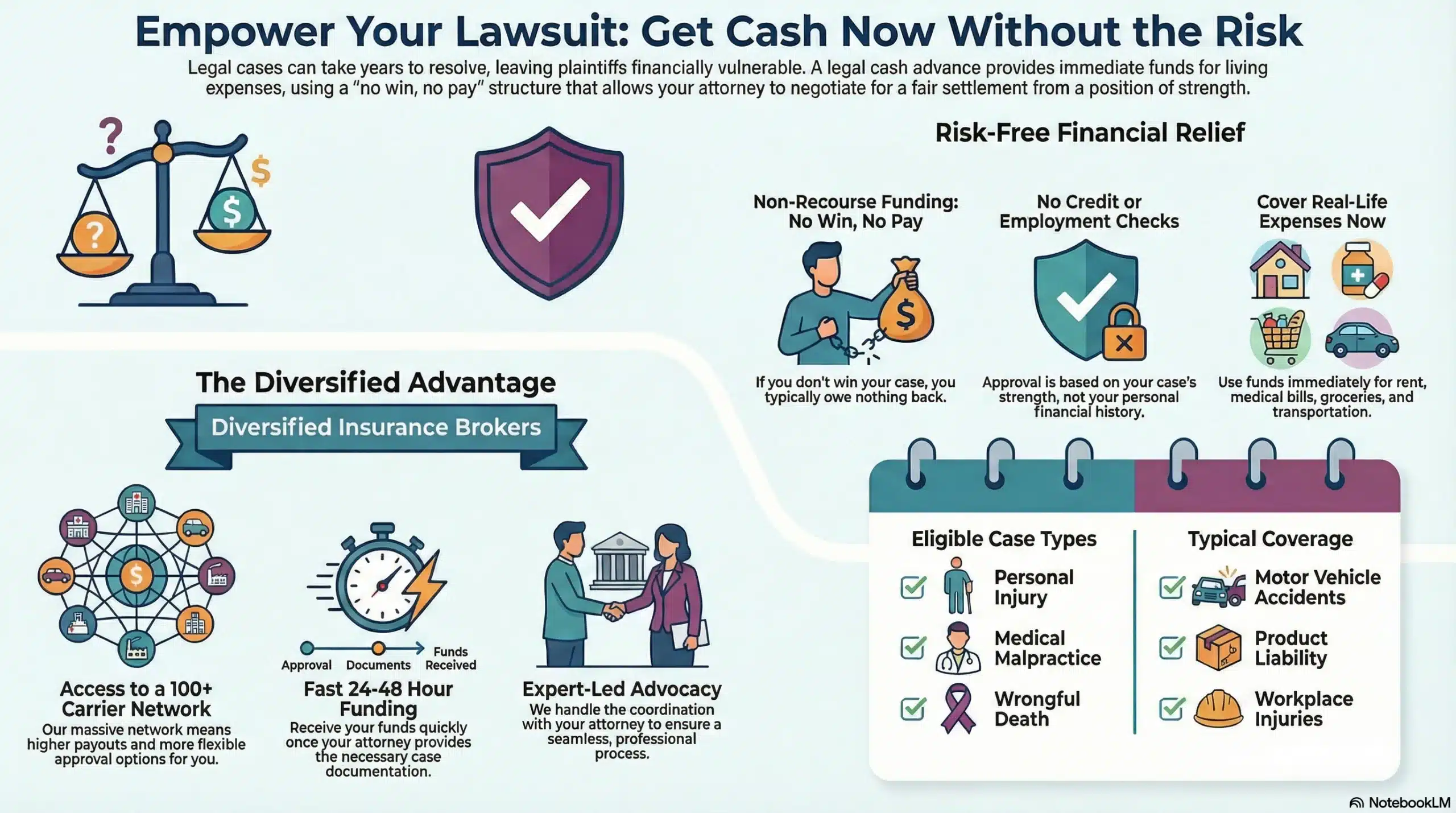
Understanding what lawsuit loans actually are — and equally important, what they are not — is the right starting point for anyone evaluating this option. In virtually all legitimate legal funding transactions, the advance is structured as a non-recourse cash advance, not a conventional loan. Non-recourse means repayment is conditioned on a successful case outcome. If your case produces a recovery through settlement or judgment, the advance plus applicable funding costs are repaid from those proceeds through your attorney’s trust account. If your case does not produce a recovery, you generally owe nothing under a properly structured non-recourse agreement. There are no monthly payments during the life of the case. There are no credit checks. There is no employment verification. The decision to fund is based entirely on the strength and expected value of your legal claim — not your personal financial profile.
We work with one of the largest legal funding networks in the country. That network access matters because it allows us to compare terms and push for competitive offers rather than presenting a single take-it-or-leave-it number. Plaintiffs who apply directly to a single funding company get that company’s pricing model and risk appetite. Plaintiffs who work with us get a comparison process that seeks the highest responsible advance at the most competitive terms available for their specific case type, jurisdiction, and timeline. Our process is attorney-friendly, documentation-based, and designed to move quickly once your attorney confirms the case details the underwriting team needs.
Apply for a Lawsuit Loan Today
Fast approvals, high payouts, and no repayment if you lose your case. We work with one of the largest funding networks in the country to get you the most competitive offer available.
Request a Lawsuit LoanQuestions? Call 800-533-5969
What Lawsuit Loans Are — and What They Are Not
The terminology around legal funding varies deliberately across the industry. Lawsuit loans, pre-settlement funding, litigation financing, legal cash advances, settlement advances — these terms are often used interchangeably in advertising and in conversation, and they all refer to the same essential structure: a cash advance to a plaintiff based on the anticipated value of a pending legal claim, repayable from settlement or judgment proceeds, with non-recourse protection eliminating repayment obligation if the case does not recover.
What lawsuit loans are not is equally important to understand. They are not personal loans from a bank or credit union. They are not payday loans with weekly repayment demands. They are not employer benefits or government assistance programs. They are not securities or investments. They are a private financial product designed specifically for plaintiffs in active legal matters who need access to funds while the legal process runs its course. Understanding this distinction shapes every aspect of how the product works — the approval process, the repayment structure, the cost model, and the timing of every step.
The non-recourse structure is the defining characteristic that separates legal funding from every other consumer financial product. When you take a personal loan, you owe the money back regardless of what happens to your circumstances. When you take a lawsuit advance under a properly structured non-recourse agreement, your obligation to repay is contingent on your case producing a recovery. The funding provider shares the risk of an unfavorable case outcome with you — which is why these advances carry higher costs than conventional loans, and why the provider must evaluate your case carefully before making an offer. Our resource on what pre-settlement funding is explains the full structure in detail, and our resource on pre-settlement funding vs. lawsuit loans addresses the terminology distinctions that come up in conversations with funders and attorneys.
How the Process Works From Application to Funded
The best legal funding experiences are fast, transparent, and attorney-coordinated. While every case and every funder operates somewhat differently, the fundamental sequence is consistent across the industry.
Application. You provide basic case information — the type of claim, where it’s pending, and your attorney’s contact information. The application itself is minimal because the substantive information that enables an underwriting decision comes from your attorney’s office, not from you. This means the most important variable in application speed is your attorney’s willingness to respond promptly and completely to the documentation requests that follow your submission.
Attorney verification and documentation. Once the application is received, the funding team contacts your attorney directly to confirm representation and request the case materials needed for underwriting. These typically include incident reports or accident documentation, medical records and treatment summaries confirming the nature and extent of injuries, medical billing establishing economic damages, insurance information including policy limits when known, and any demand packages or settlement communications already in progress. The attorney does not need to produce everything at once, but responsive and complete documentation from the attorney’s office is what moves a case from application to approved status quickly. Attorney cooperation is not optional in this process — it is the factual foundation on which every underwriting decision rests.
Case evaluation. Underwriters evaluate the documentation to assess liability clarity, the extent and quality of documented damages, available insurance coverage or other sources of recovery, existing liens and prior funding obligations that will reduce net proceeds at settlement, and the realistic expected timeline for case resolution. This evaluation determines both whether the case qualifies and what advance amount is appropriate given the expected net recovery. Responsible underwriting results in an offer sized to serve the plaintiff’s genuine immediate financial need — not a maximum-possible advance that will over-encumber the eventual settlement and produce regret when the case resolves.
Offer review and acceptance. If the case qualifies, you receive a clear written offer that discloses the advance amount and the full cost and repayment terms. This is the most important moment in the entire process to slow down rather than rush. Before signing anything, you should understand what you receive today, what you would owe at realistic case resolution timeframes — six months, twelve months, eighteen months, twenty-four months — whether costs are calculated simply or compound over time, and whether any fees reduce the net amount you receive at disbursement. Your attorney should review this agreement before you sign. The offer carries no obligation until you accept it, and nothing prevents you from asking questions or requesting modifications before acceptance.
Funds disbursed. Once agreements are signed and all documentation is verified, funds are sent — typically within 24 to 48 hours of file completion. The speed at this final stage depends on how quickly the attorney’s office provided complete documentation in the earlier steps. When an attorney’s office is organized and responsive, the entire application-to-funded timeline can be measured in days. When documentation requests encounter delays, the same process extends accordingly. Our resource on how lawsuit loans work covers the full mechanics from application through repayment at settlement.
Who Qualifies and What Drives Approval
Legal funding underwriting is case-based rather than applicant-based — which is the fundamental reason it can serve plaintiffs who cannot access conventional credit. Your credit score does not matter. Your employment history does not matter. Your income level does not matter. What matters is the legal merit and financial expectation of your pending claim. The core qualifying requirements are attorney representation and a case with a documented expectation of recovery.
Liability clarity and evidence strength is typically the primary factor in any underwriting decision. A case with clear liability evidence — a police report assigning fault, surveillance footage, multiple consistent eyewitness accounts, or an admission of responsibility from the at-fault party — is straightforward to evaluate and fund. A case where liability is disputed, evidence is conflicting, or the at-fault party’s negligence cannot be clearly documented is harder to fund because the primary risk the funder assumes — the risk that the case doesn’t recover — is elevated. Clear liability improves both approval probability and supportable advance amount.
Documented injuries and ongoing treatment establish the damages dimension of the underwriting evaluation. Medical records confirming the diagnosis and mechanism of injury, a treatment history showing the extent of care received, medical billing documenting economic damages, and in some cases medical opinion about permanence or long-term impact of the injury all contribute to this assessment. Cases with well-documented, significant injuries support larger advances than cases where injury documentation is minimal, treatment has been limited, or no treating physician has generated records establishing the nature and severity of the harm.
Available insurance coverage and collectability determine the realistic recovery ceiling that constrains responsible advance sizing. The strongest liability and damages case in the world is ultimately limited by available insurance coverage. An at-fault driver with minimum-limits coverage constrains recovery regardless of how severe the injuries are. Cases with commercial vehicle policies, umbrella policies, or self-insured defendants with substantial assets support larger advances because the recovery ceiling is higher and the collectability risk is lower.
Existing liens and prior funding reduce net proceeds available at settlement and must be accounted for in responsible advance sizing. Medical liens from treating providers, Medicare or Medicaid liens, healthcare facility liens, and any prior legal funding already outstanding all represent obligations that must be satisfied from settlement proceeds before the plaintiff receives net recovery. Underwriters estimate known lien totals when sizing advances to avoid creating a situation where the advance plus all other settlement obligations consumes the entire recovery.
Case timeline and current posture affect how the advance can be priced and evaluated. Cases that are well-documented, actively progressing, and approaching negotiation are easier to evaluate than cases in very early stages where treatment is ongoing, no demand has been sent, and the litigation timeline is genuinely uncertain. A longer expected timeline means the funding provider’s capital is at risk for a longer period before repayment, which affects the economics of the offer. Our resource on how much you can get from pre-settlement funding explains advance sizing mechanics across different case profiles.
Case Types We Fund
We provide funding for a broad range of personal injury and civil litigation case types. The following represent the most common qualifying categories, though eligibility always depends on the specific facts, documentation, and circumstances of the individual case rather than the category alone.
Motor vehicle accident cases — including car accidents, truck and commercial vehicle accidents, motorcycle accidents, rideshare accidents, and pedestrian and bicycle incidents — represent the largest single category of funded cases nationwide. These cases typically combine clear liability documentation through police reports and accident evidence, significant injury documentation through emergency room and follow-up medical care, and defined insurance coverage from the at-fault driver’s policy. The combination of documented liability, documented damages, and identifiable coverage makes them among the most straightforward cases for funding evaluation and approval. Our dedicated resource on car accident lawsuit loans covers the specific considerations for motor vehicle funding.
Personal injury cases spanning slip and fall, premises liability, product liability, and general negligence claims qualify when liability documentation and significant documented damages are present. Slip and fall cases require particular attention to liability documentation because the legal standard requires establishing that the property owner knew or should have known of the hazardous condition — which demands documentation beyond the fall event itself. Our resource on slip and fall lawsuit funding addresses premises liability cases specifically, and our resource on personal injury lawsuit loans covers the broader personal injury category.
Medical malpractice cases are fundable when expert medical support is in place and damages are significant, though the complexity of these cases — requiring expert testimony to establish breach of standard of care and causation, combined with longer litigation timelines — produces more conservative advance sizing and more extensive underwriting review than straightforward vehicle accident cases. Our resource on medical malpractice lawsuit funding explains the specific evaluation considerations.
Workplace injury cases involving third-party negligence — rather than the standard workers’ compensation framework — may qualify when a negligent party outside the employer-employee relationship is named as a defendant. Our resource on workers’ comp settlement loans explains the distinction between workers’ compensation claims and third-party liability claims and how each is approached in the funding context.
Wrongful death, wrongful termination, and product liability claims each qualify on a case-by-case basis depending on liability documentation strength and expected recovery. Our resources on wrongful death settlement loans and wrongful termination lawsuit loans cover the specific evaluation considerations for those case types.
Understanding the Cost Structure Before You Sign
The cost structure of legal funding is the most consequential thing to understand before accepting any offer — and it is also where plaintiffs most frequently make decisions they regret at settlement time. Legal funding is not priced like a bank loan with a simple annual percentage rate applied to a declining balance that predictably reduces with each payment. It is priced in ways that vary significantly by provider and that can produce dramatically different total repayment amounts depending on how long the case takes to resolve after the advance is issued.
Some providers use simple pricing — a flat rate applied to the original advance amount for each period (often monthly or semi-annually), regardless of how much time has passed. Under simple pricing, the cost per period does not increase as the case duration extends. If the monthly rate is 3% and the case settles in eight months, the total cost is approximately 24% of the advance. The predictability of simple pricing makes it easier to evaluate and compare offers across different timelines.
Other providers use compounding pricing — where costs are assessed on a growing balance that includes previously accrued costs rather than on the original advance amount. Under compounding structures, costs that accumulate in early months become part of the balance on which future costs are calculated, producing exponential growth in the total repayment obligation as the case duration extends. A case that takes 18 months under a compounding structure can produce a total repayment that is dramatically higher than the plaintiff anticipated when reviewing only the initial short-term payoff estimate. This is the most common source of settlement-time regret in the legal funding industry — plaintiffs who did not understand that costs were compounding and did not review the payoff at extended timelines before signing.
Before accepting any legal funding offer, you must know four things: the net amount you will actually receive at disbursement after any fees, what you would owe if the case resolves in six months, what you would owe if the case resolves in twelve months, and what you would owe if the case resolves in eighteen or twenty-four months. If the provider is unwilling to disclose the payoff at multiple realistic timeframes clearly and in writing before you sign, that is a significant warning sign. Your attorney should review the complete agreement and payoff schedule before you sign. Our resource on lawsuit loan rates and how to compare costs provides a detailed breakdown of pricing structures, and our resource on pros and cons of pre-settlement funding gives a balanced evaluation of when the cost is and is not justified by the situation.
Why Financial Pressure Affects Settlement Outcomes — and What Funding Changes
The most obvious reason plaintiffs seek legal funding is immediate financial need — bills that cannot wait for the case to resolve. Rent, utilities, car payments, groceries, childcare, and medical expenses continue on their normal schedules regardless of whether a lawsuit is pending. When a serious injury has reduced or eliminated the plaintiff’s ability to work, the financial pressure builds quickly and can reach crisis level within weeks — especially for people who had limited savings before the accident occurred and who are simultaneously dealing with reduced income and increased medical expenses.
But there is a second, less-discussed reason that funding can meaningfully affect a plaintiff’s outcome: negotiation leverage. Insurance companies that defend against personal injury claims are sophisticated institutions with claims management strategies built around a detailed understanding of plaintiff financial psychology. They know — because decades of claims experience have documented it — that financially stressed plaintiffs are more likely to accept early, undervalued settlement offers that provide immediate cash relief at the cost of long-term recovery adequacy. This is not cynicism. It is a documented pattern in claims management that defense practitioners openly acknowledge and that plaintiff attorneys work against constantly.
A plaintiff who cannot make next month’s rent is evaluating every settlement offer through the lens of urgent desperation. Whatever number is on the table feels attractive because it ends the financial emergency, regardless of whether it adequately compensates the actual harm. A plaintiff whose immediate financial obligations are covered is evaluating the same settlement offer through the lens of what the case is actually worth — the liability evidence, the documented damages, the comparable case outcomes their attorney can reference. This difference in evaluation frame is often what determines whether a settlement adequately compensates an injured person for what they actually suffered.
Legal funding removes the financial emergency component from the settlement evaluation equation. It does not change the law, the liability evidence, or the skill of the attorney. What it changes is the plaintiff’s ability to wait — to allow the case to develop fully, to reject inadequate early offers, and to evaluate settlement numbers based on case value rather than immediate financial survival. Our resource on whether pre-settlement funding is worth it evaluates this dynamic in the context of realistic case timelines and cost structures.
How to Use a Lawsuit Loan Strategically
The most important strategic principle for legal funding is this: borrow what you genuinely need for essential household stabilization, not as much as you can possibly qualify for. Every dollar advanced plus applicable costs reduces your eventual net recovery at settlement. The plaintiff who takes $15,000 when they genuinely need $8,000 to stabilize their household will owe repayment on $15,000 when the case resolves — and the difference between the two is pure net recovery loss. Funding is most useful and least regrettable when it is sized to the actual financial gap it needs to fill rather than the maximum the case can support.
Before applying, calculate your actual essential monthly obligations: housing, utilities, food, transportation, minimum debt service, health insurance if applicable. Estimate how many months of support you genuinely need to reach a realistic case resolution timeline — not the best-case scenario your attorney might mention, but the conservative estimate that accounts for unexpected delays. That calculation gives you a rational target advance amount. Request that amount specifically, not more.
After receiving an offer, review the payoff schedule at multiple timelines with your attorney before signing. Ask directly: if this case settles in twelve months, what does my net recovery look like after this repayment, the attorney fee, and all known liens? If the net number is meaningful and fair given your documented damages, the advance may make financial sense for your situation. If the net number is uncomfortably thin, the advance amount should be reduced, the terms should be negotiated, or alternatives should be considered before committing.
If your injury has disrupted your household’s financial position beyond the immediate bill-payment gap, consider whether additional protections are appropriate while the case is pending. Plaintiffs with ongoing income disruption should evaluate options like disability insurance for income replacement protection, short-term health insurance for medical coverage gaps during employment transitions, and life insurance for family financial protection during a period of heightened vulnerability. Legal funding addresses the immediate cash flow need. These other protections address the broader financial exposure that a serious injury creates for a household over a longer period.
Why Network Access Produces Better Offers Than Applying Directly
The most common mistake plaintiffs make when seeking legal funding is applying to a single provider under time pressure and accepting whatever offer that provider makes — because urgency makes comparison feel like a luxury they can’t afford. The practical consequence is that single-provider applicants accept terms set by one company’s pricing model and risk appetite without knowing whether better terms are available elsewhere for their specific case.
The legal funding industry includes providers with meaningfully different pricing structures, advance sizing parameters, fee schedules, and risk appetites by case type and jurisdiction. A case that one provider prices at one rate may be priced more favorably by a different provider with a different underwriting philosophy. A case that one provider declines because it falls outside their preferred risk profile may be fundable through another provider in a network with broader criteria for that case type. These differences are real and they affect the net financial outcome for plaintiffs — sometimes substantially.
We work with one of the largest legal funding networks in the country because network access produces better outcomes than single-source applications. When we can compare offers for a qualifying case across multiple funding sources, we can identify the offer that delivers the highest net advance at the most competitive payoff terms — rather than presenting whatever the first provider quoted. Our resource on pre-settlement funding companies explains how different providers are structured and why the comparison process matters. Our resource on whether lawsuit funding is safe covers the consumer protection considerations that should inform every plaintiff’s evaluation of any offer they receive, regardless of source.
After Funding: What Happens Between Disbursement and Settlement
Once your advance is disbursed, the immediate responsibility is straightforward: use it for the essential household stabilization purposes it was intended to serve. Pay the rent. Catch up on utilities. Address the medical bills that have been accumulating. Make the car payment. The advance is most useful — and least regrettable — when it is deployed specifically for the genuine financial emergency that the injury created rather than for discretionary spending that contributes nothing to household stability and reduces net recovery at settlement time.
Maintain open communication with your attorney throughout the period the funding is outstanding. Your attorney should know the advance is in place and should factor the repayment into any settlement negotiation and analysis. There should never be a settlement discussion where the attorney is not accounting for the funding payoff as part of the client’s net recovery calculation. This sounds obvious, but in practice plaintiffs sometimes accept settlements that look adequate at the gross level without fully accounting for the funding repayment that will reduce the net check they actually receive. Clear communication between client and attorney about the outstanding funding prevents this outcome.
If circumstances change materially — the case is expected to take substantially longer than originally projected, the defendant’s available coverage turns out to be lower than anticipated, significant new liens are identified, or another development affects the expected net recovery — contact us to discuss the situation before taking any additional action. Additional funding may or may not be appropriate depending on the changed circumstances, and that evaluation should happen with full information rather than after a second advance has already been committed.
Get Your Lawsuit Loan Started
Apply now for a fast, high-payout cash advance on your pending settlement. No monthly payments. No repayment if you lose your case. Network access means competitive offers, not just the first number that comes back.
Apply NowQuestions? Call 800-533-5969
Financial Protection While Your Case Is Pending
Insurance and financial protection resources for injured plaintiffs managing household finances during a pending lawsuit.
Related Pages
Talk With an Advisor Today
Choose how you’d like to connect—call or message us, then book a time that works for you.
Schedule here:
calendly.com/jason-dibcompanies/diversified-quotes
Licensed in all 50 states • Fiduciary, family-owned since 1980
FAQs: Lawsuit Loans
What is a lawsuit loan and how is it different from a traditional loan?
A lawsuit loan — also called pre-settlement funding, legal funding, or a litigation cash advance — is a non-recourse cash advance provided to a plaintiff while their legal matter is pending. It is structured fundamentally differently from a traditional loan. With a conventional personal loan, repayment is unconditional — you owe the money back regardless of what happens. With a properly structured lawsuit loan, repayment is conditioned on a successful case outcome. If your case produces a recovery through settlement or judgment, the advance plus applicable costs are repaid from those proceeds. If your case does not produce a recovery, you generally owe nothing under a true non-recourse agreement.
The other major distinction is underwriting. Traditional loans are underwritten based on your personal financial profile — your credit score, income, employment history, and assets. Lawsuit loans are underwritten based entirely on the strength and expected value of your legal claim. Your credit history, employment status, and personal financial profile are not factors in the approval decision. This makes legal funding accessible to injured plaintiffs who may be out of work due to their injuries and whose finances have been disrupted by the accident — exactly the situations where traditional credit is hardest to access. Our resource on what pre-settlement funding is explains the full structure in plain terms.
How do lawsuit loans work from application to funding?
The process moves through five stages. First, you submit a basic application with case information and your attorney’s contact details — the application itself is minimal because the underwriting documentation comes from your attorney’s office, not from you directly. Second, the funding team contacts your attorney to confirm representation and request case documentation — incident reports, medical records, treatment summaries, medical billing, insurance information, and any demand package or settlement communications. Third, underwriters evaluate the documentation to assess liability, documented damages, available coverage, existing liens, and expected timeline. Fourth, if the case qualifies you receive a written offer with full disclosure of the advance amount and repayment terms — which you and your attorney should review carefully before signing. Fifth, once agreements are signed and documentation is verified, funds are disbursed, often within 24 to 48 hours of file completion.
The speed of the entire process depends almost entirely on attorney responsiveness. When an attorney’s office responds quickly to documentation requests and provides complete information, the application-to-funded timeline can be remarkably fast. When documentation requests go unanswered for days, the same process extends accordingly. Our resource on how lawsuit loans work covers the full mechanics in depth.
Who qualifies for a lawsuit loan?
Qualification requires attorney representation and a case with a reasonable expectation of recovery. The funding decision is based on case merit — not credit score, employment history, income, or personal assets. Cases that most commonly qualify include motor vehicle accidents with clear liability documentation, personal injury claims with significant documented injuries, medical malpractice cases with expert support, premises liability and slip and fall cases, workplace accident cases involving third-party negligence, wrongful death claims, product liability cases, and wrongful termination claims with strong documentation. The case must have an attorney actively handling it — funding providers require attorney cooperation and documentation to make underwriting decisions.
Cases that present more difficulty include those with disputed liability where fault is genuinely contested, cases with minimal documented damages, and cases with significant prior liens or funding that reduce net proceeds. The application process is designed to confirm eligibility quickly — the most reliable way to know if your case qualifies is to apply and let the underwriting team evaluate the specific facts. Our resource on how much you can get from pre-settlement funding explains the factors that determine both eligibility and advance sizing.
What are the costs and fees associated with lawsuit loans?
Legal funding costs vary by provider and are typically structured as a pricing rate applied to the advance amount over time, plus potentially additional fees depending on the provider. The most important distinction in cost structure is between simple pricing and compounding pricing. Under simple pricing, costs are calculated on the original advance amount for each period — so the cost per period does not increase even as the case takes longer to resolve. Under compounding pricing, costs are assessed on a growing balance that includes previously accrued costs, creating exponential growth in the total repayment obligation as the case duration extends. A case that takes 18 months under a compounding structure can produce dramatically higher total repayment than the same case under simple pricing.
This is why reviewing the payoff schedule at multiple realistic timeframes — 6 months, 12 months, 18 months, 24 months — before signing is the single most important due diligence step in the process. Your attorney should review the repayment agreement before you sign. Our resource on lawsuit loan rates and how to compare costs explains the pricing structures in detail and what to look for when comparing offers from different providers.
What happens if I lose my case?
Under a true non-recourse funding agreement, you owe nothing if your case does not produce a recovery. If the case is dismissed, you lose at trial, or the case otherwise fails to result in a settlement or judgment in your favor, your repayment obligation is extinguished under a properly structured non-recourse agreement. This is the defining protection of legal funding and what distinguishes it fundamentally from a conventional loan.
The critical qualification is the phrase “true non-recourse.” Not all legal funding agreements are identically structured, and the non-recourse nature of any specific agreement must be confirmed in the actual contract language before you sign — not assumed based on verbal representations or marketing descriptions. Before accepting any offer, your attorney should review the agreement and confirm that the non-recourse terms are clearly and unambiguously stated in the written contract. If a provider is unwilling to confirm this in writing, that is a significant warning sign. Our resource on whether lawsuit funding is safe explains the consumer protection considerations that should inform every plaintiff’s evaluation.
How fast can I receive the funds after applying?
Many applicants receive funds within 24 to 48 hours after attorney documentation is provided and funding agreements are signed. The limiting factor in this timeline is almost never the underwriting review itself — it is the speed at which your attorney’s office provides the documentation that underwriters need to evaluate the case. When an attorney’s office responds promptly to documentation requests and provides complete information on the first request, the application-to-funded timeline can be measured in days. When documentation requests are responded to slowly or incompletely, the same process can extend to a week or more.
If speed is important — and for financially stressed injured plaintiffs, it almost always is — the most effective action you can take is to notify your attorney that you are pursuing funding, ask them to respond promptly and completely to documentation requests from the funding provider, and confirm that all relevant case information is organized and accessible. Attorney preparation is the variable you control that most directly affects funding speed.
Does a lawsuit loan affect my credit score or require employment verification?
In most cases, no. Because legal funding decisions are based on the strength and expected value of your case rather than your personal financial profile, credit checks, employment verification, income documentation, and personal collateral are generally not part of the approval process. Your credit score, employment status, and personal assets are typically not factors in determining whether you qualify or how large an advance you can receive. This structure makes legal funding accessible to the injured plaintiffs who most need it — people who are out of work because of their injuries and whose credit has been affected by the financial disruption the accident caused.
Most legal funding transactions are not reported to credit bureaus as conventional consumer debt. The advance is structured as a commercial transaction against the anticipated settlement asset rather than as a personal loan against your creditworthiness. However, the specific reporting practices vary by provider, and confirming the credit reporting treatment in the agreement is a reasonable question to ask before accepting any offer.
How much funding can I receive against my case?
Advance amounts are typically sized as a portion of expected net recovery — not the full expected settlement, and not the full expected gross settlement without accounting for attorney fees, liens, and other deductions. Responsible underwriting produces an advance that covers genuine immediate financial needs while preserving enough net recovery for the plaintiff to benefit meaningfully from the case resolution. Taking the maximum possible advance regardless of financial need is the most common mistake that leads to settlement regret.
The specific advance amount depends on the liability strength, documented damages, available insurance coverage, existing liens, expected timeline, and the underwriter’s assessment of net recovery. Cases with strong liability evidence, significant documented damages, and substantial available coverage support larger advances than cases with limited documentation or coverage constraints. Our resource on how much you can get from pre-settlement funding walks through the factors that determine advance sizing for different case types and fact patterns.
Browse All Lawsuit Loan & Legal Funding Options
About the Author:
Jason Stolz, CLTC, CRPC, DIA, CAA and Chief Underwriter at Diversified Insurance Brokers (NPN 20471358), is a senior insurance and retirement professional with more than 25 years of real-world experience helping individuals, families, and business owners protect their income, assets, and long-term financial stability. As a long-time partner of the nationally licensed independent agency Diversified Insurance Brokers, Jason provides trusted guidance across multiple specialties—including fixed and indexed annuities, long-term care planning, personal and business disability insurance, life insurance solutions, Group Health, Travel Medical and Evacuation Insurance, and short-term health coverage. Diversified Insurance Brokers maintains active contracts with over 100 highly rated insurance carriers, ensuring clients have access to a broad and competitive marketplace.
His practical, education-first approach has earned recognition in publications such as VoyageATL, and contributions from his agency featured in Kiplinger and GoBankingRates— highlighting his commitment to financial clarity and client-focused planning. Drawing on deep product knowledge and years of hands-on field experience, Jason helps clients evaluate carriers, compare strategies, and build retirement and protection plans that are both secure and cost-efficient. Visitors who want to explore current annuity rates and compare options across multiple insurers can also use this annuity quote and comparison tool.
Explore All Insurance & Retirement Services: Return to our Diversified Insurance Brokers home page — covering annuities, life insurance, disability, Medicare, long term care, burial insurance & more from 100+ carriers.
Last Reviewed: June 14, 2026 |
Reviewed by: Jason Stolz, CLTC, CRPC, DIA, CAA
Chief Underwriter, Diversified Insurance Brokers, Inc. | NPN: 20471358 | Diversified Insurance Brokers, Inc. — Licensed in all 50 states
Fact Checked by: Tonia Pettitt, CMIP©
Medicare Specialist, Diversified Insurance Brokers, Inc. | NPN: 14374308 | Diversified Insurance Brokers, Inc. — Licensed in all 50 states
Did you find this content helpful? Leave us a Google review — it helps others find trustworthy guidance too.
Editorial Standards: Diversified Insurance Brokers maintains rigorous editorial standards to ensure accuracy, clarity, and independence in all content. Learn more about our editorial standards and commitment to transparency.
