
Get Money Before Settlement Check – Fast Legal Funding
Get Money Before Settlement Check – Fast Legal Funding

Jason Stolz CLTC, CRPC, DIA, CAA
Get Money Before Your Settlement Check — How Pre-Settlement Funding Works and When It Makes Sense
When a lawsuit is pending and a settlement is clearly coming, the financial gap between filing and receiving the check can create serious pressure. Rent, mortgage payments, medical bills, utilities, and everyday household expenses do not pause while civil litigation moves through discovery, negotiation, and resolution — a process that, according to Bureau of Justice Statistics data on state civil cases, averages approximately 23 months for tort cases and longer for medical malpractice. If you have a valid, attorney-represented claim and need cash now rather than in a year or two, a pre-settlement cash advance provides access to a portion of your expected recovery without monthly payments, without a credit check, and without any repayment obligation if your case does not result in a recovery. The advance is non-recourse — the funding company is purchasing a portion of your future case proceeds, not making a personal loan against your assets. If you lose, you owe nothing. At Diversified Insurance Brokers, we connect plaintiffs with funding options designed to reduce financial pressure so that settlement decisions are made based on case value, not desperation. A cash advance for a lawsuit — what it is, how it works, and what to expect from the application and funding process — is the starting point for any plaintiff evaluating whether pre-settlement funding is the right tool for their situation.
Why Financial Pressure During a Lawsuit Matters More Than Most People Expect
The defendant’s strategy in many personal injury and civil cases is patience. Insurance companies and corporate defendants know that plaintiffs facing mounting bills and lost income become more willing to accept reduced settlements as financial pressure builds. A plaintiff who cannot cover rent or medical expenses in month eight of a two-year litigation process is a more accommodating negotiating partner than a plaintiff whose finances are stable. Pre-settlement funding disrupts that dynamic — it gives the plaintiff the financial stability to wait for a fair settlement rather than accepting the first offer that appears. Getting money before a settlement is not just a convenience consideration; for many plaintiffs, it is the difference between recovering full case value and accepting a fraction of it under financial duress. Accessing money during a lawsuit covers the full range of financial options available to plaintiffs at different stages of litigation — pre-settlement funding, structured advances, and the circumstances where each is most appropriate.
Request a Funding Review — No Credit Check, No Monthly Payments
Access part of your expected settlement now. No repayment if you lose.
Request Funding ReviewHow Pre-Settlement Funding Works — The Complete Process
| Stage | What Happens | What to Know |
|---|---|---|
| Application | The plaintiff applies with basic case details — case type, attorney contact, estimated value, and current stage of litigation; the funding company contacts the attorney to gather case documentation; no personal financial documents, credit history, or employment verification required | Attorney representation is required — funding companies will not advance funds to plaintiffs without an attorney on the case; the attorney’s involvement is not optional and is one of the primary quality indicators that a funding company is operating responsibly |
| Case evaluation | The funding company reviews the case’s liability strength, expected settlement value, stage of litigation, and defendant’s ability to pay; approval is based entirely on case merit — not credit score, employment status, or income; a strong liability position with a solvent defendant typically produces faster approval and a higher advance offer | Turnaround for straightforward cases is commonly 24–48 hours; complex cases with multiple defendants, disputed liability, or large medical records may take longer; the funding company’s risk assessment is the same analysis your attorney has already done — cases with clear liability and documented damages move through evaluation quickly |
| Funding | Once approved and documents signed, funds are typically transferred via wire or check within one business day; most reputable funders advance 10–15% of the expected settlement value to ensure sufficient case proceeds remain at resolution to cover the advance, fees, and the plaintiff’s net recovery | The advance amount is deliberately conservative — it is sized so that even if the case settles for less than expected, the plaintiff still receives a meaningful net recovery after repayment; requesting more than the funder’s recommended amount based on inflated case value estimates can result in a net settlement that is smaller than it should have been |
| Repayment | When the case resolves, the advance plus the agreed-upon fee is repaid directly from the settlement proceeds by the attorney before the net settlement is disbursed to the plaintiff; if the case does not result in a recovery, no repayment is required — the plaintiff keeps the advance with no further obligation | Fees accumulate over time — the longer the case takes, the more the total repayment amount grows; reviewing the fee structure carefully before signing and asking the funding company to project total repayment at different case resolution timelines is essential for making an informed decision about whether the advance cost is worth the financial relief it provides |
The process table establishes the key operational reality: this is not a personal loan. The funding company’s only recourse is the case proceeds — not the plaintiff’s bank account, not their wages, not their home. That non-recourse structure is what makes pre-settlement funding different from a traditional loan and what makes the no-credit-check process possible. How lawsuit loans work — the mechanics of the non-recourse structure, how funders evaluate cases, and what the repayment process looks like from the plaintiff’s perspective — covers the complete picture for anyone evaluating this option for the first time. Getting an advance on a pending lawsuit and getting an advance on a lawsuit settlement address the specific scenarios where the timing of the advance relative to settlement status affects the available options and terms.
Which Cases Qualify — and What Affects the Advance Amount
Pre-settlement funding is available for a broad range of civil cases where a monetary recovery is expected. Personal injury cases — car accidents, slip and fall, premises liability, product liability — are the most common category because liability is often well-documented and the settlement value is estimable from medical records and damages evidence. Car accident lawsuit funding addresses the specific dynamics of auto liability cases, which represent the largest single category of pre-settlement funding nationally. Personal injury lawsuit funding covers the full personal injury spectrum — from minor injuries with clear liability to serious injury cases where the settlement value is substantial but the litigation timeline is extended. Workers’ compensation cases and workplace injury claims are also commonly funded; workers’ comp settlement funding addresses the specific rules and limitations that apply when the underlying claim is workers’ compensation rather than a third-party tort. Medical malpractice lawsuit funding addresses one of the longest-duration case categories — medical malpractice cases average 31 months to resolution and often involve complex expert testimony that extends the timeline further, making the financial bridge function of pre-settlement funding particularly important in these cases. Slip and fall lawsuit funding addresses the premises liability category specifically, including the documentation considerations that affect both case evaluation and advance amount.
What the Funding Company Is Actually Evaluating
Because the advance is non-recourse and the funder’s only recovery is from the case proceeds, the evaluation focuses entirely on case strength rather than the plaintiff’s personal financial profile. The three factors that most directly affect both approval likelihood and advance amount are liability clarity (how well-established is the defendant’s responsibility for the plaintiff’s damages), damages documentation (how clearly quantified are the medical expenses, lost income, and other recoverable losses), and defendant solvency (whether the defendant has insurance coverage or assets sufficient to pay a judgment or settlement). A case with clear liability, documented damages, and an insured defendant with established policy limits is the strongest category for pre-settlement funding — the funder has high confidence in both the fact and the amount of recovery. Cases with disputed liability, limited damages documentation, or defendants with uncertain financial resources may qualify for smaller advances or may require additional documentation before approval. Whether lawsuit funding is safe — how to evaluate a funder’s reputation, fee structure, and contract terms — is the consumer protection dimension of this decision that every plaintiff should review before signing any funding agreement. Comparing lawsuit loan rates across multiple funders is the concrete step that prevents accepting the first offer without confirming it is competitive in the current market.
Understanding the Cost — The Most Important Part of the Decision
Pre-settlement funding is not free money. The funding company charges a fee — typically structured as a monthly rate applied to the outstanding advance amount — and that fee accumulates for the entire duration of the case. A 3% monthly rate on a $20,000 advance that takes 18 months to resolve produces a total repayment significantly larger than the original advance. The longer the case takes, the larger the total repayment grows. For cases that resolve quickly — within six to twelve months — the total cost may be acceptable relative to the financial relief the advance provides. For cases that extend two or three years, the accumulated fee can consume a meaningful portion of the ultimate settlement, which is why reviewing the projected total repayment at realistic case duration scenarios before signing is essential, not optional. Getting cash before a lawsuit settles addresses the timing and cost considerations from the plaintiff’s perspective — including how to evaluate whether the advance cost is justified by the specific financial pressure the plaintiff is facing. Getting lawsuit money before resolution covers the full range of scenarios where early access to case value is appropriate versus where waiting for the settlement produces better net outcomes. Injury lawsuit cash advances and legal cash advances more broadly cover the product category from the plaintiff’s practical perspective — what to request, how to compare offers, and how to avoid contract terms that produce unfavorable outcomes at resolution.
Common Situations Where Pre-Settlement Funding Makes the Most Sense
Pre-settlement funding is not the right choice for every plaintiff or every situation — but it is clearly the right choice in specific circumstances. When a plaintiff has been injured in an accident and is unable to work, the gap between lost income and ongoing household expenses can force settlement decisions long before the case reaches its full value. When a plaintiff is facing medical bills that are growing while treatment is still ongoing and the case has not yet settled, pre-settlement funding provides the bridge that allows treatment to continue without the financial pressure of unpaid bills triggering collection action. When a defendant’s insurer is engaging in delay tactics specifically to pressure the plaintiff into accepting a low offer before the case is properly developed, a funded plaintiff is far less vulnerable to that strategy than an unfunded one. Lawsuit settlement loans — the terminology used for this same product in many states — covers the state-specific regulatory landscape that affects how funding agreements are structured and what consumer protections apply depending on where the plaintiff is located. Lawsuit funding as a category provides the broad overview of how funders operate, what makes the market competitive, and how plaintiffs can identify reputable providers from less responsible ones. Legal funding fast cash advances covers the expedited processing options available when the plaintiff’s financial need is immediate rather than a planning exercise.
Get a Funding Review — Same-Day Decisions Available
No credit check. No monthly payments. No repayment if you lose your case.
Request Funding Review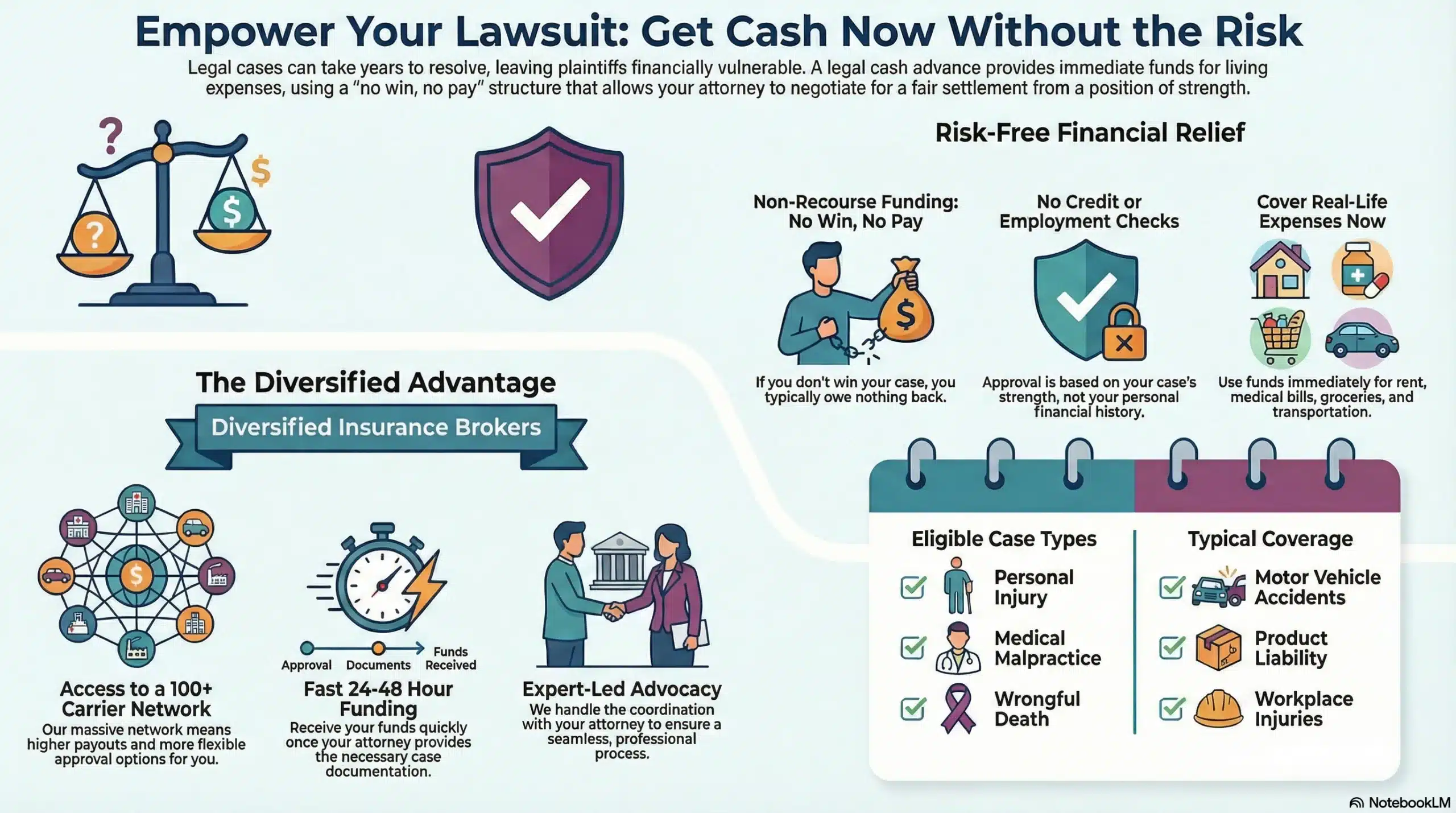
Talk With an Advisor Today
Choose how you’d like to connect—call or message us, then book a time that works for you.
Schedule here:
calendly.com/jason-dibcompanies/diversified-quotes
Licensed in all 50 states • Fiduciary, family-owned since 1980
FAQs: Get Money Before Your Settlement Check
What exactly is a pre-settlement cash advance and how is it different from a loan?
A pre-settlement cash advance is a non-recourse transaction where a funding company provides cash to a plaintiff in an active lawsuit in exchange for the right to recover that amount — plus a fee — from the eventual case proceeds. The critical distinction from a personal loan is the non-recourse structure: if the case does not result in a recovery, the plaintiff owes nothing. The funding company’s only recourse is the case itself — not the plaintiff’s wages, bank accounts, property, or other assets. There is no personal liability beyond what the case ultimately produces.
This is why approval does not require a credit check, income verification, or employment history. None of those factors are relevant because the funder is not making a personal loan — it is making an investment in the outcome of a specific legal case. The evaluation is entirely case-based: how strong is the liability, how well-documented are the damages, and is the defendant capable of paying the expected settlement or judgment. If the case is strong, the plaintiff qualifies regardless of their personal financial situation.
How much money can I get before my settlement check arrives?
Most reputable pre-settlement funders advance 10–15% of the expected settlement value. The advance is deliberately conservative for the plaintiff’s benefit — it is sized so that even if the case settles for somewhat less than the current estimate, sufficient proceeds remain at resolution to repay the advance, cover the accumulated fees, and still deliver a meaningful net recovery to the plaintiff. A case with an expected settlement value of $100,000 might produce an advance offer of $10,000–$15,000.
The advance amount also depends on the stage of the case, the clarity of liability, and the documentation of damages. Cases further along in litigation — with established medical records, completed depositions, and active settlement negotiations — typically support larger advances than cases early in discovery where the full damages picture is not yet documented. If an initial advance does not fully meet immediate financial needs, some funders allow additional advances as the case progresses and the settlement value becomes more clearly established.
What does pre-settlement funding actually cost?
Pre-settlement funding fees are typically structured as a monthly rate applied to the outstanding advance amount — common rates range from approximately 2–4% per month, though structures vary by funder and case type. The total cost depends on how long the case takes to resolve: a 3% monthly rate on a $10,000 advance that takes 12 months produces approximately $3,600 in fees, for a total repayment of around $13,600. The same advance taking 24 months produces approximately $7,200 in fees, for a total repayment of around $17,200. The fee structure rewards fast case resolution and penalizes extended litigation.
Before signing any funding agreement, ask the funder to project total repayment at 12, 18, and 24 months. Compare that projected repayment against the expected net settlement to confirm the advance makes financial sense across realistic case duration scenarios — not just the optimistic one. Funders who are unwilling to provide this projection clearly before signing are a red flag. The cost can be meaningful, and an informed decision requires seeing the full picture of what the advance will cost relative to what the case will ultimately deliver.
Do I need my attorney’s involvement to get pre-settlement funding?
Yes — attorney representation is required for pre-settlement funding. Funding companies will not advance funds to plaintiffs who do not have an attorney actively representing them on the case. This requirement is not just procedural; it is one of the primary protections in the funding process. The attorney reviews the funding agreement as part of their representation, provides the case documentation the funder needs to evaluate the advance, and handles the repayment from settlement proceeds at resolution — ensuring the funder is paid directly from the settlement before the net amount is disbursed to the plaintiff.
Some attorneys are more familiar with pre-settlement funding than others. If your attorney has concerns about a specific funder or funding agreement, those concerns are worth taking seriously — attorneys regularly see funding agreements with terms that are unfavorable to clients, and their review is a meaningful protection. If your attorney recommends against a specific funding company or fee structure, get the explanation in detail before proceeding. Reputable funders are accustomed to attorney scrutiny and welcome it; funders who pressure plaintiffs to sign without allowing attorney review are a significant red flag.
What types of cases qualify for pre-settlement funding?
Pre-settlement funding is available for a broad range of civil cases where a monetary recovery is expected. The most common eligible case types include personal injury (car accidents, slip and fall, premises liability, product liability), workers’ compensation and workplace injury claims, medical malpractice, wrongful death, wrongful termination, and civil rights violations. The common thread is that the case involves a tort or civil claim with expected monetary damages rather than a purely equitable claim where money is not the expected outcome.
Cases that typically do not qualify for pre-settlement funding include family law disputes (divorce, custody), most criminal cases, bankruptcy proceedings, and cases where there is no identifiable defendant with the financial capacity to pay a judgment or settlement. The funder’s evaluation is fundamentally about whether the case will produce a recovery — if the answer to that question is uncertain for structural reasons (no solvent defendant, purely equitable claim, criminal rather than civil matter), the case may not qualify regardless of the plaintiff’s financial need.
Does getting pre-settlement funding affect my settlement amount?
Pre-settlement funding does not directly affect the settlement amount the defendant offers — the defendant typically does not know whether the plaintiff has obtained funding, and it is not information that is disclosed in litigation. What pre-settlement funding affects is the plaintiff’s negotiating position: a plaintiff with stable finances can decline inadequate settlement offers and wait for a better one, while a plaintiff under financial pressure is more susceptible to accepting a low offer to stop the financial bleeding. From this perspective, pre-settlement funding can indirectly support a higher net settlement by giving the plaintiff the financial stability to wait for fair value.
The important caveat is that the advance and its accumulated fees are repaid from the settlement proceeds at resolution, which reduces the plaintiff’s net recovery. A $100,000 settlement with a $15,000 advance and $6,000 in accumulated fees produces a net recovery of $79,000 before attorney fees — rather than $85,000 without the advance. The question is whether the financial stability the advance provided was worth the $6,000 fee cost, and whether having that stability allowed the plaintiff to achieve a settlement closer to full case value than would have been possible without it. For many plaintiffs, the answer is yes; for others — particularly those with adequate savings or other income sources — the cost may exceed the benefit.
About the Author:
Jason Stolz, CLTC, CRPC, DIA, CAA and Chief Underwriter at Diversified Insurance Brokers (NPN 20471358), is a senior insurance and retirement professional with more than 25 years of real-world experience helping individuals, families, and business owners protect their income, assets, and long-term financial stability. As a long-time partner of the nationally licensed independent agency Diversified Insurance Brokers, Jason provides trusted guidance across multiple specialties—including fixed and indexed annuities, long-term care planning, personal and business disability insurance, life insurance solutions, Group Health, Travel Medical and Evacuation Insurance, and short-term health coverage. Diversified Insurance Brokers maintains active contracts with over 100 highly rated insurance carriers, ensuring clients have access to a broad and competitive marketplace.
His practical, education-first approach has earned recognition in publications such as VoyageATL, and contributions from his agency featured in Kiplinger and GoBankingRates— highlighting his commitment to financial clarity and client-focused planning. Drawing on deep product knowledge and years of hands-on field experience, Jason helps clients evaluate carriers, compare strategies, and build retirement and protection plans that are both secure and cost-efficient. Visitors who want to explore current annuity rates and compare options across multiple insurers can also use this annuity quote and comparison tool.
Explore All Lawsuit Loan & Legal Funding Options: Browse our complete guide to Lawsuit Loans & Legal Funding — covering pre-settlement funding, lawsuit cash advances, injury claims & more.
Last Reviewed: June 9, 2026 |
Reviewed by: Jason Stolz, CLTC, CRPC, DIA, CAA
Chief Underwriter, Diversified Insurance Brokers, Inc. | NPN: 20471358 | Diversified Insurance Brokers, Inc. — Licensed in all 50 states
Fact Checked by: Tonia Pettitt, CMIP©
Medicare Specialist, Diversified Insurance Brokers, Inc. | NPN: 14374308 | Diversified Insurance Brokers, Inc. — Licensed in all 50 states
Did you find this content helpful? Leave us a Google review — it helps others find trustworthy guidance too.
Editorial Standards: Diversified Insurance Brokers maintains rigorous editorial standards to ensure accuracy, clarity, and independence in all content. Learn more about our editorial standards and commitment to transparency.
