
Advance on a Pending Lawsuit – Fast Legal Funding Now
Advance on a Pending Lawsuit – Fast Legal Funding Now

Jason Stolz CLTC, CRPC, DIA, CAA
An advance on a pending lawsuit is a cash advance provided to personal injury plaintiffs with an active legal claim, allowing them to access a portion of their anticipated settlement proceeds before their case resolves. The financial pressure of waiting for a lawsuit to settle is a real and immediate problem for most plaintiffs: medical bills continue arriving, rent and mortgage payments do not pause, lost income from an injury does not recover on its own, and insurance companies — well aware of this pressure — often use financial strain as a negotiating advantage to push plaintiffs toward accepting lower settlements faster than they otherwise would. An advance on a pending lawsuit directly addresses this dynamic by providing plaintiffs with financial stability during the waiting period so they can pursue the best possible case outcome rather than accepting the first offer available simply to end the financial pressure.
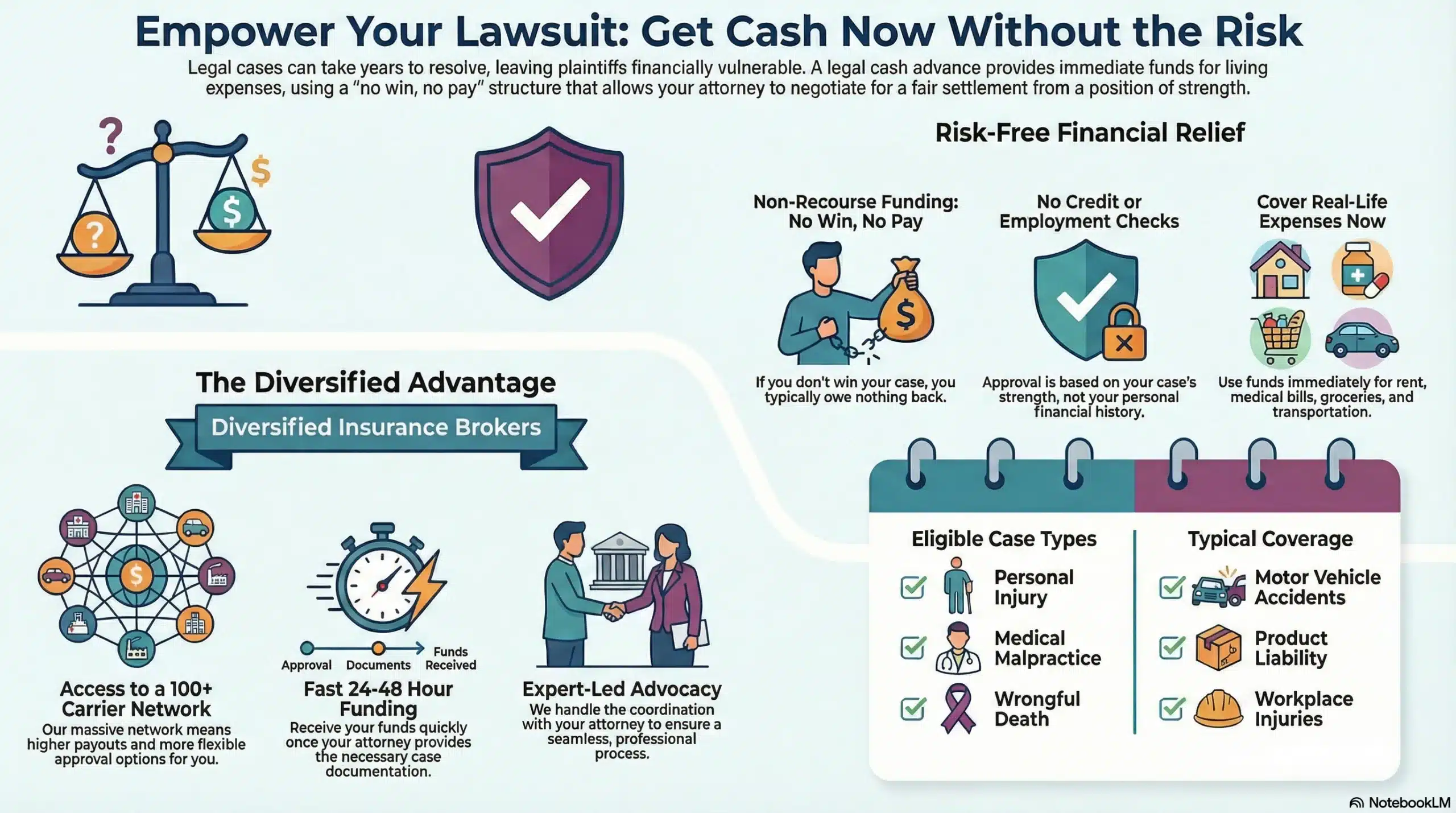
The mechanics of an advance on a pending lawsuit differ fundamentally from a traditional bank loan or consumer credit line. The most important distinction is the non-recourse structure: in most legal funding agreements, the advance is repayable only if the plaintiff recovers money through settlement or verdict. If the case is lost or dismissed without recovery, the advance does not need to be repaid. There is no monthly payment schedule during the case, no credit score requirement, no income verification, and no employment history check — because the underwriting is based on the merits of the legal claim, not the plaintiff’s personal financial profile. Repayment comes from the settlement proceeds at the end of the case, coordinated through the plaintiff’s attorney. At Diversified Insurance Brokers, we connect plaintiffs with reputable legal funding sources, help coordinate the documentation process with their attorney, and help them evaluate funding options responsibly so the advance serves its purpose without unnecessarily reducing their future net recovery. Our resource on what is pre-settlement funding covers the foundational concepts, and our resource on how pre-settlement funding works covers the full process mechanics in detail.
Request Your Advance on a Pending Lawsuit
Apply today. We coordinate directly with your attorney, connect your case with reputable funding sources, and help you access the most cash possible while protecting your future recovery.
Apply NowNon-Recourse Funding vs. Traditional Loans — The Critical Distinction
The phrase “lawsuit loan” is widely used to describe pre-settlement advances, but the terminology is misleading in an important way. Traditional loans — from banks, credit unions, or consumer lenders — create an unconditional repayment obligation. Regardless of what happens in your life after the loan is made, the debt must be repaid. A lawsuit advance structured as non-recourse funding is categorically different: the repayment obligation is contingent on recovery. No recovery, no repayment. This structure is the defining feature that makes legal funding accessible to plaintiffs who could not qualify for conventional credit and what makes it a fundamentally different financial tool from consumer debt.
The non-recourse structure exists because the legal funding company is not lending against the plaintiff’s personal creditworthiness — it is investing in the expected outcome of the legal claim. The funder evaluates the case, assesses the probability and magnitude of recovery, and provides funding based on that case-level assessment. The risk the funder accepts is case risk: if the case does not produce a recovery, the funder absorbs the loss. In exchange for accepting this case risk, funding agreements specify repayment terms that include the advance amount plus fees and charges that accrue over the period the advance is outstanding. Understanding the full repayment structure — not just the advance amount — is the most important step before signing any legal funding agreement. Our resource on legal funding structures covers how these agreements are constructed, and our resource on pre-settlement funding vs. lawsuit loans — what’s the difference covers the structural comparison in full detail.
How Funding Decisions Are Made — Case Underwriting Explained
The approval decision for an advance on a pending lawsuit is based almost entirely on the merits of the legal claim rather than the plaintiff’s personal financial characteristics. The funding company evaluates the case through a process that examines several interconnected factors, each of which affects both the likelihood of approval and the maximum amount available.
Liability clarity is the first and most fundamental factor. Cases with clear, documented fault — where the evidence strongly supports the defendant’s responsibility — are more fundable than cases with disputed or ambiguous liability. An auto accident where the defendant ran a red light and was cited by police presents clear liability; a case where both parties claim the other was at fault presents disputed liability that increases funder risk and may limit funding availability or amount.
Damages documentation is the second critical factor. Medical records, treatment history, imaging, specialist consultations, and ongoing care records establish the scope and credibility of the plaintiff’s injury claim. A well-documented injury — one where the plaintiff received consistent and appropriate treatment and where the medical records clearly support the claimed damages — supports a stronger funding evaluation. Gaps in treatment, inconsistent care timelines, or undocumented injuries can reduce available funding or delay approval while documentation is gathered.
Insurance coverage and defendant collectability determine whether a recovery is realistically achievable. A defendant with adequate insurance coverage — or significant personal or business assets — presents a credible recovery pathway. Cases where coverage is contested, insufficient, or where the defendant has limited assets create collectability risk that affects funding availability. The funding company needs confidence that there are actual proceeds available to repay the advance if the case resolves favorably.
Case timeline and stage affect how funding companies evaluate expected holding periods. Cases that are earlier in the litigation process — before discovery, before demand, before clear insurance confirmation — may present more uncertainty about timeline and outcome than cases that are well-developed with active settlement negotiations. Some funders prefer cases at more advanced stages; others will fund cases at earlier stages with appropriate expectations about the advance amount. Our resource on how much can you get from pre-settlement funding covers how case factors interact to determine funding amounts.
What Case Types Typically Qualify for an Advance on a Pending Lawsuit
| Case Type | Typical Qualification | Key Documentation Needed | Common Considerations |
|---|---|---|---|
| Auto Accident | Strong — one of the most commonly funded case types | Police report, insurance info, medical records, photos | Clear liability and sufficient coverage are key; PIP offset may apply in some states |
| Commercial Truck Accident | Strong — often higher settlement values support more funding | Accident report, trucking company info, driver logs, medical records | Multiple liable parties possible; higher coverage limits generally available |
| Slip and Fall / Premises Liability | Moderate — liability is often more contested than auto cases | Incident report, photos of hazard, witness statements, medical records | Comparative negligence issues can affect both case and funding outcome |
| Product Liability | Moderate — depends heavily on case development stage | Product documentation, injury records, expert reports if available | Cases are often complex and longer-timeline; coverage/defendant assets critical |
| Medical Malpractice | Selective — longer timeline and expert review required | Full medical records, expert opinion (often required), malpractice insurance info | Cases take longer; funders are more selective; expert consultation often needed before funding |
| Workers’ Compensation / Third-Party Work Injury | Varies by state and funding source | Claim documentation, employer and carrier information, injury records | Pure workers’ comp may have limited funding options; third-party injury claims are more fundable |
| Wrongful Death | Generally strong when liability and coverage are established | Death certificate, accident documentation, estate/representative documentation, coverage information | Estate legal structure and representative authority must be confirmed |
The table illustrates why applying is always the fastest way to determine whether a specific case qualifies — general category eligibility provides a framework, but the specific facts of each claim determine the actual outcome. A slip-and-fall case with clear video evidence of the hazard and strong medical documentation may fund more easily than an auto accident with contested liability and minimal treatment. Our resource on slip and fall lawsuit funding covers the premises liability category specifically, and our resource on lawsuit settlement loans covers how these funding structures are organized across different case types.
How Much Can Plaintiffs Receive — And Why Less Is Often the Better Choice
The maximum amount available in an advance on a pending lawsuit is determined by the anticipated net recovery — the expected settlement or verdict amount after deducting attorney fees, case costs, medical liens, and any existing advances. Funding companies advance only a portion of the anticipated net to ensure the plaintiff still receives meaningful proceeds when the case resolves and the advance is repaid. Advancing too large a portion of the anticipated net creates the risk that repayment (including accrued costs) could consume most or all of the plaintiff’s recovery — defeating the purpose of the legal process entirely.
This is why the most responsible approach to requesting an advance on a pending lawsuit is to request only what is genuinely needed to solve the immediate financial problem, rather than requesting the maximum available amount. The difference between requesting $5,000 to cover three months of essential expenses versus requesting $15,000 because it is technically available can translate into a meaningfully higher net recovery at the end of the case when repayment is made. The costs associated with legal funding accrue over the period the advance is outstanding — the longer the case takes to resolve, the higher the total repayment. A targeted, disciplined approach to funding requests directly protects the plaintiff’s future recovery. Our resource on how much can you get from pre-settlement funding covers the factors that determine maximum funding amounts, and our resource on is pre-settlement funding worth it covers the cost-benefit analysis that should inform every funding request.
Understanding Costs — What Plaintiffs Should Know Before Signing
The cost structure of an advance on a pending lawsuit is one of the most important factors for plaintiffs to understand clearly before signing any funding agreement. Legal funding is not free money — the advance must be repaid from settlement proceeds, and the repayment amount includes the original advance plus fees and charges that accrue during the period the funding is outstanding. The longer a case takes to resolve, the higher the total repayment amount.
Funding companies structure their cost agreements in different ways, and the specific cost methodology — how fees are calculated, whether they compound, what the applicable rate is, and whether there are minimum repayment terms — varies by provider, case type, and state regulation. Some states have enacted legislation regulating the cost structure of legal funding agreements; others have not. This variation makes it critically important for the plaintiff and their attorney to review the complete agreement terms carefully before signing, not just the advance amount on the front page. The question “what is the total repayment at 12 months? At 24 months? At 36 months?” should be answered in writing before any funding agreement is executed.
The most protective approach for a plaintiff is to use legal funding for a short, targeted period — covering essential expenses for the near term rather than the full case duration — and to seek resolution of the underlying case as efficiently as possible. Extended funding periods produce higher total repayment regardless of how the cost structure is designed. Our resource on pros and cons of pre-settlement funding covers the complete cost-benefit framework, and our resource on how lawsuit loans work — fast cash advances explained covers how the cost mechanics work in practice across different timeline scenarios.
Why Attorney Involvement Is Essential
An advance on a pending lawsuit cannot proceed without active participation from the plaintiff’s attorney, and this requirement exists for structurally important reasons. The attorney holds the case file, has the information the funding company needs to evaluate the claim, and is legally and ethically obligated to ensure that any third-party funding arrangement does not compromise the plaintiff’s interests. Most legal funding agreements require the attorney to sign an acknowledgment that they are aware of the funding arrangement and that repayment will be made from settlement funds when distributed.
In practical terms, the speed of the funding process depends heavily on how quickly the attorney’s office can provide the necessary documentation. Case reports, medical records summaries, insurance information, demand letters, and other file documents that the funder needs to evaluate the claim must come from the attorney. Plaintiffs who have already discussed pre-settlement funding with their attorney and secured their cooperation before applying will generally experience a faster approval process than those where the attorney’s office is hearing about the funding request for the first time during the underwriting process.
Attorney involvement also serves as a safeguard. An attorney who is attentive to their client’s interests will review the funding agreement terms, flag any provisions that may be unfavorable, and help ensure the advance amount and cost structure are reasonable relative to the case’s expected outcome. The ethical responsibility attorneys carry for their clients’ wellbeing extends to third-party financial arrangements related to the case. Our resource on get cash before lawsuit settles covers how attorney coordination works in the funding process, and our resource on settlement funding covers the disbursement process when the case resolves.
How to Request an Advance and What to Expect in the Process
The process for obtaining an advance on a pending lawsuit is straightforward for cases with well-organized documentation, though timeline depends on factors largely outside the plaintiff’s direct control — primarily how quickly the attorney’s office can provide complete case information to the funding company for review.
The plaintiff submits a request identifying themselves, their attorney, and their case. The funding company reaches out to the attorney’s office to request the relevant case file documentation. The funder reviews liability, damages, insurance coverage, and case progress, then issues an approval decision — either approving with a proposed advance amount and terms, requesting additional information, or declining if the case does not meet their underwriting criteria. If approved, the plaintiff and their attorney review the funding agreement, confirm the terms, execute the documents, and the funds are released — typically by ACH transfer or wire. The full process in cases with complete documentation can take from a few days to a couple of weeks depending on the funder and how quickly documents are assembled.
The most effective step a plaintiff can take to accelerate the process is to notify their attorney before applying and confirm that the attorney’s office is prepared to provide documentation promptly when contacted by the funder. Delays are most commonly caused not by underwriting complexity but by documentation assembly — gathering medical records, confirming insurance information, and preparing any case summaries the funder needs. For an overview of available funding options and how to compare them, our resource on lawsuit loans and legal funding covers the full landscape, and our resource on cash advance for lawsuit covers the specific application and approval process.
Protecting Financial Stability While the Case Is Pending
A pre-settlement advance on a pending lawsuit addresses the immediate cash flow problem of waiting for a case to resolve, but it is most effective when combined with other financial stability strategies that reduce the total amount the plaintiff needs to borrow against their expected recovery. The less a plaintiff needs to advance — because other resources are covering some costs — the better their net recovery position when the case eventually resolves.
For plaintiffs who lost health coverage when they were injured and left a job, short-term health coverage can provide a bridge for ongoing medical costs that would otherwise generate additional out-of-pocket expense during the recovery period. Our resource on how short-term health insurance can bridge coverage gaps covers this option in practical terms. For individuals who had disability insurance in place before the injury, those benefits may provide income replacement that reduces or eliminates the need for pre-settlement funding entirely. Our resource on why you need disability insurance even if you’re young and healthy covers why disability income protection is the most fundamental financial protection against injury-related income loss — and why having it in place before an injury occurs changes the financial picture entirely during litigation.
The combination of appropriate insurance coverage — particularly disability income insurance and health coverage — with targeted, responsibly sized pre-settlement funding represents the most financially protective approach for plaintiffs navigating an extended litigation period. Our resource on lawsuit funding fast legal cash advances covers the full funding option landscape, and our resource on get lawsuit money covers an overview of the process from application through funding.
Get the Most Cash for Your Case
Apply now for an advance on a pending lawsuit. We connect your case with reputable funding sources, coordinate directly with your attorney, and help you access funding responsibly so your future recovery is protected.
Request FundingRelated Pages
Explore funding options, case types, and financial stability strategies while your lawsuit is pending.
Financial Protection Essentials
High-risk life insurance planning, disability income protection with COLA, and financial institution reviews.
Talk With an Advisor Today
Choose how you’d like to connect—call or message us, then book a time that works for you.
Schedule here:
calendly.com/jason-dibcompanies/diversified-quotes
Licensed in all 50 states • Fiduciary, family-owned since 1980
Frequently Asked Questions: Advance on a Pending Lawsuit
What is an advance on a pending lawsuit (pre-settlement funding)?
An advance on a pending lawsuit is a cash advance provided to personal injury plaintiffs with an active legal claim, allowing them to access a portion of their anticipated settlement proceeds before the case resolves. The advance is typically non-recourse — repayable only from settlement funds if the case produces a recovery, with no repayment owed if the case is lost. There are no monthly payments during the case, no credit check, and no employment verification because underwriting is based on the merits of the legal claim rather than the plaintiff’s personal financial profile. Our resource on what is pre-settlement funding covers the foundational concepts and product structure in full detail.
Is this a loan, or non-recourse funding?
Most lawsuit advances are structured as non-recourse funding rather than traditional loans. The critical distinction is that repayment is contingent on recovery — if the case is lost or dismissed without a monetary recovery, the advance does not need to be repaid. A traditional loan creates an unconditional repayment obligation regardless of the case outcome. The non-recourse structure is what makes legal funding accessible to plaintiffs who could not qualify for conventional credit and who cannot risk taking on unconditional debt while their case is pending. Our resource on legal funding structures explains how these agreements are constructed and what “non-recourse” means in practical terms in the funding agreement.
Who qualifies for a lawsuit cash advance?
Qualification requires an active legal claim with attorney representation, sufficient liability evidence to establish the defendant’s responsibility, documented injuries or damages, a liable party with insurance coverage or collectible assets, and a realistic probability of monetary recovery. Qualification is case-based, not credit-based — the funder evaluates the strength and value of the legal claim, not the plaintiff’s personal financial history. Most personal injury cases with an attorney working on contingency are eligible for evaluation, though the amount available depends on case-specific factors. Our resource on how pre-settlement funding works covers the full qualification criteria and underwriting process.
How much money can I receive from an advance on a pending lawsuit?
Funding amounts depend on the anticipated net recovery — the expected settlement or verdict amount after attorney fees, case costs, medical liens, and any existing advances are deducted. Funding companies advance only a portion of the anticipated net proceeds to ensure the plaintiff still receives meaningful funds when the case resolves. Requesting only what is genuinely needed rather than the maximum technically available amount directly protects the plaintiff’s future net recovery, since costs accrue over the period the advance is outstanding. Our resource on how much can you get from pre-settlement funding covers the factors that determine funding amounts across different case types.
How fast can I get funds after applying?
Timeline depends primarily on how quickly the attorney’s office can provide the documentation the funding company needs to evaluate the case — not typically on the underwriting process itself. Cases where the attorney is prepared and documentation is organized can move from application to funding in a few days. Cases where documentation must be gathered from multiple sources or where the attorney’s office is slow to respond can take longer. Notifying your attorney before applying and confirming their cooperation with document sharing is the single most effective step for accelerating the process. Our resource on lawsuit funding fast legal cash advances covers the timeline factors and what plaintiffs can do to keep the process moving efficiently.
Do you check my credit score or employment history?
No. Legal funding underwriting is case-based, not credit-based. The funding company evaluates the strength and anticipated value of the legal claim — not the plaintiff’s credit score, employment status, income level, or financial history. Because repayment comes from settlement proceeds rather than personal income, the plaintiff’s personal financial profile is not relevant to the approval decision. The case facts — liability clarity, damages documentation, insurance coverage, and timeline — determine both whether an advance is available and how much the funder is willing to offer. Our resource on cash advance for lawsuit covers the underwriting process in practical terms.
What fees or costs apply to lawsuit advances?
Legal funding agreements include costs beyond the advance amount — fees and charges that accrue over the period the advance is outstanding. The specific cost structure varies by provider, case type, and state regulation. Because costs accrue over time, longer cases produce higher total repayment amounts. Plaintiffs and their attorneys should request a complete repayment schedule showing the total amount owed at multiple time intervals (12 months, 24 months, 36 months) before executing any agreement. Requesting a targeted, appropriately sized advance rather than the maximum available amount and pursuing case resolution efficiently are the two most effective strategies for managing total funding costs. Our resource on pros and cons of pre-settlement funding covers the full cost-benefit analysis framework plaintiffs should apply before signing.
Will I owe anything if I lose my case?
With properly structured non-recourse funding, you generally do not repay the advance if the case produces no recovery. The written agreement is the controlling document — “non-recourse” must be confirmed in the contract language, not assumed from verbal representations. Before signing, verify that the agreement clearly states the non-recourse nature of the funding and specifies the conditions under which no repayment is owed. Our resource on is pre-settlement funding worth it covers the risk considerations and what plaintiffs should confirm in writing before committing to any funding agreement.
Can I request more than one advance on my pending lawsuit?
In some situations, additional funding may be available as a case develops and additional case milestones are reached — particularly if the initial advance was modest and the case’s anticipated value has become clearer or higher as documentation and negotiations progress. Additional funding depends on case progress, updated case valuation, attorney approval, and the funder’s assessment of remaining net proceeds available after existing advance repayment obligations. Stacking multiple advances without careful evaluation of the cumulative repayment obligation can significantly reduce net recovery. Each additional advance should be evaluated with the same disciplined, needs-based approach as the first. Our resource on get lawsuit money covers funding options throughout the full case lifecycle.
Does my attorney have to be involved in the process?
Yes — attorney involvement is both required and essential for the process to function properly. The attorney holds the case file documentation that the funding company needs to evaluate the claim. The attorney signs an acknowledgment of the funding arrangement and agrees to repay the advance plus accrued costs from settlement funds when disbursed. The attorney also has an ethical responsibility to ensure the funding arrangement serves the client’s interests. Cases where the attorney is cooperative and organized process most efficiently. Our resource on get cash before lawsuit settles covers how attorney coordination functions throughout the funding and repayment process.
Are there state restrictions on lawsuit advances?
Yes — some states have enacted legislation regulating pre-settlement legal funding, including requirements around disclosure, cost caps, cooling-off periods, and agreement terms. Other states have no specific regulation of legal funding. Availability and specific agreement terms vary by state and funding source. Because regulations in this area continue to evolve, confirming current state-specific terms with the funding company and your attorney before signing is important. Our resource on slip and fall lawsuit funding covers state-specific considerations for one of the most common personal injury case types that seeks pre-settlement funding.
What can I use the advance money for?
There are no restrictions on how advance funds from a pending lawsuit are used. The most common uses include rent or mortgage payments, utility bills, groceries, transportation, medical bills and co-pays, prescription costs, childcare, and other essential living expenses that cannot wait for the case to resolve. The unrestricted nature of the funds is one of the features that makes pre-settlement advances particularly valuable — the plaintiff can address whichever financial pressure is most acute rather than being limited to specific approved expense categories. Our resource on settlement funding covers the full range of financial situations where pre-settlement advances provide the most meaningful support.
About the Author:
Jason Stolz, CLTC, CRPC, DIA, CAA and Chief Underwriter at Diversified Insurance Brokers (NPN 20471358), is a senior insurance and retirement professional with more than 25 years of real-world experience helping individuals, families, and business owners protect their income, assets, and long-term financial stability. As a long-time partner of the nationally licensed independent agency Diversified Insurance Brokers, Jason provides trusted guidance across multiple specialties—including fixed and indexed annuities, long-term care planning, personal and business disability insurance, life insurance solutions, Group Health, Travel Medical and Evacuation Insurance, and short-term health coverage. Diversified Insurance Brokers maintains active contracts with over 100 highly rated insurance carriers, ensuring clients have access to a broad and competitive marketplace.
His practical, education-first approach has earned recognition in publications such as VoyageATL, and contributions from his agency featured in Kiplinger and GoBankingRates— highlighting his commitment to financial clarity and client-focused planning. Drawing on deep product knowledge and years of hands-on field experience, Jason helps clients evaluate carriers, compare strategies, and build retirement and protection plans that are both secure and cost-efficient. Visitors who want to explore current annuity rates and compare options across multiple insurers can also use this annuity quote and comparison tool.
Explore All Lawsuit Loan & Legal Funding Options: Browse our complete guide to Lawsuit Loans & Legal Funding — covering pre-settlement funding, lawsuit cash advances, injury claims & more.
Last Reviewed: May 25, 2026 |
Reviewed by: Jason Stolz, CLTC, CRPC, DIA, CAA
Chief Underwriter, Diversified Insurance Brokers, Inc. | NPN: 20471358 | Diversified Insurance Brokers, Inc. — Licensed in all 50 states
Fact Checked by: Tonia Pettitt, CMIP©
Medicare Specialist, Diversified Insurance Brokers, Inc. | NPN: 14374308 | Diversified Insurance Brokers, Inc. — Licensed in all 50 states
Did you find this content helpful? Leave us a Google review — it helps others find trustworthy guidance too.
Editorial Standards: Diversified Insurance Brokers maintains rigorous editorial standards to ensure accuracy, clarity, and independence in all content. Learn more about our editorial standards and commitment to transparency.
