
Get Cash Before Lawsuit Settles
Get Cash Before Lawsuit Settles

Jason Stolz CLTC, CRPC, DIA, CAA
You Don’t Have to Wait for Your Lawsuit to Settle to Access Cash
If you have an active personal injury, workers’ compensation, or civil lawsuit and you need money now, a non-recourse pre-settlement cash advance can provide immediate financial relief without requiring you to repay anything if your case does not succeed. This type of funding exists specifically for plaintiffs who are waiting on a case to resolve while everyday expenses — rent, medical bills, groceries, utilities, car payments — continue to accumulate regardless of how long the legal process takes. Bureau of Justice Statistics data on state civil cases places the average tort lawsuit resolution at approximately 23 months, and cases involving medical malpractice or premises liability frequently stretch considerably longer. For a plaintiff who is out of work, in recovery, or facing income disruption because of the injury or event at the center of their lawsuit, that timeline can create a financial crisis that has nothing to do with the ultimate merit of the case. Pre-settlement funding is designed to solve exactly that problem — providing access to a portion of the expected case proceeds before the case closes, so the plaintiff can meet current financial obligations without being pressured into accepting a low settlement offer just to end the financial strain. Pre-settlement funding as a financial product is evaluated, approved, and disbursed based on the strength of the underlying legal claim — not the plaintiff’s credit score, employment history, or bank account balance — which is precisely why it is accessible to many people who cannot qualify for conventional financing while their case is pending. The non-recourse structure is the defining feature that distinguishes this funding from a traditional loan: the funder is purchasing a portion of the future case proceeds, not extending credit secured by the plaintiff’s personal assets, which is why no repayment obligation exists if the case is lost.
Why the Non-Recourse Structure Changes Everything
The practical significance of the non-recourse structure is that the plaintiff assumes no personal financial risk from the funding itself. If the case settles or a judgment is awarded, the agreed repayment amount is taken from the proceeds before the plaintiff receives the net settlement. If the case is dismissed, lost at trial, or otherwise does not result in a recovery, the plaintiff owes nothing — the funder absorbs the loss entirely. This risk transfer is what makes pre-settlement funding categorically different from a personal loan, a payday loan, or a credit card advance: those products require repayment regardless of what happens to the lawsuit, while pre-settlement funding repayment is entirely contingent on case success. Legal cash advances structured on a non-recourse basis allow the plaintiff to meet immediate financial needs with no personal liability beyond the case proceeds themselves — the worst-case scenario for the funded plaintiff is losing the case and owing nothing, rather than losing the case and still carrying a debt obligation. Cash advance options for lawsuit plaintiffs are evaluated on this same non-recourse framework — the funding amount, the fee structure, and the repayment terms all reflect the funder’s assessment of case risk rather than the plaintiff’s personal financial profile. Getting money before the settlement check arrives is the practical planning question that pre-settlement funding answers — providing cash to bridge the gap between the financial need created by the injury or legal event and the eventual resolution that delivers the settlement proceeds.
Get Cash Before Your Lawsuit Settles
No credit check. No monthly payments. No repayment if you lose. Access part of your expected settlement now while your attorney continues working toward full value.
Request Funding OptionsHow Pre-Settlement Funding Works — The Full Process From Application to Disbursement
| Step | What Happens | What the Plaintiff Needs to Know |
|---|---|---|
| Application submission | The plaintiff submits basic case information — the nature of the lawsuit, the attorney’s contact information, and a description of the injury or damages involved; no credit check, no income verification, no employment confirmation is required at this stage | The application focuses entirely on the case, not the plaintiff’s personal financial profile; the plaintiff’s attorney must be willing to cooperate with the funding review — cases where the attorney declines to provide information cannot be funded |
| Case evaluation | The funding network evaluates the strength of the liability claim, the documented damages, the expected settlement range, the defendant’s insurance coverage, and the attorney’s assessment of the case timeline and probable outcome; the evaluation is case-based underwriting, not personal credit underwriting | A stronger case with clear liability, documented injuries, and sufficient defendant insurance coverage will qualify for a higher advance at more favorable terms; cases with disputed liability, limited insurance, or early-stage evidentiary development may qualify for less or require additional documentation |
| Funding offer | If the case meets the funding criteria, an offer is made detailing the advance amount, the total repayment amount at settlement, the fee structure, and the terms governing how repayment is calculated from settlement proceeds; most reputable funders advance approximately 10 to 20 percent of the expected settlement value | The plaintiff should review the offer carefully with their attorney before accepting; the attorney can assess whether the repayment terms are reasonable relative to the expected case value and whether the advance amount is appropriate given the projected net settlement proceeds |
| Disbursement | Once the plaintiff accepts the offer and the agreement is signed, funds are disbursed — typically within 24 to 48 hours through wire transfer or other direct payment method; there are no upfront fees, no origination charges deducted from the advance, and no monthly payment obligations during the case | The full advance amount is available to use for any purpose — living expenses, medical bills, mortgage or rent, vehicle payments, or any other financial need; there are no restrictions on how the cash is used and no reporting requirements to the funder |
| Case resolution and repayment | When the case settles or a judgment is awarded, the agreed repayment amount is paid to the funder directly from the settlement proceeds — typically handled by the attorney as part of the settlement distribution; the plaintiff receives the net proceeds after the repayment and attorney fees are satisfied | If the case is lost or dismissed without recovery, the plaintiff owes nothing — the non-recourse structure means the funder has no claim against the plaintiff’s personal assets, income, or any funds outside the case proceeds; no collections, no credit reporting, no recourse of any kind if the case does not succeed |
The process is designed to be accessible to plaintiffs who are typically in difficult financial circumstances — people who are injured, out of work, facing mounting medical bills, and waiting on a legal process that moves on its own timeline regardless of their financial pressure. The approval is not contingent on recovering financially before the case resolves; it is contingent on having a case with sufficient merit and expected value to support the advance. Understanding how different financial instruments work — including the structural differences between non-recourse advances, traditional loans, and insurance-based financial products — helps plaintiffs make informed decisions about which funding option is appropriate for their specific situation and at what amount.
Eligible Case Types — Which Lawsuits Qualify for Pre-Settlement Funding
Pre-settlement funding is available for a range of civil and personal injury case types where liability is reasonably clear, damages are documented, and a settlement or judgment can be reasonably expected within a defined timeline. Personal injury cases involving motor vehicle accidents — car accidents, truck accidents, motorcycle collisions — represent the most common case type for pre-settlement funding because liability is frequently well-documented through police reports, witness statements, and insurance company records, and the defendant’s insurance coverage provides a defined recovery pool that the funder can evaluate. Slip and fall and premises liability cases qualify when the property owner’s liability is supported by incident reports, surveillance footage, maintenance records, or other documentation establishing the unsafe condition and the owner’s knowledge of it. Medical malpractice cases qualify when the deviation from the standard of care is supported by medical expert review and the damages are well-documented, though the more complex litigation timeline for malpractice cases is a factor in the advance amount and fee structure. Workers’ compensation cases qualify in many states depending on the specific legal structure of the claim and whether the case involves a third-party liability component alongside the workers’ compensation filing. Product liability, civil rights, wrongful death, and other civil litigation cases are evaluated on a case-by-case basis depending on the specific liability theory, the defendant’s financial capacity, and the expected case timeline.
The common thread across all qualifying case types is a combination of clear or reasonably clear liability, documented damages, a represented plaintiff working with an attorney who can provide the case documentation the funder needs, and sufficient expected recovery to support the advance amount requested. Cases where liability is genuinely disputed, where the defendant lacks insurance or sufficient assets to fund a judgment, or where the expected case value is insufficient to cover the advance plus repayment terms may not qualify or may qualify for a smaller advance than requested. The case evaluation process is designed to identify the funding amount that is supportable given the realistic expected case value — both to protect the plaintiff from over-borrowing against a settlement that may not cover the full repayment, and to ensure the funder is advancing against a case with a reasonable probability of recovery. Understanding how settlement proceeds can be structured after a case resolves — including the option to receive future periodic payments rather than a lump sum through a structured settlement arrangement — is a planning dimension that some plaintiffs consider when evaluating both the funding decision and the eventual settlement structure. The tax treatment of settlement proceeds varies depending on the nature of the claim — personal physical injury settlements are generally not federally taxable, while settlements for other types of damages may produce taxable income — and understanding the tax dimension of the eventual settlement is relevant to evaluating how much net proceeds the advance will be repaid from. This is not tax advice and plaintiffs should confirm the tax treatment of their specific settlement with a qualified tax professional.
What Pre-Settlement Funding Costs — Understanding the Fee Structure
Pre-settlement funding carries higher effective costs than traditional loans, and understanding those costs before accepting an advance is essential to making an informed decision. The higher cost reflects the funder’s risk: because repayment is entirely contingent on case success, and because cases can lose or resolve for less than projected, the funder is absorbing a risk that a traditional lender never accepts. The fee structure for most pre-settlement funding is expressed as a percentage of the advance amount applied over the life of the case — the longer the case takes to resolve, the larger the total repayment amount relative to the advance. Some funders use simple interest structures; others use compounding fee structures that can increase the total repayment amount significantly for cases that extend longer than anticipated. The difference between simple and compounding fee structures can be substantial for long-duration cases, making the fee methodology one of the most important terms to understand when comparing funding offers.
The practical implication of the fee structure is that the advance should be sized at the minimum amount needed to address the specific financial need — not the maximum amount the case could theoretically support. An over-borrowed plaintiff who takes a large advance against a case that ultimately settles for less than projected may find that the funder’s repayment claim consumes a disproportionate share of the settlement proceeds, reducing the net amount the plaintiff receives below what they expected. Most reputable funders advance approximately 10 to 20 percent of the expected settlement value as a guideline — this range reflects both the funder’s risk management and the goal of leaving sufficient net proceeds for the plaintiff after repayment and attorney fees. The attorney’s perspective on the advance amount and repayment terms is particularly valuable because the attorney has the most accurate assessment of the realistic settlement range and can identify whether a proposed advance and repayment structure is reasonable relative to the expected net proceeds. Understanding how different financial instruments are taxed — including how settlement proceeds and any structured payment arrangements are treated for income tax purposes — is part of the comprehensive financial picture that a plaintiff receiving pre-settlement funding should understand before finalizing any settlement structure. How the exclusion ratio applies to structured settlement annuity payments if the case eventually resolves through a periodic payment arrangement is a financial planning dimension relevant to plaintiffs considering both the pre-settlement advance and the eventual settlement structure. How annuity death benefits work in structured settlement contexts — where some settlement proceeds are placed in an annuity that provides ongoing payments — is relevant for plaintiffs who are evaluating whether a lump sum settlement or a structured periodic payment arrangement better serves their long-term financial needs after the case resolves. Whether annuity death benefits from structured settlements are taxable is a planning question that intersects with the settlement structure decision for plaintiffs who are considering how proceeds should be arranged for both current income and legacy purposes.
How Pre-Settlement Funding Compares to Other Financing Options
For a plaintiff facing financial pressure while a lawsuit is pending, the financing landscape includes several options — each with a different cost structure, repayment obligation, and risk profile. Credit cards and personal loans require repayment regardless of case outcome and typically require good credit and documented income — neither of which a plaintiff out of work due to an injury may have. Family borrowing avoids interest costs but creates interpersonal financial dynamics that can complicate relationships, particularly if the case resolves for less than expected. Payday loans carry extremely high annual percentage rates and require repayment within weeks regardless of whether the lawsuit has resolved. Pre-settlement funding, by contrast, requires no repayment if the case is lost, carries no monthly payment obligation during the pendency of the case, and requires no credit check or income documentation — the only qualification is the strength of the underlying case. The trade-off is that the total repayment amount from case proceeds is higher than the advance received, and the effective cost expressed as an annual rate is higher than conventional financing. For plaintiffs who cannot qualify for conventional financing and who have a strong case with a reasonable expected recovery, the non-recourse structure of pre-settlement funding makes it the most appropriate option available — not because the cost is low in absolute terms, but because the risk structure is appropriate for a plaintiff whose financial position is temporary and whose recovery depends on a case that has not yet resolved.
The financial planning dimension that extends beyond the pre-settlement advance itself is how the eventual settlement proceeds are structured to support the plaintiff’s long-term financial needs. Deferred annuities and lifetime income annuities are financial instruments that some settlement recipients use to convert a lump sum settlement into a structured income stream — providing guaranteed monthly income rather than a single lump sum that must be self-managed over a lifetime. Fixed indexed annuities offer principal protection and index-linked growth potential for settlement proceeds that are not needed as immediate income — a planning option for plaintiffs whose settlement is large enough to fund both current needs and long-term financial security. What annuity guarantees mean — the contractual protection of principal, the guaranteed income provisions, and the death benefit structures — is relevant planning context for any settlement recipient who is evaluating how to structure proceeds for both security and long-term adequacy. Whether an annuity can lose money — and under what conditions principal is protected — is a foundational question for any settlement recipient considering placing proceeds in an annuity rather than managing them in a market-exposed investment account. The full range of annuity contract benefits — tax deferral, guaranteed growth, income guarantees, and death benefit provisions — represents the value proposition that makes annuities a planning tool worth understanding for settlement recipients who want to convert a lump sum into lasting financial security. What annuity fees look like across different contract types helps settlement recipients evaluate the cost structure of any annuity being recommended as a placement vehicle for settlement proceeds. How annuities compare to 401k and retirement account structures for long-term asset accumulation is relevant context for settlement recipients who are receiving proceeds outside of any existing retirement account framework. The distinction between immediate and deferred annuities determines whether settlement proceeds begin generating income immediately after placement or accumulate tax-deferred for future income activation — a timing decision that depends on the plaintiff’s current income needs and longer-term financial objectives. Annuity free withdrawal rules are relevant for settlement recipients who want the security of an annuity contract while maintaining some access to the settlement proceeds during the surrender period — confirming the free withdrawal provision before placing funds ensures the recipient understands their liquidity options. Surrender charges and their schedule are the primary liquidity consideration for any annuity placement of settlement proceeds — understanding what access costs exist, when they expire, and how they interact with the free withdrawal provision is essential before any placement decision. How 1035 exchanges work for annuity contracts is a planning tool available to settlement recipients who already hold annuity assets and want to consolidate or reposition those assets in connection with the new settlement proceeds. Annuity strategies for early retirees are specifically relevant for plaintiffs whose settlement results from an injury that has permanently limited their ability to work — where the settlement proceeds may need to fund decades of living expenses rather than merely supplement an existing retirement income plan. Fixed indexed annuities with income riders provide a combination of accumulation potential and guaranteed lifetime income activation that can be particularly valuable for settlement recipients who need both growth and income certainty from a single asset pool. The best fixed indexed annuity for any specific settlement placement depends on the recipient’s age, the amount of proceeds, the income timeline, and the importance of legacy preservation — a comparison across carriers and product designs that Diversified Insurance Brokers provides through independent broker access to the full market. Current fixed annuity rates for settlement recipients who want guaranteed interest rather than index-linked growth establish the baseline return available from the simplest annuity structure — a guaranteed rate credited for a defined term with no market exposure and full principal protection. Annuities with long-term care benefits address a specific planning need for settlement recipients whose injury has created ongoing care requirements — placing settlement proceeds in an annuity that doubles as long-term care funding ensures the proceeds serve both the income need and the potential care cost need simultaneously. The annuity rescue plan process is available for settlement recipients who placed prior funds in annuity contracts that no longer serve their needs optimally — evaluating whether repositioning through a 1035 exchange would improve the settlement’s long-term financial outcome. Whether annuities are a good investment for settlement proceeds specifically depends on the individual’s financial situation, income needs, tax position, and time horizon — a question Diversified Insurance Brokers evaluates through the full annuity planning process. Annuity beneficiary designations for settlement proceeds placed in annuity contracts are a planning dimension that settlement recipients with dependents should address at the time of purchase — ensuring the remaining contract value passes efficiently to named beneficiaries if the recipient dies before depleting the proceeds. What annuity death benefits mean in the settlement proceeds context establishes the baseline legacy protection available from the annuity structure — the standard account value death benefit that most deferred annuity contracts include at no additional charge. Annuitization versus lifetime withdrawal strategies for settlement proceeds placed in a deferred annuity determines whether the recipient eventually converts the accumulated value to a guaranteed income stream or takes systematic withdrawals — a decision with lifetime income, tax, and legacy implications that requires specific planning before any irreversible election is made. Disability insurance planning is relevant context for settlement recipients whose case involved an injury that impaired their earning capacity — because a settlement may address past losses and current medical expenses but may not fully address the long-term income replacement need if the disability is permanent and the plaintiff still has working years ahead. Life insurance planning following a settlement ensures that any survivor income obligation — supporting a spouse or dependents if the recipient dies — is addressed through an appropriate life insurance structure rather than leaving that obligation entirely to the settlement proceeds. How much life insurance is needed following a personal injury settlement depends on the settlement amount, the surviving household’s income needs, the recipient’s age and health, and the extent to which other income sources cover survivor income obligations — a calculation that Diversified Insurance Brokers provides as part of the comprehensive financial planning review for settlement recipients. Qualified annuity taxation and non-qualified annuity structures each have implications for how settlement proceeds placed in an annuity are taxed at distribution — with non-qualified annuities taxing only the earnings above cost basis and qualified annuities taxing the full distribution as ordinary income, making the choice between the two relevant to the settlement recipient’s long-term tax planning.
Apply for Pre-Settlement Funding
No credit check. No monthly payments. No repayment if you lose. Get cash now while your attorney continues working toward the full value of your case.
Request Funding Options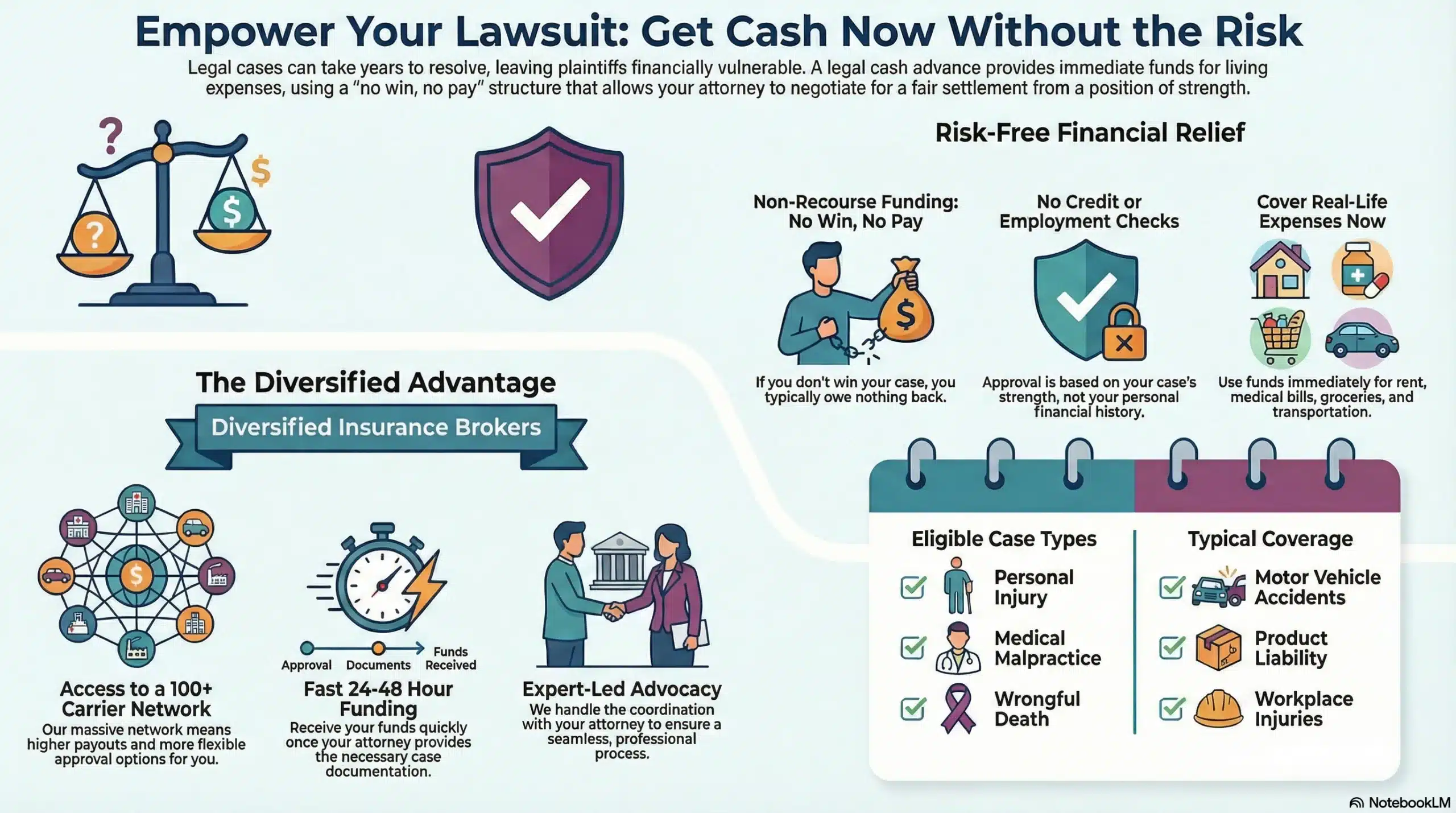
Talk With an Advisor Today
Choose how you’d like to connect—call or message us, then book a time that works for you.
Schedule here:
calendly.com/jason-dibcompanies/diversified-quotes
Licensed in all 50 states • Fiduciary, family-owned since 1980
FAQs: Get Cash Before Your Lawsuit Settles
What exactly is pre-settlement funding and is it really a loan?
Pre-settlement funding is technically not a loan in the traditional banking sense — it is a non-recourse cash advance structured as a purchase of a portion of the future proceeds of your pending lawsuit. The distinction matters because a traditional loan requires repayment regardless of outcome: if you take a personal loan and your lawsuit fails, you still owe the lender the full amount plus interest. Pre-settlement funding is repaid only if your case succeeds — if you win a settlement or judgment, the agreed repayment amount is paid from those proceeds. If your case is lost or dismissed without recovery, you owe nothing, and the funder has no claim against your personal assets, income, or any funds outside the case.
The non-recourse structure is what makes pre-settlement funding appropriate for plaintiffs in financial difficulty who cannot qualify for conventional financing and who have a strong case pending. Because the funder absorbs the entire risk of case loss, the cost structure reflects that risk — effective rates are higher than conventional loan rates. But for a plaintiff who needs funds now, cannot qualify for credit, and has a legitimate strong case, the non-recourse protection is the feature that makes the advance financially viable: the worst-case scenario is losing the case and owing nothing, rather than losing the case and carrying a debt obligation on top of an unfavorable legal outcome.
Does my credit score affect my eligibility for pre-settlement funding?
No — pre-settlement funding approval is based entirely on the strength of your legal case, not your personal credit history, credit score, employment status, or income level. The funding network evaluates the liability evidence in your case, the documented damages, the expected settlement range, the defendant’s insurance coverage, and the attorney’s assessment of the case’s probable outcome. A plaintiff with poor credit, no current employment, and no savings can qualify for pre-settlement funding if their case is strong; a plaintiff with excellent credit and stable income will not qualify if their case is weak or lacks sufficient expected recovery.
This case-based underwriting is specifically designed for the situation that most injured plaintiffs find themselves in: they are out of work or facing income reduction because of the injury that is the subject of their lawsuit, which has damaged their financial profile at exactly the time they need financial relief. The case evaluation focuses on whether the lawsuit is likely to result in a recovery sufficient to repay the advance — which is a question about the case’s merits, not the plaintiff’s personal finances. No credit check is run, no income documentation is required, and no employment verification is part of the approval process.
How much can I receive in a pre-settlement advance?
The advance amount is determined by the expected value of your case — specifically, by the funder’s assessment of the realistic settlement or judgment range after accounting for liability strength, documented damages, attorney fees, and the probability of different case outcomes. Most reputable funders advance approximately 10 to 20 percent of the expected settlement value, with the total funding kept well below the projected net case proceeds so the plaintiff retains meaningful proceeds after the advance is repaid. The advance amount is not determined by how much you need — it is determined by how much the case can reasonably support after all costs are considered.
The most common planning error in pre-settlement funding is over-borrowing — accepting the maximum advance available rather than the minimum needed to address the specific financial need. A large advance creates a proportionally large repayment obligation that is deducted from the eventual settlement, potentially leaving the plaintiff with significantly less net proceeds than expected. The attorney’s perspective on the appropriate advance amount is specifically valuable because the attorney has the most complete picture of the realistic settlement range and can assess whether the proposed advance and repayment terms are reasonable relative to the expected net outcome. Taking less than the maximum available — and supplementing with other resources where possible — is generally the approach that produces the best net financial result at case resolution.
Does my attorney need to be involved in the pre-settlement funding process?
Yes — attorney cooperation is a required component of the pre-settlement funding process. The funder contacts your attorney directly to obtain the case documentation needed for the evaluation: the specifics of the liability theory, the documented damages, the insurance coverage available from the defendant, and the attorney’s assessment of the case’s strength and timeline. Without the attorney’s participation and willingness to provide this information, the case cannot be funded. Cases where the attorney declines to cooperate — whether due to the attorney’s own policies, ethical concerns, or business reasons — cannot be advanced regardless of the apparent strength of the underlying claim.
Many attorneys are familiar with pre-settlement funding and cooperate routinely as part of serving clients who have legitimate financial need during lengthy litigation. Some attorneys have specific policies or preferences about which funders they will work with, and the plaintiff should discuss the funding decision with their attorney before applying. The attorney’s review of the funding offer — specifically the repayment terms and their relationship to the realistic settlement range — is one of the most valuable safeguards in the process, because the attorney can identify whether the proposed terms are reasonable or whether the repayment obligation would consume an unreasonable share of the expected proceeds. Never accept a pre-settlement funding offer without first reviewing the terms with your attorney.
How quickly can I receive funds after applying?
Once an application is submitted and the funder has obtained the necessary case documentation from the plaintiff’s attorney, the evaluation and approval process typically moves quickly — most cases that qualify receive an offer within 24 to 48 hours of the attorney providing the documentation, and funds are typically disbursed within 24 to 48 hours after the plaintiff accepts the offer and signs the agreement. The total timeline from initial application to cash in hand is often two to five business days for cases where the documentation is complete and the attorney responds promptly to the funder’s requests.
The most common source of delay in the funding timeline is incomplete case documentation or delayed response from the attorney — not the evaluation process itself. Cases with complete documentation, a responsive attorney, and clear liability evidence move through the process most quickly. Cases where liability is disputed, documentation is incomplete, or the attorney’s schedule delays their response to the funder may take longer. For plaintiffs with urgent financial needs, proactively informing the attorney about the funding application and requesting prompt cooperation with the documentation request is the most effective way to accelerate the timeline.
Should I consider how my settlement proceeds will be structured long-term?
Yes — for plaintiffs who receive a meaningful settlement, the financial planning decision of how to structure and manage those proceeds is as important as the case itself. A settlement that addresses past lost income, medical expenses, and pain and suffering may represent the largest single sum of money the plaintiff will ever receive, and how it is managed after receipt determines whether it provides lasting financial security or is depleted within a few years. The pre-settlement advance is a bridge to get through the litigation period; the settlement structure decision is what determines whether the proceeds serve the plaintiff’s financial needs for years or decades.
For settlement recipients whose injury has permanently affected their ability to work, converting settlement proceeds into a guaranteed lifetime income stream through an annuity structure ensures the money does not run out regardless of how long the plaintiff lives. Immediate annuities, deferred income annuities, and fixed indexed annuities with income riders each offer different structures for converting a lump sum into reliable ongoing income — the right approach depends on the settlement amount, the plaintiff’s age, current income needs, and long-term financial objectives. Placing settlement proceeds in a principal-protected vehicle rather than in market-exposed accounts ensures the proceeds cannot decline in value if markets fall in the years following the settlement. At Diversified Insurance Brokers, Jason Stolz works with settlement recipients to evaluate the full range of financial planning options for structuring proceeds — from annuity income structures to insurance coverage gaps that the settlement may not have addressed — ensuring the financial outcome of a successful lawsuit produces lasting benefit rather than a temporary windfall.
About the Author:
Jason Stolz, CLTC, CRPC, DIA, CAA and Chief Underwriter at Diversified Insurance Brokers (NPN 20471358), is a senior insurance and retirement professional with more than 25 years of real-world experience helping individuals, families, and business owners protect their income, assets, and long-term financial stability. As a long-time partner of the nationally licensed independent agency Diversified Insurance Brokers, Jason provides trusted guidance across multiple specialties—including fixed and indexed annuities, long-term care planning, personal and business disability insurance, life insurance solutions, Group Health, Travel Medical and Evacuation Insurance, and short-term health coverage. Diversified Insurance Brokers maintains active contracts with over 100 highly rated insurance carriers, ensuring clients have access to a broad and competitive marketplace.
His practical, education-first approach has earned recognition in publications such as VoyageATL, and contributions from his agency featured in Kiplinger and GoBankingRates— highlighting his commitment to financial clarity and client-focused planning. Drawing on deep product knowledge and years of hands-on field experience, Jason helps clients evaluate carriers, compare strategies, and build retirement and protection plans that are both secure and cost-efficient. Visitors who want to explore current annuity rates and compare options across multiple insurers can also use this annuity quote and comparison tool.
Explore All Lawsuit Loan & Legal Funding Options: Browse our complete guide to Lawsuit Loans & Legal Funding — covering pre-settlement funding, lawsuit cash advances, injury claims & more.
Last Reviewed: June 9, 2026 |
Reviewed by: Jason Stolz, CLTC, CRPC, DIA, CAA
Chief Underwriter, Diversified Insurance Brokers, Inc. | NPN: 20471358 | Diversified Insurance Brokers, Inc. — Licensed in all 50 states
Fact Checked by: Tonia Pettitt, CMIP©
Medicare Specialist, Diversified Insurance Brokers, Inc. | NPN: 14374308 | Diversified Insurance Brokers, Inc. — Licensed in all 50 states
Did you find this content helpful? Leave us a Google review — it helps others find trustworthy guidance too.
Editorial Standards: Diversified Insurance Brokers maintains rigorous editorial standards to ensure accuracy, clarity, and independence in all content. Learn more about our editorial standards and commitment to transparency.
