
Annuity Benefits
As an Independent Annuity Broker, we compare rates across 100+ carriers and 1,000 different annuities— not just one company’s product offerings — to find the best fit for your goals.
Annuity Benefits

Jason Stolz CLTC, CRPC, DIA, CAA
Understanding Annuity Benefits in Today’s Retirement Environment
Retirement today looks fundamentally different than it did a generation ago. Pensions have largely disappeared, investment returns fluctuate based on market cycles, inflation affects purchasing power, and retirees are living longer than ever before. In that environment, annuity benefits have become increasingly important for individuals and couples who want predictable income, principal protection, and tax-deferred growth without having to actively manage investments throughout retirement. While annuities are not appropriate for every dollar of a portfolio, they can play a powerful role in replacing pension income, reducing sequence-of-returns risk, creating a guaranteed income floor, and building stability alongside Social Security. Whether you are evaluating a fixed annuity with guaranteed rates, exploring bonus indexed annuities, or estimating payouts with an annuity income calculator, understanding the core benefits is the first step toward making an informed decision.
At its core, an annuity is a contract with an insurance company designed to provide future income, principal protection, or both. The structure depends on the type selected—whether a traditional fixed annuity, a multi-year guaranteed annuity (MYGA), a fixed indexed annuity (FIA), or an immediate income annuity. Each type offers a different combination of guarantees, growth potential, liquidity provisions, and optional riders. When properly matched to a retiree’s goals, annuity benefits create lifetime income streams that cannot be outlived, protect principal from market losses, defer taxation on growth, and provide legacy options for beneficiaries. For many households transitioning from accumulation to distribution, that combination of stability and predictability provides peace of mind that traditional market-based portfolios alone may not deliver.
Ensure you are receiving the absolute top rates
Current Fixed Annuity Rates
Compare today’s best fixed annuity rates from top carriers.
View Current RatesCurrent Bonus Annuity Rates
See which annuities offer the highest upfront bonus today.
View Bonus RatesRequest an Annuity Quote
Submit our annuity request form to get personalized rate options.
Quote Request FormLifetime Income Calculator
Use our calculator to see how much guaranteed income your annuity can provide.
Guaranteed Lifetime Income: Replacing the Pension You May Not Have
One of the most compelling annuity benefits is guaranteed lifetime income. Immediate income annuities begin paying within a year of purchase and convert a lump sum into a predictable stream of payments for life. Deferred annuities with income riders allow clients to accumulate value over several years before activating guaranteed withdrawals that continue for life, even if the underlying account value is depleted due to withdrawals. This addresses longevity risk—the risk of outliving your assets. As life expectancy increases, retirees must plan for 25 to 35 years of income, and guaranteed income structures help remove uncertainty from that equation.
The economics of longevity risk are stark. A retiree at age 65 who lives to age 90 faces 25 years of expense coverage. If that retiree has $600,000 and withdraws 4% annually ($24,000 per year), they will deplete their capital in roughly 22-25 years under average market conditions—but only if markets perform adequately. A severe downturn early in retirement (the so-called “sequence-of-returns risk”) can compress that timeline dramatically. By contrast, a $300,000 annuity purchased at age 65 might generate $1,400-$1,600 monthly ($16,800-$19,200 annually) for life, regardless of market performance, and regardless of whether the retiree lives to 90, 95, or beyond. The mathematical certainty of that income is what makes guaranteed lifetime income so valuable—it provides protection against an outcome (outliving money) that no portfolio withdrawal strategy can truly guarantee.
Many clients use annuities to cover essential expenses such as housing, food, utilities, and healthcare, while leaving other investments for discretionary spending and growth opportunities. This bifurcated approach reduces anxiety about whether basic needs will be met regardless of market performance. The psychology of knowing certain income is guaranteed cannot be understated. Studies consistently show that retirees with a guaranteed income floor report higher life satisfaction, sleep better at night, and make fewer reactive decisions based on short-term market movements. When a retiree knows that Social Security plus an annuity covers all essential expenses, the investment portfolio can be managed with a longer-term perspective and greater risk tolerance—because a market downturn no longer threatens basic living standards.
When comparing income potential, several factors matter: age at purchase, premium amount, length of deferral, and payout structure. A joint life option ensures a spouse continues receiving income after the first death—one of the most valuable features for married couples planning to have one partner outlive the other. Period-certain guarantees protect beneficiaries if the annuitant dies early, ensuring the estate receives remaining payments. Those evaluating larger deposits often research scenarios such as how much a $1 million annuity pays to benchmark expectations against market returns and other income sources. The most accurate way to compare is by running personalized projections through our embedded calculator or requesting a custom quote that reflects your specific age, health, state of residence, and income timeline.
Principal Protection and Market Downside Control
Another key annuity benefit is principal protection. Fixed annuities and MYGAs provide guaranteed interest rates for a defined period—typically 3 to 10 years—offering stability similar to certificates of deposit but generally with higher yields. You can review current fixed annuity rates to compare available options across carriers, or explore the best MYGA annuity rates if you prefer longer terms with potentially higher crediting.
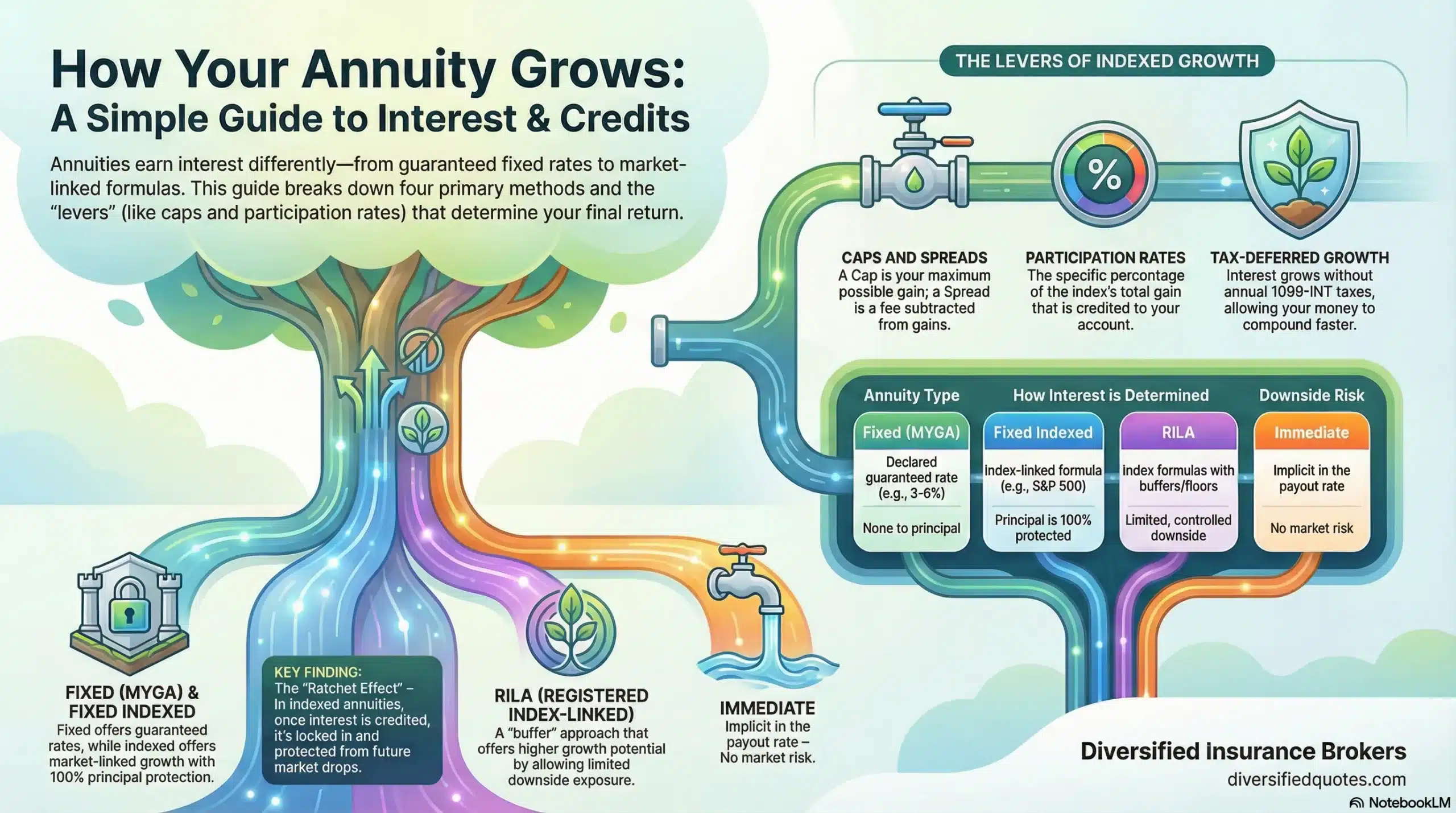
Fixed indexed annuities add a layer of sophistication by linking growth potential to market indices while protecting principal from market losses. When markets decline—whether a 10% correction or a 30% bear market—indexed annuities do not lose value due to index performance. The principal remains whole. However, gains may be capped through participation rate limits or crediting method caps that restrict how much of positive index performance gets credited to the contract. For example, an FIA might have a 60% participation rate in the S&P 500, meaning if the S&P 500 gains 10%, the FIA credits 6%. Or it might have an 8% annual cap, meaning gains above 8% in any year do not get credited. These limitations exist precisely because the carrier is absorbing all downside risk—the cap or participation limit is the tradeoff for principal protection. For conservative investors approaching or in early retirement, this structure can meaningfully reduce portfolio volatility while still offering growth potential beyond traditional fixed income instruments like bonds or CDs.
Principal protection becomes particularly important in the years immediately before and after retirement, often called the “retirement red zone.” A severe market downturn during this window—say, a 30-40% decline like those that occurred in 2008, 2020, and 2022—can permanently reduce sustainable income levels if the portfolio is forced to sell at depressed prices to meet living expenses. Imagine a retiree at age 62 who planned to retire at 65 with a $1 million portfolio generating 4% annual withdrawal ($40,000). If a bear market drops the portfolio to $600,000 before retirement, the new 4% withdrawal becomes only $24,000—a permanent 40% reduction in retirement income. By allocating a portion of assets to annuities with guaranteed floors before the retirement red zone begins, retirees can mitigate that sequence-of-returns risk and maintain confidence in their income plan. This is why many financial advisors recommend a “barbell” approach: some capital in guaranteed vehicles (annuities, fixed income) and some in growth-oriented investments that are not needed in the near term.
The carrier’s financial strength backing these guarantees is critical. Annuity guarantees are backed by the claims-paying ability and reserve requirements of the issuing insurance company, not by FDIC insurance or other federal deposit protection. Evaluating carrier ratings from AM Best (A- or higher is standard for meaningful allocations), understanding state guaranty association protections, and considering carrier diversification for large allocations all contribute to managing credit risk alongside market risk. Our resource on state guaranty association protections covers how state systems back annuity guarantees if an issuer faces financial difficulties.
Tax-Deferred Growth and Income Planning Efficiency
Annuities offer significant tax-deferral advantages that compound substantially over multi-year accumulation horizons. Earnings inside annuities accumulate without annual taxation until withdrawn, which meaningfully enhances long-term growth compared to taxable accounts where interest and dividends are taxed annually. Consider the mathematics: a $300,000 deposit earning 4% annually in a taxable account with a 24% tax rate on interest yields net annual growth of only 3.04% after taxes. The same $300,000 in an annuity compounds at the full 4%, producing significantly more capital after 10, 15, or 20 years. Our resource on how tax deferral creates generational compounding quantifies this benefit—it’s often 15-30% more wealth after 20 years, depending on the after-tax return in the taxable alternative.
Within qualified accounts such as traditional IRAs and 401(k)s, annuities follow standard IRA distribution rules, meaning distributions in retirement are taxed as ordinary income. In non-qualified accounts (funded with after-tax dollars), annuity taxation follows a last-in, first-out (LIFO) method, meaning only earnings are taxable when distributed until all gains are recovered. This exclusion ratio can make non-qualified annuities particularly attractive for clients with significant pre-tax retirement savings who want to shield additional savings from annual taxation. A retiree with a $500,000 401(k), a $200,000 IRA, and $400,000 in personal savings might allocate the personal savings to a non-qualified annuity, deferring taxation on that allocation while keeping pre-tax accounts available for RMD planning.
Coordinating annuities with Social Security, pensions, and required minimum distributions can help smooth tax brackets throughout retirement. For example, a retiree might delay Social Security to age 70 while using annuity income at ages 65-70, potentially keeping themselves in a lower tax bracket and maximizing the longevity credit that Social Security provides for delayed claiming. The income from a maturing annuity at age 68, combined with annuity distributions, might position the retiree in the 22% federal bracket, whereas triggering Social Security at 66 plus higher portfolio withdrawals might push them into the 24% or 32% bracket. The difference in taxes over a 20-year retirement can be substantial—$10,000-$30,000+ in many cases. Some retirees also explore how annuity death benefits are taxed compared to life insurance proceeds or other assets passed to heirs, recognizing that tax treatment of wealth transfer is another dimension of comprehensive planning.
The new tax provisions under the “One Big Beautiful Bill” Act (effective 2025) also create planning opportunities. Seniors 65 and older can claim up to a $6,000 additional deduction (or $12,000 for married couples both 65+), provided their modified adjusted gross income stays under specified limits. Strategic annuity purchases can help reduce taxable income and qualify for this new benefit. For example, a retiree with pension income, Social Security, and portfolio withdrawals might use a deferred income annuity (DIA) purchase to reduce current-year AGI, thereby qualifying for the surtax relief—and simultaneously positioning themselves for higher guaranteed income starting 5-10 years later.
Comparing Annuity Types and Structures
Choosing the right annuity depends on your primary objective. Each annuity type serves a different planning need, and understanding those distinctions prevents mismatching product to purpose.
| Annuity Type | Primary Focus | Growth Potential | Principal Protected | Best For |
|---|---|---|---|---|
| Fixed Annuity | Guaranteed interest rate for set term (3-10 years) | Predictable, fixed return (typically 3-5%) | Yes | Conservative investors seeking certainty and simplicity |
| Multi-Year Guaranteed (MYGA) | Fixed rate for longer commitment (typically 5-10 years) | Higher rates for longer terms (typically 4-5.5%) | Yes | Affluent retirees with multi-year accumulation horizon; laddering strategies |
| Fixed Indexed Annuity (FIA) | Index-linked growth with principal floor | Capped or participation-limited index upside; no downside | Yes | Moderate investors wanting upside with downside floors |
| Immediate Annuity (SPIA) | Convert lump sum to guaranteed income now | No growth; fixed lifetime payouts | N/A (immediate payout phase) | Retirees needing income immediately; longevity insurance |
| Deferred Annuity with Income Rider | Accumulate now, income guaranteed later | Varies by product and underlying crediting method | Partial (income benefit floor; account value at risk) | Mid-career to early-retirement accumulators; income planning 5-15 years out |
If rate maximization is your priority, reviewing today’s current annuity rates across multiple carriers and terms helps identify competitive options. If lifetime income is your goal, income rider comparisons are essential—evaluating payout factors (the percentage of the income base paid annually), roll-up rates (how quickly the income base grows), and rider costs (typically 0.5-1.25% annually) determines whether the income guarantee is worth the fee. Evaluating whether income riders have fees and understanding surrender charges and market value adjustments are critical before committing capital.
Annuity Benefits for Different Life Circumstances
Annuity benefits extend well beyond the basic advantage of guaranteed income. For couples, joint life options ensure a surviving spouse maintains income continuity—one of the most important beneficiary protections available. A joint life annuity with a 100% survivor benefit means the surviving spouse receives the same monthly payment after the first spouse’s death, providing crucial income stability for the widow or widower. For business owners, annuities can fund deferred compensation plans, key person insurance arrangements, or retirement buyout agreements—providing certainty that capital will be available when needed. For divorced individuals concerned about ex-spouse support obligations, certain annuity structures can provide protected income streams that are not subject to equitable distribution in subsequent legal proceedings. For special needs families, annuities can serve as guardianship assets that generate income without jeopardizing SSI or Medicaid eligibility when structured as ABLE account-compliant or special needs trust-held vehicles.
Retirees in good health with long life expectancy may benefit from longevity-focused strategies that prioritize maximum lifetime income over liquidity. Such retirees might use immediate annuities to maximize the longevity credit—the implicit return that comes from converting capital at rates that assume average life expectancy, which underprices income for those who live above-average lifespans. Conversely, those with shorter life expectancy or who value legacy planning might prioritize payout structures with period-certain guarantees or return-of-premium options, which ensure beneficiaries receive value even if the annuitant dies early. Some retirees layer annuities alongside other income sources strategically: Social Security provides the inflation-adjusted floor, annuities provide the guaranteed middle tier, and investment portfolios provide upside and flexibility. This three-layer approach allows each component to serve its highest purpose without forcing all assets to perform all functions simultaneously.
Understanding Annuity Benefits Requires Proper Education
Because annuities are issued by insurance companies rather than traded on public exchanges, rates and rider structures vary significantly between carriers. A contract from one company at one time differs materially from a contract offered by another company or by the same company six months later. Working with an independent brokerage like Diversified Insurance Brokers allows you to compare multiple companies simultaneously rather than being limited to a single provider or carrier representative.
We monitor rate changes daily and provide transparent comparisons of guarantees, surrender schedules, and liquidity provisions. Our education-first process ensures clients understand how contracts work, what riders cost, how different payout structures affect lifetime income, and what happens at contract maturity before making decisions. Many prospective buyers have fundamental questions about whether annuities are guaranteed, whether annuities are worth it, or how annuities fit within broader retirement strategies. We address all of these systematically, using your specific financial situation, timeline, and goals as the reference point—not generic industry talking points.
The value of working with a specialized independent firm is concrete. A client who receives quotes from their current insurance agent (who represents one carrier) sees one set of terms at one rate. The same client working with Diversified compares 5-10 carriers, sees material rate differences (often 20-50 basis points, which compound to significant dollars over 7-10 year terms), and makes an informed choice about which product and carrier best serve their actual goals. For a $500,000 annuity, a 30-basis-point rate advantage compounds to over $50,000 in additional income over a 10-year term.
Annuity Benefits in Volatile Markets
Market volatility highlights the value proposition of annuities more clearly than stable market environments. When stock markets experience sharp corrections—such as the 2020 COVID crash (down ~30%), the 2022 rate-hike downturn (down ~20%), or inevitable future declines—annuity holders with fixed or indexed contracts experience no loss to principal. This is not theoretical. In 2022, the S&P 500 fell 18.1% and the Nasdaq fell 32.4%. A retiree with a $500,000 portfolio split 50-50 between equities and a fixed annuity saw the equity portion decline to roughly $410,000 while the fixed annuity portion remained at $250,000. The portfolio’s combined value was $660,000 versus the $410,000 it would have been if fully in equities. More importantly, if that retiree needed to withdraw $24,000 that year (a 4% withdrawal rate), the annuity portion made that withdrawal without forcing equity sales at depressed prices. This is the behavioral benefit that prevents costly emotional decisions.
Fixed indexed annuities benefit even more directly from volatile environments because higher volatility increases the value of the embedded index option used to calculate index credits. In low-volatility environments, FIAs often see lower caps and participation rates offered by carriers because the index options cost less. In high-volatility environments like 2022, crediting methods adjust to reflect the underlying index option value, and carriers often improve caps and participation rates. While no retiree wants a bear market, if one occurs, FIA owners often see the tradeoff of lower caps in stable periods suddenly seem worth it when volatility drives improved crediting opportunities. Our resource on understanding sequence-of-returns risk covers the mathematical reality that the order of returns matters as much as average returns, and how annuities mathematically solve this problem.
Building an Annuity Strategy Aligned with Your Goals
No single annuity strategy works for all retirees. Those focused on securing the best annuity for guaranteed income in retirement might prioritize immediate or deferred income annuities with aggressive income riders. Conservative investors might favor fixed or MYGA contracts, possibly in a ladder structure to balance rate certainty with periodic access. Growth-oriented investors might combine indexed annuities with deferred income riders, balancing protection with upside participation. Life insurance professionals and business owners might use annuities for key person arrangements or deferred compensation, where the annuity’s guarantees provide certainty about available capital at a future date.
The Diversified Insurance Brokers approach begins with a comprehensive conversation about your timeline, risk tolerance, income goals, legacy objectives, and tax situation. We then model multiple scenarios, comparing proposals from 5-10 top carriers based on your specific profile. This process typically reveals 1-2 standout contracts that deliver superior benefits for your circumstances compared to generic off-the-shelf products or single-carrier quotes.
Ready to Explore Annuity Benefits?
Get a personalized comparison of today’s top rates and strategies, no pressure, no obligation.
Get Your Quote TodayKey Takeaways on Annuity Benefits
Annuity benefits center on four pillars: guaranteed income that lasts for life, principal protection from market losses, tax-deferred growth until withdrawal, and customizable structures that align with individual goals. Annuities are not appropriate for all of a retiree’s portfolio—holding 100% of retirement savings in annuities eliminates necessary flexibility and growth potential. But they play a critical role in creating the stable income foundation that enables peace of mind throughout retirement. By converting a portion of accumulated assets into guaranteed income, retirees can afford to take appropriate growth risk with remaining assets without jeopardizing essential spending. This is why so many sophisticated retirement plans pair annuities for basic needs (Social Security + annuity = guaranteed floor) with market-based portfolios for discretionary spending and growth.
The decision whether to purchase an annuity—and if so, what type, from which carrier, and with which riders—should be based on rigorous analysis of your personal situation, not sales pressure or generic industry advice. Working with an independent broker who compares multiple carriers and educates clients thoroughly provides the transparency and confidence necessary for such consequential decisions. For additional information, explore our guides on annuities 101, review why to work with an independent annuity broker, or request a personalized analysis today.
Related Annuity Resources
Dive deeper into annuity rates, calculators, and strategies.
Financial Protection Essentials
Protect your health and income with comprehensive insurance planning.
Talk With an Advisor Today
Choose how you’d like to connect—call or message us, then book a time that works for you.
Schedule here:
calendly.com/jason-dibcompanies/diversified-quotes
Licensed in all 50 states • Fiduciary, family-owned since 1980
What are the primary benefits of annuities?
The primary benefits include guaranteed lifetime income that cannot be outlived, principal protection in fixed and indexed annuities, tax-deferred growth on earnings, customizable payout structures, and the ability to reduce retirement income risk. Some conservative investors also explore MYGA annuity strategies for affluent individuals when building stable income plans.
Are annuities safe?
Fixed and fixed indexed annuities protect principal from market losses. Guarantees are backed by the financial strength and claims-paying ability of the issuing insurance company. Evaluating insurer strength and retirement platforms helps assess safety. Most major insurers carry strong AM Best ratings indicating solid financial stability.
How do annuity income riders work?
An income rider creates a separate income base (often called an income account or benefit base) that may grow at a guaranteed rate during the deferral period, sometimes 5-8% annually. When activated, it provides lifetime withdrawals based on age and payout structure, even if the actual account value fluctuates. This guarantees income regardless of market performance.
Do annuities offer tax advantages?
Yes. Earnings inside annuities grow tax-deferred until withdrawn. In non-qualified accounts, only earnings are taxable when distributed (LIFO method). IRA annuities follow standard IRA tax rules. Tax planning coordinated with Social Security, pensions, and RMDs can help smooth tax brackets throughout retirement. The new 2025 senior tax deduction can also be supported through strategic annuity planning.
Can annuities help reduce retirement risk?
Yes. By creating a guaranteed income floor, annuities reduce reliance on market withdrawals and help manage sequence-of-returns risk and longevity risk. A study from Morningstar found that retirees with annuities experienced measurably less portfolio volatility in withdrawal strategies and lower stress levels during market downturns.
What is the difference between fixed and indexed annuities?
Fixed annuities credit a guaranteed interest rate for a set period (3-10 years typically). Fixed indexed annuities credit interest based on index performance while protecting principal from market losses. Investors comparing safe growth vehicles should understand crediting methods, participation rates, and caps before committing.
How much income does an annuity provide?
Income depends on several factors: age at purchase, amount invested, deferral period, payout structure (life only vs. joint life vs. period certain), and current interest rate environment. A $500,000 annuity purchased at age 65 might provide $2,200-$2,800 monthly for a single life, or $1,900-$2,400 monthly for joint life with spouse. Use our annuity payout calculator for personalized estimates.
What are annuity surrender charges?
Surrender charges are penalties for withdrawing more than allowed (typically 10% annually) within the contract term (often 5-10 years). They decline each year and disappear at contract end. Understanding these constraints is critical before purchasing, as they limit emergency access to funds.
Who should buy an annuity?
Annuities are appropriate for retirees or near-retirees who prioritize guaranteed income, have accumulated significant retirement savings, are comfortable with reduced liquidity, and want to reduce portfolio risk and sequence-of-returns risk. They are less appropriate for those who need frequent access to capital or who believe they have shorter life expectancies.
What happens to my annuity if I die?
This depends on the payout structure selected. Life-only annuities stop at death, but beneficiaries may receive remaining accumulated value if purchased during the accumulation phase. Period-certain options guarantee income for a set term (e.g., 10, 15, or 20 years) to beneficiaries if the original owner dies early. Joint life options continue income to the surviving spouse. Discuss beneficiary protections with your advisor before purchasing.
About the Author:
Jason Stolz, CLTC, CRPC, DIA, CAA and Chief Underwriter at Diversified Insurance Brokers (NPN 20471358), is a senior insurance and retirement professional with more than 25 years of real-world experience helping individuals, families, and business owners protect their income, assets, and long-term financial stability. As a long-time partner of the nationally licensed independent agency Diversified Insurance Brokers, Jason provides trusted guidance across multiple specialties—including fixed and indexed annuities, long-term care planning, personal and business disability insurance, life insurance solutions, Group Health, Travel Medical and Evacuation Insurance, and short-term health coverage. Diversified Insurance Brokers maintains active contracts with over 100 highly rated insurance carriers, ensuring clients have access to a broad and competitive marketplace.
His practical, education-first approach has earned recognition in publications such as VoyageATL, and contributions from his agency featured in Kiplinger and GoBankingRates— highlighting his commitment to financial clarity and client-focused planning. Drawing on deep product knowledge and years of hands-on field experience, Jason helps clients evaluate carriers, compare strategies, and build retirement and protection plans that are both secure and cost-efficient. Visitors who want to explore current annuity rates and compare options across multiple insurers can also use this annuity quote and comparison tool.
Explore More Annuity Options: Browse our complete guide to Annuities 101 — covering annuity education, planning guides, pros & cons, how to choose & buy from 100+ carriers.
Last Reviewed: May 26, 2026 |
Reviewed by: Jason Stolz, CLTC, CRPC, DIA, CAA
Chief Underwriter, Diversified Insurance Brokers, Inc. | NPN: 20471358 | Diversified Insurance Brokers, Inc. — Licensed in all 50 states
Fact Checked by: Tonia Pettitt, CMIP©
Medicare Specialist, Diversified Insurance Brokers, Inc. | NPN: 14374308 | Diversified Insurance Brokers, Inc. — Licensed in all 50 states
Did you find this content helpful? Leave us a Google review — it helps others find trustworthy guidance too.
Editorial Standards: Diversified Insurance Brokers maintains rigorous editorial standards to ensure accuracy, clarity, and independence in all content. Learn more about our editorial standards and commitment to transparency.
