
Is Charles Schwab a Good Company?
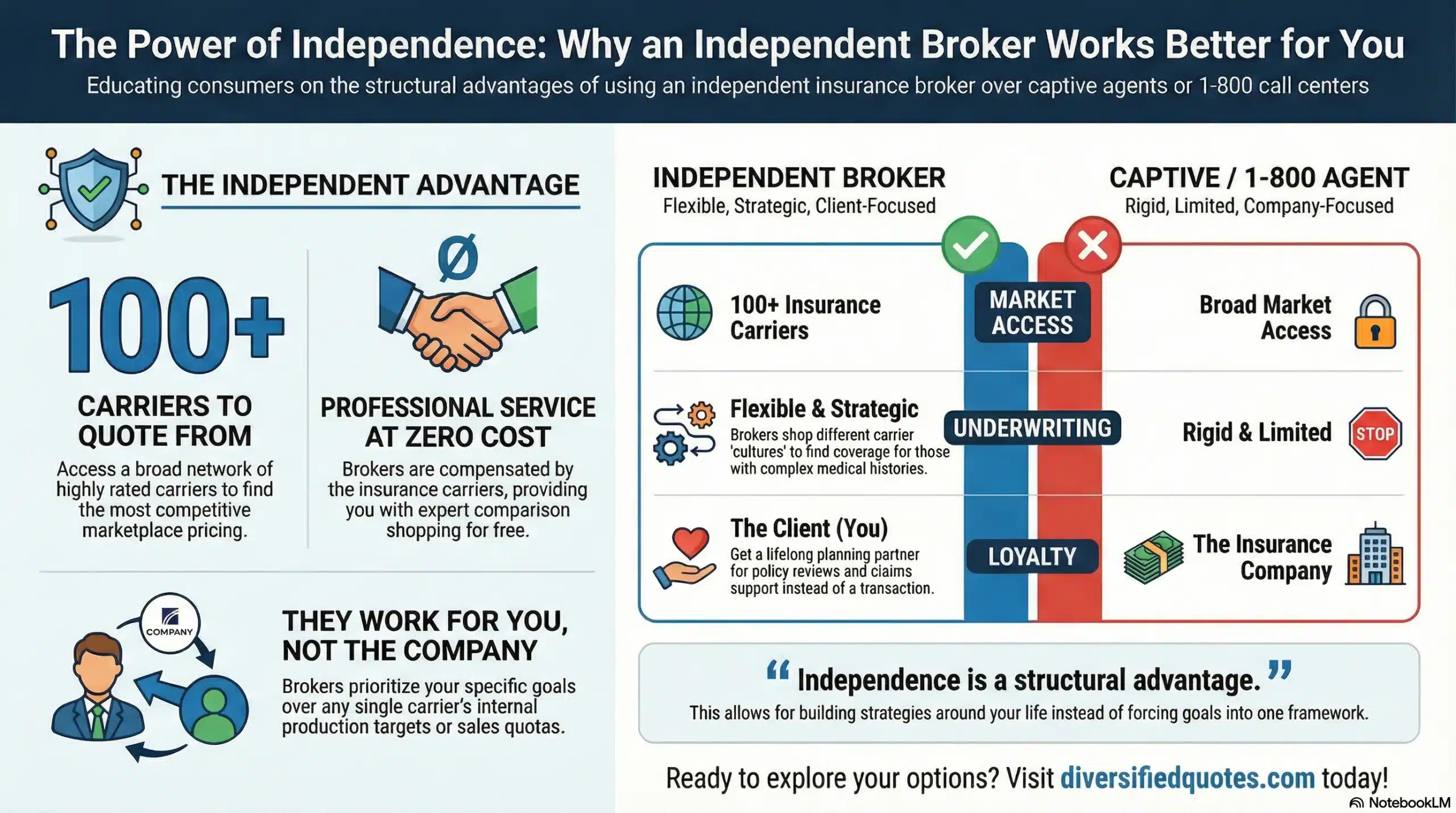
View the table near the end of the page to see why working with an independent insurance broker provides you the best possible rates.
Is Charles Schwab a Good Company?

Jason Stolz CLTC, CRPC, DIA, CAA
Charles Schwab is one of the most trusted names in American financial services — and one that most retirement savers encounter primarily as the custodian of their brokerage or IRA account rather than as an insurance or annuity carrier. Founded in 1971 and now headquartered in Westlake, Texas, The Charles Schwab Corporation (NYSE: SCHW) is a genuinely dominant financial institution: $11.90 trillion in total client assets across 46.5 million accounts, record revenue of $23.9 billion in 2025, and over 40% market share in registered investment advisor custody. It is SEC-regulated, FINRA-member, SIPC-covered, and FDIC-insured on its banking products. By any institutional stability measure, Schwab is one of the most financially sound and operationally trustworthy platforms an investor can work with. The question most visitors to this page are actually asking is more specific: can I trust Schwab with my retirement savings, and should I buy an annuity through Schwab or through the independent market? The answer requires understanding a distinction that Schwab itself discloses clearly but that many buyers miss: when you purchase an annuity through Charles Schwab, the financial guarantee backing that annuity comes from the insurance company that issued it — not from Schwab. Schwab functions as an annuity marketplace and custodian. Variable annuities, fixed indexed annuities, SPIAs, deferred income annuities, and MYGAs are all available through Schwab, but the underlying issuing carrier determines the product’s financial strength and the creditworthiness of the guarantee. For buyers with $100,000 or more to allocate — the minimum for all annuity contracts at Schwab — this distinction is critical to understand before comparing Schwab’s annuity offerings against the independent market. At Diversified Insurance Brokers, Jason Stolz, CLTC, CRPC, DIA, CAA, works with clients who hold accounts at Schwab and who want an independent evaluation of whether the annuity products available through Schwab’s platform match or exceed what is available through the full independent carrier market.
See Real-Term Rates Side by Side
Life Insurance Quoter
Ensure you are receiving the absolute top rates
Current Fixed Annuity Rates
Compare today’s best fixed annuity rates from top carriers.
Current Bonus Annuity Rates
See which annuities offer the highest upfront bonus today.
Request an Annuity Quote
Submit our annuity request form to get personalized rate options.
Lifetime Income Calculator
Use our calculator to see how much guaranteed income your annuity can provide.
What Schwab Offers and What Buyers Need to Understand
| Service / Product | How It Works | What Buyers Should Know |
|---|---|---|
| Brokerage Accounts | $0 commissions on stocks, ETFs, and options; access to mutual funds, bonds, CDs, futures; powerful thinkorswim trading platform (from TD Ameritrade acquisition); research tools and educational resources | SIPC coverage up to $500,000 on securities; Schwab also carries excess SIPC coverage beyond standard limits; Schwab Security Guarantee covers unauthorized account activity losses |
| Retirement Accounts (IRA, 401k, etc.) | Traditional IRA, Roth IRA, rollover IRA, SEP IRA, SIMPLE IRA, solo 401(k), inherited IRA; robo-advisor option through Schwab Intelligent Portfolios; managed portfolio services; strong retirement planning tools | Schwab is one of the best platforms for IRA rollovers from former employer plans; no account minimums and no annual IRA fees make it accessible; $0 commissions on ETF trades within the IRA |
| Banking | Checking, savings, money market, CDs, mortgage products through Charles Schwab Bank; FDIC-insured up to $250,000 per depositor; no ATM fees worldwide on checking | Schwab’s uninvested cash sweep rate has historically been below the rates available in money market funds or high-yield savings accounts; buyers who keep large cash balances at Schwab should actively move uninvested cash to higher-yielding options |
| Annuities (Marketplace) | Schwab offers variable annuities, fixed indexed annuities, registered index-linked annuities, SPIAs, deferred income annuities, and MYGAs — but as a marketplace, not an issuer; $100,000 minimum on all contracts; variable annuity fees 35-65% below industry average | The financial guarantee on any annuity purchased through Schwab comes from the issuing insurance carrier — not from Schwab itself; Schwab’s platform limits you to its approved carrier list, which may not include the best rates available in the full independent market |
| RIA Custody and Advisor Services | Schwab holds over 40% market share in registered investment advisor custody — the back-office infrastructure that independent financial advisors use to hold and manage client assets; the Schwab Advisor Network connects clients with vetted independent advisors | Many buyers interact with Schwab’s platform through their independent financial advisor without realizing Schwab is the custodian; this is a meaningful institutional endorsement — sophisticated RIAs trust Schwab with their clients’ assets |
Annuities at Schwab — The Honest Comparison
Schwab offers a wider range of annuity types than most people realize — variable, fixed indexed, registered index-linked, immediate income, deferred income, and fixed-rate MYGAs are all available on the platform. The genuinely strong point in Schwab’s annuity offering is fees: Schwab reports that its variable annuity fees run 35% to 65% below the industry average, which is a material advantage for buyers who want a variable annuity and are comparing total cost of ownership over a multi-year contract. The area where buyers consistently find Schwab’s annuity platform limiting is rate competitiveness on fixed products. Schwab’s annuity marketplace is not open to the full independent carrier market — it presents a curated selection of approved carriers, and the rates available through Schwab on MYGAs and FIAs are often below what the top-rate A-rated carriers in the independent market offer. Our resource on best MYGA annuity rates covers the full competitive market in real time, including how Schwab’s MYGA rates compare to the highest-rate A-rated alternatives on any given day. Two structural facts matter for buyers evaluating annuities at Schwab. First, the $100,000 minimum means Schwab’s annuity platform is not accessible for buyers with smaller allocations — the full independent market has carriers with minimums starting at $5,000 or $10,000. Second, the guarantee on any annuity at Schwab comes from the issuing insurance carrier — if the product is backed by Protective Life at A+, the guarantee is a Protective Life guarantee, not a Schwab guarantee. Schwab is the distribution channel and the custodian; the financial strength of the promise is the carrier’s. For buyers who are Schwab clients and want to understand whether the annuity products on Schwab’s platform are the best available for their specific need — or whether the independent market offers better rates or features — our resource on getting a second opinion on your annuity quote covers exactly that comparison process.
Is Schwab Safe? Account Protection Explained
For investors and retirees whose primary question is whether their money is safe at Schwab, the answer is clearly yes — with specific protections for specific account types. Brokerage accounts are covered by SIPC membership, which protects securities and cash up to $500,000 per account (including up to $250,000 in cash). Schwab also carries excess SIPC coverage that extends protection beyond the standard limits — covering the realistic balance levels that most Schwab clients actually hold. Banking accounts at Charles Schwab Bank are FDIC-insured up to $250,000 per depositor. For cash held in third-party bank sweep accounts, Schwab maintains Program Banks where the FDIC coverage applies. Schwab’s Security Guarantee covers unauthorized activity losses — if someone gains unauthorized access to your account and moves funds, Schwab commits to restoring the assets. The platform is SEC-regulated and FINRA-member, subject to regular compliance oversight. In March 2023, when Silicon Valley Bank and Signature Bank failed, Schwab experienced significant market speculation about potential vulnerability due to its bank subsidiary’s unrealized bond losses. Schwab was not at risk of failure — it had substantial liquidity and the bond losses were mark-to-market accounting entries that would resolve at maturity — but the episode led many clients to scrutinize Schwab’s balance sheet more carefully. By 2024 and through 2025, those concerns resolved as rates stabilized and Schwab delivered record results, but it is worth understanding that Schwab’s bank subsidiary and brokerage subsidiary are different legal entities with different protection structures. Your brokerage account assets are protected by SIPC regardless of what happens to Schwab Bank. For retirement savers who want to understand how an IRA or 401(k) rollover at Schwab fits into a comprehensive retirement income strategy — including when and whether to convert a portion of the Schwab account into guaranteed annuity income — our resources on how long an IRA lasts in retirement and sequence of returns risk cover the planning decisions that typically precede an annuity consideration from a Schwab account holder.
Talk With an Advisor Today
Choose how you’d like to connect—call or message us, then book a time that works for you.
Schedule here:
calendly.com/jason-dibcompanies/diversified-quotes
Licensed in all 50 states • Fiduciary, family-owned since 1980
Frequently Asked Questions: Is Charles Schwab a Good Company?
Is Charles Schwab financially stable and is my money safe there?
Yes — with protection layers that are specific to account type. Brokerage accounts are covered by SIPC membership up to $500,000 per account (including up to $250,000 in cash), and Schwab carries excess SIPC coverage beyond those standard limits. Banking accounts at Charles Schwab Bank are FDIC-insured up to $250,000 per depositor. Schwab reported record revenue of $23.9 billion and record earnings in 2025, holds $11.90 trillion in client assets across 46.5 million accounts, and has delivered a 50% year-over-year increase in adjusted earnings per share. The March 2023 concerns about Schwab Bank’s unrealized bond losses — which arose in the context of the Silicon Valley Bank failure — resolved as interest rates stabilized and Schwab’s financial position remained sound throughout. Your brokerage account assets are protected by SIPC regardless of what happens to Schwab Bank, because the two are separate legal entities. Schwab’s Security Guarantee additionally covers losses from unauthorized account activity.
Does Schwab sell annuities and are they worth buying through Schwab?
Schwab offers a marketplace of annuity products — variable annuities, fixed indexed annuities, registered index-linked annuities, SPIAs, deferred income annuities, and MYGAs — but as a distributor, not as the issuing carrier. All contracts require a $100,000 minimum. The most clearly competitive segment of Schwab’s annuity offering is variable annuities, where Schwab reports fees 35% to 65% below the industry average — a genuine advantage for buyers who want market-linked growth within an annuity structure. For fixed products — MYGAs and fixed indexed annuities — the rates available through Schwab’s curated marketplace are often below the best rates available from A-rated carriers in the full independent market. An important clarification: the financial guarantee on any annuity you purchase through Schwab comes from the issuing insurance carrier, not from Schwab itself. If the product is backed by an A+-rated carrier, the guarantee is that carrier’s obligation. Schwab is the distribution and custody platform. For a real-time comparison of Schwab’s annuity rates against the full independent market, our rate tools above cover the field, and our resource on getting a second opinion on your annuity quote covers the independent comparison process.
Should I roll my 401(k) into an IRA at Schwab when I leave my employer?
Schwab is a strong platform for a rollover IRA — no account minimums, no annual IRA fees, $0 commissions on ETF trades, extensive investment selection, and retirement planning tools that are among the best available from a self-directed brokerage. The rollover process is straightforward, and Schwab’s customer service for this type of transaction is generally well-regarded. The decision of where to roll over matters less than the mechanics of the rollover itself: always execute a direct rollover — funds transfer directly from your former employer’s plan to your IRA custodian — to avoid the 20% mandatory withholding that applies if you receive the check in your name. What to evaluate after the rollover is in place: whether a self-directed IRA at Schwab is the right long-term vehicle for your retirement savings, or whether allocating a portion to guaranteed income through an annuity makes sense given your timeline and income needs. Our resource on how long an IRA lasts in retirement and our resource on sequence of returns risk cover the planning decisions that most people face after the rollover is complete.
How does Schwab compare to Fidelity and Vanguard for retirement investors?
All three are strong, trustworthy platforms for retirement savers, and the differences are real but largely marginal for most investors. Schwab’s distinctive strengths: the thinkorswim trading platform (from the TD Ameritrade acquisition) for active traders, the Schwab Advisor Network for connecting with independent advisors, strong RIA custody infrastructure, and a full-service banking relationship with FDIC-insured accounts. Fidelity’s distinctive strengths: fractional shares on individual stocks, strong mutual fund lineup including zero-fee index funds, and consistent recognition for retirement account management. Vanguard’s distinctive strengths: ownership structure (investor-owned, no external shareholders) and the index fund cost leadership that Vanguard pioneered. For annuity buyers specifically, none of the three operate as standalone independent annuity comparison marketplaces the way a dedicated annuity broker does — each limits you to its approved carrier list and its pricing. For buyers who are Schwab clients and want to know whether the annuities available through Schwab’s platform are the best the market offers, an independent annuity broker running a multi-carrier comparison is the right addition to the due diligence process, not a replacement for Schwab’s platform itself.
I have a large IRA at Schwab approaching retirement. Should I convert some to guaranteed income?
The question of converting a portion of a Schwab IRA or brokerage account to guaranteed income is one of the most consequential decisions retirement savers face, and the right answer depends on factors specific to your situation: Social Security claiming strategy, pension income if any, monthly expense requirements, health status, and risk tolerance. The core planning insight: a market-linked portfolio at Schwab can potentially generate higher returns over a long retirement, but it cannot guarantee a specific monthly income regardless of what markets do. An annuity — whether a SPIA that starts income immediately or an FIA with a guaranteed lifetime withdrawal benefit — guarantees a specific monthly amount for life, regardless of market performance. The two work together rather than competing: most financial plans for retirement benefit from a guaranteed income floor from Social Security and an annuity, with the remaining assets invested at Schwab for growth and flexibility. Our resource on how Social Security and annuities work together covers the coordination strategy that most retirement income plans rely on, and our resource on MYGA strategies for affluent individuals covers how larger IRA balances — the type typically held at Schwab — approach the annuity allocation decision.
About the Author:
Jason Stolz, CLTC, CRPC, DIA, CAA and Chief Underwriter at Diversified Insurance Brokers (NPN 20471358), is a senior insurance and retirement professional with more than 25 years of real-world experience helping individuals, families, and business owners protect their income, assets, and long-term financial stability. As a long-time partner of the nationally licensed independent agency Diversified Insurance Brokers, Jason provides trusted guidance across multiple specialties—including fixed and indexed annuities, long-term care planning, personal and business disability insurance, life insurance solutions, Group Health, Travel Medical and Evacuation Insurance, and short-term health coverage. Diversified Insurance Brokers maintains active contracts with over 100 highly rated insurance carriers, ensuring clients have access to a broad and competitive marketplace.
His practical, education-first approach has earned recognition in publications such as VoyageATL, and contributions from his agency featured in Kiplinger and GoBankingRates— highlighting his commitment to financial clarity and client-focused planning. Drawing on deep product knowledge and years of hands-on field experience, Jason helps clients evaluate carriers, compare strategies, and build retirement and protection plans that are both secure and cost-efficient. Visitors who want to explore current annuity rates and compare options across multiple insurers can also use this annuity quote and comparison tool.
Review More Carrier Reviews: Browse our complete Financial Company Reviews — covering Fidelity Investments, Vanguard, Charles Schwab, Edward Jones, and more.
Last Reviewed: June 12, 2026 |
Reviewed by: Jason Stolz, CLTC, CRPC, DIA, CAA
Chief Underwriter, Diversified Insurance Brokers, Inc. | NPN: 20471358 | Diversified Insurance Brokers, Inc. — Licensed in all 50 states
Fact Checked by: Tonia Pettitt, CMIP©
Medicare Specialist, Diversified Insurance Brokers, Inc. | NPN: 14374308 | Diversified Insurance Brokers, Inc. — Licensed in all 50 states
Did you find this content helpful? Leave us a Google review — it helps others find trustworthy guidance too.
Editorial Standards: Diversified Insurance Brokers maintains rigorous editorial standards to ensure accuracy, clarity, and independence in all content. Learn more about our editorial standards and commitment to transparency.
