
Best 2 Year Annuity Rate
As an Independent Annuity Broker, we compare rates across 100+ carriers and 1,000 different annuities— not just one company’s product offerings — to find the best fit for your goals.
Best 2 Year Annuity Rate

Jason Stolz CLTC, CRPC, DIA, CAA
The best 2-year annuity rate represents something specific in the fixed annuity marketplace: the first term where meaningful rate improvement over 1-year products appears without requiring a commitment measured in half-decades. The buyer accepts twelve additional months of commitment and is compensated with a higher declared rate — a trade-off whose dollar value depends entirely on deposit size and is straightforward to calculate against your own premium. More importantly, the 2-year tier is where a meaningful number of A-rated and A- rated carriers become genuinely competitive, frequently landing within a fraction of a percentage point of the term’s rate leader. This carrier diversity — investment-grade companies competing inside a narrow rate band alongside lower-rated carriers — is what makes the 2-year tier specifically interesting for buyers who want to balance competitive yield with financial strength without sacrificing either completely. At the 1-year tier, the carrier universe is narrow. At 5-to-10-year terms, B-rated carriers tend to dominate the highest rates by wider margins. The 2-year term sits at a point where A-rated carriers can genuinely compete, giving buyers a more complete choice across the quality spectrum at competitive yields. Understanding this dynamic — and evaluating every carrier in the table on the complete picture of rate, carrier strength, and penalty-free withdrawal provisions rather than the headline rate alone — is the correct analytical framework for the 2-year MYGA decision. For the broader fixed annuity context before narrowing to the 2-year tier, our annuities overview and the highest guaranteed annuity rates page provide the complete market perspective.
The 2-year MYGA serves buyers who are committed enough in their planning that the 1-year term’s maximum flexibility is more than they need, but whose planning horizon or risk tolerance does not yet support a 3-to-5-year surrender period. This is a genuine planning position for a meaningful segment of conservative savers — not a compromise between options, but the correct structural choice for buyers whose actual planning horizon is 24 months. A retiree who expects to make a significant financial decision — downsizing a home, gifting funds to children, repositioning their overall retirement income allocation — in approximately two years is best served by a 2-year MYGA rather than either a 1-year (too many renewals and transaction friction for a 2-year horizon) or a 3-year (one additional year of surrender commitment beyond the actual planning horizon). Matching the MYGA term to the actual planning decision horizon is the primary determinant of the correct term selection — and for buyers whose real horizon is 24 months, the 2-year MYGA’s rate improvement over the 1-year tier, combined with the available A-rated carrier options, frequently makes it the cleanest and most appropriate choice. For buyers who have already determined they want the short-term tier of the MYGA market generally, our resource on best short-term MYGA annuities covers the full 1-to-3-year landscape for comparison context. For those who may be anchoring on common annuity myths that are limiting their evaluation of the 2-year tier, our dedicated resource addresses those misconceptions directly.
The penalty-free withdrawal provisions across the carriers in the 2-year rate table reveal an important dimension of the comparison that the headline rate alone does not capture, because those provisions are not standardized. Some carriers allow a stated percentage of the accumulation value each year beginning immediately. Others allow the same percentage but only from year two, leaving the first twelve months with no penalty-free access at all. Others permit interest-only withdrawals, which is a less flexible provision than a percentage-of-accumulation-value approach because the accessible amount is capped by what the contract has actually credited. And the percentage itself varies from one carrier to the next. For buyers who expect to need any access to funds during the 2-year term, these provisions may matter as much as the rate differential between the top of the table and the carriers sitting just below it. A buyer with a specific annual dollar need should work backward: divide that amount by the deposit to get the percentage of accumulation value required, then read the withdrawal column and eliminate every carrier whose provision cannot accommodate it — including any carrier offering nothing in year one if the need begins immediately. This is why evaluating the full contract terms alongside the headline rate is the correct analytical approach for any MYGA selection. Our resource on market value adjustments provides the complete context for understanding how MVA provisions interact with penalty-free withdrawal terms for any of these carriers.
Ensure you are receiving the absolute top rates
Current Fixed Annuity Rates
Compare today’s best fixed annuity rates from top carriers.
View Current RatesCurrent Bonus Annuity Rates
See which annuities offer the highest upfront bonus today.
View Bonus RatesRequest an Annuity Quote
Submit our annuity request form to get personalized rate options.
Quote Request FormLifetime Income Calculator
Use our calculator to see how much guaranteed income your annuity can provide.
What Is a 2-Year Fixed Annuity — And Why the 24-Month Commitment Is Meaningful
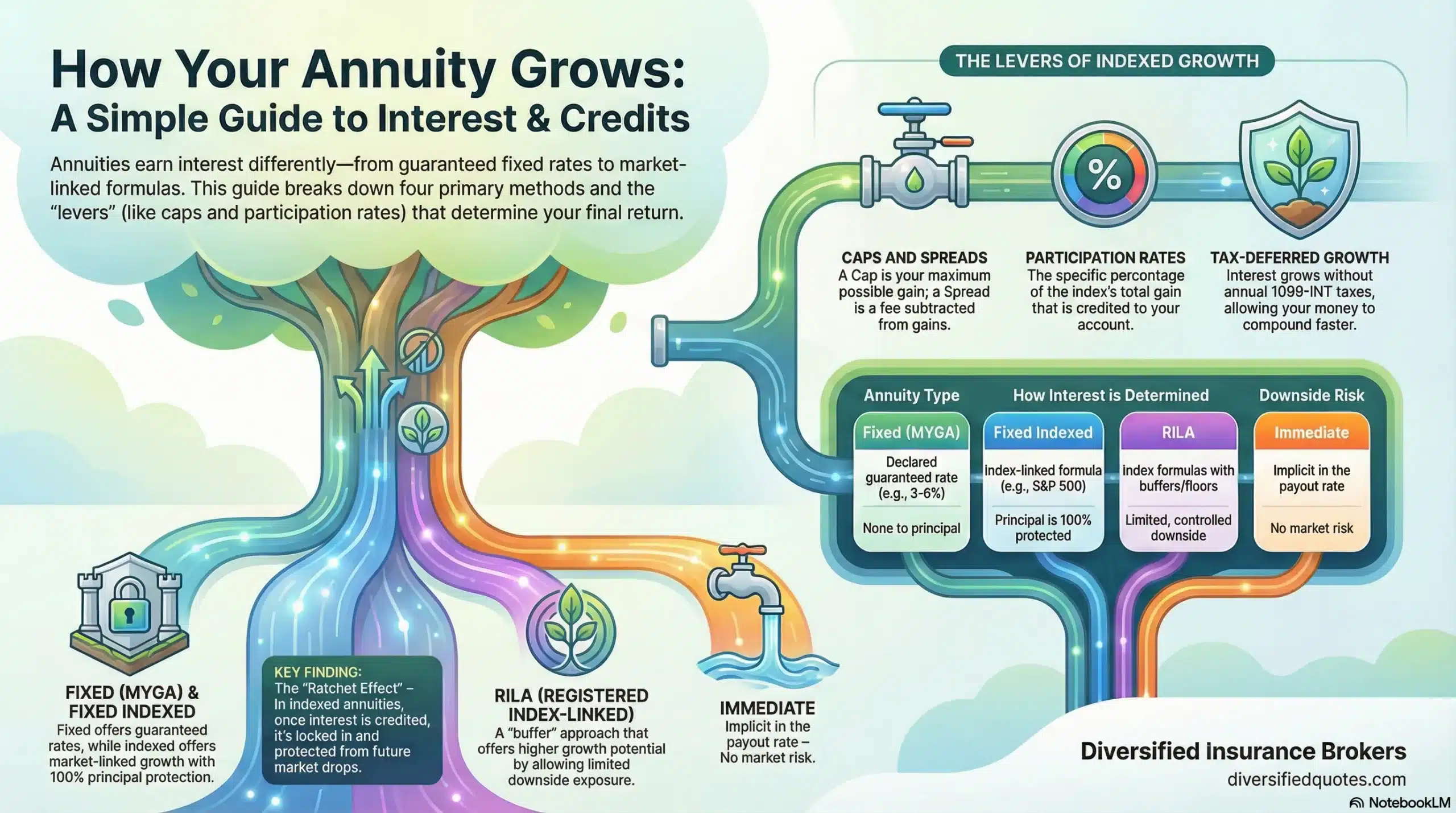
A 2-year fixed annuity is a MYGA (Multi-Year Guaranteed Annuity) that declares a guaranteed interest rate at issuance and applies that rate for exactly 24 months. The contract provides complete principal protection — the accumulated value cannot decline due to market conditions — and credits the declared rate annually (or at the contract’s specified crediting schedule) throughout the 2-year period. Interest accumulates tax-deferred inside the contract for non-qualified money, generating no annual 1099 during the holding period. At the end of month 24, a maturity window opens — typically 30 days — during which the buyer can withdraw the full accumulated value penalty-free, renew into a new 2-year or different-term contract at then-current rates, or reposition the funds into a different annuity structure. A 24-month commitment is not the same as a 5-year commitment in the buyer’s daily financial life — it is a relatively short period that many buyers find genuinely manageable without sacrificing meaningful yield improvement over 12-month alternatives. The 2-year MYGA’s placement in the rate spectrum — above the 1-year tier by a meaningful margin, and below the 3-to-7-year tiers where the most significant rate improvements are concentrated — makes it a distinct choice for buyers whose actual horizon is approximately 24 months rather than either shorter or longer.
💰 Current Best 2-Year Annuity Rates (as of October 2026)
The table below shows the best available 2-year fixed annuity declared rates from competitive carriers, including penalty-free withdrawal provisions that are essential for comparing the full contract picture alongside the headline rate. Rates change frequently — confirm live quotes for your state and premium amount. The carrier review pages linked in the Provider column provide detailed financial strength analysis for each carrier listed.
| Company | AM Best Rating | Current Rate | Penalty-Free Withdrawal |
|---|---|---|---|
| Mountain Life | B- | 5.25% | 5% / None yr 1 |
| CL Life | B++ | 5.25% | Interest only |
| Axonic | A- | 5.15% | 10% / None yr 1 |
| Oceanview | A | 5.15% | 10% / None yr 1 |
| GBU Life | A- | 5.05% | 10% |
Rates are subject to change and may vary by state, age, and deposit size. Some of the highest annuity rates are sometimes offered by carriers with B or B+ ratings. We also work with many A-rated carriers. The most important factor is finding the right option for your goals — contact us to compare both segments for your specific situation.
Compare Annuity Income by Investment Amount
See estimated income examples for different annuity investment amounts to understand how payouts can scale.
Reading the 2-Year Rate Table Correctly — Rate, Carrier Strength, and Withdrawal Provisions Together
The carriers in the 2-year rate table typically span a meaningful range of financial strength ratings inside a compressed declared rate band. That combination — a wide quality spectrum within a narrow rate spread — is the defining characteristic of the 2-year tier, and it is the reason the carrier selection decision at two years is more nuanced than at longer terms where lower-rated carriers lead by larger margins. The relevant comparison questions are: how much rate improvement does accepting a lower carrier quality tier actually provide at this term, and do the penalty-free withdrawal provisions align with the buyer’s expected usage pattern?
That first question is worth answering with arithmetic rather than intuition. Take the rate leader and the highest-rated carrier in the table, subtract the lower rate from the higher, multiply by your deposit, then multiply again by two for the full term. The result is the effective premium you would be paid for accepting the weaker balance sheet over twenty-four months — and on the compressed spreads typical of this tier, that figure is frequently smaller than buyers assume before they calculate it. Whether the premium is worth taking depends on the buyer’s specific situation: premium size relative to state guaranty association limits, comfort with a lower-rated carrier across a twenty-four-month relationship, and overall risk tolerance for the conservative portion of the portfolio. Buyers for whom the additional interest is genuinely meaningful may find a lower-rated carrier entirely appropriate at this term length. Buyers for whom carrier financial strength is a primary concern — particularly at larger premium amounts, or where investment-grade counterparties are a requirement across the whole conservative allocation — will usually find at least one A-rated or A- rated option in the table sitting only a fraction of a point below the leader, which is precisely what distinguishes this term from longer ones. For the full details on how to evaluate any carrier in the table, each carrier name links to a dedicated review page.
The 2-Year vs. 1-Year and 3-Year Decision — Where the 24-Month Commitment Earns Its Place
The 2-year MYGA earns its place in the term spectrum through a rate-flexibility trade-off worth quantifying against your own numbers rather than in the abstract. Compared to a 1-year MYGA, the two-year term pays a higher declared rate in exchange for twelve additional months of commitment. To value that precisely, subtract the 1-year rate from the 2-year rate, multiply by your premium, and multiply by two — the result is the additional guaranteed interest the longer commitment produces across the full term relative to two sequential one-year contracts. A buyer who genuinely does not need access within twenty-four months captures that difference at no practical cost. Compared to a 3-year MYGA, the same calculation runs in the other direction, and the question becomes whether twelve additional months of surrender commitment is worth the interest the longer term would add. If the buyer’s actual planning horizon genuinely extends to thirty-six months, the three-year is almost always the better choice. If the realistic horizon is closer to twenty-four months, the two-year provides the better commitment-adjusted value. One assumption belongs in both comparisons: stacking shorter contracts back to back assumes whatever rate happens to be available at each renewal, and that rate is unknowable when the first contract is signed, while a single longer contract locks it for the entire period. The 2-year MYGA is not the right choice as a conservative compromise between two other options — it is the right choice when the buyer’s actual planning horizon is genuinely 24 months.
The Penalty-Free Withdrawal Comparison — Why the Withdrawal Column Matters as Much as the Rate
The carriers in the 2-year table carry meaningfully different penalty-free withdrawal provisions, and for buyers who expect to need any access to funds during the term, those provisions are as important as the declared rate. Four patterns recur at this term length. The most flexible is a stated percentage of the accumulation value available annually from contract inception, which gives the buyer access in both year one and year two. Next is the same percentage available only from year two, leaving the first twelve months with no penalty-free access whatsoever — a provision that regularly catches buyers who assumed the allowance applied immediately. Third is an interest-only allowance, where the accessible amount is limited to what the contract has actually credited rather than a percentage of the full accumulation value, which generally produces a smaller withdrawal capacity than a double-digit percentage provision. Fourth, and least flexible, is a lower stated percentage, which can cut the available amount roughly in half compared with carriers offering the more generous allowance.
These differences matter significantly for buyers who plan to take systematic withdrawals from a 2-year MYGA — for income supplementation, interest harvesting on the CD-alternative model, or RMD accommodation inside qualified-account contracts. The method is the same in every case. Establish the dollar amount you expect to need each year and the year in which the need begins, express that amount as a percentage of your deposit, then read the withdrawal column and strike every carrier that cannot accommodate it. A need beginning in month one eliminates every carrier offering nothing in year one, regardless of how attractive its rate is. A need approaching a double-digit percentage of the deposit eliminates every carrier offering a lower percentage or interest-only access. Running that filter before comparing rates prevents the most common version of this mistake, which is selecting on rate and discovering the access limitation afterward, when the contract is already in force.
Why a 2-Year Term Appeals to Conservative Investors
The 2-year MYGA appeals to a specific type of conservative investor who is navigating the tension between rate uncertainty and commitment length. A buyer who is uncertain whether rates will be higher or lower in twenty-four months faces a genuine choice, and the two-year term answers it symmetrically. If rates decline after purchase, the contract holder is protected for the full twenty-four months at a rate the market no longer offers. If rates continue to rise, the commitment expires soon enough that the buyer can re-enter at the improved level without having forgone years of better returns. That symmetry is the term’s central appeal, and it distinguishes the 2-year buyer both from the 1-year buyer, who wants maximum flexibility and pays for it in yield, and from the 5-year buyer, who is willing to commit further out along the curve in exchange for the longest available rate lock. The 2-year buyer wants to participate in prevailing rates without foreclosing the ability to reassess within a reasonable timeframe. For buyers who hold their conservative allocation alongside other portfolio components — market investments, real estate, or other annuity structures — the 2-year MYGA provides a defined boundary for when the fixed-rate portion will next come up for reassessment. This portfolio integration context is covered in our resource on the annuities overview, which addresses how fixed annuity allocations interact with broader retirement planning strategies.
Principal Protection and Tax-Deferred Growth at the 2-Year Term
Two of the most important features of a 2-year MYGA are not unique to the 2-year tier but are particularly relevant to buyers evaluating it against bank alternatives. The first is principal protection: unlike a bond fund or any market-linked instrument, the 2-year MYGA cannot lose value due to market conditions. The declared rate is the floor for accumulation — the accumulated value after 2 years will be exactly premium plus 2 years of compound interest at the declared rate, regardless of what equity or bond markets do during the period. The second is tax deferral: for non-qualified (after-tax) money, the interest credited inside the 2-year MYGA generates no annual 1099. Compared to a 2-year CD that generates taxable interest annually regardless of whether the buyer withdraws — requiring the buyer to pay income tax in year one on interest they may not access until year two — the MYGA’s deferral provides a meaningful after-tax yield advantage for buyers in higher income tax brackets. Over a 2-year period, this advantage compounds: the full pre-tax interest from year one remains in the contract and earns interest in year two, while the CD buyer’s year-one after-tax position (reduced by the income tax paid) earns interest in year two on a smaller base. The detailed after-tax comparison across multiple tax brackets is covered in our resource on fixed annuities vs. CDs. For buyers who want the complete picture on non-qualified annuity tax mechanics, our non-qualified annuity guide provides the full treatment. And for buyers evaluating whether any fees might reduce the effective yield, standard MYGAs carry no ongoing management or administrative charges, so the declared rate is the net credited rate — our annuity overview sets that alongside the other annuity structures for context.
Who Should Specifically Consider a 2-Year MYGA
The 2-year MYGA serves buyers with a 24-month planning horizon who want more yield than the 1-year tier provides without committing to a 3-to-5-year surrender period. Five specific buyer profiles emerge most frequently at this term length. Buyers with maturing 2-year CDs who are renewing conservative savings and want to capture the MYGA’s tax deferral and competitive rate improvement represent the most common category. Buyers who expect a significant financial decision — real estate transaction, retirement income strategy finalization, major estate planning decision — in approximately two years use the 2-year MYGA as a structured holding period that provides competitive growth without committing to a longer surrender. Buyers building a fixed annuity ladder who want the 2-year rung in their staggered maturity structure — typically combined with a 1-year, 3-year, and 5-year rung — use the 2-year position to capture a rate improvement over the 1-year while maintaining a maturity window in 24 months. Buyers who have completed a retirement account rollover and want a conservative 2-year holding position before finalizing their long-term income strategy use the 2-year MYGA to earn competitive interest while the long-term plan is determined. For these buyers, the resources on what to do with a 401(k) after retiring and what to do with an IRA after retiring provide the broader context for the rollover-to-annuity decision that precedes the 2-year MYGA placement. And buyers who want the transitional positioning that a fixed indexed annuity with a lifetime income rider will eventually provide, but who are not yet ready to commit to the FIA’s longer surrender period, use the 2-year MYGA as the bridge to that longer-term income structure.
Using a 2-Year Annuity in a Ladder Strategy
The 2-year MYGA is one of the most commonly included rungs in a well-designed fixed annuity ladder — providing the second maturity window in a staggered structure that creates annual or biennial liquidity opportunities while capturing rates across multiple points on the MYGA yield curve. A practical ladder combining the 1-year, 2-year, 4-year, and 5-year terms on $400,000 total premium might allocate $100,000 to each rung. The first rung matures twelve months after issue, the second at twenty-four months, the third at forty-eight, and the fourth at sixty. This creates four independent maturity decisions across a five-year planning window, with no single rate environment determining the entire portfolio’s reinvestment timing. The 2-year rung in this structure provides the second scheduled liquidity window — ensuring that after the first maturity at the twelve-month mark, the buyer does not face a full two-year gap before the next decision point. Laddering strategies reduce reinvestment risk by distributing it across multiple future dates rather than concentrating it at one point, and the 2-year rung’s specific placement makes it a natural midpoint connector between the short-term flexibility tier and the medium-term rate-capture tier of the ladder.
Market Value Adjustments on 2-Year MYGAs — Understanding the Early Exit Mechanics
Some 2-year MYGA contracts include a Market Value Adjustment provision that affects the value received on surrenders or withdrawals above the penalty-free allowance during the 2-year term. Understanding what a market value adjustment is is essential before selecting any 2-year MYGA that includes this feature. An MVA adjusts the surrender value based on interest rate movements since the contract was issued — if rates have risen, the MVA reduces the surrender value; if rates have declined, the MVA increases it. For 2-year MYGAs specifically, the MVA applies only to early exits above the penalty-free withdrawal allowance — buyers who hold through the full 24-month term and access funds only during the penalty-free maturity window are unaffected by the MVA regardless of which direction rates moved during the period. The practical significance of the MVA is highest for buyers who anticipate needing access to funds above the penalty-free allowance during the 2-year term. For those buyers, a non-MVA product at a modestly lower rate may be the better selection. Confirming whether any specific 2-year MYGA includes an MVA — and how it would affect the buyer’s expected withdrawal scenarios — is part of the complete pre-purchase evaluation. Our resource on annuity surrender charges explained covers the mechanics of both surrender charges and MVA provisions for short-term MYGA contracts.
Funding a 2-Year MYGA — Qualified Accounts and Non-Qualified Money
A 2-year MYGA accepts both qualified (IRA, 401k, 403b, TSP, SIMPLE IRA, SEP IRA, Roth IRA) and non-qualified (after-tax personal savings) funding. The transfer mechanics for each account type are covered in the Retirement Transfer Guides below, which provide step-by-step guidance for each qualified account category. For non-qualified money, the 2-year MYGA’s tax deferral provides the after-tax yield advantage described above — no annual 1099 on accrued interest during the 2-year period. For qualified money, the 2-year MYGA provides the declared rate and principal protection within the account’s existing tax-deferred framework. RMD provisions should be confirmed for any qualified-account 2-year MYGA — most products accommodate RMD withdrawals without surrender charges, but this must be verified for the specific product before funding. For buyers who hold existing non-qualified annuity contracts with lower declared rates and are evaluating whether to 1035 exchange into a 2-year MYGA to capture a better available rate, our annuity rescue plan resource provides the break-even analysis framework for evaluating any exchange. The annuity beneficiary death benefits guide covers how named beneficiaries work across 2-year MYGA contracts — including how the accumulated value passes at the owner’s death and the beneficiary’s distribution options.
Compare Annuity Rates by Term Length
If a 2-year commitment is shorter than your actual planning horizon, the following term-specific resources show what additional yield is available at each step up the term ladder. The single step from two years to three is often the most impactful comparison for buyers near the 2-year decision, since it typically delivers a meaningful rate improvement in exchange for only twelve additional months of commitment.
Request a Personalized 2-Year Quote
Receive customized comparisons from top-rated carriers based on your timeline and deposit amount — including both B-rated and A-rated carrier options with full penalty-free withdrawal details.
Talk With an Advisor Today
Choose how you’d like to connect—call or message us, then book a time that works for you.
Schedule here:
calendly.com/jason-dibcompanies/diversified-quotes
Licensed in all 50 states • Fiduciary, family-owned since 1980
About the Author:
Jason Stolz, CLTC, CRPC, DIA, CAA and Chief Underwriter at Diversified Insurance Brokers (NPN 20471358), is a senior insurance and retirement professional with more than 25 years of real-world experience helping individuals, families, and business owners protect their income, assets, and long-term financial stability. As a long-time partner of the nationally licensed independent agency Diversified Insurance Brokers, Jason provides trusted guidance across multiple specialties—including fixed and indexed annuities, long-term care planning, personal and business disability insurance, life insurance solutions, Group Health, Travel Medical and Evacuation Insurance, and short-term health coverage. Diversified Insurance Brokers maintains active contracts with over 100 highly rated insurance carriers, ensuring clients have access to a broad and competitive marketplace.
His practical, education-first approach has earned recognition in publications such as VoyageATL, and contributions from his agency featured in Kiplinger and GoBankingRates— highlighting his commitment to financial clarity and client-focused planning. Drawing on deep product knowledge and years of hands-on field experience, Jason helps clients evaluate carriers, compare strategies, and build retirement and protection plans that are both secure and cost-efficient. Visitors who want to explore current annuity rates and compare options across multiple insurers can also use this annuity quote and comparison tool.
Explore More Annuity Options: Browse our complete guide to Current Annuity Rates — covering current fixed, bonus, MYGA & income annuity rates by term from top carriers from 100+ carriers.
Last Reviewed: October 16, 2026 |
Reviewed by: Jason Stolz, CLTC, CRPC, DIA, CAA
Chief Underwriter, Diversified Insurance Brokers, Inc. | NPN: 20471358 | Diversified Insurance Brokers, Inc. — Licensed in all 50 states
Fact Checked by: Tonia Pettitt, CMIP©
Medicare Specialist, Diversified Insurance Brokers, Inc. | NPN: 14374308 | Diversified Insurance Brokers, Inc. — Licensed in all 50 states
Did you find this content helpful? Leave us a Google review — it helps others find trustworthy guidance too.
Editorial Standards: Diversified Insurance Brokers maintains rigorous editorial standards to ensure accuracy, clarity, and independence in all content. Learn more about our editorial standards and commitment to transparency.
