
2nd Opinion Quote Review
2nd Opinion Quote Review

Jason Stolz CLTC, CRPC
A 2nd opinion quote review is one of the most valuable steps in any insurance or retirement planning decision — and the most consistently skipped. The reason most people skip it is the same reason it matters: the process of getting a first quote feels thorough. You answered questions. An agent ran numbers. A proposal was presented with professional formatting and confident explanations. It feels like a complete process. What is not visible from inside that process is how narrow it actually is — one agent’s product knowledge, one company’s underwriting appetite, one set of assumptions that may or may not reflect what the full market offers for your specific situation.
At Diversified Insurance Brokers, a second opinion is not a criticism of the first proposal you received. It is a structured comparison against the full marketplace — 100+ carriers across annuities, life insurance, disability insurance, long-term care, group health, and Medicare — that answers one specific and important question: is what you were shown the best available option for your situation, or did something better go unexamined? In many cases we confirm the original proposal is strong, and the client moves forward with genuine confidence rather than residual uncertainty. In a significant number of cases, we find meaningful improvements — lower premiums for equivalent coverage, better income projections for the same deposit, more appropriate product structure, or a carrier whose underwriting is demonstrably more favorable for the specific health profile in front of us. Either outcome is worth knowing before a long-term financial commitment is made. Getting a quote is easy. Getting the right quote, structured correctly and compared honestly against alternatives, is what a second opinion provides.
Choose Your 2nd Opinion Review
Select the product category most relevant to your situation. Each review is free, carrier-neutral, and completed by our team against the full available market.
Why a Second Opinion Matters More Than Most People Realize
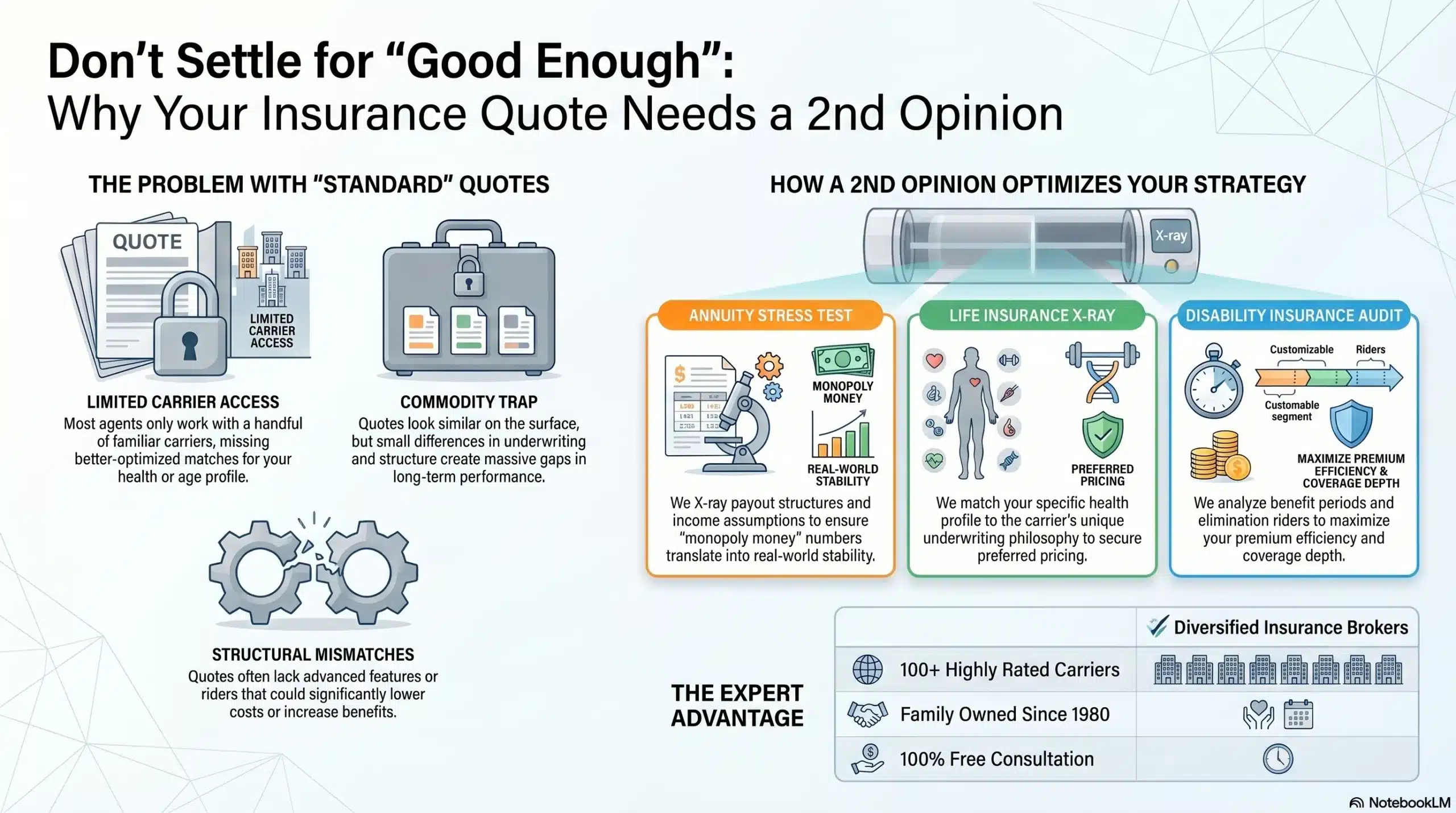
Insurance and annuity products are not commodities. Two policies with identical face amounts, two annuities with similar income projections, two disability quotes with matching monthly benefits — these can behave dramatically differently over time based on underwriting philosophy, carrier financial strength, product design details, and the specific features and riders that either were or were not included in the original proposal. The surface similarity is real. The difference beneath the surface is also real, and it is what a proper second opinion uncovers.
The most fundamental reason second opinions produce different results is carrier access. Most agents work with a limited carrier panel — a handful of companies they know well, have existing relationships with, and whose products they are familiar enough to sell confidently. That is a practical reality of the insurance industry, not a criticism of individual agents. The consequence for the consumer is that the proposal they receive reflects the carriers the agent works with, not the carriers that are most competitive for their specific situation. An agent who works primarily with three or four life insurance carriers will never show you the carrier whose underwriting guidelines are most favorable for your heart history, your diabetes diagnosis, or your occupation — because they don’t have access to or experience with that carrier. A second opinion through an independent broker with 100+ carrier relationships runs the comparison that the first agent’s panel didn’t allow.
The second fundamental reason is that even within a given carrier’s product lineup, product design choices — the specific riders elected, the premium structure chosen, the benefit period and elimination period calibration, the income rider versus accumulation rider selection — produce dramatically different long-term outcomes for costs that may appear similar at the point of sale. These design choices are where the most significant value differences hide. A disability insurance proposal with a 90-day elimination period when a 60-day period would fit the client’s financial situation produces unnecessary income exposure during a disability. An annuity income illustration built with an aggressive credited interest assumption will look better on paper than one built conservatively — but the conservative one is more honest about realistic outcomes. These are the kinds of differences that don’t show up in a side-by-side premium comparison but that determine the actual value of the coverage over time.
How We Stress-Test and X-Ray Your Existing Quote
Our review process is not a competing sales pitch. It is a structured analytical process designed to determine whether the quote you received is genuinely the best available option for your situation — or whether specific improvements exist that would better serve your goals.
The first step is understanding what the original proposal is actually showing — and what assumptions it is built on. Many proposals, particularly annuity income illustrations, are built using credited interest assumptions, benefit base growth projections, and payout rates that are presented as representative without clearly communicating the assumptions behind them. Normalizing these assumptions — running comparisons with identical inputs across multiple carriers — is how genuine differences in product competitiveness become visible rather than obscured by presentation differences.
The second step is evaluating carrier match. For every insurance product category — life insurance, disability insurance, LTC, annuities — specific carriers consistently outperform others for specific applicant profiles. Banner Life may offer the most competitive underwriting for certain health conditions. Symetra may be more favorable at older ages for annuity income products. Ameritas may offer stronger disability insurance provisions for specific occupation classes. Matching the applicant to the carrier that is genuinely most competitive for their specific profile — rather than the carrier that happened to be in the first agent’s panel — is where the most consistent improvements come from.
The third step is evaluating product design. Once the carrier match is established, the specific features, riders, benefit structures, and premium configurations are evaluated against the client’s actual retirement or income protection objectives. A product that is technically competitive on a per-premium basis but poorly structured for the client’s specific goal is still a suboptimal recommendation. As described in the original page, a SPIA quoted in annual mode can look very different from a monthly structure requiring far less premium. Without normalizing these structural variables across proposals, comparison is not meaningful.
Annuity Second Opinions: The Most Common Place We Find Significant Improvements
Annuity second opinions are the single most common category where our review process uncovers meaningful differences — both because annuity products are among the most complex financial instruments available to retail consumers, and because the incentive structures in annuity distribution are heavily commission-weighted in ways that can introduce bias toward certain product structures or carriers regardless of whether they are genuinely optimal for the client.
The most frequent issue we encounter is what the original page accurately describes as “monopoly money income” — income illustrations that appear strong on paper but are built on Benefit Base projections and roll-up rate assumptions that favor the carrier’s marketing interests rather than the client’s realistic income outcome. When we normalize the comparison — same premium, same age, same income start date, realistic credited interest assumptions — the difference between a well-designed rider and a poorly designed one becomes immediately visible. A client who was shown $3,200 per month in guaranteed income from one carrier may find that a different carrier, with identical premium and identical income start age, produces $3,700 per month — a difference of $500 per month or $6,000 per year for life that compounds significantly over a long retirement.
Annuity fee structures are a second frequent source of meaningful differences. Rider fees, administrative fees, and surrender charge schedules that appear similar in summary presentations can diverge significantly in their long-term effect on account value performance and net income. A rider fee charged on the Benefit Base rather than the accumulation value extracts meaningfully more from the contract than the same percentage charged on the accumulation value — a distinction that is frequently not clearly explained in initial proposals. Our annuity second opinion service evaluates these structural differences across the full current marketplace, not just the carriers the original agent had access to.
Life Insurance Second Opinions: Why Carrier Underwriting Matters More Than Premium Comparison
In life insurance, carrier selection based on underwriting philosophy for the applicant’s specific health profile is almost always more important than any product feature comparison. This is because two carriers can quote very different premiums for identically structured policies on the same applicant, based entirely on how their underwriting guidelines treat the applicant’s health history. The difference is not a negotiation. It is a function of how each carrier’s actuaries and underwriting guidelines evaluate the mortality risk of applicants with specific conditions.
For a 55-year-old applicant with well-controlled Type 2 diabetes, certain carriers will offer Preferred Non-Smoker rates while others will apply a table rating that adds 50% to 75% to the standard premium. The same $500,000 of coverage on the same applicant can cost $4,200 per year from one carrier and $7,100 per year from another — not because of product differences, but because of underwriting classification differences. Matching the applicant to the carrier whose underwriting guidelines are most favorable for their specific condition — diabetes, cardiovascular history, cancer history, BMI, occupation risk, or other factors — is the single highest-value action in life insurance placement.
Banner Life, Lincoln National, Pacific Life, Protective, Prudential, and other major carriers each have specific strengths and weaknesses in their underwriting guidelines for different health conditions and applicant profiles. An agent who works primarily with one or two of these carriers will consistently place applicants at non-optimal rates when those applicants’ health profiles happen to be better-handled by a different carrier. A second opinion through an independent broker who can compare underwriting assessment across 30 to 40+ life insurance carriers is what produces genuinely competitive placement. Our life insurance second opinion service evaluates the full carrier spectrum to identify the right underwriting match for each applicant’s specific profile, and our resource on how to get the best life insurance rates explains the factors that determine classification outcomes.
Disability Insurance Second Opinions: Structure Determines Value, Not Just Premium
Disability insurance second opinions frequently uncover issues that are not about price at all — they are about policy design, definition quality, and the presence or absence of riders that fundamentally determine what the policy will actually do when a claim is filed. A disability insurance proposal that looks competitive on a per-premium basis can be deeply inadequate if the own-occupation definition is weak, if the mental health coverage is limited to 24 months, if there is no residual disability rider, or if the benefit period is shorter than the applicant’s financial exposure requires.
The own-occupation definition is the most consequential structural variable in disability insurance design. A true own-occupation policy defines disability as the inability to perform the material and substantial duties of the specific occupation the insured was engaged in at the time of disability — regardless of whether the insured can perform some other employment. A any-occupation policy defines disability as the inability to perform any occupation for which the insured is reasonably suited by education, training, and experience. The difference is enormous in practice: a surgeon whose hand injury prevents surgery but who could theoretically teach medical school is disabled under an own-occupation definition and employable under an any-occupation definition. The premium difference between these definitions may be 15% to 25%. The protection difference is categorical.
Rider selection is the second major design variable. The residual disability rider — which provides proportionate benefits when an illness or injury reduces income without eliminating it entirely — is one of the most valuable disability insurance riders available and one of the most consistently omitted from initial proposals because it increases premium. An applicant who is shown a proposal without a residual rider and who doesn’t know to ask for it may purchase a policy that provides no benefits during a partial disability — the most common disability scenario — while paying most of the premium cost of a policy that would have covered it. Carriers like Assurity sometimes offer SSDI offsets that reduce premiums by coordinating with Social Security disability benefits, a provision that is frequently missed in initial proposals. Our disability insurance second opinion service evaluates both carrier selection and complete policy design against the full available market.
Long-Term Care Insurance Second Opinions: Hybrid vs. Traditional and the Inflation Rider Question
Long-term care insurance second opinions involve a product landscape that has changed substantially over the past decade, with the traditional standalone LTC market shrinking and hybrid life/LTC and annuity/LTC products growing in both availability and market share. A second opinion in LTC is valuable for two distinct reasons: first, because the carrier and product landscape has evolved quickly and a proposal from even two or three years ago may not reflect what is currently available; and second, because the decision between traditional, hybrid life/LTC, and annuity/LTC structures is a genuine planning decision with meaningful financial consequences that deserves comparison rather than defaulting to whatever the first agent recommended.
The inflation rider question is the most consequential design choice in traditional LTC insurance. A policy with a 3% compound inflation rider on benefits will provide meaningfully more coverage 15 to 20 years into a long retirement than a level-benefit policy — but it costs more today. The decision between compound inflation protection, simple inflation protection, and level benefits involves a trade-off between affordable today versus adequate when needed that depends on the applicant’s age, health, financial resources, and realistic care cost trajectory in their geography. A second opinion that models this trade-off explicitly, using realistic care cost inflation assumptions rather than marketing assumptions, produces a more honest comparison than a single-carrier proposal.
The Partnership program qualification is a frequently overlooked consideration in LTC second opinions. Partnership-qualified policies provide a dollar-for-dollar asset protection benefit for Medicaid purposes that non-partnership policies do not — a significant protection for middle-class retirees concerned about asset preservation in extended care scenarios. Confirming that any proposed traditional LTC policy is partnership-qualified in the applicant’s state is a basic due diligence step that is sometimes missed. Our LTC insurance second opinion service evaluates the full spectrum of traditional, hybrid, and annuity-based LTC options with attention to all these variables.
Medicare Second Opinions: The Long-Term Cost Trap in Initial Plan Selection
Medicare second opinions address a mismatch between how people typically evaluate Medicare plans — by comparing monthly premiums — and how plan value actually materializes over time — through out-of-pocket cost exposure, network adequacy, drug formulary access, and the specific benefits that become relevant as health needs increase in later retirement years. A plan with a $0 monthly premium that has high out-of-pocket maximums, limited specialist access, and restrictive prior authorization requirements may cost far more in total annual healthcare spending than a plan with a moderate monthly premium and comprehensive coverage.
The Medicare Advantage versus Medicare Supplement decision is the most significant structural choice in Medicare planning, and it is one where the right answer varies substantially by individual health situation, geography, financial resources, and care preferences. Medicare Advantage plans offer plan-managed care with defined benefit structures and often attractive initial premiums. Medicare Supplement (Medigap) plans offer freedom of provider choice and predictable out-of-pocket exposure for a monthly premium. For a 65-year-old in good health with moderate healthcare utilization, either structure may be appropriate. For a 72-year-old with multiple chronic conditions, specialist relationships, and higher healthcare utilization, the unrestricted access and predictable cost structure of a Medicare Supplement plan may be significantly more valuable than the lower initial premium of an Advantage plan. Our resource on best-rated Medicare Advantage companies and our service on Medicare plan second opinion review provide the framework for evaluating this decision against the full market rather than the first agent’s preferred plan.
Drug coverage is a dimension of Medicare plan evaluation that is frequently oversimplified in initial proposals. Part D drug plan selection should be based on the specific medications the enrollee currently takes and their anticipated drug needs — not on plan premiums in isolation. A plan with the lowest premium may have a formulary that places the enrollee’s medications in higher cost tiers or requires prior authorization, producing actual drug costs that significantly exceed what a slightly higher-premium plan with better formulary coverage would have cost. Our resource on whether Medicare premiums increase explains how premium trajectories and plan design changes over time affect the long-term cost comparison.
Group Health Insurance Second Opinions: The Hidden Cost in Plan Design
Group health insurance second opinions for business owners and HR professionals address a category where the total cost picture is significantly more complex than the employer contribution and premium structure visible in the initial proposal. The plan design itself — deductibles, out-of-pocket maximums, coinsurance rates, network breadth, specialist access, and the specific benefits covered — determines the total healthcare cost burden for both the employer and the employees in ways that a premium comparison doesn’t reveal.
Level-funded and self-funded plan designs have grown substantially as alternatives to traditional fully-insured group health insurance for small and mid-size employers, offering the potential for premium refunds when claims are lower than expected and greater transparency into actual claims experience. These structures are appropriate for some employer groups and not for others — the risk tolerance, employee demographics, and claims history all affect whether a level-funded design produces better outcomes than a fully-insured equivalent. An employer who received only a fully-insured proposal may have been shown only part of the available design space. Our group health insurance second opinion service evaluates these structural alternatives alongside carrier and plan comparisons.
Get a 2nd Opinion by Product Type
Select the category that applies to your situation. Each review is free, carrier-neutral, and designed to confirm whether your existing proposal is genuinely optimal — or to identify specific improvements where they exist.
Annuity Quote Review
Stress test your income strategy, payout structure, rider fees, and long-term performance across 100+ carriers.
Review My Annuity QuoteLife Insurance Quote Review
X-ray underwriting assumptions, carrier selection, and policy design for your specific health profile.
Review My Life Ins QuoteDisability Ins. Quote Review
Analyze definition quality, benefit structure, riders, and premiums against the full DI market.
Review My Disability QuoteGroup Health Insurance Review
Compare plan design, networks, level-funded alternatives, and total long-term cost exposure.
Review My Group Health PlanLong-Term Care Insurance Review
Evaluate benefit triggers, inflation riders, traditional vs. hybrid structure, and partnership qualification.
Review My LTC QuoteMedicare Quote Review
Compare Medicare Advantage vs. Supplement structure, drug formularies, and total out-of-pocket exposure.
Review My Medicare PlanWhen to Get a Second Opinion — and When It Matters Most
A second opinion is always worth having before committing to any long-term insurance or financial product — but there are specific situations where the value is highest and the risk of skipping it is greatest.
If your quote came from a single-company captive agent — someone who works exclusively for one insurer and can only offer that company’s products — a second opinion is essential because the comparison was never done. A captive agent doesn’t have the ability to tell you that a different carrier would be better for your situation. They can only offer what their one company provides, which means the first quote you received was not a market comparison — it was a single data point.
If your situation involves any health complexity — managed chronic conditions, significant medical history, elevated BMI, unusual occupation, tobacco use, or any other factor that could affect underwriting — a second opinion is especially important because the difference between carriers’ treatment of these factors can be dramatic and is not predictable without running the comparison across multiple carriers simultaneously.
If the annuity illustration you were shown produces income projections that seem impressively high relative to competitors you have seen advertised, a second opinion is warranted to confirm whether those projections are built on comparable assumptions or are inflated by more aggressive credited interest expectations, longer deferral periods, or other structural differences that make them appear stronger without being genuinely more competitive.
Even if your situation is uncomplicated and your first quote seems reasonable, a second opinion provides validation — confirmation that the market has been properly surveyed and that you are paying a fair price for coverage that is appropriately structured for your goals. Confidence that a decision is right is worth having independently of whether the review produces any changes. As described in the original page, in many cases we confirm the original quote is strong. The value is knowing, not wondering. Explore our deeper insights on what the top 0.1% already know about fully informed financial decision-making — a perspective that consistently includes independent verification rather than assumption-based confidence.
What Happens When We Do Find Something Better
When a second opinion review uncovers a genuinely better option, the improvement can take several forms depending on the product category and the nature of the issue found in the original proposal.
In annuities, the most common improvement is a higher guaranteed lifetime income amount for the same premium and the same income start age — the result of a carrier whose payout rate and benefit base structure are more favorable for the specific applicant’s age and deferral timeline. An improvement of $200 to $600 per month in guaranteed lifetime income for an identical premium is not uncommon in active annuity income comparisons because the market is genuinely competitive and carrier-specific advantages are real and meaningful.
In life insurance, the most common improvement is a better underwriting classification — and therefore a significantly lower premium — for the same coverage amount, achieved by matching the applicant to the carrier whose underwriting guidelines treat their specific health profile most favorably. Saving $1,000 to $3,000 per year on a 20-year term or permanent life insurance policy through better carrier selection is a common outcome for applicants with any health complexity.
In disability insurance, the most common improvement is better policy design — the addition of a residual disability rider, an upgraded own-occupation definition, or an income benefit period that actually aligns with the applicant’s retirement timeline — at a cost that was previously excluded from the proposal because the original agent either didn’t prioritize or didn’t know to recommend those features. Better design without necessarily lower cost is still a meaningful improvement if it produces dramatically more useful coverage.
In Medicare, the most common improvement is a better long-term total cost outcome — not necessarily lower premium, but lower expected total healthcare spending over several years based on plan design, formulary coverage, network adequacy, and cost-sharing structure for the specific enrollee’s health situation and utilization patterns.
Don’t Settle for “Good Enough” — Get a Free 2nd Opinion
If you’ve received a quote you want reviewed — or if you simply want to know whether the full market was surveyed for your situation — start with the category most relevant to your needs. No cost, no obligation, no pressure.
Questions? Call 800-533-5969 | Contact Us
Related Pages
Financial Protection Essentials
Core resources across insurance and retirement planning categories — referenced when evaluating whether your existing coverage is optimized.
Talk With an Advisor Today
Choose how you’d like to connect—call or message us, then book a time that works for you.
Schedule here:
calendly.com/jason-dibcompanies/diversified-quotes
Licensed in all 50 states • Fiduciary, family-owned since 1980
FAQs: 2nd Opinion Quote Review
Is there a cost for a 2nd opinion review?
No — our second opinion reviews are completely free and carry no obligation. The review is a service we provide because we believe informed clients make better decisions, and because we can demonstrate value through transparency rather than through pressure. We compare your existing quote against the full market and give you an honest assessment of whether we found something better — or whether your current proposal is already competitive.
The review requires no upfront commitment and no payment at any stage. If the review confirms your existing quote is strong, you have gained valuable confidence. If it identifies meaningful improvements, you have gained a better option. Either outcome is worth having, and the absence of any cost removes any downside to requesting the review before making a final commitment on any insurance or annuity product.
Will you always find a better option?
Not always — and we think that’s important to say directly. In a meaningful percentage of cases, the original quote is genuinely competitive, and our review confirms that rather than manufacturing an artificial “better option” to justify the review. When we confirm a quote is strong, we explain why it’s strong — which carriers we compared it to, what the competitive landscape shows for the applicant’s profile, and what factors make the original recommendation appropriate. That confirmation has real value because it converts residual uncertainty into genuine confidence before a long-term financial commitment is made.
In the cases where we do find improvements, the nature of the improvement varies — it may be lower cost for equivalent coverage, higher guaranteed income for the same annuity premium, better policy design with riders or definitions that provide more complete protection, or a carrier whose underwriting is more favorable for the applicant’s specific health profile. These improvements are real and documented, not marginal differences dressed up as significant. When we find something materially better, we explain exactly what it is and why it matters for your specific situation.
What do you need to review my quote?
The review process is designed to be as simple as possible for you. We typically need your existing quote or illustration — a PDF, screenshot, or summary of what you were shown — along with basic personal information relevant to the product category: age, health profile summary, the coverage amount or premium involved, and your goals for the coverage. For annuity reviews, the income start date and deferral timeline are important. For life insurance, a high-level health summary allows us to evaluate which carriers will view your profile most favorably. For disability insurance, occupation and income are relevant. For Medicare, a current medication list and geography help us evaluate formulary coverage.
We handle the analysis from there. You don’t need to gather carrier-specific documentation or do comparison research yourself — that is the point of the service. What we need from you is enough information to run the comparison properly, which typically takes a brief conversation or a straightforward document submission rather than an extensive information-gathering process.
How long does the review take?
Most reviews are completed quickly — typically within one to two business days for straightforward cases, and within three to five business days for more complex situations involving health underwriting analysis across multiple carriers or multi-product comparisons. The timeline depends on the complexity of the product category and the completeness of the information submitted. Annuity income comparisons that involve normalizing multiple carrier illustrations to identical assumptions take more time than a Medicare plan comparison, for example.
We prioritize completing reviews before the client’s existing proposal expires or before a decision deadline — if there is time pressure from a carrier offer expiring, letting us know upfront helps us prioritize the timeline accordingly. The review is designed to give you enough time to consider the findings and make a fully informed decision rather than rushing to meet an artificial deadline, which is one of the more common pressure tactics in insurance sales that a properly timed second opinion directly counters.
Why are results different between carriers?
Every carrier has its own actuarial models, underwriting guidelines, investment portfolios, and competitive positioning strategies that produce genuinely different outcomes for identical coverage requests. In life insurance, carrier underwriting philosophy for specific health conditions — diabetes, cardiovascular history, cancer history, BMI, and others — can produce dramatically different rate classifications for the same applicant. The same person with well-controlled Type 2 diabetes may receive Preferred Non-Smoker classification from one carrier and a Table 2 rating from another, producing premium differences of 50% or more for identical coverage.
In annuities, carrier differences reflect investment portfolio performance, expenses, and competitive positioning that produce genuinely different caps, participation rates, roll-up rates, and payout percentages for identical premium amounts. A carrier that is aggressively competing for market share in fixed indexed annuity income products may offer significantly more favorable rider economics than a carrier that is de-emphasizing that segment of business. These differences are real and persistent — they are not noise around a single “correct” price. Matching the right carrier to the right applicant profile in the right market environment is what produces consistently better outcomes than accepting the first proposal received from a limited-panel agent. Our service on carrier review analysis illustrates how these differences materialize in specific product evaluations.
What if my quote is from a carrier you don’t work with?
We can still conduct a meaningful second opinion review. The review does not require us to have a direct relationship with the carrier whose product you received a quote on — it requires us to be able to compare that proposal against alternatives from the carriers we do work with. We evaluate the structure, assumptions, and terms of your existing proposal and compare them honestly against the current market of alternatives available through our carrier network. If your existing proposal is the most competitive option available for your situation across all the carriers we access, we will tell you that directly and explain why.
What we are not able to do is place business with carriers we are not contracted with — but that limitation does not prevent us from evaluating whether your existing proposal is competitive against the options we can offer. The comparison is the service, not the requirement to work with a specific carrier.
About the Author:
Jason Stolz, CLTC, CRPC, DIA, CAA and Chief Underwriter at Diversified Insurance Brokers (NPN 20471358), is a senior insurance and retirement professional with more than 25 years of real-world experience helping individuals, families, and business owners protect their income, assets, and long-term financial stability. As a long-time partner of the nationally licensed independent agency Diversified Insurance Brokers, Jason provides trusted guidance across multiple specialties—including fixed and indexed annuities, long-term care planning, personal and business disability insurance, life insurance solutions, Group Health, Travel Medical and Evacuation Insurance, and short-term health coverage. Diversified Insurance Brokers maintains active contracts with over 100 highly rated insurance carriers, ensuring clients have access to a broad and competitive marketplace.
His practical, education-first approach has earned recognition in publications such as VoyageATL, and contributions from his agency featured in Kiplinger and GoBankingRates— highlighting his commitment to financial clarity and client-focused planning. Drawing on deep product knowledge and years of hands-on field experience, Jason helps clients evaluate carriers, compare strategies, and build retirement and protection plans that are both secure and cost-efficient. Visitors who want to explore current annuity rates and compare options across multiple insurers can also use this annuity quote and comparison tool.
Explore All Insurance & Retirement Services: Return to our Diversified Insurance Brokers home page — covering annuities, life insurance, disability, Medicare, long term care, burial insurance & more from 100+ carriers.
Last Reviewed: August 18, 2026 |
Reviewed by: Jason Stolz, CLTC, CRPC, DIA, CAA
Chief Underwriter, Diversified Insurance Brokers, Inc. | NPN: 20471358 | Diversified Insurance Brokers, Inc. — Licensed in all 50 states
Fact Checked by: Tonia Pettitt, CMIP©
Medicare Specialist, Diversified Insurance Brokers, Inc. | NPN: 14374308 | Diversified Insurance Brokers, Inc. — Licensed in all 50 states
Did you find this content helpful? Leave us a Google review — it helps others find trustworthy guidance too.
Editorial Standards: Diversified Insurance Brokers maintains rigorous editorial standards to ensure accuracy, clarity, and independence in all content. Learn more about our editorial standards and commitment to transparency.
