
Disability Insurance for Cabinet Makers
As an Independent Disability Insurance Broker, we have access to exclusive discounts and negotiated pricing most captive agents can’t offer — see the full breakdown near the end of this page.
Disability Insurance for Cabinet Makers

Jason Stolz CLTC, CRPC, DIA, CAA
Cabinet making is a skilled trade built entirely on the ability to use hands, tools, and precision machinery — and that dependency on physical capacity is exactly what makes disability insurance one of the most important financial decisions a cabinet maker can make. Whether working as an employee in a production shop, as a self-employed craftsman running a custom cabinet operation, or as the owner of a small cabinet business with employees and overhead obligations, a cabinet maker’s income stops the moment an injury, illness, or chronic condition prevents them from performing the precision cuts, joinery work, finishing, and installation that the trade requires. The hands, wrists, shoulders, back, and respiratory system are all in active use every working day — and each represents a documented pathway to the kind of disability that ends production and eliminates income without warning.
At Diversified Insurance Brokers, Jason Stolz, CLTC, CRPC, DIA, CAA works with cabinet makers and custom woodworking professionals to build income protection structures that reflect how cabinet making income actually works — including the documentation challenges of self-employed shop owners, the business overhead obligations that continue during a disability, and the occupational class dynamics that affect what coverage is available and at what cost. The strategy, carrier selection, and policy architecture that produces the strongest outcome for a cabinet maker is not the same as what applies to a desk-based professional, and working with an advisor who understands this distinction produces meaningfully better results.
Compare Disability Insurance for Cabinet Makers
We review coverage options across 100+ carriers and identify the policy structure that fits your trade income, shop overhead, and occupational risk profile.
Request Disability Insurance OptionsCabinet Making — Occupational Hazards, Income Risk, and the Disability Protection Gap
| Hazard Category | Primary Source | Resulting Disability Risk | Workers’ Comp Coverage | DI Coverage Gap |
|---|---|---|---|---|
| Power tool and saw contact | Table saws, band saws, routers, jointers, miter saws | Lacerations, finger amputation, partial hand loss, permanent grip impairment | Covers employees for work-related incidents; owner-operators typically excluded unless specifically elected | Full gap for sole proprietors; partial gap where owner coverage not elected |
| Repetitive strain and musculoskeletal | Sustained sawing, sanding, routing, assembly; prolonged standing and awkward postures | Carpal tunnel syndrome, tendinitis, rotator cuff damage, herniated disc, chronic back injury | Covers acute work-related incidents; chronic cumulative conditions disputed | Significant gap for illness-based and cumulative musculoskeletal conditions |
| Wood dust and respiratory exposure | Daily sawing, sanding, routing; finishing chemicals, lacquers, stains, adhesives | Occupational asthma, chronic bronchitis, hypersensitivity pneumonitis, nasal conditions | Occupational disease covered for employees in most states; owner often excluded | Full gap for owner; illness-based respiratory conditions outside workers’ comp entirely |
| Noise-induced hearing loss | Daily operation of table saws, routers, planers, sanders above safe decibel thresholds | Permanent hearing loss; occupational deafness; tinnitus affecting work performance | Occupational disease provisions apply for employees; owner exposure uncompensated | Gradual hearing loss often falls outside workers’ comp’s acute-injury framework |
| Back, neck, and shoulder strain | Heavy sheet goods handling, prolonged stooped postures, installation work overhead and in confined spaces | Herniated disc, chronic lower back syndrome, shoulder impingement, cervical strain | Acute work incidents covered for employees; chronic or degenerative conditions often disputed | Major gap for illness-based and degenerative spinal conditions regardless of work history |
| Illness-based disability (non-occupational) | Cancer, cardiac events, neurological conditions, immune disorders unrelated to specific workplace incident | Extended inability to operate tools, manage shop, or perform installation work | Not covered — workers’ comp applies only to work-related injury and occupational disease | Approximately 90% of long-term disabilities are illness-based; complete gap for all workers |
What the table makes immediately clear is that the injury risks most visible in cabinet making — the saw contact events, the acute back injuries, the chemical burns — are only one layer of the disability exposure cabinet makers carry. The larger and more statistically probable layer is the approximately 90 percent of long-term disabling conditions that are illness-based, arising from health events entirely unrelated to any specific workplace incident. A cabinet maker who understands this distinction understands why disability insurance for woodworking professionals is not primarily about catastrophic shop accidents — it is about the full spectrum of health events that can remove a skilled tradesperson from the work their income depends on.
The Physical Demands of Cabinet Making and What They Mean for Long-Term Income Risk
Bureau of Labor Statistics occupational data classifies wood sawing machine setters, operators, and tenders — a category that includes cabinet shop operators — as having one of the highest rates of injuries and illnesses among all production occupations. The daily workflow of a cabinet maker involves operating machinery that OSHA consistently identifies among the most injury-prone in manufacturing: table saws, band saws, jointers, routers, shapers, planers, and sanders — each capable of producing lacerations, amputations, and permanent functional loss in a fraction of a second. The hand and finger contact injuries that occur in cabinet shops are not theoretical risks; they are documented occupational events that permanently alter the affected worker’s ability to perform precision work at the machinery level a cabinet making career requires.
Beyond the acute machinery contact risks, the cumulative physical loading of cabinet making creates a parallel set of disability pathways that develop gradually and are sometimes more financially devastating than sudden injuries because they are harder to anticipate and plan for. Cabinet makers work with sheet goods — full sheets of plywood, medium density fiberboard, and solid wood stock — that require sustained lifting, positioning, and feeding through machinery in patterns that load the lower back, shoulders, and wrists repeatedly across a full working day. OSHA’s woodworking safety documentation identifies highly repetitious movements, excessive force during shaping operations, and whole-body vibration from power tool use as putting woodworking professionals at particular risk for work-related musculoskeletal disorders, with the wrists, neck, and shoulders identified as the highest-risk structures. A cabinet maker who develops a chronic rotator cuff condition or a disabling disc herniation faces months or years of reduced or eliminated work capacity — precisely the scenario that long-term disability insurance is designed to address.
The respiratory exposure dimension of cabinet making deserves particular attention because it operates invisibly and cumulatively. Wood dust generated during sawing, sanding, and routing is not a uniform hazard — it varies significantly by wood species, with hardwoods including oak, mahogany, beech, walnut, and birch documented as producing dust associated with respiratory sensitization and, in long-term exposures, nasal and sinus conditions. OSHA’s woodworking hazard documentation specifically identifies wood dust and the finishing chemicals used in cabinet work — lacquers, stains, adhesives, and solvents — as health hazards capable of producing skin and respiratory diseases. A cabinet maker who develops occupational asthma or hypersensitivity pneumonitis from sustained dust and chemical exposure faces a disability that is entirely illness-based in the workers’ compensation framework, producing zero workers’ comp benefit despite arising directly from the conditions of the trade. This gap — between the occupational origin of a condition and the illness-based categorization that leaves it outside workers’ comp — is one of the most important structural vulnerabilities in a cabinet maker’s income protection picture.
Workers’ Compensation and the Cabinet Maker — What It Covers and Where It Stops
Workers’ compensation is frequently cited as income protection for tradespeople, and for cabinet making employees it provides a meaningful but structurally limited floor: approximately two-thirds of wages up to state-specific maximums for work-related injuries and occupational diseases. For a cabinet shop employee who suffers an acute table saw injury or develops a documented occupational lung condition, workers’ comp activates as designed. But the picture changes substantially — and the gap widens considerably — for the cabinet maker who owns the shop, operates as a sole proprietor, or runs a small custom operation as an independent contractor. Understanding why cabinet makers buy disability insurance begins with understanding precisely where workers’ comp fails.
Sole proprietors and single-member LLC owners are not employees of their own businesses under the workers’ compensation framework. Unless a self-employed cabinet maker has specifically and deliberately elected to purchase workers’ compensation coverage that includes themselves — a step most solo operators never take because the system does not require or prominently prompt it — they are operating with zero workers’ comp protection for their own injuries. This means the most skilled person in the shop, the one whose loss of working capacity would eliminate the business’s revenue entirely, carries no workers’ comp protection by default. A single table saw incident that removes two fingers from the owner’s dominant hand generates no workers’ comp benefit for that owner — it simply stops the income.
The second structural gap applies to all workers regardless of ownership status: workers’ compensation covers only work-related injuries and occupational diseases. It does not cover disability arising from illness, from off-duty injury, or from any health condition not directly attributable to a specific workplace exposure or incident. This limitation is not a technicality — it is the defining boundary of the workers’ comp system’s purpose. Since approximately 90 percent of long-term disabling conditions are illness-based rather than traumatic-injury-based, workers’ compensation is structurally designed to handle the minority of disability events, not the majority. Social Security Disability Insurance provides an average benefit of approximately $1,630 to $1,634 per month — far below what most cabinet makers earn and far below what a shop owner needs to cover both personal living expenses and business overhead simultaneously. The combination of the owner coverage gap and the illness-based disability gap means that short-term and individual long-term disability insurance are not supplements to an existing protection system for most cabinet makers — they are the protection system.
Cabinet makers who operate as self-employed professionals face an additional layer of exposure that employees do not: the absence of any employer-provided group disability plan as a baseline. Most cabinet shop employees at small and mid-size operations receive no employer-sponsored long-term disability coverage because small employers are not required to provide it and most do not. This means even cabinet makers who are W-2 employees — not owners — are frequently unprotected beyond whatever workers’ comp their employer carries. The complete income protection picture for a cabinet maker in nearly any employment structure begins with individual disability insurance rather than supplementing an existing group plan.
Own-Occupation Coverage — Why the Policy Definition Determines the Real-World Outcome
The disability definition in a policy is the contractual language that determines whether a benefit is paid when a claim occurs — and for a skilled tradesperson like a cabinet maker, the difference between an own-occupation definition and an any-occupation definition is not abstract. It is the difference between receiving benefits when a hand injury prevents precision woodworking and being denied because the insurer argues that the injured cabinet maker could theoretically work as a customer service representative or a retail stocker.
A true own-occupation disability insurance policy pays benefits when the insured cannot perform the material and substantial duties of their specific occupation — even if they are capable of working in some other capacity. For a cabinet maker, this means a bilateral wrist condition, a significant hand injury, or a respiratory condition that prevents sustained exposure to wood dust and finishing chemicals would generate benefit payments under an own-occupation definition, because the specific physical capacity the occupation requires has been compromised. The policy recognizes the economic reality that a cabinet maker’s income derives from a specific set of manual skills, and that the loss of those skills constitutes a genuine disability regardless of what other work the person might theoretically perform.
An any-occupation definition applies a fundamentally different standard: benefits are paid only when the insured cannot perform any gainful work for which they are reasonably suited by education, training, or experience. Under this standard, a cabinet maker who can no longer operate a table saw due to a hand condition but who is capable of working at any sedentary job earning even a modest wage would likely receive no benefit — despite having permanently lost the income-generating capacity their trade provides. Understanding how short-term and long-term disability definitions interact is essential context for cabinet makers evaluating any policy, because many group plans start with an own-occupation definition but transition to any-occupation after 24 months — exactly when the disability has proven itself to be long-term and ongoing.
Business Overhead Expense Coverage for Cabinet Shop Owners
For cabinet makers who own their shop — whether a solo custom operation or a small production business with employees — disability creates a two-layer financial crisis that personal income replacement alone cannot fully address. The first layer is the loss of the owner’s earned income. The second is the continuation of business overhead obligations — shop rent or mortgage, equipment financing, employee wages, utility costs, insurance premiums, and material supply commitments — that do not pause because the owner is disabled. A cabinet shop owner who carries only personal disability income coverage has addressed one layer and left the other entirely exposed.
Business overhead expense disability insurance is the policy structure designed specifically for this second layer. A BOE policy pays a monthly benefit calibrated to the fixed and semi-fixed operating costs of the business during the owner’s qualifying disability, allowing the shop infrastructure to remain intact during the disability period rather than accumulating unpaid obligations against zero revenue. The practical outcome is the difference between a disability that temporarily pauses a cabinet making business and one that permanently ends it — a meaningful difference for a shop owner who has invested years building customer relationships, equipment assets, and a production infrastructure that would be costly and time-consuming to rebuild.
The BOE structure is calibrated to the actual overhead of the specific business — a solo operator working from a home workshop has very different overhead obligations than a mid-size shop with dedicated space, CNC equipment financing, and two or three employees on payroll. The appropriate BOE benefit amount is determined by analyzing the real monthly fixed cost structure of the operation, not by applying a general formula. Cabinet shop owners who have not yet had this calculation done are likely either over-insuring overhead they do not carry or under-insuring obligations that would continue through an extended disability.
Occupational Class, Income Documentation, and What Cabinet Makers Can Realistically Obtain
Cabinet making occupies the middle tiers of most disability insurance carriers’ occupational class schedules — a classification that reflects the documented physical demands, machinery exposure, and injury probability of the trade compared to sedentary professional occupations. This classification determines the premium rate per dollar of benefit, the available monthly benefit maximum, and in some cases the benefit period options a carrier will offer. Middle-tier classification does not preclude obtaining meaningful, comprehensive disability protection — it calibrates the cost and terms relative to the occupational risk profile the carrier is assuming.
Income documentation is the other critical underwriting input for cabinet makers, particularly those who are self-employed. Carriers determine the maximum approvable monthly benefit as a percentage of documented earned income — typically 60 to 70 percent of net earned income — which means the Schedule C or business financial documentation the cabinet maker provides directly determines the ceiling on the coverage they can obtain. Cabinet makers who operate as 1099 earners or independent contractors follow the same documentation framework, using tax filings and earnings records to establish the income basis for underwriting. One common challenge for small cabinet shop owners who aggressively deduct business expenses — a sound tax strategy — is that the resulting lower documented net income limits the disability benefit they can obtain. Planning this documentation before applying, with guidance on how to present the accurate income picture most effectively, is a meaningful part of the underwriting preparation process.
Cabinet makers who have employees and whose own disability would affect not just personal income but the business’s ability to serve clients and fulfill contracts may also want to evaluate how much total disability coverage is needed across both personal and business layers. The answer is almost always more than the personal income replacement layer alone suggests once overhead obligations and key-person business impact are factored in.
Policy Design Decisions That Determine Real-World Protection for Cabinet Makers
Beyond occupational class and benefit amount, the specific policy design decisions a cabinet maker makes at application time determine whether the coverage delivers meaningful protection when a claim actually occurs. The elimination period — the waiting period between disability onset and the first benefit payment — is one of the most consequential of these decisions. Cabinet makers with modest liquid reserves may benefit from a shorter elimination period, such as 30 or 60 days, that begins paying benefits more quickly after the disability begins, while those with sufficient savings to cover several months of expenses may find the premium savings from a 90-day or 180-day elimination period worthwhile. Understanding how elimination periods affect both coverage and premium is an essential step in designing a policy that matches the cabinet maker’s actual financial situation rather than a generic template.
The benefit period — how long the policy pays benefits during a qualifying disability — is equally consequential. Benefit period options typically range from two years to five years to age 65. For a cabinet maker whose entire livelihood depends on the physical capacity to operate precision machinery, a benefit period extending to age 65 provides the floor that matters most: protection against a disability that proves to be long-term or permanent rather than a temporary recovery event. A two-year benefit period covers the recoverable injury scenarios adequately but leaves a complete gap for the chronic conditions, the permanent impairments, and the serious illnesses that remove a cabinet maker from their trade for years. The riders available on individual disability policies — including the future insurability option that allows benefit increases as income grows without new medical underwriting — add meaningful flexibility to the core policy structure that cabinet makers in growth phases of their business careers should strongly consider.
The cost of living adjustment rider protects the real purchasing power of a disability benefit across a multi-year claim by increasing the monthly benefit in proportion to inflation. For a cabinet maker facing a long-term disability extending several years, a fixed monthly benefit loses meaningful purchasing power over time — the COLA rider ensures the income floor does not silently erode while the claim is active. This rider is most valuable for younger cabinet makers who face longer potential claim periods if a serious disability occurs early in their working lives.
When Pre-Existing Conditions Are Part of the Picture
Cabinet makers who approach the disability insurance market with an existing health history — a prior back injury, a documented hearing loss, a respiratory condition, a previous hand or wrist surgery — will find that the outcome varies significantly depending on which carrier reviews the application and how the history is presented. Some carriers will exclude the specific pre-existing condition while providing full coverage for all other disabling events; others may offer coverage after a waiting period; and some carriers specialize in impaired-risk applications that a direct-channel general carrier would decline outright.
Working with an no-exam disability insurance option is one pathway for cabinet makers whose health history makes the traditional fully underwritten process uncertain or slow — simplified underwriting products provide meaningful benefit amounts without requiring full paramedical examination, at higher premium cost and lower maximum benefit thresholds than fully underwritten coverage. For cabinet makers whose health history is clean and straightforward, the fully underwritten process produces the best combination of benefit capacity, policy terms, and premium efficiency. Disability insurance with pre-existing conditions is available through independent broker channels that access the full range of carrier guidelines simultaneously — and high-risk disability insurance options exist specifically for applicants whose occupational or health profile falls outside the standard underwriting appetite of general carriers.
Get Your Cabinet Maker Disability Insurance Review
We compare occupational class assignments, benefit structures, and BOE options across 100+ carriers to identify the coverage architecture that fits your trade income and shop obligations.
Request Disability Insurance Options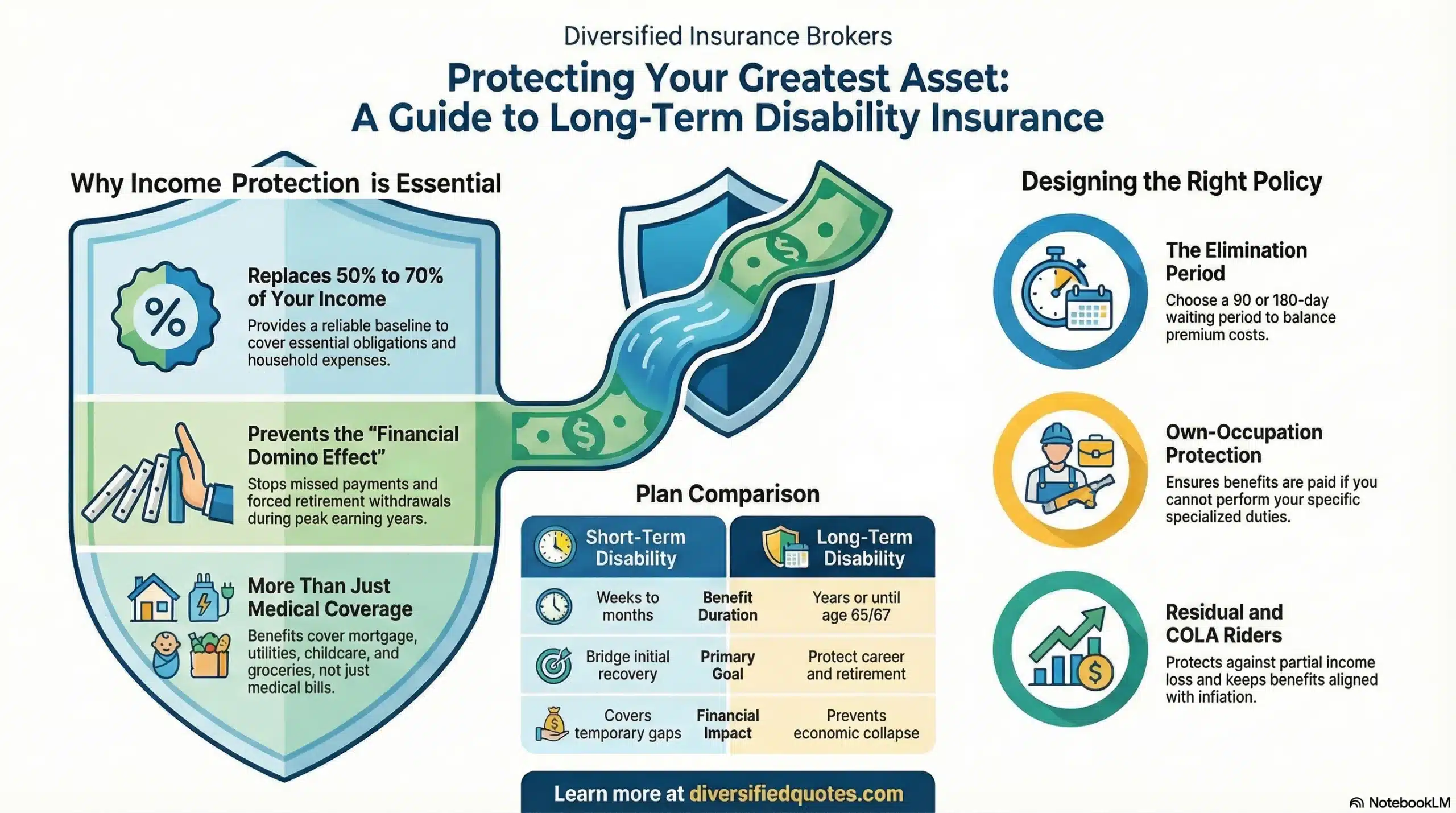
Talk With an Advisor Today
Choose how you’d like to connect—call or message us, then book a time that works for you.
Schedule here:
calendly.com/jason-dibcompanies/diversified-quotes
Licensed in all 50 states • Fiduciary, family-owned since 1980
FAQs: Disability Insurance for Cabinet Makers
What occupational class does cabinet making receive for disability insurance?
Cabinet making typically receives a middle-tier occupational class assignment from most disability insurance carriers — a classification that reflects the documented physical demands, power tool exposure, and injury probability of the trade relative to sedentary professional occupations. The specific class varies by carrier, which is one of the reasons working with an independent disability insurance broker produces better outcomes than applying directly to a single carrier: different carriers classify the same occupation differently, and those differences translate directly into different premium rates and maximum benefit amounts for identical coverage terms.
The practical impact of occupational class on a cabinet maker’s coverage is threefold. First, it determines the monthly benefit maximum the carrier will approve — typically expressed as a percentage of documented earned income. Second, it affects the premium rate per dollar of benefit, with middle-tier classifications carrying higher premiums than top-tier white-collar occupations. Third, it may affect the benefit period options available at some carriers. None of these factors prevents a cabinet maker from obtaining meaningful, comprehensive disability protection — they calibrate the terms and cost of that protection relative to the risk profile the carrier is underwriting. Comparing how multiple carriers treat the cabinet making classification before applying is the most effective way to identify the best available terms.
If I own my cabinet shop, do I need disability insurance even if I carry workers’ compensation for my employees?
Yes — and the gap between your employees’ workers’ comp protection and your own is one of the most important income protection vulnerabilities in a cabinet shop owner’s financial picture. Workers’ compensation covers employees for work-related injuries and occupational diseases. As the owner, unless you have specifically elected to include yourself in your own workers’ comp policy — which most small shop owners do not do by default — you have zero workers’ comp protection for your own injuries. The person whose disability would most directly eliminate the business’s revenue stream is operating entirely outside the system your employees rely on.
Beyond the ownership gap, workers’ compensation is structurally limited to work-related injuries and occupational diseases regardless of how comprehensive the policy is. It does not cover disability arising from illness — cancer, cardiac events, neurological conditions, serious orthopedic conditions unrelated to a specific workplace incident — which account for approximately 90 percent of long-term disabling conditions. A cabinet shop owner who becomes disabled from a serious illness receives no workers’ comp benefit and must fund both personal living expenses and business overhead from whatever reserves exist. Individual disability insurance is the coverage that fills both gaps: it covers disability from any qualifying cause and applies to the owner directly, regardless of how the business’s workers’ comp is structured. Evaluating whether your current coverage is truly adequate is worth a second opinion — understanding whether disability insurance is worth it for your specific situation starts with an accurate picture of what you currently have and where the gaps are.
What if I am partially disabled — can I still work in my shop at reduced capacity and collect disability benefits?
This is one of the most practically important policy design questions for cabinet makers, and the answer depends entirely on whether the policy includes a residual or partial disability benefit. Many disabilities that affect skilled tradespeople do not result in total inability to work — they reduce capacity, slow production, limit the types of tasks that can be performed, or require modified work arrangements that reduce earning capacity below the pre-disability level. A cabinet maker who can work three days per week after a back surgery but cannot sustain the full-day production schedule that generates full income is experiencing a real and significant economic disability, even though they are not completely unable to work.
A policy with a residual disability benefit addresses this scenario by paying a proportional benefit based on the percentage of income loss the partial disability produces. If the cabinet maker’s income has dropped by 40 percent due to the disability, the policy pays 40 percent of the full disability benefit — not zero because the insured is still doing some work, and not the full benefit because they are not totally disabled. For a production-based trade like cabinet making, where partial capacity is a common recovery trajectory after surgery or injury, a residual benefit provision transforms the policy from a binary total-disability-only product into a comprehensive income protection tool that responds to the most realistic disability scenarios the trade faces. Always confirm whether a residual benefit is included before purchasing any disability policy.
Are the respiratory risks of cabinet making — wood dust, lacquers, solvents — covered by disability insurance?
Yes — individual disability insurance covers disability arising from respiratory conditions including those that develop from occupational exposure, as long as the condition meets the policy’s definition of disability and the insured is not excluded for a pre-existing respiratory condition. This is one of the most significant advantages individual disability insurance holds over workers’ compensation for cabinet makers: a respiratory condition that develops from cumulative wood dust and finishing chemical exposure over years of working in a shop is an illness-based disability under the workers’ comp framework, meaning it generates no workers’ comp benefit regardless of how clearly its origin traces to the work environment. Individual disability insurance does not require the condition to arise from a specific workplace incident — it requires the condition to meet the definition of disability, which respiratory conditions severe enough to prevent sustained work in a wood-dust-and-chemical environment typically do.
OSHA’s woodworking hazard documentation identifies wood dust and finishing chemicals as health hazards associated with respiratory diseases and skin conditions, and the occupational risk profile for cabinet makers explicitly includes these long-term health exposures as part of the disability risk picture. Cabinet makers who have already developed a documented respiratory condition before applying for disability insurance should expect underwriting scrutiny of that history — some carriers will exclude the specific condition while covering all other causes of disability, and others may offer coverage after a waiting period. Working with a broker who knows which carriers take the most favorable view of respiratory history in woodworking trades is essential to getting the best outcome for applicants with this exposure.
How are disability insurance benefits taxed for cabinet makers?
The tax treatment of disability insurance benefits for cabinet makers depends on how the premiums are paid. When an individual pays disability insurance premiums with after-tax dollars — which is the standard case for self-employed cabinet makers and sole proprietors purchasing individual coverage — the benefits received during a claim are generally received income-tax-free. This is a significant advantage: whether disability insurance payments are taxable has a direct impact on how much of the monthly benefit actually reaches the cabinet maker’s household, and the after-tax premium structure that most individual policies use produces the most favorable tax treatment at claim time.
For cabinet makers who are employees and whose employer pays some or all of the disability insurance premiums, the tax treatment changes: employer-paid premiums are typically not included in the employee’s taxable income, but the resulting benefits — when received — are generally taxable as ordinary income. This means the effective purchasing power of a group plan benefit paid by an employer is lower than the face amount suggests, because a portion will be owed in taxes at claim time. Self-employed cabinet makers who deduct disability insurance premiums as a business expense should also understand that this deduction may affect the taxability of benefits received. Confirming the specific tax treatment for a given policy structure with a tax advisor before finalizing coverage is always advisable, as individual circumstances vary.
I received a disability insurance quote that seemed expensive — is there a way to know if it is competitive?
A single disability insurance quote from a single carrier tells you almost nothing about whether the pricing is competitive — it tells you only what that one carrier charges for that coverage structure under their occupational class assignment for cabinet making. Disability insurance premiums for middle-tier occupational classifications can vary meaningfully across carriers for identical benefit amounts and policy terms, and occupational class assignments themselves can differ between carriers, producing different base rates for the same applicant. Accepting the first quote as representative of the market is one of the most common and costly mistakes skilled tradespeople make when evaluating disability coverage.
The most effective way to assess whether a quote is competitive is to request a parallel comparison across multiple carriers through an independent broker who works with the full range of disability insurance providers — not a captive agent or direct-channel source limited to a single company’s product line. A second opinion on your disability insurance quote is straightforward to obtain and frequently reveals meaningful premium differences, better policy terms, or coverage structures the original quote did not include. For cabinet makers who received a quote and found it expensive, the question worth asking before declining coverage is not whether the coverage costs too much — it is whether the coverage costs too much relative to what the full market offers for the same protection.
About the Author:
Jason Stolz, CLTC, CRPC, DIA, CAA and Chief Underwriter at Diversified Insurance Brokers (NPN 20471358), is a senior insurance and retirement professional with more than 25 years of real-world experience helping individuals, families, and business owners protect their income, assets, and long-term financial stability. As a long-time partner of the nationally licensed independent agency Diversified Insurance Brokers, Jason provides trusted guidance across multiple specialties—including fixed and indexed annuities, long-term care planning, personal and business disability insurance, life insurance solutions, Group Health, Travel Medical and Evacuation Insurance, and short-term health coverage. Diversified Insurance Brokers maintains active contracts with over 100 highly rated insurance carriers, ensuring clients have access to a broad and competitive marketplace.
His practical, education-first approach has earned recognition in publications such as VoyageATL, and contributions from his agency featured in Kiplinger and GoBankingRates— highlighting his commitment to financial clarity and client-focused planning. Drawing on deep product knowledge and years of hands-on field experience, Jason helps clients evaluate carriers, compare strategies, and build retirement and protection plans that are both secure and cost-efficient. Visitors who want to explore current annuity rates and compare options across multiple insurers can also use this annuity quote and comparison tool.
Explore More Disability Insurance Options: Browse our complete guide to Disability Insurance for Trades, Construction & Industrial — covering contractors, electricians, plumbers, welders, roofers, machinists & skilled trades from 100+ carriers.
Last Reviewed: June 6, 2026 |
Reviewed by: Jason Stolz, CLTC, CRPC, DIA, CAA
Chief Underwriter, Diversified Insurance Brokers, Inc. | NPN: 20471358 | Diversified Insurance Brokers, Inc. — Licensed in all 50 states
Fact Checked by: Tonia Pettitt, CMIP©
Medicare Specialist, Diversified Insurance Brokers, Inc. | NPN: 14374308 | Diversified Insurance Brokers, Inc. — Licensed in all 50 states
Did you find this content helpful? Leave us a Google review — it helps others find trustworthy guidance too.
Editorial Standards: Diversified Insurance Brokers maintains rigorous editorial standards to ensure accuracy, clarity, and independence in all content. Learn more about our editorial standards and commitment to transparency.
