
Disability Insurance for Window Cleaners
As an Independent Disability Insurance Broker, we have access to exclusive discounts and negotiated pricing most captive agents can’t offer — see the full breakdown near the end of this page.
Disability Insurance for Window Cleaners

Jason Stolz CLTC, CRPC, DIA, CAA
Professional window cleaners — from residential ladder work and commercial low-rise extension pole cleaning through the high-rise rope descent, suspended scaffold, and bosun chair work that defines urban building maintenance — practice what multiple industry and regulatory sources specifically identify as one of the most dangerous jobs in the building maintenance sector. A government agency analysis cited across OSHA documentation and occupational safety literature documents 88 window cleaning accidents over a 15-year period, 62 of which resulted in fatalities — a seventy percent fatality rate among documented window cleaning incidents that reflects the consequence of fall events from extreme height above busy streets and public spaces. NIOSH research specifically identifies defective scaffold equipment, improper installation or operation, improper training, and failure to use appropriate personal fall protection as the causes of fatal falls in window cleaning work. OSHA data documents seven window washer deaths nationwide during the two-year period from January 2022 to December 2023 — in a workforce of relatively modest total size, representing a documented fatality rate that underscores the severity of the occupation’s primary hazard. In New York City alone, industry sources document approximately 15 window washers experiencing falls every day — a figure that reflects the concentration of high-rise window cleaning activity in a major urban building stock and the cumulative frequency with which fall events occur even in a well-regulated market. OSHA’s specific regulatory framework for window cleaning reflects the hazard’s severity: OSHA 1910.28 requires fall protection whenever workers are exposed to fall hazards at 4 feet or more above a lower level, and OSHA specifically limits rope descent systems on buildings exceeding 300 feet, requiring demonstration that other access methods are not feasible before rope descent can be employed at extreme height. The International Window Cleaning Association, working in cooperation with OSHA, specifically identifies fall hazards including scaffolds, skylights, different roof levels, retaining walls, balconies, unprotected holes, extreme temperatures, wind, and inclement weather as causal factors in window washing accidents — a hazard catalogue that encompasses the full range of the occupation’s physical risk environment from residential ladder work through downtown high-rise rope access. Bureau of Labor Statistics wage data for building cleaning workers ranges from approximately $35,000 to $45,000 annually at the median level, with experienced high-rise specialists in major urban markets earning significantly above median through specialty differential and overtime. For a profession that OSHA’s documentation, NIOSH research, and industry safety analysis all specifically identify as presenting serious fall hazard at every level of the height spectrum, the disability insurance imperative is answered by the documented fatality record itself: 62 fatalities in 88 documented accidents is a severity rate that makes every working day without income protection a day of uninsured financial exposure to the most predictable consequence of the occupation’s primary hazard. For self-employed window cleaning business owners and independent residential and commercial window cleaners — who constitute a substantial share of the occupation’s workforce — that exposure is complete, with no employer benefit baseline and no workers’ compensation for the owner’s own injuries under most self-employment structures.
At Diversified Insurance Brokers, Jason Stolz, CLTC, CRPC, DIA, CAA works with window cleaning professionals across the full range of the occupation’s height spectrum and business structures — residential window cleaners whose ladder work on two and three-story homes creates the same fall hazard profile at lower absolute height as any ladder-dependent trade, commercial low-rise cleaning contractors whose extension pole, platform, and aerial lift work spans from ground-accessible to several stories, high-rise specialists in major urban markets whose rope descent, swing stage, and bosun chair work represents the most technically demanding and most acutely hazardous end of the professional window cleaning spectrum, and window cleaning business owners whose operations range from owner-operated residential routes to multi-crew commercial contracts with the employee overhead and equipment investments that make business overhead expense coverage as consequential as personal income protection. The coverage architecture for window cleaning professionals requires specific attention to the occupational class implications of the height at which the specific cleaner works — residential ladder versus high-rise rope access receive different classifications from most carriers — the income documentation for variable route-based or contract-based window cleaning revenue, and the self-employment disability framework that applies to the large independent contractor and small business owner segment of the window cleaning workforce.
Compare Disability Coverage for Window Cleaning Professionals
We review coverage options across 100+ carriers and identify the policy structure, income documentation approach, and business overhead coverage that fits your specific window cleaning role and height of work.
Window Cleaner Disability Risk — The Fall Hazard Spectrum from Residential Ladders to High-Rise Rope Access
| Work Category | Hazard Profile and Regulatory Context | Primary Disability Risk | Employment Structure | Income Protection Gap |
|---|---|---|---|---|
| Residential window cleaning — ladders and extension poles | OSHA fall protection requirements apply at 4 feet above the lower level — meaning residential two-story work is within OSHA’s documented fall protection threshold; residential cleaning requires repositioning ladders on varied terrain including slopes, landscaping, and uneven surfaces that create the unstable base conditions contributing to ladder falls; wet glass cleaning creates slippery working surfaces; IWCA specifically identifies retaining walls, balconies, and different roof levels as fall hazards alongside scaffold and elevation work; residential window cleaners frequently work alone with delayed emergency response if a fall occurs | Ladder falls from 8 to 25 feet producing fractures, spinal injuries, or head trauma requiring extended recovery; falls on wet residential surfaces; musculoskeletal conditions from sustained reaching, carrying, and ladder repositioning across a full residential cleaning route | Predominantly self-employed owner-operators or small business owners; some employed by residential cleaning companies; self-employed carry complete coverage gap | Complete gap for self-employed; individual DI is the entire income protection for the most common employment structure in residential window cleaning |
| Commercial low-rise — aerial lifts, platforms, and multi-story access | Commercial cleaning of office buildings, retail centers, and institutional facilities up to several stories uses aerial work platforms, scissor lifts, extension equipment, and multi-story ladders — each with the fall protection requirements OSHA’s 1910.28 standard imposes; commercial low-rise work adds equipment failure risk (aerial lift malfunction), overhead powerline contact from boom equipment, and the physical demands of sustained cleaning production across a commercial route; wet conditions on commercial hard surfaces and loading docks create additional slip and fall exposure | Falls from aerial work platforms or multi-story ladders; aerial lift tip-over or malfunction; electrocution from overhead powerline contact with boom equipment; back and shoulder MSDs from sustained commercial cleaning production demands | Mix of self-employed contractors and employed building services workers; commercial cleaning company employees may have group plan access at varying quality | Full gap for self-employed; significant structural gaps for employed workers whose group plan access is minimal in the building services sector |
| High-rise rope descent and swing stage — urban skyscraper work | Government analysis documents 88 window cleaning accidents over 15 years with 62 fatalities — 70% fatality rate; NIOSH identifies defective scaffold equipment, improper installation, improper training, and failure to use fall protection as the specific causes; OSHA limits rope descent systems on buildings exceeding 300 feet; documented case: window cleaner fell 11 stories after disconnecting safety lanyard to reach a difficult area; OSHA data documents 7 window washer deaths nationwide in the 2-year period 2022-2023; NYC sees approximately 15 window washers experience falls every day; OSHA requires building owners to maintain certified roof anchors for suspended platform and rope descent systems | Fatal or catastrophic fall from high-rise height during rope descent or swing stage work; equipment failure (defective rope, failed anchor, platform malfunction) producing fall at extreme height; weather-induced swing stage instability; the 70% fatality rate among documented window cleaning accidents reflects the consequence of high-rise fall events specifically | Mix of employed (large urban building service contractors) and independent high-rise specialists; high-rise specialty work commands premium compensation but carries the most severe documented fall hazard profile of any window cleaning segment | Full gap for self-employed specialists; employer group plans limited for employed workers; individual DI or accident-only coverage provides the income floor for the most severely documented fall hazard in the occupation |
| Weather, powerline, and non-fall acute hazards | IWCA and OSHA both specifically identify weather as a causal factor in window cleaning accidents — wind loading on swing stages, extreme temperatures affecting grip and alertness, and inclement weather creating hazardous working conditions at elevation; electrocution from powerline contact is documented as a cause in window cleaning accidents; one documented case describes a window washer in Edmonton left dangling after a swing stage twisted in strong winds; OSHA specifically notes overhead powerlines as a hazard for window cleaning workers at wind farms and in urban environments where boom equipment can contact live lines | Electrocution or severe burns from overhead powerline contact; wind-induced platform instability producing falls or entrapment; cold weather injuries from sustained outdoor exposure; heat illness from sustained summer exterior work on glass-covered building facades | All employment structures; weather and powerline hazards exist across the full height spectrum of window cleaning work | Individual DI covers qualifying disability from all acute non-fall hazard causes including electrical injury and weather-related incidents; workers’ comp covers employed workers at documented incidents |
| Chemical exposure and musculoskeletal disorders | Professional window cleaning uses a range of cleaning solutions including concentrated surfactants, alkaline window cleaning concentrates, water-fed pole solutions, and for specialized work, acid-based glass restoration products and heavy-duty commercial cleaners; sustained skin and respiratory exposure to concentrated cleaning chemicals across a cleaning career creates the gradual chemical sensitization pathway documented for all cleaning occupational categories; sustained reaching, carrying, ladder climbing, and equipment repositioning across a full route creates the cumulative MSD loading documented for physically demanding outdoor service occupations | Occupational dermatitis or respiratory sensitization from sustained cleaning chemical exposure; back, shoulder, and wrist conditions from sustained reaching and equipment handling across a full cleaning career; carpal tunnel from sustained squeegee and pole handling | Gradual chemical exposure and MSD conditions outside workers’ comp incident framework; individual DI covers qualifying disability from any illness cause regardless of gradual onset | Significant gap for gradual exposure and cumulative MSD conditions; individual DI fills where workers’ comp attribution fails for the illness-based disability pathways |
The table documents the full disability risk landscape across window cleaning’s work categories — from residential ladder falls through the government-documented 70% fatality rate among high-rise window cleaning accidents — and establishes that the income protection gap is comprehensive across all levels of the occupation for the self-employed and independent contractor segment that defines how most window cleaning professionals work. Why window cleaning professionals prioritize income protection is answered by a simple calculation: at any height above the ground, a fall producing a serious back injury, lower extremity fracture, or head trauma can eliminate the ability to perform ladder, rope, and aerial platform work — the specific physical functions that window cleaning income requires — for an extended or permanent period, with no employer benefit and no income floor in place for the self-employed majority of the workforce.
The Fall Hazard Record — What NIOSH, OSHA, and Industry Research Specifically Document
The seventy percent fatality rate among the 88 window cleaning accidents documented in government agency analysis is the most important single statistic in the occupational safety literature for this profession — because it establishes that window cleaning fall events are not merely injury-producing but are overwhelmingly fatal when they occur. This fatality rate reflects the physics of the work: window cleaning falls at height produce the injuries associated with extreme fall distance, with the severity determined by the height from which the fall occurs and the nature of the landing surface. NIOSH’s specific research on fatal falls in window cleaning identifies four primary causal pathways — defective scaffold equipment, improper installation or operation, improper training, and failure to use appropriate personal fall protection — all of which represent systemic safety failures rather than random events, and all of which continue to produce documented fatalities despite OSHA’s specific regulatory framework for window cleaning access equipment.
The documented case of a window cleaner who fell 11 stories after disconnecting his safety lanyard to reach a difficult area — surviving but requiring extensive medical treatment and achieving approximately 80 percent recovery — illustrates both the catastrophic injury consequence of high-rise window cleaning falls and the specific mechanism by which safety systems fail: the individual decision made in the course of normal work to access a difficult area in a way that removes fall protection. A fall from 11 stories that produces approximately 80 percent recovery still produces 20 percent permanent functional impairment — an outcome that for a window cleaning professional may permanently limit the physical capacity for ladder and aerial platform work even after maximum medical improvement. Long-term disability income coverage to age 65 provides the income floor for the full career earnings horizon when a fall-related injury produces extended or permanent disability. Short-term disability coverage fills the immediate income gap from the first day of disability through long-term coverage activation — critical for any window cleaning professional whose route income stops immediately when injury prevents work. Accident-only disability income insurance provides a specifically targeted and accessible coverage layer for window cleaning professionals who want coverage that directly addresses the acute physical fall and accident scenarios that the government analysis, NIOSH research, and OSHA documentation all identify as the primary fatality and serious injury categories for this occupation. The parallel framework for professionals working in documented hazard categories with specific OSHA regulatory attention applies to window cleaning — an occupation where OSHA has developed specific regulatory standards for rope descent systems, suspended platforms, and roof anchor certification precisely because the fall hazard is specific, documented, and severe.
Window Cleaning Business Owners — The Two-Layer Financial Exposure
Window cleaning business owners — those who have built residential or commercial routes, purchased vehicles and equipment, hired employees, and developed client relationships representing the business’s revenue base — carry the two-layer disability exposure that any service business owner faces with the specific intensity of an occupation whose primary hazard produces the 70% fatality rate documented in the incident literature. A disability that prevents the owner from cleaning windows creates both personal income loss and simultaneous business overhead obligations: vehicle payments, equipment financing for aerial lifts or specialized access systems, liability insurance premiums, employee wages, and the fixed costs of maintaining a route-based cleaning operation. All of these continue from the first day of disability regardless of whether any window cleaning revenue is being generated.
Business overhead expense disability coverage specifically addresses the window cleaning business’s fixed operating costs during the owner’s qualifying disability — vehicle payments, equipment financing, employee wages, insurance premiums, and fixed business costs — preserving the business and its client route relationships during recovery. The BOE benefit is sized to actual documented monthly fixed overhead rather than to route revenue, covering what the operation costs to maintain. Personal disability income and BOE coverage together create the complete protection architecture for any window cleaning business owner — the household income floor and the business overhead floor that disability simultaneously threatens. 1099-earning independent window cleaners who subcontract to commercial cleaning companies or building services managers follow the Schedule C income documentation framework for all contract cleaning revenue. The multi-year averaging approach applied to Schedule C income smooths the seasonal variability of window cleaning revenue — residential peaks in spring and fall, commercial contracts providing more even annual distribution — rather than penalizing a slow quarter or rewarding a peak season year.
Coverage Options, Occupational Class, and Policy Design for Window Cleaning Professionals
Window cleaning professionals receive occupational class assignments that vary meaningfully based on the height at which they primarily work — a distinction that matters more for window cleaners than for many other trades because the hazard profile changes dramatically between residential ladder work and high-rise rope descent. Residential window cleaners working predominantly at ladder height receive Class A to Class B assignments from most carriers; commercial low-rise specialists with aerial platform work receive Class B assignments; high-rise rope descent and swing stage specialists may receive Class B to Class C assignments reflecting the specific extreme-height exposure that the documented 70% accident fatality rate represents. These classifications produce higher premiums than sedentary occupations but do not prevent meaningful individual disability insurance coverage from the carriers serving physically hazardous service trades. The most consequential step for any window cleaning professional is working with an independent broker who accesses the full carrier market and who understands the specific height-based classification nuance that makes carrier selection particularly consequential for this occupation. Own-occupation disability coverage for a window cleaning professional should encompass the specific physical climbing, rappelling, aerial platform, and exterior building access functions that generate the income — not merely generic inability to perform any physical work.
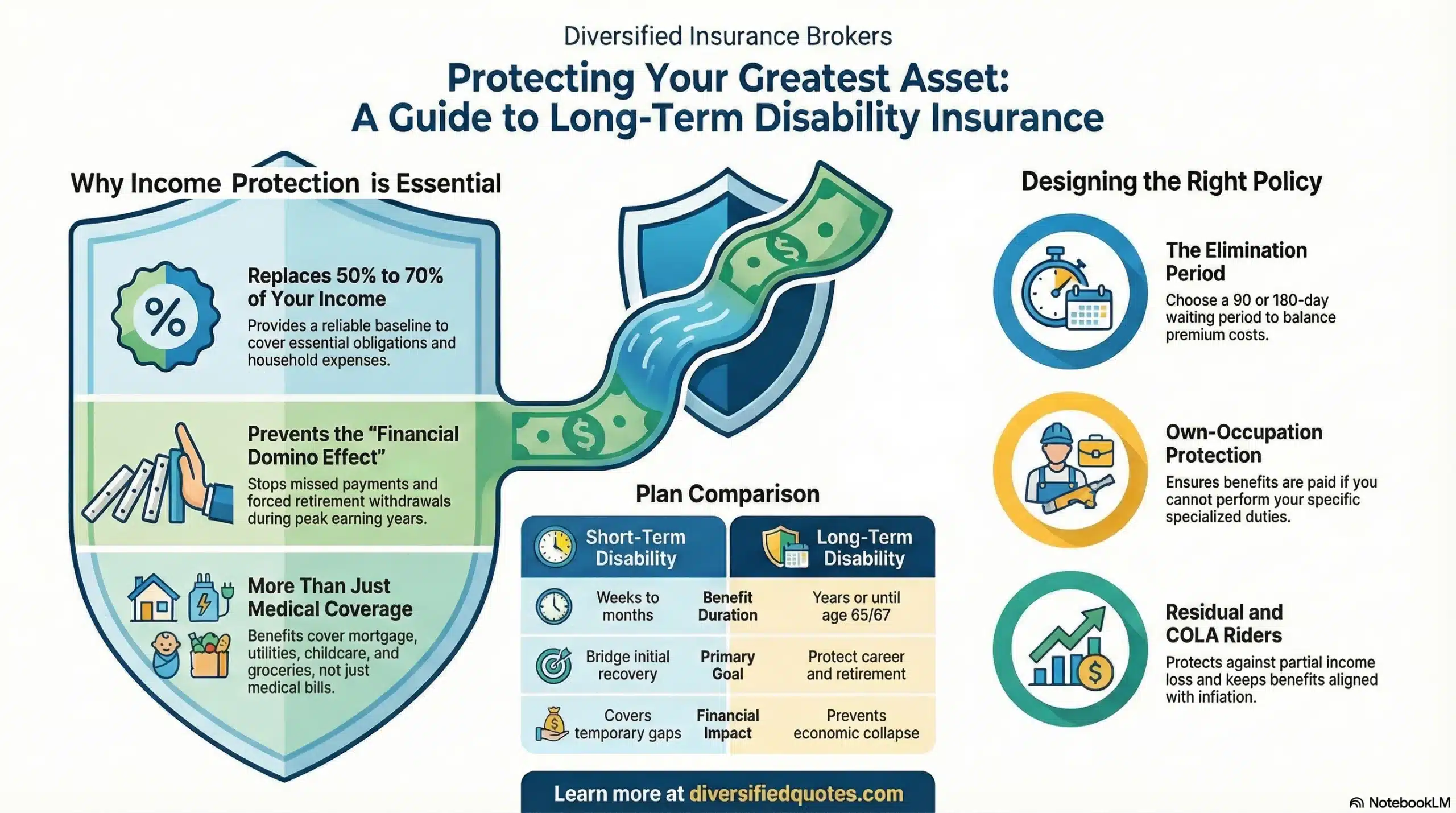
Residual disability coverage addresses the partial disability scenario — a window cleaning professional managing ground-level residential work during recovery from a fall injury while unable to perform the aerial and high-rise work that commands the premium rate — paying proportionally based on actual income reduction. How short-term and long-term disability structures interact maps coverage from the first day of any qualifying disability through the full benefit period. Coverage for window cleaning professionals with prior back, knee, or shoulder conditions from physical cleaning demands is available through independent broker comparison, typically with partial exclusion riders for documented prior conditions and full coverage for all other disability causes including all fall-related acute injury scenarios. Specialty and modified options extend coverage availability for window cleaning professionals whose specific occupational classification or health history creates standard underwriting complexity. How much disability income a window cleaning professional needs reflects documented income — W-2 wages for employed commercial cleaning workers, Schedule C for self-employed route owners — and household financial obligations. The elimination period reflects actual financial reserves. The future increase option is valuable for early-career window cleaning professionals whose route income is building with client base expansion. Cost of living adjustment protects purchasing power across extended disability periods. Guarantee issue disability insurance provides a last-resort access point when standard underwriting produces limited terms for the higher-risk height classifications. Why early-career window cleaning professionals need income protection from career start is answered by the documented accident record: fall events occur at every career stage and experience level, the 11-story fall documented by OSHA specifically involved a worker making a routine access decision rather than an inexperienced technician making a first-time error, and the window of opportunity to purchase comprehensive fall injury coverage before any fall-related health history has been documented closes with each working season. No-exam disability coverage provides streamlined approval for healthy window cleaning professionals. Getting the best available rates requires independent broker comparison across the full carrier market — carrier variation in height-based classification for window cleaning occupations is specific and financially meaningful. Whether disability benefits are taxable for a self-employed window cleaning business owner: personally purchased individual policies paid with after-tax income generally produce tax-free benefits. Whether disability insurance is worth the cost for a window cleaning professional is answered by the documented 70% fatality rate among window cleaning accidents — which means the non-fatal outcome of a serious fall event still represents the minority of documented serious incidents, making the financial consequence of any survivable serious fall injury in this profession an extremely high-stakes event for any household without income protection in place. A second opinion on any disability insurance proposal for a window cleaning professional confirms whether the height-based occupational class assignment is competitive, the own-occupation definition encompasses the specific physical cleaning functions that generate income, and the business overhead dimension is addressed appropriately before any premium commitment is made.
Get Your Window Cleaning Coverage Review
We compare height-based occupational class assignments, fall accident income protection, and business overhead structures across 100+ carriers to build the most comprehensive available income protection for your window cleaning career.
Talk With an Advisor Today
Choose how you’d like to connect—call or message us, then book a time that works for you.
Schedule here:
calendly.com/jason-dibcompanies/diversified-quotes
Licensed in all 50 states • Fiduciary, family-owned since 1980
FAQs: Disability Insurance for Window Cleaners
I only clean residential windows from ladders — do I really need disability insurance for that level of work?
Yes — and the rationale applies with specific force to residential ladder work because the income-stopping consequence of a ladder fall at residential height is as complete as a fall from any greater height, while the fall protection framework that OSHA applies begins at 4 feet above the lower level. A residential window cleaner working from a ladder at 16 to 24 feet on a two-story home who falls and sustains a serious back injury, lower extremity fracture, or head trauma faces the same immediate and complete income loss as any window cleaning professional at any height: the route stops, the revenue stops, and for a self-employed residential cleaner there is no employer sick pay, no group disability plan, and no income floor of any kind during recovery.
The IWCA, working in cooperation with OSHA, specifically identifies retaining walls, balconies, different roof levels, and unprotected holes as fall hazards alongside the more visually dramatic scaffold and elevation work — meaning the residential environment’s terrain variations, landscaping obstacles, uneven ground, and architectural complexity create the specific unstable base conditions that produce ladder falls at residential height. Residential window cleaning also carries the isolation risk that the accident literature documents as amplifying the consequence of any fall event: a solo residential cleaner working alone at a property has delayed emergency response if a fall occurs, compared to an employed worker at a managed commercial site. Individual disability insurance — sized to the residential route income that the cleaner actually depends on — is the only income floor available for the self-employed residential window cleaner when a ladder fall eliminates the ability to work, regardless of whether that fall occurs at 10 feet or 100 feet.
I own a window cleaning business with a crew — what disability coverage do I need?
As a window cleaning business owner with employees, your disability exposure has two distinct layers. Personal disability income insurance replaces your earned income when a qualifying disability prevents you from working — whether that means you can no longer perform cleaning work yourself, manage the crew, or both — sized to your documented net self-employment income from Schedule C averaged across two to three years. This policy addresses your household’s financial obligations during the disability period. Business overhead expense disability coverage addresses the business’s fixed operating costs: vehicle payments, equipment financing for aerial lifts or access systems, employee wages, liability insurance premiums, and any other fixed costs that continue during disability regardless of whether route revenue is being generated.
A disability that prevents you from active field management for three months creates both personal income loss and overhead accumulation against reduced or zero route revenue simultaneously. For a window cleaning operation where the owner’s active participation in sales, quality control, crew supervision, or field cleaning drives significant revenue, a disability can create both the personal income loss and meaningful revenue reduction — while fixed employee wages, vehicle payments, and insurance premiums continue at their full monthly level. BOE disability coverage pays the documented fixed monthly overhead of the cleaning business during qualifying disability, preserving the operation, the client route relationships, and the crew during the recovery period. The BOE benefit is sized to actual documented monthly fixed overhead — not to route revenue — covering what the business costs to maintain rather than what it generates. Together, personal disability income and BOE create the complete protection architecture for any window cleaning business owner, addressing both the household financial floor and the business overhead floor that disability simultaneously threatens.
Are disability insurance benefits taxable for a self-employed window cleaner?
For self-employed window cleaners who purchase individual disability insurance personally and pay premiums with after-tax personal income, monthly disability benefits received during a qualifying disability are generally received income-tax-free. The full benefit amount reaches the household without income tax reduction during the disability period when no route or contract cleaning revenue is being generated. The full tax treatment of disability insurance benefits matters for policy sizing: a tax-free individually purchased benefit should cover actual after-tax take-home income from the cleaning business, ensuring genuine income replacement during a disability period when the household’s obligations — mortgage, utilities, vehicle, family expenses — continue at their full level.
For window cleaning business owners who operate through LLC or S-corporation entities and who pay disability insurance premiums at the entity level, the tax treatment should be confirmed with a tax professional before assuming the standard personal-premium/tax-free-benefit baseline applies. BOE premiums paid by the business entity are generally deductible as ordinary business expenses, but BOE benefits received during disability are typically taxable business income — creating a roughly neutral net tax impact since the taxable BOE benefits offset the deductible overhead expenses they fund. The personal disability income policy purchased personally with after-tax income delivers its tax-free benefits at the household level independent of the business entity’s tax position. For employed window cleaning workers whose employer pays group disability premiums, resulting group plan disability benefits are typically taxable as ordinary income — reducing the effective replacement rate below the stated plan percentage, making individually purchased supplemental coverage more financially efficient at claim time when disability occurs.
I do high-rise window cleaning on rope descent systems — is disability insurance even available for that work?
Disability insurance is available for high-rise window cleaning professionals, including rope descent and swing stage specialists — though the specific occupational classification and the carrier underwriting guidelines for extreme-height window cleaning make carrier selection through an independent broker more consequential than for most occupations. High-rise rope descent and swing stage window cleaning receives the more challenging occupational class assignments — reflecting the documented 70% fatality rate among window cleaning incidents in the government agency analysis — which produces higher premiums than residential or commercial low-rise work but does not prevent meaningful income protection coverage from the carriers whose guidelines accommodate this hazard profile.
The most consequential factors in high-rise window cleaning disability insurance are the specific height at which the cleaner works, the access method used, and whether the carrier’s underwriting guidelines for extreme-height exterior building access produce standard policy terms, accident-only coverage, or some combination. An independent broker who regularly places coverage for high-elevation and high-hazard occupations knows which carriers are most favorable for high-rise rope access work specifically — a distinction that matters significantly because one carrier’s Class B rating with standard policy terms for a high-rise rope descent specialist may be another carrier’s Class C rating with significant benefit limitations for the same worker. Specialty and modified market options extend coverage availability for high-rise specialists whose specific extreme-height profile places them at the more challenging end of standard carrier underwriting. Guarantee issue disability insurance provides a last-resort access point when standard individual underwriting produces limited terms. A second opinion from an independent broker familiar with high-hazard physical occupation underwriting is the essential first step for any high-rise window cleaning professional before assuming that coverage is unavailable or before accepting the first terms a single direct application produces.
My window cleaning income varies seasonally — how does disability insurance handle that?
Window cleaning income variability — the spring and fall residential peaks, the winter slowdown in cold-weather markets, and the more even annual distribution of commercial contract revenue — is addressed through the multi-year averaging approach that disability insurance carriers apply to all self-employment income documentation. A two to three year average of documented net earned income from Schedule C smooths seasonal and year-to-year variability rather than penalizing a slow winter quarter or rewarding an exceptional spring season, producing a sustainable average income figure that reflects the cleaning business’s actual economic profile across its full seasonal cycle.
For window cleaning business owners whose revenue mix includes both variable residential work and more stable commercial contract revenue, the combined income documentation captures both streams in Schedule C — providing the most complete and accurate income basis for the benefit calculation. Residential cleaning route owners who also provide add-on services like gutter cleaning, power washing, or solar panel cleaning should include all earned income from these complementary services in their Schedule C documentation, since they reflect the total economic output of the cleaning business that the disability insurance is protecting. The residual disability benefit provision is specifically relevant for window cleaning professionals whose seasonal income structure may allow partial return to lower-risk cleaning work — ground-level residential or commercial interior work — during recovery from a fall or physical injury while the more demanding ladder and aerial work remains impossible. A residual benefit pays proportionally based on actual income reduction during this partial capacity recovery period rather than requiring total inability to perform any cleaning work as the only benefit trigger.
When is the best time for a window cleaner to purchase disability insurance?
Career start — or as early in the career as possible — is the most strategically advantageous purchase point for any window cleaning professional, and the fall hazard documentation makes the timing argument more specific than in many service occupations. The documented case of a window cleaner falling 11 stories after disconnecting a safety lanyard specifically involved an experienced worker making a routine access decision — not an inexperienced first-day technician. Fall events in window cleaning are not concentrated among the inexperienced; they are distributed across career stages, experience levels, and routine working conditions. This means fall risk exists from the first working day and remains present throughout the career, making every year without income protection a year of uninsured exposure to the primary disability cause.
Premium rates are age-rated and lock in at policy issuance on non-cancellable, guaranteed renewable policies. A window cleaning professional purchasing disability insurance at 24 locks in substantially lower annual premiums than the same coverage at 34 after ten years of ladder and aerial work have potentially produced back, knee, or shoulder health documentation. The future increase option allows benefit increases as route income grows — from a small initial client base through an established commercial and residential cleaning operation — without new medical underwriting that any fall-related or cleaning-activity health findings after the original purchase might affect. For window cleaning business owners specifically, the window to purchase comprehensive disability insurance at favorable terms — before any occupational health history has narrowed underwriting options — is at business formation rather than after years of physical cleaning work have produced the health record that underwriters evaluate at application time. Every season of ladder and aerial platform cleaning work is a season during which the documented fall hazard exists and the opportunity to purchase comprehensive coverage before any fall-related injury history closes incrementally.
About the Author:
Jason Stolz, CLTC, CRPC, DIA, CAA and Chief Underwriter at Diversified Insurance Brokers (NPN 20471358), is a senior insurance and retirement professional with more than 25 years of real-world experience helping individuals, families, and business owners protect their income, assets, and long-term financial stability. As a long-time partner of the nationally licensed independent agency Diversified Insurance Brokers, Jason provides trusted guidance across multiple specialties—including fixed and indexed annuities, long-term care planning, personal and business disability insurance, life insurance solutions, Group Health, Travel Medical and Evacuation Insurance, and short-term health coverage. Diversified Insurance Brokers maintains active contracts with over 100 highly rated insurance carriers, ensuring clients have access to a broad and competitive marketplace.
His practical, education-first approach has earned recognition in publications such as VoyageATL, and contributions from his agency featured in Kiplinger and GoBankingRates— highlighting his commitment to financial clarity and client-focused planning. Drawing on deep product knowledge and years of hands-on field experience, Jason helps clients evaluate carriers, compare strategies, and build retirement and protection plans that are both secure and cost-efficient. Visitors who want to explore current annuity rates and compare options across multiple insurers can also use this annuity quote and comparison tool.
Explore More Disability Insurance Options: Browse our complete guide to Disability Insurance for Trades, Construction & Industrial — covering contractors, electricians, plumbers, welders, roofers, machinists & skilled trades from 100+ carriers.
Last Reviewed: June 8, 2026 |
Reviewed by: Jason Stolz, CLTC, CRPC, DIA, CAA
Chief Underwriter, Diversified Insurance Brokers, Inc. | NPN: 20471358 | Diversified Insurance Brokers, Inc. — Licensed in all 50 states
Fact Checked by: Tonia Pettitt, CMIP©
Medicare Specialist, Diversified Insurance Brokers, Inc. | NPN: 14374308 | Diversified Insurance Brokers, Inc. — Licensed in all 50 states
Did you find this content helpful? Leave us a Google review — it helps others find trustworthy guidance too.
Editorial Standards: Diversified Insurance Brokers maintains rigorous editorial standards to ensure accuracy, clarity, and independence in all content. Learn more about our editorial standards and commitment to transparency.
