
Disability Insurance for Welders
As an Independent Disability Insurance Broker, we have access to exclusive discounts and negotiated pricing most captive agents can’t offer — see the full breakdown near the end of this page.
Disability Insurance for Welders

Jason Stolz CLTC, CRPC, DIA, CAA
Professional welders — structural welders, pipe welders, MIG and TIG specialists, shipyard welders, pipeline welders, and fabrication shop welders — work in an occupational environment that OSHA specifically identifies as posing safety and health risks to over 500,000 American workers across a wide variety of industries. OSHA’s welding, cutting, and brazing hazards documentation is explicit: health hazards include exposures to metal fumes and ultraviolet radiation; safety hazards include burns, eye damage, electrical shock, cuts, and crushed toes and fingers. What OSHA’s categorical language only begins to capture is the specific toxicological profile of what welding fumes actually contain — and why that profile creates some of the most serious documented illness-based disability pathways of any trade profession. The International Agency for Research on Cancer classifies hexavalent chromium — generated specifically when welding stainless steel, chromium-plated metals, and certain alloys — as a Group 1 carcinogen, the highest possible IARC classification indicating definitive evidence of cancer risk in humans, with documented health consequences including lung cancer, nasal and skin ulcers, kidney and liver damage, and erosion of the nasal septum. OSHA created a separate, specifically dedicated hexavalent chromium standard (29 CFR 1910.1026) reflecting the severity of this exposure — with a permissible exposure limit of just 5 micrograms per cubic meter reflecting the serious health risks associated with this compound at even low sustained exposure levels. Manganese — present in virtually all welding electrodes and in many steel alloys — produces manganism upon chronic inhalation, a Parkinson’s-like neurological condition documented in occupational medicine as characterized by tremors, difficulty walking, cognitive impairment, and psychiatric symptoms. Critically, peer-reviewed occupational medicine research specifically notes that manganism often affects younger workers and may not respond to standard Parkinson’s disease treatments — meaning chronic manganese fume exposure can produce permanent neurological disability in working-age welders without the treatment options that a general Parkinson’s diagnosis might offer. Bureau of Labor Statistics wage data documents the median annual wage for welders, cutters, solderers, and brazers at $50,990 as of May 2024. For the most experienced pipeline, structural, and underwater welders, specialty compensation substantially exceeds the median. For a profession that sits within the documented high-risk tier of American trade occupations, the disability insurance planning imperative is answered by the OSHA documentation itself: 500,000 workers in daily exposure to documented carcinogens, neurological toxins, burn hazards, arc radiation, and electrical shock — with most carrying either no employer group disability coverage or the structural limitations of group plans that fail to address the gradual illness pathways that define the most serious long-term disability consequences of sustained welding work. For self-employed welding contractors and fabrication shop owners, the exposure is total — no employer benefit of any kind, no workers’ compensation for the owner’s own injuries under most self-employment structures, and no income floor whatsoever when disability eliminates the ability to weld.
At Diversified Insurance Brokers, Jason Stolz, CLTC, CRPC, DIA, CAA works with welding professionals across the full range of the trade’s employment and business structures — construction welders on structural steel and infrastructure projects whose fall, burn, and electrical hazard profile combines with fume exposure from cutting and joining operations, pipeline welders in the oil and gas sector whose specialty skill commands premium compensation and whose remote, physically demanding work environment combines multiple hazard categories simultaneously, shipyard welders whose confined space and marine environment work adds atmospheric hazard and physical fall risk to the standard welding exposure profile, manufacturing and fabrication shop welders whose sustained daily fume exposure in enclosed production environments creates the long-duration chemical disability pathway that the IARC carcinogen classification specifically documents, and self-employed welding shop owners and custom fabricators who carry equipment financing obligations for welding systems, plasma cutters, and fabrication tooling alongside personal income exposure. The coverage architecture for each requires specific attention to the occupational class implications of the specific welding environment, the income documentation for variable project-based and contract welding income, and the self-employment disability framework that applies to the significant portion of experienced welders who operate their own shops or contract their specialty skills independently.
Compare Disability Coverage for Welding Professionals
We review coverage options across 100+ carriers and identify the policy structure, fume exposure underwriting approach, and shop overhead coverage that fits your specific welding specialty and employment structure.
Request Disability Insurance OptionsWelder Disability Risk — Fume Carcinogens, Neurological Toxins, and the Physical Hazard Profile
| Risk Category | OSHA, IARC, and Research Context | Resulting Disability Risk | Coverage Status | Income Protection Gap |
|---|---|---|---|---|
| Hexavalent chromium — IARC Group 1 carcinogen from stainless steel welding | IARC classifies hexavalent chromium as Group 1 carcinogen with definitive evidence of cancer risk; OSHA created a dedicated separate standard (29 CFR 1910.1026) with a permissible exposure limit of 5 µg/m³; approximately 558,000 workers face hexavalent chromium exposure annually in general industry and construction; stainless steel welding produces hexavalent chromium fumes as a fundamental byproduct of the process — peer-reviewed research documents SS welding presents added hazards from hexavalent chromium and nickel, both known carcinogens; documented consequences include lung cancer, nasal and skin ulcers, kidney and liver damage, and nasal septum erosion; symptoms often don’t appear immediately — a welder may work under-ventilated for years before developing chronic respiratory issues | Lung cancer requiring extended treatment and producing permanent disability; nasal cavity cancer from sustained chromium exposure; kidney or liver disease from systemic chromium effects — long-duration illness-based disabilities developing across a stainless steel welding career | Gradual exposure conditions outside workers’ comp incident framework; no single datable incident for cancer or organ disease; individual DI covers qualifying illness-based disability from any cause | Complete gap; individual DI specifically covers the Group 1 carcinogen illness pathway that workers’ comp attribution requirements leave entirely unprotected |
| Manganism — neurological disability from manganese fume inhalation | Manganese is a component of virtually all welding electrodes and many steel alloys; chronic manganese inhalation produces manganism — a Parkinson’s-like neurological condition documented in occupational medicine as characterized by tremors, difficulty walking, cognitive impairment, and psychiatric symptoms; peer-reviewed 2024 research (American Welding Society) documents MRI-confirmed manganism in welders from elevated manganese fume exposure and documents neuropsychological performance impairment in welders; occupational medicine specifically notes manganism often affects younger workers and may not respond to standard Parkinson’s disease treatments — making it potentially permanent and career-ending in working-age welders | Progressive neurological disability from chronic manganese exposure — tremors and motor impairment preventing sustained precision welding; cognitive impairment eliminating the technical judgment that quality welding requires; permanent disability in younger working-age welders without the treatment options that other neurological conditions may offer | Gradual neurological conditions outside workers’ comp; individual DI covers qualifying disability from neurological conditions including manganism regardless of occupational causation attribution difficulty | Full gap; individual DI covers the neurological disability pathway that may permanently end a welding career in younger workers — precisely the disability scenario where long-term income protection is most consequential |
| Pulmonary disease — COPD, siderosis, and respiratory failure from sustained fume inhalation | Peer-reviewed research documents chronic bronchitis and COPD as consequences of long-term welding career exposure; a 2024 cross-sectional study of 3,958 workers specifically documents lung function impairment in spot-welders compared to unexposed controls — measuring forced expiratory volume differences attributable to welding fume exposure; iron oxide exposure causes pulmonary siderosis — a lung condition impairing respiratory function; cadmium and beryllium fumes cause severe lung complications and pulmonary edema; welding fume fever (zinc oxide inhalation) produces acute flu-like symptoms that can mask more serious long-term effects | Progressive COPD or pulmonary fibrosis preventing sustained welding work requiring adequate respiratory capacity; lung function impairment producing disability that accumulates across the welding career without a single attributable incident; pulmonary siderosis impairing the sustained physical demands of welding | Gradual pulmonary conditions outside workers’ comp incident attribution; individual DI covers all qualifying respiratory disability regardless of gradual onset | Significant gap; individual DI fills where workers’ comp’s incident framework specifically fails for the most common actual illness disability pathway of sustained welding fume inhalation |
| Burns, arc eye, and acute physical injury | OSHA specifically documents burns, eye damage, and electrical shock as safety hazards from welding operations; arc eye (photokeratitis) — inflammation of the cornea from UV radiation exposure — is a documented acute welding hazard producing severe eye pain and temporary vision loss; metal spatter from welding processes produces burn injuries to exposed skin; electrical shock from welding equipment is a documented acute safety hazard; structural welders on elevated work platforms face the fall hazard profile common to all elevated construction work | Serious burn injuries requiring extended recovery; eye injuries potentially affecting vision and the ability to perform precision welding; electrical shock producing cardiac effects or nerve damage; falls from elevated work positions producing fractures or spinal injuries | Workers’ comp for employed welders at documented acute incidents; self-employed welding contractors entirely unprotected; individual DI or accident-only coverage provides income floor for all acute injury causes | Complete gap for self-employed; individual DI covers qualifying disability from all acute physical injury causes including burns, electrical injury, and falls |
| Musculoskeletal disorders from sustained awkward welding postures | Welding frequently requires sustained awkward postures — overhead welding positions loading the shoulder and neck, confined space welding requiring sustained bent or cramped postures, floor-level work requiring sustained lumbar flexion — producing the cumulative musculoskeletal loading documented for physically demanding manufacturing and construction trades; pipeline welders in remote locations perform physically demanding sustained posture work in outdoor conditions; fabrication shop welders sustain the physical demands of manipulating heavy metal components alongside the heat and radiation of the welding arc | Lumbar disc conditions from sustained overhead and awkward welding postures; shoulder tendinopathy from sustained overhead welding; neck conditions from sustained forward-flexed position during arc welding; cumulative MSD conditions eventually preventing continued welding work | Workers’ comp for acute documented incidents; cumulative MSD conditions disputed; self-employed welders entirely unprotected; individual DI covers all qualifying MSD disability | Significant gap for cumulative MSD conditions; individual DI covers disability from any qualifying musculoskeletal cause without incident attribution requirement |
The table documents a disability risk profile that is both physically acute and chemically catastrophic in its long-duration consequences — two Group 1 carcinogens (hexavalent chromium and nickel from stainless welding), a documented neurological toxin (manganese) producing permanent Parkinson’s-like disability in working-age welders, and a full spectrum of pulmonary disease from COPD through siderosis produced by the particle and gas mixture that the welding arc generates from every metal joining operation. Why welding professionals prioritize income protection is answered by the specific toxicological documentation: the substances inhaled during an ordinary day of welding stainless steel — hexavalent chromium, nickel, manganese — are IARC-classified carcinogens and documented neurological toxins that accumulate in tissue across a welding career, producing disabilities that may not appear for years or decades but that, when they do, produce severe and permanent consequences without any automatic income protection mechanism in place.
Manganism and the Neurological Disability Pathway — What the Research Specifically Documents
Manganism deserves specific attention as a disability planning consideration for welders because it represents a uniquely consequential combination of characteristics: it is specific to welding as an occupational exposure, it affects younger workers, it produces permanent disability, and it may not respond to standard treatments. Occupational medicine sources describe manganism as a Parkinson’s-like neurological condition characterized by tremors, difficulty walking, cognitive impairment, and psychiatric symptoms — arising specifically from chronic inhalation of manganese-containing welding fumes, which are present in the fume mixture of virtually all arc welding processes because manganese is a component of most welding electrodes and many steel alloys. The 2024 literature update from the American Welding Society documents MRI-confirmed manganism in a welder from elevated manganese fume concentrations, and documents research evaluating impacts of welding fume exposure on medial temporal lobe structural changes and neuropsychological performance — assessing whether welders have increased risk of neurodegenerative diseases including Alzheimer’s.
The specific disability planning implication of manganism is that it can end a welding career permanently in a worker’s 30s or 40s — precisely the career phase when the welding professional’s income is at its peak and household financial obligations including mortgages, dependent children, and long-term financial commitments are most acute. A welder who develops manganism-related tremors severe enough to prevent precision arc welding — or whose cognitive impairment affects the judgment and spatial awareness that quality structural or pipeline welding requires — has experienced a permanent occupational disability with decades of foregone income ahead of them. Long-term disability income coverage to age 65 provides the income floor that covers the full foregone career earnings horizon for a welder whose manganism or other occupational neurological condition produces permanent disability in their working prime. Short-term disability coverage addresses the immediate income gap from the first day of disability before long-term coverage activates. Accident-only disability income insurance provides a lower-cost targeted option for welders who want specific coverage for the acute physical injury scenarios — burns, eye injuries, electrical incidents, falls — that OSHA specifically documents as safety hazards of welding operations. The chemical carcinogen and fume exposure disability framework documented for other manufacturing trades applies with equal force to welding — where IARC Group 1 carcinogens are generated as fundamental byproducts of the core production process.
Self-Employed Welding Contractors and Fabrication Shop Owners — The Two-Layer Exposure
Self-employed welding contractors and custom fabrication shop owners carry the two-layer disability exposure that any service or production business owner faces — with the additional intensity of working in an occupation whose documented fume carcinogen and neurological toxin exposure begins accumulating from the first arc struck. A welding contractor who owns plasma cutting equipment, MIG and TIG welding systems, fabrication tooling, a work vehicle, and the shop space to operate them carries equipment financing obligations that continue during any disability alongside the personal income that stops the moment they cannot weld. A disability that prevents the owner from welding for three to four months creates both personal income loss and the unmet overhead of equipment payments, shop lease, and any employee wages — all accumulating against zero production revenue.
Business overhead expense disability coverage specifically addresses the welding shop’s fixed operating costs during the owner’s qualifying disability — equipment financing, shop lease, business insurance, employee wages — preserving the operation during recovery rather than allowing overhead accumulation to force shop closure during a disability that may be entirely recoverable with financial support in place. The BOE benefit is sized to actual documented monthly fixed shop overhead rather than to production revenue. Personal disability income and BOE coverage together create the complete protection architecture for any self-employed welding professional — the household income floor and the shop overhead floor, each addressing the distinct financial layer that disability simultaneously threatens. Income documentation for self-employed welding contractors uses Schedule C net self-employment income averaged across two to three years — capturing all contract welding fees, fabrication project revenue, and any other earned welding income as the personal benefit basis alongside the separately documented shop overhead. 1099-earning contract welders who provide welding services to fabricators, contractors, and industrial facilities follow the same Schedule C framework for all contract welding income.
Coverage Options, Occupational Class, and Policy Design for Welding Professionals
Welders receive Class A to Class B occupational class assignments from most disability insurance carriers — reflecting the physical hazards, the documented fume exposure profile, and the trade’s injury statistics. These classifications produce higher premiums than white-collar occupations but do not prevent meaningful individual disability insurance coverage from the carriers that serve skilled manufacturing and construction trade occupations. The most effective approach for any welding professional is working with an independent broker who has access to the full carrier market — carrier variation in how they classify specific welding environments (construction versus fabrication shop versus pipeline) and how they underwrite prior fume exposure health histories produces real differences in premium and coverage quality for the same worker. Own-occupation disability coverage for a welder should encompass the specific arc welding, precision joining, and metal fabrication functions that generate income — not merely generic inability to perform physical work. A certified pipe welder whose specific credential and skill generates premium project rates is protected by a policy covering inability to perform that specific welding function.
Residual disability coverage addresses the partial disability scenario — a welder managing lighter fabrication or supervisory functions during recovery from a physical injury while unable to perform full structural or pipeline welding — paying proportionally based on actual income reduction. How short-term and long-term disability structures interact maps coverage from the first day of any qualifying disability through the full benefit period. Coverage for welders with prior respiratory or musculoskeletal conditions from welding work is available through independent broker comparison, typically with partial exclusion riders for documented prior conditions but with full coverage for all other disability causes including the carcinogen and neurological toxin illness pathways that define the most serious long-duration welding disability scenarios. Specialty and modified options address welders whose occupational classification or health history creates standard underwriting complexity. How much disability income a welder needs reflects documented income — W-2 wages for employed production welders, Schedule C for self-employed contractors — and household financial obligations. The elimination period reflects actual financial reserves; the future increase option locks in the ability to increase benefits as income grows — from apprentice through journeyman through certified specialty welder — without new medical underwriting as any fume exposure health history develops after the original purchase. Cost of living adjustment is specifically relevant given the decades-long development timeline of fume-exposure carcinogen and neurological conditions — a welder disabled by manganism at 42 requires purchasing power protection across a 23-year period to age 65. Guarantee issue disability insurance provides a last-resort access point when standard underwriting produces limited terms for specific high-hazard welding classifications. The window to purchase comprehensive coverage before any fume exposure health history has developed is early in the welding career — the hexavalent chromium, manganese, and nickel exposure accumulates from the first arc struck on stainless steel or high-manganese alloys, and the respiratory sensitization that precedes overt COPD or asthma diagnosis can develop across years of sustained exposure before it appears in medical records. Early purchase secures the most comprehensive respiratory and neurological coverage without exclusion riders. No-exam disability coverage provides streamlined approval for healthy welding professionals. Getting the best available rates requires independent broker comparison across the full carrier market. Whether disability benefits are taxable for a self-employed welding contractor: personally purchased individual policies paid with after-tax income generally produce tax-free benefits. Whether disability insurance is worth the cost for a welder is answered by the IARC documentation: a Group 1 carcinogen is generated as a fundamental byproduct of everyday stainless steel welding, and no amount of careful technique changes the toxicological reality of what the welding arc produces. A second opinion on any disability insurance proposal for a welder confirms whether the occupational class is competitive, the policy definition encompasses the specific welding functions that generate income, and the shop overhead dimension is appropriately addressed before any premium commitment is made.
Get Your Welder Coverage Review
We compare occupational class assignments, fume carcinogen exposure underwriting approaches, and shop overhead structures across 100+ carriers to build the most comprehensive available income protection for your welding career.
Request Disability Insurance Options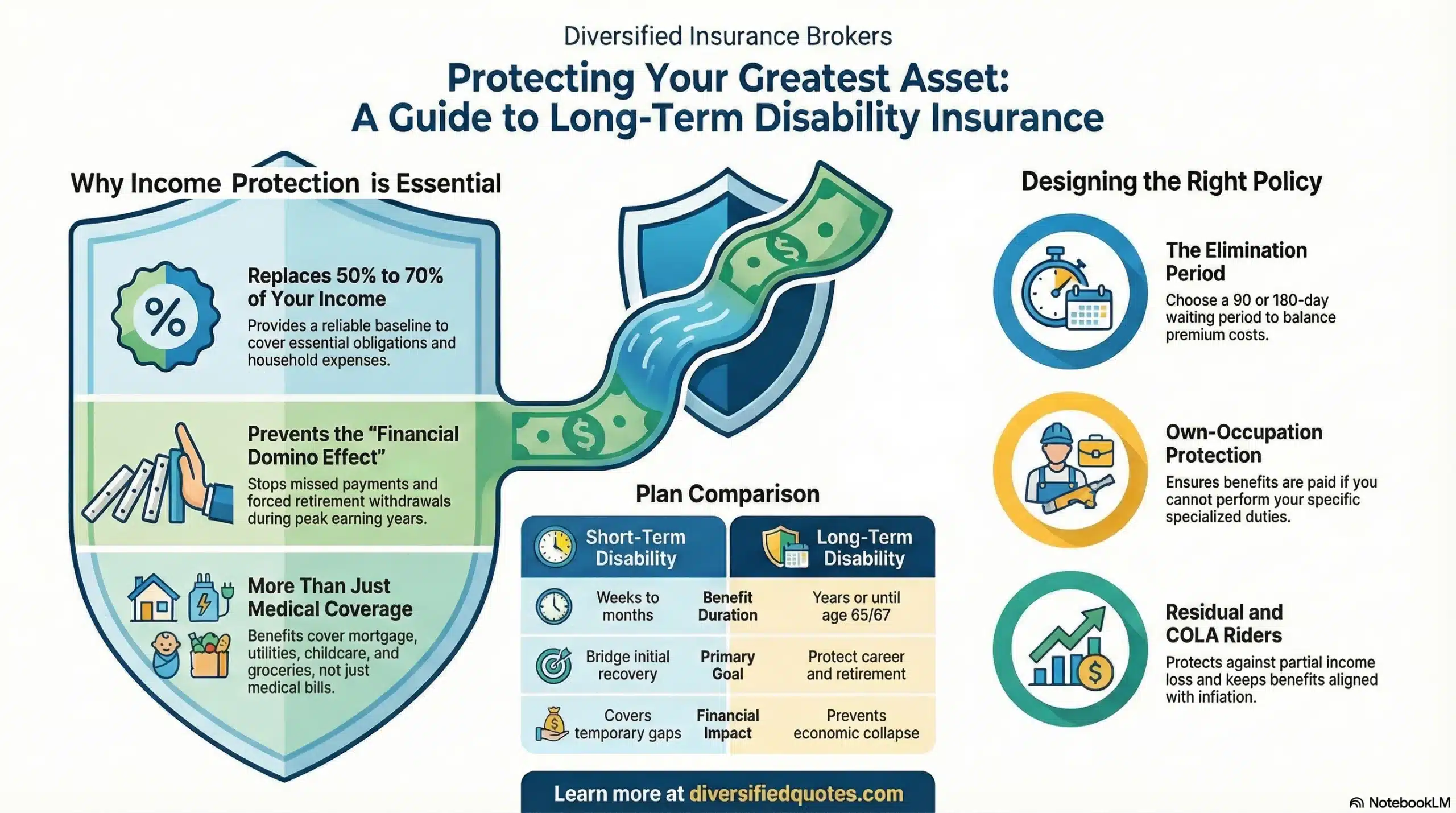
Talk With an Advisor Today
Choose how you’d like to connect—call or message us, then book a time that works for you.
Schedule here:
calendly.com/jason-dibcompanies/diversified-quotes
Licensed in all 50 states • Fiduciary, family-owned since 1980
FAQs: Disability Insurance for Welders
I weld stainless steel daily — what are the specific health risks I should know about?
Stainless steel welding produces hexavalent chromium fumes as a fundamental byproduct of the welding process — and hexavalent chromium is classified by IARC as a Group 1 carcinogen with definitive evidence of cancer risk in humans. OSHA created a dedicated hexavalent chromium standard (29 CFR 1910.1026) specifically because of its severe documented health risks, setting a permissible exposure limit of just 5 micrograms per cubic meter. The documented health consequences of hexavalent chromium exposure include lung cancer, nasal cavity cancer, and kidney and liver damage — conditions that often do not appear immediately. A welder might work in under-ventilated conditions for years before developing chronic respiratory issues; by then, cumulative damage has already accumulated. Stainless steel welding also generates nickel fumes — a second known carcinogen — alongside manganese. Peer-reviewed research specifically documents that stainless steel welding presents added occupational hazards compared to mild steel welding because of hexavalent chromium and nickel exposure.
From a disability insurance planning standpoint, this specific hazard profile makes the timing of purchase critically important. The hexavalent chromium and nickel exposure that can produce lung cancer or other occupational cancers begins accumulating from the first stainless steel arc. A welder who purchases disability insurance before any respiratory symptoms, pulmonary function findings, or occupational health documentation related to chromium or nickel exposure secures comprehensive cancer and respiratory illness coverage without exclusion riders — coverage that may not be available on the same terms after any chromium-related health findings have appeared in medical records. Coverage for welders with prior respiratory conditions from fume exposure is still available through independent broker comparison, typically with partial exclusion riders for documented prior conditions and full coverage for all other disability causes — but comprehensive pre-exposure coverage is always the most protective outcome for a welder working daily with IARC Group 1 carcinogen-producing processes.
What is manganism and how does it affect a welder’s disability insurance planning?
Manganism — sometimes called welder’s disease — is a Parkinson’s-like neurological condition produced by chronic inhalation of manganese-containing welding fumes. Manganese is present in the fume mixture of virtually all arc welding processes because it is a component of most welding electrodes and many steel alloys. Unlike Parkinson’s disease itself, which typically affects older individuals and responds to standard dopaminergic treatments, manganism is documented as specifically affecting younger workers and as potentially not responding to standard Parkinson’s disease treatments — meaning chronic manganese fume exposure can produce permanent, treatment-resistant neurological disability in working-age welders in their 30s and 40s. The documented symptoms include tremors, difficulty walking, cognitive impairment, and psychiatric symptoms — all directly relevant to a welder’s ability to perform the precision physical and cognitive demands of quality welding work.
For disability insurance planning, manganism represents a specific and sobering scenario: a neurological disability producing permanent career incapacity in the middle of a welder’s peak earning years, without the treatment response that might allow return to function. A 38-year-old pipe welder disabled by manganism-related tremors severe enough to prevent precision TIG welding faces a 27-year income gap to age 65 — the exact coverage period that a long-term disability policy to age 65 specifically addresses. Individual disability insurance covers qualifying disability from neurological conditions including manganism when those conditions prevent the specific welding functions that generate income — regardless of whether the manganese exposure occurred at one employer or multiple employers over many years, and regardless of the difficulty of attributing the neurological condition to any specific incident that workers’ compensation could identify. The urgency of purchasing disability insurance early in a welding career — before any tremor or neurological symptom has appeared in medical records — is specifically reinforced by manganism’s documented occurrence in working-age welders whose condition cannot be attributed to age or general health factors.
I’m a self-employed welding contractor with my own equipment — what disability coverage do I need?
As a self-employed welding contractor with your own equipment and tools, your disability exposure has two distinct financial layers. Personal disability income insurance replaces your earned income from welding contracts when a qualifying disability prevents you from working — sized to your documented net self-employment income from Schedule C averaged across two to three years, capturing all contract welding fees, fabrication project revenue, and any other earned welding income. This policy addresses your household’s financial obligations during the disability period. Business overhead expense disability coverage addresses your welding operation’s fixed costs: equipment financing for your MIG and TIG welders, plasma cutter, and fabrication tooling; shop lease if you operate from a dedicated facility; business insurance premiums; and any employee wages if you have shop help — all continuing during disability regardless of whether any welding production is occurring.
A disability preventing you from welding for three months creates both personal income loss and overhead accumulation against zero contract revenue simultaneously. Without BOE coverage, the equipment payments and shop costs accumulate during recovery, potentially forcing decisions about equipment repossession or shop closure during a disability that may be entirely recoverable given adequate financial support. BOE disability coverage pays the documented fixed monthly overhead of your welding operation during qualifying disability, preserving the business and the client and contractor relationships that represent your career’s professional investment. The BOE benefit is sized to actual documented monthly fixed overhead — not to contract revenue — covering what the operation costs to maintain rather than what it generates. Together, personal disability income and BOE create the complete protection architecture for any self-employed welding professional, addressing both the household financial floor and the shop overhead floor that a disability simultaneously threatens.
Are disability insurance benefits taxable for a self-employed welder?
For self-employed welders who purchase individual disability insurance personally and pay premiums with after-tax personal income, monthly disability benefits received during a qualifying disability are generally received income-tax-free. The full benefit amount reaches the household without income tax reduction during the disability period when no welding contract revenue is being generated. Understanding the full tax treatment of disability insurance benefits matters for sizing the policy: a tax-free individually purchased benefit should cover actual after-tax take-home income from welding work, ensuring genuine income replacement during a disability period when the household’s financial obligations continue at their full level.
For welding shop owners who operate through LLC or S-corporation entities and who pay disability insurance premiums at the entity level, the tax treatment should be confirmed with a tax professional before assuming the standard personal-premium/tax-free-benefit baseline applies — entity-level premium payment arrangements create complexity in how resulting benefits are taxed at claim time. BOE premiums paid by the welding business entity are generally deductible as ordinary business expenses, but BOE benefits received during disability are typically taxable business income — creating a roughly neutral net tax impact since the taxable BOE benefits offset the deductible overhead expenses they fund. The personal disability income policy purchased personally with after-tax income delivers its tax-free benefits at the household level independent of the shop entity’s tax treatment, making the combination of personally purchased individual DI and entity-paid BOE the most efficient overall architecture for most self-employed welding shop owners. For employed welders at fabrication shops or construction companies whose employer pays group disability premiums, the resulting group benefits are typically taxable as ordinary income — reducing effective replacement below the stated plan percentage.
I hurt my shoulder from overhead welding — will disability insurance cover that?
A shoulder injury from sustained overhead welding work is a qualifying disability for individual disability insurance when the injury prevents you from performing the material and substantial duties of your welding occupation — the arc welding, positioning, and physical fabrication functions that generate your welding income. Overhead welding is one of the most physically demanding positions in the trade, requiring sustained shoulder abduction and external rotation that loads the rotator cuff and shoulder tendons at the extreme end of their range. A rotator cuff condition or shoulder tendinopathy severe enough to prevent sustained overhead welding eliminates the specific welding function the policy is designed to protect.
The more significant planning point is timing relative to the injury. A shoulder condition already in your medical record creates a potential partial exclusion rider at future underwriting — meaning a policy application after a documented shoulder injury may produce coverage that excludes claims attributable to that specific documented shoulder condition, while an application before any shoulder symptoms have been documented produces comprehensive shoulder coverage without restriction. For welders whose overhead and awkward posture work creates the musculoskeletal loading that the occupational ergonomics literature specifically documents, the window to purchase comprehensive bilateral shoulder and back coverage without exclusion riders is before any posture-related health history has appeared in medical records. Coverage for welders with prior shoulder or back conditions is still available through independent broker comparison across carriers whose guidelines for welding occupation musculoskeletal histories vary — some take narrower, joint-specific exclusion approaches that are less restrictive than the broad exclusions others apply for the same documented history.
When is the best time for a welder to purchase disability insurance?
Career start — or as early as possible — is the most strategically important purchase point for any welder, and the specific toxicological profile of welding fume exposure makes the timing argument more concrete here than in most trades. The hexavalent chromium exposure from stainless steel welding — an IARC Group 1 carcinogen — begins accumulating from the first stainless arc. The manganese exposure that occupational medicine documents as producing manganism in younger workers begins from the first use of manganese-containing electrodes. Respiratory sensitization from sustained fume inhalation is a progressive process that develops over years of exposure before producing the overt symptoms that generate medical documentation and subsequent underwriting complexity.
A welding apprentice or early-career welder who purchases disability insurance before any fume exposure health history has been documented — before any respiratory symptoms, before any tremor or neurological finding, before any pulmonary function test reveals fume-related impairment — secures the most comprehensive available coverage across all those disability pathways without exclusion riders. Premium rates are age-rated and lock in at policy issuance on non-cancellable policies; a welder purchasing at 22 during apprenticeship locks in substantially lower annual premiums than the same coverage at 32 after a decade of documented fume exposure. The future increase option allows benefit increases as welding specialty income grows — from apprentice through journeyman through certified pipe or structural welder — without new medical underwriting that any fume exposure health findings developed after the original purchase might complicate. The manganism scenario specifically illustrates why early purchase matters most in this trade: a welder disabled by occupational neurological disease at 38 needs a policy purchased years before the exposure produced any documented neurological findings, covering the full 27-year income horizon to age 65 at terms no longer available after the condition has appeared. Every year of welding work without comprehensive disability insurance is a year during which the IARC Group 1 carcinogen exposure accumulates and the occupational health record potentially narrows the comprehensive terms available at the next application.
About the Author:
Jason Stolz, CLTC, CRPC, DIA, CAA and Chief Underwriter at Diversified Insurance Brokers (NPN 20471358), is a senior insurance and retirement professional with more than 25 years of real-world experience helping individuals, families, and business owners protect their income, assets, and long-term financial stability. As a long-time partner of the nationally licensed independent agency Diversified Insurance Brokers, Jason provides trusted guidance across multiple specialties—including fixed and indexed annuities, long-term care planning, personal and business disability insurance, life insurance solutions, Group Health, Travel Medical and Evacuation Insurance, and short-term health coverage. Diversified Insurance Brokers maintains active contracts with over 100 highly rated insurance carriers, ensuring clients have access to a broad and competitive marketplace.
His practical, education-first approach has earned recognition in publications such as VoyageATL, and contributions from his agency featured in Kiplinger and GoBankingRates— highlighting his commitment to financial clarity and client-focused planning. Drawing on deep product knowledge and years of hands-on field experience, Jason helps clients evaluate carriers, compare strategies, and build retirement and protection plans that are both secure and cost-efficient. Visitors who want to explore current annuity rates and compare options across multiple insurers can also use this annuity quote and comparison tool.
Explore More Disability Insurance Options: Browse our complete guide to Disability Insurance for Trades, Construction & Industrial — covering contractors, electricians, plumbers, welders, roofers, machinists & skilled trades from 100+ carriers.
Last Reviewed: June 8, 2026 |
Reviewed by: Jason Stolz, CLTC, CRPC, DIA, CAA
Chief Underwriter, Diversified Insurance Brokers, Inc. | NPN: 20471358 | Diversified Insurance Brokers, Inc. — Licensed in all 50 states
Fact Checked by: Tonia Pettitt, CMIP©
Medicare Specialist, Diversified Insurance Brokers, Inc. | NPN: 14374308 | Diversified Insurance Brokers, Inc. — Licensed in all 50 states
Did you find this content helpful? Leave us a Google review — it helps others find trustworthy guidance too.
Editorial Standards: Diversified Insurance Brokers maintains rigorous editorial standards to ensure accuracy, clarity, and independence in all content. Learn more about our editorial standards and commitment to transparency.
