
Disability Insurance for the Woodworking Industry
As an Independent Disability Insurance Broker, we have access to exclusive discounts and negotiated pricing most captive agents can’t offer — see the full breakdown near the end of this page.
Disability Insurance for the Woodworking Industry

Jason Stolz CLTC, CRPC, DIA, CAA
Professional woodworkers — cabinetmakers, furniture makers, finish carpenters, millwork operators, wood turners, pattern makers, and custom shop owners — work in an occupational environment that OSHA specifically identifies as very dangerous, with machine guarding violations consistently topping the list of citations issued during OSHA woodworking inspections. OSHA’s woodworking research documents the consequences of improperly guarded machines with directness: laceration, amputation, severed fingers, and blindness. Beyond the acute machinery injury risk, OSHA specifically classifies wood dust and finishing product chemicals as health hazards to woodworkers, capable of causing skin and respiratory diseases. The International Agency for Research on Cancer classified wood dust as a Group 1 carcinogen in 1995 — carcinogenic to humans — specifically identifying increased risk of cancers of the nasal cavities and paranasal sinuses in workers exposed to wood dust. OSHA’s own health hazards documentation on woodworking expands this further: exposure to wood dust has long been associated with dermatitis, allergic respiratory effects, asthma, hypersensitivity pneumonitis, chronic bronchitis, and cancer. The chemicals used for finishing products — lacquers, stains, adhesives, and solvents — add a distinct chemical VOC exposure layer alongside the wood dust itself, and the sustained noise environment of woodworking machinery produces the occupational noise-induced hearing loss that BLS documents across the manufacturing sector. Bureau of Labor Statistics data documents the median annual wage for woodworkers at $43,720 as of May 2024, and specifically notes that wood sawing machine setters, operators, and tenders have one of the highest rates of injuries and illnesses of all occupations — a ranking shared by very few civilian job categories. The disability income protection gap in the woodworking industry is shaped primarily by the self-employment structure that characterizes the craft and custom segments of the trade: woodworking sits within the tier of high-risk manufacturing occupations where the documented injury and illness rate is among the highest of any production category, and where self-employed custom shop owners, independent cabinetmakers, and freelance woodworking contractors carry the complete self-employment coverage gap that eliminates every employer benefit baseline simultaneously.
At Diversified Insurance Brokers, Jason Stolz, CLTC, CRPC, DIA, CAA works with woodworking industry professionals across the full range of the trade’s employment and business structures — employed woodworkers at furniture manufacturing facilities and millwork plants whose employer group plan access is limited and whose wood dust and machinery exposures create specific disability pathways that group plans inadequately address, custom cabinetmakers and furniture makers who operate independent shops with meaningful equipment investments and business overhead obligations that disability insurance must address on two separate layers, finish carpenters whose field work combines the woodworking machinery exposure of the shop with the physical and fall hazard exposure of construction site installation, and pattern makers and wood turners whose hand and wrist function as a precision professional instrument in the same way a surgeon’s or musician’s does. The coverage architecture for each requires specific attention to the occupational class implications of the specific woodworking activity, the income documentation for variable project-based or custom-order revenue, and the self-employment disability coverage framework that applies to the significant portion of woodworking professionals who operate outside any employer benefit structure entirely.
Compare Disability Coverage for Woodworking Professionals
We review coverage options across 100+ carriers and identify the policy structure, income documentation approach, and shop overhead coverage that fits your specific woodworking role and business structure.
Request Disability Insurance OptionsWoodworking Industry Disability Risk — Machinery Injuries, Wood Dust, and the Chemical Exposure Profile
| Risk Category | OSHA, BLS, and Research Context | Resulting Disability Risk | Coverage Status | Income Protection Gap |
|---|---|---|---|---|
| Table saw, router, and power tool injuries | OSHA specifically documents that woodworking is one of the few industries where hands of the operator are constantly exposed to danger; machine guarding violations consistently top OSHA woodworking inspection citations; OSHA documents laceration, amputation, severed fingers, and blindness as the direct consequences of improperly guarded woodworking machines; woodworking Wikipedia safety article notes rotating equipment guarding as a major industry issue; table saw kickback events produce high-velocity workpiece projectiles capable of causing severe injury beyond direct blade contact | Finger or hand amputation eliminating precision woodworking capacity permanently; lacerations requiring surgery and extended recovery; eye injuries from workpiece projectiles; any injury to hands or fingers that prevents the sustained precision tool operation that woodworking income depends on | Workers’ comp for employed woodworkers at documented acute incidents; self-employed shop owners entirely unprotected; individual DI covers qualifying disability from all acute machinery injury causes | Complete gap for self-employed; significant gap for cumulative hand/wrist conditions; individual DI or accident-only coverage provides the income floor for the acute injury scenarios OSHA documents as the trade’s most serious hazard |
| Wood dust — IARC Group 1 carcinogen and respiratory hazard | IARC classified wood dust as Group 1 carcinogen (carcinogenic to humans) in 1995, specifically for nasal cavity and paranasal sinus cancers; OSHA woodworking health hazards documentation lists asthma, hypersensitivity pneumonitis, chronic bronchitis, dermatitis, and cancer as wood dust-associated conditions; OSHA notes both skin and respiratory system can become sensitized to wood dust — once sensitized, severe allergic reactions can occur at lower concentrations; peer-reviewed meta-analysis documents increased leukemia risk associated with wood dust exposure | Occupational asthma from sensitization preventing sustained shop work; chronic bronchitis or hypersensitivity pneumonitis limiting respiratory function; nasal cavity or sinus cancer from sustained Group 1 carcinogen exposure across a woodworking career; leukemia association from prolonged exposure | Gradual respiratory conditions outside workers’ comp incident framework; cancer disability not covered by workers’ comp; individual DI covers all illness-based qualifying disability regardless of occupational causation | Significant gap; individual DI fills precisely where workers’ comp incident attribution fails for the most serious illness-based disability pathways wood dust exposure creates |
| Finishing chemical VOC exposure — lacquers, stains, adhesives | OSHA documents that chemicals used for finishing products are health hazards to woodworkers capable of causing skin and respiratory diseases; woodworking finishing operations expose workers to volatile organic compounds from lacquers, polyurethane coatings, oil-based stains, contact cements, and solvent-based cleaners; peer-reviewed research documents woodworkers exposed to both wood dust and formaldehyde in furniture and door production operations; sustained VOC inhalation across a finishing career produces the gradual respiratory and neurological consequences associated with solvent exposure in other industries | Occupational asthma or chemical sensitization from lacquer and coating VOC exposure; skin conditions from sustained adhesive and solvent contact; neurological effects from sustained high-concentration VOC inhalation in inadequately ventilated finishing environments | Gradual chemical exposure conditions outside workers’ comp framework; individual DI covers all illness-based qualifying disability from any cause | Full gap for gradual VOC exposure conditions; individual DI covers the chemical illness pathway that workers’ comp attribution specifically fails |
| Noise-induced hearing loss from sustained machinery operation | BLS specifically documents that woodworkers encounter machinery noise as a documented occupational hazard; table saws, routers, planers, sanders, and CNC machining centers produce sustained high-decibel noise environments that OSHA’s occupational noise exposure standard addresses; progressive noise-induced hearing loss across a woodworking career produces disability consequences that extend beyond the immediate shop — communication capacity, safety awareness, and quality of professional function all decline with hearing impairment | Progressive hearing impairment limiting communication, machine operation awareness, and professional function across a woodworking career; acute acoustic trauma from unexpected high-decibel events in the shop environment | Gradual hearing loss outside workers’ comp incident framework; individual DI covers qualifying disability from hearing impairment when it prevents continued professional woodworking function | Significant gap for gradual hearing loss; individual DI addresses qualifying noise-induced hearing disability regardless of gradual onset |
| Musculoskeletal disorders from sustained shop work | BLS documents strains, sprains, and other musculoskeletal injuries from heavy material handling in woodworking operations — pushing, pulling, and lifting large wood panels, assembled cabinet components, and finished furniture pieces; sustained standing on concrete shop floors; repetitive hand tool use producing wrist and forearm tendinosis; the physical demands of custom furniture and cabinetry production across a career produce cumulative MSD loading documented across all physically demanding production occupations | Back conditions from heavy panel and material handling; wrist and forearm tendinosis from sustained hand tool use and router operation; knee degeneration from sustained standing on concrete shop floors — progressive conditions that eventually prevent continued woodworking production | Workers’ comp for acute documented incidents; cumulative MSD conditions disputed; self-employed shop owners entirely unprotected; individual DI covers all qualifying MSD causes | Significant gap for cumulative MSD conditions; individual DI covers disability from any qualifying musculoskeletal cause without incident attribution requirement |
The table documents a disability risk profile that spans the full hazard spectrum — acute catastrophic machinery injury documented by OSHA as a primary woodworking hazard, through the IARC Group 1 carcinogen classification of wood dust that creates a documented cancer disability pathway, to the gradual chemical and respiratory exposure and cumulative musculoskeletal conditions that workers’ compensation specifically fails to address for the most characteristic long-term disability scenarios of the trade. Why woodworking professionals prioritize income protection is answered by the same calculation that applies to any professional whose hands are their primary income-generating instrument: when those hands are injured, when the respiratory system fails from sustained dust exposure, or when illness eliminates the ability to operate machinery and produce woodwork, the income stops — completely and immediately for self-employed woodworkers, and with severe structural inadequacy even for those with employer group plan access.
The Machinery Injury Risk — When Hands Are the Income-Generating Instrument
The woodworking industry’s acute physical injury risk is concentrated in a specific and uniquely consequential anatomical location: the hands and fingers that operate the saws, routers, chisels, and hand tools that produce the woodworker’s professional output. OSHA’s observation that woodworking is one of the few industries where the hands of the operator are constantly exposed to danger is not merely a safety citation — it is a description of the disability risk reality that makes hand and finger injury in woodworking categorically different from hand injury in most other occupations. A woodworker who loses a finger, sustains severe laceration to the hand, or develops a hand injury requiring extended surgical recovery has lost the specific anatomical instrument that all woodworking production depends on — regardless of whether cognitive function, general physical capacity, or any other professional capability is affected. The machine guarding violations that OSHA specifically documents as consistently topping woodworking inspection citations reflect the industry’s ongoing challenge with the fundamental exposure that table saws, band saws, jointers, and routers create for operators who hand-feed materials through machinery designed to cut hard surfaces at high speed.
For custom woodworkers, cabinetmakers, and furniture makers whose income derives specifically from the precision hand and tool work that defines the craft, an own-occupation disability policy that specifically encompasses the manual woodworking production functions — the tool operation, the precision fitting, the hand finishing — is the essential policy feature that distinguishes meaningful income protection from a policy that would fail to pay for a woodworker who cannot operate a table saw but could theoretically perform sedentary work. The hands and the woodworking craft are the specific occupation being protected. Long-term disability income coverage provides the income floor during extended recovery from serious hand or machinery injuries — the months of surgical recovery, physical therapy, and gradual return to function that serious woodworking tool injuries require. Short-term disability coverage fills the immediate income gap from the first day of disability before long-term coverage activates. Accident-only disability income insurance provides a lower-cost targeted coverage layer specifically for the acute physical injury scenarios — saw injuries, tool injuries, shop accidents — that dominate the woodworking industry’s most severe and most characteristic disability event profile.
Wood Dust as an IARC Group 1 Carcinogen — The Illness-Based Disability Pathway
The IARC Group 1 carcinogen classification of wood dust — placing it in the same carcinogenicity category as asbestos and benzene — is the most consequential and least discussed disability planning fact in the woodworking industry. IARC specifically identified wood dust as carcinogenic to humans in 1995, with the documented cancer sites being the nasal cavities and paranasal sinuses — the anatomical structures most directly exposed to airborne wood dust during sustained woodworking operations. A peer-reviewed meta-analysis of wood dust exposure and leukemia provides additional evidence of blood cancer association beyond the sinonasal cancers in the original IARC classification. OSHA’s woodworking health hazards documentation compounds this cancer risk with the full respiratory disease spectrum: asthma, hypersensitivity pneumonitis, and chronic bronchitis as documented conditions associated with wood dust exposure, with the specific note that once a worker becomes sensitized to wood dust, severe allergic reactions can occur at even lower concentrations — meaning the sensitization itself becomes a permanent occupational limitation.
These illness-based disability pathways — cancer, progressive respiratory disease, chemical sensitization — are precisely what workers’ compensation’s incident attribution framework fails to cover for woodworking professionals. A cabinetmaker who develops nasal sinus cancer after twenty years of wood dust exposure in a production shop has no single datable incident to attribute to a specific employer, and workers’ comp provides nothing. Individual disability insurance covers qualifying disability from any illness cause regardless of whether occupational exposure can be specifically proven — filling the gap that the most serious long-term health consequences of sustained woodworking exposure create. The broader wood products industry disability framework documents the same wood dust carcinogen exposure across the full supply chain from logging through lumber processing — woodworking’s finishing and production segment shares these documented risks with the processing sector upstream. Coverage for woodworkers with prior respiratory or chemical sensitivity conditions from shop work is available through independent broker comparison — though early purchase before any respiratory treatment history has been documented remains the approach that produces the most comprehensive available coverage without exclusion riders for the occupation’s most characteristic illness-based disability pathway.
Custom Shop Owners — The Business Overhead Layer
Custom cabinetmakers, furniture makers, and independent woodworking shop owners who have invested in professional shop infrastructure — table saws, band saws, jointers, planers, routers, CNC machinery, dust collection systems, spray finishing booths, and the building space to house them — carry the two-layer disability exposure that any service or production business owner faces. A disability that prevents the shop owner from producing woodwork creates both personal income loss and unmet overhead obligations simultaneously: equipment financing payments, shop lease or mortgage, dust collection and ventilation system maintenance contracts, business insurance premiums, and any employee wages if the shop employs help — all continuing regardless of whether any production is occurring.
Business overhead expense disability coverage specifically addresses the shop’s fixed operating costs during the owner’s qualifying disability — equipment loan payments, shop lease, business insurance, and fixed operational costs — preserving the woodworking business and its equipment investments during recovery rather than allowing accumulated debt to force shop closure during what may be a temporary and recoverable disability period. The BOE benefit is sized to actual documented monthly fixed overhead rather than to production revenue, covering what the shop costs to maintain rather than what it generates. Personal disability income and BOE coverage together address the complete two-layer financial exposure that a woodworking shop owner’s disability creates. Income documentation for self-employed woodworking contractors uses Schedule C net self-employment income averaged across two to three years — capturing all custom project fees, production contracts, and woodworking-related income as the personal benefit basis alongside the separately documented shop overhead. 1099-earning custom woodworking contractors who work on project contracts for interior designers, contractors, and direct residential clients document all project income through the same Schedule C framework.
Coverage Options, Occupational Class, and Policy Design for Woodworking Professionals
Woodworking professionals receive occupational class assignments in the Class A to Class B range from most disability insurance carriers — reflecting the physical demands, the documented machinery injury rate, and the chemical and dust exposure environment of the trade. This produces higher premiums than sedentary professional occupations but does not prevent meaningful individual disability insurance coverage across the carrier market that serves skilled manufacturing and production occupations. The most effective approach for any woodworking professional is independent broker comparison across the full carrier market — carrier variation in how they classify specific woodworking activities is meaningful enough to produce real differences in premium and coverage quality for the same worker. Specialty and modified market options extend coverage availability for woodworkers whose occupational classification or health history places them outside the most favorable standard market terms.
Residual disability coverage is specifically important for woodworkers because realistic disability scenarios frequently involve partial capacity rather than complete inability to work — a hand injury allowing some light bench work but not table saw operation, or a respiratory condition limiting daily shop hours without eliminating all woodworking activity — and residual benefits pay proportionally based on actual income reduction rather than requiring total disability as the only trigger. How short-term and long-term disability structures interact maps the coverage from the first day of any qualifying disability through the full benefit period, addressing the production income that stops from day one for any self-employed woodworker. How much disability income a woodworking professional needs reflects documented income — W-2 wages for employed production woodworkers, Schedule C for self-employed shop operators — and the household’s actual financial obligations during a disability period. The elimination period should reflect actual financial reserves; the future increase option locks in the ability to increase coverage as shop income grows without new medical underwriting. Cost of living adjustment protects purchasing power across extended permanent disability periods — relevant given the IARC Group 1 carcinogen profile of wood dust that can produce long-duration illness-based disability. Guarantee issue disability insurance provides a last-resort access point when standard underwriting produces limited terms for the more challenging woodworking occupational classifications.
The timing of purchase is as consequential in woodworking as in any other industry with documented occupational carcinogen exposure. The window to purchase comprehensive coverage before any wood dust respiratory or chemical sensitivity history has developed is early in the career — before the OSHA-documented sensitization process has had time to produce the medical documentation that generates respiratory exclusion riders at underwriting. No-exam disability coverage provides streamlined approval for healthy woodworking professionals. Getting the best available rates means independent broker comparison across the full carrier market rather than a single direct application. Custom shop owners with established production operations generating meaningful annual revenue may need layered coverage structures to adequately replace both personal income and business overhead in the most comprehensive way available. Whether disability benefits are taxable for a self-employed woodworking shop owner: personally purchased individual policies paid with after-tax income generally produce tax-free benefits. A second opinion on any disability insurance proposal for a woodworking professional confirms whether the occupational class assignment is competitive, the own-occupation definition encompasses the hand and precision tool work that generates the income, and the shop overhead dimension is appropriately addressed before any premium commitment is made.
Get Your Woodworking Industry Coverage Review
We compare occupational class assignments, wood dust carcinogen underwriting approaches, and shop overhead structures across 100+ carriers to build the most comprehensive available income protection for your woodworking career.
Request Disability Insurance Options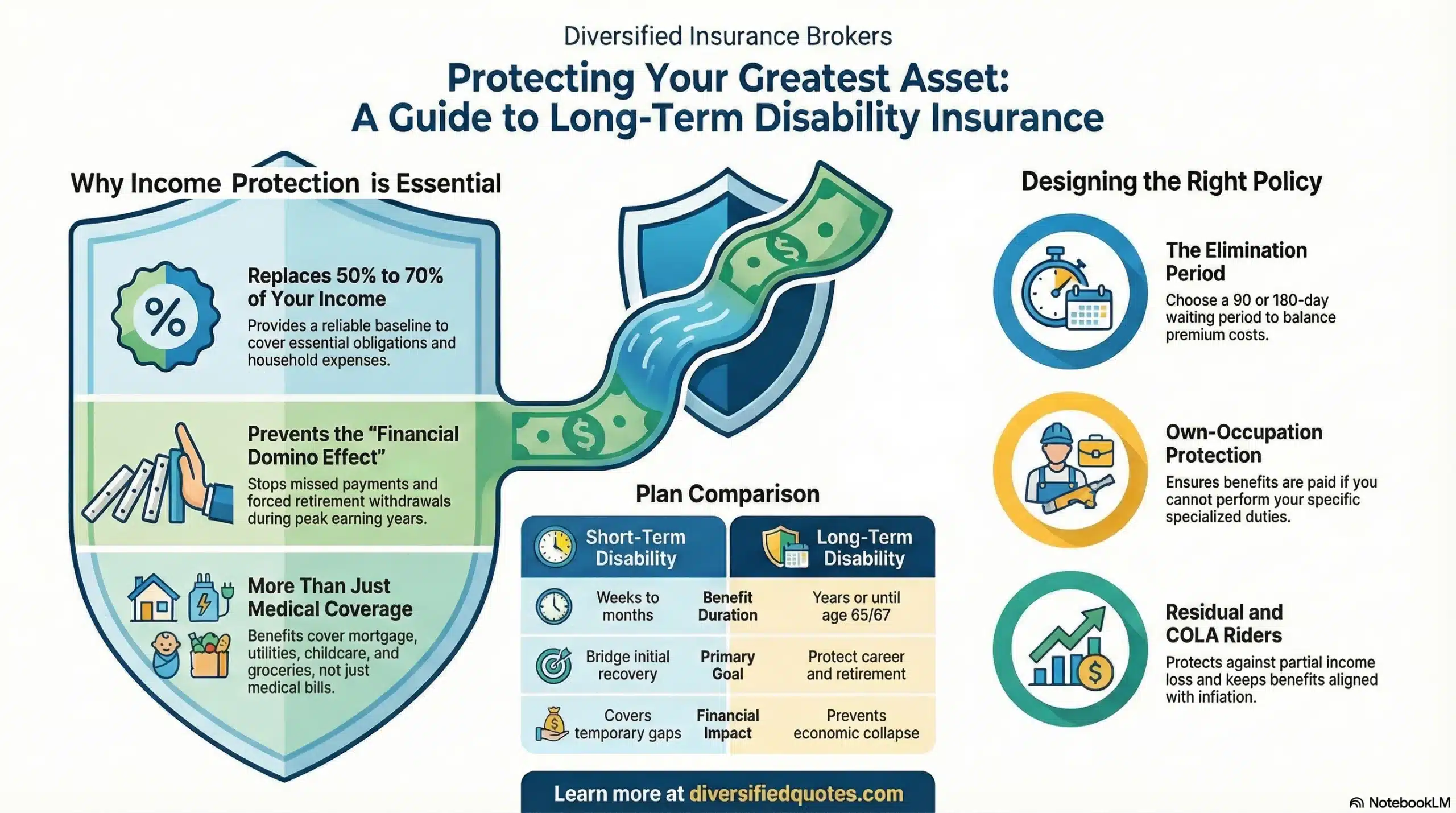
Talk With an Advisor Today
Choose how you’d like to connect—call or message us, then book a time that works for you.
Schedule here:
calendly.com/jason-dibcompanies/diversified-quotes
Licensed in all 50 states • Fiduciary, family-owned since 1980
FAQs: Disability Insurance for the Woodworking Industry
I lost part of a finger in a table saw accident — will disability insurance cover me?
Whether a finger amputation produces a disability insurance claim depends on two factors: whether the injury prevents you from performing the material and substantial duties of your woodworking occupation, and what specific policy language covers amputation-related functional limitations. For a professional cabinetmaker, furniture maker, or custom woodworker whose production depends on the precision hand and finger function that the table saw injury has permanently altered, the inability to perform those specific woodworking production functions is a genuine occupational disability under own-occupation policy language — even if general mobility, cognitive function, and other capabilities are fully intact. The key is whether your policy specifically covers inability to perform your woodworking occupation rather than an any-occupation standard that might require inability to perform any work whatsoever.
The more significant planning point is timing: the table saw accident that has already occurred is in your medical record and cannot be undone from a coverage standpoint. For woodworkers who have not yet had a serious tool injury, the optimal purchase window is before any hand, finger, or wrist injury has been documented — when comprehensive bilateral hand and finger coverage is available without exclusion riders. For woodworkers with documented prior hand injuries, coverage is still available but typically with a partial exclusion for the documented injury site, providing full coverage for all other disability causes. Coverage for woodworkers with prior hand or finger conditions from tool accidents is available through independent broker comparison across carriers whose guidelines for woodworking occupational hand injury histories vary meaningfully. A second opinion on any disability insurance proposal specifically confirms whether the own-occupation language encompasses the precision woodworking production functions before any premium commitment is made.
I’m a custom cabinetmaker with a shop and equipment — what disability coverage do I need?
As a custom cabinetmaker with a shop operation, your disability exposure has two distinct layers requiring two coordinated coverage responses. Personal disability income insurance replaces your earned income from the cabinetmaking business when a qualifying disability prevents you from producing woodwork — sized to your documented net self-employment income from Schedule C averaged across two to three years. This policy addresses your household’s financial obligations during the disability period. Business overhead expense disability coverage addresses the shop’s fixed operating costs — equipment loan payments on your table saw, jointer, planer, and router equipment, shop lease or mortgage, dust collection and ventilation system costs, business insurance premiums, and any employee wages if you have shop help — all continuing regardless of whether any production is occurring during your disability.
A disability preventing you from producing cabinets for three to six months creates both personal income loss and simultaneous overhead accumulation against zero production revenue. Without business overhead expense coverage, the equipment payments and shop lease accumulate during the recovery period, potentially forcing shop closure during what may be a fully recoverable disability. BOE disability coverage pays the documented fixed monthly shop overhead during qualifying disability, preserving the operation and the client relationships that years of craft building have created. The BOE benefit is sized to actual documented monthly fixed overhead — not to production revenue — covering what the shop costs to maintain. Together, personal disability income and BOE create the complete protection architecture for a custom cabinetmaking shop owner, addressing both the household financial floor and the business continuity floor that any disability simultaneously threatens.
I’ve developed occupational asthma from wood dust — can I still get disability insurance?
Yes — though the underwriting outcome depends on the severity, current clinical status, and documentation of the prior occupational asthma. For most documented prior occupational asthma that is currently stable — a managed condition under appropriate medication with documented stable current pulmonary function and ongoing woodworking capacity — the standard underwriting outcome is a partial exclusion rider specifically for that documented respiratory condition, providing full coverage for all other disability causes: hand and machinery injuries, musculoskeletal conditions, illness-based disability from non-respiratory causes, and all other qualifying events outside the excluded respiratory area. The policy with a respiratory exclusion rider still provides genuine and meaningful protection for the majority of the woodworking trade’s documented disability pathways beyond the excluded respiratory condition.
The challenge for woodworkers is that the respiratory system is precisely where OSHA and IARC’s documented wood dust hazard most specifically concentrates — a respiratory exclusion limits coverage in the area where the occupation’s most characteristic occupational health consequence is documented. This reinforces the urgency of early purchase: a new cabinetmaker or woodworker whose lungs have not yet accumulated the sensitization that OSHA specifically documents as a progressive wood dust consequence can purchase disability insurance with comprehensive respiratory coverage without exclusion riders that the prior-sensitization route cannot replicate. Specialty and modified options address woodworkers whose documented respiratory history creates complexity beyond what a simple partial exclusion rider addresses. Carrier guidelines for occupational asthma in woodworking occupation histories vary enough that independent broker comparison is the most effective approach for identifying the best available terms for a specific documented respiratory condition.
Are disability insurance benefits taxable for a self-employed woodworking shop owner?
For self-employed woodworking shop owners who purchase individual disability insurance personally and pay premiums with after-tax personal income, monthly disability benefits received during a qualifying disability are generally received income-tax-free. The full benefit amount reaches the household without income tax reduction during the disability period when no production revenue is being generated. Understanding the full tax treatment of disability insurance benefits matters for sizing the policy correctly: a tax-free individually purchased benefit should cover actual after-tax take-home income from the woodworking business, ensuring genuine income replacement rather than a further tax-reduced benefit during what may be an extended recovery period.
For custom shop owners who operate through LLC or S-corporation structures and who pay disability insurance premiums at the entity level, the tax treatment should be confirmed with a tax professional before assuming the standard personal-premium/tax-free-benefit baseline applies — entity-level premium payment arrangements create complexity in how benefits are taxed at claim time. The BOE policy has a different tax treatment: BOE premiums paid by the woodworking business entity are generally deductible as ordinary business expenses, but BOE benefits received during disability are typically taxable income to the business — creating a roughly neutral net tax impact since the taxable benefits offset the deductible overhead expenses they fund. The personal disability income policy purchased personally with after-tax income delivers its tax-free benefits independent of the business entity’s tax position, making the combination of personally purchased individual DI and entity-paid BOE the most tax-efficient overall architecture for most self-employed woodworking shop owners.
My woodworking income varies significantly by project and season — how does disability insurance handle that?
Variable project-based woodworking income — fluctuating with custom order volume, seasonal demand for furniture and cabinetry, contractor relationships, and the natural variability of a craft production business — is addressed through the multi-year averaging approach that disability insurance carriers apply to all self-employment income documentation. A two to three year average of documented net earned income from Schedule C smooths year-to-year project variability rather than penalizing a slow winter order period or rewarding an exceptional renovation project year, producing a sustainable average that reflects the career’s actual economic profile.
The practical documentation approach for woodworking shop owners is consistent, complete Schedule C filing across multiple years — capturing all custom project fees, production contract revenue, installation income, and any other earned woodworking-related income as the benefit calculation basis. Woodworkers who also provide design consultation, finishing services, or material sourcing as part of their client relationships should capture those revenue streams in the Schedule C documentation as well. The residual disability benefit provision is particularly valuable for woodworking professionals because realistic disability scenarios often involve partial capacity — a hand condition allowing light bench work but not table saw operation, or a respiratory condition limiting daily shop hours — producing income reduction rather than complete cessation. A residual benefit pays proportionally based on actual income reduction, matching the realistic partial disability trajectory that many woodworking industry conditions produce rather than requiring total inability to produce any woodwork as the only benefit trigger.
When should a woodworker purchase disability insurance — and does it matter how long I’ve been in the trade?
Career start is the most strategically valuable purchase point — and the IARC Group 1 carcinogen classification of wood dust makes the timing argument for woodworkers more specific than in many professional occupations. Wood dust’s documented sensitization mechanism — where the respiratory system becomes progressively sensitized with sustained exposure, eventually producing severe reactions at even lower concentrations — means the respiratory health record that builds with each year of woodworking potentially narrows the comprehensive coverage terms available at the next insurance application. A woodworker who establishes disability insurance at career entry before any sensitization, respiratory symptoms, or hand injury history has been documented secures comprehensive bilateral hand and respiratory coverage that becomes progressively harder to access as the career’s health record develops.
For experienced woodworkers who have not yet established disability insurance, the appropriate response is not to wait further but to apply immediately — before any additional health events have time to develop and add to the occupational health record. The comparison between a 25-year-old woodworker with a clean health record and a 40-year-old woodworker with documented respiratory and hand conditions is not merely academic: the 25-year-old secures lower age-rated premiums locked for the career, comprehensive coverage without exclusion riders, and the future increase option that allows benefit increases as shop income grows — all features that narrow with each passing year. Why young woodworkers need income protection from career start is answered directly by the OSHA and IARC documentation: the documented carcinogen exposure and machinery injury risk begin from the first day of shop work, and the window to purchase comprehensively without occupational health exclusions closes as that work accumulates its health record.
About the Author:
Jason Stolz, CLTC, CRPC, DIA, CAA and Chief Underwriter at Diversified Insurance Brokers (NPN 20471358), is a senior insurance and retirement professional with more than 25 years of real-world experience helping individuals, families, and business owners protect their income, assets, and long-term financial stability. As a long-time partner of the nationally licensed independent agency Diversified Insurance Brokers, Jason provides trusted guidance across multiple specialties—including fixed and indexed annuities, long-term care planning, personal and business disability insurance, life insurance solutions, Group Health, Travel Medical and Evacuation Insurance, and short-term health coverage. Diversified Insurance Brokers maintains active contracts with over 100 highly rated insurance carriers, ensuring clients have access to a broad and competitive marketplace.
His practical, education-first approach has earned recognition in publications such as VoyageATL, and contributions from his agency featured in Kiplinger and GoBankingRates— highlighting his commitment to financial clarity and client-focused planning. Drawing on deep product knowledge and years of hands-on field experience, Jason helps clients evaluate carriers, compare strategies, and build retirement and protection plans that are both secure and cost-efficient. Visitors who want to explore current annuity rates and compare options across multiple insurers can also use this annuity quote and comparison tool.
Explore More Disability Insurance Options: Browse our complete guide to Disability Insurance for Trades, Construction & Industrial — covering contractors, electricians, plumbers, welders, roofers, machinists & skilled trades from 100+ carriers.
Last Reviewed: June 8, 2026 |
Reviewed by: Jason Stolz, CLTC, CRPC, DIA, CAA
Chief Underwriter, Diversified Insurance Brokers, Inc. | NPN: 20471358 | Diversified Insurance Brokers, Inc. — Licensed in all 50 states
Fact Checked by: Tonia Pettitt, CMIP©
Medicare Specialist, Diversified Insurance Brokers, Inc. | NPN: 14374308 | Diversified Insurance Brokers, Inc. — Licensed in all 50 states
Did you find this content helpful? Leave us a Google review — it helps others find trustworthy guidance too.
Editorial Standards: Diversified Insurance Brokers maintains rigorous editorial standards to ensure accuracy, clarity, and independence in all content. Learn more about our editorial standards and commitment to transparency.
