
How Lawsuit Loans Work – Fast Cash Advances Explained
How Lawsuit Loans Work – Fast Cash Advances Explained

Jason Stolz CLTC, CRPC, DIA, CAA
How Lawsuit Loans Work — What They Are, How Approval Happens, and What to Understand Before You Apply
A lawsuit loan is not a traditional loan. It is a non-recourse pre-settlement cash advance secured by the anticipated value of your legal claim — not your credit score, employment history, or personal assets. That single distinction changes everything about how this type of funding works. With a traditional loan, repayment is required regardless of what happens. With a lawsuit loan, repayment comes only from your settlement or judgment if your case is successful. If your case does not recover money, you typically owe nothing. This non-recourse structure is what makes pre-settlement funding accessible to plaintiffs who are unable to work, facing mounting medical bills, and dealing with financial pressure that is building faster than their legal case is moving. The financial pressure is real — insurance companies and defendants know it, and they frequently use time to their advantage, waiting for a financially stressed plaintiff to accept a lower settlement rather than waiting for a fair one. Pre-settlement funding addresses that dynamic by stabilizing your financial situation so your attorney has the time to pursue the full value of your case. At Diversified Insurance Brokers, the pre-settlement legal funding review process evaluates your case alongside multiple funding providers to identify the highest available advance amount on the most favorable terms — no upfront fees, no monthly payments, and repayment only from your settlement proceeds through your attorney’s trust account. Car accident lawsuit loans — funding specifically structured for motor vehicle accident plaintiffs whose cases involve clear liability, documented injuries, and insurance-backed recovery — represent the most common category of pre-settlement funding and illustrate the case profile that funders evaluate most readily. Personal injury lawsuit loans cover the broader category of physical injury claims where damages are documented, liability is established, and the expected recovery provides the collateral that secures the non-recourse advance.
How the Application and Approval Process Actually Works
The lawsuit loan application process is designed to be fast and frictionless for the plaintiff because approval does not depend on any of the financial information that makes traditional loan applications cumbersome. There is no credit check, no income verification, no employment history review, and no personal financial disclosure. The application asks for basic information about your case — the type of claim, the jurisdiction, the name and contact information of your attorney, and a brief description of what happened. The funding provider then contacts your attorney directly to verify representation, review the liability facts, assess the insurance coverage available, and evaluate the expected settlement range. Your attorney plays a critical role in the process — most funders will not advance funds without attorney cooperation, and your attorney’s assessment of the case’s strength and value directly influences both approval and the advance amount. Medical malpractice lawsuit funding illustrates the case type where the evaluation is most detailed — these cases typically involve complex causation, contested damages, and longer resolution timelines, which means funders assess them more conservatively and advance smaller percentages of the estimated net recovery than they would for a straightforward auto accident claim. Slip and fall lawsuit funding covers premises liability cases where the liability determination — whether the property owner knew or should have known about the hazardous condition — is the central evaluation variable that determines both the funding approval and the advance size.
Need Cash While Your Lawsuit Is Pending?
We review your case with multiple funding providers — no upfront fees, no monthly payments, repayment only from your settlement proceeds if your case is successful.
Request a Funding ReviewHow Advance Amounts Are Determined — The Factors That Drive Funding Size
| Factor | How It Affects the Advance | What This Means for Applicants |
|---|---|---|
| Liability strength | Cases with clear, documented liability — police reports confirming fault, surveillance footage, eyewitness accounts, or an admission of responsibility — qualify for larger advances and faster approval; disputed liability significantly reduces both the likelihood of approval and the advance amount because the funder’s non-recourse risk is higher when the outcome is uncertain | Plaintiffs whose cases have strong documented liability should expect more favorable terms than those whose cases involve genuinely contested fault questions; providing your attorney’s liability assessment as early as possible in the application process helps funders evaluate the case accurately and move faster |
| Documented damages | Medical records, treatment bills, wage loss documentation, and other evidence of economic damages directly determine the case’s expected recovery value; larger documented damages support higher advance amounts because they establish a larger recovery pool from which the advance will be repaid; undocumented or speculative damages reduce the advance calculation | Ensuring that all medical treatment is documented and that your attorney has compiled the full damages picture before the funding application is submitted produces the best advance outcome; applying before treatment is complete often results in a conservative advance that does not reflect the case’s full expected value |
| Available insurance coverage | Most pre-settlement funding is secured by the defendant’s insurance coverage — liability insurance, commercial insurance, or umbrella policies — that will pay the settlement; known, sufficient insurance coverage is the most important single approval factor because it confirms the recovery pool from which repayment will come; underinsured or uninsured cases are significantly harder to fund | Cases involving commercially insured defendants — businesses, trucking companies, medical providers, property owners — typically access larger advances than cases involving individual defendants with minimal personal auto or homeowner coverage; your attorney should confirm available coverage limits as part of the pre-application information gathering |
| Existing liens and attorney fees | Attorney fees — typically 33% to 40% of the gross recovery on contingency — and any existing medical liens, Medicare/Medicaid liens, or prior funding advances are subtracted from the gross expected recovery to arrive at the net recovery available to the plaintiff; the advance is sized as a percentage of that net figure rather than the gross expected recovery | Understanding the net recovery calculation helps set realistic expectations for the advance amount; a case with a projected gross settlement of $100,000 and $40,000 in attorney fees plus $15,000 in medical liens has a net recovery of $45,000 — the advance is typically a fraction of that net figure, not the gross amount; existing advances from prior funders further reduce the available net recovery for any new advance |
The four factors together determine what a funder will offer — and understanding them before applying helps plaintiffs set realistic expectations and approach the process strategically rather than discovering the advance limits after submission. Workers’ compensation settlement loans illustrate how funding applies in a specific case type where the recovery pool is defined by workers’ comp law and where third-party negligence claims alongside the comp claim can expand the available funding base. Wrongful death settlement loans cover the estate and family member plaintiff scenario where damages are substantial, liability is usually clear, and the need for financial stability during a long litigation period is particularly acute. Wrongful termination lawsuit loans address employment cases where lost wages and emotional distress damages combine with a typically longer litigation timeline than personal injury cases, making the income bridge function of pre-settlement funding particularly valuable.
The Cost Structure — What Fees Look Like and How to Evaluate Them
Pre-settlement funding is more expensive than traditional credit — the non-recourse structure means the funder absorbs a complete loss if the case does not recover, which is a risk that traditional lenders never accept. That risk premium is reflected in the fee structure. Rates and fees vary by funder, case type, and expected timeline — and the variation is significant enough that shopping across multiple funders for the same case often produces meaningfully different total costs. The most transparent pricing structures express the total cost as a defined fee schedule — a flat percentage per period or a compound rate — and allow the plaintiff and attorney to calculate the expected payoff at the settlement date based on projected resolution timing. Less transparent structures bury fees in compound interest calculations that significantly inflate the total payoff without clear disclosure of how the accumulation works.
The most important evaluation step before signing any funding agreement is to request a projected payoff schedule at multiple time intervals — for example, at 6 months, 12 months, 18 months, and 24 months — and to review those projections with your attorney. The attorney sees the funding agreement and the projected payoff in the context of the expected net settlement, which allows them to evaluate whether the advance makes economic sense for the case or whether the total cost will consume too large a share of the net recovery. A funding advance that is appropriately sized and used to stabilize finances for a legitimate financial need during a strong case with a reasonable timeline is a useful financial tool. An oversized advance on a weak case or a short-timeline case can dramatically reduce the plaintiff’s net recovery and should be avoided. Injury lawsuit cash advances — the specific funding product for physical injury plaintiffs whose medical treatment is complete or near-complete and whose damages are fully documented — produce the clearest alignment between advance amount and expected net recovery because the damages picture is established rather than projected. Cash advances for lawsuit plaintiffs generally cover the broader universe of case types and advance structures that apply across different legal claim categories. Getting cash before a lawsuit settles provides the applicant-facing explanation of the process from the plaintiff’s perspective — what to expect at each stage, how long funding typically takes, and what documentation helps move the process forward. Getting lawsuit money before the settlement check arrives covers the spectrum of pre-settlement funding options from the smallest cash advances to larger structured funding arrangements for high-value cases. When you need money before settlement — the practical financial planning question that plaintiffs are actually asking when they search for pre-settlement funding — addresses the complete range of financial bridge options available to a plaintiff awaiting a legal recovery, including both funded and non-funded alternatives. Money during a lawsuit covers the ongoing financial management strategies that plaintiffs can use to extend financial stability during a long litigation period even when pre-settlement funding is not available or appropriate for their specific case. Lawsuit settlement loans covers the product category more broadly, including the distinction between pre-settlement funding that is paid before resolution and post-settlement funding available after a settlement has been reached but before the check has been distributed. Advances on lawsuit settlements — the post-settlement funding product that provides cash against a settled case that is delayed in disbursement due to lien resolution, probate proceedings, or payment processing — is the funding option for plaintiffs who have already won or settled but are waiting for funds to arrive.
Get the Maximum Available Advance for Your Case
We work with multiple funding providers to find the highest advance at the most favorable terms for your specific case type, jurisdiction, and timeline. No upfront fees. No monthly payments. Repayment only from your settlement proceeds.
Request a Funding Review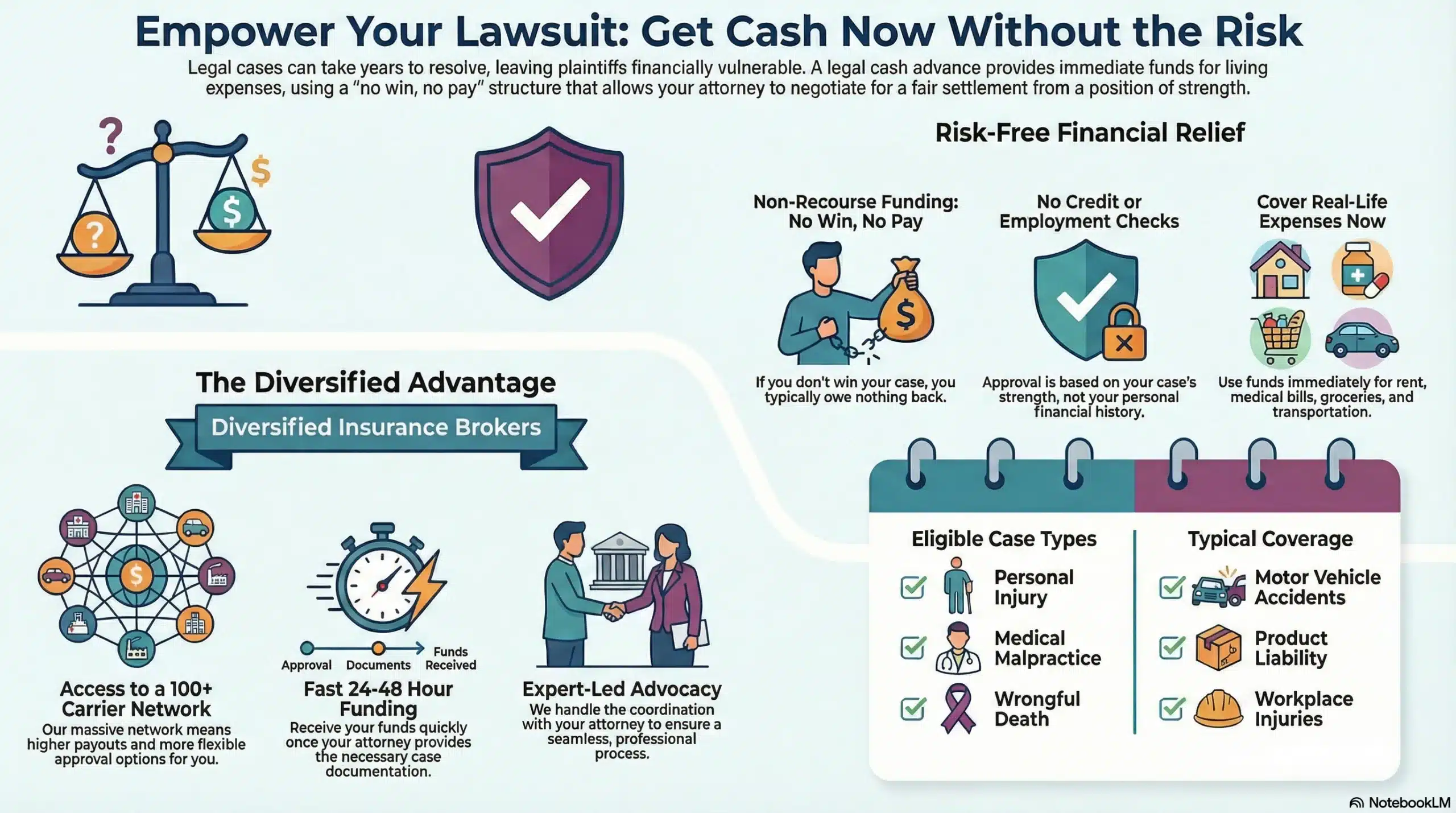
Talk With an Advisor Today
Choose how you’d like to connect—call or message us, then book a time that works for you.
Schedule here:
calendly.com/jason-dibcompanies/diversified-quotes
Licensed in all 50 states • Fiduciary, family-owned since 1980
FAQs: How Lawsuit Loans Work
Is a lawsuit loan really a loan — what happens if I lose my case?
Despite the name, a lawsuit loan is technically not a loan in the traditional sense — it is a non-recourse cash advance. The distinction is legally and financially significant. With a traditional loan, you are personally obligated to repay the amount borrowed regardless of what happens — if your income changes, if your financial situation worsens, or if the event you anticipated to fund repayment does not produce the expected proceeds, the loan is still owed and collection can follow. With a non-recourse pre-settlement advance, you have no personal repayment obligation if your case does not produce a financial recovery. If your case is dismissed, if the jury rules against you, or if the settlement comes in at zero, you typically owe nothing — the funding company absorbs the loss as the risk of their investment in the outcome of your case.
This non-recourse structure is the defining feature that makes pre-settlement funding accessible to plaintiffs who could not qualify for traditional credit and who could not afford the risk of personal repayment obligation while their case is pending. It is also why the funding is more expensive than traditional credit — the non-recourse risk premium compensates the funder for accepting complete loss exposure rather than the personal credit risk that conventional lenders manage. When you sign a funding agreement, confirming explicitly that the agreement is non-recourse — that there is no personal guarantee and that repayment is limited to proceeds from your specific legal case — is the most important verification step in the process.
Will applying for a lawsuit loan affect my credit score?
No — applying for pre-settlement funding does not involve a credit check and does not affect your credit score. The approval decision is made entirely based on the strength and expected value of your legal claim, not on your personal financial history, employment status, income level, or any information that would appear on a credit report. The funder is evaluating the case, not the plaintiff — specifically the liability evidence, the damages documentation, the available insurance coverage, and the expected recovery value. Your credit history is irrelevant to that evaluation.
This is one of the primary practical advantages of pre-settlement funding for injured plaintiffs who may have already experienced financial stress from being unable to work — missed payments, collections, or other credit events that occurred because of the injury and its financial consequences do not disqualify a plaintiff from accessing funding based on a strong legal claim. The funding company’s risk is entirely in the case outcome, not in the plaintiff’s personal financial behavior, which is why the underwriting process focuses exclusively on the legal claim rather than the personal credit profile.
How quickly can I get money after applying?
The funding timeline depends primarily on how quickly the funder can communicate with your attorney and receive the case documentation needed for the underwriting evaluation. For straightforward cases with clear liability — a rear-end collision where liability is uncontested, police report confirms fault, and medical treatment is documented — the complete process from application to funds in your account can take as little as 24 to 48 hours. For more complex cases — medical malpractice, disputed liability, or cases where the insurance coverage has not yet been confirmed — the evaluation typically takes longer because the underwriting requires more detailed case review and potentially more documentation from your attorney.
The most common delay in the funding process is attorney responsiveness — the funder cannot evaluate or approve the advance without attorney cooperation, and attorneys vary in how quickly they respond to funding company inquiries. Letting your attorney know in advance that you have applied for funding and asking them to respond promptly to the funder’s request for case information is the single most effective step for accelerating the timeline. Providing the funder with complete and accurate case information at the time of application — including your attorney’s direct contact information — also reduces the back-and-forth that can add days to the process.
Will taking a lawsuit loan affect my settlement amount or my attorney’s control of the case?
Pre-settlement funding does not give the funding company any authority over your case, any input into settlement decisions, or any ability to force or delay resolution. Your attorney remains fully in control of the case strategy and all settlement negotiations. The funding company’s only legal connection to your case is the contractual right to repayment from the settlement proceeds through the attorney’s trust account — they are not a party to the litigation and have no standing to direct how the case is managed or settled.
What pre-settlement funding can affect is your negotiating posture — generally in a positive direction. A plaintiff who is financially stable and not under immediate pressure to settle for less than the full value of the case is in a stronger negotiating position than one who is desperate for any settlement offer. By removing the short-term financial pressure, funding allows your attorney to decline inadequate offers, wait for liability to be fully established, and pursue the case timeline that maximizes the recovery rather than accepting a discounted settlement to end the financial stress. The indirect effect is often a larger net settlement — though whether that improvement exceeds the cost of the funding depends on the specific case, the timeline, and the advance amount.
How much of my settlement will I keep after repaying the lawsuit loan?
The amount you keep depends on the gross settlement, the attorney fee percentage, any medical liens or other deductions, the advance amount you took, and the fees that have accumulated from the date of funding to the date of settlement. The calculation starts with the gross settlement, subtracts attorney fees (typically 33% to 40%), subtracts any medical liens or Medicaid/Medicare liens, subtracts the outstanding advance balance including accrued fees, and delivers the remainder to you as the net settlement proceeds. Every one of these variables affects the net amount, which is why taking the smallest advance that addresses your actual financial need — rather than the maximum available — typically produces the best outcome for your total net recovery.
Before signing any funding agreement, ask the funder to provide a written payoff projection at multiple settlement dates — six months, twelve months, eighteen months, and twenty-four months from funding — so you and your attorney can evaluate what the advance will cost under different resolution scenarios. A funding advance that costs 20% of the net recovery in a case that settles in eight months represents a different financial decision than the same advance that costs 45% of the net recovery in a case that takes two years to resolve. The total cost of the funding relative to the expected net recovery is the key metric — not the advance amount in isolation.
What types of cases do not qualify for lawsuit loans?
Pre-settlement funding is most readily available for cases with three characteristics: clear liability, documented damages, and insurance-backed recovery. Cases that lack one or more of these characteristics face more difficult funding approval or outright denial. Cases with genuinely disputed liability — where the evidence of fault is contested and the outcome could reasonably go either way — are funded more conservatively or declined because the funder’s non-recourse risk is substantially higher when the case outcome is uncertain. Cases with limited or no insurance coverage on the defendant side are difficult to fund regardless of liability strength, because the recovery pool must exist and be identifiable before a funder will commit non-recourse capital against it.
Case types that are typically the most difficult to fund include: purely speculative damage claims without documented economic loss, breach of contract cases without clear damages calculations, cases involving uninsured defendants with limited personal assets, divorce and family law matters, criminal cases, and most employment discrimination claims unless they involve documented lost wages and a solvent employer defendant. Cases that are in the very early stages — where liability has not yet been evaluated by counsel and where no treatment records or damages documentation exists — are also typically too early to fund accurately, since the advance must be sized against the expected net recovery and that recovery cannot be estimated without adequate case development. The practical guidance is that if your attorney has reviewed the case, believes it is strong, and can communicate that assessment to a funder, the case is likely in a position to be evaluated for funding.
About the Author:
Jason Stolz, CLTC, CRPC, DIA, CAA and Chief Underwriter at Diversified Insurance Brokers (NPN 20471358), is a senior insurance and retirement professional with more than 25 years of real-world experience helping individuals, families, and business owners protect their income, assets, and long-term financial stability. As a long-time partner of the nationally licensed independent agency Diversified Insurance Brokers, Jason provides trusted guidance across multiple specialties—including fixed and indexed annuities, long-term care planning, personal and business disability insurance, life insurance solutions, Group Health, Travel Medical and Evacuation Insurance, and short-term health coverage. Diversified Insurance Brokers maintains active contracts with over 100 highly rated insurance carriers, ensuring clients have access to a broad and competitive marketplace.
His practical, education-first approach has earned recognition in publications such as VoyageATL, and contributions from his agency featured in Kiplinger and GoBankingRates— highlighting his commitment to financial clarity and client-focused planning. Drawing on deep product knowledge and years of hands-on field experience, Jason helps clients evaluate carriers, compare strategies, and build retirement and protection plans that are both secure and cost-efficient. Visitors who want to explore current annuity rates and compare options across multiple insurers can also use this annuity quote and comparison tool.
Explore All Lawsuit Loan & Legal Funding Options: Browse our complete guide to Lawsuit Loans & Legal Funding — covering pre-settlement funding, lawsuit cash advances, injury claims & more.
Last Reviewed: June 10, 2026 |
Reviewed by: Jason Stolz, CLTC, CRPC, DIA, CAA
Chief Underwriter, Diversified Insurance Brokers, Inc. | NPN: 20471358 | Diversified Insurance Brokers, Inc. — Licensed in all 50 states
Fact Checked by: Tonia Pettitt, CMIP©
Medicare Specialist, Diversified Insurance Brokers, Inc. | NPN: 14374308 | Diversified Insurance Brokers, Inc. — Licensed in all 50 states
Did you find this content helpful? Leave us a Google review — it helps others find trustworthy guidance too.
Editorial Standards: Diversified Insurance Brokers maintains rigorous editorial standards to ensure accuracy, clarity, and independence in all content. Learn more about our editorial standards and commitment to transparency.
