
Is Pre-Settlement Funding Worth It?
Is Pre-Settlement Funding Worth It?

Jason Stolz CLTC, CRPC, DIA, CAA
Is pre-settlement funding worth it? That question almost always arrives at a difficult moment. You are waiting on a personal injury settlement, an employment dispute payout, or another civil claim while rent, mortgage payments, utilities, car notes, medical bills, and everyday living costs continue arriving regardless of where the case stands. Pre-settlement funding — sometimes called lawsuit funding or a legal advance — offers plaintiffs access to cash now in exchange for a portion of future settlement proceeds if the case succeeds. Whether it is “worth it” depends entirely on four variables: your financial situation and the alternative options available to you, the strength and expected value of your case, the cost structure of the specific advance being offered, and how long the case is realistically likely to take from today. A funding advance that represents 5% of the final recovery on a case that resolves in six months is a very different financial decision than an advance that represents 40% of the recovery on a case that took two years. If you are new to how these programs are structured before making that calculation, cash for lawsuit plaintiffs and fast settlement advances provides the foundational overview of how funding programs work and what plaintiffs can expect from the approval and funding process.
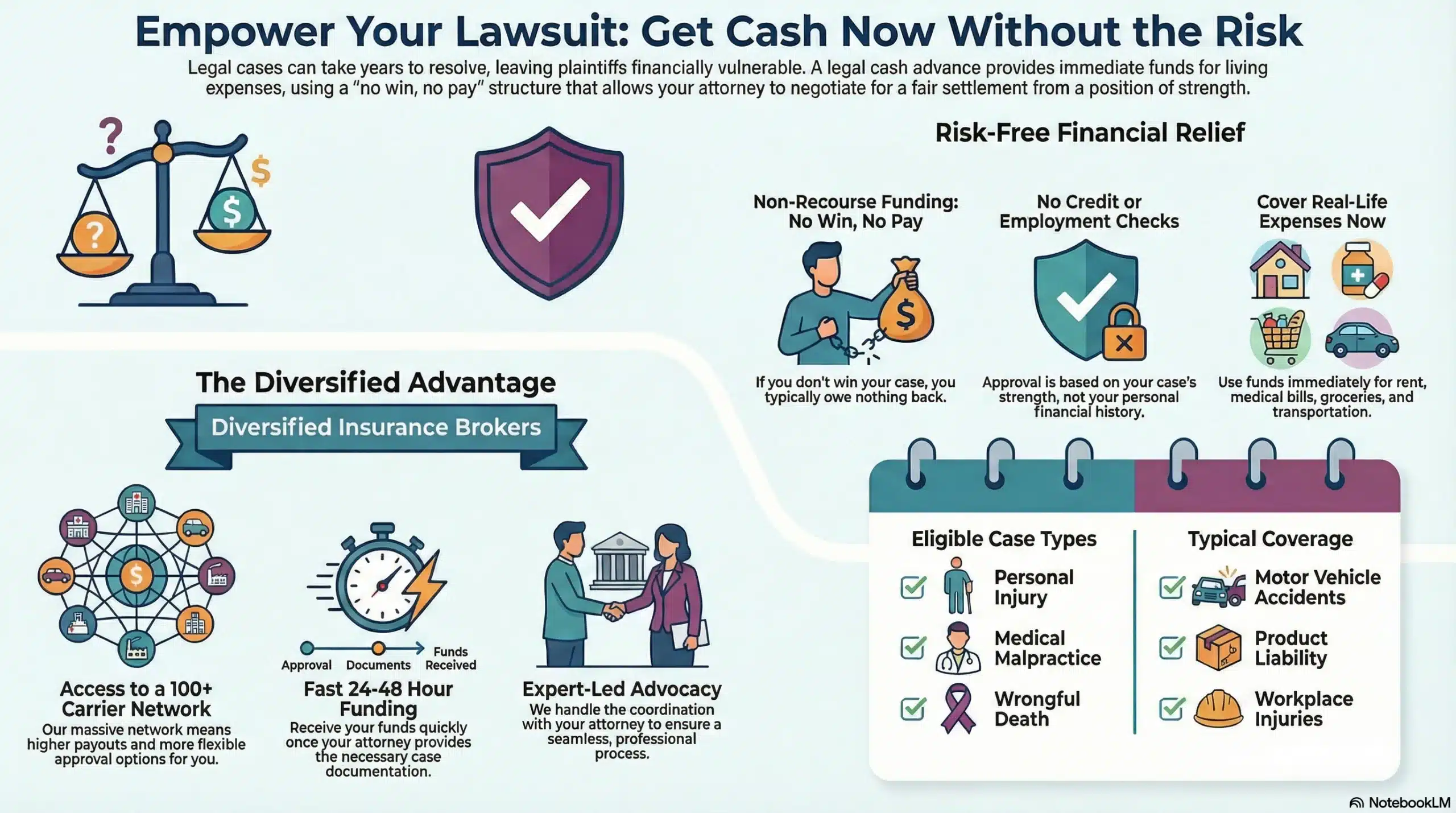
Unlike a traditional loan, pre-settlement funding is typically non-recourse — meaning if the case does not produce a recovery, the plaintiff usually owes nothing. That single feature makes it structurally different from every conventional debt alternative: credit cards, personal loans, home equity lines, and borrowing against retirement savings all create repayment obligations that exist regardless of what happens in the lawsuit. Many plaintiffs first explore whether they can obtain an advance on a pending lawsuit specifically because they are not in a financial position to take on additional debt with fixed monthly payments, and the non-recourse structure removes that concern. However, the convenience and reduced repayment risk come at a cost — and that cost must be understood clearly before signing. Lawsuit advances are case-based rather than credit-based, which is part of why they are accessible when conventional borrowing is not, but accessibility does not mean the cost is irrelevant. Understanding what you will owe at settlement across a range of possible timelines — not just the optimistic one — is the foundation of making an informed decision about whether the advance is genuinely worth it.
Request a Free Pre-Settlement Funding Review
See if you qualify for non-recourse lawsuit funding with no upfront costs. Fast review. No obligation.
Apply for Pre-Settlement FundingCall 800-533-5969
The Core Case for Pre-Settlement Funding — When It Is Worth It
The most compelling argument for pre-settlement funding is leverage. Insurance carriers and defense attorneys are experienced at evaluating plaintiff financial pressure and adjusting settlement negotiations accordingly. A plaintiff who is three months behind on rent, facing vehicle repossession, and unable to cover out-of-pocket medical costs is not in the same negotiating position as a plaintiff who is financially stable and able to wait for full case value. The financial strain of waiting is not a neutral factor in litigation — it is a dynamic that the defense side frequently uses to depress settlement value, whether explicitly or implicitly. If mounting bills are creating pressure toward accepting a lower offer just to resolve the financial crisis today, funding can provide the breathing room that allows the attorney to continue building the case and negotiating for full compensation without that pressure distorting the negotiation. Plaintiffs who pursue legal cash advances specifically to avoid premature settlements that undervalue their injuries are using the tool for exactly the purpose it is designed to serve.
The cases where pre-settlement funding produces the clearest value are those with strong liability, documented damages, and a realistic pathway to a settlement that is meaningfully higher than the defendant’s current offer. When the gap between what the defense is offering now and what the case is worth with additional time is large — and when financial pressure is the primary factor pushing toward the lower offer — funding can pay for itself by enabling the plaintiff to wait for the better outcome. If a plaintiff’s case is worth $200,000 but the defense is currently offering $80,000 because they know the plaintiff needs cash immediately, and a $15,000 advance at a total repayment of $22,000 allows the attorney to negotiate to $175,000, the advance produced an enormous net benefit. That math does not always work out that neatly in practice, but it illustrates why the value of funding cannot be evaluated in isolation from the settlement outcome it enables.
When Pre-Settlement Funding Is Not Worth It — The Honest Trade-Off Analysis
Pre-settlement funding is not automatically the right answer for every plaintiff who needs cash during a pending case. Several conditions create situations where the cost of funding is more difficult to justify against the realistic alternatives and the expected recovery. Cases with uncertain liability — where the plaintiff may not be the clear prevailing party — create a scenario where funding fees accumulate during a case that may resolve at a lower value than initially expected, or may not resolve favorably at all. Even with a non-recourse structure protecting the plaintiff from personal liability, a case that settles for less than anticipated leaves less recovery to cover the funding repayment alongside attorney fees and costs, potentially leaving the plaintiff with a smaller net recovery than they would have had without the advance.
Cases with modest damages also require careful analysis. If the total expected settlement value is $25,000 and attorney fees, costs, and medical liens will consume $15,000 of that, the remaining $10,000 is what the plaintiff actually takes home. An advance of $5,000 at a repayment of $8,000 at settlement reduces the net recovery to $2,000. In that scenario, the advance may have provided temporary relief but significantly reduced the financial benefit of the lawsuit itself. The comparison that matters is not “funding versus no cash” — it is “net recovery with funding versus net recovery without funding if I can find another way to cover the immediate need.” If any conventional alternative — a family loan, an extension negotiation with a creditor, a deferral on an obligation — can address the immediate financial crisis without reducing the settlement net, that alternative is usually preferable to a funding advance. Honest conversations with the attorney about realistic case valuation ranges are essential before committing to any advance, because the attorney’s assessment of what the case is likely to produce at resolution is the most important input in the funding cost-benefit calculation.
Borrowing more than needed is one of the most common and most avoidable ways to make funding less worth it. Because repayment comes from settlement proceeds and is tied to the advance amount and the time elapsed, every dollar borrowed today costs more than a dollar at settlement — the fee accumulates from the advance date through the resolution date. A plaintiff who borrows $30,000 when $8,000 would have covered the actual essential need has spent an additional $22,000 in advance fees at settlement to fund expenses that were not genuinely necessary. The safest approach is to calculate the minimum monthly burn rate for true essentials — rent or mortgage, utilities, food, transportation, and necessary medical out-of-pocket costs — and request an advance sized to cover that amount for a defined period, then reassess based on how the case progresses. Some plaintiffs use this approach to get cash before their case settles in a staged, conservative way rather than projecting the full case timeline and borrowing for the entire anticipated duration at once.
The Variables That Determine Whether Funding Is Worth It
| Variable | Favors Funding Being Worth It | Favors Funding Being Less Worth It |
|---|---|---|
| Liability Strength | Strong, clear liability where recovery is highly probable | Contested or uncertain liability where outcome is genuinely in doubt |
| Settlement Gap | Large gap between current defense offer and realistic full case value — funding allows time to close that gap | Current offer is already close to realistic case value — additional wait time and funding cost produce minimal additional recovery |
| Case Damages | Significant documented damages with clear economic impact — funding cost is a small percentage of realistic recovery | Modest damages where funding repayment consumes a large percentage of the net recovery after fees and costs |
| Alternatives Available | No realistic conventional alternative — cannot qualify for credit, no family resources, no asset-based option | Conventional alternatives exist — family loan, creditor negotiation, deferral — that can address the immediate need without reducing net recovery |
| Advance Size | Minimum advance sized for essential expenses only — fee burden at settlement is proportional and manageable | Oversized advance funds non-essential spending — fee burden disproportionately reduces net recovery |
Comparing Pre-Settlement Funding to Alternative Liquidity Options
The relevant comparison for evaluating whether pre-settlement funding is worth it is not “funding versus nothing” — it is “funding versus the best realistic alternative available.” For some plaintiffs, that alternative may be borrowing from a family member who is willing and able to lend without interest. For others, it may be negotiating a temporary deferral with a landlord or creditor who is willing to work with a plaintiff waiting on a lawsuit settlement. For still others, it may be a short-term personal loan or credit card that carries known monthly payment obligations. Each alternative has its own cost structure, its own risk profile, and its own impact on net recovery at settlement.
What makes lawsuit funding distinctive — and sometimes more appropriate than conventional alternatives — is the combination of features it provides: no monthly payment obligation, no credit score requirement, no employment or income verification, and no personal liability if the case does not produce a recovery. A plaintiff who cannot qualify for a personal loan due to injury-related unemployment and who does not want to make monthly payments on a credit card while waiting for a case to resolve may find that lawsuit funding is the only realistic option that covers essential needs without creating additional ongoing financial obligations. Comparing the total repayment cost of funding against the total cost of each alternative — including interest, fees, and the impact of monthly payments on the household cash flow — provides the clearest basis for determining which option is genuinely the most efficient. Reviewing options through legal funding companies near you helps identify competitive terms rather than accepting the first offer. And for broader financial planning context relevant to your overall situation, the pre-retirement checklist covers financial planning considerations that may be relevant depending on your circumstances and age.
Emotional and psychological factors are also real and worth acknowledging. Financial pressure during litigation affects more than just the settlement negotiation — it affects decision-making quality, health, family stability, and the plaintiff’s ability to cooperate effectively with the attorney throughout the litigation process. A plaintiff who is focused on how to cover next month’s rent is not in the same mental position to engage productively with the legal strategy as one who is financially stable. The psychological relief of having essential expenses covered during a difficult period of waiting has value that does not show up in a simple cost-benefit calculation but that is consistently reported by plaintiffs who have used funding responsibly. How much you can get from pre-settlement funding and what pre-settlement funding actually is cover the mechanics of how approval amounts are determined and what plaintiffs can realistically expect from the process.
Don’t Let Financial Stress Dictate Your Settlement
Find out if a non-recourse lawsuit advance can give you the flexibility to pursue the compensation you deserve.
Check Your Eligibility NowCall 800-533-5969
Talk With an Advisor Today
Choose how you’d like to connect—call or message us, then book a time that works for you.
Schedule here:
calendly.com/jason-dibcompanies/diversified-quotes
Licensed in all 50 states • Fiduciary, family-owned since 1980
Frequently Asked Questions: Is Pre-Settlement Funding Worth It?
How do I determine if pre-settlement funding is worth it for my specific case?
The most reliable way to evaluate whether pre-settlement funding is worth it is to compare two outcomes: what your expected net recovery looks like with funding against what it looks like without it. With funding, you get immediate financial stability but reduce the net settlement proceeds by the repayment amount at resolution. Without funding, you preserve the full net recovery but must manage financial pressure through the case period — which may create real risk of accepting a lower settlement to resolve immediate needs. If the financial pressure without funding is likely to produce a premature settlement that is materially lower than the case’s realistic value, the funding cost may be significantly smaller than the value it enables. If the financial situation is manageable without funding and the case value is modest, conventional alternatives that do not reduce the net recovery are generally preferable. Your attorney’s honest assessment of realistic case value at different resolution timelines is the most important input in this analysis, because it determines whether the potential settlement upside justifies the funding cost.
Does pre-settlement funding affect my credit score or require monthly payments?
In most cases, no — pre-settlement funding does not require monthly payments and does not appear on your credit report as a debt obligation in the way conventional loans do. Because the advance is non-recourse — meaning repayment is tied to the case proceeds rather than the plaintiff personally — it does not create an ongoing monthly payment obligation that would affect your cash flow or credit utilization during the case period. Approval is based on the strength and documentation of the case rather than on credit score, employment history, or income. This is one of the features that makes lawsuit funding particularly accessible to plaintiffs whose financial situation has been disrupted by the injury or circumstances underlying the lawsuit — the people who most need financial support during litigation are often the people who cannot qualify for conventional credit. The absence of monthly payments also means the funding does not add to the monthly financial burden the plaintiff is already experiencing, though the total repayment at settlement can be significant depending on the advance amount and the elapsed time.
What types of cases typically qualify for pre-settlement funding?
Personal injury cases represent the largest category of funded claims — car and truck accidents, slip and fall injuries, premises liability, product liability, and construction accidents are among the most commonly approved case types. Workers’ compensation claims, medical malpractice cases, and wrongful death lawsuits are also frequently funded, though eligibility criteria and available amounts vary by case type and jurisdiction. Employment disputes involving wrongful termination, discrimination, or wage and hour violations may qualify depending on the funder and the strength of the claim. Civil rights and civil rights-adjacent claims are funded by some companies. The universal eligibility factors across all case types are: represented by an attorney, the case has been filed or is clearly viable, liability is reasonably strong, damages are documented, the defendant has the capacity to pay through insurance or other means, and the attorney is willing to cooperate with the funding process. Cases with uncertain liability, minimal damages, or defendants who may not be collectable are less likely to qualify or may receive smaller advance amounts relative to case value.
How much of my settlement will pre-settlement funding consume?
The percentage of the settlement consumed by funding repayment depends on three factors: the advance amount, the fee structure (compounding or non-compounding), and the elapsed time from advance to settlement. A $10,000 advance at a non-compounding fee structure that resolves in six months might cost $12,500 to $13,500 at repayment — roughly 25% to 35% of the advance in fees, which may represent 5% to 7% of a $200,000 settlement. The same $10,000 advance under a compounding fee structure over 24 months could cost significantly more. The percentage of the total settlement consumed increases when the advance is large relative to the settlement, when the fee structure is compounding, when the case takes longer than expected, and when the settlement is at the lower end of the realistic range. The percentage decreases when the advance is modest, the fee structure is non-compounding, the case resolves relatively quickly, and the settlement is at the high end of the realistic range. Requesting a written payoff schedule at 6, 12, 18, and 24 months at the time of application — and comparing it against the attorney’s realistic settlement value range — is the only way to know in advance what percentage of the recovery the funding will consume across different scenarios.
What is the best way to use pre-settlement funding responsibly?
The most effective approach is to define the specific financial problem the advance is solving before applying, and to borrow only the amount needed to solve that specific problem. Essential living expenses — rent or mortgage, utilities, food, transportation, and necessary medical costs directly related to the case — are the appropriate uses for a pre-settlement advance. Non-essential discretionary spending funded through an advance increases the repayment burden at settlement without meaningfully improving the plaintiff’s ability to wait for a better outcome. Involving the attorney in the decision — including having the attorney review the funding agreement before signing — provides an informed check on both the reasonableness of the terms and the appropriateness of the advance relative to the case’s realistic value. Comparing offers from multiple funders rather than accepting the first approval produces the best available pricing. Requesting a staged approach — a smaller initial advance to cover 60 to 90 days of essential expenses, with the option to request additional funding if the case continues longer than expected — minimizes total repayment compared to taking the projected full-timeline amount upfront.
About the Author:
Jason Stolz, CLTC, CRPC, DIA, CAA and Chief Underwriter at Diversified Insurance Brokers (NPN 20471358), is a senior insurance and retirement professional with more than 25 years of real-world experience helping individuals, families, and business owners protect their income, assets, and long-term financial stability. As a long-time partner of the nationally licensed independent agency Diversified Insurance Brokers, Jason provides trusted guidance across multiple specialties—including fixed and indexed annuities, long-term care planning, personal and business disability insurance, life insurance solutions, Group Health, Travel Medical and Evacuation Insurance, and short-term health coverage. Diversified Insurance Brokers maintains active contracts with over 100 highly rated insurance carriers, ensuring clients have access to a broad and competitive marketplace.
His practical, education-first approach has earned recognition in publications such as VoyageATL, and contributions from his agency featured in Kiplinger and GoBankingRates— highlighting his commitment to financial clarity and client-focused planning. Drawing on deep product knowledge and years of hands-on field experience, Jason helps clients evaluate carriers, compare strategies, and build retirement and protection plans that are both secure and cost-efficient. Visitors who want to explore current annuity rates and compare options across multiple insurers can also use this annuity quote and comparison tool.
Explore All Lawsuit Loan & Legal Funding Options: Browse our complete guide to Lawsuit Loans & Legal Funding — covering pre-settlement funding, lawsuit cash advances, injury claims & more.
Last Reviewed: June 14, 2026 |
Reviewed by: Jason Stolz, CLTC, CRPC, DIA, CAA
Chief Underwriter, Diversified Insurance Brokers, Inc. | NPN: 20471358 | Diversified Insurance Brokers, Inc. — Licensed in all 50 states
Fact Checked by: Tonia Pettitt, CMIP©
Medicare Specialist, Diversified Insurance Brokers, Inc. | NPN: 14374308 | Diversified Insurance Brokers, Inc. — Licensed in all 50 states
Did you find this content helpful? Leave us a Google review — it helps others find trustworthy guidance too.
Editorial Standards: Diversified Insurance Brokers maintains rigorous editorial standards to ensure accuracy, clarity, and independence in all content. Learn more about our editorial standards and commitment to transparency.
