
Cash for Lawsuit Plaintiffs – Fast Settlement Advances
Cash for Lawsuit Plaintiffs – Fast Settlement Advances

Jason Stolz CLTC, CRPC, DIA, CAA
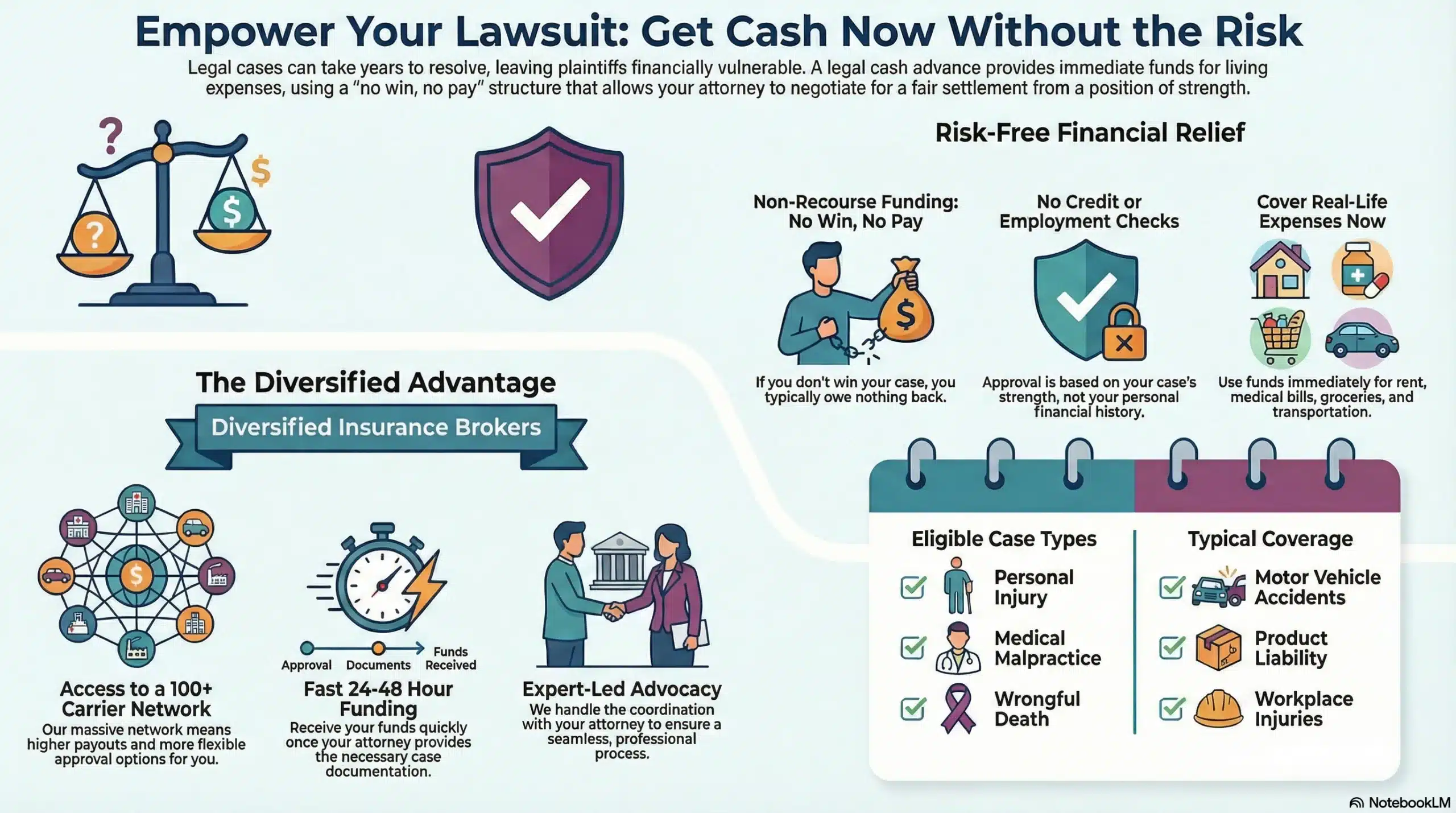
When you are a plaintiff in an active lawsuit, the financial pressure of waiting for a settlement or trial outcome operates on a completely different timeline than your bills. Rent, groceries, medical treatment, utilities, and car payments are all monthly obligations that arrive regardless of how long insurance companies and defendants take to resolve your case. The average tort lawsuit in the United States takes approximately 23 months to resolve according to Bureau of Justice Statistics data — and motor vehicle, premises liability, and medical malpractice cases stretch even further. For plaintiffs who were injured, are missing work, and are managing ongoing medical costs, that timeline without income support can create a financial crisis serious enough to force acceptance of a settlement that does not fairly reflect the value of the case. Pre-settlement funding was developed to address this exact problem: providing cash access against the anticipated proceeds of a pending case so that financial pressure does not dictate a legal outcome.
Diversified Insurance Brokers connects qualified plaintiffs with our funding network to request cash advances against pending lawsuit proceeds. We work with a network of legal funding sources and, when cases qualify, route requests to funders positioned to offer competitive terms and higher advance amounts. Our companion page at getting money before your settlement check covers the fast legal funding process in detail. The pre-settlement funding market reached $19.62 billion in 2025 and is growing at approximately 12% annually — reflecting both the genuine need plaintiffs have for financial bridging during extended litigation and the expanding availability of funding sources across case types. Understanding exactly how pre-settlement funding works, what it costs, which case types typically qualify, and what questions to ask before signing any funding agreement is essential for making an informed decision about whether this option serves your situation.
Apply for Pre-Settlement Lawsuit Funding
Quick case review and attorney-coordinated funding. Access money against your pending case while your attorney continues working toward the best possible outcome.
Request Funding NowPre-Settlement Funding — How It Works, What It Costs, and What to Know Before You Apply
| Feature | Pre-Settlement Funding | Traditional Bank Loan |
|---|---|---|
| Repayment obligation | Non-recourse — repayment comes only from settlement or judgment proceeds; if the case loses, you owe nothing | Full recourse — you must repay regardless of outcome; personal liability follows you regardless of the lawsuit result |
| Approval basis | Based on the strength of the legal case — liability assessment, damages, and available insurance or defendant assets; credit score and employment history are not factors | Based on credit score, income verification, employment history, and existing debt obligations |
| Monthly payments | None — no monthly payments required; the full repayment is settled from case proceeds at resolution | Regular monthly payments required whether or not the lawsuit is resolved, adding to financial pressure during litigation |
| Advance amount | Typically 10-20% of estimated case value; a case estimated at $100,000 might qualify for $10,000-$20,000 | Based on creditworthiness and income; lawsuit value is not a consideration |
| Cost | Interest rates typically 2-5% per month (roughly 27-60%+ annually); some funders charge higher rates — APRs exceeding 100-150% are not uncommon and represent a real cost that compounds over the duration of the case | Lower interest rates but requires credit qualification and ongoing monthly payments |
| Attorney involvement | Attorney cooperation required — funder coordinates directly with the law firm for case verification; repayment is deducted from settlement proceeds before the attorney distributes the rest to the plaintiff | No attorney involvement required |
| Regulation | Most U.S. states have no specific regulations governing legal funding; approximately 17 states restrict or regulate the industry; state law varies significantly | Subject to federal and state lending regulations including Truth in Lending Act disclosures |
Which Case Types Typically Qualify
Pre-settlement funding is available for a wide range of personal injury and civil litigation case types, with funding decisions driven by the funder’s evaluation of liability strength, estimated damages, and the defendant’s insurance coverage or ability to pay. The most commonly funded case categories include motor vehicle accidents, slip-and-fall and premises liability claims, workplace injuries, product liability cases, medical malpractice, wrongful death actions, and employment discrimination and wrongful termination claims. Cases with clear liability, documented injuries, and substantial available insurance coverage tend to qualify for larger advances at more competitive rates. Cases with disputed liability, limited insurance coverage, or uncertain damages may qualify for smaller advances or may not qualify at all. The funder’s primary evaluation question is: if this case resolves in the plaintiff’s favor, is there a realistic settlement or judgment from which repayment can be made? That assessment — not the plaintiff’s personal credit — determines eligibility.
Attorney cooperation is an essential condition of funding. The funder will contact the plaintiff’s attorney directly to verify the case, understand the legal theory, review insurance coverage information, and confirm the attorney’s willingness to acknowledge the funding arrangement and handle repayment from settlement proceeds at closing. Most experienced personal injury attorneys are familiar with pre-settlement funding and can provide the documentation needed. Attorneys who do not cooperate with the funder’s verification process generally prevent the funding from proceeding regardless of how strong the underlying case appears. Our network works with attorneys who regularly coordinate pre-settlement funding arrangements to facilitate the process efficiently. Plaintiffs whose attorneys are unfamiliar with the process should discuss the option with their attorney before applying.
Understanding the Real Cost — What to Know Before You Sign
The most important thing to understand about pre-settlement funding is the cost, which is meaningfully higher than conventional lending. Interest rates typically run 2-5% per month — roughly 27-60% annually — and some funders charge rates that produce APRs exceeding 100-150% when compounded over the duration of a long-running case. A $10,000 advance taken at the beginning of a case that takes two years to resolve could require repayment of $18,000-$20,000 or more depending on the rate structure. Before signing any funding agreement, review the total repayment amount — not just the monthly rate — against the anticipated settlement amount to understand what portion of the final recovery will be consumed by the funding cost. Request the terms in writing and have your attorney review the agreement. Comparing terms across at least two to three funders provides the best baseline for evaluating whether the offered terms are competitive. The non-recourse structure that protects you if you lose the case is genuinely valuable, but the cost of that protection is real and accumulates over time — particularly in cases that take longer than expected to resolve. Understanding these economics clearly is the foundation for making a decision that serves your situation rather than one made under financial pressure alone.
How the Application Process Works
The pre-settlement funding application process is straightforward. You provide basic information about your case, your attorney’s contact information, and the case status. The funder contacts your attorney to verify case details, review the available insurance coverage and liability position, and assess the estimated case value. Most funding decisions for qualifying cases are made within 24-48 hours of receiving complete case information. If approved, funds are typically wired directly to your account within 24-48 hours of the signed agreement. Repayment is structured as a lien against your settlement or judgment proceeds — when the case resolves, your attorney deducts the funded amount plus accrued fees and charges from the settlement proceeds before disbursing the remaining amount to you. If the case does not resolve in your favor — whether through a defense verdict, dismissal, or settlement below the funding threshold — the non-recourse structure means you have no personal obligation to repay the advance. The funder absorbs that loss. Our team at Diversified Insurance Brokers coordinates the routing process across our funding network. For questions or to discuss your specific situation before submitting an application, call 800-533-5969 or visit our contact page. Frequently asked questions about the process are at our FAQ page.
The Financial Logic of Pre-Settlement Funding
Pre-settlement funding solves a specific financial problem that no other product addresses precisely: the gap between when a plaintiff needs money and when a legal case produces it. Personal injury and civil litigation cases move on legal timelines that are not designed with the plaintiff’s financial situation in mind. Insurance company claims operations, discovery schedules, court calendars, and defense attorney strategies all influence the pace of case resolution. Plaintiffs who cannot sustain their financial position through extended litigation sometimes accept settlements that are significantly lower than the case’s realistic value — not because the legal outcome is poor, but because the financial pressure becomes unsustainable. Pre-settlement funding removes or reduces that financial pressure, allowing plaintiffs to make settlement decisions based on legal merit rather than financial desperation. The cost is real and must be understood clearly. But for plaintiffs with strong cases and genuine financial needs during an extended litigation timeline, the non-recourse advance can be the difference between a fair resolution and a forced settlement. The disability insurance services at Diversified Insurance Brokers are also available for plaintiffs whose injuries have caused or will cause extended work disruption, as are income protection insurance resources for ongoing income planning. For plaintiffs who are self-employed or independent contractors, income protection planning during and after the litigation period may also be worth discussing with us alongside the funding application. Our disability insurance for attorneys serves legal professionals in the network who may themselves face disability income planning needs.
Talk With an Advisor Today
Choose how you’d like to connect—call or message us, then book a time that works for you.
Schedule here:
calendly.com/jason-dibcompanies/diversified-quotes
Licensed in all 50 states • Fiduciary, family-owned since 1980
FAQs: Pre-Settlement Cash Advances for Lawsuit Plaintiffs
What does “non-recourse” mean in pre-settlement funding?
Non-recourse means that if your case does not produce a recovery sufficient to cover the advance — whether because the case is lost, dismissed, or settles for less than the funded amount — you have no personal obligation to repay the advance. The funder absorbs the loss. Your other assets, income, and credit are not at risk if the case outcome is unfavorable. This is the fundamental difference between pre-settlement funding and a traditional bank loan, which must be repaid regardless of what happens in the lawsuit. The non-recourse protection is a genuine benefit that justifies the higher cost of pre-settlement funding compared to conventional lending.
Will applying for pre-settlement funding affect my credit score?
No — pre-settlement funding approval is based on the strength of the legal case, not the plaintiff’s credit score, employment history, or income. Funding companies evaluate the liability position, estimated damages, and available insurance coverage for repayment. No credit inquiry is run in the conventional sense. Because there are no monthly payments and repayment comes only from settlement proceeds, the funding arrangement does not appear on your credit report as a debt obligation in the way a personal loan would. This makes pre-settlement funding accessible to plaintiffs who would not qualify for a conventional loan.
How much can I borrow against my pending lawsuit?
Most funding companies advance 10-20% of the estimated case value. A case estimated to be worth $100,000 might qualify for $10,000-$20,000. The advance amount reflects the funder’s assessment of likely recovery, the liability strength of the case, and the available insurance coverage. Larger and stronger cases qualify for larger advances. Cases in mass tort or multidistrict litigation may qualify for larger advances than individual slip-and-fall claims. Funding companies set advance amounts conservatively to ensure that even at a lower settlement amount, the repayment can be covered from proceeds.
Do I need my attorney’s permission to apply for pre-settlement funding?
You do not need your attorney’s permission to apply, but your attorney’s cooperation is required for the funding to actually be approved and processed. The funder must contact your attorney to verify case details, review insurance coverage information, and have the attorney acknowledge the funding arrangement. Repayment is handled through the settlement process — your attorney deducts the funded amount plus fees from settlement proceeds before distributing the remainder to you. Attorneys who refuse to cooperate with the verification process prevent funding from being completed regardless of case strength. Most experienced personal injury attorneys are familiar with pre-settlement funding arrangements and can participate in the process. Discuss the option with your attorney before applying.
What is the real cost of pre-settlement funding and what should I compare?
Pre-settlement funding is significantly more expensive than conventional lending. Interest rates typically run 2-5% per month — roughly 27-60% annually — and some funders charge rates that produce APRs exceeding 100-150% over the life of a long case. A $10,000 advance in a case that takes two years to resolve could require repayment of $18,000-$20,000 or more. Before signing any agreement, request the total repayment amount for your specific case timeline, not just the monthly rate. Compare terms from at least two to three funders. Have your attorney review the agreement before you sign. Understand that the longer your case takes, the more the cost compounds. The non-recourse protection has genuine value, but that value should be weighed honestly against the cost given your specific financial need and case timeline.
About the Author:
Jason Stolz, CLTC, CRPC, DIA, CAA and Chief Underwriter at Diversified Insurance Brokers (NPN 20471358), is a senior insurance and retirement professional with more than 25 years of real-world experience helping individuals, families, and business owners protect their income, assets, and long-term financial stability. As a long-time partner of the nationally licensed independent agency Diversified Insurance Brokers, Jason provides trusted guidance across multiple specialties—including fixed and indexed annuities, long-term care planning, personal and business disability insurance, life insurance solutions, Group Health, Travel Medical and Evacuation Insurance, and short-term health coverage. Diversified Insurance Brokers maintains active contracts with over 100 highly rated insurance carriers, ensuring clients have access to a broad and competitive marketplace.
His practical, education-first approach has earned recognition in publications such as VoyageATL, and contributions from his agency featured in Kiplinger and GoBankingRates— highlighting his commitment to financial clarity and client-focused planning. Drawing on deep product knowledge and years of hands-on field experience, Jason helps clients evaluate carriers, compare strategies, and build retirement and protection plans that are both secure and cost-efficient. Visitors who want to explore current annuity rates and compare options across multiple insurers can also use this annuity quote and comparison tool.
Explore All Lawsuit Loan & Legal Funding Options: Browse our complete guide to Lawsuit Loans & Legal Funding — covering pre-settlement funding, lawsuit cash advances, injury claims & more.
Last Reviewed: June 6, 2026 |
Reviewed by: Jason Stolz, CLTC, CRPC, DIA, CAA
Chief Underwriter, Diversified Insurance Brokers, Inc. | NPN: 20471358 | Diversified Insurance Brokers, Inc. — Licensed in all 50 states
Fact Checked by: Tonia Pettitt, CMIP©
Medicare Specialist, Diversified Insurance Brokers, Inc. | NPN: 14374308 | Diversified Insurance Brokers, Inc. — Licensed in all 50 states
Did you find this content helpful? Leave us a Google review — it helps others find trustworthy guidance too.
Editorial Standards: Diversified Insurance Brokers maintains rigorous editorial standards to ensure accuracy, clarity, and independence in all content. Learn more about our editorial standards and commitment to transparency.
