
Long Term Care Insurance for Diabetics
As an Independent Long Term Care Insurance Broker, we compare traditional, hybrid, and partnership-qualified policies across dozens of carriers to find the structure that actually fits your situation.
Long Term Care Insurance for Diabetics

Jason Stolz CLTC, CRPC, DIA, CAA
Long-term care insurance for diabetics is attainable, but the outcome depends on underwriting details that most people never see until it is too late. Diabetes is not automatically disqualifying. Instead, long-term care insurers focus on functional risk — whether your health profile suggests a higher likelihood of needing help with everyday activities earlier than average. The goal of this page is to help you understand what carriers actually look for, how to position your case correctly, and which planning paths may be realistic based on the type of diabetes, your current control, and your overall health picture. At Diversified Insurance Brokers, Jason Stolz, CLTC, CRPC, DIA, CAA, approaches long-term care insurance for diabetics with an underwriting-first mindset — identifying which carriers are most appropriate for a specific medical profile before an application is ever submitted, because unnecessary declines create MIB record complications that limit future options.
The biggest mistake diabetic applicants make is assuming all long-term care insurance carriers treat diabetes the same. They do not. Underwriting is not uniform, and carrier appetites for diabetic risk profiles change over time and differ meaningfully across companies. One carrier may accept a stable diabetic profile with reasonable terms, while another might offer coverage only with heavier pricing or restrictions — or decline entirely for the same profile. That difference is why strategy matters more than any other single factor in LTC planning for diabetics. The “right” long-term care policy for a diabetic applicant is rarely found by applying without carrier pre-screening. It is found by matching the specific medical profile to carriers that underwrite it most reasonably and presenting the case in a way that underwriters can approve with confidence. The stakes are significant: current care costs show assisted living averaging $71,040 annually, semi-private nursing home rooms at $118,500, and private rooms at $129,575 — costs that grow at 3–4% annually and that represent among the largest uninsured financial risks most retirees carry.
Check Your Eligibility and Options
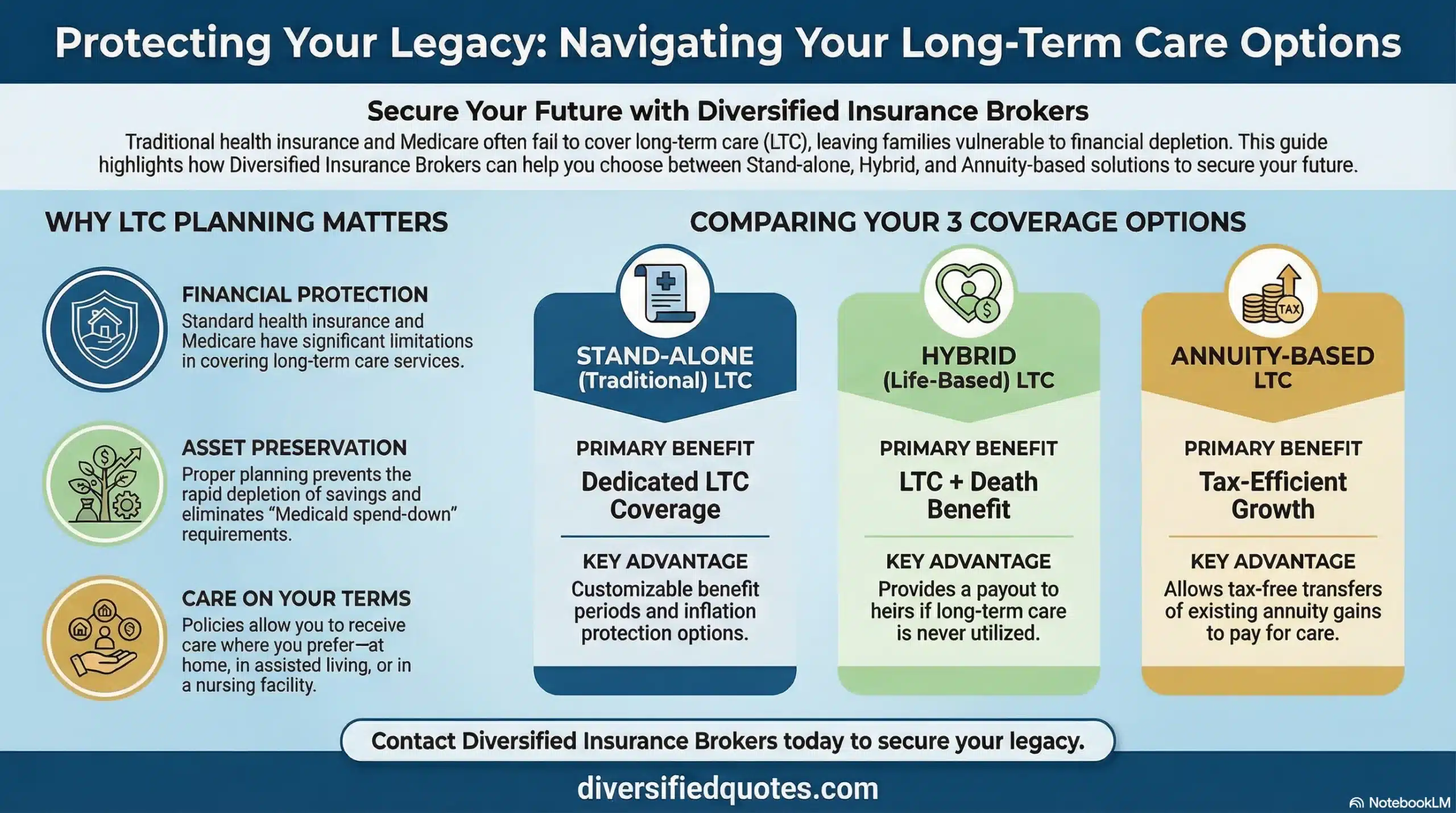
We’ll compare carriers and explain your best path — traditional LTC vs. hybrid life/LTC vs. annuity with LTC benefits.
Why Long-Term Care Planning Matters for Diabetics
Diabetes is associated with medical complications that can increase the probability of needing long-term care assistance earlier in life than the general population. Peripheral neuropathy affecting balance and walking, circulation impairments that limit mobility, vision changes including diabetic retinopathy that impacts daily safety and independence, nephropathy that can lead to fatigue and functional decline, and cardiovascular events that may require ongoing assistance are all complications that underwriters weight when evaluating diabetic applicants. Not every person with diabetes will experience these outcomes — many diabetics remain active and independent for decades. But long-term care insurers evaluate probability rather than certainty, and the statistical relationship between diabetes and long-term care need is well-documented enough to inform every carrier’s underwriting guidelines.
Long-term care insurance is specifically designed to pay for the care that traditional health insurance and Medicare do not cover in a meaningful way. Medicare does not cover extended long-term custodial care — the ongoing help with bathing, dressing, meal preparation, transferring, and supervision that represents the bulk of what families actually need to fund over a multi-year care situation. Medicare and long-term care insurance are not the same, and the gap between what Medicare covers and what a prolonged care situation actually costs is among the largest unprotected financial risks in most retirement plans. For diabetics, who face a statistically elevated probability of needing assistance, understanding and closing that gap proactively — before complications develop and underwriting options narrow — is especially important. Whether long-term care insurance is worth it addresses the financial case for coverage in terms most families find directly relevant to their planning decisions.
The timing dimension is critical. Applying while diabetes is stable and complications are minimal results in better approval odds, more comprehensive benefit options, stronger inflation protection choices, and more affordable premiums. Waiting until complications develop or until age advances into the range where carriers become more selective narrows the available options and typically increases cost. This is why the most effective long-term care planning for diabetics is done proactively — often well before care is anticipated — rather than reactively after the need becomes urgent. Who qualifies for long-term care insurance covers the underwriting standards across common health conditions and explains how functional independence and stability are evaluated across the full range of health histories carriers encounter.
How Long-Term Care Underwriting Actually Evaluates Diabetes
Long-term care insurance underwriting is primarily focused on functional risk rather than diagnostic labels. Underwriters want to understand whether a medical condition increases the likelihood of needing help with activities of daily living within a foreseeable timeframe, and whether there are patterns in the current health record that suggest independence is already declining. For diabetic applicants, underwriting is less about the word “diabetes” and more about what the diabetes is doing — or not doing — to the body over time and how the medical management has responded to that trajectory.
When reviewing diabetic applicants, underwriters typically evaluate time since diagnosis, trend in A1C levels over the most recent years (rather than a single snapshot), medication history and escalation pattern, frequency and quality of physician follow-up, and whether complications are present or absent. They also consider overall build and BMI, blood pressure control, lipid management, and cardiovascular history because diabetes frequently interacts with these risk factors in ways that compound functional risk more than any single factor in isolation. Underwriters look for patterns: stable medical management, consistent specialist follow-up, and a record of compliance with treatment recommendations. One isolated excellent lab value rarely tells the whole story — consistency and direction of trend matter more than any single number.
The functional trigger framework that underwriters are ultimately predicting is the same framework that determines when benefits begin. Most long-term care policies pay benefits when an insured cannot perform a defined number of activities of daily living or when cognitive impairment requires substantial supervision for safety. What activities of daily living are and how insurers use them as both underwriting and claim criteria helps diabetic applicants understand what carriers are actually trying to predict when they evaluate a diabetic profile — which makes the underwriting conversation much more productive. LTC care coordination benefits covers how professional care management at claim time helps families navigate benefit triggers and documentation requirements efficiently when benefits are eventually needed.
Type 2 Diabetes: Underwriting Outcomes and What Drives Them
Type 2 diabetes is often more insurable than most applicants expect, particularly when it is managed with oral medications or lifestyle measures and there are no meaningful complications present in the health record. Applicants with stable A1C trends — typically below 8.0 and ideally below 7.5, with documentation of consistent values over the most recent two to three years — consistent medical follow-up, and no functional impairments frequently qualify for long-term care coverage. The underwriter’s core question is whether the condition appears controlled, the treatment approach has been stable, and the applicant shows no patterns that suggest accelerating complication development or near-term functional decline.
Insulin use does not automatically produce a decline in Type 2 diabetes cases. Many carriers will consider insulin-managed Type 2 diabetes when control is stable and documented, follow-up with a treating physician is consistent, and complications are absent or minimal and stable. Underwriters typically review whether insulin usage has been a stable part of the management regimen, whether it was introduced in response to progression or was the initial management approach, and whether insulin has successfully improved glycemic control or whether control remains inconsistent despite treatment escalation. The presence of multiple compounding risk factors — significant cardiovascular history, uncontrolled blood pressure, severe obesity measured against carrier build tables, or mobility limitations from other causes — can shift underwriting outcomes materially, but many insulin-treated Type 2 applicants remain insurable with targeted carrier selection. Long-term care insurance with pre-existing conditions covers how multiple interacting health factors are evaluated together rather than in isolation, which is the reality of how underwriters approach complex profiles.
Type 1 Diabetes: More Conservative Underwriting, Not Impossible
Type 1 diabetes is underwritten more conservatively across the carrier market because it is a lifelong autoimmune condition that has required insulin therapy from the outset rather than as a progression response. That conservative approach does not mean approval is impossible — many Type 1 diabetics are healthy, physically active, and metabolically stable for decades, and carriers with experience evaluating Type 1 profiles recognize that the diagnosis label tells a different story than the clinical reality in well-managed cases. For Type 1 applicants, carriers focus heavily on long-term stability documentation, consistent endocrinology follow-up, absence of hospitalizations or serious hypoglycemic events, and the absence or early staging of complications that are most predictive of future functional limitation.
Complications reviewed most carefully in Type 1 cases include peripheral neuropathy affecting balance and sensation, nephropathy progression and current kidney function metrics, diabetic retinopathy staging and current vision function, and cardiovascular history given the elevated cardiovascular risk associated with long-duration Type 1 diabetes. Underwriters assess severity, treatment response, and real-world functional impact rather than simply noting the presence of a complication. Two Type 1 applicants can share the same diagnosis and even the same complication on paper but receive different underwriting outcomes because of differences in functional impact, trend direction, and management response.
In Type 1 cases specifically, the carrier selection step is even more consequential than in Type 2 cases because the variance in carrier appetite for well-managed Type 1 profiles is substantial. Targeting the carriers most likely to evaluate the profile fairly — before any formal applications create MIB records — is the approach that consistently produces better outcomes than broad application to multiple carriers simultaneously.
Complications That Matter Most to Underwriters
| Complication | Why Underwriters Weight It | Favorable Presentation | Concerning Presentation |
|---|---|---|---|
| Peripheral neuropathy | Directly affects balance, walking, and fall risk — predictors of near-term functional limitation | Mild, stable, no gait or balance impact documented; no falls history | Progressive, documented balance impairment, fall history, gait aids required |
| Nephropathy / CKD | Progressing kidney disease predicts fatigue, treatment burden, and eventual dialysis dependence | Stable eGFR above 45 over multiple readings; no dialysis history; consistent nephrology follow-up | Declining eGFR trend, advanced CKD staging, history of dialysis, frequent hospitalizations |
| Retinopathy / vision impairment | Vision loss affects daily safety, driving, medication management, and independent living capacity | Mild background retinopathy, corrected vision adequate for daily activities, stable ophthalmology | Proliferative retinopathy, significant vision loss, history of laser treatment for active disease |
| Cardiovascular disease | Diabetes + cardiovascular disease compounds mortality and functional limitation risk significantly | No cardiovascular history; or treated, stable, remote history with normal function | Recent MI, CHF history, multiple stents, arrhythmia requiring ongoing intervention |
| Stroke / TIA history | Prior stroke or TIA signals elevated recurrence risk and potential functional and cognitive impact | Remote history, full functional recovery, no residual deficits, stable imaging | Recent event, residual cognitive or functional deficits, multiple episodes, ongoing anticoagulation for AF |
| Amputation | Indicates severe peripheral vascular disease and significantly elevated functional limitation risk | Minor toe amputation with full rehabilitation and no ongoing circulation complications | Below-knee or above-knee amputation; multiple amputations; ongoing wound or circulation management |
Policy Design Considerations for Diabetic Applicants
Applying earlier generally results in better options across all design dimensions. If diabetes is stable and complications are minimal, the applicant may have access to stronger benefit amounts, competitive inflation protection choices, and more flexible elimination period and benefit duration structures. Once approved, building the right policy becomes as important as achieving eligibility. Benefit amounts, elimination periods, benefit durations, and inflation protection together determine how useful the policy will actually be when care is eventually needed. A policy that looks affordable today but does not keep pace with future care costs leaves a gap that is discovered at the worst possible time. The comparison of limited-term versus lifetime LTC benefits covers how to evaluate benefit duration against the risk profile — an especially relevant comparison for diabetics who may face elevated long-duration care risk.
Many diabetic applicants prioritize affordability and simplicity while balancing other retirement costs. Others prioritize stronger inflation protection because long-term care costs have consistently risen at 3–4% annually over recent decades and a benefit adequate for today’s care costs may be insufficient in 15 or 20 years. The right design depends on age, total retirement assets, household income, how much risk the household wants to self-insure through savings, and what premium level the household can sustain indefinitely without strain. Long-term care insurance with return of premium covers how policies that preserve premium value if care is never needed work and whether those structures fit certain planning goals. How to find, evaluate, and apply for long-term care insurance walks through the full analytical process from needs assessment through carrier selection and application strategy. For applicants approaching the upper end of the traditional LTC underwriting window, whether you can still get LTC insurance after age 60 and long-term care insurance after age 80 cover what remains available as the planning window shortens and health history accumulates.
Traditional LTC vs. Hybrid Options for Diabetics
Traditional long-term care insurance provides maximum leverage when the applicant can qualify on reasonable underwriting terms: premiums paid over time create access to a benefit pool that can pay for care worth multiples of total premium investment, depending on benefit levels and duration. For diabetics who can qualify with favorable classification, traditional LTC can be a highly efficient asset protection tool. The psychological trade-off is that if care is never needed, premiums do not create residual value unless the policy includes specific return-of-premium provisions. Long-term care planning strategies covers the full range of approaches and how they interact with different asset profiles and planning goals.
Hybrid life and LTC policies combine long-term care benefits with a life insurance component, creating a “either way it pays” structure — a death benefit if care is never needed, or LTC benefits accelerated from the death benefit if qualifying care needs arise. Hybrid designs can be appealing to diabetic applicants who want the psychological security of retained value regardless of whether benefits are ever triggered. Hybrid life insurance with long-term care benefits covers how the LTC component of these products works in practice, and understanding hybrid long-term care insurance explains the mechanics in depth for applicants evaluating this structure. Hybrid products have their own underwriting requirements that differ from traditional LTC policies, and for some diabetic profiles, hybrid underwriting may be more or less accessible than traditional LTC underwriting depending on the specific carrier and product.
Annuities with long-term care benefits offer a repositioning approach for diabetics who have existing low-yield assets and want to create a defined care funding pool without an ongoing premium stream. Annuities with long-term care benefits and fixed annuities with long-term care benefits cover how these structures work for applicants whose medical profile may limit traditional LTC options but who still want meaningful LTC leverage from existing assets. For diabetic applicants whose health history makes standard underwriting unlikely across all structures, guaranteed issue long-term care insurance covers the options that remain available when standard underwriting pathways are not accessible. Getting a second opinion on a long-term care insurance quote is the most direct way to confirm whether an offer already received represents the best available in the full carrier market for a specific diabetic profile.
The right strategy for any specific diabetic applicant is the one they can qualify for, afford sustainably, and comfortably keep in force through the years before care is needed. An underwriting-first review is designed to clarify which path that is before any applications are submitted. As a practical note, if you plan to use long-term care benefits overseas, specific policy provisions and carrier rules govern how international care is handled, and those details are worth understanding before selecting a policy if international use is part of your anticipated care plan.
Not sure if you’ll qualify with diabetes?
A diabetes-focused review can clarify eligibility, carrier fit, and realistic coverage paths before you apply.
Related Pages
Explore these next if you’re comparing eligibility, benefits, tax angles, and hybrid long-term care strategies.
Financial Protection Essentials
Retirement income and protection tools that often coordinate with LTC planning for diabetics.
Talk With an Advisor Today
Choose how you’d like to connect—call or message us, then book a time that works for you.
Schedule here:
calendly.com/jason-dibcompanies/diversified-quotes
Licensed in all 50 states • Fiduciary, family-owned since 1980
Frequently Asked Questions: Long-Term Care Insurance for Diabetics
Can diabetics get long-term care insurance?
Yes — many diabetics can qualify for long-term care insurance, though the underwriting outcome depends on the type of diabetes, current control, medication management, complication status, and the specific carrier selected. Type 2 diabetes managed with oral medications or stable insulin therapy and no significant complications often qualifies on reasonable terms at carriers whose underwriting guidelines reflect a nuanced evaluation of diabetic profiles. Type 1 diabetes is underwritten more conservatively but can still be approved when the condition is well-managed, endocrinology follow-up is consistent, and complications are absent or early-stage and stable. The key is carrier selection — underwriting standards vary meaningfully across companies, and an underwriting-first approach that matches the specific profile to the most receptive carrier before any applications are submitted consistently produces better outcomes than broad application without pre-screening.
Does insulin use automatically disqualify me from LTC insurance?
No — insulin use does not automatically disqualify an applicant from long-term care insurance. Many carriers will consider both Type 2 and Type 1 diabetics on insulin when glycemic control is stable and documented over multiple A1C readings, physician follow-up is consistent, and complications are absent or minimal and stable. Underwriters evaluate insulin use in context: whether it has been part of a stable management regimen, whether it successfully achieved control, and whether control is maintained consistently are all more important than the presence of insulin itself. The compounding factors that create the most underwriting concern alongside insulin use are cardiovascular history, uncontrolled blood pressure, obesity against build tables, and functional limitations from complications — not insulin treatment as a standalone factor.
Which diabetic complications most affect LTC insurance underwriting?
The complications that carry the most weight in LTC underwriting are those that directly affect functional independence: peripheral neuropathy affecting balance, walking, or sensation; nephropathy with progressing kidney function decline; retinopathy producing significant vision impairment; cardiovascular disease including coronary artery disease and congestive heart failure; stroke or TIA history; and peripheral vascular disease severe enough to require amputation. Each is weighted in the context of severity, progression trend, treatment response, and real-world functional impact rather than simply the presence of the diagnosis. Early-stage, stable, well-managed complications without functional impact are evaluated very differently from progressive complications with documented functional limitations, even when the named complication is the same in both cases.
When is the best time for a diabetic to apply for LTC insurance?
Earlier is almost always better for diabetic applicants. Applying while diabetes is stable, A1C trends are favorable, complications are absent or minimal, and overall health is strongest produces the widest range of carrier options, the most favorable underwriting classifications, and the most cost-efficient premium structures. Once complications develop, underwriting options narrow and premiums for equivalent coverage increase. Waiting until health deteriorates further can eliminate eligibility entirely for traditional LTC insurance, leaving hybrid and annuity-based structures as the only remaining options — which have their own eligibility requirements. The most effective long-term care planning for diabetics is proactive, often pursued well before care is anticipated rather than reactively after the need becomes urgent or health history has accumulated in ways that limit carrier options.
What if I can’t qualify for traditional LTC insurance due to diabetes?
If standard LTC underwriting is not accessible, several alternative structures may still provide meaningful long-term care protection. Hybrid life and LTC policies have their own underwriting requirements that sometimes accommodate profiles that standard LTC policies decline. Annuities with long-term care benefits can reposition existing low-yield assets to create a care funding pool with underwriting requirements that differ from traditional LTC. Guaranteed issue long-term care insurance options exist for situations where standard underwriting is completely inaccessible, typically with benefit structures calibrated for that risk profile. Reviewing all available paths before accepting that coverage is not available — and specifically getting a second opinion if a decline or unfavorable offer has already been received — is the most reliable way to identify which options remain realistically available for a specific diabetic profile at the current point in time.
About the Author:
Jason Stolz, CLTC, CRPC, DIA, CAA and Chief Underwriter at Diversified Insurance Brokers (NPN 20471358), is a senior insurance and retirement professional with more than 25 years of real-world experience helping individuals, families, and business owners protect their income, assets, and long-term financial stability. As a long-time partner of the nationally licensed independent agency Diversified Insurance Brokers, Jason provides trusted guidance across multiple specialties—including fixed and indexed annuities, long-term care planning, personal and business disability insurance, life insurance solutions, Group Health, Travel Medical and Evacuation Insurance, and short-term health coverage. Diversified Insurance Brokers maintains active contracts with over 100 highly rated insurance carriers, ensuring clients have access to a broad and competitive marketplace.
His practical, education-first approach has earned recognition in publications such as VoyageATL, and contributions from his agency featured in Kiplinger and GoBankingRates— highlighting his commitment to financial clarity and client-focused planning. Drawing on deep product knowledge and years of hands-on field experience, Jason helps clients evaluate carriers, compare strategies, and build retirement and protection plans that are both secure and cost-efficient. Visitors who want to explore current annuity rates and compare options across multiple insurers can also use this annuity quote and comparison tool.
Explore More Long Term Care Insurance Options: Browse our complete guide to Tax, Medicare & Special Situations — covering tax advantages, Medicare vs LTC, seniors, couples, diabetics & age-specific coverage from top carriers.
Last Reviewed: June 15, 2026 |
Reviewed by: Jason Stolz, CLTC, CRPC, DIA, CAA
Chief Underwriter, Diversified Insurance Brokers, Inc. | NPN: 20471358 | Diversified Insurance Brokers, Inc. — Licensed in all 50 states
Fact Checked by: Tonia Pettitt, CMIP©
Medicare Specialist, Diversified Insurance Brokers, Inc. | NPN: 14374308 | Diversified Insurance Brokers, Inc. — Licensed in all 50 states
Did you find this content helpful? Leave us a Google review — it helps others find trustworthy guidance too.
Editorial Standards: Diversified Insurance Brokers maintains rigorous editorial standards to ensure accuracy, clarity, and independence in all content. Learn more about our editorial standards and commitment to transparency.
