
How to Qualify for Long-Term Care Insurance
As an Independent Long Term Care Insurance Broker, we compare traditional, hybrid, and partnership-qualified policies across dozens of carriers to find the structure that actually fits your situation.
How to Qualify for Long-Term Care Insurance

Jason Stolz CLTC, CRPC, DIA, CAA
Qualifying for long-term care insurance comes down to one central question underwriters are trying to answer: how likely are you to need care in the near term, and does your current health, function, and cognitive status suggest you are a stable long-term risk? That question is more nuanced than most applicants expect. LTC underwriting is not primarily a diagnosis checklist. It is a functional health assessment that evaluates age, medical history, medication patterns, mobility and balance, cognitive status, independence with daily activities, and whether the overall profile suggests stability or early decline. Two people with identical diagnoses can receive different underwriting decisions because one is stable, active, and fully independent while the other has frequent complications, fall history, or cognitive concerns that suggest a near-term claim is more likely. Understanding how underwriters think about each of these dimensions — and how to position your application for the best possible outcome — is the difference between a successful application and an avoidable decline.
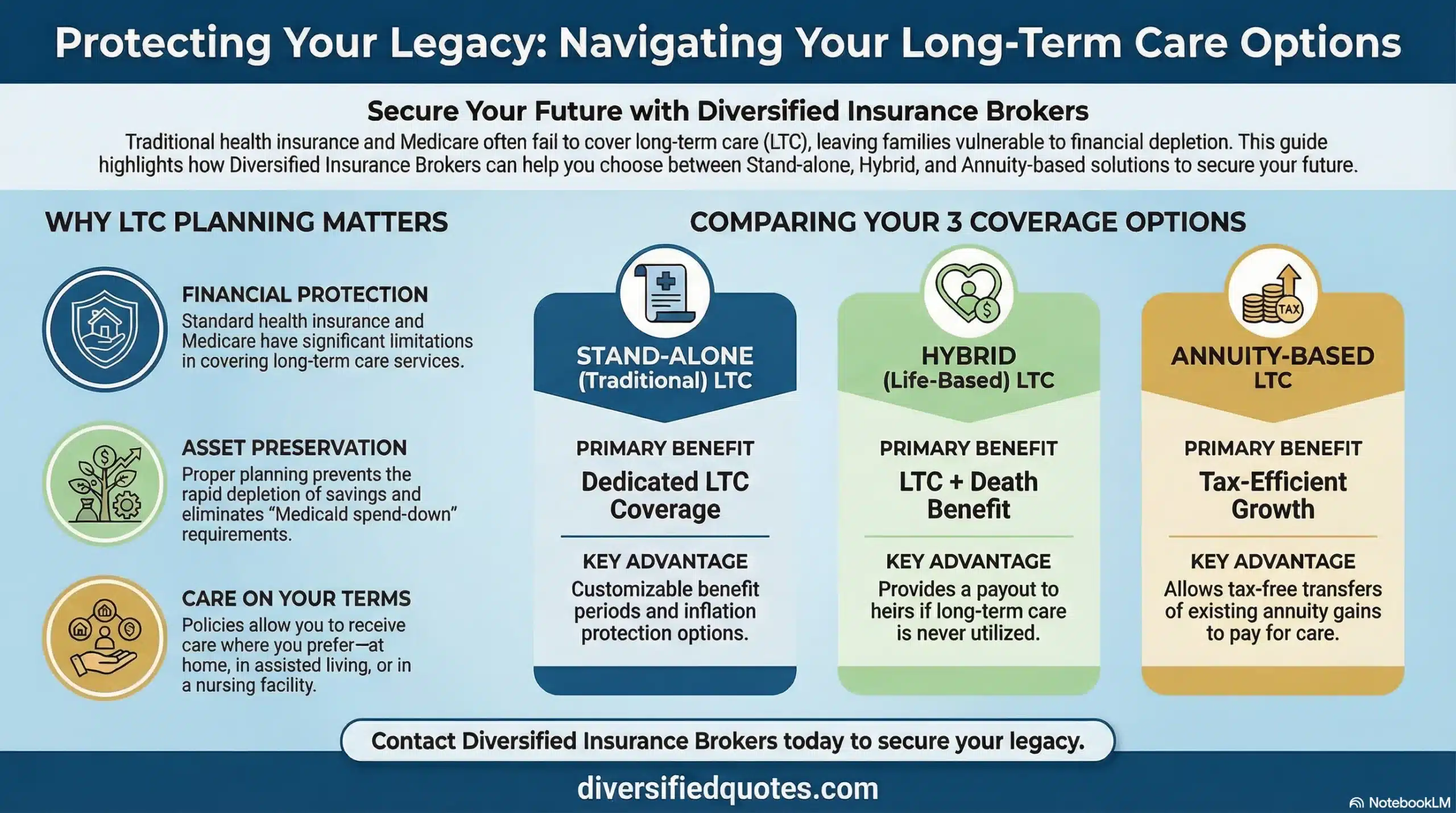
The most important structural insight for anyone beginning the LTC planning process is that traditional LTC insurance, hybrid life/LTC policies, and annuities with LTC benefits are underwritten differently. An applicant who cannot qualify for traditional LTC may qualify for a hybrid policy because hybrid underwriting follows life insurance logic rather than standalone care claim logic. An applicant who cannot qualify for either traditional or hybrid coverage may still access meaningful LTC protection through an annuity-based strategy that uses simplified underwriting and asset repositioning rather than health underwriting as the primary gate. One decline does not mean you are uninsurable for long-term care protection — it means the product type or the timing needs to change. Our resource on how to buy long-term care insurance covers the full product landscape before underwriting begins, and our resource on hybrid life vs traditional long-term care insurance covers the structural comparison that determines which underwriting path is most appropriate for a given applicant profile.
At Diversified Insurance Brokers, Jason Stolz, CLTC, CRPC, DIA, CAA, takes a carrier-neutral approach to LTC qualification. Underwriting appetites vary significantly across carriers — a profile that one carrier declines may be approved by another at the same premium class, or approved at a rated premium that still provides meaningful protection. The goal is not to find any policy that will issue. The goal is to match your health profile to the carrier and product type most likely to produce an approval at a premium level that is sustainable for the duration of your retirement. For applicants who want to understand the full range of options before beginning the underwriting process, our resource on how to find, evaluate, and apply for long-term care insurance provides that end-to-end framework.
Check Your Eligibility and Options
We’ll compare carriers and outline your best path: traditional LTC, hybrid life/LTC, or annuity with LTC benefits.
Request an LTC Eligibility Review
Questions? Call 800-533-5969
What LTC Underwriters Evaluate — The Six Core Dimensions
| Dimension | What Carriers Are Evaluating | What Helps vs What Raises Concern |
|---|---|---|
| Age and Timing | How many premium-collecting years the carrier expects before a likely claim; how sensitive the underwriting will be to minor health variations | Mid-50s to early 60s is typically the strongest window for traditional LTC approval and pricing; later applicants can still qualify but underwriting tolerance for mobility, medication complexity, and cognitive changes narrows; recent surgery, hospitalization, or new diagnosis in the last 6–12 months triggers a wait-for-stability preference |
| Medical History | Which conditions are present, how controlled and stable they are, and whether they predict functional decline; underwriting theme is stability, not absence of conditions | Helps: controlled hypertension, stable cholesterol, well-managed thyroid, mild arthritis not impairing walking, resolved cancers with ongoing follow-up, treated sleep apnea. Raises concern: progressive neurological conditions, recent stroke with deficits, uncontrolled diabetes with complications, frequent hospitalizations, significant fall history |
| Medication History | What medications suggest about severity, stability, and complexity — not just what is listed but what the pattern implies about the underlying conditions | Helps: consistent medication list that matches disclosed conditions, stable dosages, regular follow-up. Raises concern: multiple medications for the same condition (suggesting difficult-to-control issue), frequent medication changes, pain management medications suggesting chronic pain or fall risk |
| Function and Mobility | Current independence with activities of daily living (ADLs) and instrumental ADLs; fall history; use of assistive devices; whether the applicant walks safely and handles daily tasks without support | Helps: full independence in ADLs, no fall history, stable and active lifestyle. Raises concern: fall history even with mild medical conditions (falls predict frailty and future claim risk), assistive device use without demonstrated stable function, limitations with ADLs or IADLs, recovery from recent surgery with unclear functional outcome |
| Cognition | Cognitive status is one of the strongest predictors of LTC claims, especially memory care; most carriers include a phone interview with a brief cognitive screen; documented cognitive impairment in the medical record is typically disqualifying for traditional LTC | Helps: clear and consistent cognitive function during the phone interview; no cognitive concerns in physician notes. Raises concern: documented cognitive impairment, any pattern of cognitive concerns in the medical record, or a phone interview that suggests significant memory issues even without a formal diagnosis |
| Financial Suitability | Whether the premium is sustainable relative to income and assets; LTC is a long-duration product and carriers and regulators require that the benefit design is appropriately sized for the applicant’s financial situation | Helps: benefit design calibrated to cover the catastrophic risk at a premium that is a reasonable percentage of income. Raises concern: applying for maximum benefits at a premium that appears likely to strain the budget; better approach is often to insure the catastrophic risk and plan to self-fund the initial phase of care |
Traditional LTC vs Hybrid vs Annuity-Based — Three Different Underwriting Paths
The most consequential decision in LTC qualification is not which carrier to apply to — it is which product type to apply for. Traditional LTC insurance, hybrid life/LTC policies, and annuities with LTC benefits are underwritten through fundamentally different logic, and matching the product type to the applicant’s health profile is the difference between a successful outcome and a series of avoidable declines.
Traditional LTC insurance is underwritten strictly because the carrier is bearing standalone care claim risk with no offsetting death benefit or asset structure. The carrier is betting that you will be a long-duration premium payer who does not claim for many years — and the underwriting scrutiny reflects that asymmetric risk. Traditional LTC offers the most design flexibility: monthly benefit amounts, benefit periods from two years to lifetime, inflation protection options, elimination periods, and couples designs including shared benefit pools. Our resource on long-term care insurance with shared spousal benefits covers how shared pools work for couples, and our resource on limited-term benefits vs lifetime benefits covers the benefit period decision. For applicants over 60, our resource on whether you can still get LTC insurance after age 60 covers how the traditional underwriting window narrows with age.
Hybrid life/LTC policies follow life insurance underwriting logic rather than standalone care claim logic, which can be more forgiving in certain health profiles — particularly for applicants who are stable and functional but have a medical history that makes traditional LTC more difficult. The hybrid structure also addresses the most common objection to traditional LTC: if you never need care, traditional premiums provide no return. A hybrid policy builds in a death benefit so the policy delivers value either way — as LTC protection if care is needed, or as a life insurance benefit to heirs if it is not. Our resource on hybrid life insurance with long-term care benefits covers how these products are structured, and our resource on understanding hybrid long-term care insurance covers how the benefits activate and what to look for in the LTC rider terms. For applicants evaluating specific hybrid carriers, our resource on John Hancock Life Care hybrid life and LTC covers one of the major products in this category.
Annuities with LTC benefits are typically designed for asset repositioning — taking existing non-qualified savings and repositioning them into a structure that provides both a guaranteed income or accumulation component and a leveraged LTC benefit pool. Underwriting for annuity-based LTC is generally simpler than either traditional or hybrid life underwriting, making it accessible to applicants who have been declined elsewhere. For applicants with non-qualified savings who want to evaluate this path, our resources on annuity with long-term care benefits and fixed annuity with long-term care benefits cover how those structures work and what the LTC benefit leverage typically looks like. Our resource on non-qualified long-term care annuity covers the tax treatment considerations that are especially relevant for non-qualified assets repositioned into an LTC annuity structure.
The Underwriting Process — Step by Step
Most LTC applicants encounter underwriting as a sequence of steps that feels opaque until you understand what each step is designed to evaluate. Knowing what is coming — and preparing for each step — reduces the chance of an avoidable decline and makes the process significantly less stressful.
The process begins with the application and health questionnaire, which collects detailed medical history, prior surgeries, hospitalizations, current medications with dosages, and functional independence questions. The functional questions are where many applicants are underprepared — whether you need help with bathing, dressing, cooking, shopping, managing finances, or transportation matters as much to the underwriter as the diagnosis list. Answering accurately and consistently is essential because the medical records and prescription database check will be compared against what the application discloses.
The phone interview and cognitive screen is the step that surprises applicants most. Most carriers schedule a 15-to-30-minute interview that evaluates lifestyle, functional independence, and cognition. The cognitive component may include simple recall tasks, attention tasks, and orientation questions. The applicant should schedule this interview at a time when they are rested, focused, and in a quiet environment. Hearing quality matters — if hearing is a challenge, use a device that ensures clear audio so questions are not misheard or answers appear uncertain. Cognitive impairment that is already documented in the medical record is typically disqualifying for traditional LTC regardless of interview performance, which is why applicants with known cognitive concerns should evaluate whether a hybrid or annuity-based path is more realistic before submitting a traditional application.
Prescription database checks run early in the process and compare what the application discloses against actual prescription patterns. The carrier is looking for consistency — medications should align with disclosed conditions and should not suggest instability through frequent changes, escalating doses, or pain management patterns that imply chronic pain or fall risk. If there were recent medication changes, preparing a clear explanation with supporting follow-up documentation that shows the condition is now stable can prevent a concern from becoming a decline. Medical records may be requested if the applicant has a complex history, recent specialist care, or a hospitalization. When medical records show a pattern of stable follow-up and controlled conditions, they often turn a borderline case into an approval rather than a decline. The final decision typically includes: approved as applied, approved with a rating (higher premium for higher risk), approved with modified benefits, postponed pending stability, or declined. A postponement is not a permanent decline — it is an invitation to reapply after the medical record demonstrates the stability the carrier needs. Our resource on whether LTC insurance requires a medical exam covers what each carrier type requires during this process.
Conditions That Help, Conditions That Are Case-by-Case, and Conditions That Create Barriers
Underwriters evaluate conditions in terms of stability and functional implication rather than diagnosis alone. The same diagnosis can be acceptable or disqualifying depending on how controlled it is, how long it has been stable, what medications are being used to manage it, and whether there are any associated functional limitations. Understanding how underwriters categorize common conditions helps applicants set realistic expectations before investing time in the application process.
Conditions that are commonly favorable when well controlled include: controlled hypertension and cholesterol with no cardiac complications, stable thyroid conditions, mild orthopedic history that does not impair walking or daily function, successfully treated cancers with appropriate follow-up and no current recurrence, treated sleep apnea with documented compliance, stable mental health conditions on consistent medication, and many other well-managed chronic conditions where the medical record shows regular follow-up, stable dosing, and no pattern of complications. The common thread: the record shows that the condition is being actively managed and is not progressing.
Conditions that are typically evaluated case-by-case include: cardiac events with good documented recovery and stable follow-up, controlled diabetes without complications or significant neuropathy, obesity where build is paired with stable function and no complicating conditions, mild musculoskeletal issues with physical therapy documentation showing improvement, and mental health histories with long periods of stability. These cases often depend on how much time has passed since the acute event, what the follow-up record shows, and whether the medical history as a whole suggests stability rather than ongoing risk.
Conditions that typically create significant barriers to traditional LTC qualification include: progressive neurological conditions, significant stroke with functional deficits, repeated fall history, moderate to severe cognitive impairment whether diagnosed or suggested by interview, uncontrolled diabetes with complications including peripheral neuropathy or vision impairment, advanced chronic obstructive pulmonary disease, significant chronic pain that limits mobility, and active cancer under treatment. These profiles may still have access to LTC protection through hybrid or annuity-based paths — our resource on long-term care insurance with pre-existing conditions covers the options available when traditional underwriting is likely to be difficult, and our resource on guaranteed issue long-term care insurance covers the limited-underwriting alternatives that exist for applicants who cannot qualify through standard underwriting at all.
How to Improve Your Approval Odds Before You Apply
LTC underwriting rewards preparation more than most insurance categories, because the functional and stability factors that underwriters evaluate can often be strengthened in the months before an application. The following practical steps can meaningfully improve the outcome for borderline profiles — and can reduce the risk of an avoidable decline for stronger profiles.
Apply earlier if possible. The mid-50s to early-60s window is typically the strongest combination of pricing and underwriting tolerance. Waiting adds cost and narrows the margin for minor health variations that become more significant with age. If LTC planning is already on your radar and you are in this age window, the cost of delay is real. Our resource on should you buy long-term care insurance covers the planning case for acting during the optimal window.
Stabilize your health before applying. If you recently changed medications, had a procedure, received a new diagnosis, or were hospitalized, waiting until follow-up is complete and the medical record clearly shows stability is usually smarter than applying immediately and triggering a preventable decline or postponement. Carriers want to see that the situation has resolved and that the applicant is back to baseline. Six to twelve months of clean follow-up after a significant health event can change an underwriting outcome materially.
Know your medication list inside and out. Underwriters see your prescription database before the medical records arrive. Inconsistencies between your application answers and your actual prescription history create concerns. If you have had medication changes, be prepared to explain the reason and provide documentation that the change resolved the issue. Multiple medications for the same condition, escalating dosing, or frequent changes should be accompanied by physician notes that confirm the condition is now well controlled.
Take the phone interview seriously. Schedule it for a morning when you are rested, in a quiet room, using a phone or device where you can hear the interviewer clearly. The cognitive screen component is not difficult for someone with intact cognition — but it becomes a problem if the applicant is fatigued, distracted, has hearing difficulty, or is rushed. For older applicants, this step deserves specific preparation and focus.
Shop multiple carriers. The same health profile receives different underwriting responses across carriers. One carrier’s decline is not a universal market answer. An independent broker with active contracts across multiple LTC carriers can present the profile to the carriers most likely to provide a favorable response, rather than defaulting to the first carrier that responds with a proposal. Our resource on how to get the best long-term care insurance rates covers the multi-carrier comparison process, and our resource on best independent long-term care insurance broker covers what to look for when choosing the advisor who handles this comparison.
Find the Most Approvable Design for Your Profile
We model multiple benefit levels, elimination periods, and product types to improve approval odds without overpaying.
Questions? Call 800-533-5969
Design Choices That Affect Both Eligibility and Long-Term Sustainability
LTC qualification is not only about being approved — it is about building a benefit design that is both obtainable and sustainable over a retirement that could last 20 to 30 years. Many applicants can qualify for a benefit level that is financially impractical to maintain. That is not a success. It is better to design a plan that fits the household budget, aligns with the actual risk the family is trying to protect against, and remains affordable even if the carrier requests a rate increase in the future.
The monthly benefit and benefit period together determine the scope of coverage and the premium. Higher monthly benefits and longer benefit periods — including lifetime benefit periods — increase both premium and underwriting scrutiny. For older applicants or those with more complex health profiles, choosing a shorter benefit period with a meaningful monthly benefit can produce an approval that a maximum-benefit design would not. Our resource on what a long-term care insurance benefit period is covers how benefit periods work and what the research says about average care duration. Our resource on limited-term benefits vs lifetime benefits covers the tradeoff in depth.
The elimination period — the waiting period before benefits begin — directly affects premium and can also improve financial suitability. A 90-day elimination period is the standard for most traditional LTC policies, but longer elimination periods reduce premium and signal that the applicant is willing to self-fund the initial phase of care. This is particularly appropriate for applicants who have sufficient liquid savings to cover several months of care costs before the insurance begins paying. Inflation protection decisions — whether to include a compound inflation rider and at what percentage — are most important for younger buyers, where the future cost of care will be significantly higher than today’s costs. For buyers in their late 60s or 70s, the cost of inflation protection can outweigh its benefit depending on the planning horizon. Our resource on LTC elimination periods explained covers how to evaluate the right elimination period for your specific situation. For couples, shared benefit pools — where both spouses draw from a combined benefit reserve — can provide significantly more efficiency than independent benefit stacks and can reduce the total premium while increasing the combined benefit available. Our resource on long-term care insurance with shared spousal benefits covers how these designs work.
For households evaluating whether the tax advantages of LTC insurance change the cost equation, our resource on tax advantages of long-term care insurance covers the qualified LTC expense deductibility rules and how partnership-qualified policies interact with Medicaid planning. Our resource on partnership-qualified long-term care insurance covers the asset protection benefit that partnership policies provide in states with reciprocity agreements. And for households that want an independent review of any LTC proposal before committing, our resource on getting a second opinion on your long-term care insurance quote covers that validation process.
Talk With an Advisor Today to learn how to Qualify for Long-Term Care Insurance
Choose how you’d like to connect—call or message us, then book a time that works for you.
Schedule here:
calendly.com/jason-dibcompanies/diversified-quotes
Licensed in all 50 states • Fiduciary, family-owned since 1980
Frequently Asked Questions: How to Qualify for Long-Term Care Insurance
What health conditions automatically disqualify me from long-term care insurance?
No single condition “automatically” disqualifies every applicant from every LTC product — because the product type matters as much as the condition. For traditional LTC insurance, the most common disqualifying profiles include: progressive neurological conditions such as Parkinson’s or ALS, recent stroke with documented functional deficits, moderate to severe cognitive impairment (whether formally diagnosed or indicated by the phone interview), significant repeated fall history, uncontrolled diabetes with complications, and active cancer under current treatment. However, applicants who cannot qualify for traditional LTC may still qualify for a hybrid life/LTC policy through life insurance underwriting, or for an annuity-based LTC strategy through simplified or asset-based underwriting. A decline from one carrier on one product type is not the end of the LTC planning conversation — it is a signal to evaluate a different product path. Our resources on LTC insurance with pre-existing conditions and guaranteed issue long-term care insurance cover the options available when standard underwriting is unlikely to succeed.
What is the best age to apply for long-term care insurance?
For traditional LTC insurance, the mid-50s to early-60s window provides the best combination of pricing, underwriting approval odds, and meaningful benefit period options. At these ages, most applicants are healthy enough to pass full underwriting, premiums are lower because the carrier has more years before a likely claim, and the benefit period options are most favorable. Waiting until 65 or 70 is common but adds cost and narrows the margin for the minor health variations that become more significant with age — a fall, a medication change, or a new diagnosis can shift a borderline profile into a decline that would have been approved five years earlier. That said, applicants in their late 60s and 70s can still qualify for traditional LTC with the right profile, and hybrid and annuity-based options have wider age eligibility. Our resource on whether you can still get LTC insurance after age 60 covers what the market offers for applicants past the optimal traditional window.
I was declined for long-term care insurance. Do I have any options?
Yes — a traditional LTC decline does not mean all LTC protection options are closed. The most important next step is understanding why the decline occurred and which alternative product paths are still available for your specific health profile. If the decline was from a traditional LTC carrier, a hybrid life/LTC policy follows life insurance underwriting logic which can be more forgiving for certain conditions — particularly for applicants who are stable and functional but have a medical history that traditional LTC underwriters weigh heavily. If both traditional and hybrid paths are difficult, annuity-based LTC strategies can provide meaningful care coverage through simplified or asset-based underwriting that does not involve the same health scrutiny. For applicants who need guaranteed access to some LTC protection regardless of health history, our resource on guaranteed issue long-term care insurance covers what exists in the limited-underwriting market. A carrier-neutral broker who can map your profile across all three product types — traditional, hybrid, and annuity-based — gives you the clearest picture of what is actually available.
What happens during the long-term care insurance phone interview?
The phone interview is a 15-to-30-minute conversation that most carriers include as part of traditional LTC and many hybrid LTC underwriting processes. It typically covers lifestyle and functional independence questions — whether you drive, manage your own finances, shop, cook, and handle daily activities without assistance — as well as a brief cognitive screen. The cognitive component may include simple memory recall tasks, attention tasks, and orientation questions designed to confirm that the applicant’s cognitive function is intact. The interview is not designed to be difficult for someone with normal cognitive function, but it is evaluative. Applicants should schedule it at a time when they are rested and focused, in a quiet environment, using a phone or device where they can hear the interviewer clearly. Missed or misheard questions can appear in the record as cognitive uncertainty even when the applicant’s cognition is entirely intact. If there is a documented cognitive diagnosis or a pattern of cognitive concerns in the medical record, the interview outcome is unlikely to overcome that record, and a hybrid or annuity-based path should be evaluated before submitting a traditional LTC application. Our resource on whether LTC insurance requires a medical exam covers the full range of underwriting requirements by product type.
What is the difference between traditional LTC, hybrid life/LTC, and annuity-based LTC for underwriting purposes?
Each product type uses fundamentally different underwriting logic, which is why the same health profile can receive different outcomes across product types. Traditional LTC is underwritten strictly because the carrier bears standalone care claim risk — it is the most sensitive to health history, functional limitations, and cognitive concerns, and typically requires the cleanest health profile to qualify. Hybrid life/LTC policies follow life insurance underwriting logic, which can be more tolerant of certain stable chronic conditions that make traditional LTC difficult, and which also offers the death benefit backstop that eliminates the “use it or lose it” objection many families have about traditional LTC. Annuity-based LTC strategies typically use simplified or asset-based underwriting that focuses on the applicant’s financial suitability for the product rather than performing the same depth of health scrutiny as traditional or hybrid underwriting — making these products accessible for applicants who cannot qualify through standard health underwriting. The right starting product type depends entirely on the applicant’s specific health profile. Our resource on hybrid life vs traditional long-term care insurance covers the structural comparison, and our resource on annuity with long-term care benefits covers the asset-repositioning path.
About the Author:
Jason Stolz, CLTC, CRPC, DIA, CAA and Chief Underwriter at Diversified Insurance Brokers (NPN 20471358), is a senior insurance and retirement professional with more than 25 years of real-world experience helping individuals, families, and business owners protect their income, assets, and long-term financial stability. As a long-time partner of the nationally licensed independent agency Diversified Insurance Brokers, Jason provides trusted guidance across multiple specialties—including fixed and indexed annuities, long-term care planning, personal and business disability insurance, life insurance solutions, Group Health, Travel Medical and Evacuation Insurance, and short-term health coverage. Diversified Insurance Brokers maintains active contracts with over 100 highly rated insurance carriers, ensuring clients have access to a broad and competitive marketplace.
His practical, education-first approach has earned recognition in publications such as VoyageATL, and contributions from his agency featured in Kiplinger and GoBankingRates— highlighting his commitment to financial clarity and client-focused planning. Drawing on deep product knowledge and years of hands-on field experience, Jason helps clients evaluate carriers, compare strategies, and build retirement and protection plans that are both secure and cost-efficient. Visitors who want to explore current annuity rates and compare options across multiple insurers can also use this annuity quote and comparison tool.
Explore More Long Term Care Insurance Options: Browse our complete guide to How to Buy, Qualify & Coverage Details — covering how to buy, who qualifies, policy types, shared benefits, partnership plans & more from top carriers.
Last Reviewed: June 13, 2026 |
Reviewed by: Jason Stolz, CLTC, CRPC, DIA, CAA
Chief Underwriter, Diversified Insurance Brokers, Inc. | NPN: 20471358 | Diversified Insurance Brokers, Inc. — Licensed in all 50 states
Fact Checked by: Tonia Pettitt, CMIP©
Medicare Specialist, Diversified Insurance Brokers, Inc. | NPN: 14374308 | Diversified Insurance Brokers, Inc. — Licensed in all 50 states
Did you find this content helpful? Leave us a Google review — it helps others find trustworthy guidance too.
Editorial Standards: Diversified Insurance Brokers maintains rigorous editorial standards to ensure accuracy, clarity, and independence in all content. Learn more about our editorial standards and commitment to transparency.
