
Guaranteed Issue Long-Term Care Insurance
As an Independent Long Term Care Insurance Broker, we compare traditional, hybrid, and partnership-qualified policies across dozens of carriers to find the structure that actually fits your situation.
Guaranteed Issue Long-Term Care Insurance

Jason Stolz CLTC, CRPC, DIA, CAA
Guaranteed Issue Long-Term Care Insurance — What It Actually Is, How It Works, and Who It Serves
Guaranteed issue long-term care insurance exists in the current market — and understanding exactly how it works, what it covers, and who it is designed for is the starting point for any buyer who has been told they cannot qualify for traditional LTC coverage. A true guaranteed-issue LTC product accepts every applicant: no one is declined. The product uses a digital underwriting process built around five specific health questions and a brief video-based cognitive and physical assessment, and it assigns every applicant to one of three underwriting classes. The class determines how much LTC benefit each premium dollar purchases — applicants who bypass underwriting or answer yes to any of the first three questions receive the base class. Buyers in better functional health who complete the full digital assessment may qualify for a more favorable class that produces a higher LTC benefit for the same premium. The guarantee holds across all three classes: coverage is issued to every applicant who applies. At Diversified Insurance Brokers, Jason Stolz, CLTC, CRPC, DIA, CAA works with clients across the full LTC underwriting spectrum — from buyers who qualify for traditional standalone LTC at preferred rates to buyers who have been declined multiple times and need the guaranteed-issue path that specific carriers in our portfolio provide. Whether Medicare covers long-term care is the foundational planning gap this coverage addresses — Medicare does not cover custodial care, which means the financial exposure for extended home care, assisted living, or nursing home residence falls entirely on personal assets unless insurance is in place.
The Five Health Questions That Determine Underwriting Class
The guaranteed-issue LTC product uses five specific health questions in place of a traditional medical records review or paramed exam. The first three questions function as immediate determinants of the base class: the first asks whether the applicant currently lives in or receives care from a nursing home, assisted living facility, or any residential care facility, or currently uses home health care or adult day care. The second asks whether the applicant currently needs any assistance or supervision performing Activities of Daily Living — bathing, dressing, eating, walking, moving in or out of a bed or chair, toileting, or bowel and bladder control. The third asks whether the applicant currently uses a wheelchair, motorized scooter, stair lift, Hoyer lift, or respirator. Answering yes to any of these first three questions — or choosing to bypass the digital assessment entirely — results in automatic assignment to the base underwriting class. The fourth question covers diagnoses or treatment within the past five years for a defined list of serious conditions: heart attack, bypass or angioplasty, stent surgery of the heart or legs, COPD, chronic kidney failure, specific cancers including bone, esophagus, liver, lung, ovary, pancreas, stomach, or uterus, as well as lymphoma, leukemia, or any metastatic cancer. The fifth asks whether the applicant received Social Security Disability Insurance benefits in the past five years. A yes to questions four or five does not automatically result in the base class — the full digital assessment still applies and the class assignment reflects the complete assessment outcome. Critically, even applicants who answer yes to every question receive a class assignment and coverage. Whether long-term care insurance requires a medical exam depends entirely on product type — this digital assessment process replaces the traditional medical records review and paramed exam with a 30-minute video-based evaluation that produces a class decision typically within minutes of completion. Who qualifies for long-term care insurance across the full market spectrum establishes the complete eligibility landscape that determines which path is appropriate for each buyer’s health profile.
One important clarification embedded in the product documentation: a client who resides in a senior or independent living facility but is not receiving any assistance with Activities of Daily Living should answer no to the first health question. The first question addresses receipt of care, not the type of residence — independent living residents who do not receive hands-on ADL assistance are not in a care situation that the first question is designed to identify. How to qualify for long-term care insurance across different product tiers — including the specific conditions that produce declines in the traditional market and how the guaranteed-issue assessment handles those same conditions differently — is the practical eligibility reference for buyers assessing their options across all product types.
Find Out Which LTC Class You Qualify For — Including Guaranteed-Issue
We walk you through the guaranteed-issue assessment process, compare your options across traditional and guaranteed-issue designs, and show you what each class produces in benefits before you apply.
Request LTC Coverage ReviewThe Three Underwriting Classes — What Each Means for Your Coverage
| Class | How It Is Assigned | What It Means for Benefits | Who Typically Lands Here |
|---|---|---|---|
| Preferred | Assigned based on the complete digital underwriting assessment — both the cognitive recall component and the physical balance and strength evaluation — with favorable outcomes across all dimensions; requires completing the full assessment rather than bypassing it | The highest LTC benefit per premium dollar among the three classes; each premium dollar purchases more benefit coverage than the Standard or base class; the most favorable outcome for buyers who can complete the assessment with strong results | Buyers in reasonably good functional and cognitive health who complete the full digital assessment and perform well on both the cognitive recall and physical balance and strength exercises |
| Standard | Assigned based on the complete digital assessment with results that fall between Preferred and the base class; completing the assessment rather than bypassing it produced outcomes that support a better benefit-per-dollar ratio than the minimum | A higher LTC benefit per premium dollar than the base class; meaningfully better than bypassing the assessment entirely, which is why completing the assessment is worth doing even for buyers with health complexity | Buyers with moderate health complexity who complete the assessment and demonstrate current functional independence and adequate cognitive performance, even if their health history includes managed chronic conditions |
| Base (Secure) | Assigned automatically to applicants who bypass underwriting, or who answer yes to any of the first three health questions; may also result from the assessment for applicants with significant functional or cognitive limitations identified during the evaluation | The minimum LTC benefit per premium dollar — each premium dollar purchases less benefit than in Preferred or Standard; meaningful coverage is still available, but the benefit amount per dollar is lower than in the more favorable classes | Buyers already receiving some care assistance, using specified mobility equipment, or who prefer not to complete the digital assessment; this is the guaranteed-issue baseline ensuring no applicant is declined regardless of health or functional status |
The three-class structure is the mechanism that makes true guaranteed issue financially sustainable: the carrier accepts all applicants, but benefits are calibrated to the applicant’s health profile rather than providing the same benefit regardless of risk. A buyer assigned to the base class still gets meaningful LTC protection — they are not declined — but the premium buys less benefit than it would for a Preferred applicant. This is risk-based pricing applied within a guaranteed-acceptance framework. The practical implication is that completing the full digital assessment is almost always worth doing — even applicants with health concerns may qualify for Standard rather than the base class, producing more LTC benefit for the same premium. Only buyers who already need ADL assistance or use the specified mobility equipment have a strong reason to expect automatic base class assignment regardless of the assessment. Long-term care insurance with pre-existing conditions covers the specific landscape for buyers whose health history complicates their eligibility and how different carriers and product types treat those conditions differently.
The Digital Assessment Process — What Applicants Should Expect
The digital underwriting assessment takes approximately 30 minutes and is conducted via a recorded video call. A trained support professional joins the call to assist the applicant throughout the process. The applicant must have a current government-issued photo ID available for identity verification. The session includes a cognitive component — questions designed to evaluate recall ability — and a physical component requiring the applicant to perform exercises evaluating balance and muscle strength. The cognitive assessment is particularly important: the interviewer is specifically trained to monitor for coaching indicators, and coaching during the cognitive portion can negatively affect the assigned class. The assessment is designed to evaluate current functional status honestly; it is not a trap, but it is a genuine assessment of cognitive and physical capability at the time of application.
Practical preparation guidance for applicants: ensure the computer camera and microphone are working before the session begins and connect to WiFi rather than cellular data. Applicants who use a cane or walker should have it available during the session. Applicants who wear a hearing aid should have it in place. Applicants should sit in a stable chair with back support that does not have wheels — not on a sofa or bed — and position the camera so their head, hands, and feet are visible. Headphones should not be worn during the session due to feedback, connection issues, and the trip hazard they create during the physical exercises. After the session concludes, the underwriting class notification is typically sent within minutes of completion. All underwriting decisions are final. What the Activities of Daily Living are and how carriers assess impairment in each category is the clinical context that makes the second health question’s focus on ADL assistance understandable as an evaluation mechanism rather than an arbitrary exclusion.
How LTC Benefits Trigger — The Federal Standard That Applies Across All Products
Regardless of underwriting class or product type, all tax-qualified long-term care insurance policies use the federally standardized benefit triggers under HIPAA and Internal Revenue Code §7702B. Benefits become payable when the insured either cannot perform at least two of the six Activities of Daily Living without substantial human assistance, or requires substantial supervision due to severe cognitive impairment. The six ADLs — bathing, dressing, toileting, transferring, continence, and eating — are the functional benchmarks that confirm when a person’s care needs have crossed the threshold from independent living into the territory where ongoing assistance is medically necessary. The IRS per diem limitation on tax-qualified LTC benefit payments is $430 per day in 2026, establishing the maximum daily benefit amount that can be received on a tax-free basis under a qualifying contract.
The benefit trigger is identical across Preferred, Standard, and base class assignments — what differs is the benefit amount available once the trigger is met, not the clinical standard for when the policy begins paying. How LTC elimination periods work — the number of days of qualifying care the insured must receive before benefit payments begin — is the other key design dimension that affects both premium and the practical experience of accessing coverage. Understanding the elimination period’s dollar impact at the point of care is essential for evaluating whether the policy’s design provides meaningful protection at the relevant care cost levels in the buyer’s geographic market. Long-term care insurance with lifetime benefits and LTC insurance with shared spousal benefits represent the benefit design options available in the traditional fully underwritten market for buyers whose health permits that path.
Where Guaranteed Issue Fits — Compared to Traditional and Hybrid LTC Options
The guaranteed-issue path serves a specific and clearly defined population: buyers who need LTC coverage and cannot obtain it through the traditional market, but who are not yet in an active care situation. The traditional standalone LTC market is among the most stringent in insurance — conditions that are managed and stable for years can still produce declines, and the medical records review process surfaces health history details that applicants may have considered minor. Buyers who have been declined for traditional LTC, buyers whose age makes traditional market qualification more difficult, buyers with multiple managed chronic conditions, and buyers who want certainty about the outcome before investing time in an extended underwriting process are all candidates for the guaranteed-issue approach. Long-term care insurance after age 80 addresses the specific market dynamics for older buyers where the traditional market is largely closed and the guaranteed or simplified-issue path is often the only realistic option. Affordable long-term care insurance for retirees covers the pricing landscape across product types for buyers whose planning must fit within a retirement budget.
For buyers whose health does permit evaluation through simplified or traditional underwriting, the hybrid market and the traditional market typically produce better benefit-per-dollar outcomes than the guaranteed-issue base class. Understanding hybrid long-term care insurance covers how life-based and annuity-based hybrid designs work, what they cost, and how their benefit architecture compares to traditional standalone policies. Hybrid long-term care and hybrid life insurance with long-term care benefits provide the product comparison context for buyers evaluating hybrid designs alongside the guaranteed-issue option. Annuities with long-term care benefits and non-qualified long-term care annuities address the annuity-based hybrid structure that typically offers the most relaxed underwriting among non-guaranteed-issue designs. Single-premium LTC designs cover the lump-sum funding approach available across both life-based and annuity-based hybrid products. The tax advantages of long-term care insurance — premium deductibility, the 1035 exchange pathway for repositioning existing assets, and the income-tax-free treatment of qualified LTC benefits — apply across product types. How much long-term care insurance costs across all product types and the best LTC rates available in the current market establish the pricing context for evaluating whether any specific product is competitively priced. Long-term care planning strategies cover the broader planning framework — asset protection, Medicaid planning, and family burden reduction — within which the product selection decision sits. Whether long-term care insurance is worth it relative to the premium investment is the planning judgment that depends on both the buyer’s care cost exposure and the specific options available given their health profile. Partnership-qualified long-term care insurance provides Medicaid asset protection benefits in participating states that non-partnership products cannot replicate. Whether to buy long-term care insurance — the planning question that precedes the product question — is answered differently once the guaranteed-issue option is on the table for buyers who previously assumed they were uninsurable. Whether Medicare covers nursing home care and its specific limitations establishes the Medicare coverage gap that LTC insurance is designed to fill regardless of which product tier the buyer selects. Self-insuring for long-term care is the alternative strategy whose feasibility depends on the buyer’s asset base and tolerance for care cost uncertainty. Life insurance with a chronic illness rider provides living benefit access from a life insurance chassis for buyers whose primary goal is death benefit protection with an LTC component.
No One Is Declined — Let’s Find Your LTC Path
Whether you qualify for traditional LTC, a hybrid design, or need the guaranteed-issue path, we identify realistic options and show you what each produces in coverage before you commit to any application.
Request LTC Coverage Review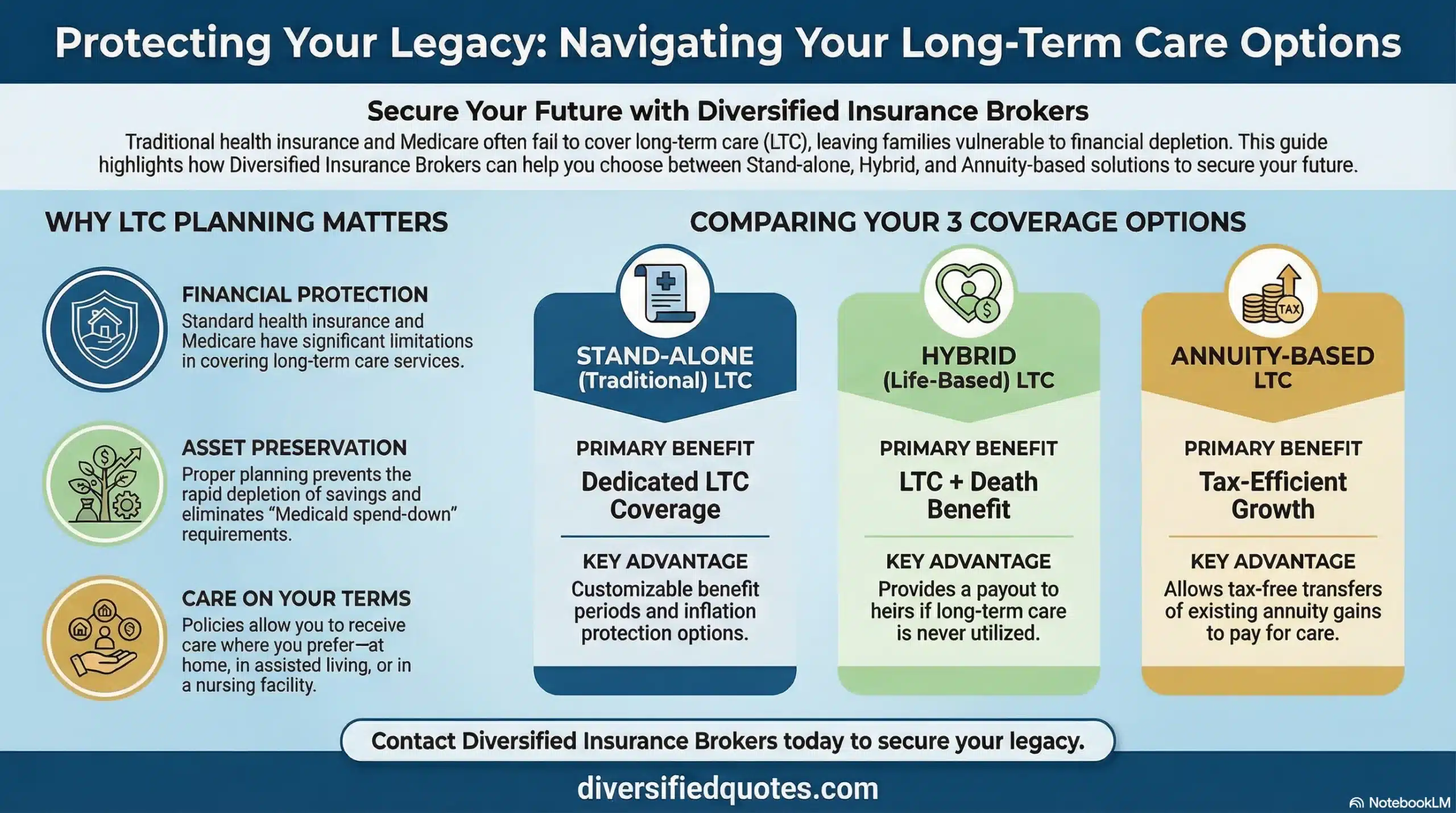
Talk With an Advisor Today
Choose how you’d like to connect—call or message us, then book a time that works for you.
Schedule here:
calendly.com/jason-dibcompanies/diversified-quotes
Licensed in all 50 states • Fiduciary, family-owned since 1980
FAQs: Guaranteed Issue Long-Term Care Insurance
Does guaranteed issue long-term care insurance actually exist — or is it just a marketing term?
It exists. Diversified Insurance Brokers works with a guaranteed-issue LTC product where no applicant is declined. The product uses a digital underwriting process involving five health questions and a video-based cognitive and physical assessment, assigning every applicant to one of three classes — Preferred, Standard, or base. Applicants who bypass underwriting or answer yes to any of the first three health questions are automatically placed in the base class. Applicants who complete the full assessment may qualify for Standard or Preferred, which produces more LTC benefit per premium dollar. The guarantee is absolute across all classes: no application is rejected.
What guaranteed issue means in this context is precisely this: the class assignment determines how much benefit each premium dollar purchases, not whether coverage is issued. A buyer with significant health complexity may be assigned the base class and receive less benefit per dollar than a healthier buyer in the Preferred class — but they are not turned away. At Diversified Insurance Brokers, Jason Stolz works with clients across the full LTC spectrum, including buyers previously declined by traditional carriers who need a guaranteed-acceptance path to get meaningful LTC protection in place.
What are the five health questions that determine my underwriting class?
The five questions are specific and directly focused on current functional status and recent serious medical history. Question one asks whether the applicant currently lives in or receives care from a nursing home, assisted living facility, or any residential care facility, or currently uses home health care or adult day care. Question two asks whether the applicant currently needs any assistance or supervision performing Activities of Daily Living — bathing, dressing, eating, walking, moving in or out of a bed or chair, toileting, or bowel and bladder control. Question three asks whether the applicant currently uses a wheelchair, motorized scooter, stair lift, Hoyer lift, or respirator. Answering yes to any of these first three — or choosing to bypass the assessment entirely — results in automatic base class assignment.
Question four asks whether the applicant has been diagnosed or treated in the past five years for a defined list of serious conditions: heart attack, bypass or angioplasty, stent surgery of the heart or legs, COPD, chronic kidney failure, specific cancers including bone, esophagus, liver, lung, ovary, pancreas, stomach, or uterus, as well as lymphoma, leukemia, or any metastatic cancer. Question five asks whether the applicant received Social Security Disability Insurance benefits in the past five years. A yes to either of questions four or five does not automatically result in the base class — the full digital cognitive and physical assessment still applies, and the final class reflects the complete assessment outcome. One important clarification: a client who resides in a senior or independent living facility but is not receiving any assistance with ADLs should answer no to question one.
What is the digital underwriting process like — what should I expect?
The assessment takes approximately 30 minutes and is conducted via a recorded video call. A trained support professional joins to assist the applicant throughout. A current government-issued photo ID is required for identity verification. The session includes a cognitive component — questions evaluating recall ability — and a physical component requiring exercises that evaluate balance and muscle strength. The interviewer is trained to monitor for coaching indicators: coaching during the cognitive portion can negatively affect the assigned class, so applicants should complete the assessment honestly and independently without guidance from anyone present during the call.
Practical preparation: ensure the camera and microphone are working and connect to WiFi before the session begins. Have a cane or walker available if used; have a hearing aid in place if worn. Sit in a stable chair with back support that does not have wheels — not on a sofa or bed — and position the camera so your head, hands, and feet are fully visible. Do not wear headphones during the session. After the session, the class notification is typically sent within minutes of completion. All underwriting decisions are final. Jason Stolz walks clients through this process before the assessment begins so there are no surprises on the day of the call.
Should I try to qualify for a better class or just bypass the underwriting?
In almost every case, completing the full digital assessment is worth doing. Bypassing results in automatic base class assignment — the lowest LTC benefit per premium dollar. Completing the assessment and receiving Standard or Preferred means each dollar of premium purchases more LTC benefit at no additional cost to the applicant. Unless the buyer already knows with certainty they would be assigned the base class — because they currently need ADL assistance, currently use specified mobility equipment, or reside in an active care facility — going through the assessment creates the opportunity to qualify for better benefit terms.
Buyers with complex medical histories who are nonetheless currently functionally independent may perform well on both the cognitive and physical components and receive Standard or Preferred classification. The assessment evaluates current functional status, not lifetime health history. The only situation where bypassing is genuinely straightforward is when the answers to the first three questions would already result in base class assignment — in that case the outcome is predetermined and the assessment adds nothing. For everyone else, completing the assessment is the path that potentially produces better coverage value. Jason Stolz reviews each client’s specific situation before the assessment to help identify which class outcome is realistic so clients approach the call with accurate expectations.
How does guaranteed issue LTC compare to traditional and hybrid LTC options?
Traditional standalone LTC insurance, for buyers who qualify at standard or preferred health classifications, typically produces more LTC benefit per premium dollar than either hybrid or guaranteed-issue designs — the fully underwritten market prices coverage most favorably for healthy buyers. However, traditional LTC involves a stringent medical records review that declines many applicants, provides no return of premium if no claim is made, and carries potential for future rate increases. Hybrid life-based and annuity-based products offer simplified underwriting, guaranteed premiums, and return of value if LTC benefits are never used — addressing the use-it-or-lose-it concern that makes traditional LTC a difficult value proposition for some buyers.
The guaranteed-issue product occupies a distinct tier: it accepts everyone, eliminates the uncertainty of medical records review or prior decline history, and provides LTC coverage where no other option exists for the buyer. The tradeoff is that the base class produces the least LTC benefit per premium dollar across the market — meaningful coverage, but not the most cost-efficient path if the buyer could qualify for a higher tier. For buyers who have been declined elsewhere, who cannot navigate a traditional underwriting process, or who want certainty that coverage will be issued before investing time in an application, the guaranteed-issue path resolves the access problem the rest of the market cannot. Jason Stolz evaluates all three tiers for each client’s health profile and budget to identify the option that produces the best coverage outcome for their specific situation.
When does the LTC benefit actually start paying — what triggers coverage?
LTC benefits under this guaranteed-issue product — like all tax-qualified LTC products — trigger when the insured cannot perform at least two of the six Activities of Daily Living without substantial human assistance, or requires substantial supervision due to severe cognitive impairment. The six ADLs are bathing, dressing, toileting, transferring, continence, and eating. The trigger must be certified by a licensed healthcare practitioner and submitted to initiate the claims process. This federal standard under HIPAA and Internal Revenue Code §7702B applies identically across all three underwriting classes — Preferred, Standard, and base — and across all tax-qualified LTC products regardless of how the underwriting was conducted.
The elimination period — the number of days of qualifying care the insured must receive before benefit payments begin — is specified in the policy contract and represents the insured’s out-of-pocket responsibility at the start of a qualifying care episode. Understanding the elimination period’s practical dollar impact at the local cost of care is an important part of evaluating whether the policy’s design provides meaningful protection relative to the care costs the buyer is likely to face. Jason Stolz helps clients model this calculation as part of the coverage review, confirming that the combination of the elimination period, the benefit amount, and the benefit period produces protection that is substantive rather than nominal for their specific situation and geography.
About the Author:
Jason Stolz, CLTC, CRPC, DIA, CAA and Chief Underwriter at Diversified Insurance Brokers (NPN 20471358), is a senior insurance and retirement professional with more than 25 years of real-world experience helping individuals, families, and business owners protect their income, assets, and long-term financial stability. As a long-time partner of the nationally licensed independent agency Diversified Insurance Brokers, Jason provides trusted guidance across multiple specialties—including fixed and indexed annuities, long-term care planning, personal and business disability insurance, life insurance solutions, Group Health, Travel Medical and Evacuation Insurance, and short-term health coverage. Diversified Insurance Brokers maintains active contracts with over 100 highly rated insurance carriers, ensuring clients have access to a broad and competitive marketplace.
His practical, education-first approach has earned recognition in publications such as VoyageATL, and contributions from his agency featured in Kiplinger and GoBankingRates— highlighting his commitment to financial clarity and client-focused planning. Drawing on deep product knowledge and years of hands-on field experience, Jason helps clients evaluate carriers, compare strategies, and build retirement and protection plans that are both secure and cost-efficient. Visitors who want to explore current annuity rates and compare options across multiple insurers can also use this annuity quote and comparison tool.
Explore More Long Term Care Insurance Options: Browse our complete guide to How to Buy, Qualify & Coverage Details — covering how to buy, who qualifies, policy types, shared benefits, partnership plans & more from top carriers.
Last Reviewed: June 9, 2026 |
Reviewed by: Jason Stolz, CLTC, CRPC, DIA, CAA
Chief Underwriter, Diversified Insurance Brokers, Inc. | NPN: 20471358 | Diversified Insurance Brokers, Inc. — Licensed in all 50 states
Fact Checked by: Tonia Pettitt, CMIP©
Medicare Specialist, Diversified Insurance Brokers, Inc. | NPN: 14374308 | Diversified Insurance Brokers, Inc. — Licensed in all 50 states
Did you find this content helpful? Leave us a Google review — it helps others find trustworthy guidance too.
Editorial Standards: Diversified Insurance Brokers maintains rigorous editorial standards to ensure accuracy, clarity, and independence in all content. Learn more about our editorial standards and commitment to transparency.
