
Group Health Insurance for Construction Firms
Group Health Insurance for Construction Firms

Jason Stolz CLTC, CRPC, DIA, CAA
Group health insurance for construction firms is not a straightforward procurement exercise — it is a workforce management decision that affects recruiting, retention, crew stability, and long-term operating costs in ways that most construction leaders underestimate until a bad renewal forces a reckoning. Construction companies face a combination of challenges that most standard small-group health plans are not designed to handle: mobile crews that work across county and state lines, seasonal workforce fluctuations that affect participation rates, physically demanding work environments that generate healthcare utilization patterns different from white-collar groups, and the recruiting pressure of competing against other firms for skilled tradespeople who increasingly evaluate benefits alongside wages when choosing employers. A group health plan that ignores these realities — one selected primarily on first-year premium rather than structural fit — typically produces escalating renewals, network complaints, and frustrated employees who eventually leave for a competitor with better coverage.
At Diversified Insurance Brokers, Jason Stolz, CLTC, CRPC, DIA, CAA helps construction companies of all sizes — from two-person specialty trade operations to multi-state general contractors — design group health plans that attract skilled workers, control long-term costs, and adapt to the changing project demands that define the industry. The goal is not the cheapest plan; it is the plan that stays stable, protects the crew, and gives leadership measurable levers to manage cost over time rather than absorbing annual surprises. Our resource on group health insurance covers the foundational mechanics of employer plan structure, and our resource on top questions employers ask about group health insurance addresses the specific concerns that construction firm leadership most commonly raises before making a plan decision.
Get a Construction Group Health Insurance Review
Compare insured, level-funded, and self-funded health plans built for construction firms — so you can control costs, keep great crews, and stop getting surprised at renewal.
Request a Group Health Review Call 800-533-5969Construction Firm Plan Structures — Fully Insured vs. Level-Funded vs. Self-Funded
Construction companies typically have three primary group health funding structures to evaluate. Each offers different levels of financial risk, cost control transparency, renewal predictability, and plan design flexibility. The right choice depends on crew size, enrollment stability, cash flow discipline, and how much control leadership wants over long-term cost trends — not simply which structure has the lowest first-year premium.
| Feature | Fully Insured | Level-Funded | Self-Funded |
|---|---|---|---|
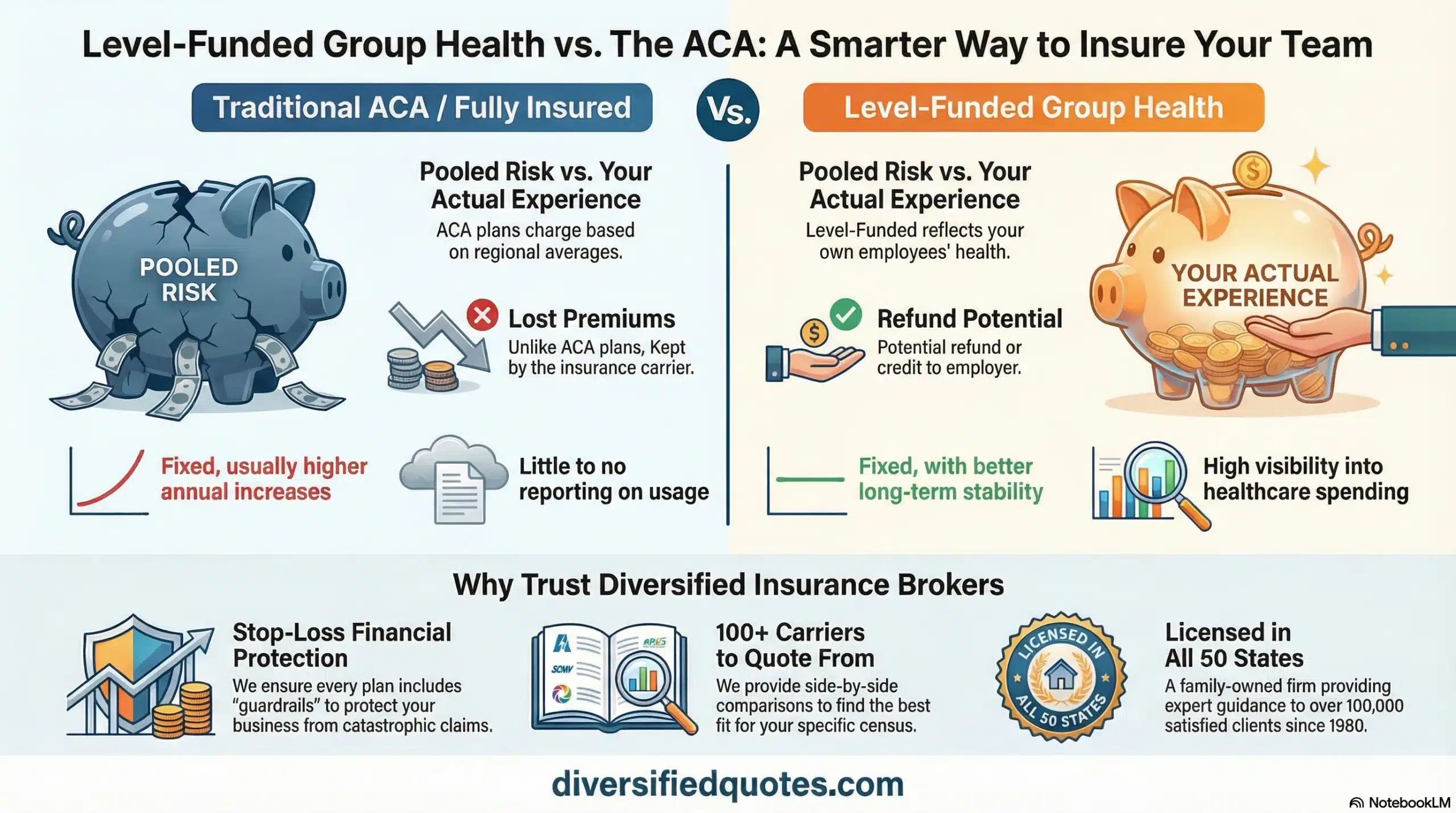
| Monthly cost structure | Fixed premium — same amount every month regardless of actual claims | Fixed monthly payment covering expected claims, admin, and stop-loss — potential year-end refund if claims are lower | Variable — employer pays actual claims as incurred plus admin and stop-loss premium |
| Claims savings when utilization is low | None — carrier keeps all margin from favorable claim years | Partial — employer may receive refund at year-end on unused claim funding | Full — all favorable claims experience stays with the employer |
| Claims data transparency | Minimal — carrier owns claims data; employer sees only aggregate renewal numbers | Moderate — employer receives reporting on claims trends; better than fully insured | Full — employer accesses detailed utilization data for targeted cost management |
| Catastrophic claim protection | Carrier bears all risk above premium — employer fully protected | Stop-loss caps individual and aggregate exposure — employer protected within defined limits | Specific and aggregate stop-loss provides protection — employer sets attachment points based on risk tolerance |
| Plan design flexibility | Limited — must use carrier’s approved plan designs and networks | Moderate — more flexible than fully insured; network and design options vary by TPA | Maximum — employer designs the plan; ERISA preemption provides flexibility on mandates |
| Best suited for construction firms | Very small firms (2–25 employees) where simplicity and maximum budget predictability outweigh cost optimization | Small to mid-size firms (25–100 employees) wanting cost control and data without full self-funding exposure or admin complexity | Mid-size to large firms (100+ employees) with stable cash flow, financial reserves, and leadership appetite for active plan management |
The table reveals the construction-specific planning principle: plan structure matters as much as carrier selection for group health insurance for construction firms. A construction company that switches from carrier A to carrier B within the same fully insured structure typically sees one renewal cycle of savings before the pricing reverts to market. A construction company that transitions from fully insured to level-funded changes the underlying economics — creating a path to favorable claims experience directly benefiting the employer’s net cost rather than the carrier’s retained margin. Our resource on pros and cons of self-funded group health covers the decision framework in detail, and our resource on what is self-funded group health insurance covers the mechanics for firms evaluating the self-funded path for the first time.
Why Group Health Insurance Is Different for Construction Firms
Construction firms operate in an environment that most traditional small-group health plans are not designed to accommodate. Work is physically demanding, hours can be long and irregular, and job sites change weekly or monthly as projects progress and conclude. Some employees commute across county lines daily; some crews travel across state lines for extended project assignments. These realities affect how employees access care, whether the plan’s network functions where employees actually live and work, and how healthcare utilization patterns show up in claims data over time.
Construction is also a “two-track” risk environment. On one track, workplace injuries are handled through workers’ compensation. On the other track — which group health covers — everything else applies: routine care for employees and families, non-work injuries, chronic condition management, prescription drug needs, preventive care, diagnostics, and mental health services. Group health insurance covers the track that most directly affects household stability and employee retention, because it touches employees and their dependents every day rather than only when a job-site incident occurs.
Without a properly structured group health strategy built for these realities, construction firms typically see escalating premium increases, reduced carrier options at renewal, and plan changes that frustrate employees who have come to depend on consistent coverage. Over time, leadership faces a deteriorating choice between absorbing rising costs or reducing benefits — both of which damage retention and bidding competitiveness in markets where skilled tradespeople have genuine options. Our resource on what is the primary reason to buy group health insurance covers the employer motivation framework that informs a well-structured plan decision for any industry, including construction.
Common Health Insurance Challenges in the Construction Industry
Many construction firms arrive at the benefits conversation after years of reacting to annual rate increases without a clear strategy. They accepted renewal terms because they were busy running projects, only to realize that the plan drifted into an expensive, mismatched design that employees still complained about. In construction, health insurance easily becomes a quiet budget leak — until the renewal forces a major disruption during a time when leadership has limited bandwidth to manage it.
Workforce diversity creates the first significant challenge. Construction firms typically employ a mix of field crews, supervisors, project managers, administrative staff, estimators, and working owners. Each group uses healthcare differently. Field workers may have more acute care needs driven by physical work; administrative staff may use more preventive and primary care. A plan designed exclusively around one group’s patterns creates friction and dissatisfaction in the others — contributing to turnover that compounds over time.
Turnover and seasonality create the second challenge. Firms that scale up and down with project cycles see enrollment fluctuations that can affect participation rates and carrier pricing. This does not mean the firm is uninsurable or unsuited for quality group coverage — it means eligibility rules, contribution strategy, and enrollment communication must be designed to maintain participation stability even when workforce composition changes. Our resource on minimum employees for group health insurance covers the size thresholds and participation requirements that determine what plan options are available at different headcounts.
Network fit is the third challenge — and the most commonly overlooked in the initial plan selection. A plan can look excellent on paper based on premium and benefit design and fail completely when employees discover they cannot find in-network providers near where they live or near the job sites where they work extended assignments. When employees go out of network regularly, plan costs rise, employee frustration rises, and the plan underperforms on every metric that matters for both the employer and the workforce.
Why Construction Firms Are Moving Toward Level-Funded and Self-Funded Plans
In recent years, construction firms that have moved away from traditional fully insured plans have done so for one practical reason: they want better information about what is driving their healthcare costs and a more direct relationship between their group’s actual claims experience and their renewal pricing. Under a fully insured structure, a construction firm may see a 12% renewal increase with no explanation beyond “medical trend” — which makes it impossible to identify whether the increase reflects their specific group’s experience, broad market pricing, or carrier risk conservatism applied to the construction industry category. That opacity makes planning difficult and breeds the reactive, last-minute renewal negotiations that disrupt operations and produce suboptimal outcomes.
Level-funded and self-funded structures provide the claims transparency that makes proactive management possible. When a construction firm can see which conditions, which medications, and which care access patterns are driving cost, leadership can implement targeted interventions — clinical navigation programs, pharmacy management, care management for high-cost chronic conditions — that reduce future claims rather than simply hoping next year’s experience is better. Construction companies already understand operational levers: labor efficiency, material costs, safety protocols, and vendor performance. Healthcare becomes more manageable when leadership applies the same discipline — know the drivers, build guardrails, and make consistent measurable improvements year over year.
Eligibility, Participation, and Seasonal Workforce Planning
Group health insurance eligibility for construction firms depends on employee count, ownership structure, state rules, and the specific carrier or TPA providing coverage. Some plan structures can qualify with as few as two enrolled employees; others require minimum participation percentages that must be maintained throughout the plan year. Even when a carrier is flexible on minimum size, the plan must have clean, consistently applied eligibility rules so that administration does not become a source of constant exceptions and enrollment disputes.
Seasonal workforce fluctuations add complexity because participation rates may change as crews scale up or down with project demand. The practical solution is designing eligibility rules and contribution strategies that maintain a stable core enrollment — the employees who are most important to retain — while creating clear, fair rules for seasonal or part-time workers that do not expose the plan to adverse selection or participation penalties. A sustainable contribution strategy typically provides strong employer support for employee-only coverage (to maximize participation among full-time workers) and a structured approach to dependent coverage that does not create an unsustainable long-term cost commitment. Our resources on group health insurance for specific workforce sizes — including group health insurance for 10 employees, group health insurance for 50 employees, and group health insurance for 100 employees — cover the specific plan options and eligibility dynamics that apply at different construction firm sizes.
Multi-State and Mobile Construction Crews — Network Strategy
Group health insurance for construction firms with multi-state operations or traveling crews requires network planning that goes beyond identifying the carrier with the best rates at headquarters. The relevant network question is not “what network does this carrier have?” but “does this network provide adequate in-network access where our employees actually live and where our crews actually work?” For construction firms with employees distributed across multiple states or with crews that spend weeks or months on project sites far from their home counties, a narrow or region-specific network consistently fails to deliver the coverage quality that the plan’s premium cost should support.
Broad national or regional PPO networks, combined with clear employee education about how to use out-of-area emergency provisions, typically perform best for construction workforces with significant geographic diversity. Some level-funded and self-funded plan structures allow employers to select networks specifically because network selection is not constrained by a single carrier’s product offering. This is one of the practical advantages that construction firms gain by evaluating plan structure options rather than selecting carrier brand alone. When employees understand the network, can find in-network care consistently wherever they are working, and know exactly what to do in an emergency far from home, the plan performs as designed — and the resulting satisfaction reduces the turnover that network complaints frequently accelerate.
The Cost Drivers That Actually Move Your Renewals
Construction firm leadership often assumes health insurance premiums rise because “healthcare is expensive” — which is accurate but strategically useless without understanding which specific factors within that general trend are driving their group’s renewal. Renewals respond to a combination of drivers that can be measured and managed when the plan structure provides visibility into the underlying data.
Claims volatility is the most acute driver for smaller construction groups. When a group has 30 employees, a single high-cost diagnosis — cancer treatment, cardiovascular surgery, a premature birth, a complex orthopedic repair from a non-work injury — can disproportionately affect renewal pricing. Stop-loss coverage addresses the catastrophic claim exposure, but claim run-out timing and corridor exposure still affect the employer’s economics. For firms in this size range, the plan structure decision — particularly whether to use a level-funded structure with its built-in stop-loss protection — directly affects renewal stability more than carrier selection does.
Pharmacy spend is increasingly the largest single driver of healthcare cost for construction groups with older workforces or members managing chronic conditions with specialty medications. A single specialty drug for a serious condition can cost more in one year than the entire expected claims budget for several other employees combined. Pharmacy benefit management practices — formulary design, specialty drug protocols, step therapy requirements — can make a meaningful difference in whether these costs are controlled, predicted, and accommodated within the plan’s financial model or arrive as a surprise at renewal.
Network leakage — employees consistently using out-of-network providers because the network is inadequate, confusing, or inaccessible near their homes or job sites — silently inflates cost while also generating the billing confusion and surprise charges that create the most employee complaints. Dependent enrollment and contribution strategy, utilization of emergency departments for non-emergency care, and the absence of primary care relationships that provide coordinated chronic condition management round out the cost driver picture. Construction firms that understand these drivers specifically — rather than treating renewals as weather events — can build multi-year cost management strategies rather than reacting to each renewal as a new crisis.
Plan Design Levers That Control Cost Without Hurting Crew Retention
Cost control in construction group health insurance fails when it is implemented through benefit reductions or excessive employee cost-shifting. That approach may lower employer premium expense for one renewal cycle, but it consistently produces the downstream consequences that cost more in aggregate: reduced participation that destabilizes the risk pool, turnover of experienced workers who find better coverage elsewhere, and recruiting disadvantages that increase time-to-hire and training costs for replacements. The more durable cost control approach uses plan architecture, provider incentives, and employee navigation support — not benefit cuts.
Offering two plan tiers instead of forcing a single plan gives employees choice while keeping the employer’s cost contribution predictable. A value plan with lower payroll impact becomes the enrollment default that maximizes participation; a buy-up plan gives employees who want richer coverage the ability to pay for it through higher contributions. This creates benefit competitiveness across employee segments without requiring the employer to fund the richest plan for everyone. Designing care access around how construction crews actually seek care — straightforward urgent care access rather than requiring primary care gatekeeper referrals, practical telehealth integration for minor issues, clear prescription protocols — reduces both cost and utilization friction simultaneously. A simple, well-written benefits guide that explains the difference between urgent care and emergency room usage, how to find in-network providers, and how telehealth works can reduce avoidable high-cost care utilization without any change to benefit design.
Attracting and Retaining Skilled Construction Workers Through Benefits
Health insurance plays a significant role in skilled trade worker retention — a reality that has become more pronounced as the competition for experienced carpenters, electricians, plumbers, ironworkers, and equipment operators has intensified across most markets. Construction firms that offer well-structured, easy-to-use group health insurance consistently report lower turnover among experienced workers, better crew morale during extended project assignments, and stronger recruiting outcomes when wages between competing employers are comparable. Benefits signal organizational stability and long-term employment commitment in ways that hourly wage comparisons do not.
The goal is not the most expensive plan in the market — it is a plan that experienced workers can understand, can actually use when they need care, and that covers their families reliably. A plan that is administratively confusing, that has a network full of providers who are out of reach from where employees live, or that imposes high out-of-pocket costs for routine care provides none of these retention benefits regardless of how competitive the employer’s premium contribution appears on paper. When group health insurance for construction firms is designed with the crew’s real-world experience in mind — not just the employer’s cost — it becomes a genuine workforce retention asset rather than a line item that generates annual complaints.
Get Group Health Options Built for Your Construction Firm
Tell us your firm size, project footprint, and workforce goals — and we’ll present practical plan options across insured, level-funded, and self-funded structures with clear tradeoffs for your specific construction operation.
Request a Group Health ReviewRelated Group Health Insurance Resources
Explore more pages that help construction firms compare structures, qualify correctly, and build a stable renewal process.
Financial Protection Essentials
Medicare updates, retirement rollover strategies, group coverage planning, and dental insurance comparison resources.
Talk With an Advisor Today
Choose how you’d like to connect—call or message us, then book a time that works for you.
Schedule here:
calendly.com/jason-dibcompanies/diversified-quotes
Licensed in all 50 states • Fiduciary, family-owned since 1980
FAQs: Group Health Insurance for Construction Firms
Can a construction company get group health insurance with a small team?
Yes — many construction firms qualify for group health insurance with small teams, and specific eligibility depends on state rules, participation requirements, and how many employees choose to enroll. Some carriers and plan structures can accommodate groups starting at two enrolled employees; others require a minimum participation percentage (commonly 50-75% of eligible employees) to activate certain plan designs. Construction-specific considerations matter: if the workforce includes a mix of full-time employees and 1099 contractors, only employees typically count toward group plan eligibility and participation requirements. Working owners may qualify for inclusion on the plan depending on the business entity structure and state rules. Our resource on minimum employees for group health insurance covers the size thresholds and participation requirements that determine what plan structures are available at different construction firm sizes, and our resource on group health insurance for 10 employees covers the specific options for small construction crews.
What type of group health plan is best for construction firms?
The best plan structure for group health insurance for construction firms depends on crew size, cash flow stability, enrollment predictability, and how much control leadership wants over long-term cost management. Fully insured plans offer maximum budget predictability through fixed monthly premiums and are simplest to administer — making them most appropriate for very small firms or those prioritizing administrative simplicity above cost optimization. Level-funded plans provide fixed monthly costs with the potential for year-end refunds when claims are favorable, offer more claims transparency than fully insured, and represent the practical on-ramp for construction firms ready to move beyond fully insured pricing. Self-funded plans provide the greatest long-term cost control and data transparency but require adequate financial reserves, stop-loss coverage, and leadership capacity to manage a more complex multi-vendor arrangement. For most construction firms in the 25-100 employee range, level-funded is often the most impactful structural improvement available without requiring the full administrative infrastructure of self-funding.
How does a level-funded plan work for contractors?
A level-funded plan for construction firms works by establishing a fixed monthly payment that covers three components: the employer’s expected claims funding (the money used to pay actual medical and pharmacy claims), administrative costs for plan management, and the stop-loss insurance premium that protects the employer against catastrophic individual or aggregate claims above defined thresholds. The monthly payment stays the same throughout the plan year — providing the budget predictability of a fully insured plan — but the underlying economics differ because the employer is effectively funding their own claims rather than paying a premium that includes the carrier’s risk margin and profit. If the group’s actual claims for the year are lower than the amount funded, many level-funded plan designs return the unused portion to the employer at year-end. If claims are higher than funded, stop-loss insurance covers the excess above the attachment point. This structure directly links the group’s claims experience to the employer’s net cost — creating the financial incentive for proactive plan management that fully insured structures typically cannot produce.
Is self-funded group health insurance too risky for construction companies?
Self-funded group health insurance is not inherently too risky for construction companies — the risk level is determined by how the stop-loss coverage is structured, how the employer’s financial reserves match the plan’s potential exposure, and whether the firm has the administrative capacity to manage the multi-vendor arrangement that self-funding requires. Stop-loss insurance — both specific (individual) and aggregate — provides the risk management framework that makes self-funding financially viable for employers of appropriate size and financial position. The specific deductible on stop-loss coverage determines how much the employer pays before the stop-loss carrier reimburses — setting this at the right level for the firm’s cash flow capacity is the central risk management decision. Self-funding is typically most appropriate for construction firms with 100+ employees, stable revenue cycles, adequate financial reserves, and leadership interested in active plan management. Our resource on pros and cons of self-funded group health covers the complete risk-benefit framework for evaluating whether self-funding is appropriate for a specific construction firm’s profile.
What is stop-loss insurance and why does it matter?
Stop-loss insurance is the risk management product that protects self-funded and level-funded construction employers from financial exposure when individual claims or total group claims are unexpectedly high. Specific stop-loss — also called individual stop-loss — applies to claims for a single covered employee or dependent. The employer funds claims up to the specific deductible (commonly $25,000 to $100,000 or higher depending on employer size and risk tolerance), and the stop-loss carrier reimburses claims above that amount for the rest of the plan year. Aggregate stop-loss applies to the total claims for the entire group — if total annual claims exceed the aggregate attachment point (typically 115-125% of expected annual claims), the stop-loss carrier reimburses the excess. Together, these two layers cap the employer’s maximum financial exposure at predictable levels regardless of how many high-cost claims occur. For construction firms evaluating level-funded or self-funded options, the stop-loss attachment points, reimbursement terms, and carrier financial strength are as important to evaluate as the plan’s base premium cost.
Can construction companies cover multi-state or traveling crews?
Yes — group health insurance for construction firms regularly covers multi-state and traveling crews when the plan’s network strategy is designed to accommodate where employees actually live and work rather than only where the company is headquartered. The key is selecting a network with broad geographic coverage that provides adequate in-network provider access in the states and regions where crews are regularly deployed. Broad national PPO networks — available through both fully insured and self-funded plan structures — typically perform best for construction firms with significant multi-state crew deployment because they provide consistent in-network access without requiring employees to navigate separate regional network rules for each project location. Emergency care provisions should also be clearly documented so crews understand how to access care during extended job-site assignments far from their home network areas. Firms operating primarily in one region but occasionally deploying crews elsewhere should confirm that out-of-area emergency coverage terms are clearly defined in the plan documentation before deployment rather than discovering coverage limitations during an incident.
Do group health premiums go up every year for construction firms?
Premium levels and funding amounts in group health insurance for construction firms typically change at each annual renewal, and the magnitude of change depends on the group’s actual claims experience, the plan’s funding structure, the broader healthcare cost trend, and how the carrier or TPA has priced the risk for the next plan year. Fully insured plans often see larger renewal increases for construction firms because carriers apply industry-wide risk factors and conservative assumptions to a category they view as higher-risk than white-collar industries. Level-funded and self-funded plans create a more direct relationship between the construction firm’s own claims experience and renewal pricing — favorable claims experience produces more favorable renewal terms, and the claims data transparency allows the employer to identify and address cost drivers proactively. Construction firms that implement proactive plan management — pharmacy oversight, care navigation, employee wellness programs, consistent plan design — consistently report more stable multi-year renewal trajectories than firms that treat health insurance as a once-a-year passive decision.
How can a construction firm lower group health costs without cutting coverage?
The most effective cost control strategies for group health insurance for construction firms work through plan architecture and utilization management rather than benefit reductions or employee cost-shifting. Evaluating whether a level-funded or self-funded structure is appropriate for the firm’s size and financial position is typically the highest-impact structural decision — because changing the funding model changes the economic relationship between the group’s claims experience and the employer’s net cost. Within the existing plan structure, offering a two-tier plan design that provides a value option for employees who want lower payroll impact alongside a buy-up option gives employees choice while keeping the employer’s cost predictable. Employee education about care access — specifically about when urgent care is appropriate vs. emergency room, how telehealth works for minor conditions, and how to find in-network providers — reduces avoidable high-cost utilization without changing any plan benefits. Pharmacy management practices that address specialty drug costs and generic substitution opportunities can have material impact on total plan spend. And improving the plan’s network fit — ensuring employees can access in-network care where they live and work — reduces out-of-network cost exposure and the employee frustration that accelerates turnover.
What information do you need to quote a construction company plan?
A group health insurance review for a construction firm typically starts with census data covering all eligible employees — ages, zip codes, dependent status, and employment classification (full-time vs. part-time) — which provides the foundation for carrier and TPA underwriting. If the firm has current group health coverage, details on the existing plan structure, current premium or funding amounts, carrier and plan type, and any available claims experience data allow for a meaningful comparison rather than just an apples-to-oranges rate comparison. The employer’s contribution goals — whether a fixed dollar amount per employee, a percentage of premium, or a tiered structure for employee vs. dependent coverage — shape which plan designs are most practical. The geographic footprint of the workforce, any multi-state project locations where crews regularly work, and the preferred plan structure (fully insured, level-funded, or self-funded) frame the network and product evaluation. Our resource on group medical insurance covers the general plan evaluation framework, and we guide construction firms through the information gathering process to make the comparison as efficient and accurate as possible.
Can owners be included on the construction company group health plan?
Owners of construction firms can often be included on the group health plan, but the specific rules depend on the business entity type, state regulations, and the specific carrier or TPA’s guidelines. Sole proprietors, partners in a partnership, and more-than-2% shareholders of S-corporations face different eligibility rules than W-2 employees — and in some cases, owners may have different tax treatment for health insurance premiums than regular employees. For construction firms organized as LLCs, corporations, or partnerships with working owner-operators, confirming owner eligibility and tax treatment before plan design is finalized ensures that the coverage structure is both compliant and financially efficient. Family members of working owners who are also W-2 employees of the business may qualify through regular employee eligibility rules depending on the business structure. We confirm owner eligibility, partnership structure considerations, and appropriate contribution approaches as part of the group health review process for any construction firm where ownership structure creates eligibility questions.
About the Author:
Jason Stolz, CLTC, CRPC, DIA, CAA and Chief Underwriter at Diversified Insurance Brokers (NPN 20471358), is a senior insurance and retirement professional with more than 25 years of real-world experience helping individuals, families, and business owners protect their income, assets, and long-term financial stability. As a long-time partner of the nationally licensed independent agency Diversified Insurance Brokers, Jason provides trusted guidance across multiple specialties—including fixed and indexed annuities, long-term care planning, personal and business disability insurance, life insurance solutions, Group Health, Travel Medical and Evacuation Insurance, and short-term health coverage. Diversified Insurance Brokers maintains active contracts with over 100 highly rated insurance carriers, ensuring clients have access to a broad and competitive marketplace.
His practical, education-first approach has earned recognition in publications such as VoyageATL, and contributions from his agency featured in Kiplinger and GoBankingRates— highlighting his commitment to financial clarity and client-focused planning. Drawing on deep product knowledge and years of hands-on field experience, Jason helps clients evaluate carriers, compare strategies, and build retirement and protection plans that are both secure and cost-efficient. Visitors who want to explore current annuity rates and compare options across multiple insurers can also use this annuity quote and comparison tool.
Explore More Group Health Insurance Options: Browse our complete guide to Group Health Insurance by Industry — covering law firms, consulting, construction, medical practices, schools & more from 100+ carriers.
Last Reviewed: May 26, 2026 |
Reviewed by: Jason Stolz, CLTC, CRPC, DIA, CAA
Chief Underwriter, Diversified Insurance Brokers, Inc. | NPN: 20471358 | Diversified Insurance Brokers, Inc. — Licensed in all 50 states
Fact Checked by: Tonia Pettitt, CMIP©
Medicare Specialist, Diversified Insurance Brokers, Inc. | NPN: 14374308 | Diversified Insurance Brokers, Inc. — Licensed in all 50 states
Did you find this content helpful? Leave us a Google review — it helps others find trustworthy guidance too.
Editorial Standards: Diversified Insurance Brokers maintains rigorous editorial standards to ensure accuracy, clarity, and independence in all content. Learn more about our editorial standards and commitment to transparency.
