
Level-Funded Health Insurance Tax Benefits Explained
As an Independent Group Health Insurance Broker, we compare fully insured, level-funded, and self-funded options across carriers to find the lowest cost coverage for your business.
Level-Funded Health Insurance Tax Benefits Explained

Jason Stolz CLTC, CRPC, DIA, CAA
Level-funded health insurance tax benefits explained in plain English start with one simple reality: the way your health plan is funded can materially change your after-tax cost, cash flow timing, and financial predictability from one plan year to the next. Many employers focus exclusively on the monthly premium when evaluating group health options, but the tax treatment of claims funding, stop-loss premiums, administrative costs, and potential year-end surplus can change the true net cost of coverage more than most business owners expect. Understanding these mechanics before choosing a funding model is not optional — it is the difference between a plan that works on paper and a plan that delivers real financial advantage over time.
At Diversified Insurance Brokers, conversations about level-funded health insurance tax benefits typically start with understanding the employer’s accounting method, entity structure, workforce composition, and risk tolerance. Level-funded plans sit between fully insured and self-funded plans — a hybrid position that creates the potential for meaningful tax advantages, but also requires thoughtful plan design and early coordination with tax advisors to capture those benefits fully. Working with an independent group health insurance broker who understands both the insurance mechanics and the tax implications is one of the most effective ways to ensure that a level-funded plan is structured to deliver its maximum financial value from day one.
Level-funded health insurance tax benefits explained properly means evaluating not just deduction eligibility, but also timing, expense classification, surplus treatment, stop-loss structure, and payroll eligibility rules. When these components are aligned correctly, level-funded plans can produce meaningful after-tax cost advantages while still preserving the predictable monthly budgeting that makes them accessible to businesses of all sizes. This guide walks through each of those components in depth — from the basic structural mechanics to the nuanced entity-level considerations that affect the actual dollars reaching your bottom line.
For employers who want to understand the full spectrum of funding options before choosing a model, our resource on what self-funded group health insurance is provides the structural context within which level-funded plans sit, and our guide on the pros and cons of self-funded group health covers the full comparison between self-funded and level-funded approaches.
Request a Tax-Aware Level-Funded Comparison
See pre-tax and after-tax cost comparisons between level-funded and fully insured group health plans.
What Level-Funded Health Insurance Actually Is
Before examining the tax implications, it helps to have a precise understanding of what level-funded health insurance actually is and how it differs structurally from the two plan types it sits between. A fully insured plan is one where the employer pays a fixed monthly premium to an insurance carrier, and the carrier assumes all financial risk for employee claims. The employer’s financial exposure is capped at the premium, claims never directly affect the employer’s costs within a plan year, and there is no surplus to share if claims are favorable. A self-funded plan operates at the opposite extreme: the employer takes on direct financial responsibility for employee claims, paying them as they occur from employer funds, often with stop-loss insurance to cap catastrophic exposure but without the predictable monthly structure of a premium.
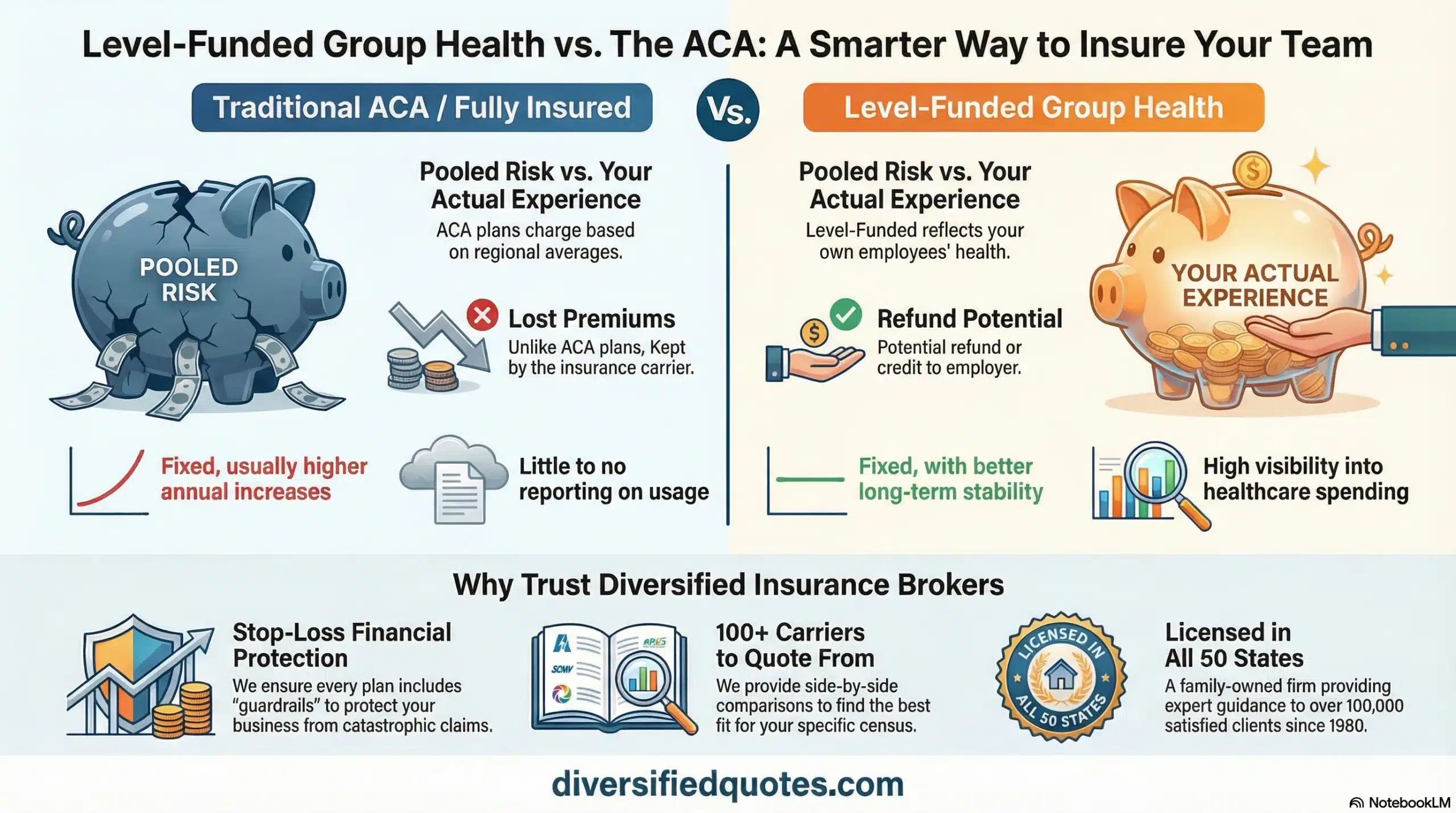
A level-funded plan combines elements of both. It provides the predictable monthly payment structure of a fully insured plan — employers pay the same fixed amount each month — while incorporating the underlying mechanics of self-funding, where claims are actually paid from a dedicated fund rather than from the carrier’s general risk pool. This hybrid structure is what creates the potential for year-end surplus (when claims run better than expected), and it is also what opens the door to the tax treatment advantages that fully insured premiums cannot provide in the same way. Understanding why employers choose group level funding reveals both the financial logic and the practical advantages that have driven adoption of this model among small and mid-sized businesses over the past decade.
The three components of a level-funded monthly payment — claims funding, stop-loss insurance, and administrative services — each have their own cost structure, their own risk characteristics, and potentially their own tax treatment. Disaggregating these three components is the starting point for understanding what level-funded tax benefits actually look like in practice, and it is the framework that allows tax advisors and group health brokers to have productive conversations about plan design choices and their downstream financial effects. For employers asking how much health insurance their business needs, understanding the level-funded structure is essential context for making that sizing decision accurately.
How Level-Funded Health Plans Are Structured From a Tax Perspective
Level-funded plans combine predictable monthly payments with self-funded claim mechanics. Employers typically pay a fixed monthly amount that includes three major components: expected claims funding, fixed administrative costs, and stop-loss insurance premiums. Because these payments are directly tied to providing employee health benefits, many employers treat them as ordinary business expenses deductible under Section 162 of the Internal Revenue Code, which allows deductions for ordinary and necessary expenses paid or incurred in carrying on a trade or business.
The predictable payment structure makes budgeting easier than traditional self-funding, where claim spikes in any given month can create significant variance in actual expense. From a tax standpoint, the monthly structure also creates consistent expense recognition patterns that simplify both accounting and forecasting. An employer on a calendar fiscal year can predict with reasonable accuracy what their group health expense line will look like for each month of the year, which is not possible under a pure self-funded structure where claims fluctuate. This predictability is not just an operational convenience — it has real value in the context of tax planning, where the timing of deductions can interact with income recognition, estimated tax obligations, and year-end financial strategy.
The accounting method an employer uses — cash basis or accrual — has an important bearing on exactly when and how level-funded expenses are recognized. Cash basis taxpayers generally deduct expenses when they are actually paid, which means the level-funded monthly payment is typically deductible in the month it is made. Accrual basis taxpayers may recognize expenses when the liability is incurred, which can sometimes differ from when cash actually changes hands. The structure of level-funded payments typically fits cleanly into either framework, which is one reason tax advisors often find level-funded plans easier to handle from a documentation and reporting standpoint than plans with irregular, claims-driven expense patterns. Coordinating this accounting question with your CPA before the plan year begins — rather than trying to reconcile it after the fact — is the most reliable approach to capturing the full deduction benefit.
Claims Funding Contributions and Deductibility
Claims funding contributions represent the portion of the monthly level-funded payment that is allocated toward expected medical claims for covered employees. While these contributions are not technically classified as “insurance premiums” in the traditional sense — because the claims are technically being paid from a dedicated fund rather than from the carrier’s risk pool — they are typically treated as part of the cost of providing employee health benefits, which makes them deductible as ordinary business expenses for most employers.
The predictability of level-funded claims funding offers several practical advantages beyond pure deductibility. Because the claims fund contribution is fixed at the beginning of the plan year and does not change with actual claims activity, employers can model their healthcare expense with confidence and avoid the cash flow disruptions that occur when a self-funded plan experiences a bad claims month. Businesses with seasonal income patterns — construction companies, retailers, agricultural operations, professional services firms with uneven revenue cycles — sometimes find that this predictability is particularly valuable because it allows healthcare expenses to be matched against revenue cycles without imposing additional volatility.
One important nuance in claims funding deductibility is the relationship between the claims fund structure and the carrier or third-party administrator. Some level-funded arrangements are structured so that the employer’s claims fund contribution is effectively held in trust or in a dedicated account managed by the TPA, while others are structured as a more direct transfer of funds to the carrier who then manages claims payment. The specific structure of these arrangements can affect how the CPA categorizes and documents the deduction, and it is worth requesting clear documentation from the carrier or TPA about the legal structure of the claims fund before the first filing that includes these deductions.
Stop-Loss Insurance and Tax Treatment
Stop-loss insurance is the risk management layer that makes level-funded plans accessible to employers who want the financial upside of self-funding without unlimited claims exposure. Stop-loss comes in two forms: specific stop-loss, which caps the employer’s liability for any single member’s claims at a defined attachment point, and aggregate stop-loss, which caps the employer’s total claims liability for the entire plan at a defined percentage of expected claims. Together, these two forms of stop-loss define the employer’s maximum financial exposure under the level-funded arrangement and provide the predictability that distinguishes level-funded from pure self-funding.
Stop-loss premiums are typically treated similarly to traditional business insurance premiums for tax purposes — they are generally deductible as ordinary and necessary business expenses in the year they are paid or incurred, subject to the employer’s accounting method. This treatment is relatively straightforward compared to the claims funding component, because stop-loss premiums look and function much like conventional insurance premiums from both a legal and accounting standpoint. The insurance carrier accepts the premium, assumes the defined risk, and makes payments when claims exceed the applicable threshold. The tax treatment follows that conventional insurance premium framework accordingly.
The specific stop-loss structure chosen — particularly the attachment point selection — has important implications for the overall cost allocation between premium expense and retained claims risk. A lower specific stop-loss attachment point (meaning the employer is protected at a lower per-member claims threshold) increases the stop-loss premium but reduces the amount of claims risk the employer retains. A higher attachment point reduces the premium but increases retained exposure. From a tax perspective, both components — premium and retained claims — are typically deductible, but the timing can differ: stop-loss premiums are deductible when paid, while retained claims are deductible when paid to providers. Understanding stop-loss insurance in level-funded plans in full detail is an important prerequisite to making the attachment point decision wisely. Our resource on group health insurance cost for small businesses provides useful context for how stop-loss structure affects total plan cost at different employer sizes.
Administrative Costs and Expense Treatment
Administrative services only (ASO) fees cover the third component of the level-funded monthly payment: the cost of running the plan operationally. These fees typically cover claims processing and adjudication, network access and repricing, compliance reporting and documentation, eligibility management, employee communications, and customer service infrastructure. Because these services are integral to operating the health benefit plan, ASO fees are generally expensed as ordinary business costs in the same way that other management and administrative expenses are treated.
One of the practical advantages of the level-funded structure is that administrative costs are bundled into the fixed monthly payment rather than invoiced separately as variable administrative charges. This bundling simplifies expense categorization and forecasting, because the employer sees a single monthly line item that covers all three cost components rather than separate invoices for claims, stop-loss, and administration that must be tracked, reconciled, and categorized individually. For businesses with lean accounting functions, this simplified structure reduces the administrative burden of managing the health plan’s financial records and minimizes the risk of documentation errors that could complicate tax filing.
Some level-funded arrangements allow employers to request itemized breakdowns of the monthly payment showing the allocation across claims funding, stop-loss premium, and administrative fees. While the consolidated payment is typically adequate for most tax filing purposes, having this itemization available can be valuable if a tax advisor wants to analyze the cost structure in detail, if there is a question about how specific components should be characterized, or if the employer is comparing the true all-in cost of the level-funded plan against alternative funding models. Requesting this documentation upfront is a best practice, even if it turns out not to be necessary for the immediate filing.
Year-End Surplus and After-Tax Cost Impact
One of the most frequently discussed potential benefits of level-funded plans — and one of the most commonly misunderstood — is the possibility of year-end surplus. When a group’s actual claims for the year run lower than the funding amount collected, some level-funded contract structures return the unused portion of the claims fund to the employer after a defined run-out period during which late claims can still be submitted and adjudicated. This surplus — if and when it materializes — represents a genuine reduction in the net cost of the health benefit program for that year, and its financial significance can be substantial when a group has a favorable claims year.
The tax treatment of surplus is one of the areas where early coordination with a CPA is most important, because the appropriate treatment depends on how the original claims fund contributions were characterized, how the surplus is applied or returned, and the employer’s accounting method. If the employer deducted the full monthly claims funding contribution in each month as an ordinary business expense, then a surplus return in a subsequent period may need to be recognized as income in the year received — effectively reversing a portion of the prior-year deduction. Alternatively, if the surplus is applied as a credit against future monthly payments, the employer would simply have lower deductible expenses in the months when the credit applies. Getting this treatment documented and consistent across plan years requires proactive communication between the group health broker, the TPA or carrier, and the employer’s tax advisor.
It is essential to treat surplus as upside potential rather than guaranteed savings in any financial planning or budgeting exercise. Whether unused claims dollars are returned depends entirely on actual claims experience, the plan’s stop-loss structure, the specific contract language governing surplus distribution, and the run-out period during which late claims can still be filed against the prior year’s fund. A group that has a good claims year one year may have a challenging year the next. Any surplus projections that treat potential refunds as reliable cost reductions are likely to create financial planning problems when actual experience diverges from projections. The right approach is to budget assuming no surplus and treat any return of funds as an unexpected financial improvement rather than a planned cost reduction.
Cash Flow Timing Advantages
Beyond pure deductibility, level-funded plans offer meaningful cash flow timing advantages that have practical value for businesses managing their finances throughout the year. Because the monthly payment is fixed and predictable, employers can reserve the appropriate amount each month without uncertainty about whether a claims-heavy month will require a larger-than-planned payment. This predictability extends to quarterly estimated tax payments, year-end accrual adjustments, and annual budgeting exercises — all of which are simpler when one of the company’s largest expense line items behaves consistently throughout the year.
Contract basis selection — whether the plan is structured on a 12/12 basis or an extended basis such as 12/15 or 12/18 — influences when claims are paid and recognized, which can have meaningful implications for year-end financial reporting. A 12/12 contract covers claims incurred during the plan year and paid within the same 12-month period. An extended run-out basis extends the window during which claims incurred in the plan year can be paid and counted against that year’s funding, which can affect both the stop-loss calculation and the timing of surplus determination. While the choice of contract basis typically does not change the total deduction over time, it can materially impact how expenses and liabilities are reported at year-end — a consideration that matters particularly for businesses with formal financial statements, bank covenants, or investor reporting obligations.
For employers evaluating level-funded plans for the first time, understanding how cash flow timing interacts with their specific fiscal year, revenue seasonality, and tax filing deadlines is an important part of the implementation planning process. Our resource on how to set up group health insurance for employees covers the implementation steps in detail, and our guide on how to get the best group health insurance rates addresses the evaluation process that precedes plan selection.
Entity Structure Considerations
Entity structure is one of the most important variables in the level-funded tax analysis, because different business structures have different rules governing how health benefit costs are deducted, how owner participation is handled, and how payroll tax treatment interacts with benefit funding. Getting this analysis right requires coordination between the group health broker, the employer’s CPA, and sometimes the employer’s legal counsel, because the rules are nuanced and the consequences of getting them wrong can include disallowed deductions, incorrect payroll tax reporting, or compliance exposure under applicable plan regulations.
C-corporations generally have the most straightforward treatment of employer-paid health benefit costs. A C-corporation can deduct health insurance premiums and equivalent level-funded costs as ordinary business expenses, and these costs are generally not taxable to employee participants as compensation. Owner-employees of a C-corporation can participate in the health plan on the same terms as other employees, with the corporation deducting the cost and the owner not recognizing the benefit as taxable income. This favorable treatment makes the C-corporation structure particularly well-suited to level-funded plans from a tax efficiency standpoint.
S-corporations face more complex rules when it comes to owner participation. S-corporation shareholders who own more than 2 percent of the company’s stock are treated as self-employed individuals for purposes of health insurance benefit taxation. This means that health insurance premiums or equivalent level-funded costs paid on behalf of a more-than-2-percent shareholder must generally be included in the shareholder’s W-2 wages, though the shareholder may then be eligible for a self-employed health insurance deduction on their individual return. The interaction between this reporting requirement and the company-level deduction needs to be carefully coordinated with payroll and tax advisors to ensure both the W-2 reporting and the individual deduction are handled correctly.
Partnerships and LLCs taxed as partnerships face similar complexity for partners who participate in health benefit plans. Health insurance costs paid for partners are generally treated as guaranteed payments, which creates specific reporting and deduction rules that must be followed. For employer groups with complex ownership structures, evaluating level-funded plans requires a conversation about entity structure first — not as an afterthought — to ensure that the plan design aligns with the applicable ownership and compensation rules. Our resource on minimum employees required for group health insurance addresses the group size thresholds that also interact with entity structure in determining plan eligibility.
Payroll and Eligibility Impact on Tax Efficiency
Level-funded plans typically require W-2 employee participation, which creates an important boundary around who can be covered under the plan and who cannot. Independent contractors, 1099 workers, and other non-employee individuals are generally ineligible to participate, and including ineligible participants in the plan can create serious compliance complications that affect both the plan’s qualified status and the employer’s tax documentation. Proper classification of workers before establishing a level-funded plan is not just a compliance best practice — it is a prerequisite for ensuring that the plan’s tax treatment is clean and defensible.
For employers with mixed workforces of W-2 employees and 1099 contractors, this distinction is particularly important. While the question of whether 1099 workers can access group level funding is one that many employers raise, the answer requires careful analysis of each worker’s classification, the employer’s relationship with those workers, and the specific carrier’s participation requirements. Misclassifying a worker as either an employee or a contractor — intentionally or unintentionally — can trigger audit exposure, back taxes, and penalties that far exceed any short-term cost savings from improper plan participation.
Participation rates among eligible employees also affect the plan’s economics and its tax efficiency. Most level-funded carriers require a minimum participation percentage among eligible employees, and plans that fall below that threshold may not be available or may face adverse underwriting terms. Higher participation rates generally produce more stable claims experience — a more representative cross-section of health risks — which supports more accurate claims funding projections and reduces the risk of adverse selection that can destabilize the plan’s financial performance. Stable claims experience is directly connected to surplus potential, which is one of the primary tax-related financial advantages of a well-functioning level-funded plan.
Risk Retention vs. Premium Allocation Strategy
The attachment point decision in stop-loss design is fundamentally a risk retention versus premium allocation choice, and it has meaningful implications for both the employer’s cash flow and the plan’s overall tax efficiency. The attachment point defines the threshold at which the stop-loss insurer takes over responsibility for an individual member’s claims. A low attachment point — say, $25,000 per member — means the stop-loss carrier absorbs claims above that level, and the employer’s per-member exposure is capped at $25,000 plus the administrative and claims fund costs. A high attachment point — $100,000 or more — means the employer retains more risk per member but pays a lower stop-loss premium to achieve that higher threshold of protection.
From a tax perspective, both the stop-loss premium and the retained claims are generally deductible, so the total deduction available over time may not differ dramatically between a low-attachment and high-attachment structure. The difference lies in the volatility and timing of that deduction. A low-attachment plan with higher premiums produces consistent, predictable deductions month after month. A high-attachment plan with lower premiums produces smaller monthly premium deductions but larger, potentially lumpy deductions when retained claims are paid directly to providers or through the claims fund. For employers on accrual accounting who want smooth, predictable expense recognition, a lower attachment point structure often fits better. For employers with strong cash reserves who want to minimize monthly premiums and are comfortable with retained risk, a higher attachment point may produce better economics.
Laser provisions deserve particular attention in this analysis. A laser is a specific stop-loss provision that excludes a specific high-cost individual from the standard stop-loss coverage or raises their individual attachment point above the plan’s standard threshold, typically because that individual has a known condition that creates predictable high claims. While lasers can reduce the overall stop-loss premium, they increase the employer’s retained exposure for the lasered individual — potentially significantly. The after-tax impact of a laser needs to be modeled carefully across multiple claims scenarios, because the savings from the reduced premium can be offset by the additional claims liability if the lasered individual’s health situation deteriorates during the plan year.
Comparison of Funding Models: Tax and Cost Perspective
| Feature | Fully Insured | Level-Funded | Self-Funded |
|---|---|---|---|
| Monthly Payment Predictability | Fixed premium; fully predictable | Fixed monthly payment; predictable | Variable; claims-driven volatility |
| Surplus Potential | None; carrier retains all savings | Yes; may receive refund if claims are low | Yes; employer retains all savings directly |
| Claims Risk | Fully transferred to carrier | Shared; stop-loss caps exposure | Primarily retained; stop-loss optional |
| Deductibility | Premiums deductible as business expense | Components generally deductible as business expense | Claims and premiums deductible when paid/incurred |
| State Insurance Regulation | Subject to state mandates | Often ERISA-governed; may avoid state mandates | ERISA-governed; avoids state mandates |
| Data Access | Limited claims data visibility | Meaningful claims data available | Full claims data access |
| Minimum Group Size | Available for 1+ employee in most states | Typically 2+ Employees | Typically 50+ employees for viability |
ERISA Preemption and State Mandate Avoidance
One of the less-discussed but practically significant advantages of level-funded plans — particularly for employers in states with extensive health insurance mandates — is that properly structured level-funded plans are typically governed by ERISA (the Employee Retirement Income Security Act) rather than state insurance regulations. This is because level-funded plans are technically self-funded at the claims payment level, which brings them under ERISA’s federal framework and generally preempts state insurance mandates that apply to fully insured carriers.
The practical implication is that a level-funded plan may not be required to include certain state-mandated benefits that a fully insured plan in the same state would be legally required to cover. Depending on the state, these mandated benefits can include fertility treatments, specific mental health parity provisions, chiropractic coverage, and various other services that add cost to the fully insured premium. By operating under ERISA rather than state insurance law, a level-funded employer can potentially design a plan that provides the benefits their employees genuinely use and value without paying for mandated benefits that have low utilization in their specific workforce population.
This design flexibility interacts directly with the tax analysis because a more cost-efficient plan design — covering the right benefits at the right levels without paying for unused mandated additions — reduces the total plan cost that the employer is deducting. Lower plan costs mean lower total tax deductions, of course, but they also mean higher retained earnings for the business, which are available for investment, compensation, or other purposes. The net economic benefit of mandate avoidance depends on which mandates would otherwise apply, how much they cost, and how the resulting premium savings compare to any increased compliance costs associated with operating a self-funded/level-funded plan under ERISA. Working with an independent group health broker who understands both the regulatory landscape and the plan design implications is essential for this analysis.
Claims Data Access and Long-Term Cost Management
One of the structural advantages that level-funded plans share with self-funded plans — and that fully insured plans do not provide — is meaningful access to claims data. Under a fully insured arrangement, the carrier owns the claims data and typically provides employers only with aggregate utilization reports that lack the granularity needed to drive meaningful cost management decisions. Under a level-funded arrangement, employers typically receive more detailed claims information from their TPA, which can be analyzed to identify utilization patterns, high-cost conditions, and opportunities for targeted intervention.
Why does this matter from a tax and cost perspective? Because claims data access enables proactive plan management that can meaningfully reduce costs over time — and lower costs translate directly to lower tax deductions, yes, but also to lower total outlays for health benefits. An employer who identifies that a significant portion of claims are being driven by a small number of high-utilization members may be able to implement targeted wellness programs, disease management support, or benefits design changes that reduce claim frequency or severity in subsequent years. Over multiple plan years, this kind of data-driven management can compound into substantial cost advantages that a fully insured employer — operating without visibility into claims patterns — cannot achieve.
The long-term strategic value of level-funded planning is most fully realized when employers commit to actively managing the plan across multiple renewal cycles rather than treating it as a one-year premium decision. Groups that invest in wellness programs, participate in utilization management, review claims data regularly, and work with their broker and TPA to optimize plan design year over year consistently report better long-term financial outcomes than groups that simply renew the same plan design year after year without evaluation. Reviewing resources like how to choose the right group health plan each year — rather than auto-renewing — is part of that discipline. Similarly, our guide on getting a second opinion on your group health insurance quote provides a structured approach to validating that your current arrangement is still competitive before each renewal.
When Level-Funded Plans Tend to Deliver Maximum Tax Efficiency
Level-funded plans tend to produce their best financial outcomes — including their strongest tax efficiency advantages — in specific circumstances that are worth understanding before committing to this funding model. Stable groups with predictable utilization patterns, strong workforce participation, and moderate demographic risk distribution tend to experience the most favorable outcomes. When the group’s actual claims run consistently near or below the expected level, the claims funding component of the monthly payment is well-calibrated, surplus potential is meaningful, and the total net cost of the plan is genuinely competitive with fully insured alternatives.
Groups with strong wellness participation or lower rates of chronic health conditions tend to generate more favorable claims experience, which directly supports better surplus outcomes and stronger after-tax cost efficiency. Employers who actively encourage preventive care, participate in disease management programs offered through their TPA, and design plan benefits in ways that incentivize cost-effective care utilization tend to see this reflected in their year-over-year claims trends.
Employers with consistent revenue cycles and stable workforce sizes also benefit from the predictable expense patterns that level-funded plans provide. When both revenue and health benefit costs are predictable, the accounting and tax planning work is simpler, the matching of expenses to revenues is cleaner, and the year-end reporting process is more straightforward. For employers considering level-funded plans for the first time, our resource on small employer group health insurance options and our guide to small business group health insurance more broadly provide the sizing and eligibility context that determines whether level-funded is even available and appropriate for a given employer’s situation.
Common Mistakes That Reduce Level-Funded Tax Advantages
Several common planning mistakes can reduce or eliminate the tax advantages available through a level-funded plan, and most of them are avoidable with adequate preparation. The first and most common is overestimating surplus likelihood in financial projections. Surplus should always be treated as upside potential — a pleasant financial surprise if it materializes — rather than as a reliable cost reduction built into the budget. Employers who plan their finances assuming surplus will materialize and then experience a challenging claims year face a double problem: higher-than-expected health costs and a budget that was built on an assumption that did not come true.
Failing to coordinate plan design with tax advisors early in the process is another common mistake. Many employers choose a level-funded plan based on the broker’s recommendation and then ask their CPA about the tax treatment after the plan is already in place. By that point, decisions about accounting method, expense classification, and entity-level owner participation that should have been made upfront are already baked in — and correcting them may require plan amendments, retroactive accounting adjustments, or in some cases, a plan year of suboptimal tax treatment before the right structure can be implemented going forward.
Misaligned payroll eligibility structures — including the inadvertent coverage of ineligible workers, incorrect treatment of owner-employees, or failure to document the basis for eligibility determinations — can create compliance complications that affect both the plan’s qualified status and the deductibility of the contributions. These complications are often discovered during audit or at tax filing time, when the cost of correcting them is higher than the cost of preventing them would have been. Working with an advisor who understands both the insurance mechanics and the tax framework from the outset is the most reliable prevention. Our resource on ACA alternatives for company healthcare and on top questions employers ask about group health insurance address many of the related planning considerations that employers navigating these decisions frequently raise.
See If Level-Funded Plans Improve Your After-Tax Cost
We model claims scenarios, surplus potential, and tax treatment side-by-side.
Long-Term Strategic Value of Level-Funded Planning
Level-funded health insurance tax benefits explained fully means viewing the plan not as a one-year premium decision but as a component of multi-year financial strategy. Over multiple renewal cycles, predictable claims patterns and surplus cycles can compound into meaningful financial advantage. Employers who approach level-funded planning with a three-to-five-year perspective — evaluating year-over-year claims trends, adjusting plan design in response to utilization data, and managing renewal negotiations from a position of data — consistently achieve better outcomes than those who treat each year’s renewal as an isolated cost management exercise.
For employers who want to explore how level-funded plans compare to other ACA alternatives and emerging funding models, our resource on ACA subsidies expired alternatives provides context for the broader landscape of employer health insurance options. And for businesses evaluating whether their current group health arrangement is optimally structured, the second opinion on your group health insurance quote process provides a structured way to validate that the plan, carrier, and TPA arrangement in place is as competitive as the market currently allows.
Request a Level-Funded Risk and Tax Strategy Review
Understand your exposure, surplus potential, and after-tax impact before choosing a funding model.
Related Level-Funded & Group Health Guides
Continue learning how funding models, stop-loss structure, and employer size influence cost, compliance, and after-tax outcomes.
Financial Protection Essentials
Retirement income strategy, business planning, beneficiary considerations, and long-term care resources.
Talk With an Advisor Today
Choose how you’d like to connect—call or message us, then book a time that works for you.
Schedule here:
calendly.com/jason-dibcompanies/diversified-quotes
Licensed in all 50 states • Fiduciary, family-owned since 1980
FAQs: Level-Funded Health Insurance Tax Benefits Explained
Are level-funded plan payments tax-deductible for employers?
In most cases, employers treat level-funded plan costs as ordinary and necessary business expenses deductible under Section 162 of the Internal Revenue Code. The three components of the monthly payment — claims funding, administrative fees, and stop-loss premiums — are each generally deductible as costs incurred in providing employee health benefits. Because health benefits are widely recognized as a legitimate ordinary business expense, the deductibility of level-funded plan costs is generally straightforward for most employer entities.
The specific timing and classification of each deduction — whether it is recognized when paid or when the liability is incurred — depends on the employer’s accounting method. Cash basis taxpayers generally deduct level-funded payments in the month they are made. Accrual basis taxpayers may need to analyze when the liability for each component is deemed incurred under applicable accounting standards. The level-funded structure’s predictable monthly payment typically fits cleanly into either framework, which simplifies the accounting treatment compared to self-funded plans with variable monthly claims obligations.
Because the interaction between plan structure, accounting method, and entity type can create nuances in how the deduction is properly taken, coordinating with your CPA before the plan year begins — rather than after — is strongly recommended. The details matter, and getting the documentation right upfront prevents complications at filing time.
Is the “claims fund” portion treated differently than insurance premiums?
Yes, it can be — and this distinction is one of the more technically nuanced aspects of level-funded plan accounting. The claims-funding portion of the monthly payment is not technically a traditional insurance premium in the conventional sense, because the claims are being paid from a dedicated fund rather than from the carrier’s general insurance risk pool. Instead, claims funding is generally considered part of the cost of providing employee health benefits — an ordinary business expense — that happens to be structured as a fixed monthly contribution rather than a variable claims payment.
Many employers and their CPAs expense the claims funding contribution as a business cost in the same category as other employee benefit expenses, without drawing a sharp distinction between the claims fund and the stop-loss premium for deduction purposes. However, some accounting frameworks do distinguish between these components, and carriers and TPAs may structure their documentation differently in ways that make the distinction more or less visible in the employer’s records. Requesting an itemized breakdown of the monthly payment components from your carrier or TPA is a best practice that supports clean documentation and gives your CPA the information needed to make the appropriate categorization.
Are stop-loss premiums deductible?
Yes. Stop-loss premiums are generally treated like other business insurance expenses and are commonly deducted as ordinary business costs in the year paid or incurred. Because stop-loss insurance functions as conventional insurance — the employer pays a premium, the carrier assumes defined risk, and claims payments are triggered by specific contractual conditions — the premium deduction follows the same framework that applies to other types of business insurance.
The stop-loss structure chosen — both specific and aggregate attachment points — influences the total premium amount but does not typically change the fundamental deductibility of that premium. Higher attachment points produce lower premiums (and therefore smaller deductions from that component), while lower attachment points produce higher premiums (and larger deductions). The retained claims that remain below the attachment point are also deductible when paid, so the total deduction available over time does not necessarily differ dramatically between high-attachment and low-attachment structures — the difference lies primarily in the timing and predictability of the deductions.
Contract basis details — including the timing of reimbursement for claims that exceed the specific stop-loss threshold — can affect when the stop-loss reimbursement reduces the employer’s net expense and how that reduction is recorded. Your CPA and your stop-loss carrier should both be involved in documenting these details correctly for the applicable plan year.
How is year-end surplus typically handled for tax purposes?
Surplus treatment is one of the areas where early CPA coordination is most important, because the appropriate tax treatment depends on how the original claims fund contributions were characterized, how the surplus is applied or returned, and the employer’s accounting method. If the employer fully deducted monthly claims funding contributions as ordinary business expenses throughout the year, then receiving a surplus return — whether as cash or as a credit against future payments — may need to be recognized as income in the year received, effectively reversing a portion of the deduction that was taken in the prior year.
If the surplus is applied as a credit against future monthly payments rather than returned as cash, the employer would not receive a taxable payment but would have reduced deductible expenses in the months when the credit is applied. This is generally a simpler tax outcome than a cash surplus return, though it delays the financial benefit until future months rather than providing an immediate return of funds.
The key is to document the treatment consistently across plan years and to ensure that the carrier or TPA’s year-end surplus documentation provides the level of detail that the CPA needs to apply the correct treatment. Surprise surplus amounts that appear without adequate documentation can create filing complications that are more disruptive to resolve retroactively than they would have been to prevent with adequate upfront planning.
Is surplus guaranteed in level-funded plans?
No — surplus is never guaranteed, and treating it as guaranteed in financial planning or tax projections is one of the most common and consequential planning mistakes employers make with level-funded plans. Whether any unused claims dollars are returned depends entirely on the group’s actual claims experience for the year, the specific stop-loss structure and attachment points, the program’s run-out provisions, and the contract language governing surplus distribution. A group that has a favorable claims year may receive a meaningful surplus return. A group that has a challenging year — due to one or more high-cost members, a particularly severe flu season, or any number of other factors — will have no surplus and may actually have stop-loss claims that reduce the carrier’s net exposure relative to the claims fund.
The right financial planning approach treats surplus potential as an upside scenario — a positive outcome that improves the plan’s economics if it occurs — rather than as a base case assumption. Any budget that relies on level-funded surplus to meet a target health benefit cost is a budget that is one bad claims year away from a significant variance. The prudent approach is to budget conservatively, assuming no surplus, and to communicate clearly to stakeholders that any surplus return will be recognized as an improvement to actual costs rather than a planned reduction.
Does contract basis affect tax treatment?
Contract basis — whether the plan is structured on a 12/12, 12/15, or other extended run-out basis — primarily affects claims timing and stop-loss protection timing, which in turn can influence when claims are paid, when stop-loss reimbursements are received, and how the plan’s financial activity maps to the employer’s fiscal year. While contract basis typically does not change the overall deductibility of plan costs, it can affect when specific costs hit the employer’s books and how cleanly the year-end financial picture reflects the plan’s actual performance for a given period.
For employers on an accrual basis with formal financial reporting obligations — particularly those with bank covenants, investor reporting requirements, or formal audits — the choice of contract basis can have meaningful implications for year-end balance sheet and income statement presentation. A 12/12 plan that closes the claims window sharply at year-end creates a cleaner financial boundary than an extended run-out arrangement where significant claims are still being processed and adjudicated after the fiscal year has closed. Discussing contract basis selection with both the broker and the CPA before the plan is implemented ensures that the choice aligns with the employer’s accounting and reporting framework.
Can independent contractors (1099s) be covered under a level-funded plan?
Most level-funded programs require W-2 employee status for participation eligibility, and independent contractors are typically excluded. This is not unique to level-funded plans — most group health insurance arrangements, whether fully insured or self-funded, restrict participation to individuals who meet the definition of an eligible employee under the plan documents and applicable law. The distinction matters because misclassifying a contractor as an employee to include them in a benefit plan creates compliance exposure that can affect the plan’s qualified status and the employer’s tax documentation.
For employers with mixed workforces, this boundary requires careful worker classification analysis before the plan is implemented. If the workforce classification question is not fully resolved before the plan is set up, including ineligible workers can trigger issues during underwriting, audit, or plan review that are more costly to resolve than they would have been to prevent. Our resource on whether 1099 contractors can access group level funding addresses this question in detail and explains when and how contractors may have access to alternative coverage options.
Do business owners qualify for level-funded coverage?
Owner eligibility depends on the entity type, how the owner is compensated, and the carrier’s underwriting rules. C-corporation owner-employees who receive W-2 wages generally qualify for the plan on the same terms as other employees, with the corporation deducting the benefit cost and the owner not recognizing the benefit as taxable compensation. This is the most straightforward ownership participation scenario from both a tax and compliance standpoint.
S-corporation shareholders who own more than 2 percent of the company must have the health benefit cost reported as W-2 wages, though they may then be eligible for a self-employed health insurance deduction on their individual return. Partners and LLC members face similar complexity under partnership tax rules. Because owner participation intersects with compensation structure, payroll reporting, and entity-level tax treatment in ways that require careful coordination, it is essential to discuss ownership participation specifically with the CPA and broker before establishing the plan — not after the first year of operation.
What plan design choices most influence after-tax cost?
The biggest drivers of after-tax cost in a level-funded plan are the stop-loss attachment point selection, the contract basis structure, the administrative fee arrangement, and whether the program returns any unused claims dollars at year-end. Two plans with similar headline monthly pricing can have meaningfully different after-tax outcomes depending on how these design choices play out over the course of a plan year — and particularly over multiple plan years.
Attachment point selection is often the most consequential single design choice, because it determines how much claims risk the employer retains versus how much is transferred to the stop-loss carrier. Lower attachment points increase premium cost but reduce volatility; higher attachment points reduce premium but increase the employer’s exposure to individual large claims. The right attachment point depends on the employer’s financial capacity to absorb retained risk, the size and health profile of the group, and the premium savings available at different attachment levels. Modeling the after-tax outcomes under multiple claims scenarios — including a good year, an average year, and a challenging year — before selecting the attachment point is the most reliable approach to making this decision confidently.
Is level-funded always better than fully insured plans?
Not always — and any broker who presents level-funded as universally superior to fully insured without evaluating the specific employer’s situation is not giving complete advice. Level-funded plans can be an excellent fit for groups that want predictable monthly payments while retaining the potential upside of favorable claims experience, have sufficient workforce stability to produce meaningful claims data, and can accept the additional administrative complexity of operating under ERISA rather than as a fully insured purchaser.
Fully insured plans may fit better when predictability is the only priority and no upside potential is needed, when the group’s eligibility and participation levels make level-funded underwriting difficult to obtain at competitive terms, or when the employer does not have the internal resources or broker support to manage the additional reporting and compliance requirements of a self-funded-equivalent plan. A proper comparison models multiple claims scenarios, evaluates after-tax cost under each scenario, and looks at the full picture of plan economics — not just monthly premiums. Our guide to how to choose the right group health plan provides a structured framework for making this comparison across funding models and plan designs.
How does ERISA preemption affect state tax and mandate obligations?
Level-funded plans that are structured as self-funded arrangements — which most properly designed level-funded plans are — are generally governed by ERISA rather than state insurance regulation. This federal preemption of state insurance law has several important practical implications, one of which is that state-mandated health insurance benefits that apply to fully insured carriers may not apply to the level-funded employer’s plan. Depending on the state, this can reduce required coverage and the associated cost, which in turn reduces the total plan expense that the employer is deducting and paying.
From a tax perspective, avoiding state insurance premium taxes — which apply to premiums paid to insurance carriers in many states but typically do not apply to self-funded claims payments — can also produce meaningful savings in premium-tax-heavy states. The combination of mandate avoidance and premium tax avoidance is one of the structural cost advantages that makes level-funded plans attractive to employers in states with extensive insurance regulation, and it is one reason the spread of level-funded adoption has been particularly strong in heavily regulated states.
It is important to note that ERISA compliance brings its own obligations — including Form 5500 reporting for plans over certain size thresholds, ERISA summary plan description requirements, and fiduciary responsibility obligations for plan administrators. These compliance costs are real and must be factored into any honest comparison of the total cost of level-funded versus fully insured arrangements.
About the Author:
Jason Stolz, CLTC, CRPC, DIA, CAA and Chief Underwriter at Diversified Insurance Brokers (NPN 20471358), is a senior insurance and retirement professional with more than 25 years of real-world experience helping individuals, families, and business owners protect their income, assets, and long-term financial stability. As a long-time partner of the nationally licensed independent agency Diversified Insurance Brokers, Jason provides trusted guidance across multiple specialties—including fixed and indexed annuities, long-term care planning, personal and business disability insurance, life insurance solutions, Group Health, Travel Medical and Evacuation Insurance, and short-term health coverage. Diversified Insurance Brokers maintains active contracts with over 100 highly rated insurance carriers, ensuring clients have access to a broad and competitive marketplace.
His practical, education-first approach has earned recognition in publications such as VoyageATL, and contributions from his agency featured in Kiplinger and GoBankingRates— highlighting his commitment to financial clarity and client-focused planning. Drawing on deep product knowledge and years of hands-on field experience, Jason helps clients evaluate carriers, compare strategies, and build retirement and protection plans that are both secure and cost-efficient. Visitors who want to explore current annuity rates and compare options across multiple insurers can also use this annuity quote and comparison tool.
Explore More Group Health Insurance Options: Browse our complete guide to Level Funding, Self-Funded & ACA Alternatives — covering stop-loss coverage, tax benefits, 1099 options & ACA alternatives from 100+ carriers.
Explore More: Browse our complete Group Health Insurance guide — covering level funded plans, stop-loss coverage & group health solutions for businesses from 100+ carriers.
Last Reviewed: June 14, 2026 |
Reviewed by: Jason Stolz, CLTC, CRPC, DIA, CAA
Chief Underwriter, Diversified Insurance Brokers, Inc. | NPN: 20471358 | Diversified Insurance Brokers, Inc. — Licensed in all 50 states
Fact Checked by: Tonia Pettitt, CMIP©
Medicare Specialist, Diversified Insurance Brokers, Inc. | NPN: 14374308 | Diversified Insurance Brokers, Inc. — Licensed in all 50 states
Did you find this content helpful? Leave us a Google review — it helps others find trustworthy guidance too.
Editorial Standards: Diversified Insurance Brokers maintains rigorous editorial standards to ensure accuracy, clarity, and independence in all content. Learn more about our editorial standards and commitment to transparency.
