
Can Small Groups Get Health Insurance Refunds?

Jason Stolz CLTC, CRPC, DIA, CAA
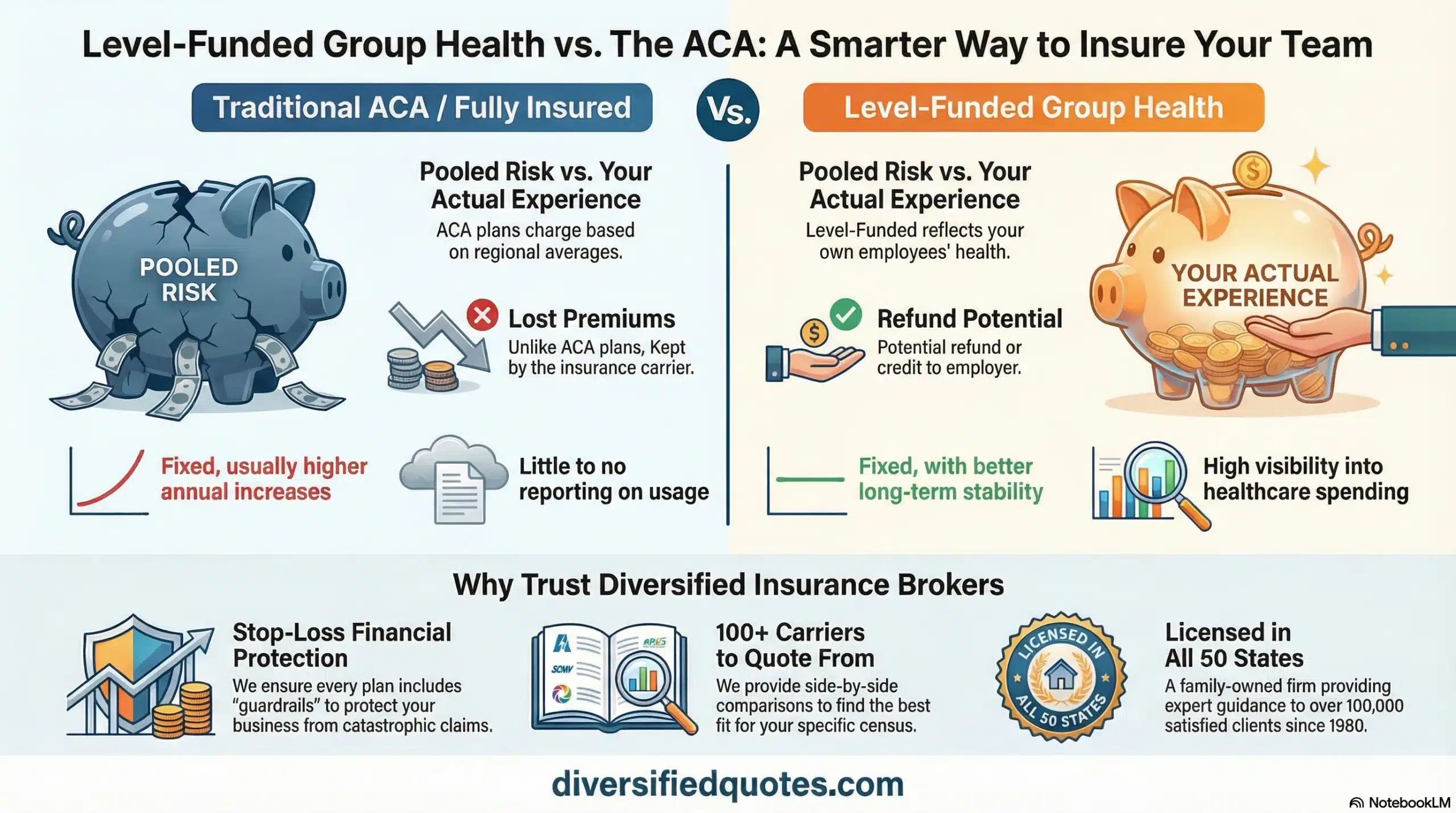
Yes — small groups can get health insurance refunds, but only through specific plan structures that allow unused claims dollars to be returned to the employer. The type of plan matters more than any other factor. In a traditional fully insured group health plan, the insurance carrier collects premiums, assumes the claims risk, and keeps any money left over if claims run below projections. There is no mechanism for the employer to receive a surplus because the carrier owns the risk and the premium. In a level-funded group health plan, the structure is fundamentally different: a portion of the employer’s fixed monthly payment goes into a claims fund that specifically belongs to the group’s claims experience. When actual claims for the year run below the projected target, a portion of the unused claims fund can be returned to the employer — a surplus distribution that reduces the net effective cost of the plan for that year. Understanding this structural difference is the foundation of any small employer conversation about refund-eligible health benefits. Our resource on why group level funding can make sense covers the full value proposition for small employers, and our resource on what is self-funded group health insurance covers the self-funded model that level-funding is derived from.
The appeal of level-funded plans for small employers has grown significantly in recent years. According to Kaiser Family Foundation employer health benefits survey data, the percentage of small firms offering level-funded plans has risen dramatically — from a small fraction of the market to roughly a third of small employers — driven by growing awareness of the cost management and surplus potential that level-funding provides compared to traditional fully insured plans. The core structure is straightforward: the employer pays a fixed monthly amount that covers three components — a claims-funding portion, administrative service fees, and stop-loss insurance premiums. The fixed payment gives the employer the predictability of a fully insured plan while retaining the claims-experience upside that only applies to self-funded structures. When claims run below expectations, the claims fund has money left in it. Depending on the carrier’s contract terms, a portion of that remaining balance is returned at year end or credited toward future premiums. When claims run above expectations, stop-loss insurance — the third component of the monthly payment — covers costs beyond the defined threshold, protecting the employer from catastrophic exposure. Our resource on understanding stop-loss insurance in level-funded plans covers both specific and aggregate stop-loss structures in plain language.
The refund potential is real but not guaranteed, and evaluating it correctly requires understanding both the probability-weighted value of the surplus and the complete cost picture — including administrative fees, stop-loss premiums, and the claims risk being retained. A group that consistently runs low claims and has stable participation is a genuinely strong level-funding candidate. A group with unpredictable claims history, high turnover, or several employees with known chronic conditions may find that the stop-loss protection functions as expected (protecting from catastrophic costs) but the surplus never materializes because claims regularly meet or exceed projections. Matching the funding model to the group’s specific risk profile — not chasing a refund as a headline — is the right frame for this decision. Our resource on pros and cons of self-funded group health covers the risk-reward tradeoff analysis in detail.
Get a Level-Funded Plan Comparison
We model surplus potential across multiple carriers and compare net cost under optimistic, expected, and high-claims scenarios — before you commit to any plan design.
Request a Plan ComparisonThree Health Plan Funding Models — Where Refund Potential Comes From
The refund question makes sense only in the context of comparing all three primary health benefit funding models available to small employers. The table below maps each model against the factors that determine whether surplus or refunds are possible.
| Feature | Fully Insured | Level-Funded | True Self-Funded |
|---|---|---|---|
| Monthly payment structure | Fixed premium to carrier; carrier assumes all claims risk; no reconciliation at year end | Fixed monthly amount = claims fund + admin fees + stop-loss premiums; claims fund reconciled against actual experience at year end | Variable — employer pays actual claims as incurred plus admin fees and stop-loss; monthly costs fluctuate with claims activity |
| Refund / surplus potential | No — carrier keeps any unused premium if claims are favorable; employer has no claim on surplus | Yes — if actual claims are below the funded target, a portion of the unused claims fund may be returned to the employer or credited toward future premiums | Yes — employer owns the claims fund; any unspent balance is retained; but variable payments mean favorable years produce “savings” not a distinct refund event |
| Stop-loss protection | Not applicable — carrier absorbs all claims risk including catastrophic events | Built in — specific stop-loss per member (commonly $5,000–$50,000 threshold) and aggregate stop-loss for the whole group protect the employer from high-claims exposure | Typically purchased separately; employer bears claims risk up to stop-loss thresholds; stop-loss structure and attachment points are fully negotiated |
| Claims data access | Limited or none — carrier typically does not share detailed claims data with small group employers | Yes — employer typically receives claims utilization reports enabling wellness program targeting, plan design optimization, and more informed renewals | Full access — employer or TPA has complete view of all claims activity |
| ACA compliance / state regulation | Subject to all ACA requirements and state insurance regulations including essential health benefits, community rating, and MLR minimums | ERISA-governed (generally exempt from many state insurance mandates, not subject to state community rating or ACA small group market rules); more design flexibility | ERISA-governed; same design flexibility as level-funded; exempt from state insurance mandates |
| Budget predictability | Highest — fixed premium, no year-end adjustment, no cash reserve requirement | High — fixed monthly payment provides the same budgeting predictability as fully insured; surplus is upside, not a required cash outlay | Lower — actual monthly costs vary with claims; requires employer cash reserves to fund claims as they occur |
| Minimum group size typically needed | As few as 1-2 employees in many states | Typically 2–50+ employees; most carriers require minimum participation; group size affects underwriting depth and stop-loss pricing | Typically 50-100+ employees for viability; smaller groups carry too much claims volatility without level-funding’s fixed structure |
| Best fit | Very small groups; employers prioritizing simplicity over cost optimization; groups with unpredictable or high claims history | Small to mid-size groups (5–200 employees) with reasonably healthy and stable populations; employers wanting cost management upside without true self-funding volatility | Mid to large employers with the scale and cash reserves to absorb claims volatility; sophisticated benefits management teams |
Plan structures, minimum group requirements, stop-loss thresholds, and regulatory treatment vary by carrier, state, and specific plan design. ERISA self-funded status for level-funded plans depends on plan structure and legal interpretation; consult qualified benefits legal and compliance counsel before selecting a funding model. This table reflects general market patterns and is not a comprehensive legal or regulatory analysis.
How Level-Funded Surplus Mechanics Work in Practice
The monthly payment in a level-funded plan is designed to remain fixed throughout the plan year, providing budget predictability that resembles a fully insured plan. Inside that fixed payment, however, three distinct cost components are operating simultaneously: the claims fund, the administrative services fee, and the stop-loss premium. The claims fund is the portion allocated to pay actual member claims throughout the year. The administrative fee covers plan administration, TPA services, and carrier overhead. The stop-loss premium covers both specific stop-loss (which activates when any individual member’s claims exceed a defined threshold in a plan year) and aggregate stop-loss (which activates when the group’s total claims exceed the aggregate attachment point). At the end of the plan year — typically 3-6 months after the plan year closes, to allow final claims from the last months of the year to process through — the claims fund is reconciled against actual paid claims. If total claims are below the funded target, the remaining balance represents a potential surplus. Depending on the carrier’s contract terms, a defined percentage of that surplus is returned to the employer. A concrete example: a 20-person group with a monthly payment of $9,000 accumulates $108,000 in total payments over 12 months. If the claims fund component is $72,000 and actual claims come in at $55,000, there is a $17,000 surplus. If the contract returns 70% of surplus, the employer receives $11,900 back — reducing the effective annual cost to approximately $96,100 against the original $108,000 paid. With a traditional fully insured plan, that $17,000 surplus would belong to the carrier. Our resource on level-funded health insurance tax benefits explained covers the additional tax treatment advantages that can apply to level-funded plan structures.
MLR Rebates — The Other Type of Health Insurance Refund
Level-funded surplus is the most significant and predictable refund mechanism for small groups, but there is a second refund mechanism that applies specifically to fully insured plans: the Medical Loss Ratio rebate. Under the ACA, fully insured carriers are required to spend a minimum percentage of premium revenue on claims and quality improvement activities — 80% for small group and individual markets, 85% for large group markets. When a carrier fails to meet this minimum in a given calendar year, it must issue a rebate to policyholders. MLR rebates for small group employers are typically modest — they represent the difference between what the carrier spent on claims and the required minimum, not a full surplus return — and they do not occur every year. For most small employers, MLR rebates are an occasional windfall rather than a planned cost management tool. The level-funded surplus mechanism is meaningfully different: it is a structural feature of the plan design that produces refunds based on the specific group’s own claims experience rather than the carrier’s overall book of business performance. A group that runs low claims receives a surplus regardless of how other groups in the carrier’s book performed, whereas an MLR rebate is driven by carrier-wide performance.
What Determines Whether Your Group Actually Gets a Surplus
Several group-specific variables drive the probability of surplus in a level-funded plan. Claims performance is the primary lever: actual claims below the funded target generate a surplus; claims at or above target do not. Claims performance is influenced by the group’s demographic profile (age, gender mix, family status), existing conditions among covered members, plan design (deductible levels, network type, prescription formulary), and the group’s engagement with wellness programs or care management resources. Participation stability is the second major lever: groups with consistent enrollment, stable headcount, and predictable membership produce more credible underwriting and more manageable claims volatility than groups with high turnover or fluctuating participation. Stop-loss attachment points are the third lever: a lower specific stop-loss threshold (the point at which stop-loss kicks in per member) means more high-cost claims are absorbed by the carrier, reducing the employer’s retained risk and improving surplus probability; a higher attachment point reduces the stop-loss premium but exposes the claims fund to more volatility. Contract terms — including what percentage of surplus the carrier returns, how run-out claims (claims from the plan year submitted after year-end) are treated, and whether surplus is paid as a check or credited to future premiums — vary across carriers and must be compared directly. Our resource on group health insurance cost for small business covers the broader cost framework, and our resource on top questions employers ask about group health insurance covers the decision framework most small employers work through when evaluating plan structures.
Eligibility — Who Counts and Why It Affects Surplus
Surplus calculations are based exclusively on the claims generated by eligible enrolled members. Eligible members in a level-funded plan are generally W-2 employees who meet the plan’s hours-worked requirements and have satisfied the waiting period. Independent contractors — 1099 workers — are typically not eligible to enroll in employer-sponsored group health coverage, including level-funded plans. This matters because the group’s claims fund is sized based on the underwriting of eligible enrollees. A business that attempts to include 1099 contractors in the group plan risks violating IRS and ERISA eligibility rules and may undermine the plan’s qualified status. For businesses with a significant contractor workforce, maintaining a separate coverage pathway for non-W-2 workers — while keeping the group plan exclusively for eligible employees — is the compliant approach. Our resource on can 1099s get group level funding covers exactly this situation in detail. Minimum participation rules also apply: most carriers require a minimum percentage of eligible employees to enroll (commonly 75% of those not waiving due to other coverage) before the plan is approved. Groups that cannot meet participation minimums may not qualify for level-funded plans at all, or may receive less favorable underwriting. Our resource on minimum employees for group health insurance covers the size and participation thresholds across different plan types.
When Level-Funding May Not Be the Right Fit
Level-funded plans are not the optimal solution for every small group. The structure works best for groups that have a reasonable expectation of favorable claims relative to the funded target. For groups with known high-cost conditions in the current employee population, groups with high turnover that creates unpredictable enrollment patterns, or groups in industries with elevated occupational injury risk, the stop-loss protection will still function as designed — but surplus is unlikely to materialize and the administrative complexity of level-funding may not justify the potential upside. For these groups, fully insured plans offer simplicity and premium stability without the claims volatility exposure. For very small groups — two to four employees — the statistical credibility of claims experience is inherently limited and underwriting may not produce favorable terms for level-funding. Our resource on 2-person group health insurance covers the options specific to very small employers, and our resource on small business group health insurance covers the full range of options across the small group market. For contractors or employees in coverage transitions, our resource on how short-term health insurance can bridge coverage gaps covers the pathway for keeping non-eligible workers covered without affecting the group plan’s underwriting. Our resource on ACA alternatives for company healthcare covers the broader landscape of employer health benefit structures beyond traditional group insurance.
How to Evaluate Net Cost, Not Just Refund Potential
The correct evaluation framework for a level-funded plan is not “will we get a refund” but “what is the expected net cost across a range of outcomes?” A plan with a higher fixed monthly payment but a better stop-loss structure may produce lower net costs in an average claims year than a plan with a lower fixed payment and a higher stop-loss attachment point that absorbs more claims volatility. Modeling the comparison requires running at least three scenarios: a favorable claims year (what net cost looks like if claims run 20-30% below target), an expected year (what net cost looks like at projected claims), and a high-claims year (what net cost looks like if claims approach the aggregate stop-loss threshold). Viewing surplus as the favorable-scenario outcome and verifying that the high-claims scenario is financially manageable is the right due diligence sequence. Our resource on how to choose the right group health plan covers the selection framework, our resource on how to get the best group health insurance rates covers the carrier comparison process, and our resource on why work with an independent group health insurance broker covers why independent broker access to multiple carriers matters for this kind of multi-carrier comparison. Our resource on get a 2nd opinion on your group health insurance quote covers the review process for employers who have already received a level-funded proposal and want to validate it against the full market.
Talk With an Advisor Today
Choose how you’d like to connect—call or message us, then book a time that works for you.
Schedule here:
calendly.com/jason-dibcompanies/diversified-quotes
Licensed in all 50 states • Fiduciary, family-owned since 1980
FAQs: Can Small Groups Get Health Insurance Refunds?
Can a small business actually get money back from its health insurance?
Yes — but only through specific plan structures. In a level-funded plan, the monthly payment includes a claims fund that is reconciled against actual claims at year end. When claims run below the projected target, a portion of the unused claims fund can be returned to the employer as a surplus distribution. In traditional fully insured plans, the carrier keeps any unused premium when claims are favorable — there is no employer surplus mechanism. Small groups on fully insured plans may occasionally receive Medical Loss Ratio (MLR) rebates from the ACA when carriers fail to meet minimum spend thresholds on claims, but these are modest and not a reliable cost management tool. Level-funded surplus is the primary meaningful refund mechanism for most small employers.
How much of a surplus refund can a small group expect?
Surplus refunds are not guaranteed and vary widely based on claims performance and the carrier’s contract terms. In favorable years — groups with healthy populations, stable participation, and low claims utilization — surplus distributions can range from 10-20% of total premiums paid. In average years with typical claims levels, surplus may be modest or zero. In high-claims years, stop-loss insurance prevents catastrophic exposure but no surplus is generated. The carrier typically returns only a defined percentage of the surplus (not 100%), so a group should understand the specific return formula before selecting a plan. Surplus distributions typically arrive 3-6 months after the plan year closes, to allow final claims from the year to process.
What is stop-loss insurance and why is it critical to level-funded plans?
Stop-loss insurance is the protection layer built into the level-funded structure that caps the employer’s financial exposure from high-cost claims. Specific stop-loss activates when any individual member’s claims exceed a defined per-person threshold in the plan year — costs above that threshold are covered by the carrier rather than charged against the claims fund. Aggregate stop-loss activates when the group’s total claims exceed the group-wide attachment point — if the whole group’s claims exceed this level, the carrier covers the excess. Together, these protections ensure that even in a catastrophic claims year, the employer’s cost does not spiral beyond the known worst-case scenario. Without stop-loss, level-funding would expose small employers to unpredictable financial risk that most cannot sustain. Stop-loss is what makes level-funding viable for groups that cannot absorb true self-funding volatility.
Can independent contractors (1099 workers) be included in a level-funded plan?
No — independent contractors are generally not eligible to enroll in employer-sponsored group health plans, including level-funded plans. Eligibility typically requires W-2 employee status with qualifying hours worked. Including 1099 workers in the group plan can create compliance issues under IRS and ERISA rules and may affect the plan’s qualified status. For businesses with significant contractor workforces, maintaining a separate coverage pathway — such as short-term health insurance or individual market coverage — for non-W-2 workers is the compliant approach while keeping the group plan focused on eligible employees.
What types of small groups are the best candidates for level-funded plans?
The strongest candidates for level-funded plans share several characteristics: a reasonably healthy employee population (younger demographic, few known chronic conditions); stable enrollment with low turnover and predictable headcount; consistent participation rates meeting or exceeding the carrier’s minimum enrollment requirements; and a risk tolerance for moderate claims variance within the stop-loss protection structure. Professional service firms, technology companies, and knowledge-worker businesses often fit this profile well. Industries with elevated occupational injury risk, businesses with high turnover, and very small groups (fewer than 5 employees) face more uncertainty in level-funded underwriting and may find fully insured plans more suitable despite the absence of surplus potential.
How is a level-funded plan different from a fully insured plan for employees?
From the employee’s perspective, a level-funded plan typically looks and functions identically to a traditional fully insured group health plan — same network access, same ID cards, same deductibles, copays, and prescription coverage. The funding difference operates entirely at the employer level, behind the scenes. Employees do not experience the claims reconciliation process, do not see the surplus calculation, and do not benefit or bear risk from claims performance in the way the employer does. The employer manages the financial structure; employees interact only with the benefits side of the plan. This transparency gap is one reason level-funded plans have grown so significantly — the employee experience requires no change while the employer gains cost management advantages unavailable in fully insured structures.
About the Author:
Jason Stolz, CLTC, CRPC, DIA, CAA and Chief Underwriter at Diversified Insurance Brokers (NPN 20471358), is a senior insurance and retirement professional with more than 25 years of real-world experience helping individuals, families, and business owners protect their income, assets, and long-term financial stability. As a long-time partner of the nationally licensed independent agency Diversified Insurance Brokers, Jason provides trusted guidance across multiple specialties—including fixed and indexed annuities, long-term care planning, personal and business disability insurance, life insurance solutions, Group Health, Travel Medical and Evacuation Insurance, and short-term health coverage. Diversified Insurance Brokers maintains active contracts with over 100 highly rated insurance carriers, ensuring clients have access to a broad and competitive marketplace.
His practical, education-first approach has earned recognition in publications such as VoyageATL, and contributions from his agency featured in Kiplinger and GoBankingRates— highlighting his commitment to financial clarity and client-focused planning. Drawing on deep product knowledge and years of hands-on field experience, Jason helps clients evaluate carriers, compare strategies, and build retirement and protection plans that are both secure and cost-efficient. Visitors who want to explore current annuity rates and compare options across multiple insurers can also use this annuity quote and comparison tool.
Browse More Resources: Return to our complete Health Insurance, Dental, Vision & Disability guide — covering short term health, dental, vision, group health & disability.
Last Reviewed: June 4, 2026 |
Reviewed by: Jason Stolz, CLTC, CRPC, DIA, CAA
Chief Underwriter, Diversified Insurance Brokers, Inc. | NPN: 20471358 | Diversified Insurance Brokers, Inc. — Licensed in all 50 states
Fact Checked by: Tonia Pettitt, CMIP©
Medicare Specialist, Diversified Insurance Brokers, Inc. | NPN: 14374308 | Diversified Insurance Brokers, Inc. — Licensed in all 50 states
Did you find this content helpful? Leave us a Google review — it helps others find trustworthy guidance too.
Editorial Standards: Diversified Insurance Brokers maintains rigorous editorial standards to ensure accuracy, clarity, and independence in all content. Learn more about our editorial standards and commitment to transparency.
