
How to Set Up Group Health Insurance for Employees
As an Independent Group Health Insurance Broker, we compare fully insured, level-funded, and self-funded options across carriers to find the lowest cost coverage for your business.
How to Set Up Group Health Insurance for Employees

Jason Stolz CLTC, CRPC, DIA, CAA
Setting up group health insurance for employees is one of the most consequential decisions a business owner makes — and one that most approach with less information than the decision deserves. The stakes are real: group health benefits directly affect your ability to hire the people you want, retain the people you have, and control one of the largest and most variable line items in your operating budget. A poorly structured plan costs more than necessary, covers less than employees expect, and creates renewal volatility that forces reactive decisions every year. A well-structured plan does the opposite — it provides meaningful protection for your workforce, keeps your cost trajectory predictable, and gives you competitive standing in the talent market without requiring you to overpay for coverage you are not using.
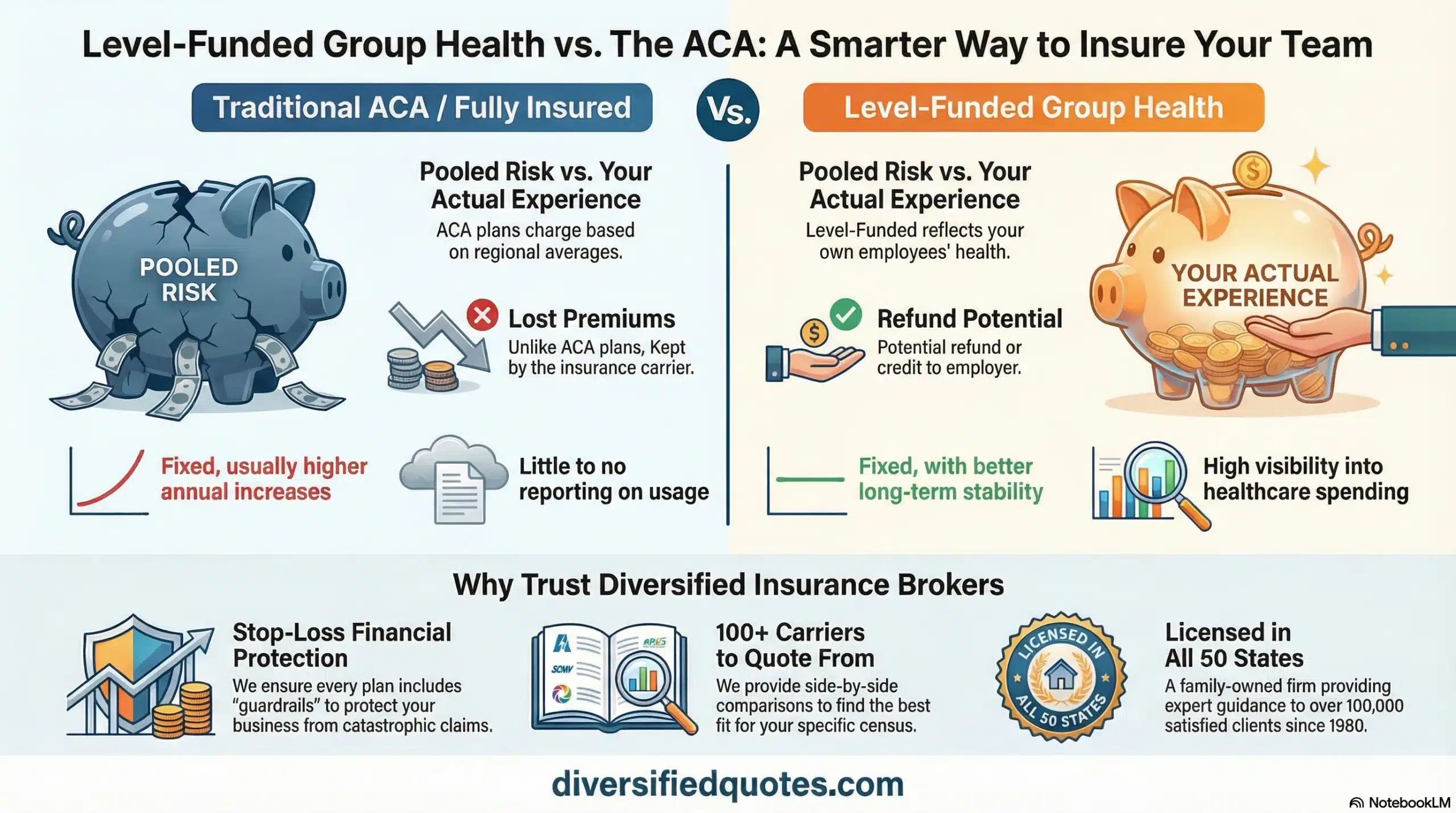
The first and most important structural decision most small and mid-sized employers miss is the choice between fully insured and level-funded plans. Most employers default to fully insured coverage — where the carrier assumes all the claims risk and charges accordingly — without ever evaluating whether a level-funded approach would save money for their specific group. Level-funded plans, which combine a fixed monthly payment with stop-loss insurance that caps the employer’s exposure on catastrophic claims, can produce significantly lower costs for groups with healthy claims experience because the employer shares in the savings when claims come in below projections. Our resource on why group level funding makes sense covers the structural differences in full, and our resource on understanding stop-loss insurance in level-funded plans covers how the catastrophic claims protection works so employers can evaluate the risk correctly. For employers who want to understand the full self-funded landscape before evaluating level-funded as a step toward it, our resource on what self-funded group health insurance is provides that broader context.
At Diversified Insurance Brokers, Jason Stolz, CLTC, CRPC, DIA, CAA, helps employers across all 50 states compare group health plan structures, evaluate funding options, and design benefits programs that control cost and support retention. The right plan for your business depends on your workforce size, demographics, claims history, budget, and competitive context — not on which carrier ran the last proposal. Our resource on how to choose the right group health plan covers the decision framework that should precede any carrier comparison, and our resource on how to get the best group health insurance rates covers the negotiation and comparison process that follows.
Ready to Set Up Group Health Insurance for Your Team?
Compare fully insured, level-funded, and self-funded options from 100+ carriers. Our licensed specialists help employers design benefits programs that control costs and compete for talent.
Get Group Health Insurance Quotes
Questions? Call 800-533-5969
Key Components of a Group Health Plan — And What Each One Costs
| Component | What It Is | Impact on Cost | What to Watch |
|---|---|---|---|
| Funding Structure | Fully insured, level-funded, or self-funded — determines who bears claims risk and how premiums are calculated | Level-funded typically saves healthy groups 10–20% vs. fully insured; self-funded can save more with larger groups | Most employers default to fully insured without evaluating alternatives — the funding structure decision belongs first |
| Plan Type | HMO restricts to network; PPO offers broader provider access; HDHP pairs with HSA for tax advantages; EPO is a hybrid | HMOs are lowest premium; PPOs highest; HDHPs lower premium but shift more cost to employees at point of service | Network quality matters more than plan type label — a PPO with a weak network delivers less value than it appears |
| Employer Contribution | The percentage of employee-only and dependent premiums the employer covers; minimum contribution thresholds vary by carrier | Higher contribution = higher employer cost but higher participation; low contribution can trigger carrier minimums and adverse selection | Contribution strategy affects participation rates, which affect carrier eligibility and pricing — these are connected decisions |
| Deductibles and Cost-Sharing | Out-of-pocket amounts employees pay before coverage kicks in; also includes copays and coinsurance provisions | Higher deductibles lower premiums but shift cost to employees; the balance determines real total compensation, not just the premium | A low premium with a high deductible can feel like a benefit reduction to employees — model the total cost of care, not just the premium |
| Participation Requirements | Carriers typically require 50–75% of eligible employees to enroll; employees with other coverage (spouse’s plan) may be excluded from the calculation | Low participation can disqualify a group from coverage or trigger adverse-selection pricing adjustments | Our resource on minimum employees for group health insurance covers the eligibility thresholds by carrier |
Step by Step — How to Set Up Group Health Insurance for Employees
Setting up a group health plan involves more decisions than most business owners anticipate, and the sequence matters. Employers who start by picking a carrier before deciding on a funding structure are making a downstream decision before an upstream one, which often means paying more than necessary. The right sequence starts with the structural questions and works its way to the carrier and plan-design details.
The first step is confirming eligibility. Most carriers require a minimum number of full-time equivalent employees — typically two or more — and a minimum participation rate. The exact thresholds vary by carrier, state, and plan type. Our resource on minimum employees for group health insurance covers what those thresholds look like across the market, and our resource on small employer group health insurance covers the specific options available to businesses at the smaller end of the workforce range. For businesses that are not yet eligible for traditional group coverage or are looking for bridge solutions, our resource on ACA alternatives for company healthcare covers what options exist outside the traditional group market.
The second step is choosing the funding structure — and this is the decision most employers get wrong by defaulting rather than choosing. Fully insured coverage is simpler to administer but prices in a risk margin that goes to the carrier whether claims are high or low. Level-funded coverage requires slightly more administrative awareness but gives healthy groups access to claims data and the opportunity to share in savings when utilization is below projections. Self-funded coverage provides the most control and cost transparency but requires sufficient workforce size and risk tolerance. For employers evaluating which path fits their group, our resource on group health insurance cost for small business covers how the numbers typically look across funding structures at different workforce sizes.
The third step is selecting the plan design — the deductible levels, copay structures, network type, and cost-sharing provisions that employees will actually experience. This is where the difference between a plan that employees value and a plan that creates resentment lives. A plan with an attractively low premium but high out-of-pocket costs feels like a benefit reduction to employees the first time they use it. The total cost of care — premium plus expected out-of-pocket — is the number that matters for employee satisfaction, and that number should be modeled before the plan is finalized. Our resource on how to choose the right group health plan covers that modeling process in detail.
The fourth step is selecting and enrolling with a carrier. Insurance companies vary significantly in pricing, network quality, claims processing speed, and service quality — differences that are not visible in the initial proposal and only become apparent at renewal or when an employee has a complex claim. Reviewing carriers with the same rigor you would apply to any vendor relationship — including checking claim turnaround, provider network adequacy in your specific geography, and renewal history — produces better long-term outcomes than selecting solely on initial premium. For employers who want a second set of eyes on any group health proposal before committing, our resource on getting a second opinion on your group health insurance quote covers that review process.
The fifth step is managing employee communication and enrollment. A plan that employees do not understand is a plan they do not value — and a plan they do not value drives dissatisfaction and voluntary turnover that the benefits investment was supposed to prevent. Clear communication about what the plan covers, what it costs employees, how to use it correctly, and how to access care efficiently should be built into the enrollment process, not treated as an afterthought. This is especially important for employees who are enrolling in group coverage for the first time or transitioning from a different carrier. The enrollment experience is the first impression the benefits program makes, and it matters more than most employers realize.
Building a Complete Benefits Package — What Belongs Alongside Group Health
Group medical coverage is the anchor of most employer benefits programs, but employees’ financial protection needs extend beyond medical insurance. Dental and vision coverage are the most common additions — often expected as part of a competitive package — and our resources on best dental insurance rates and best vision insurance rates cover those markets. Disability insurance is one of the most underappreciated additions to an employer benefits package: our resource on best disability insurance rates covers the landscape, and our resource on why people buy disability insurance covers the protection case that makes it worth offering. Life insurance rounds out the core protection package for most employers, and our resource on best life insurance rates covers the group term options that are typically the most cost-effective way to provide that benefit.
For larger employers, group long-term care insurance can be a meaningful differentiator — particularly for employee populations that skew older or that include high earners for whom long-term care exposure is a significant household financial risk. Our resource on group long-term care insurance covers how that benefit is structured and what employers need to know to evaluate it. And for employers who are also thinking about how the benefits package connects to retirement income planning for their workforce, our resource on group medical insurance covers how healthcare benefits and retirement benefits interact in a comprehensive employee compensation strategy.
Working with an independent broker — rather than a captive agent who represents a single carrier — is the practical difference between a benefits program that is continuously optimized and one that defaults to whatever the incumbent carrier proposes at renewal. Our resource on why to work with an independent group health insurance broker covers that value proposition directly, and our resource on best independent group health broker covers what to look for when evaluating broker qualifications for group health specifically.
Compare Group Health Insurance Options
Get proposals from multiple carriers across fully insured, level-funded, and self-funded structures. Our licensed specialists help employers find the right plan for their workforce size, budget, and competitive goals.
Questions? Call 800-533-5969
Pick Your Company Size
Not the right headcount? Use the buttons below to jump to the group health page that matches your workforce.
Group Health Insurance for 10 Employees
Small-team pricing, participation strategy, and easy rollout.
Group Health Insurance for 20 Employees
Plan design choices that improve cost control and retention.
Group Health Insurance for 30 Employees
Reduce renewal spikes and address pharmacy cost drivers.
Group Health Insurance for 40 Employees
Better plan efficiency as your claims credibility improves.
Group Health Insurance for 50 Employees
Cost containment strategies and scalable benefit design.
Group Health Insurance for 60 Employees
Improve predictability and reduce waste without cutting benefits.
Group Health Insurance for 70 Employees
Funding choices that reduce renewal volatility as you grow.
Group Health Insurance for 80 Employees
Plan design and vendor strategy to control cost trends.
Group Health Insurance for 90 Employees
Prepare for 100+ pricing leverage and stabilize renewals.
Group Health Insurance for 100 Employees
A major transition point: funding options expand and plan design matters more.
Group Health Insurance for 150 Employees
More claims credibility means more leverage—optimize funding and reduce overpaying.
Group Health Insurance for 250 Employees
Advanced funding and transparency strategies for stronger cost control.
Group Health Insurance for 500 Employees
Enterprise approach: analytics, vendor oversight, and smarter funding strategy.
Group Health Insurance for 750 Employees
Scaled cost-control with deeper data visibility and targeted interventions.
Group Health Insurance for Over 1,000 Employees
Enterprise governance, advanced funding, and high-impact cost management.
Talk With an Advisor Today
Choose how you’d like to connect—call or message us, then book a time that works for you.
Schedule here:
calendly.com/jason-dibcompanies/diversified-quotes
Licensed in all 50 states • Fiduciary, family-owned since 1980
Frequently Asked Questions: How to Set Up Group Health Insurance for Employees
What is the difference between fully insured, level-funded, and self-funded group health insurance?
These three funding structures determine who bears the risk of employee claims and how premiums are calculated — and the difference has a material impact on cost. Fully insured is the most common default: the employer pays a fixed monthly premium and the insurance carrier assumes all claims risk. The carrier prices in a risk margin and profit load on top of the expected claims, which means fully insured groups with healthy claims experience effectively subsidize other groups in the carrier’s pool. Level-funded combines a fixed monthly payment (covering expected claims plus stop-loss protection and administrative costs) with stop-loss insurance that caps the employer’s exposure if claims exceed projections. At year-end, employers typically receive a refund if actual claims came in below the projected level — which is the structural advantage for healthy groups. Self-funded plans have the employer paying claims directly with stop-loss protection setting the ceiling on exposure, providing the most cost transparency and control but requiring sufficient size and administrative infrastructure. Most small and mid-sized employers with healthy workforces save meaningfully by moving from fully insured to level-funded rather than continuing to default. Our resource on understanding stop-loss insurance in level-funded plans covers how the claims protection layer works.
How many employees do I need to offer group health insurance?
Most carriers require a minimum of two full-time equivalent employees to qualify for group health coverage, though thresholds vary by carrier, state, and plan type. Participation requirements — typically 50% to 75% of eligible employees — are equally important: if too few employees enroll, the group may not meet carrier minimums, and the adverse selection risk drives pricing up. Employees who have coverage through a spouse’s plan are usually excluded from the participation calculation, which can help small employers meet thresholds even when not all employees enroll. The definition of “eligible employee” and how part-time hours count toward the FTE calculation are details that vary by carrier and should be confirmed before submitting an application. Our resource on minimum employees for group health insurance covers the specific thresholds across the market, and our resource on small employer group health insurance covers the options available to businesses at the lower end of the workforce range.
How much should an employer contribute toward employee health insurance premiums?
There is no universal correct answer, but there are structural constraints and competitive benchmarks that should inform the decision. Most carriers require employers to contribute at least 50% of the employee-only premium — not the dependent premium — as a condition of offering coverage. ACA affordability rules for applicable large employers (50 or more full-time equivalent employees) add an additional constraint: the employee’s share of the lowest-cost self-only plan premium cannot exceed a specified percentage of household income for the employer to avoid potential penalties. Beyond the compliance floor, the contribution strategy affects participation: lower employer contributions reduce cost per covered employee but can depress enrollment, which can create carrier eligibility issues and adverse selection dynamics that increase rates at renewal. Competitive benchmarking against what employers in your industry and geography are contributing helps set a contribution level that attracts and retains employees without overpaying relative to market. For employers unsure how their current contribution level compares to alternatives, our resource on how to get the best group health insurance rates covers the full rate comparison process including contribution strategy optimization.
What additional benefits should I offer alongside group medical coverage?
Dental and vision are the most universally expected additions to a group medical plan — many employees view them as a baseline expectation rather than a differentiating benefit, which means not offering them creates a perceived gap even if the medical coverage is strong. Disability insurance is one of the most impactful and underappreciated additions to an employer benefits package: short-term disability covers income disruption during illness or injury, while long-term disability protects against the financial consequences of an extended inability to work. Group term life insurance provides a basic death benefit to employees and their families and is typically inexpensive to offer at meaningful coverage levels through a group policy. For employers with a more senior workforce or high-earning employees, group long-term care insurance can be a meaningful differentiator. Our resource on group long-term care insurance covers how that benefit is structured. The goal of a complete benefits package is not to offer every product that exists — it is to cover the protection gaps that matter most to your specific workforce and that your competitors are not already covering adequately.
How do I control group health insurance costs as premiums increase at renewal?
Renewal cost management requires both proactive and reactive strategies, and the employers who manage costs best are the ones who are not surprised by their renewal because they understand what drives it. On the funding structure side, moving from fully insured to level-funded is the single highest-impact structural change most small and mid-sized employers can make, because it gives them visibility into actual claims experience and the ability to benefit from good years rather than subsidizing the carrier’s risk pool. On the plan design side, adjusting deductibles, copays, and cost-sharing provisions can reduce premiums while keeping the benefit structure competitive — but the adjustments need to be modeled against employee out-of-pocket impact before being finalized. On the carrier side, re-marketing the group to competing carriers at renewal — rather than auto-renewing with the incumbent — consistently produces better pricing because carriers compete for new business more aggressively than they price renewals. An independent broker who can run competitive proposals across multiple carriers is the practical tool for this exercise. For employers already seeing renewal pressure and evaluating whether there are structural alternatives, our resource on ACA alternatives for company healthcare covers the broader landscape of options beyond traditional group coverage.
About the Author:
Jason Stolz, CLTC, CRPC, DIA, CAA and Chief Underwriter at Diversified Insurance Brokers (NPN 20471358), is a senior insurance and retirement professional with more than 25 years of real-world experience helping individuals, families, and business owners protect their income, assets, and long-term financial stability. As a long-time partner of the nationally licensed independent agency Diversified Insurance Brokers, Jason provides trusted guidance across multiple specialties—including fixed and indexed annuities, long-term care planning, personal and business disability insurance, life insurance solutions, Group Health, Travel Medical and Evacuation Insurance, and short-term health coverage. Diversified Insurance Brokers maintains active contracts with over 100 highly rated insurance carriers, ensuring clients have access to a broad and competitive marketplace.
His practical, education-first approach has earned recognition in publications such as VoyageATL, and contributions from his agency featured in Kiplinger and GoBankingRates— highlighting his commitment to financial clarity and client-focused planning. Drawing on deep product knowledge and years of hands-on field experience, Jason helps clients evaluate carriers, compare strategies, and build retirement and protection plans that are both secure and cost-efficient. Visitors who want to explore current annuity rates and compare options across multiple insurers can also use this annuity quote and comparison tool.
Explore More Group Health Insurance Options: Browse our complete guide to Small Business Group Health Insurance — covering getting started, costs, how to set up, best rates & working with a broker from 100+ carriers.
Last Reviewed: June 13, 2026 |
Reviewed by: Jason Stolz, CLTC, CRPC, DIA, CAA
Chief Underwriter, Diversified Insurance Brokers, Inc. | NPN: 20471358 | Diversified Insurance Brokers, Inc. — Licensed in all 50 states
Fact Checked by: Tonia Pettitt, CMIP©
Medicare Specialist, Diversified Insurance Brokers, Inc. | NPN: 14374308 | Diversified Insurance Brokers, Inc. — Licensed in all 50 states
Did you find this content helpful? Leave us a Google review — it helps others find trustworthy guidance too.
Editorial Standards: Diversified Insurance Brokers maintains rigorous editorial standards to ensure accuracy, clarity, and independence in all content. Learn more about our editorial standards and commitment to transparency.
