
Group Health Insurance for 20 Employees
As an Independent Group Health Insurance Broker, we compare fully insured, level-funded, and self-funded options across carriers to find the lowest cost coverage for your business.
Group Health Insurance for 20 Employees

Jason Stolz CLTC, CRPC, DIA, CAA
Group health insurance for 20 employees is where many growing businesses first realize that “having a plan” and having a real benefits strategy are two different things. At this size, healthcare is usually the second-largest operating cost after payroll, and yet most 20-employee companies are still on a default fully insured plan they’ve never meaningfully compared to alternatives. The renewal arrives, the rate goes up, leadership grumbles, and the cycle repeats. What often goes unexamined is whether the plan structure itself is the problem—not just the market. At Diversified Insurance Brokers, we help 20-employee organizations evaluate group health options across fully insured, level-funded, and alternative funding designs, side by side, in plain language. The goal is not complexity—it’s clarity. You should understand what you’re paying for, why, and whether a smarter structure can produce better outcomes for both the company and the people it employs. Whether you’re setting up group health for the first time or evaluating a renewal that doesn’t feel right, the right starting point is understanding your actual options at this size.
Compare Group Health Options for 20 Employees
We’ll review your current plan, renewal pressure, and cost drivers to identify smarter options.
Level-Funded Plans
Predictable monthly cost with potential refunds when your group’s claims run efficiently.
Self-Funded Options
Pay closer to actual claims with stop-loss protection limiting your exposure.
Request a Group Health Review
We’ll compare fully insured, level-funded, and self-funded options side by side for your group.
Why Healthcare Costs Often Jump at 20 Employees
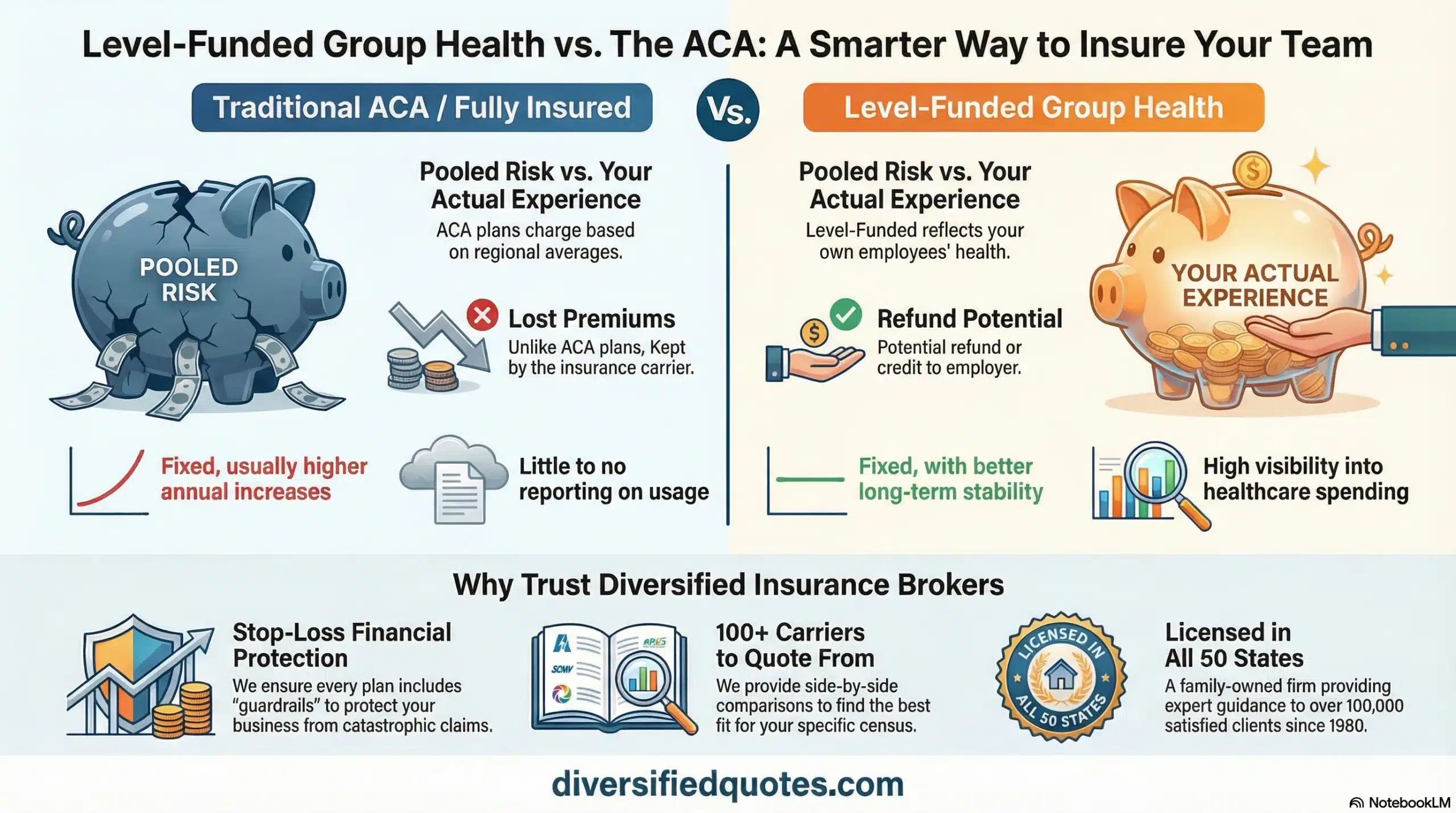
Many 20-employee companies are still placed into a fully insured small-group plan by default, often because it’s what the first broker set up and no one has formally re-evaluated it since. Fully insured coverage is straightforward: you pay a set premium every month, the carrier pays claims, and renewals are recalculated each year. The simplicity is appealing, especially when leadership is focused on growing the business. The challenge is that fully insured premiums include conservative risk pricing, administrative load, and carrier profit—regardless of whether your team actually generates that level of claims. Pricing is built to protect the carrier from variability across the market, which means your premiums may reflect pooled assumptions that don’t match your specific group’s reality, especially if your workforce is stable and utilization is efficient. If your group has a healthy year, you generally don’t benefit. If the carrier’s broader pool has a bad year, your renewal can rise even though your own claims were flat. That is why many employers describe fully insured renewals as a “black box”—costs move without clear, actionable explanation. Understanding the fundamentals of group medical insurance helps clarify why this happens and what structural choices can change it.
What Makes 20 Employees a Strategic Moment
Twenty employees is no longer a startup—it’s a real company with real operating costs and real employees who depend on the benefits package as part of their total compensation. At this size, benefits stop being just an expense and start being a competitive tool. Employees at 20-person companies are often choosing between you and larger employers with more established HR infrastructure. When your benefits package matches or exceeds what larger competitors offer, retention improves and recruiting becomes meaningfully easier. When it doesn’t, turnover cost compounds quickly at this scale—losing even one employee and replacing them can cost 50-200% of their annual salary when recruiting, onboarding, and productivity lag are factored in.
From a cost standpoint, 20 employees is often a stable enough base to begin thinking about plan design more intentionally. The group is past the “two or three person” volatility stage where a single enrollment decision can materially shift participation percentages and pricing. Enrollment is more predictable, which makes some carriers willing to look at alternative funding approaches. It also means there’s enough history to identify utilization patterns—where spending concentrates, what drives it, and what changes could reduce it. Understanding minimum employee requirements for group health insurance and how participation rules apply at this size is the right starting point for evaluating which plan structures are realistically available.
Funding Model Comparison: What Each Option Means at 20 Employees
| Feature | Fully Insured | Level-Funded | Partially Self-Funded |
|---|---|---|---|
| Monthly Cost Structure | Fixed premium regardless of actual claims | Predictable monthly amount (claims + admin + stop-loss) | Variable—employer funds actual claims as incurred |
| Claims Visibility | None; carrier owns all data | Reporting typically available; trend visibility improves | Full claims transparency; employer sees all cost drivers |
| Refund Potential | None; unused premiums retained by carrier | Yes—unused claim dollars may be returned at year-end | Yes—employer pays actual claims, not padded estimates |
| Downside Protection | Full; carrier absorbs all claims risk | Stop-loss caps individual and aggregate exposure | Stop-loss required; employer retains more risk than level-funded |
| Renewal Behavior | Pooled market; your claims may not drive your rate | More experience-based; stable groups often see better renewals | Renewal tied more directly to group performance |
| Admin Complexity | Lowest; carrier manages all mechanics | Low to moderate; often feels similar to fully insured | Moderate to higher; employer more actively engaged |
| Best For | Groups prioritizing simplicity, new groups without claims history | Most 20-employee groups seeking cost control with predictability | Stable groups with leadership comfortable with more visibility and engagement |
Level-Funded Plans for 20 Employees
Level-funded plans have become increasingly available to groups at 20 employees, though carrier eligibility varies more at this size than at 30 or 40. When available, they are often the most compelling first step away from fully insured for a 20-employee company because they preserve budget predictability while improving how the plan is priced and what happens at year-end. Your monthly cost is fixed and easy to forecast. The employee experience typically feels just like a traditional plan. But underneath the surface, the economics are aligned differently—you’re paying for your expected claims, not for the carrier’s pooled worst-case assumptions.
The refund mechanics are one of the strongest arguments for level-funded at 20 employees. If your group has a favorable claims year—which healthy, younger, or stable workforces often do—a portion of unused claim dollars may be returned based on the program’s reconciliation terms. That changes the employer’s relationship with healthcare in a meaningful way: instead of paying a fixed premium regardless of performance, there’s a pathway to benefit financially when utilization is efficient. For many 20-employee employers, this is the first time healthcare “feels fair.” On the renewal side, level-funded pricing tends to reflect the group’s own experience more closely than pooled fully insured pricing, which can reduce the randomness of annual renewals. Explore our deeper guide on why group level funding works for the full picture of how these plans are structured and what eligibility typically looks like.
Partially Self-Funded Plans: Is 20 Employees Too Small?
Partial self-funding is less commonly used at 20 employees than at 30 or larger, but it isn’t unavailable. Some carriers and third-party administrators have specific programs designed for smaller groups, and when the workforce is stable, industry risk is reasonable, and leadership is comfortable engaging with the plan’s performance data, partial self-funding can produce strong results. The mechanics are the same as at any size: the employer pays claims as they occur, stop-loss insurance caps the exposure on large individual claims and total annual costs, and the employer gains transparency into what is actually driving spend.
The more meaningful question at 20 employees is not “can we do this?” but “should we do this given our specific situation?” Groups with high expected claims, significant turnover, seasonal enrollment changes, or leadership with very limited appetite for administrative engagement are often better served by level-funded or fully insured plans. Groups with stable, consistent enrollment, relatively healthy demographics, and leadership interested in long-term cost management can often benefit from the additional transparency and performance alignment that partial self-funding creates. Understanding the full trade-off through our guide on the pros and cons of self-funded group health is a useful step before evaluating whether this structure fits your organization. For context on how this works mechanically, see also what self-funded group health insurance is.
Small Business Health Care Tax Credits: What 20-Employee Employers Should Know
One planning advantage that is often overlooked by 20-employee companies is the Small Business Health Care Tax Credit available to qualifying small employers under the ACA. Employers with fewer than 25 full-time equivalent employees, average annual wages below a defined threshold, and who pay at least 50% of employee-only premiums through a qualifying plan may be eligible for a federal tax credit of up to 50% of premiums paid. This credit is designed specifically to make coverage more affordable for smaller employers—and at 20 employees, many companies fall into the qualifying range.
The credit is available for coverage purchased through a SHOP (Small Business Health Options Program) marketplace plan, and it can be claimed for two consecutive tax years. Not every 20-employee company will qualify—the FTE calculation, wage averaging, and contribution requirements must all be met—but for those that do, the effective cost of offering health coverage can be meaningfully lower than the sticker premium suggests. This is a conversation to have with your tax advisor and your group health broker together, because the credit interacts with how the plan is structured and funded. Even if you don’t ultimately qualify for the full credit, understanding where you stand relative to the thresholds can inform contribution and plan design decisions.
Benefits as a Recruiting and Retention Tool at 20 Employees
For a 20-employee company, the benefits package is often one of the most visible signals you send to job candidates and current employees about how you value the people who work for you. Larger employers typically have more established HR infrastructure, more recognized brand names, and more structured career paths. What a 20-person business can offer is often more personal, more flexible, and more directly connected to leadership. But candidates still compare benefits. A strong health insurance package—one that is genuinely competitive rather than just technically compliant—can tip the balance in your favor when recruiting against larger competitors.
Retention operates through a similar mechanism but with higher stakes. When a valued employee is recruited away by a larger company offering richer benefits, the cost of replacement is significant: recruiting fees, productivity gaps during the search, onboarding time, and knowledge loss. A benefits package that makes employees feel genuinely cared for reduces voluntary turnover in ways that don’t always show up in compensation surveys but show up clearly in retention data over time. The investment in a competitive health plan often returns multiples of its cost through reduced turnover at 20 employees. For context on what is available across the small-group market, our resource on small business group health insurance covers the full landscape of options for employers at this size.
Reducing Healthcare Costs Without Cutting Benefits
When employers say they want to lower healthcare costs, the instinct is often to raise deductibles or shift more premium to employees. That approach can backfire—lower participation, reduced morale, and employees who delay needed care, which often leads to higher-cost claims later. At 20 employees, you want cost control that employees can live with, not cost-shifting that creates resentment and poorer health outcomes. Meaningful savings almost always come from plan architecture rather than benefit reduction. A better network fit can reduce claims cost without changing the employee experience. A smarter prescription approach can lower spend significantly, especially if specialty medications are involved. Deductibles and copays can be structured to encourage appropriate utilization rather than simply shifting costs. When the plan encourages primary care, telemedicine, and urgent care for non-emergency needs, avoidable high-cost utilization tends to decline over time.
Why Independent Carrier Comparison Matters More at 20 Employees
Many 20-employee groups are shown one or two carriers and told to choose between plans that look superficially similar. That approach removes leverage and hides alternatives that might be meaningfully better. Carrier appetite varies significantly by industry, geography, and group profile—one carrier may price aggressively for a service-industry group while another prices the same group conservatively. One level-funded program may offer stronger stop-loss terms for your demographic profile while another provides more useful quarterly reporting. Independent comparison across carriers and funding structures is often what creates savings, because it ensures you’re paying for the plan that fits your group—not the plan that was easiest for someone else to sell.
The act of comparing also improves renewal positioning. When a carrier knows you actively compare and are willing to move, renewals tend to be more defensible. When they know you renew passively year after year without evaluating alternatives, increases can be more aggressive. A second opinion on your group health quote is one of the simplest ways to confirm whether your current plan is competitive or whether a better structure exists. Our guide to group health insurance cost for small businesses can help calibrate what a competitive benchmark looks like before you request quotes.
When a 20-Employee Group Should Stay Fully Insured
Not every 20-employee employer should move away from fully insured coverage. If the group has very high expected claims, significant enrollment instability, industry risk that makes alternative underwriting difficult, or leadership with limited interest in engaging with plan data, a well-chosen fully insured plan may still be the most practical fit. In those situations, the best strategy is selecting the right carrier for your industry and geography, negotiating contribution strategy to support strong participation, and using renewal comparison to prevent passive rate acceptance. The goal is never to force a funding model—it’s to make a deliberate, informed choice rather than accepting whatever renews automatically. For employers growing toward 30 employees, thinking now about the plan structure that will serve you at the next size is equally valuable. See how strategy evolves at 30 employees to understand what additional options become available as headcount grows.
Ready to Compare Group Health Plans for 20 Employees?
We’ll build side-by-side options across funding models so you can see exactly how costs and renewal stability differ for your specific group.
Group Health Cost Guide
Understand what drives group health costs for small businesses and how to benchmark your plan.
Get a 2nd Opinion
Already have a plan or renewal? We’ll tell you if you’re overpaying and what alternatives exist.
Request a Side-by-Side Comparison
We’ll compare all three funding models for your 20-employee group with your specific goals in mind.
Not the Right Headcount?
Use the options below to jump to the group health page that matches your workforce size.
Group Health Insurance Resources
Explore related guides for small employers and growing businesses.
Employee Benefits and Ancillary Coverage
Complement your group health plan with dental, vision, critical illness, and supplemental benefits.
Talk With an Advisor Today
Choose how you’d like to connect—call or message us, then book a time that works for you.
Schedule here:
calendly.com/jason-dibcompanies/diversified-quotes
Licensed in all 50 states • Fiduciary, family-owned since 1980
FAQs: Group Health Insurance for 20 Employees
Can a company with 20 employees get group health insurance?
Yes. At 20 employees, companies qualify for group health insurance through most carriers offering small-group plans. Fully insured small-group coverage is available in all states for groups of this size. Level-funded options are increasingly available at 20 employees, though eligibility depends on industry, state, and carrier underwriting guidelines. Partially self-funded arrangements exist but are less common at 20 than at larger sizes. The range of options available depends on your industry, workforce demographics, participation rate, and employer contribution structure.
Are level-funded plans available for groups of 20 employees?
In many cases, yes—though availability varies more at 20 employees than at larger sizes. Some carriers and programs have minimum group size requirements of 25 or more, while others actively target groups as small as 10-15. Industry matters too: carriers may be more or less comfortable with level-funded underwriting depending on your business type. When available, level-funded plans are often one of the best options for 20-employee groups because they preserve predictable monthly budgeting while aligning costs more closely with actual claims and creating refund potential for favorable years. An independent broker with access to multiple programs can tell you quickly which ones are available and competitive for your specific group.
Can a 20-employee group qualify for small business health care tax credits?
Potentially yes. The ACA’s Small Business Health Care Tax Credit is available to employers with fewer than 25 full-time equivalent employees, average annual wages below a defined IRS threshold, and who pay at least 50% of employee-only premiums through a qualifying SHOP marketplace plan. Eligible employers can receive a federal tax credit of up to 50% of premiums paid for up to two consecutive tax years. At 20 employees, many companies fall within the qualifying range—but the FTE calculation, wage averaging, and contribution requirements must all be met. Confirm eligibility with your tax advisor before structuring your plan, as the credit can meaningfully reduce the net cost of offering coverage.
Can a 20-employee group receive refunds from their health plan?
Refunds are possible under level-funded or partially self-funded plans when claims run lower than expected during the plan year. In a level-funded arrangement, the employer contributes to a claims fund throughout the year; unused amounts above the program’s retention may be reconciled and returned at year-end. In a partially self-funded plan, efficient utilization directly reduces net cost since the employer pays actual claims rather than a padded premium. Refund potential depends on the specific program’s reconciliation terms and the group’s actual claims performance. It is not guaranteed, but it creates a meaningful incentive for employers to invest in plan design and employee education.
Is self-funding too risky for a 20-employee company?
Risk is managed through stop-loss insurance regardless of group size. Specific stop-loss protects against high individual claims exceeding a threshold; aggregate stop-loss caps total annual plan exposure. With properly designed stop-loss, a 20-employee employer’s maximum exposure is defined and manageable. That said, partial self-funding is a better fit for groups with stable enrollment, predictable demographics, and leadership comfortable engaging with claims data. Groups with high expected claims, volatile enrollment, or very limited administrative bandwidth are often better served by a well-structured level-funded or fully insured plan. The right question isn’t “is self-funding risky?” — it’s “is self-funding appropriate for our specific situation?”
What participation requirements apply at 20 employees?
Participation requirements vary by carrier, state, and plan type, but most carriers require a minimum percentage of eligible employees to enroll—commonly 70-75%—after accounting for valid waivers (employees covered elsewhere, such as through a spouse’s plan). At 20 employees, meeting participation thresholds is usually more manageable than at very small groups where a few waivers can dramatically affect the percentage. Strong employer contribution (typically at least 50% of employee-only premium) supports participation. Some alternative funding programs have different or more flexible participation requirements than fully insured small-group plans—confirming these details upfront avoids surprises at underwriting.
How can offering health insurance help a 20-employee company with recruiting and retention?
Benefits are often one of the most visible signals a company sends about how it values its people—and at 20 employees, candidates are frequently choosing between smaller companies and larger employers with more established HR programs. A genuinely competitive health plan can tip the balance in your favor during recruiting. On the retention side, employees who feel their benefits are strong are less likely to leave for marginally higher salaries elsewhere. The cost of replacing one employee at a 20-person company can equal 50-200% of their annual salary when recruiting, onboarding, and productivity gaps are factored in. A well-designed health plan is one of the highest-return investments a growing company can make in workforce stability.
How long does it take to implement a new group health plan?
Most plans can be implemented within a few weeks once underwriting and enrollment are complete. A typical timeline: census submission and underwriting review (1-2 weeks), plan selection and employee communication (1-2 weeks), open enrollment (1-2 weeks), then effective date. Starting the process 60-90 days before your desired effective date provides adequate time without rushing. Renewals are generally faster since the group’s history is already established. If you’re approaching a renewal date and haven’t started evaluating options yet, the time to begin is immediately—late starts can eliminate your ability to compare alternatives properly.
Should a 20-employee company offer dental and vision along with medical?
There is no federal requirement to offer dental or vision for employers below 50 FTEs, but these benefits are among the most valued by employees with families and are often among the first things candidates ask about. Offering medical without dental and vision creates a gap that competing employers may fill. At 20 employees, adding voluntary dental and vision is typically affordable and easy to administer. Many employers offer a medical plan with a defined contribution and add dental and vision as voluntary employee-paid options—providing the benefit without adding meaningfully to the employer’s premium cost. The perception value to employees often exceeds the actual cost to the company.
How do healthcare costs typically change as a company grows from 20 to 30+ employees?
As companies grow from 20 to 30 and beyond, two things happen simultaneously. First, additional funding options often become more accessible: level-funded eligibility broadens, more carriers compete for the group, and the employer gains more credibility in underwriting. Second, the absolute dollar impact of renewal increases grows—a 10% renewal increase costs more per year at 30 employees than at 20. This means the incentive to be strategic about plan structure increases as headcount grows. Planning the healthcare strategy at 20 employees—rather than waiting until renewals become crisis-level at 35 or 40—typically produces better long-term outcomes with less disruption to employees.
What is the most common mistake 20-employee companies make with group health insurance?
The most common mistake is passive renewal—accepting whatever rate the existing carrier proposes without evaluating alternatives. At 20 employees, renewal increases often go unchallenged because benefits administration is not a dedicated function, and the person responsible for it is usually handling multiple other priorities. Passive renewal typically results in overpaying year after year, accumulating cost without ever confirming whether a better-structured plan exists. The second most common mistake is cost-shifting to employees as the primary cost-control mechanism, which tends to reduce participation and delay care in ways that increase costs over time. The right approach is deliberate comparison, proactive carrier selection, and plan architecture that aligns costs with actual utilization rather than the carrier’s worst-case assumptions.
About the Author:
Jason Stolz, CLTC, CRPC, DIA, CAA and Chief Underwriter at Diversified Insurance Brokers (NPN 20471358), is a senior insurance and retirement professional with more than 25 years of real-world experience helping individuals, families, and business owners protect their income, assets, and long-term financial stability. As a long-time partner of the nationally licensed independent agency Diversified Insurance Brokers, Jason provides trusted guidance across multiple specialties—including fixed and indexed annuities, long-term care planning, personal and business disability insurance, life insurance solutions, Group Health, Travel Medical and Evacuation Insurance, and short-term health coverage. Diversified Insurance Brokers maintains active contracts with over 100 highly rated insurance carriers, ensuring clients have access to a broad and competitive marketplace.
His practical, education-first approach has earned recognition in publications such as VoyageATL, and contributions from his agency featured in Kiplinger and GoBankingRates— highlighting his commitment to financial clarity and client-focused planning. Drawing on deep product knowledge and years of hands-on field experience, Jason helps clients evaluate carriers, compare strategies, and build retirement and protection plans that are both secure and cost-efficient. Visitors who want to explore current annuity rates and compare options across multiple insurers can also use this annuity quote and comparison tool.
Explore More Group Health Insurance Options: Browse our complete guide to Group Health Insurance by Company Size — covering plans for 2, 10, 20, 50, 100, 250, 500, 750 & 1,000+ employees from 100+ carriers.
Last Reviewed: June 1, 2026 |
Reviewed by: Jason Stolz, CLTC, CRPC, DIA, CAA
Chief Underwriter, Diversified Insurance Brokers, Inc. | NPN: 20471358 | Diversified Insurance Brokers, Inc. — Licensed in all 50 states
Fact Checked by: Tonia Pettitt, CMIP©
Medicare Specialist, Diversified Insurance Brokers, Inc. | NPN: 14374308 | Diversified Insurance Brokers, Inc. — Licensed in all 50 states
Did you find this content helpful? Leave us a Google review — it helps others find trustworthy guidance too.
Editorial Standards: Diversified Insurance Brokers maintains rigorous editorial standards to ensure accuracy, clarity, and independence in all content. Learn more about our editorial standards and commitment to transparency.
