
What are the Pros and Cons of Self Funded Group Health
What are the Pros and Cons of Self Funded Group Health

Jason Stolz CLTC, CRPC, DIA, CAA
The pros and cons of self-funded group health insurance represent one of the most consequential strategic decisions an employer makes about their benefit structure — because the choice between self-funding, level-funding, and traditional fully insured group health determines not just the monthly cost of coverage, but the employer’s financial exposure, data access, plan design flexibility, and long-term healthcare cost trajectory. Self-funded group health plans have grown significantly among mid-size and large employers over the past decade for a straightforward reason: when claims are lower than expected, the savings stay with the employer rather than the insurance carrier. This fundamental difference in how risk and reward are allocated between employer and carrier drives the entire self-funded value proposition — and it also drives the primary risk that makes self-funding inappropriate for some employer profiles and excellent for others. Understanding both sides of this equation with specificity — not at a general level — is the prerequisite for making an informed decision about whether self-funded group health insurance belongs in your organization’s benefit strategy.
At Diversified Insurance Brokers, Jason Stolz, CLTC, CRPC, DIA, CAA helps employers evaluate self-funded group health plans within the full context of their workforce profile, financial position, and benefit strategy — comparing self-funded structures against level-funded and fully insured alternatives with multi-year cost modeling rather than single-year premium comparisons. Our resource on what is self-funded group health insurance covers the foundational mechanics, and our resource on level-funded health insurance tax benefits explained covers the level-funded hybrid structure that many employers use as an on-ramp before full self-funding. Our resource on understanding stop-loss insurance in level-funded plans covers the catastrophic claims protection that makes self-funding financially manageable regardless of employer size.
Request a Group Health Strategy Review
See side-by-side cost structures, stop-loss strategies, and multi-year projections across self-funded, level-funded, and fully insured models — before making any changes to your employee health plan structure.
Request a Group Health Strategy Review Call 800-533-5969Self-Funded vs. Level-Funded vs. Fully Insured Group Health — The Strategic Comparison
Before evaluating the specific pros and cons of self-funded group health, understanding where it sits relative to the two other primary employer health plan structures provides essential context. The three structures represent a spectrum of risk allocation, cost predictability, and employer control — and the right position on that spectrum depends on the employer’s financial capacity, workforce health profile, and administrative infrastructure.
| Feature | Fully Insured | Level-Funded | Self-Funded |
|---|---|---|---|
| Monthly cost structure | Fixed premium — same amount every month regardless of actual claims | Fixed monthly payment with potential year-end refund if claims are lower than expected | Variable — employer pays actual claims as incurred plus administration and stop-loss premium |
| Who bears claims risk | Insurance carrier bears all claims risk above premium | Employer bears claims risk within the structure; stop-loss provides cap | Employer bears claims risk; stop-loss provides individual and aggregate caps |
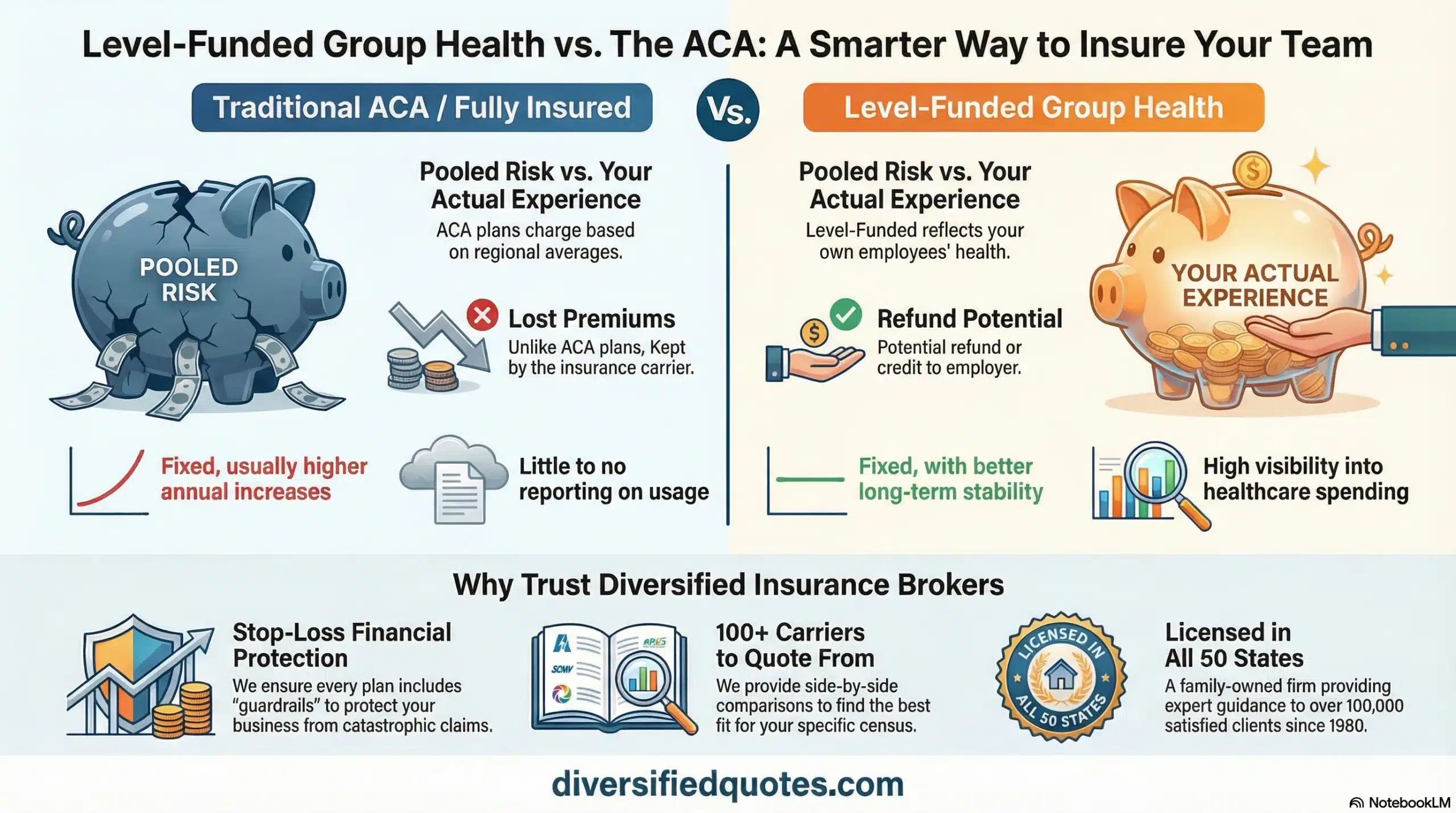
| Claims savings if utilization is low | None — carrier keeps all margin from favorable claim years | Partial — employer may receive refund at year-end if claims are below the funded level | Full — all savings from favorable claims experience stay with the employer |
| Claims data transparency | Minimal — carrier owns and controls claims data | Moderate — employer gets reporting but often with limitations | Full — employer accesses detailed claims data for cost analysis and wellness strategy |
| Plan design flexibility | Limited — must use carrier’s approved plan designs; state mandates apply | Moderate — more flexible than fully insured; some state mandates still apply depending on structure | Maximum — employer designs the plan; ERISA preemption allows exemption from most state mandates |
| Regulatory framework | State insurance regulation + ACA | Varies — can be ERISA or state-regulated depending on structure | Federal ERISA + ACA — generally exempt from state insurance mandates |
| Administrative burden | Lowest — carrier manages all claims processing and most administration | Moderate — TPA involved but structure is simpler than full self-funding | Highest — TPA, PBM, stop-loss carrier, and wellness vendor coordination required |
| Best suited for | Small employers (under 50–100 employees); organizations prioritizing cost predictability and administrative simplicity over cost optimization | Small to mid-size employers (25–150 employees) ready for more cost control but not full self-funding exposure | Mid-size to large employers (100+ employees) with financial reserves, stable workforce health, and administrative capacity |
The table defines the strategic territory for the pros and cons of self-funded group health most precisely: self-funding maximizes employer upside and control but requires the financial capacity to absorb claims volatility, the administrative infrastructure to manage a multi-vendor arrangement, and the workforce size to produce meaningful actuarial credibility. The level-funded structure to the left of self-funding on the spectrum represents the practical on-ramp for many employers — providing meaningful cost transparency and partial claims savings while maintaining more predictable monthly cash flow. Our resource on why group level funding covers this transitional structure in detail.
The Core Advantages of Self-Funded Group Health Insurance
The most significant advantage of self-funded group health for employers who fit the profile is the direct financial benefit from favorable claims experience. In a fully insured plan, the employer pays a premium that includes the carrier’s risk margin, administrative overhead, and profit layer — and when the group has a good claims year, all of that unused margin stays with the carrier. In a self-funded plan, when claims are lower than expected, the unused dollars stay with the employer. Over a multi-year horizon, this difference can represent substantial cumulative savings for employers with healthy, relatively low-utilization workforce populations. This is not guaranteed — self-funding is a long-term strategy, not a short-term cost reduction — but it is the fundamental financial argument that makes self-funded group health the fastest-growing segment of the employer health plan market.
Cash flow efficiency is the second major advantage. Fully insured employers pre-pay a fixed premium each month regardless of actual healthcare consumption. Self-funded employers retain control of healthcare dollars until claims are actually incurred — which means the capital is not committed to the insurance carrier until it is needed to pay a claim. For employers with strong cash management disciplines and predictable revenue cycles, this working capital advantage can be meaningful, particularly as the plan matures and the employer builds experience with their group’s actual utilization patterns. Our resource on group health insurance cost for small business covers how cost structures compare at different employer sizes — providing the baseline for evaluating whether self-funding’s cost efficiency argument is compelling for a specific employer’s employee count and financial profile.
Transparency into claims data is the third major advantage — and arguably the one with the highest long-term strategic value. Self-funded employers receive detailed claims reporting from their third-party administrator covering diagnosis categories, utilization patterns, specialty medication costs, emergency vs. urgent care usage, and chronic condition prevalence across the employee population. This data allows employers to identify cost drivers with precision, design targeted wellness and disease management programs, negotiate network and pharmacy contracts more intelligently, and build multi-year benefit strategies grounded in their group’s actual health profile rather than generic carrier assumptions. A fully insured employer operating without this visibility is essentially flying blind on one of their largest operating cost categories. Our resource on best independent group health broker covers how to evaluate advisory capability in the context of self-funded plan data analysis and vendor coordination.
Plan design flexibility represents the fourth major advantage for employers with specific benefit design objectives. Under ERISA preemption, self-funded plans are generally exempt from state insurance mandate requirements — which means multi-state employers can design a single consistent benefit structure rather than adapting to different state-specific coverage mandates across their employee population. For employers who want to design specific cost-sharing structures, implement targeted preventive care incentives, customize network access for different employee categories, or build condition management programs into the plan design itself, self-funding provides the flexibility to do this in ways that fully insured state-regulated products do not.
Stop-Loss Insurance — The Risk Management Layer That Makes Self-Funding Viable
The element that makes self-funded group health financially manageable for employers who might otherwise be concerned about catastrophic claim exposure is stop-loss insurance — a separate insurance product that caps the employer’s financial liability at defined thresholds. Understanding stop-loss structure is essential to understanding the full risk profile of self-funded group health, because stop-loss is not an optional feature — it is the foundational risk management mechanism that differentiates a responsibly designed self-funded plan from an unprotected claims exposure.
Specific stop-loss coverage — also called individual stop-loss — applies to individual employees or dependents. The employer’s plan pays claims for any individual up to the specific deductible (commonly set at $25,000 to $100,000 or higher depending on the employer’s risk tolerance and financial capacity), and the stop-loss carrier reimburses claims above that threshold for the remainder of the plan year. This prevents a single catastrophic diagnosis — cancer treatment, premature birth, major cardiac surgery — from creating an outsized financial impact on the employer’s claims fund. Aggregate stop-loss coverage applies to the total claims for the entire group. If total annual claims exceed the aggregate attachment point (typically set at 115–125% of expected claims), the stop-loss carrier reimburses the excess — providing a global financial safety net for years when overall utilization is substantially higher than expected across multiple employees simultaneously. Our resource on understanding stop-loss insurance in level-funded plans covers both stop-loss types in detail, and the mechanics described there apply directly to fully self-funded plan structures as well.
The Risks and Challenges of Self-Funded Group Health
The financial risk in self-funded group health is real and must be understood with the same precision as the financial opportunity. Employers who self-fund are directly responsible for claims payments, which means that adverse claims experience — more high-cost diagnoses, more specialty medications, more hospitalizations than expected — creates direct financial exposure up to the stop-loss attachment points. The stop-loss coverage provides a ceiling on that exposure, but the period between when claims occur and when stop-loss reimbursement arrives creates a cash flow timing demand that must be accommodated in the employer’s financial planning. Self-funded plans require adequate cash reserves — commonly modeled at three to six months of expected claims — to manage claims volatility without operational disruption.
Cash flow volatility is the risk that surprises employers most accustomed to fully insured structures. Healthcare claims do not distribute evenly across months. January and July — when deductibles reset or when employees return from winter breaks — often produce elevated claim volumes. A single complex diagnosis or high-cost medication can produce a spike in one month’s claim run that bears no resemblance to the prior month’s experience. For employers transitioning from the flat monthly premium structure of fully insured to the variable claims-driven structure of self-funding, this variability requires financial discipline and reserve management practices that may not have been necessary in the prior structure.
Administrative complexity increases substantially under self-funded arrangements. A fully insured employer has one primary vendor relationship — the insurance carrier. A self-funded employer typically manages relationships with a third-party administrator (TPA) that processes claims and manages plan administration, a pharmacy benefit manager (PBM) that handles prescription drug benefits and formulary management, a stop-loss carrier that provides catastrophic claims protection, potentially a wellness vendor, and potentially a care management vendor for high-cost condition management programs. Each of these relationships requires contract management, performance monitoring, and coordination — creating an administrative burden that organizations without strong HR or benefit operations infrastructure may find challenging. Our resource on small business group health insurance covers the structure options most appropriate for smaller employers where full self-funding administrative demands may exceed available resources.
Compliance responsibility expands significantly. Self-funded ERISA plans must satisfy federal reporting and disclosure requirements including Form 5500 filing, summary plan description maintenance, HIPAA privacy and security requirements, ACA reporting, COBRA administration, and other federal obligations. While most TPAs help manage many of these compliance requirements, ultimate fiduciary responsibility remains with the employer as the plan sponsor — and the organizational expertise to understand, oversee, and certify compliance cannot be entirely delegated to a vendor.
Which Employers Benefit Most From Self-Funded Group Health
The employer profile that benefits most from self-funded group health shares several consistent characteristics that determine both the financial upside potential and the operational feasibility of the structure. Mid-size and larger employers — generally 100 employees or more, though some level-funded structures make partial self-funding accessible to groups as small as 25 — have sufficient employee populations to produce actuarially meaningful claims data that can be analyzed and acted upon. Smaller groups produce more volatile claims experience, which increases the risk that any single high-cost claim produces a materially adverse financial outcome even with stop-loss coverage in place.
Employers with stable cash reserves and predictable revenue cycles manage the variable claims exposure that self-funding introduces more effectively than businesses with tight liquidity or revenue volatility. The capacity to absorb a claims-heavy quarter without financial stress is a prerequisite for self-funding — not a competitive advantage to be developed after enrollment. Organizations with experienced financial leadership — CFOs or controllers who are comfortable modeling variable expense scenarios and managing reserve requirements — tend to adapt to self-funded financial management disciplines most effectively.
Employers who already invest in employee health and wellness have a meaningful structural advantage in self-funded plans because they can directly influence the claims experience their self-funded plan pays. In a fully insured plan, wellness investment that reduces claims produces savings for the carrier, not the employer. In a self-funded plan, every dollar of claims reduced through preventive care, chronic disease management, or behavior change programs directly benefits the employer’s claims fund — creating a financial ROI alignment that fully insured structures cannot replicate. Our resource on ACA alternatives for company healthcare covers the broader landscape of employer health plan alternatives for employers evaluating their options holistically.
The Level-Funded On-Ramp — How Employers Transition Toward Self-Funding
Many employers who are intellectually interested in self-funded group health but operationally or financially uncertain about full self-funding use the level-funded structure as a transitional path. Level-funded plans blend elements of both fully insured and self-funded structures: employers pay a fixed monthly amount — covering expected claims, stop-loss premiums, and administrative fees — that provides budget predictability similar to fully insured. If actual claims for the year are lower than the funded level, the employer receives a refund of the unused portion at year-end. If claims exceed the funded level, the stop-loss structure provides protection.
The level-funded structure serves several important functions for employers preparing to evaluate full self-funding. It begins generating claims data that the employer can use to understand their group’s actual utilization patterns — the same data that full self-funding would produce, but within a more financially predictable structure during the learning period. It builds the administrative relationships — TPA, PBM, stop-loss carrier — that full self-funding requires, allowing the employer to evaluate vendor performance before committing to a full self-funded structure. And it tests the employer’s financial discipline and operational capacity for managing a more complex benefit structure than fully insured provides, revealing gaps that can be addressed before the stakes are higher. Our resource on level-funded health insurance tax benefits explained covers an additional financial dimension of level-funded plans that many employers overlook — the tax treatment of level-funded contributions and how it differs from fully insured premium treatment.
ACA Compliance and Federal Regulatory Considerations
Self-funded group health plans must satisfy Affordable Care Act requirements that apply to employer-sponsored plans — including the employer mandate for applicable large employers, coverage of essential health benefits for dependent children to age 26, prohibition on lifetime dollar limits, coverage of preventive services at no cost-sharing, and ACA reporting requirements including Forms 1094-C and 1095-C. The ERISA preemption that self-funded plans receive does not exempt them from federal ACA requirements — it exempts them from state insurance mandates that apply on top of ACA requirements to fully insured plans. This distinction matters for plan design: a self-funded employer can design a plan without including state-mandated benefits that apply only to fully insured plans in a given state, but cannot omit federal ACA requirements that apply universally.
For multi-state employers, the ERISA preemption from state insurance mandates is often cited as one of the most practical administrative advantages of self-funding — it allows a single consistent plan design to be administered uniformly across all employee locations rather than requiring state-specific design variations to accommodate different state mandate requirements. Our resource on ACA subsidies expired — what alternatives are available covers the current ACA landscape for employers evaluating health coverage decisions in the context of subsidy changes that may affect employee decision-making about employer-sponsored coverage participation. Our resource on 2-person group health insurance covers the smallest-group coverage structures for employers at the minimum qualifying size for group health plan participation.
Build Your Group Health Cost Projection
Compare 3-year and 5-year cost projections across fully insured, level-funded, and self-funded models — showing best-case, expected-case, and worst-case claim scenarios so your decision is based on complete financial modeling rather than general industry guidance.
Start My Group Health Cost ProjectionRelated Group Health Strategy Pages
Employer health plan strategy guides, cost comparisons, and plan structure resources.
Financial Protection Essentials
Employer insurance planning resources — ACA alternatives, business continuity, and supplemental coverage options for businesses of all sizes.
Talk With an Advisor Today
Choose how you’d like to connect—call or message us, then book a time that works for you.
Schedule here:
calendly.com/jason-dibcompanies/diversified-quotes
Licensed in all 50 states • Fiduciary, family-owned since 1980
FAQs: Pros and Cons of Self-Funded Group Health Insurance
How does a self-funded health plan work?
In a self-funded group health plan, the employer pays employee medical claims directly rather than paying a fixed premium to an insurance carrier each month. The employer establishes a claims fund, typically managed by a third-party administrator (TPA), from which medical and pharmacy claims are paid as they are incurred by employees and covered dependents. Because the employer is directly paying claims rather than purchasing a pre-packaged carrier product, the employer retains any unspent claims funds at the end of the plan year — unlike a fully insured plan where the premium is fully consumed regardless of actual utilization. To protect against unexpectedly large individual claims or catastrophically high total group claims, employers pair self-funded plans with stop-loss insurance. The stop-loss carrier reimburses claims above defined attachment points, providing financial protection that makes self-funding feasible even when a single high-cost diagnosis or procedure would otherwise create an unsustainable financial demand. Our resource on what is self-funded group health insurance covers the complete mechanics.
What is stop-loss insurance in a self-funded plan?
Stop-loss insurance is the risk management product that protects self-funded employers from catastrophic financial exposure. It operates through two coverage layers: specific stop-loss covers individual employees or dependents — the employer pays claims for any covered individual up to the specific deductible (the attachment point, commonly set between $25,000 and $150,000 depending on employer size and risk tolerance), and the stop-loss carrier reimburses claims above that threshold for the remainder of the year. Aggregate stop-loss covers the total claims for the entire group — if total annual claims exceed the aggregate attachment point (typically set at 115–125% of expected annual claims), the stop-loss carrier reimburses the excess. Together, these two layers cap the employer’s maximum financial exposure at a predictable level regardless of how many high-cost claims occur in a given plan year. Stop-loss attachment points, premium rates, and coverage terms are set annually and must be evaluated carefully — the stop-loss structure is as important to the financial design of a self-funded plan as the claims fund itself. Our resource on understanding stop-loss insurance covers both coverage types in detail.
Can small employers self-fund their group health plan?
Small employers can access self-funding principles through level-funded plan structures — which provide fixed monthly payments, stop-loss protection, and potential year-end refunds for favorable claims experience — without the full financial exposure and administrative complexity of pure self-funding. True self-funding (where the employer directly funds a claims account and pays all claims without the predictable monthly payment structure) is generally most appropriate for employers with 100 or more employees, where the actuarial credibility of the group is sufficient to produce meaningful and relatively predictable claims experience year over year. For smaller groups, claims volatility can be significant — a single complex diagnosis in a group of 30 employees represents a much larger proportion of total expected claims than the same diagnosis in a group of 300. The level-funded structure addresses this volatility concern by providing stop-loss protection within a fixed monthly payment framework, making the risk management more appropriate for smaller group sizes. Our resource on small business group health insurance covers the full range of structure options most appropriate for smaller employers.
What are the main advantages of self-funding group health?
The four primary advantages of self-funded group health are cost savings from favorable claims experience (all unspent claims funds stay with the employer rather than the carrier), cash flow efficiency (healthcare dollars are retained until claims are actually incurred rather than pre-paid as a fixed premium), claims data transparency (the employer receives detailed utilization reports that identify cost drivers and enable proactive wellness strategy), and plan design flexibility (ERISA preemption allows self-funded employers to design benefit structures without the state insurance mandate requirements that apply to fully insured plans). Over multi-year horizons, the cumulative effect of these advantages — particularly for employers with stable, healthy workforce populations who actively manage their benefit designs — can produce meaningful cost advantages relative to fully insured structures. The most sophisticated self-funded employers use their claims data to implement targeted chronic disease management programs, formulary management strategies, and network design optimizations that further reduce claims over time, creating a compounding cost control advantage that fully insured employers cannot access.
What are the biggest risks and downsides of self-funding?
The three primary risks of self-funded group health are financial exposure to adverse claims experience (despite stop-loss protection, employers bear claims up to attachment points and must manage reimbursement timing), cash flow volatility (claims do not distribute evenly across months, requiring adequate reserve management and financial discipline), and administrative complexity (managing TPA, PBM, stop-loss carrier, and compliance vendors requires organizational capacity that fully insured plans do not demand). Additionally, self-funding may not be appropriate for smaller employers with unpredictable workforce health profiles, organizations with limited financial reserves, or companies without HR or financial leadership capable of managing the multi-vendor oversight requirements. The critical evaluation question is not whether self-funding produces better average outcomes than fully insured — it can — but whether the specific employer’s financial profile, workforce size, and administrative capacity make the risk-reward tradeoff appropriate for their organization. A multi-year cost modeling comparison — showing best-case, expected-case, and worst-case claim scenarios — is the most reliable basis for this decision.
About the Author:
Jason Stolz, CLTC, CRPC, DIA, CAA and Chief Underwriter at Diversified Insurance Brokers (NPN 20471358), is a senior insurance and retirement professional with more than 25 years of real-world experience helping individuals, families, and business owners protect their income, assets, and long-term financial stability. As a long-time partner of the nationally licensed independent agency Diversified Insurance Brokers, Jason provides trusted guidance across multiple specialties—including fixed and indexed annuities, long-term care planning, personal and business disability insurance, life insurance solutions, Group Health, Travel Medical and Evacuation Insurance, and short-term health coverage. Diversified Insurance Brokers maintains active contracts with over 100 highly rated insurance carriers, ensuring clients have access to a broad and competitive marketplace.
His practical, education-first approach has earned recognition in publications such as VoyageATL, and contributions from his agency featured in Kiplinger and GoBankingRates— highlighting his commitment to financial clarity and client-focused planning. Drawing on deep product knowledge and years of hands-on field experience, Jason helps clients evaluate carriers, compare strategies, and build retirement and protection plans that are both secure and cost-efficient. Visitors who want to explore current annuity rates and compare options across multiple insurers can also use this annuity quote and comparison tool.
Explore More Group Health Insurance Options: Browse our complete guide to Level Funding, Self-Funded & ACA Alternatives — covering stop-loss coverage, tax benefits, 1099 options & ACA alternatives from 100+ carriers.
Last Reviewed: May 26, 2026 |
Reviewed by: Jason Stolz, CLTC, CRPC, DIA, CAA
Chief Underwriter, Diversified Insurance Brokers, Inc. | NPN: 20471358 | Diversified Insurance Brokers, Inc. — Licensed in all 50 states
Fact Checked by: Tonia Pettitt, CMIP©
Medicare Specialist, Diversified Insurance Brokers, Inc. | NPN: 14374308 | Diversified Insurance Brokers, Inc. — Licensed in all 50 states
Did you find this content helpful? Leave us a Google review — it helps others find trustworthy guidance too.
Editorial Standards: Diversified Insurance Brokers maintains rigorous editorial standards to ensure accuracy, clarity, and independence in all content. Learn more about our editorial standards and commitment to transparency.
