
Travel Medical and Evacuation from Ireland
Travel Medical and Evacuation from Ireland

Jason Stolz CLTC, CRPC, DIA, CAA
Travel medical and evacuation from Ireland is one of the clearest ways to protect your trip when you want real medical access, fast support, and the ability to get home safely if something goes wrong. Ireland is one of the most popular European destinations for U.S. travelers — a country whose dramatic coastal scenery along the Wild Atlantic Way, ancient stone monuments and castle ruins, world-class Dublin cultural scene, Galway’s creative energy, and ring roads through Connemara and the Dingle Peninsula create itineraries that consistently rank among travelers’ most memorable experiences. Ireland has excellent medical infrastructure by European standards: Dublin’s Beaumont Hospital, Mater Private Hospital, St. Vincent’s University Hospital, and a network of regional hospitals across the country provide emergency care and specialist access that most U.S. travelers find genuinely capable. The reasons to carry travel medical and evacuation coverage for an Ireland trip are therefore not about hospital quality — they are about the practical friction that international medical events create even in excellent healthcare systems, the financial exposure of being an uninsured foreign visitor in Ireland’s care environment, and the coverage infrastructure that makes a medical disruption manageable rather than chaotic during a busy itinerary far from home.
At Diversified Insurance Brokers, we help travelers protect themselves with plans that focus on the two most important categories: medical treatment coverage and emergency evacuation support. Most travelers don’t realize how often a “small” issue becomes a costly one overseas. A severe stomach infection, an asthma flare-up, a broken ankle, an unexpected ER visit, a short hospital admission — any of these can create a chain of billing, documentation, and coordination complexity that a strong travel medical plan cuts through by giving you both financial protection and 24/7 assistance. For a foundational overview of how travel medical plans are structured, our guide to travel medical insurance covers the core categories. For how evacuation benefits work in practice, our guide to emergency medical evacuation insurance covers the mechanics and coordination process. For multi-country European planning context, international travel health coverage covers how plan structures work across different itineraries.
Get Protected Before You Travel to Ireland
Compare travel medical coverage and emergency evacuation benefits in minutes.
Why Travelers Still Buy Travel Medical Coverage for Ireland
Ireland’s medical system serves its own population well, but it creates practical challenges for U.S. visitors worth understanding before arrival. As a foreign visitor without Irish health insurance or European Health Insurance Card eligibility, you access care as a private patient — which means private billing rates apply to almost all care you receive outside a genuine public emergency presentation. Dublin’s Mater Private and Beacon Hospital charge private rates that accumulate rapidly for anything beyond a single outpatient visit — a hospital admission involving diagnostics, specialist consultation, and overnight observation can reach thousands of euros in days. GP visit fees for walk-in uninsured patients run approximately €60–100 per visit plus diagnostic costs. Emergency room attendances at Irish public hospitals charge a non-referred visitor fee. None of these are individually catastrophic, but they compound in ways uninsured travelers consistently find surprising.
The second practical challenge is geographic. Ireland’s most popular travel itineraries routinely take visitors well beyond Dublin’s hospital corridor. The Ring of Kerry is three to four hours from Dublin and passes through areas where the nearest hospital may be in Killarney or Tralee. The Cliffs of Moher are an hour from Ennis and two hours from Galway. Connemara’s remote Atlantic peninsulas are similarly distant from Galway University Hospital. The Wild Atlantic Way traces Ireland’s entire western coastline from Donegal to Cork, placing travelers at points as far as five to seven hours from Dublin’s major hospitals. For most medical events this is irrelevant — a twisted ankle or respiratory infection can be addressed at the nearest GP clinic regardless of location. For serious events — significant trauma from a car accident, cardiac events, neurological presentations requiring advanced imaging — the distance from regional care to the nearest specialist hospital matters, and having a coordinated assistance team that can guide those transport decisions is the real-world value of evacuation coverage in Ireland. Another reason travel medical matters is that many travelers are not in Ireland alone — a spouse, parent, or adult child may be on the trip. If one person becomes ill, the entire travel plan can shift overnight. Travel medical benefits stabilize the situation financially while assistance services coordinate next steps.
Ireland Travel Medical: Coverage Priorities by Itinerary Type
| Ireland Itinerary / Traveler Type | Medical Access Reality | Key Coverage Priority | Evacuation Consideration |
|---|---|---|---|
| Dublin city stay — tourism / business | Mater Private, Beacon, St. Vincent’s, and Beaumont provide strong hospital access; GP clinics widely available; private billing rates apply to non-EHIC visitors; English-speaking system reduces navigation friction but not billing complexity | Financial protection against Dublin private hospital billing; direct billing or payment guarantee support; assistance team for facility navigation and documentation; clear claims process from the start of any event | Intra-Ireland transfer to higher-capability facility for rare events exceeding Dublin hospitals; medically supervised repatriation to U.S. for prolonged recovery where home country follow-up is appropriate |
| Wild Atlantic Way — rural coastal driving | Regional hospitals in Galway, Sligo, Donegal, and Cork serve major points; between regional centers care options vary significantly; narrow Irish roads and left-side driving create road accident risk; wet Atlantic terrain adds physical injury exposure | Assistance team guidance for nearest appropriate facility along the route; road accident injury coverage; coordination of intra-Ireland transfer from remote Atlantic locations to regional hospitals; rental car accident coverage clarity | Intra-Ireland transfer from rural Atlantic location to Galway University or Cork University Hospital; repatriation from Dublin Airport after stabilization for prolonged cases |
| Ring of Kerry / southwest Ireland | Killarney Regional and Tralee University hospitals serve the southwest; route passes remote mountain and coastal terrain; Iveragh Peninsula among most remote points on popular routes; significant tourist traffic on narrow roads | Coverage for injuries on narrow mountain roads; assistance team routing from southwest Ireland to nearest appropriate hospital; activity coverage for hiking and coastal walking; heat and exertion coverage for summer touring | Killarney for initial stabilization; Cork University Hospital for complex events; repatriation from Cork or Dublin Airport as appropriate |
| Senior travelers / 60+ | Ireland’s medical system accessible; significant walking demands and wet stone surfaces create fall and cardiovascular risk for older travelers; long rural driving days fatigue older travelers differently than urban itineraries; pre-existing condition prevalence higher | Higher medical benefit limits for extended observation and specialist costs; careful pre-existing condition language review before purchase; lower deductible for travelers likely to use outpatient benefits; real-time assistance coordination rather than reimbursement-only | Medically supervised repatriation for prolonged recovery; family coordination support when U.S.-based family is managing logistics remotely; case management for multi-day hospitalizations |
| Students / study abroad programs | UCD, Trinity College, and NUI Galway programs involve semester-length or longer stays; Irish student health services available for enrolled students; multi-month accumulation of medical probability beyond short-trip exposure; prescription management across Irish pharmacy system | Coverage structure appropriate for semester or longer duration; outpatient access for non-emergency care; prescription coordination support; mental health benefit availability; interaction with Irish university health enrollment terms reviewed against specific plan | Repatriation for serious events requiring home country follow-up; family coordination support if student is hospitalized; coverage continuity across full program including breaks and travel outside Ireland |
What Travel Medical Covers and How Claims Work
Travel medical coverage for Ireland is designed for unexpected medical situations during your trip — emergency room treatment, hospital admission, physician visits, diagnostic testing, imaging, emergency procedures, and prescription medication related to a covered event. Even when a traveler is treated quickly in Ireland’s accessible healthcare environment, the process of being billed as an uninsured international visitor creates documentation requirements and payment sequences that most U.S. families do not encounter at home. A strong plan reduces out-of-pocket exposure and removes the need to make financial decisions while stressed, sick, or injured. If you want to compare broader travel medical structures as they apply across European itineraries, our guide to international travel health coverage covers the major structural differences across plan types. For emergency-specific designs, emergency travel health insurance covers the key distinctions between emergency-focused and comprehensive travel medical plans.
Documentation is the most practically important travel insurance skill, and Ireland’s itinerary structure — where travelers commonly move cities every two to three days — makes early collection especially critical. Before leaving any facility, collect itemized billing statements, payment receipts, and clinical notes or discharge summaries if available. Waiting until after departure from a Galway clinic to request documentation when you are already in Cork the next day creates avoidable delay. The assistance team can help manage this process in real time, which is why early assistance team contact — at the first sign of a developing serious situation rather than after full escalation — consistently produces better outcomes. For travelers comparing Ireland alongside other European destinations, our pages on travel medical and evacuation from England, travel medical and evacuation from Spain, travel medical and evacuation from Italy, and travel medical and evacuation from Sweden cover how coverage priorities shift across different European healthcare environments. For longer itineraries that extend to Australia or other long-haul destinations after Ireland, travel medical and evacuation from Australia and travel medical and evacuation from Canada cover the most common non-European extensions of Ireland-anchored itineraries.
Compare Travel Medical & Evacuation Options
Pick coverage limits that match your itinerary, traveler age, and risk tolerance.
Pre-Existing Conditions, Limit Selection, and Multi-Country Planning
Pre-existing conditions are the most important plan detail to evaluate for Ireland travel — not because Ireland creates unusual medical risks for travelers with health history, but because the events most likely to require private hospital care are also most likely to have a pre-existing condition connection for travelers with meaningful medical history: cardiac events, respiratory crises, blood sugar management complications, joint injuries with underlying conditions, and gastrointestinal flare-ups are all categories where pre-existing condition language directly determines coverage eligibility. Different plans define pre-existing conditions differently — look-back periods, stability windows, acute-onset provisions, and purchase-timing waivers all vary by carrier — and confirming how the specific plan’s language applies to the specific traveler’s health profile before purchase is the correct approach. If you’re traveling with a known medical history, plan selection should be treated as part of your pre-trip checklist rather than a last-minute detail. Travelers over 60 who want predictable access to care and help coordinating services should review travel medical insurance for seniors before choosing limits, since the features that matter most differ meaningfully from those relevant for younger travelers.
Benefit limits for Ireland should reflect the realistic cost of the events the plan is designed to handle. Emergency medical limits of $50,000 to $100,000 are a reasonable baseline — Ireland’s private hospital rates are significant but not at the extreme end of the international private care cost spectrum. For evacuation and repatriation, limits of $250,000 or more are appropriate because medically supervised return to the United States — when indicated after a serious hospitalization — involves air transport logistics whose costs accumulate significantly regardless of Ireland’s general accessibility. Deductible selection should match the traveler’s actual tolerance: lower deductibles for travelers planning to use the plan for outpatient visits and urgent care; higher deductibles for those primarily seeking protection against high-severity events. For travelers who combine Ireland with non-European destinations where infrastructure and risk profiles differ more dramatically, our page on travel medical and evacuation from Algeria provides useful contrast. For digital nomads who include Ireland as part of ongoing multi-country travel, travel insurance for digital nomads covers the coverage structures best suited to continuous international travel. Our short-term and travel medical resource library covers the full spectrum of plan types for different traveler profiles and trip structures.
Related Travel Medical Pages
Continue exploring travel medical coverage and evacuation topics that may apply to your trip planning.
Related Destination Pages
Destination-specific travel medical pages for different travel profiles and coverage needs.
Talk With an Advisor Today
Choose how you’d like to connect—call or message us, then book a time that works for you.
Schedule here:
calendly.com/jason-dibcompanies/diversified-quotes
Licensed in all 50 states • Fiduciary, family-owned since 1980
Frequently Asked Questions: Travel Medical and Evacuation Insurance for Ireland
Does my U.S. health insurance cover me in Ireland?
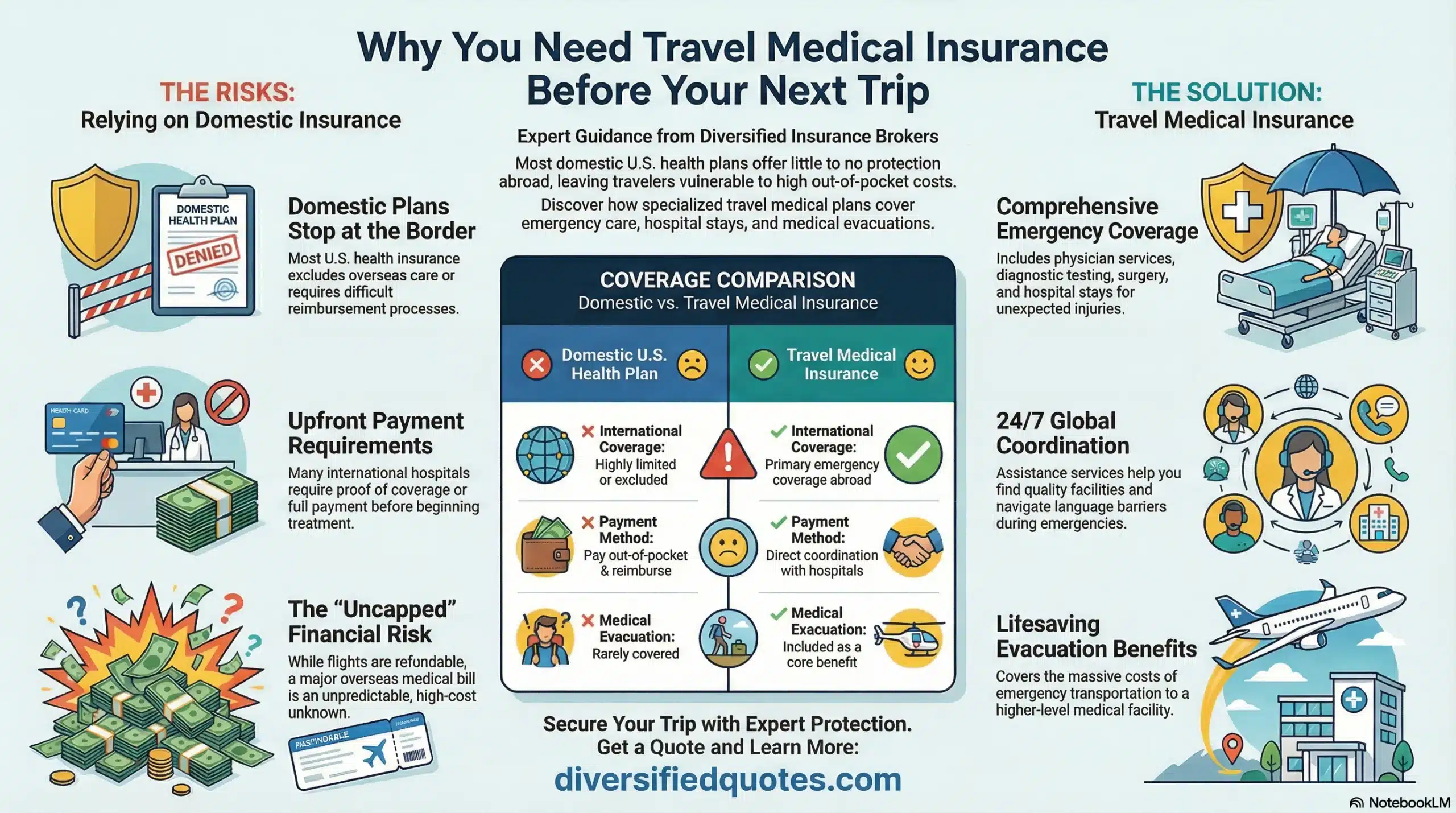
Most U.S. domestic health insurance plans provide limited or no coverage for medical care received in Ireland. Some plans include limited out-of-network international benefits that may reimburse a portion of costs after the fact, but they typically do not provide direct billing, real-time coordination support, or evacuation benefits — and the reimbursement process for international claims is significantly more complex and slower than for domestic claims. Ireland’s healthcare system operates independently of U.S. insurance networks, meaning even when a plan technically includes international coverage, you are effectively paying out of pocket at the point of service and seeking reimbursement later under complex documentation requirements. Travel medical coverage is specifically designed for the international travel context — it provides direct benefit response, assistance team coordination, and evacuation support that domestic plans are not structured to deliver.
What are the most common medical events for travelers in Ireland?
Falls on Ireland’s wet stone surfaces — castle steps, coastal trail rocks, pub-area cobblestones, and cathedral floors — are among the most common acute injury presentations for U.S. travelers in Ireland, creating sprains, fractures, and head injuries that require imaging and orthopedic evaluation. Road accidents on Ireland’s narrow rural roads are a consistent risk for travelers driving unfamiliar left-side driving in the Ring of Kerry, Connemara, and other scenic driving routes. Gastrointestinal illness from food and water exposure, respiratory infections — Ireland’s cool damp climate creates conditions favorable for upper respiratory illness particularly in autumn and winter — and dehydration during high-activity summer touring days are standard travel health presentations. Asthma flare-ups, cardiac presentations during the physical demands of Irish touring itineraries for older travelers, and prescription medication management problems when expected medications are unavailable at Irish pharmacies without a local prescription are recurring coverage scenarios for travelers with medical histories.
What coverage limits should I carry for Ireland travel?
Emergency medical limits of $50,000 to $100,000 are a reasonable baseline for most Ireland travelers, reflecting the realistic cost of inpatient care at an Irish private hospital — a multi-day admission involving diagnostics, specialist consultation, and procedure can reach €5,000 to €20,000 or more at Dublin’s Mater Private or Beacon Hospital. For evacuation and repatriation, limits of $250,000 or more are appropriate because medically supervised repatriation to the United States — when indicated after a prolonged hospitalization or serious event requiring home country follow-up care — involves air transport logistics whose costs accumulate significantly regardless of Ireland’s general accessibility. Senior travelers and those with meaningful health histories should select limits at the higher end of these ranges and should prioritize pre-existing condition language review over premium minimization. Deductible selection should reflect the traveler’s actual tolerance for first-dollar costs — travelers planning to use the plan for outpatient visits should select low deductibles; those primarily seeking protection against high-severity events can accept higher deductibles.
My Ireland trip includes England and France. Does one plan cover all three?
Most international travel medical plans designed for multi-country European travel provide coverage across Ireland, England, and France when policy dates cover the full travel period and all countries are within the plan’s geographic territory. The practical verification steps before purchase: confirm all three countries are explicitly within the plan’s covered territory, ensure policy dates span the complete itinerary including transit days and any buffer for flight changes, and verify whether the plan’s premium calculation requires listing all destination countries or only the primary destination. For the specific coverage and healthcare context of each country in the combination, our pages on travel medical and evacuation from England and travel medical and evacuation from France cover the relevant infrastructure and practical coverage priorities for those two destinations.
Is evacuation coverage necessary for a developed country like Ireland?
The primary value of evacuation coverage for Ireland is not rescue from a country with inadequate healthcare — it is medically supervised repatriation to the United States when that becomes appropriate after a serious event. A traveler who is hospitalized in Dublin for a serious cardiac event, stabilized over several days, and determined to require ongoing specialist care and rehabilitation that is better pursued at home has a medically-indicated need for supervised transport that standard commercial air travel does not provide. That transport — coordinated by the assistance team, with appropriate medical staffing and equipment for the patient’s specific condition — is what the evacuation benefit addresses. For travelers planning high-activity rural itineraries, intra-Ireland transport coordination — from a remote Ring of Kerry location to Cork University Hospital, or from a western Ireland road accident scene to Galway University Hospital — is the more immediate evacuation scenario. The coverage cost relative to the financial exposure it protects against makes evacuation coverage appropriate for Ireland even though the country’s healthcare system is strong.
How does driving in Ireland affect my coverage needs?
Driving in Ireland creates two specific coverage considerations that travelers should address explicitly. First, road accident injury risk: Ireland’s narrow rural roads, left-side driving unfamiliarity for U.S. travelers, high hedge density limiting sightlines, and significant tourist traffic on popular routes like the Ring of Kerry and Wild Atlantic Way create genuine road accident risk that is higher than most travelers anticipate. Confirming that the travel medical plan covers road accident injuries — which is standard for most plans — and that evacuation coverage addresses the intra-Ireland transport scenario from a rural accident scene to the nearest appropriate hospital is the right pre-trip coverage review. Second, rental car considerations: rental car insurance and travel medical insurance are different products addressing different risk categories. Rental car insurance covers vehicle damage and liability; travel medical insurance covers your body. Both are relevant for Ireland road trips and neither replaces the other. Some credit cards provide rental car coverage — verify specifically for Irish rental terms and whether left-side driving in a foreign country affects the card’s coverage terms.
About the Author:
Jason Stolz, CLTC, CRPC, DIA, CAA and Chief Underwriter at Diversified Insurance Brokers (NPN 20471358), is a senior insurance and retirement professional with more than 25 years of real-world experience helping individuals, families, and business owners protect their income, assets, and long-term financial stability. As a long-time partner of the nationally licensed independent agency Diversified Insurance Brokers, Jason provides trusted guidance across multiple specialties—including fixed and indexed annuities, long-term care planning, personal and business disability insurance, life insurance solutions, Group Health, Travel Medical and Evacuation Insurance, and short-term health coverage. Diversified Insurance Brokers maintains active contracts with over 100 highly rated insurance carriers, ensuring clients have access to a broad and competitive marketplace.
His practical, education-first approach has earned recognition in publications such as VoyageATL, and contributions from his agency featured in Kiplinger and GoBankingRates— highlighting his commitment to financial clarity and client-focused planning. Drawing on deep product knowledge and years of hands-on field experience, Jason helps clients evaluate carriers, compare strategies, and build retirement and protection plans that are both secure and cost-efficient. Visitors who want to explore current annuity rates and compare options across multiple insurers can also use this annuity quote and comparison tool.
Explore More Travel Medical Insurance Options: Browse our complete guide to Europe, Asia & Pacific Travel Medical Insurance — covering medical evacuation coverage for Europe, Asia, Australia & Pacific destinations.
Last Reviewed: June 18, 2026 |
Reviewed by: Jason Stolz, CLTC, CRPC, DIA, CAA
Chief Underwriter, Diversified Insurance Brokers, Inc. | NPN: 20471358 | Diversified Insurance Brokers, Inc. — Licensed in all 50 states
Fact Checked by: Tonia Pettitt, CMIP©
Medicare Specialist, Diversified Insurance Brokers, Inc. | NPN: 14374308 | Diversified Insurance Brokers, Inc. — Licensed in all 50 states
Did you find this content helpful? Leave us a Google review — it helps others find trustworthy guidance too.
Editorial Standards: Diversified Insurance Brokers maintains rigorous editorial standards to ensure accuracy, clarity, and independence in all content. Learn more about our editorial standards and commitment to transparency.
