
Travel Medical and Evacuation from Italy
Travel Medical and Evacuation from Italy

Jason Stolz CLTC, CRPC, DIA, CAA
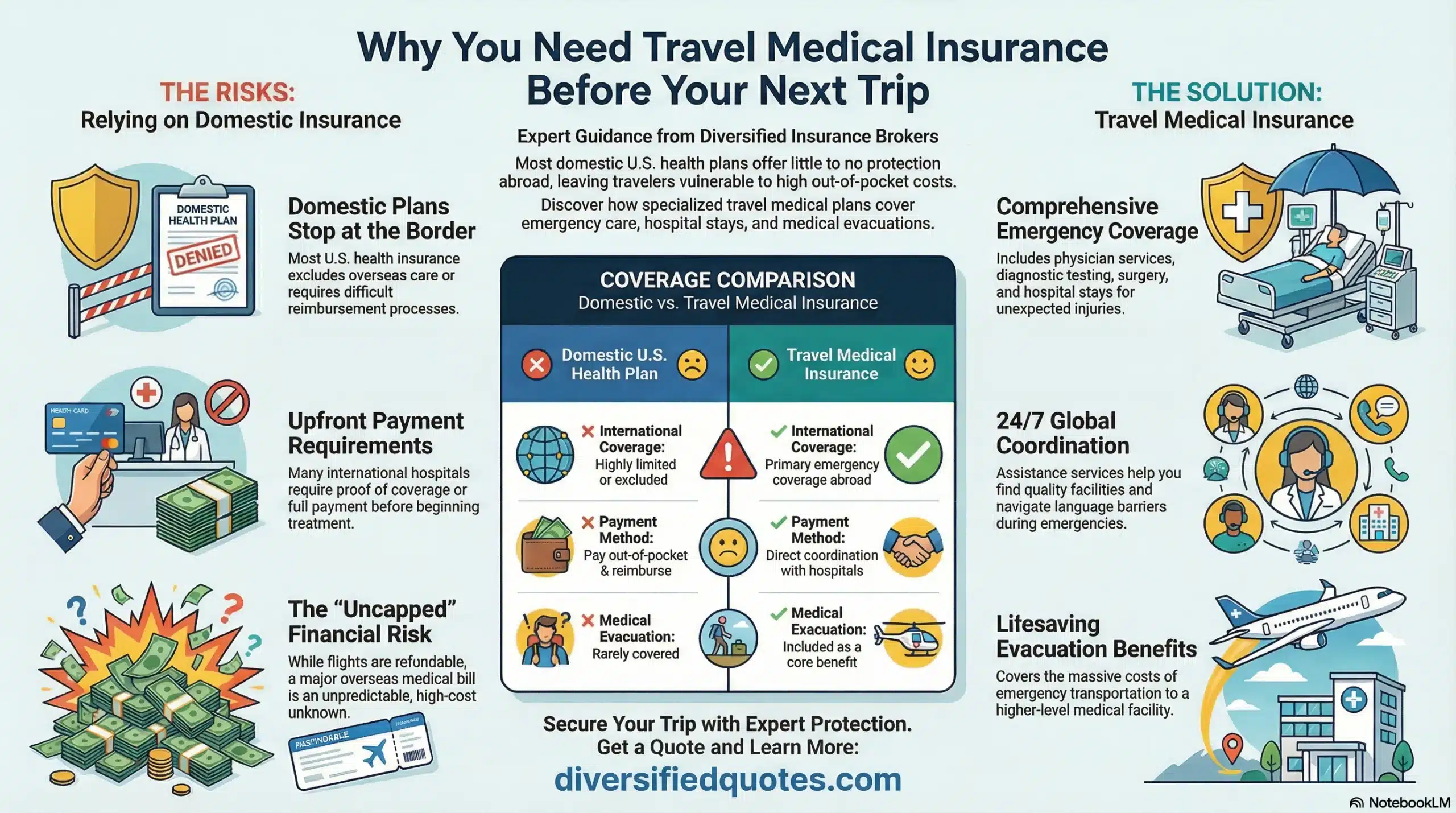
If you are traveling to Italy, the goal is usually simple: enjoy the trip, stay flexible, and avoid expensive surprises. What catches many travelers off guard is that good health insurance at home often becomes limited — or completely unusable — once you are outside the U.S. Travel medical coverage fills that gap by paying for eligible emergency treatment abroad, while medical evacuation coverage helps with transport to an appropriate facility or back home when the best care is not local. At Diversified Insurance Brokers, we build travel medical plans around real-world scenarios: an ER visit in Rome, a broken ankle in the Dolomites, a sudden illness in Florence, a hospital admission in Naples, or a situation where an English-speaking facility and coordinated evacuation matter more than price alone.
Ready to Lock In Coverage Before You Depart?
Getting coverage in place early ensures your dates and destinations are correctly reflected — and avoids last-minute stress.
Quote Travel Medical + Evacuation for ItalyWhy Travel Medical Coverage Matters for Italy
Italy is not considered a high-risk destination in the typical travel insurance sense, but it is still international travel. That means different healthcare networks, different billing practices, different up-front deposit expectations, and a different claims process than you are used to at home. A minor incident can become an expensive logistical problem when you need help coordinating care, payment, prescriptions, follow-up visits, and in some cases transport to a better-equipped facility. The right travel medical plan is designed to keep a health issue from turning into a financial or administrative crisis while you are abroad.
When we say travel medical and evacuation from Italy, we are describing two protections working together. Travel medical coverage focuses on eligible medical costs incurred while you are in Italy — urgent care, emergency room services, physician visits, diagnostics, hospitalization, and certain prescriptions related to a covered event. Evacuation coverage focuses on movement: getting you to an appropriate level of care when your location, condition, or local resources make that necessary. That can mean transport to a different hospital in Italy, a transfer to another country if that is medically appropriate, or repatriation home when the plan and medical team determine it is the right course. For a foundational overview of how these plans work across destinations, our resource on travel medical insurance explains the core structure and then allows you to apply those principles to Italy-specific details like itinerary, season, and planned activities.
Understanding the Structure Beneath the Headline Numbers
One common mistake is choosing a plan based on a single number — like the cheapest premium or the highest medical limit — without understanding the structure underneath it. Two plans can show similar medical maximums but behave very differently when you actually need help. That difference usually comes down to exclusions, pre-existing condition language, deductibles, how the plan defines “emergency,” and how the plan handles evacuation coordination. For many travelers, the claims experience depends less on the headline limit and more on whether the plan’s assistance team is responsive and whether the coverage actually matches the realities of the trip. Another common mistake is assuming that travel coverage is only about catastrophic events. In reality, many claims are ordinary: dehydration, food-related illness, infections, asthma flare-ups, a fall on uneven stone steps, or a minor accident that still needs imaging and follow-up. The best travel medical plan handles the ordinary issues cleanly, because those are the ones most likely to happen.
Italy is also a destination where travelers often mix city travel with region-to-region movement. You might spend time in Rome and then head north to Tuscany, across to the Adriatic coast, or into the mountains. When you are moving frequently, a plan with strong assistance and straightforward coverage definitions matters more — because the location of treatment and the logistics of follow-up can change quickly. If your itinerary includes rural areas, smaller towns, or high-mobility travel days, evacuation and coordination become even more valuable. Not because Italy lacks healthcare, but because the right facility for your condition may not be the closest one. For travelers evaluating how Italy compares to other Western European destinations, our resources on travel medical and evacuation from Spain and travel medical and evacuation from Sweden provide useful context for how plan priorities shift across similar European healthcare environments.
| Italy Itinerary / Traveler Type | Medical Access Reality | Key Coverage Priority | Evacuation Consideration |
|---|---|---|---|
| Rome / Florence / Naples — multi-city touring | Strong urban hospital and private clinic access in all three cities; public emergency care available to visitors; private facilities preferred for English-language support and billing clarity; up-front deposit requirements common for uninsured foreign visitors | Financial protection against Italian private hospital billing; direct billing or payment guarantee support; assistance team guidance for identifying the right facility type for the specific condition; documentation collection support before moving to next city | Evacuation within Italy to a higher-capability hospital for complex events; repatriation to the U.S. after stabilization when medically supervised return is appropriate; European specialty routing available for rare highest-complexity events |
| Dolomites / Alps — skiing and hiking | Mountain rescue and helicopter evacuation services available; nearest major hospital may be 1–2 hours from remote ski or trail locations; orthopedic evaluation commonly required after ski and hiking injuries; high-altitude exposure for some routes | Explicit activity coverage confirmation for skiing and snowboarding; helicopter rescue and mountain evacuation coordination; orthopedic surgery cost limits; assessment of fitness to fly after significant injury before departure | Mountain rescue to nearest trauma-capable hospital; ground or air transfer to Bolzano, Verona, or Innsbruck (Austria) for complex orthopedic or neurosurgical events; repatriation coordination after stabilization |
| Tuscany / Amalfi Coast / rural Italy | Regional hospitals in smaller towns provide basic emergency care; specialist depth limited outside Florence, Siena, and Naples; Amalfi road conditions add accident and delay risk; high walking and heat exposure in summer months | Assistance team guidance for identifying highest-capability regional facility; transfer coordination to Florence or Naples for specialist events; heat illness and dehydration coverage during summer travel; road accident coverage on Amalfi coastal routes | Intra-Italy transfer to major city hospital more common than international evacuation; repatriation after stabilization when recovery is prolonged and home country follow-up is preferred |
| Senior travelers / 65+ | Italy’s medical system generally accessible; high walking demands and heat in summer create cardiovascular and dehydration risk for older travelers; minor events more likely to require extended observation, specialist consult, or imaging for older patients; pre-existing condition prevalence higher | Higher medical benefit limits accounting for extended observation and specialist costs; careful pre-existing condition language review; lower deductible for travelers likely to use outpatient benefits; real-time assistance coordination rather than reimbursement-only structure | Medically supervised repatriation when recovery requires follow-up care with familiar providers; family member coordination support; assistance team case management for multi-day hospitalizations |
| Students / study abroad programs | Italian public health system accessible for residents with enrollment documentation; private clinics preferred for English-language convenience; multi-month stays accumulate medical probability well beyond short-trip exposure; prescription management across Italian pharmacy system | Coverage structure appropriate for semester-length or longer stay; outpatient access for non-emergency care; prescription medication coordination support; mental health benefit availability; Italian health system enrollment interaction review with specific plan terms | Repatriation for serious events requiring extended follow-up with home country providers; family coordination support if student is hospitalized; evacuation decision aligned with academic program timeline where medically appropriate |
| Mission / volunteer / church groups | Group travel introduces coordination complexity when one member has a medical event affecting the full group’s schedule; volunteer programs may include service sites outside major city corridors; youth travelers in organized groups have specific supervision and documentation requirements | Group plan structure providing consistent benefit levels across all enrolled travelers; activity coverage for service-related physical work; fast assistance team response supporting group coordinator as well as the individual patient; clear authorization process for group leaders | Individual evacuation coordinated without requiring entire group to disrupt; group coordinator briefed on assistance team contact process before departure; family notification support for youth travelers requiring evacuation |
Senior Travelers and Age-Specific Coverage Considerations
We build plans differently depending on who is traveling. A 26-year-old on a short vacation needs something very different than a 72-year-old taking a multi-city itinerary — and that difference is not just the price. Seniors typically benefit from higher medical limits, careful deductible selection, and clarity around stability and recent treatment history. If your trip includes older travelers, or if you are arranging coverage for parents or grandparents, review our resource on travel medical insurance for seniors before choosing the minimum option — because the best plan is the one that still works when a minor issue becomes a hospital observation stay. Our resource on how to get the best travel medical insurance rates covers the key variables that affect premium and how to optimize the cost-to-benefit ratio across different traveler profiles and trip lengths.
Students, Volunteers, and Purpose-Driven Italy Travel
If you are traveling for school or an academic program in Italy, the right plan often means longer coverage duration, reliable access to outpatient care, and clarity on how ongoing follow-up is handled. Students and families should think about everyday medical needs as well as emergencies. Many Italy programs involve months abroad, not days, so you want a plan that feels genuinely usable for routine care rather than only for catastrophic events. Our resource on travel medical insurance for studying abroad covers the specific considerations that apply when the trip is educational — program length, housing location, and recurring outpatient access all shape which plan structures work best.
Volunteer travel has its own planning profile. You may be in group settings, working in variable environments, or traveling outside major city centers. The plan should handle urgent care and injury cleanly, and it should include strong coordination support if transport is needed. Our resource on travel medical insurance for volunteer groups covers group-specific structures that apply when multiple travelers are coordinating under a single travel program. For mission and church travel that may include Italy as part of a broader European itinerary, our resource on travel insurance for church groups covers how group coverage structures work for organized faith-based travel. Families traveling with youth teams or organized sports groups also need to think carefully about injury patterns, sports-related treatment, and the practical need for fast care and documentation — our resource on travel medical for youth sports provides the baseline for evaluating those specific coverage needs.
Medical Maximum, Deductible, and Activity Coverage Decisions
One of the most important coverage choices is the medical maximum. A low-limit plan might be fine for very short trips when you are comfortable with more out-of-pocket exposure. But many travelers prefer to set limits high enough that the plan is not exhausted by one hospital episode. Italy’s healthcare system can be excellent, but you are still dealing with international billing and the possibility of private facilities. A useful rule of thumb is to choose a limit that would still feel adequate if the event involved a few days of hospital monitoring, imaging, and specialist consults — not just one urgent care visit. Deductibles matter too, especially for travelers who are more likely to use the plan for outpatient issues. If you choose a higher deductible to reduce premium, you are effectively self-insuring the first layer of costs. That can be a smart choice if you want protection primarily for higher-severity events. But if you want a plan you will actually use for urgent care and minor treatment abroad, a lower deductible often creates a better experience. The right deductible is the one you would be comfortable paying in Italy without hesitation if a medical issue disrupts a travel day.
Activities matter significantly for Italy itineraries. Italy trips often include walking-heavy city days, hiking, skiing in season, cycling, and boat excursions. If your itinerary includes higher-risk activities, confirm the plan’s coverage stance before purchasing — some plans restrict coverage for certain activities while others cover them if they are recreational and non-professional. A plan that fits your actual itinerary reduces the risk of a denied claim when the injury is directly connected to what you were doing. For travelers heading to other active or high-adventure destinations alongside Italy, our resources on travel medical and evacuation from Bali and travel medical and evacuation from Australia illustrate how activity considerations and evacuation priorities shift with destination infrastructure and remoteness.
Evacuation Benefits — Why They Matter Even in Italy
Evacuation benefits are the coverage travelers most consistently underestimate until they need them. Evacuation is not about calling an ambulance home because you would rather be treated in the U.S. It is typically based on medical necessity and coordinated through the plan’s assistance team. The real value is that you have a structured process and a team that can coordinate transport, medical records transfer, facility coordination, and the logistics of getting you to the appropriate level of care. If you travel to Italy with any medical complexity — or simply want the confidence that you are not on your own if something serious happens — evacuation coverage is often one of the highest-value parts of the plan. Travelers who also visit more complex destinations should compare how evacuation priorities differ: our resources on travel medical and evacuation from Kenya and travel medical and evacuation from Senegal show how evacuation logistics scale with distance from major medical centers — providing useful contrast for travelers who may visit Africa before or after Italy.
Pre-Existing Conditions, Prescriptions, and the Claims Process
Pre-existing conditions are handled differently by different plans. Some exclude anything related to a pre-existing condition entirely, while others may cover acute onset events or include waivers if specific purchase timing and eligibility rules are met. The exact definition and look-back period matter significantly, so the best approach is selecting a plan with language that matches your medical stability and your risk tolerance rather than defaulting to the cheapest option and assuming it will cover your situation. If you are managing ongoing conditions and still want strong travel coverage for Italy, comparing plan language carefully — rather than comparing premium alone — is the most important step in plan selection.
Prescription medication is another practical reality. Your U.S. pharmacy network will not follow you to Italy. If you lose medication, need a temporary supply, or need a physician visit to support a medication-related issue, the plan’s structure and assistance capability matter. Travel medical coverage is typically designed around new issues that arise on the trip, but assistance teams can also help coordinate local care and pharmacy access. The best strategy is still preparation — carry medication properly, keep a list of prescriptions with generic names and dosages, and travel with enough supply — but the plan can become a valuable backstop when travel goes sideways. For travelers planning visits to other destinations where prescription access and healthcare infrastructure vary more significantly, our resources on travel medical and evacuation from Vietnam and travel medical and evacuation from Nigeria illustrate how the pharmacy and care access picture changes with destination.
Trip Duration, Multi-Country Itineraries, and Family Planning
Trip duration changes the coverage equation significantly. A ten-day vacation has a different risk profile than a sixty-day itinerary. The longer you are abroad, the more likely it is you will have some kind of medical interaction — even if it is minor. That does not mean you should fear travel; it means you should pick a plan that does not collapse under ordinary use. If you are doing a longer Italy stay, prioritize usability: outpatient benefits that are not overly restrictive, medical limits that still feel meaningful, and evacuation coverage that is strong enough to matter if you are far from your preferred facilities. For travelers on extended international stays who may need more than a short-term travel policy, our resource on international major medical insurance covers how longer-duration and broader-scope coverage structures differ from standard travel plans.
If your Italy trip includes multiple countries — France, Switzerland, Austria, Greece, or Germany — make sure the policy is structured for the full itinerary. Travel plans are typically based on travel dates and destination region, and you want the coverage to match where you will actually be. The same is true for cruises or ferry travel where the location of treatment could vary unexpectedly. A plan built for your full itinerary helps avoid gaps where a technicality becomes a problem at the worst possible moment. For families, a key planning question is how decisions get made if the traveler is hospitalized abroad. Who has access to documents? Who will coordinate flights if plans change? Who can speak with assistance teams and providers? Travel medical and evacuation coverage is stronger when paired with a simple documentation plan: a list of emergency contacts, medical information, and a way for a trusted person to access itinerary details.
How to Compare and Choose the Right Plan for Italy
For many Italy travelers, the simplest way to get the right plan is to start with a short set of questions: Who is traveling and what are their ages? How long are you staying? Are there any ongoing conditions actively being treated? Are you planning strenuous activities? Do you want the plan mainly for catastrophic protection or for everyday usability? Once those questions are answered, plan selection usually becomes much clearer. When quotes are in front of you, compare the levers: medical maximum, deductible, evacuation amount, and how the plan describes pre-existing conditions and acute onset events. Then look at what the plan includes for outpatient visits and prescriptions related to a covered event. Finally, consider the assistance experience — how easy it is to contact the support team, and what kind of coordination they provide when you are abroad. That combination typically determines whether the plan feels smooth or frustrating during a real claim. At Diversified Insurance Brokers, we approach travel medical planning like we approach all protection decisions: make the coverage understandable, match it to the real scenario, and avoid surprises in the fine print.
Get a Travel Medical Quote for Italy
Compare travel medical and evacuation options designed for international trips, then choose the coverage level that fits your itinerary.
Start My Italy Travel Medical QuoteRelated Travel Medical Pages
Related Destination Pages
Talk With an Advisor Today
Choose how you’d like to connect—call or message us, then book a time that works for you.
Schedule here:
calendly.com/jason-dibcompanies/diversified-quotes
Licensed in all 50 states • Fiduciary, family-owned since 1980
Travel Medical and Evacuation from Italy — FAQs
In most cases, yes — and the gap is larger than most travelers assume. U.S. health insurance plans often have limited or no coverage outside the country, and even when an international emergency benefit technically exists, reimbursement rules can be restrictive, documentation requirements can be burdensome, and the process can take weeks or months to resolve while you have already paid out of pocket. Travel medical coverage is specifically designed for the visitor scenario: it pays eligible medical expenses while you are abroad, provides access to an assistance team that can coordinate care in an unfamiliar healthcare environment, and handles the administrative friction so you can focus on recovering rather than on paperwork. For Italy trips specifically, the payment practices at Italian hospitals and clinics may differ from U.S. expectations — some facilities expect deposits or payment at the time of service — and having a plan with a responsive assistance team can make a significant difference in how smoothly those situations are handled.
Medical evacuation in a travel plan means medically necessary transport to an appropriate facility when the local option is not adequate for your condition. For Italy travel, this does not mean you are automatically flown home because you would prefer U.S. care — evacuation decisions are based on medical necessity, coordinated by the plan’s assistance team, and determined by what level of care is actually required and where the nearest appropriate facility is. In practice for Italy, evacuation might mean transport from a smaller regional hospital to a larger facility in Rome or Milan with specialized capabilities, or it might mean coordinated repatriation home after stabilization when continued recovery in Italy is not medically optimal. The real value of evacuation coverage is not just the financial protection against expensive transport — it is the structured coordination process that ensures decisions are made correctly, logistics are handled by people who do this regularly, and you are not left improvising a medical transport from overseas under stress.
Travel medical plans commonly cover eligible emergency treatment, diagnostics, and hospitalization for covered illnesses or injuries that occur during the trip, subject to the policy’s terms, exclusions, deductibles, and medical maximum limits. For an Italy trip, that typically includes emergency room services, inpatient hospitalization, physician consultations, imaging and laboratory diagnostics, and prescriptions related to the covered event. The key qualifiers are that the event must be sudden and unexpected — not a pre-planned or elective procedure — and the treatment must meet the policy’s definition of covered medical care. Most standard travel medical plans are well-suited for the kinds of events that actually occur on Italy trips: accidents, acute illness, infections, and other unexpected medical needs. Where travelers encounter surprises is usually in the pre-existing condition language, which is why reviewing that section of any plan you are comparing is the most important step before purchasing.
Many travel medical plans include outpatient benefits for eligible urgent care or doctor visits related to a covered event, but the details vary meaningfully across plans. If you want a plan you will actually use for non-catastrophic issues — a clinic visit for an infection, a physician consultation for a travel-related illness, an urgent care visit for a twisted ankle — focus your comparison on deductible level and outpatient structure rather than just the headline medical maximum. A plan with a $5,000 maximum and a $0 deductible may be more useful for routine Italy travel needs than a plan with a $250,000 maximum and a $2,500 deductible, depending on how you expect to use it. The right approach is to match the deductible to the out-of-pocket amount you would be comfortable paying for an ordinary claim — not an extreme scenario — and then verify that the plan’s outpatient benefit structure covers the types of care you are most likely to need.
Pre-existing conditions are handled very differently across travel medical plans, and this is one of the most important areas to review carefully for any traveler with a medical history. Some plans exclude anything related to a pre-existing condition entirely — meaning if your claim has any connection to a condition you had before the trip, coverage may be denied. Other plans offer an “acute onset of pre-existing conditions” benefit that covers sudden unexpected medical emergencies related to a pre-existing condition, as long as the event is genuinely acute and not a predictable continuation of an ongoing treatment. A third category includes plans that offer pre-existing condition waivers if you purchase the plan within a defined window after your initial trip deposit. The look-back period — how far back the plan looks to define a pre-existing condition — also varies from 60 days to 180 days to longer across different plans. For travelers managing ongoing conditions who want strong Italy travel coverage, reading the pre-existing condition language in any plan you are seriously considering is not optional — it is the most consequential section for your specific situation.
Yes — and the reason is not about the quality of Italian healthcare, which is genuinely strong in major urban centers. Evacuation matters for Italy travel for several more nuanced reasons. First, the right facility for your specific condition may not be the closest one — if you have a complex cardiac event in a smaller Italian city, the appropriate specialist or surgical team may be at a different hospital in a different city. Second, if you are in a rural area, near the Dolomites, on a coastal island, or in a smaller town, your distance from high-capability facilities may be greater than you assume. Third, international medical transport coordination is complicated — securing appropriate aircraft, medical escorts, receiving facility agreements, and documentation for international transport is not something individual travelers manage effectively under stress. The assistance team behind good evacuation coverage handles all of that logistics. And fourth, for travelers with medical complexity, repatriation home after stabilization may genuinely be the right medical decision — and having coverage ensures that decision can be made based on what is best for you rather than what you can afford.
Yes — many travel medical plans can be structured for longer durations, including stays of several months. For longer Italy trips, the coverage priorities shift somewhat from the short vacation framework. When you are abroad for an extended period, the probability of encountering at least one medical interaction — even a minor one — increases simply with time. That means outpatient usability becomes more important relative to catastrophic-only protection: you want a plan with outpatient benefits that are not overly restrictive, a deductible you would actually use the plan through, and medical limits that remain meaningful even after ordinary use. For stays that approach or exceed several months, reviewing whether a standard travel medical plan or a longer-term international medical plan is the better structural fit is a worthwhile step. Our resource on international major medical insurance covers how these longer-duration options differ from standard travel plans in terms of renewability, day-to-day coverage scope, and network structure for extended international residence.
Many travel medical plans cover typical recreational activities that are part of ordinary Italy tourism — walking tours, cycling, hiking, swimming, boat excursions, and similar activities. However, some plans have restrictions or exclusions for certain higher-risk activities, and the specific language varies by plan. If your Italy itinerary includes alpine hiking, skiing or snowboarding, cliff diving, motorized sports, or other activities that some plans classify as higher-risk recreational activities, you should confirm the plan’s coverage stance for those specific activities before purchasing. This matters because if you are injured during an excluded activity, the claim may be denied even if the treatment itself would otherwise be fully covered. The confirmation process is straightforward — most plan documents specifically enumerate excluded activities, and you can also contact the plan’s assistance line to ask about coverage for specific planned activities. Matching the plan’s activity coverage to your actual itinerary eliminates one of the most common sources of unexpected coverage gaps for active travelers.
If your Italy trip includes side trips or extended time in other European countries — France, Switzerland, Austria, Greece, Croatia, Germany, or others — you need to ensure your travel medical plan covers the entire itinerary rather than just Italy. Most international travel medical plans cover a broad geographic territory that includes multiple countries when structured correctly, but the policy must reflect your actual travel dates and the full range of destinations you plan to visit. The simplest approach is to define your travel dates to cover the entire trip including all planned destinations, and to verify with the plan or its assistance team that all countries on your itinerary are included in the plan’s covered territory. For cruises, ferry travel, or itineraries where your exact location on any given day is variable, it is especially important to confirm that the plan’s geographic coverage matches the full scope of where you might need care — because a technicality about which country you were in when an event occurred can create complications if the plan territory is narrowly defined.
In most cases, you can receive a quote and complete a purchase within minutes through an online application process. The key inputs are your travel dates, destination or coverage territory, traveler ages, and any plan options you want to include. Once those are entered accurately, comparable plan options are presented with premiums, medical maximums, deductibles, evacuation limits, and key benefit summaries. After selecting a plan, the purchase process typically produces immediate confirmation and a policy document by email. The most important thing to verify before completing the purchase is that all travel dates are correct — including departure and return dates — that all travelers are accurately listed, and that the coverage territory includes all countries you plan to visit. There is no meaningful financial advantage to waiting until the last minute before departure, and buying early means coverage is in place if a pre-departure event affects your trip plans. For travelers comparing plans, taking the extra few minutes to review the pre-existing condition language and the exclusions section before purchasing — rather than just comparing the medical maximum and premium — almost always produces a better outcome when a claim is eventually needed.
About the Author:
Jason Stolz, CLTC, CRPC, DIA, CAA and Chief Underwriter at Diversified Insurance Brokers (NPN 20471358), is a senior insurance and retirement professional with more than 25 years of real-world experience helping individuals, families, and business owners protect their income, assets, and long-term financial stability. As a long-time partner of the nationally licensed independent agency Diversified Insurance Brokers, Jason provides trusted guidance across multiple specialties—including fixed and indexed annuities, long-term care planning, personal and business disability insurance, life insurance solutions, Group Health, Travel Medical and Evacuation Insurance, and short-term health coverage. Diversified Insurance Brokers maintains active contracts with over 100 highly rated insurance carriers, ensuring clients have access to a broad and competitive marketplace.
His practical, education-first approach has earned recognition in publications such as VoyageATL, and contributions from his agency featured in Kiplinger and GoBankingRates— highlighting his commitment to financial clarity and client-focused planning. Drawing on deep product knowledge and years of hands-on field experience, Jason helps clients evaluate carriers, compare strategies, and build retirement and protection plans that are both secure and cost-efficient. Visitors who want to explore current annuity rates and compare options across multiple insurers can also use this annuity quote and comparison tool.
Explore More Travel Medical Insurance Options: Browse our complete guide to Europe, Asia & Pacific Travel Medical Insurance — covering medical evacuation coverage for Europe, Asia, Australia & Pacific destinations.
Last Reviewed: June 18, 2026 |
Reviewed by: Jason Stolz, CLTC, CRPC, DIA, CAA
Chief Underwriter, Diversified Insurance Brokers, Inc. | NPN: 20471358 | Diversified Insurance Brokers, Inc. — Licensed in all 50 states
Fact Checked by: Tonia Pettitt, CMIP©
Medicare Specialist, Diversified Insurance Brokers, Inc. | NPN: 14374308 | Diversified Insurance Brokers, Inc. — Licensed in all 50 states
Did you find this content helpful? Leave us a Google review — it helps others find trustworthy guidance too.
Editorial Standards: Diversified Insurance Brokers maintains rigorous editorial standards to ensure accuracy, clarity, and independence in all content. Learn more about our editorial standards and commitment to transparency.
