
Travel Medical and Evacuation from Australia
Travel Medical and Evacuation from Australia

Jason Stolz CLTC, CRPC, DIA, CAA
Australia occupies a distinctive position in international travel medical planning for U.S. travelers — a country with genuinely world-class healthcare infrastructure, a sophisticated emergency response system, and a remote geography that simultaneously creates some of the most demanding evacuation logistics available to travelers in any developed nation. The Alfred Hospital in Melbourne, Royal Prince Alfred Hospital in Sydney, Princess Alexandra Hospital in Brisbane, and Royal Adelaide Hospital represent tertiary medical care that rivals the world’s best academic medical centers across cardiology, neurosurgery, trauma, oncology, and critical care. Australia’s Royal Flying Doctor Service — operating since 1928 as the world’s largest aeromedical organization — provides emergency air medical response across the continent’s remote interior with a scale and operational sophistication that no other country’s internal medical transport system matches. These are not qualifications that make coverage planning simple. They are facts that shape what coverage planning for Australia actually requires: strong financial protection against Australian public hospital non-resident billing and private hospital costs, and evacuation coverage calibrated to the specific remote-region logistics of a continent where the Outback, the Cape York Peninsula, the Kimberley, and the Arnhem Land wilderness create genuine evacuation planning environments that are as demanding as any in the developed world. Travel medical and evacuation insurance from Australia is built for both dimensions of that planning reality.
At Diversified Insurance Brokers, we help travelers, students, expats, adventure travelers, and families compare plans designed for Australia’s specific combination of excellent urban hospitals and remote-region evacuation complexity. The coverage question for a Sydney or Melbourne city trip is primarily about the billing structure for non-resident international patients in Australia’s public and private hospital system. The coverage question for a Kimberley 4WD expedition, a Cape York overland crossing, a remote dive trip to the Cocos Keeling Islands, or a Snowy Mountains backcountry skiing itinerary is about whether the plan’s evacuation benefit and assistance team can execute the Royal Flying Doctor Service coordination and multi-leg transport chain that serious events in those environments require. For the foundational framework on how these plan types differ and why evacuation benefits matter more than most travelers anticipate, international travel health coverage is the right starting point before engaging with Australia’s specifics.
Get Travel Medical + Evacuation Coverage for Australia Travel
Compare plans built for international emergency medical care and evacuation coordination based on your dates and traveler details.
Australia’s Medical Geography: Urban Excellence and the Outback Gap
Australia’s major city hospital infrastructure is among the world’s strongest. The Alfred Hospital in Melbourne handles the most complex cardiovascular surgery, severe trauma, and critical care in Victoria; Royal Melbourne Hospital and St Vincent’s Melbourne round out the metropolitan network. Royal Prince Alfred Hospital and Royal North Shore in Sydney provide comparable depth for New South Wales. Princess Alexandra Hospital in Brisbane handles Queensland’s most complex cases and serves as the referral hub for much of northern Australia. Royal Perth Hospital and Fiona Stanley Hospital serve Western Australia. These facilities treat non-resident international patients at uninsured rates — Australia’s Medicare system covers Australian citizens and permanent residents, and a limited set of countries with reciprocal healthcare agreements. U.S. travelers are not covered under Australian Medicare for anything beyond immediately necessary treatment, and even immediately necessary treatment generates out-of-pocket costs for uninsured international visitors. An emergency presentation at an Australian public hospital with imaging, specialist consultation, and a 24-hour admission for observation can realistically generate AUD $3,000–$15,000+ in non-resident billing. Private hospital billing for surgical events can substantially exceed those figures.
The Outback, the Kimberley, the Cape York Peninsula, the Top End of the Northern Territory, Arnhem Land, and the remote Western Australian interior create a medical access environment that is qualitatively different from the city hospital picture. The Royal Flying Doctor Service operates from 24 bases across Australia, covering approximately 7.7 million square kilometers — nearly the size of the entire continental United States. It provides aeromedical evacuation from remote properties, Aboriginal communities, mining sites, and wilderness areas to the nearest appropriate hospital, and it is the operational backbone of medical care for roughly one-third of the Australian continent by area. For travelers in remote Australia, the RFDS is not a backup — it is the primary serious event medical transport system. Access to RFDS services for international travelers depends on the specific circumstances, location, and plan arrangements, and the cost of air medical evacuation from remote Northern Territory, Kimberley, or Cape York locations to Darwin, Alice Springs, Cairns, or further to a major city can accumulate rapidly. For travelers comparing Australia’s Outback evacuation environment to other remote-continent destinations with comparable aeromedical transport dependency, the pages on travel medical and evacuation from Canada (Yukon, NWT) and travel medical and evacuation from Pakistan cover the comparable remote-region planning framework across different geographic and infrastructure contexts.
Australia Travel Medical: Coverage Priorities by Location and Traveler Type
| Australia Location / Traveler Type | Medical Access Reality | Key Coverage Priority | Evacuation / Transfer Scenario |
|---|---|---|---|
| Sydney / Melbourne / Brisbane — urban tourism / business | Royal Prince Alfred, Alfred Hospital, Princess Alexandra — world-class tertiary care; non-resident billing applies; U.S. travelers not covered by Australian Medicare; private hospital costs add significantly above public rates; English-language environment simplifies navigation; direct U.S. flight connections from all three cities | Financial protection against Australian non-resident public and private hospital billing; direct billing or payment support with major Australian hospitals; pre-existing condition terms reviewed for older travelers; plan documentation accessible for hospital presentation | Within-city hospital transfers for complex events; U.S. repatriation via direct Los Angeles or Dallas connections from Sydney, Melbourne, and Brisbane for events requiring prolonged U.S. follow-up care |
| Great Barrier Reef / Cairns / North Queensland — diving and marine tourism | Cairns Hospital and Cairns Private Hospital serve the reef diving corridor; Townsville University Hospital provides the regional tertiary referral hub; hyperbaric chamber at Cairns Hospital serves Great Barrier Reef decompression illness cases; remote reef locations 60–90 minutes by boat from Cairns create multi-leg transport chain for serious diving incidents | Scuba diving explicitly confirmed as covered activity; decompression illness treatment confirmed under emergency medical or evacuation provisions; hyperbaric chamber access confirmed at Cairns Hospital; Great Barrier Reef liveaboard itineraries require assistance team pre-engagement given boat-to-Cairns transport chain | Vessel rescue to Cairns for initial care; Cairns hyperbaric for decompression illness; Townsville for complex specialist events; Brisbane or Sydney via commercial flight for highest-complexity cases; liveaboard incidents activate multi-leg chain requiring early assistance team call |
| Northern Territory / Outback — remote wilderness travel | Royal Darwin Hospital serves the Top End and receives RFDS transfers from across the NT; Alice Springs Hospital serves Central Australia; remote Outback locations may be 500+ km from any hospital with RFDS as only viable serious event response; heat stroke risk extreme during summer (Nov–Mar); 4WD track accidents remote from assistance; fuel range and communication isolation compound medical access challenge | Maximum evacuation limits; satellite communication device mandatory for remote Outback itineraries; RFDS coordination confirmed as covered assistance with the plan; assistance team pre-engaged with specific remote route and check-in schedule; heat illness and dehydration coverage; vehicle breakdown injury coverage | RFDS air evacuation from remote location to Darwin or Alice Springs; Darwin or Alice Springs to Adelaide, Melbourne, or Sydney for complex specialist care; U.S. repatriation via major east coast city once medically stable |
| Kimberley / Cape York / Arnhem Land — extreme remote 4WD | Among the most medically remote accessible areas in the world for travelers; Broome Regional Hospital serves the Kimberley access point but is itself hours from most Kimberley locations; Cape York has Thursday Island Hospital and some community clinics but minimal specialist depth; wet season (Nov–Apr) creates additional road and evacuation complications; crocodile, snake, and jellyfish risk adds specific injury categories | Maximum evacuation limits; satellite emergency beacon (EPIRB/PLB) as essential non-insurance complement; assistance team pre-engaged before entering remote corridor; wet season risk assessment; envenomation and wildlife injury coverage confirmed; multi-day RFDS coordination capability confirmed with assistance team | RFDS or helicopter rescue to nearest airstrip; Broome or Cairns for Kimberley and Cape York cases respectively; Perth or Brisbane for specialist care; U.S. repatriation via Perth or Brisbane; one of the most complex evacuation environments accessible to recreational travelers globally |
| Snowy Mountains / alpine skiing — NSW and Victoria | Thredbo Medical Centre and Perisher clinic serve on-mountain urgent care; Canberra Hospital (3 hours from Thredbo) and Albury Wodonga Health provide regional capability; serious orthopedic trauma and head injury cases transfer to Sydney or Melbourne; helicopter evacuation from backcountry and off-piste terrain used for serious events; avalanche and crevasse risk in backcountry | Skiing and snowboarding confirmed as covered; helicopter rescue from mountain terrain confirmed as covered transport; evacuation limits covering Sydney or Melbourne specialist care; backcountry skiing confirmation if applicable; head injury and spinal trauma coverage for mountain rescue scenarios | Mountain rescue helicopter to Canberra or Albury; Sydney or Melbourne for complex neurosurgical or orthopedic subspecialty events; U.S. repatriation via Sydney for events requiring prolonged U.S. rehabilitation |
| International students — university programs | OSHC (Overseas Student Health Cover) is mandatory for Australian student visa holders — but OSHC is a separate product from travel medical insurance with different benefit structures; OSHC covers health services within Australia but not travel evacuation or medical emergencies outside Australia during semester breaks; many students incorrectly assume OSHC equals full international travel medical coverage | OSHC vs. travel medical distinction clarified before departure; travel medical plan to supplement OSHC for domestic Australian evacuation scenarios OSHC does not address and for travel outside Australia during breaks; semester-length plan duration for gap coverage; pre-existing condition terms reviewed | Australian public hospital system for most in-Australia events (covered by OSHC); travel medical for evacuation within Australia and for medical events during international travel during study breaks; U.S. repatriation via major hub airports for events requiring U.S. specialist follow-up |
Great Barrier Reef Diving, the Royal Flying Doctor Service, and the Three Coverage Verifications That Define Australia Planning
Three specific pre-purchase verification steps define Australia coverage planning more than any others, corresponding directly to the three event categories that generate the most consequential financial exposure for international travelers: non-resident hospital billing in Australian cities, decompression illness evacuation from Great Barrier Reef diving, and RFDS-coordination for Outback and remote-region events.
Australian non-resident hospital billing is often the first surprise for U.S. travelers who assume that Australia’s excellent healthcare is also accessible and affordable for international visitors. Australia’s Medicare system is funded through taxation and serves Australian citizens and permanent residents — U.S. travelers have no Medicare entitlement. The United States does not have a reciprocal healthcare agreement with Australia that covers emergency care billing for U.S. visitors, which means a U.S. traveler presenting at an Australian public hospital emergency department receives care as an uninsured international patient. Emergency treatment billing at Australian public hospitals for non-residents typically ranges from AUD $700–$2,000 for a straightforward ER visit to AUD $5,000–$20,000+ for a hospitalization with specialist consultation and surgical intervention. Private hospital billing substantially exceeds public rates. The travel medical plan’s financial protection against this billing structure is the primary coverage value for most Australia city travelers, and confirming that the plan can support direct billing or payment guarantee with major Australian hospitals — rather than requiring the traveler to pay upfront and seek reimbursement weeks later — is the first coverage verification step. The framework for how this emergency billing structure works from an international visitor’s perspective is explained at emergency travel health insurance for foreign nationals.
Great Barrier Reef diving creates decompression illness risk in one of the world’s most extraordinary marine environments, combined with logistics that make hyperbaric access meaningfully time-sensitive. The Cairns Hospital hyperbaric unit is the primary decompression illness treatment facility for the Queensland reef diving corridor. For divers on liveaboard vessels operating in the outer Coral Sea, Osprey Reef, or the Cod Hole on the Ribbon Reefs, the vessel-to-Cairns transport chain can involve 6–12+ hours of ocean transit — making early assistance team activation the critical variable that determines whether treatment begins within an appropriate clinical window. For day-trip divers from Cairns on the accessible inner reef, the chain is shorter but still requires the same three-point verification: scuba confirmed as covered, decompression illness treatment confirmed under emergency medical or evacuation provisions, Cairns Hospital hyperbaric confirmed in the assistance team’s established network. For travelers comparing Australia’s reef diving logistics to other premier Indo-Pacific diving destinations with comparable decompression illness evacuation planning requirements, the pages on travel medical and evacuation from Vietnam and travel medical and evacuation from Spain cover regional diving environments where the same verification framework applies.
For Outback, Kimberley, Cape York, and Arnhem Land travelers, the Royal Flying Doctor Service is the operational reality of serious event medical response, and the assistance team’s ability to coordinate RFDS activation and receiving hospital arrangements is what determines whether the evacuation benefit actually functions in these environments. An experienced assistance team coordinates with RFDS dispatch, confirms the receiving hospital can accept the specific clinical condition, and manages the authorization and documentation chain that makes a remote-Australia evacuation work efficiently. A plan whose evacuation benefit is designed for international helicopter medevac to Western European hospitals has different operational familiarity than a plan whose team has established RFDS coordination relationships and knows which Darwin-versus-Alice Springs-versus-Cairns routing is most appropriate for specific remote Australia locations. This is the operational distinction that separates Australia-competent plans from plans that look adequate on paper. For the broader high-risk travel framework that applies to extreme-remote Australia itineraries, high-risk travel insurance and travel and medical insurance for high-risk travel cover the specialized product categories. For extended Australia stays — working holiday, semester study, long-term expat residence — international health insurance provides the structural alternative to short-term travel plans. The evacuation authorization mechanics most relevant to Australia’s RFDS and remote-region transport environment are covered at emergency medical evacuation insurance. For multi-destination Pacific and Southeast Asia itineraries that include Australia alongside nearby destinations, the pages on travel medical and evacuation from England, travel medical and evacuation from Sweden, travel medical and evacuation from Italy, and travel medical and evacuation from Cuba provide comparison context for how non-resident billing and evacuation logistics work across other developed-country medical systems where U.S. travelers face comparable coverage planning questions.
What U.S. Travelers Most Often Get Wrong About Australian Healthcare
The most consequential misconception is that Australia’s excellent public healthcare system is accessible to U.S. visitors the same way it is to Australians. It is not. Australian Medicare is a residence-based system, not a travel benefit. A U.S. traveler who walks into an Australian public hospital emergency department receives care — Australian emergency departments do not turn away patients in need — but receives an invoice for that care as an uninsured non-resident. The invoice arrives weeks or months later, in Australian dollars, from a hospital billing department that is not accustomed to working with U.S. insurance claims processes. The travel medical plan that provides direct billing support with Australian hospitals — or payment guarantee that prevents the uninsured-patient billing dynamic from arising in the first place — is meaningfully more useful in practice than a plan whose coverage is theoretically equivalent but operationally requires the traveler to pay upfront and seek reimbursement from the United States months after returning home.
The second misconception is about OSHC for international students. Overseas Student Health Cover is mandatory for Australian student visa holders and covers health services within Australia — but it is not travel medical insurance, it does not provide evacuation coverage, and it does not cover medical events that occur outside Australia when students travel internationally during semester breaks. A student on an Australian student visa attending the University of Melbourne who travels to Southeast Asia during mid-semester break and has a serious medical event is not covered by OSHC for that event. The supplemental travel medical plan that covers international travel during the period of Australian residence is the coverage gap that OSHC does not fill, and understanding this distinction before the international trip rather than after a foreign claim is denied is the planning step that prevents the most costly surprise. The framework for understanding how different international health coverage products interact is explained at international travel health coverage. For travelers comparing Australia’s developed-country non-resident billing pattern to the comparable pattern in other developed English-speaking destinations, the pages on travel medical and evacuation from Canada and travel medical and evacuation from England provide the most direct planning comparison for U.S. travelers navigating non-resident billing in developed-country public hospital systems.
Ready to Protect Your Australia Trip?
Choose your dates and compare travel medical and evacuation options designed for international emergencies — city travel and remote adventure alike.
Related Travel Medical Pages
Use these to compare coverage types, eligibility rules, and common travel scenarios that influence plan selection.
Related Destination Pages
If your itinerary includes multiple destinations, compare country-specific guidance and how non-resident billing and evacuation logistics vary across developed-country medical systems.
Travel Medical and Evacuation from England
Travel Medical and Evacuation from Vietnam
Travel Medical and Evacuation from Sweden
Travel Medical and Evacuation from Italy
Travel Medical and Evacuation from Spain
Travel Medical and Evacuation from Cuba
Travel Medical and Evacuation from Pakistan
Talk With an Advisor Today
Choose how you’d like to connect—call or message us, then book a time that works for you.
Schedule here:
calendly.com/jason-dibcompanies/diversified-quotes
Licensed in all 50 states • Fiduciary, family-owned since 1980
Frequently Asked Questions: Travel Medical and Evacuation Insurance for Australia
Does my U.S. health insurance cover me in Australia?
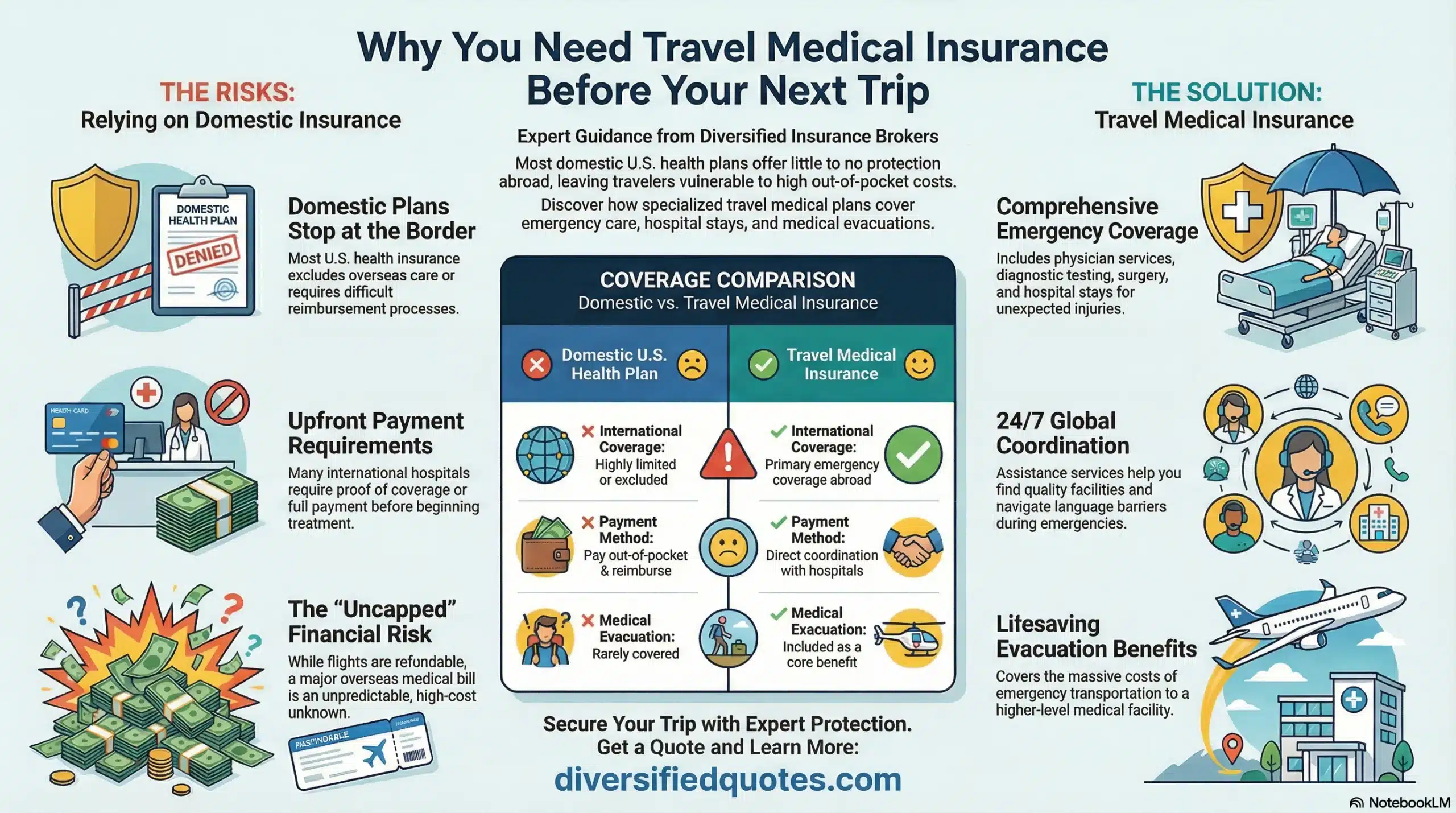
Most U.S. domestic health insurance plans provide limited or no meaningful coverage in Australia. Australian Medicare covers Australian citizens and permanent residents — U.S. travelers are not covered and receive treatment as uninsured international patients billed at non-resident rates. The United States does not have a reciprocal healthcare agreement with Australia that covers emergency billing for U.S. visitors. Some U.S. employer group plans include nominal international coverage, but apply out-of-network rates and require upfront payment with later reimbursement — which means you receive an invoice in Australian dollars from an Australian hospital billing department weeks after returning home, and manage the claims process from the United States without the assistance team support that a dedicated travel medical plan provides. A travel medical plan specifically designed for international emergency care is the practical solution for Australian non-resident billing exposure.
What is the Royal Flying Doctor Service and does my plan cover it?
The Royal Flying Doctor Service is Australia’s national aeromedical organization, operating since 1928 from 24 bases across the country and covering approximately 7.7 million square kilometers of remote Australia. For travelers in the Outback, Kimberley, Cape York, Top End, and other remote regions, the RFDS is not a backup emergency option — it is the primary serious event medical transport system, because ground ambulances cannot reach most remote Australian locations within a clinically relevant timeframe. RFDS provides emergency air evacuation from remote properties, stations, Aboriginal communities, mine sites, and wilderness areas to the nearest appropriate hospital. For international travelers, RFDS services are not free — the cost of emergency aeromedical evacuation from a remote Northern Territory location to Darwin or Alice Springs can range from AUD $5,000 to $30,000+ depending on aircraft type, distance, medical staffing level, and operational complexity. Whether your travel medical plan covers RFDS evacuation costs depends on the specific plan’s evacuation benefit language and whether the assistance team has established coordination relationships with RFDS operations. Confirm this explicitly with the carrier before any remote Australia itinerary.
I’m diving the Great Barrier Reef. What specific coverage do I need?
Three non-negotiable verification steps before any Great Barrier Reef diving: confirm scuba diving is explicitly listed as a covered activity; confirm decompression illness treatment is covered under emergency medical or evacuation provisions — hyperbaric recompression is the required treatment and is expensive; confirm the assistance team has an established relationship with the hyperbaric chamber at Cairns Hospital, which is the primary decompression illness treatment facility for the Queensland reef corridor. For liveaboard divers operating on the outer reef, Ribbon Reefs, or Coral Sea locations, the vessel-to-Cairns transport chain can involve 6–12+ hours of ocean transit before hyperbaric treatment begins — making early assistance team activation the most important variable in the clinical outcome. Decompression illness treatment outcomes are time-dependent: the longer the interval between symptom onset and recompression, the greater the neurological damage risk. Pre-trip assistance team briefing on the specific liveaboard vessel, intended reef locations, and emergency communication procedures before any dive is the operational prerequisite that makes reef diving coverage actually functional when needed most.
What coverage limits should I carry for an Australia trip?
For city-concentrated travel in Sydney, Melbourne, or Brisbane, emergency medical limits of $50,000–$100,000 AUD equivalent with evacuation coverage of $150,000–$250,000 provide meaningful protection against Australian non-resident hospital billing for most serious events. For Great Barrier Reef diving itineraries, evacuation limits of $250,000 or more better reflect the combined cost of liveaboard vessel rescue, Cairns hyperbaric treatment, and potential Townsville or Brisbane onward transfer for complex specialist events. For Outback, Kimberley, Cape York, or Arnhem Land remote travel, evacuation limits of $500,000 or more reflect the realistic RFDS evacuation cost plus receiving hospital specialist care for events requiring the full remote-Australia transport chain. These are the environments where the gap between “adequate coverage” and “inadequate coverage” is most financially consequential — a $150,000 evacuation limit that covers a Singapore medevac can be exhausted before hospital treatment begins in a complex remote Australia RFDS evacuation. Select limits based on the most demanding segment of your itinerary, not the city days.
I’m an international student in Australia. Do I need travel medical insurance beyond OSHC?
Yes — OSHC (Overseas Student Health Cover) covers health services within Australia for student visa holders, but it is not travel medical insurance and does not cover several important scenarios. OSHC does not cover medical emergencies that occur outside Australia when you travel internationally during semester breaks or holiday periods. OSHC does not provide emergency medical evacuation coverage within Australia beyond what standard ambulance arrangements provide. OSHC does not provide the international assistance team coordination that a dedicated travel medical plan includes. For an international student at the University of Sydney who travels to Vietnam during mid-semester break, OSHC provides no coverage for that trip. For the same student who needs emergency medical evacuation from a remote area of Australia during a domestic hiking trip, OSHC’s ambulance provisions may be inadequate for the full cost. A supplemental travel medical plan that covers international travel during Australian residence and provides evacuation coordination for remote Australia domestic travel fills these gaps. Confirming exactly what OSHC covers and where it stops is the first step — then a supplemental plan covers the remaining exposure.
What is the correct emergency response sequence for a serious event in Australia?
Call 000 (Australia’s emergency services number) for true emergencies — ambulance, police, or fire. In remote areas, activate your Emergency Position Indicating Radio Beacon (EPIRB) or Personal Locator Beacon (PLB) simultaneously with calling 000 if cellular coverage is unavailable. Australian Search and Rescue coordinates with RFDS for remote area evacuations triggered by emergency beacon activation. Contact the plan’s 24/7 assistance team as early as possible after initial emergency services are called — for events where RFDS evacuation may be needed, early assistance team engagement is essential because receiving hospital coordination and plan authorization must be established before the evacuation aircraft arrives. For Great Barrier Reef and marine emergencies, contact the plan’s assistance team from the vessel as early as the medical situation allows — not on arrival at the dock. For non-emergency urgent care in Australian cities, contact the plan’s assistance team before seeking treatment when possible to identify appropriate facilities with direct billing arrangements. Store the assistance team’s contact number offline in phone contacts and on a physical card before departure, and share it with a travel companion who can make the call if you are incapacitated.
About the Author:
Jason Stolz, CLTC, CRPC, DIA, CAA and Chief Underwriter at Diversified Insurance Brokers (NPN 20471358), is a senior insurance and retirement professional with more than 25 years of real-world experience helping individuals, families, and business owners protect their income, assets, and long-term financial stability. As a long-time partner of the nationally licensed independent agency Diversified Insurance Brokers, Jason provides trusted guidance across multiple specialties—including fixed and indexed annuities, long-term care planning, personal and business disability insurance, life insurance solutions, Group Health, Travel Medical and Evacuation Insurance, and short-term health coverage. Diversified Insurance Brokers maintains active contracts with over 100 highly rated insurance carriers, ensuring clients have access to a broad and competitive marketplace.
His practical, education-first approach has earned recognition in publications such as VoyageATL, and contributions from his agency featured in Kiplinger and GoBankingRates— highlighting his commitment to financial clarity and client-focused planning. Drawing on deep product knowledge and years of hands-on field experience, Jason helps clients evaluate carriers, compare strategies, and build retirement and protection plans that are both secure and cost-efficient. Visitors who want to explore current annuity rates and compare options across multiple insurers can also use this annuity quote and comparison tool.
Explore More Travel Medical Insurance Options: Browse our complete guide to Europe, Asia & Pacific Travel Medical Insurance — covering medical evacuation coverage for Europe, Asia, Australia & Pacific destinations.
Last Reviewed: June 19, 2026 |
Reviewed by: Jason Stolz, CLTC, CRPC, DIA, CAA
Chief Underwriter, Diversified Insurance Brokers, Inc. | NPN: 20471358 | Diversified Insurance Brokers, Inc. — Licensed in all 50 states
Fact Checked by: Tonia Pettitt, CMIP©
Medicare Specialist, Diversified Insurance Brokers, Inc. | NPN: 14374308 | Diversified Insurance Brokers, Inc. — Licensed in all 50 states
Did you find this content helpful? Leave us a Google review — it helps others find trustworthy guidance too.
Editorial Standards: Diversified Insurance Brokers maintains rigorous editorial standards to ensure accuracy, clarity, and independence in all content. Learn more about our editorial standards and commitment to transparency.
