
Travel Medical and Evacuation from Canada
Travel Medical and Evacuation from Canada

Jason Stolz CLTC, CRPC, DIA, CAA
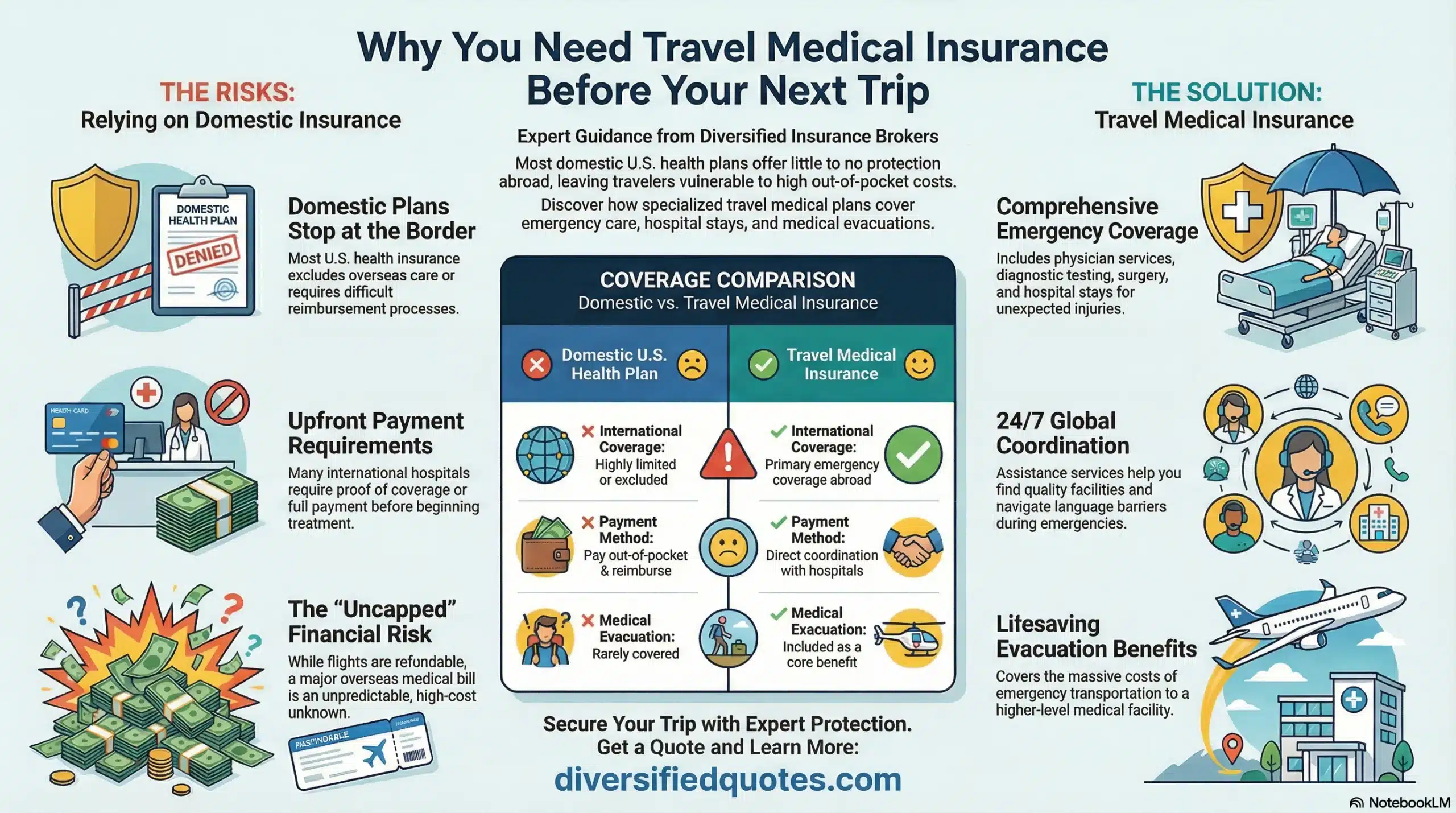
Travel medical and evacuation insurance from Canada is one of those coverage decisions that feels unnecessary — until something happens. Canada has excellent medical care and a well-earned reputation for safety, so travelers often assume they’re “covered” by default. The catch is that many health plans, including most U.S. employer group health plans, either exclude international care entirely, reimburse at deeply reduced rates for out-of-network foreign providers, or leave travelers handling large upfront bills and complex paperwork before any reimbursement begins. A travel medical plan is built for exactly that gap: sudden medical needs during the trip, assistance services to help you find appropriate care quickly, and structured benefits that prevent a medical event from turning into a financial and logistical problem. Canada also creates a travel pattern that is easy to underestimate. Many trips involve long distances, remote wilderness regions, winter conditions, outdoor activity, and cross-border itineraries where the nearest appropriate facility may be hours away — and where the value of a plan is not only the benefit limit but the ability to coordinate the right response under stress. For the foundational framework of how these plans are structured, the overview at travel medical insurance is the right starting point, and the mechanics of when and how transport benefits activate are covered at emergency medical evacuation insurance.
Get Travel Medical + Evacuation Coverage for Canada
Choose your dates and traveler details to compare plans built for international medical care and evacuation support.
Why Canada Travel Still Creates Real Medical and Evacuation Risk
Canada’s healthcare system is excellent for Canadian residents — but it is not free for international visitors. Non-residents are billed at uninsured rates at Canadian hospitals and clinics, and those rates are not nominal. An emergency room visit with imaging, a specialist consultation, and a single night of hospital observation in Ontario or British Columbia can generate a bill that comfortably exceeds USD $5,000–$10,000 before any surgical or ICU component is added. The proximity of Canada to the United States does not change how billing works: you are an international patient, and you will be billed accordingly. Provincial health plans cover only provincial residents — a U.S. traveler in Quebec or Alberta is an uninsured international patient from the provincial system’s perspective regardless of how comprehensive their U.S. domestic coverage appears.
Canada also includes travel environments where time-to-care matters significantly. If you are skiing at Whistler, snowmobiling in the Yukon, hiking in the Rockies near Banff or Jasper, fishing in remote British Columbia lakes, kayaking the Gulf Islands, whale watching off the Newfoundland coast, or visiting national parks and smaller towns, the nearest appropriate facility for a serious event may be 1–3 hours away by ground — and in winter conditions, ground transport can become its own challenge. These are not exotic itineraries. They are the normal reasons most U.S. travelers go to Canada, and they create real exposure for falls, fractures, cardiac events, severe infections, and allergic reactions that need emergency care quickly. For the specific framing of what emergency-focused travel health coverage is designed to do versus what it excludes, international travel health coverage covers that comparison clearly. For travelers whose Canada trip includes older family members or parents, the age-specific considerations around pre-existing conditions and stability windows are covered at travel medical insurance for seniors.
Canada Travel Medical: Coverage Priorities by Location and Traveler Type
| Canada Location / Traveler Type | Medical Access Reality | Key Coverage Priority | Evacuation / Transfer Scenario |
|---|---|---|---|
| Toronto / Vancouver / Montreal / Calgary — urban tourism / business | Excellent major hospital infrastructure (Toronto General, Vancouver General, McGill University Health Centre); uninsured international patient billing applies at full non-resident rates; ER wait times variable; private urgent care clinics available in major cities; English and French (Montreal/Quebec) language environments | Financial protection against Canadian non-resident hospital billing; direct billing or assistance team payment support; pre-existing condition terms reviewed for older travelers; plan documentation kept accessible for ER presentation | Within-city hospital transfer for complex events; repatriation to U.S. once medically stable for most travelers; evacuation within Canada between cities for subspecialty events requiring specific hospital capability |
| Whistler / Banff / Jasper — ski and mountain winter travel | Whistler Health Care Centre and Banff Mineral Springs Hospital handle ski injury volume but limited specialist depth for complex trauma; Squamish General and Kelowna General are 1–2 hours from Whistler for serious events; helicopter evacuation from backcountry terrain routinely used; head injury, spinal, and complex fracture cases transfer to Vancouver General or foothills Medical Centre Calgary | Helicopter evacuation from backcountry confirmed as covered transport mode; ski and snowboard activity confirmed as covered; head injury and spinal trauma coverage for complex mountain rescue scenarios; evacuation limits adequate for helicopter plus hospital transfer chain | Helicopter rescue to nearest hospital; ground or air transfer to Vancouver General or Calgary Foothills for complex trauma requiring neurosurgery or orthopedic subspecialty; U.S. repatriation via Vancouver or Calgary airports once medically stable |
| BC coast / Gulf Islands / Vancouver Island — maritime and water travel | Victoria General Hospital serves Vancouver Island; Gulf Islands have BC Ambulance Service marine response but limited island clinic infrastructure; ferry-dependent access to most Gulf Islands means medical transport planning must account for vessel availability and sea conditions; water activities create drowning, hypothermia, and trauma risk year-round given Pacific water temperatures | Water activity coverage confirmation (kayaking, boating, whale watching); hypothermia and cold-water trauma coverage; assistance team knowledge of BC coastal marine transport logistics; evacuation limits covering air or marine transport to Victoria or Vancouver | BC Air Ambulance or Coast Guard rescue to Victoria General or Vancouver General; ferry-dependent islands create transport timing uncertainty — pre-established assistance team protocols for multi-day remote island itineraries |
| Yukon / NWT / Nunavut — wilderness and remote travel | Whitehorse General Hospital serves Yukon; Yellowknife’s Stanton Territorial Hospital serves NWT; Iqaluit’s Qikiqtani General Hospital serves Nunavut but with very limited specialist depth; remote wilderness locations outside territorial capitals have minimal or no clinic access; air is the only viable serious event response for most remote Yukon, NWT, and Nunavut locations | Maximum evacuation limits; satellite communication essential for wilderness itineraries; assistance team pre-engaged before remote departure with specific route and check-in schedule; evacuation limits covering air charter from remote location to territorial capital plus onward to Vancouver or Edmonton for specialist care | Air charter from remote location to Whitehorse, Yellowknife, or Iqaluit; onward to Vancouver, Edmonton, or Calgary for specialist care — full chain can involve 2–3 transport legs from truly remote wilderness locations |
| Quebec / Maritime provinces — cultural and road travel | Quebec City and Montreal have excellent hospital infrastructure; rural Quebec, New Brunswick, Nova Scotia, PEI, and Newfoundland have regional hospitals with variable specialist depth; French-only environments in rural Quebec create communication barriers for non-French speakers; winter driving conditions create road accident risk on Trans-Canada and Maritime highway routes | French-language assistance team support for rural Quebec emergencies; road accident coverage for Trans-Canada winter driving; evacuation limits covering rural-to-Montreal or Halifax transfer for events requiring specialist care; plan documentation accessible in French for Quebec ER presentation | Transfer to Montreal’s McGill University Health Centre or Quebec City’s CHUL for complex events from rural Quebec; Halifax Infirmary for Maritime province events; U.S. repatriation via Montreal, Halifax, or St. John’s airports |
| Older travelers / families / pre-existing conditions | Canada’s excellent hospital infrastructure is fully accessible as uninsured international patients at non-resident rates; cardiac, pulmonary, and neurological events are most common serious traveler presentations; medication management across provincial pharmacy systems creates prescription continuity considerations; Canadian ER billing for complex cardiac workup and overnight monitoring can exceed USD $15,000–$25,000 | Pre-existing condition stability window and look-back period reviewed explicitly before purchase — this is the single most important pre-purchase step for travelers with medical history; prescription continuity support; cardiac and neurological event coverage; evacuation and repatriation structure appropriate for longer recovery scenarios | Transfer to nearest major Canadian hospital with appropriate specialist capability for initial event; U.S. repatriation once medically stable for ongoing recovery and follow-up — the repatriation benefit structure and its stability-before-transport requirements should be confirmed before departure |
Pre-Existing Conditions, Billing Reality, and the Mistakes That Create Coverage Problems
Pre-existing conditions are the single largest source of Canada travel medical claim surprises, and they create coverage problems that are entirely preventable with correct pre-purchase attention. Every travel medical plan defines “pre-existing condition” differently, and the definition controls what is eligible for coverage — not the marketing language on the product summary page but the specific certificate language in the actual policy. The most common definitional elements are a look-back period (how many months before the trip departure date the carrier reviews for related symptoms, diagnoses, or treatment changes), a stability requirement (whether the condition was stable and unchanged for a defined period before departure), and a symptom-based definition (whether experiencing symptoms related to a condition in the look-back window triggers the pre-existing exclusion even without a formal diagnosis). For Canada travelers with cardiac history, COPD, asthma, diabetes, hypertension, or any chronic condition that is “stable and managed” at home, the most important pre-purchase action is reading the certificate language on these three elements — not the product brochure — and confirming that the plan’s definition accommodates the specific health situation. The coverage that fails at claim time is almost always the coverage whose pre-existing language was never actually read before departure.
Canadian non-resident billing rates deserve explicit attention because proximity to the U.S. creates a false sense of financial security. A complex emergency room event in Ontario — imaging, specialist consultation, cardiac monitoring, and a 24-hour hospital admission for observation — is routinely billed at USD $8,000–$20,000 for non-residents before surgical or ICU components are added. A skiing accident requiring orthopedic evaluation, fracture repair, and two nights of hospital observation in British Columbia can exceed USD $15,000–$30,000 at non-resident rates. These are not edge cases — they represent the realistic billing exposure that Canadian hospitals generate for international patients on relatively common serious events. The purpose of the travel medical plan is to absorb that exposure rather than leaving it as a self-insured out-of-pocket risk. For the specific questions relevant to international travelers presenting at Canadian emergency departments, emergency travel health insurance for foreign nationals covers the foreign national perspective on how these events unfold administratively. The documentation practices that determine whether claims pay cleanly — itemized bills, clinical notes, proof of payment, discharge paperwork — should be understood before the trip rather than assembled under stress afterward.
Compare Travel Medical + Evac Options for Canada
Select your dates and travelers, then compare plan designs that match Canada travel — cities, winter trips, outdoor travel, and remote regions.
Related Travel Medical Pages
Use these pages to compare plan features, eligibility rules, and the trip scenarios that influence coverage.
Related Destination Pages
If your itinerary includes multiple countries, compare destination-specific guidance and planning considerations.
Talk With an Advisor Today
Choose how you’d like to connect—call or message us, then book a time that works for you.
Schedule here:
calendly.com/jason-dibcompanies/diversified-quotes
Licensed in all 50 states • Fiduciary, family-owned since 1980
Frequently Asked Questions: Travel Medical and Evacuation Insurance for Canada
Does my U.S. health insurance cover me in Canada?
Most U.S. employer group health plans provide limited or no meaningful coverage for international medical care. When international coverage is included, it is typically applied at out-of-network rates, which means significantly higher cost sharing for the insured and no guarantee of direct billing with Canadian hospitals. Canadian provincial health systems cover only provincial residents — as a U.S. visitor, you are an uninsured international patient at any Canadian hospital regardless of your U.S. insurance status. The hospital will bill you at full non-resident rates, and you will be expected to arrange payment. Some U.S. plans reimburse a portion of eligible expenses after you return home and file a claim, but the upfront payment burden, the reimbursement timeline, and the documentation requirements create real friction. Travel medical insurance is designed to solve exactly this problem: it provides defined emergency coverage for international care, and the assistance team can help coordinate direct billing or payment support so you are not managing a large out-of-pocket payment under stress.
How much does an emergency room visit in Canada typically cost for a U.S. traveler?
Canadian hospitals bill non-resident international patients at full uninsured rates, and those rates vary by province and by the services provided but are consistently significant. A straightforward emergency room visit for a non-resident — evaluation, blood work, and X-ray — typically generates a bill in the range of USD $1,500–$4,000 in most provinces. Add imaging such as a CT scan and the bill rises to $3,000–$8,000. A hospital admission for observation, even a single night, can add $2,000–$5,000 or more. A surgical event or ICU admission can generate bills in the $20,000–$80,000+ range depending on complexity and duration. These are approximate figures — actual billing varies by province, hospital, and clinical situation — but they illustrate why proximity to the United States does not translate to financial safety. The financial exposure for a serious but not catastrophic event in Canada is meaningful enough that most travelers who understand the billing reality choose coverage rather than self-insure.
When would I actually need medical evacuation on a Canada trip?
Evacuation becomes relevant in Canada more often than most travelers anticipate, because of the country’s geography and the distribution of specialist medical capability. The most common scenarios: a skiing or snowmobile accident in a remote mountain area that requires helicopter rescue to the nearest hospital, followed by a ground or air transfer to a larger center with orthopedic or neurosurgical capability; a cardiac event in a small Maritime town or rural Quebec community where the local hospital can stabilize but not definitively manage the condition, requiring transfer to a regional cardiac center; a serious injury in the Yukon or NWT wilderness where the nearest hospital is a two-hour air charter away; a complex event on a Gulf Islands ferry or Vancouver Island coastal vessel where marine rescue and air transport are the only viable responses. In all of these cases, the evacuation benefit is not exotic coverage — it is the mechanism that gets you from where the event happened to where the care you need actually exists. The plan’s authorization process and the assistance team’s real-time coordination determine how quickly that chain activates.
What coverage limits should I carry for a Canada trip?
For urban-concentrated Canada travel in Toronto, Vancouver, Montreal, or Calgary, emergency medical limits of $50,000–$100,000 with evacuation coverage of $100,000–$250,000 provide meaningful protection against the most common serious events given the quality and proximity of major Canadian city hospitals. For outdoor, adventure, or remote travel — ski resorts, Yukon wilderness, BC coast, Maritime provinces — evacuation limits of $250,000 or more better reflect the realistic cost of helicopter rescue, air ambulance, and multi-leg transport that serious events in those environments can require. For older travelers with medical history, the limit selection should account for the potential of a longer hospital stay and a medically supervised repatriation to the United States, which adds transport cost on top of in-hospital treatment costs. The deductible should be selected based on how much out-of-pocket exposure you are comfortable managing for smaller urgent events — lower deductibles make the plan more usable for families and travelers with ongoing health concerns.
Does my travel medical plan cover skiing and other adventure activities in Canada?
Activity coverage varies significantly between travel medical plans, and this is one of the most important pre-purchase verification steps for travelers with outdoor or adventure itineraries. Most standard travel medical plans cover recreational skiing and snowboarding on maintained runs without restriction. The coverage picture becomes more varied for backcountry skiing and snowboarding, heli-skiing, snowmobiling, ice climbing, mountaineering, backcountry hiking, whitewater activities, and diving. Some plans cover all of these without restriction; others require specific riders; others exclude specific high-risk activities regardless of added coverage. For a Canada trip that includes any activity beyond maintained ski runs and standard hiking, confirm the plan’s specific activity exclusion and inclusion language before purchase — not by asking a general question about “outdoor activities” but by identifying your specific planned activities and confirming each against the plan’s certificate. The consequence of assuming coverage for an activity that the plan excludes is a denied claim for exactly the event the activity was most likely to produce.
What is the correct process to follow if I need medical care in Canada?
For non-emergency urgent care, the best approach is to contact the plan’s assistance team before seeking care when possible — the team can identify in-network or preferred providers and advise on the facility most appropriate for your situation, which can simplify billing and documentation. For true emergencies, go to the nearest appropriate facility immediately without delay for plan authorization. Once you are stable and the immediate clinical situation is under control, contact the assistance team as quickly as possible — for high-cost events including hospitalization and any potential evacuation, early assistance team involvement improves both the coordination outcome and the claims outcome. Keep all documentation: request itemized bills (not just summary billing statements), ask for clinical notes or a discharge summary before you leave the facility, and keep all receipts. Photograph documents before you leave if you are uncertain about receiving copies later. Store the assistance team’s contact number offline before your trip — in your phone and on a physical card with your passport — and share it with a travel companion who can make the call if you are incapacitated.
About the Author:
Jason Stolz, CLTC, CRPC, DIA, CAA and Chief Underwriter at Diversified Insurance Brokers (NPN 20471358), is a senior insurance and retirement professional with more than 25 years of real-world experience helping individuals, families, and business owners protect their income, assets, and long-term financial stability. As a long-time partner of the nationally licensed independent agency Diversified Insurance Brokers, Jason provides trusted guidance across multiple specialties—including fixed and indexed annuities, long-term care planning, personal and business disability insurance, life insurance solutions, Group Health, Travel Medical and Evacuation Insurance, and short-term health coverage. Diversified Insurance Brokers maintains active contracts with over 100 highly rated insurance carriers, ensuring clients have access to a broad and competitive marketplace.
His practical, education-first approach has earned recognition in publications such as VoyageATL, and contributions from his agency featured in Kiplinger and GoBankingRates— highlighting his commitment to financial clarity and client-focused planning. Drawing on deep product knowledge and years of hands-on field experience, Jason helps clients evaluate carriers, compare strategies, and build retirement and protection plans that are both secure and cost-efficient. Visitors who want to explore current annuity rates and compare options across multiple insurers can also use this annuity quote and comparison tool.
Explore More Travel Medical Insurance Options: Browse our complete guide to Europe, Asia & Pacific Travel Medical Insurance — covering medical evacuation coverage for Europe, Asia, Australia & Pacific destinations.
Last Reviewed: June 19, 2026 |
Reviewed by: Jason Stolz, CLTC, CRPC, DIA, CAA
Chief Underwriter, Diversified Insurance Brokers, Inc. | NPN: 20471358 | Diversified Insurance Brokers, Inc. — Licensed in all 50 states
Fact Checked by: Tonia Pettitt, CMIP©
Medicare Specialist, Diversified Insurance Brokers, Inc. | NPN: 14374308 | Diversified Insurance Brokers, Inc. — Licensed in all 50 states
Did you find this content helpful? Leave us a Google review — it helps others find trustworthy guidance too.
Editorial Standards: Diversified Insurance Brokers maintains rigorous editorial standards to ensure accuracy, clarity, and independence in all content. Learn more about our editorial standards and commitment to transparency.
