
Travel Medical for Youth Sports
Travel Medical for Youth Sports

Jason Stolz CLTC, CRPC, DIA, CAA
Travel medical insurance for youth sports is available, widely used, and genuinely important — but the single most consequential fact families and team administrators need to know before purchasing any policy is this: many standard travel insurance plans explicitly exclude organized, competitive, or bodily contact sports from their medical coverage. A family that purchases a general travel medical policy before a soccer tournament may discover after an injury occurs that the plan’s fine print treats organized competition as a general exclusion category — meaning the claim that they assumed was covered produces a denial. Youth sports travel involves exactly the activities that many standard travel plans define as exclusions: structured team competition, organized contact sports, high-exertion tournament play, and sometimes interscholastic or club-level athletics. Identifying a travel medical plan that specifically includes organized sports coverage — not just a generic travel medical policy — is the foundational step in protecting a young athlete during travel. Our resources on travel medical insurance, high-risk travel insurance, and short-term medical services provide the broader context for understanding how travel medical coverage fits into short-term health planning.
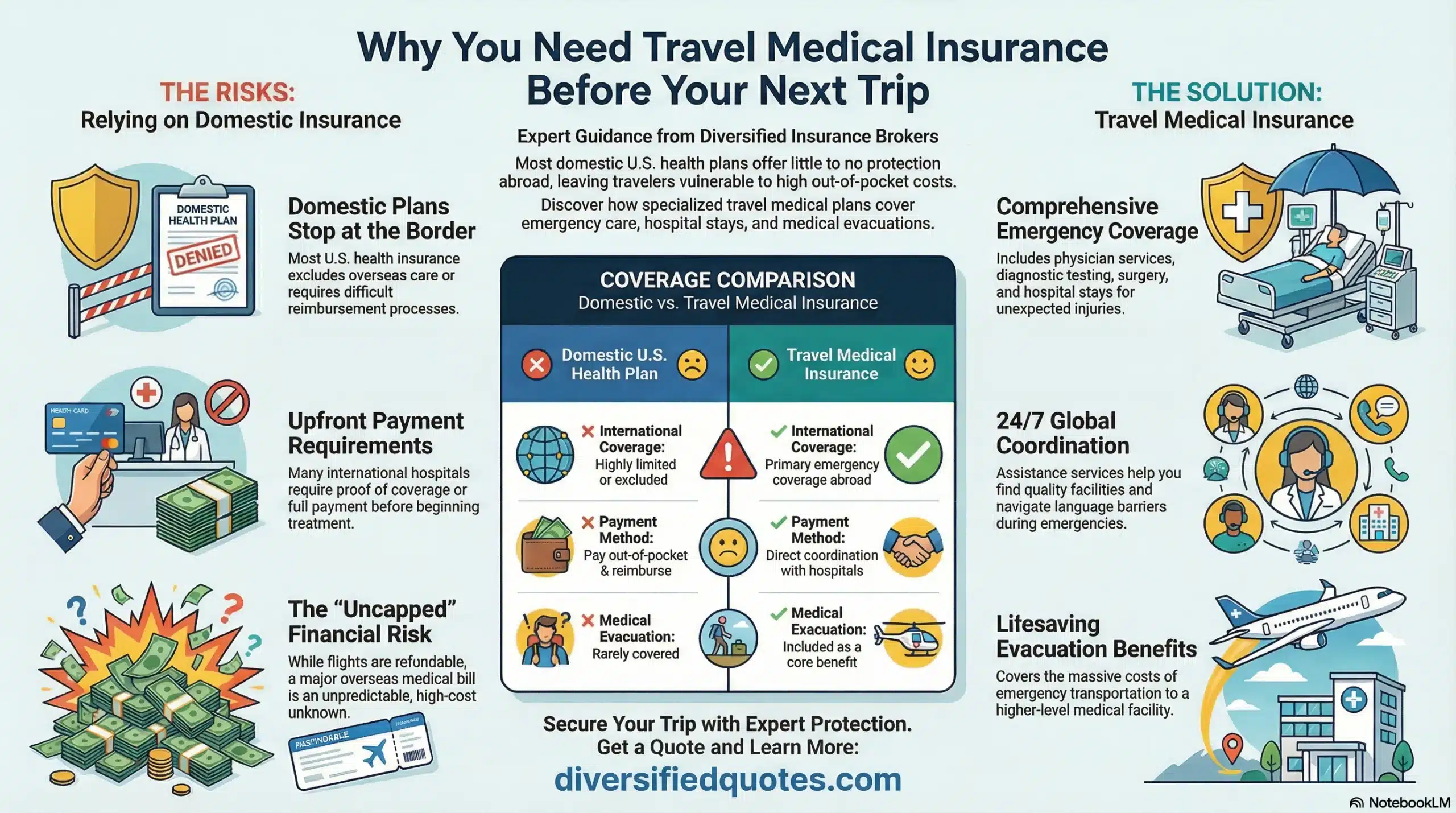
The financial exposure of a sports-related medical event during travel is significant and often underestimated. Emergency room treatment for a fracture, concussion evaluation, imaging, and follow-up care at an out-of-state or international facility can produce thousands of dollars in bills. Medical evacuation — transport from a remote tournament location or an international venue to a facility capable of delivering appropriate care — can cost tens of thousands of dollars without coverage, and this cost does not receive the same intuitive attention as an injury claim even though it can be the larger exposure. For international tournament travel, the situation is even more acute: most US-based health insurance plans provide limited or no coverage abroad, foreign facilities routinely require payment at the time of service, and the administrative process of getting a domestic insurer to reimburse international claims can be slow and contested. Travel medical insurance with explicit organized sports coverage, appropriate medical coverage limits, and strong evacuation benefits is the practical solution for families and teams taking youth sports travel seriously. Our resource on emergency medical evacuation insurance covers the evacuation component in depth, and our resource on international travel health coverage covers the international context for understanding why domestic health plans often fall short during overseas tournaments.
The good news is that travel medical plans designed for youth sports and organized athletics do exist, are available for both individual athletes and full group/team coverage, and are typically purchased within a short window before departure without requiring medical exams or complex underwriting. The challenge is knowing what to look for in the policy language, understanding the difference between a plan that covers “sports” generically and one that specifically addresses organized competition and bodily contact activities, and matching the coverage structure to the real risk profile of the specific travel — domestic weekend tournament vs. international multi-week competition vs. regional club season travel schedule. This page covers the key evaluation dimensions so families, coaches, and club administrators can make informed decisions rather than discovering gaps at claim time.
Request Youth Sports Travel Medical Coverage Options
Share the destination, travel dates, sport, and approximate group size — individual athletes and team/club coverage options available.
Youth Sports Travel Medical Coverage — What to Compare
The table below compares the key dimensions that determine whether a travel medical plan is actually appropriate for youth sports tournament travel versus a general leisure travel medical plan. The organized sports coverage question is the most important starting point; every other dimension builds on whether that foundational coverage is present.
| Coverage Dimension | Standard Travel Medical Plan | Youth Sports / Organized Sports Travel Medical | Why It Matters for Youth Athletes |
|---|---|---|---|
| Organized / Competitive Sports Coverage | Often excluded — plan language may list “organized sports,” “competitive athletics,” or “bodily contact sports” as general exclusions | Specifically included — plan either includes organized sports by default or offers a “bodily contact, interscholastic, and organized sports” rider that restores coverage for tournament and competition injuries | The most critical check before purchase — buying a general travel plan for a youth tournament without confirming this inclusion may produce a claim denial for the most likely injury scenario |
| Emergency Medical Expense Coverage | Varies widely by plan — may range from $50,000 to $1,000,000+ depending on plan tier and carrier | Should include at minimum $100,000 per person for youth sports travel; higher limits recommended for international tournament travel where hospitalization costs can be unpredictable | Fracture treatment, concussion evaluation, imaging, hospitalization, and follow-up care can accumulate quickly — plan limits should be evaluated against realistic worst-case cost scenarios for the destination |
| Emergency Medical Evacuation | Often included in standard travel plans at varying limits; may or may not cover evacuation resulting from a sports injury depending on organized sports exclusion language | Should include at minimum $250,000 in evacuation coverage; plans designed for organized sports travel should not exclude evacuation arising from sports injury | Evacuation from a remote tournament venue, international competition location, or facility without appropriate specialist care can cost tens of thousands of dollars — one of the highest single-event cost exposures in youth sports travel |
| Individual vs. Group Coverage | Most standard travel plans are individual — separate purchases required for each person traveling | Group travel medical plans available for teams and clubs — typically more administratively efficient for coaches, club directors, and parents traveling together to the same tournament | Teams traveling together benefit from coordinated coverage that ensures every athlete has consistent benefits — eliminates the gap risk of individual athletes being uninsured because their family didn’t independently purchase coverage |
| Domestic vs. International Applicability | Standard plans may be US-only or international; some designed only for international travel | Ideally structured to cover both domestic tournament travel (supplementing home health plan for out-of-network costs) and international travel (primary coverage where home plan may not apply) | Domestic tournament travel may still produce meaningful out-of-pocket costs from out-of-network emergency care; international travel typically requires travel medical as primary coverage where US plans don’t apply |
| Pre-Existing Condition Treatment | Typically excluded or limited — travel medical plans are designed for unexpected events, not ongoing condition management | Same general limitation — pre-existing conditions are typically excluded or subject to defined look-back period limitations; acute onset of a pre-existing condition may be covered by some plans under specific conditions | Youth athletes with known conditions (asthma, allergies, prior concussions, diabetes) should review plan exclusion language specific to their condition before departure to understand what is and is not covered if the condition requires care while traveling |
| 24/7 Travel Assistance | Included in most quality travel plans — phone line for accessing care, finding providers, and managing claims | Essential for youth sports travel — coaches and parents need a clear contact for medical questions, provider location, and claims guidance during a tournament when time and decision capacity are limited | The assistance line is often the first call in a medical emergency — plan administrators should share the assistance number with coaches and team managers before departure, not after an incident |
Coverage features, limits, and exclusions vary significantly by plan and carrier. This table reflects general industry patterns and should not be relied upon as a substitute for reviewing the actual policy documents of any specific plan before purchase. Always confirm that organized sports and competitive athletics are specifically included — not excluded — in the plan you select for youth sports tournament travel.
The Organized Sports Exclusion — The Most Important Policy Language to Verify
Before purchasing any travel medical plan for a youth athlete traveling to a tournament, showcase, camp, or competition, there is one question that must be answered by reading the actual policy language — not the marketing summary: does this plan specifically include coverage for injuries sustained during organized or competitive sports? The language used varies by carrier and plan: some plans list “organized sports,” “competitive athletics,” “bodily contact sports,” “interscholastic sports,” or “professional or amateur sports events” as general exclusions from the medical expense benefit. This means that if a youth soccer player fractures an ankle during tournament play, the medical claim arising from that injury would be denied — not because the injury wasn’t real or the care wasn’t necessary, but because the activity falls into an excluded category. Many families discover this exclusion only after a claim is submitted, at which point there is no remedy.
Plans specifically designed for organized sports travel either include organized sports coverage as a base policy feature or offer a rider — sometimes called a “bodily contact, interscholastic, and organized sports rider” or an “organized competition endorsement” — that explicitly removes or overrides the standard organized sports exclusion. When shopping for youth sports travel medical coverage, this rider or inclusion is the primary filter. A plan that covers illness and accidental injury during leisure activities but excludes organized sports is not appropriate for a youth athlete traveling to compete. A plan that explicitly includes coverage for injuries occurring during organized team sports competition is the correct product for the use case. Confirming this language in the plan documents before purchase — not just accepting a summary that says “sports coverage” without specifying whether organized competition is included — is the essential due diligence step. Our resource on high-risk travel insurance covers how activity type affects plan design and why standard plans often have these exclusions built into their base risk assumptions.
What Travel Medical Insurance for Youth Sports Typically Covers
A well-selected travel medical plan for youth sports — one that includes organized sports coverage — can respond to a wide range of medical events during the travel period. Emergency medical treatment is the core benefit: physician visits, urgent care, emergency room care, hospitalization, diagnostic imaging (X-rays, MRI, CT scans), laboratory testing, surgical procedures when medically necessary, and prescription medications tied to a covered illness or injury that arose during the trip. The coverage period is defined by the travel dates — from departure to return — making it a trip-specific rather than a year-round product. For acute injuries (fractures, sprains, dislocations, concussions, lacerations requiring stitching) and illness arising during travel (respiratory infections, gastrointestinal illness, heat-related conditions, altitude-related problems for mountain venue competitions), travel medical provides the coverage framework. The plan pays actual medical expenses — in most cases up to the plan’s benefit limit — rather than paying a fixed scheduled benefit for specific diagnoses. This “actual expense” structure is more protective than scheduled-benefit plans, which cap specific injury payouts at amounts that may be well below the actual cost of care at a hospital emergency department.
Travel medical plans also typically include a 24/7 travel assistance benefit — a phone line that coaches, team parents, and athletes can call in a medical emergency to receive guidance on finding the nearest appropriate provider, getting claims authorization, understanding what the plan will cover, and (when evacuation is needed) initiating the coordination process. For youth sports travel, this assistance capability is particularly important: when a parent is in the stands at a tournament three states away and their child is being transported to a local emergency room, the assistance line provides a structured path through an otherwise disorienting situation. Coaches and team administrators should ensure every parent in the traveling party has the plan’s assistance line number stored before departure. Our resource on is travel medical insurance expensive covers the cost dimension for families evaluating the trade-off between premium and coverage.
Emergency Medical Evacuation — The Coverage Most Families Overlook
Emergency medical evacuation is the benefit that receives less intuitive attention than medical expense coverage — and yet it can represent the largest single financial exposure in youth sports travel, particularly for international tournaments or domestic competitions in remote venues. Evacuation means transport from a location where adequate care is not available to a facility capable of providing the level of treatment the medical situation requires. For a youth athlete with a serious injury at an international tournament venue, evacuation can mean transport to a domestic facility — a cost that can easily reach five figures or more without coverage in place. For a tournament at a remote domestic venue with limited local hospital resources, evacuation to a regional trauma center capable of handling a complex fracture or head injury may be necessary. Without evacuation coverage, these costs fall entirely on the family, and the logistics of arranging transport during a medical emergency without a plan administrator behind it add a level of stress and delay that affects the quality of care the athlete receives. Our resource on emergency medical evacuation insurance covers the evacuation benefit mechanics and the coverage limits that are appropriate for different types of travel. For youth sports travel, evacuation coverage limits of at least $250,000 per person are widely recommended as a starting reference — actual needs vary by destination and sport.
Domestic Tournament Travel — What Your Existing Health Plan May and May Not Provide
Many families assume that because their child has comprehensive US health insurance, domestic tournament travel is covered without supplemental plans. The reality is more nuanced. Most US health plans do provide coverage nationwide — but the “in-network” versus “out-of-network” distinction matters significantly in states and regions where the family’s plan has limited or no network participation. An emergency room visit in a state where the insurer has no network agreements can result in out-of-network billing at full facility rates, with higher coinsurance and out-of-pocket costs that differ substantially from what the same care would cost within the network. Balance billing — where the provider bills the patient for the difference between the provider’s charge and what the insurer pays — can add thousands of dollars to an emergency room claim in states where balance billing protections are limited or absent. Travel medical insurance for domestic youth sports travel functions as a supplemental coverage layer: it can respond to out-of-network emergency costs, may cover the deductible and coinsurance gaps from the primary plan, and provides a clearer administrative path (including the 24/7 assistance line) than navigating an unfamiliar health plan’s claims process from a hotel room after a tournament injury.
International Youth Sports Travel — A Fundamentally Different Risk Profile
For families and clubs whose youth sports travel includes international tournaments, international competitions, or training camps abroad, the coverage need shifts substantially. Most US-based health insurance plans provide little to no coverage for medical care received outside the United States — and for those that do provide some international coverage, reimbursement timelines, documentation requirements, and claim processes are often designed for occasional use rather than active management during a medical emergency abroad. Foreign medical providers in most countries do not participate in US insurance networks, do not accept US insurance cards at the point of service, and commonly require payment in local currency at the time of treatment. The family or team that arrives at a clinic in a foreign country expecting to present an insurance card will typically face a cash payment demand — and the reimbursement process from the home insurer, if it applies at all, comes later and may require documentation in foreign languages and currencies. Travel medical insurance for international youth sports travel is the practical solution: it provides primary medical coverage in the foreign country, includes the 24/7 assistance line that can help navigate local provider access, and includes evacuation coverage for situations where local care is inadequate. Our resources on international travel health coverage and international health insurance cover the international coverage landscape in detail for families planning extended travel or season-long international competition schedules.
Individual Family Coverage vs. Group Team Plans
Travel medical insurance for youth sports can be purchased in two primary structures: individual/family coverage purchased by each athlete’s family for their specific travel dates, or group coverage purchased by the team, club, or organizing entity to cover the full traveling roster. Individual family coverage is appropriate when families are independently planning their travel to a tournament and want to ensure their child has coverage regardless of whether the team or club provides anything. Group coverage is appropriate when a club director, team administrator, or travel coordinator wants to ensure consistent coverage for every athlete on the traveling roster without relying on each family to independently purchase and maintain their own plan. Group plans eliminate the coverage gap risk that arises when some families purchase coverage and others don’t — in a group claim scenario where multiple athletes need care after an incident during competition, the group plan provides uniform benefit access rather than producing a situation where some athletes have coverage and others do not. Our resource on cheap group travel insurance covers the group travel plan structure for organizations evaluating team-level coverage, and our resource on travel insurance for youth mission trips covers a comparable group travel planning context that many club administrators find useful for comparison.
How Sports Accident Insurance Differs From Travel Medical Coverage
Sports accident insurance and travel medical insurance are distinct products that are sometimes confused or treated as interchangeable by families and clubs purchasing coverage for youth sports travel. Sports accident insurance is designed to pay defined, scheduled benefits for specific injuries — a fixed amount for a fracture of the wrist, a set amount for a hospital confinement per day, and similar structured payouts. It is often structured as secondary coverage that pays after the primary health plan, and its benefit amounts are typically fixed and may be well below the actual cost of care at a modern hospital emergency department. Travel medical insurance, by contrast, is designed to function more like a temporary primary health plan during the travel period — covering the actual cost of care (up to the plan’s medical expense limit) for covered illness and injury rather than paying a scheduled benefit for specific diagnoses. For youth sports travel, the two products serve different roles: sports accident insurance may make sense for programs that want consistent secondary coverage for all participants regardless of travel (and is often required by sport governing bodies for member clubs), while travel medical insurance is the more appropriate product for the “what happens if we need to access care away from home” scenario that tournament travel creates. Some families and clubs use both layers simultaneously — accident insurance for the sport program broadly, and travel medical for the travel periods specifically.
What Club Administrators and Travel Coordinators Should Plan Ahead
For club directors, travel coordinators, and coaches who manage youth sports travel programs, coverage planning before the travel season is substantially more effective than reactive purchasing before individual trips. The most common gap in youth sports travel programs is not the absence of coverage at the organizational level — it is the inconsistency between what the club provides, what individual families assume is covered, and what actually applies when care is needed. A club that communicates clearly to families: “Here is the travel medical plan in effect for this tournament trip, here is the assistance line number, here is how to submit a claim” provides a more useful protection framework than a club that simply says “make sure your child has health insurance.” Coordinated group coverage with clear communication to coaches and parents — including the name of the plan, the plan number, the assistance line, and the basic benefit structure — creates the operational readiness that makes coverage usable in a real medical emergency. Our resource on mission trip travel insurance covers a group travel planning context with similar administrative considerations that club directors may find useful as a structural comparison. Our resource on short-term health insurance provides additional context for families evaluating the short-term medical coverage landscape beyond the specific travel medical product.
Talk With an Advisor Today
Choose how you’d like to connect—call or message us, then book a time that works for you.
Schedule here:
calendly.com/jason-dibcompanies/diversified-quotes
Licensed in all 50 states • Fiduciary, family-owned since 1980
FAQs: Travel Medical Insurance for Youth Sports
Does standard travel insurance cover injuries during youth sports tournaments?
Not always — and this is the most critical point to confirm before purchase. Many standard travel insurance plans explicitly exclude “organized sports,” “competitive athletics,” “bodily contact sports,” or “interscholastic sports” from their medical expense coverage as general exclusions. A youth athlete injured during tournament play may find their claim denied if the plan they purchased does not specifically include organized sports coverage. Before purchasing any travel plan for a youth sports trip, confirm in the actual policy documents — not just the marketing summary — that injuries during organized or competitive sports are included, or that the plan offers a rider specifically adding this coverage. Plans or endorsements labeled “bodily contact, interscholastic, and organized sports” are what you are looking for.
Does a child’s regular health insurance cover tournament travel out of state?
US health insurance generally follows the insured across state lines for emergency care, but out-of-network costs can be significantly higher than in-network costs depending on the plan design and the insurer’s network coverage in the destination state. In areas where the family’s insurer has limited or no network participation, emergency care may be billed at full out-of-network rates with higher coinsurance and balance billing exposure. Travel medical insurance for domestic youth sports travel can supplement the primary health plan for these out-of-network cost gaps, provide a clearer administrative path through the 24/7 assistance line, and may include organized sports coverage that the primary plan’s benefits do not specifically address during travel.
Does regular health insurance work for international youth sports travel?
Generally no — most US-based health insurance plans provide very limited or no coverage for medical care received outside the United States. Foreign providers in most countries do not accept US insurance cards, do not participate in US networks, and typically require payment at the time of service. Travel medical insurance provides primary coverage for international travel, covering emergency medical expenses at foreign facilities directly rather than requiring the family to pay out of pocket and seek reimbursement later. For international youth sports travel — tournaments abroad, international showcases, training camps in other countries — travel medical insurance with evacuation coverage is strongly recommended as primary protection rather than an optional supplement.
What is emergency medical evacuation and why does it matter for youth sports travel?
Emergency medical evacuation covers the cost of transporting an injured or ill person from a location where adequate care is not available to a facility capable of providing the required level of treatment. For youth sports travel, this can mean transport from a remote tournament venue to a regional trauma center, from an international competition location to a domestic facility, or between facilities when a specialist is needed for a serious injury. Evacuation costs without coverage can run from thousands to tens of thousands of dollars depending on distance, transport method, and the complexity of the medical coordination required. Most quality travel medical plans include evacuation coverage — plans designed for youth sports travel should have evacuation limits of at least $250,000 per person as a starting reference, though actual needs depend on the destination.
Can a sports team or club purchase group travel medical coverage for the whole roster?
Yes — group travel medical plans are available for teams, clubs, and organizations traveling together. Group coverage purchased by the team or club administrator provides consistent benefits for every athlete on the traveling roster, eliminates the gap risk that occurs when some families independently purchase coverage and others do not, and simplifies the administrative process for coaches and parents. Group plans can be structured for individual tournaments or for seasonal travel schedules depending on the carrier and plan design. Club directors and travel coordinators who want to ensure uniform coverage for every athlete at a tournament should consider group coverage rather than relying on individual family purchases.
How is sports accident insurance different from travel medical insurance for youth sports?
Sports accident insurance pays defined, scheduled benefits for specific injuries — a fixed amount per fracture type, a per-day hospital confinement benefit, and similar structured payouts — and is often structured as secondary coverage that pays after the primary health plan. Travel medical insurance functions more like a temporary primary health plan during travel — covering the actual cost of care up to the plan’s medical expense limit rather than paying a fixed scheduled amount. For youth sports travel specifically, travel medical insurance is generally the more protective product because it responds to the actual cost of emergency care rather than capping payouts at scheduled benefit amounts that may be well below the real emergency room bill. Some clubs and families use both products simultaneously — accident insurance for the sport program broadly, travel medical for the travel periods specifically.
Does travel medical insurance cover pre-existing conditions for youth athletes?
Travel medical insurance is designed to cover unexpected illness and injury — it generally does not cover ongoing treatment for pre-existing conditions. Youth athletes with known conditions (asthma, allergies, diabetes, prior concussions, or other chronic or recurring health issues) should review the plan’s pre-existing condition exclusion language carefully before purchase. Some plans include an “acute onset of pre-existing condition” benefit that covers sudden, unexpected flare-ups of a pre-existing condition that require emergency treatment, even if the underlying condition is excluded from ongoing management coverage. Confirming how a specific plan treats pre-existing conditions for the specific health history of the athlete is an important due diligence step, particularly for athletes with conditions that could require care if triggered during competition.
What should coaches and team managers know about travel medical coverage before departure?
Before any youth sports travel, coaches and team managers should know: the name of the travel medical plan covering the athletes; the plan number or policy ID; the 24/7 travel assistance line phone number; the basic covered benefit structure including medical expense limits and evacuation coverage; and what to do as the first step if a medical emergency occurs. This information should be written down and carried by the coach and at least one other administrator — not only stored in a phone that might be unavailable during an emergency. Families should also receive this information before departure so they can contact the assistance line independently if the coach is unavailable. The most important operational step is ensuring the assistance line number is accessible and known before the trip, not discovered after an incident has already started.
About the Author:
Jason Stolz, CLTC, CRPC, DIA, CAA and Chief Underwriter at Diversified Insurance Brokers (NPN 20471358), is a senior insurance and retirement professional with more than 25 years of real-world experience helping individuals, families, and business owners protect their income, assets, and long-term financial stability. As a long-time partner of the nationally licensed independent agency Diversified Insurance Brokers, Jason provides trusted guidance across multiple specialties—including fixed and indexed annuities, long-term care planning, personal and business disability insurance, life insurance solutions, Group Health, Travel Medical and Evacuation Insurance, and short-term health coverage. Diversified Insurance Brokers maintains active contracts with over 100 highly rated insurance carriers, ensuring clients have access to a broad and competitive marketplace.
His practical, education-first approach has earned recognition in publications such as VoyageATL, and contributions from his agency featured in Kiplinger and GoBankingRates— highlighting his commitment to financial clarity and client-focused planning. Drawing on deep product knowledge and years of hands-on field experience, Jason helps clients evaluate carriers, compare strategies, and build retirement and protection plans that are both secure and cost-efficient. Visitors who want to explore current annuity rates and compare options across multiple insurers can also use this annuity quote and comparison tool.
Explore More Travel Medical Insurance Options: Browse our complete guide to Groups & Specialty Travel Insurance — covering church groups, missionaries, volunteers, students, expats, digital nomads & more.
Last Reviewed: June 17, 2026 |
Reviewed by: Jason Stolz, CLTC, CRPC, DIA, CAA
Chief Underwriter, Diversified Insurance Brokers, Inc. | NPN: 20471358 | Diversified Insurance Brokers, Inc. — Licensed in all 50 states
Fact Checked by: Tonia Pettitt, CMIP©
Medicare Specialist, Diversified Insurance Brokers, Inc. | NPN: 14374308 | Diversified Insurance Brokers, Inc. — Licensed in all 50 states
Did you find this content helpful? Leave us a Google review — it helps others find trustworthy guidance too.
Editorial Standards: Diversified Insurance Brokers maintains rigorous editorial standards to ensure accuracy, clarity, and independence in all content. Learn more about our editorial standards and commitment to transparency.
