
Mission Trip Travel Insurance
Mission Trip Travel Insurance

Jason Stolz CLTC, CRPC, DIA, CAA
Mission trip travel insurance is one of the most operationally important decisions a church, ministry, or nonprofit makes before sending people overseas — and one of the most commonly misunderstood. Most mission leaders think of coverage as financial protection: something that pays a medical bill if a traveler gets sick. That framing is too narrow. When a serious medical event happens in a remote area of another country, the problem is not just money. It is logistics, language, timing, access, and communication — all at once, from thousands of miles away, while a team member is in distress and a group leader is trying to keep the rest of the team focused on the work. The right mission trip travel insurance does not just cover the bill. It provides a 24-hour assistance infrastructure that can manage every dimension of that emergency: identifying the nearest appropriate facility, coordinating transport, communicating with families, and arranging the next steps so the team does not have to navigate an international medical crisis without a guide. That operational function is what separates a real safety plan from a policy document sitting in someone’s email inbox.
What makes mission trip coverage distinct from standard travel insurance is the nature of the risks it must handle. Leisure travel insurance is optimized for trip cancellations, baggage delays, and hotel inconveniences. Mission travel insurance must be optimized for environments where medical access is inconsistent, infrastructure is unreliable, and the physical demands of the work itself create elevated injury exposure. Many mission destinations involve higher rates of waterborne illness, tropical disease, heat-related conditions, and occupational injury than travelers experience at home. A stomach illness that would be managed with a quick clinic visit in the United States can become a serious dehydration emergency if the nearest IV fluids are three hours away. A construction-site injury that would be treated at an urgent care center can become a major incident if there is no orthopedic specialist, no imaging equipment, and no reliable transportation to a hospital capable of handling the case. These are not edge-case scenarios. They are the realistic conditions under which mission teams operate, and coverage that does not account for them is not genuinely protective.
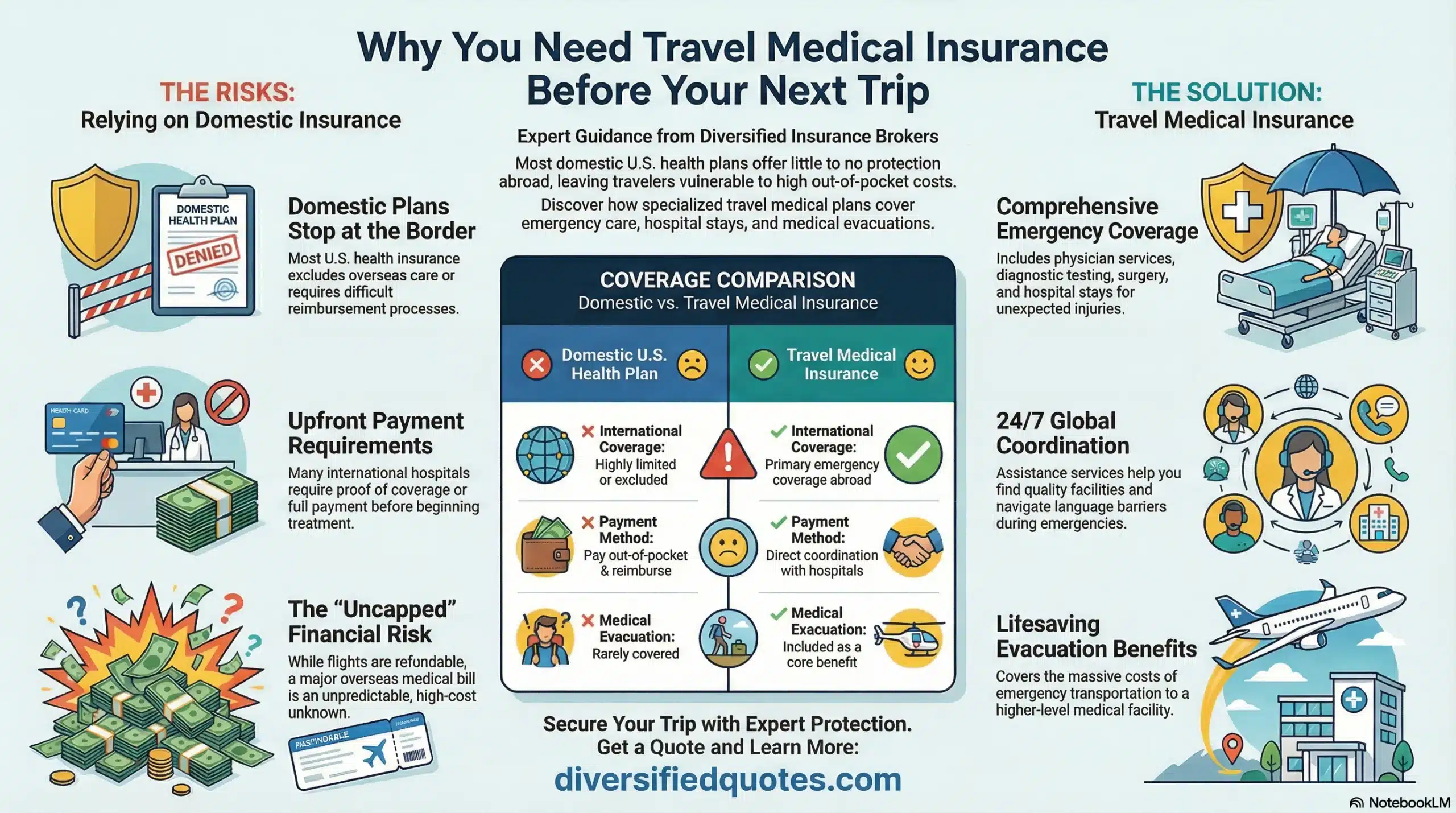
One of the most persistent misconceptions among mission travelers is that existing U.S. health insurance will cover them overseas. In most cases it will not — not adequately, and sometimes not at all. Medicare does not function as primary coverage outside the United States. Many U.S. employer-sponsored health plans provide limited or no international coverage, and the ones that do often require pre-authorization procedures that are impossible to execute during an overseas emergency. Mission teams should treat travel medical insurance as a required planning step — the same category as passport validity and vaccination documentation — not as an optional add-on that careful travelers purchase and cautious ones skip. If you want a baseline understanding of how travel medical plans are structured before diving into mission-specific considerations, our overview of travel insurance fundamentals provides that foundation. The guidance below applies that framework specifically to the volunteer and mission travel context.
Get Mission Trip Travel Insurance Options
Compare travel medical coverage and evacuation protection designed for volunteer travel and mission trips, with an assistance team that can coordinate next steps in a real emergency.
Best for churches and nonprofits that want clarity on medical limits, evacuation triggers, and activity fit before travelers depart.
What Mission Trip Travel Insurance Covers — And What to Prioritize
| Benefit | What It Covers | Why It Matters for Mission Teams |
|---|---|---|
| Travel Medical Coverage | Physician visits, urgent care, ER services, hospitalization, outpatient treatment, labs and imaging, prescription medications related to a covered condition | Removes the cost barrier that causes travelers to delay seeking care; in mission environments where illness escalates quickly, early treatment is operationally critical — and it only happens if the traveler is not paralyzed by fear of unknown costs |
| Emergency Medical Evacuation | Coordination and cost of medically necessary transport to the nearest appropriate facility when local care is insufficient; air ambulance, commercial flight escort with medical personnel, receiving facility coordination | Often the most expensive and most important benefit; a single air ambulance evacuation can cost $50,000 to over $200,000; the assistance provider must coordinate the evacuation — independent arrangements can void coverage |
| Repatriation of Remains | Coordination and cost of returning a deceased traveler’s remains to the United States, including preparation and transport logistics in the country of death | No mission leader plans for this, but the cost and logistical complexity of repatriation from a remote country are significant; this benefit removes that burden from the family and the ministry at the most difficult possible moment |
| 24/7 Assistance Services | Real-time coordination support — identifying appropriate local facilities, managing transfers between providers, communicating with families, coordinating evacuation logistics, and guiding team leaders on next steps | This is the feature that makes the rest of the plan functional; a team leader in a remote area at 2 a.m. with an injured volunteer cannot navigate an international medical crisis alone — the assistance team is the operational backbone |
| Volunteer Activity Coverage | Coverage for injuries sustained during mission-specific activities including construction, debris removal, medical outreach, disaster relief labor, and hands-on service projects — activities that standard leisure travel policies often exclude | A plan that excludes the activity most likely to cause injury on a construction mission provides no real protection for that scenario; activity coverage must be confirmed explicitly before purchase, not assumed |
| Security Evacuation (select plans) | Evacuation coverage triggered by civil unrest, political instability, terrorism, or natural disaster — separate from and in addition to medical evacuation; not universally included in standard travel medical plans | Relevant for teams serving in post-conflict environments, politically unstable regions, or destinations with active travel advisories; our resource on Travel Insurance for Humanitarian Aid Workers covers this layer in detail |
Why Emergency Medical Evacuation Deserves Its Own Focus
Most mission leaders who review a travel medical plan focus on the premium cost and the medical benefit limit. The evacuation benefit is often treated as a secondary concern — something that sounds useful but feels unlikely to matter. This is the most consequential misunderstanding in mission travel planning, and it is one that churches and organizations frequently correct only after experiencing an incident firsthand. Emergency medical evacuation is the benefit that determines whether a seriously ill or injured traveler can access appropriate care when local facilities are insufficient — which is a common scenario in the environments where mission teams work, not a rare one.
The structure of how evacuation works matters as much as the benefit limit. Most plans require that the assistance provider coordinate the evacuation for coverage to apply. That means the team must call the assistance line before making independent transport arrangements — not after. A group leader who calls a local ambulance service, negotiates a flight independently, or arranges transport through a local contact without involving the assistance provider first may find that the evacuation claim is denied because the coordination requirement was not met. This is not a technicality designed to avoid paying claims — it exists because the assistance provider is the entity with the relationships, local knowledge, and clinical oversight needed to ensure the evacuation is medically appropriate and the receiving facility is ready. Calling the assistance line first is the single most operationally important habit every mission team member should develop before departure.
The evacuation limit must also be calibrated to the destination. An evacuation from a remote location in sub-Saharan Africa, Southeast Asia, or Central America involving an air ambulance with medical personnel, a multi-leg transfer, and receiving facility coordination can cost well over $100,000 — and some complex cases exceed $200,000. A plan with a $50,000 evacuation limit may be adequate for some destinations and significantly insufficient for others. Mission leaders should evaluate the evacuation limit against the specific geography and medical access profile of the destination, not just against the premium savings of choosing a lower-limit plan. Our dedicated guide to Emergency Medical Evacuation Insurance covers how to evaluate these limits and what to look for in policy wording.
The Volunteer Activity Exclusion — The Gap Most Mission Teams Miss
Standard leisure travel insurance is underwritten for travelers who are sightseeing, attending events, and engaging in recreational activities. It is not designed for travelers who are pouring concrete, removing debris, installing roofing, mixing mortar at elevation, digging trenches, or performing hands-on clinical care in field conditions. Many standard travel policies exclude injuries sustained during manual labor, construction, or physical volunteer work because those activities carry a higher risk profile than the plan was priced for. A mission volunteer who breaks an arm during construction work on a rebuild project and discovers that the plan excludes coverage for that activity is, in practical terms, uninsured for the most likely injury scenario of the entire trip.
Confirming that the plan covers volunteer labor, construction, disaster relief, and hands-on mission activities is not a box-checking exercise — it is a determinative question about whether the coverage is real for your team. This verification must happen before purchase, and it must be specific. A plan description that covers “volunteer activities” may not cover “manual labor” or “construction work,” and the specific activity definitions in the policy document are what matter in a claim. Mission leaders who are purchasing coverage without a broker’s guidance should request written confirmation from the carrier that the specific activities their team will perform are covered before issuing any policy to travelers.
Medical professionals traveling on outreach trips — physicians, nurses, nurse practitioners, and others providing clinical care — face a related but distinct question about whether the plan covers incidents that occur while the traveler is actively providing medical services. This is a separate underwriting question from general volunteer activity coverage and should be specifically addressed for any medically credentialed team member. Our resource on Travel Medical for Volunteer Groups covers the activity eligibility questions that apply across different volunteer profiles.
Group Coverage vs. Individual Purchase — Why Consistency Matters
Mission teams that purchase coverage individually — each traveler selects their own plan — create a consistency problem that becomes apparent only in an emergency. When a team of twelve travelers has twelve different insurance cards from six different companies, with six different assistance phone numbers, six different evacuation limits, and six different activity definitions, emergency coordination becomes significantly harder. The team leader trying to manage an injury at a remote work site does not have time to determine which plan applies, which number to call, or whether the specific plan the injured traveler chose covers the specific activity they were performing when the injury occurred.
Group-structured coverage — where the mission organization selects a plan and ensures all travelers are enrolled under the same program — solves this problem. Everyone carries the same coverage, the same limits, the same assistance number, and the same activity eligibility. Emergency coordination is straightforward. The ministry can verify before departure that the plan meets its standards for medical coverage, evacuation limits, and volunteer activity fit. Coverage dates can be confirmed consistently for all travelers rather than chasing fifteen individuals for proof of purchase. For churches and nonprofits that send multiple teams per year, a coordinated approach to coverage selection is part of responsible operations and should be built into the trip budget rather than left as an individual volunteer responsibility.
For organizations managing large groups or multi-destination travel programs, our resources on Travel Medical Insurance for Large Groups and Group Medical Insurance cover the structural considerations for group purchasing and how to maintain coverage consistency across a travel program with multiple concurrent teams.
Send Your Mission Itinerary for a Coverage Fit Check
Share your dates, destination, group size, approximate ages, and mission activities. We will confirm the plan fits volunteer work and that evacuation coordination is structured correctly for where your team is going.
Request Options for a Mission Trip
Questions? Call 800-533-5969
Pre-Departure Planning — What Every Mission Team Needs Before Leaving
Purchasing a plan is not the same as being prepared. The coverage is only useful if travelers know how to activate it in the moments when it matters most. Mission leaders should build a pre-departure process that addresses four specific items for every traveler before the group departs. First, every traveler should have a physical copy of their insurance card or coverage confirmation document with the emergency assistance phone number visible — not just a digital copy that requires cell service and a working phone to access. Second, every traveler should know that the first call in a medical emergency is to the assistance provider, not to a local taxi service, the team leader’s personal network, or the nearest facility they can find independently. Third, the team leader should carry a consolidated document with all travelers’ policy numbers and the assistance contact information, stored somewhere accessible even without connectivity. Fourth, coverage dates must align with the full travel window — departure day through return day, including transit time at international airports.
For destinations with known health risks — specific infectious diseases, altitude considerations, required or recommended vaccinations, or environmental hazards — the plan should be reviewed to confirm those conditions are not excluded or subject to waiting periods. Pre-existing condition exclusions are common in travel medical plans, and a traveler with a managed chronic condition who does not review those exclusions before purchase may discover a significant gap if that condition is relevant to an overseas medical event. Our resource on High Risk Travel Insurance covers the destination-specific considerations that affect plan selection for elevated-risk environments, and our deeper guide on Travel and Medical Insurance for High Risk Travel addresses how to match plan structure to specific real-world conditions at the destination level.
How Diversified Insurance Brokers Helps Mission Teams
At Diversified Insurance Brokers, Jason Stolz, CLTC, CRPC, DIA, CAA, helps churches, ministries, and nonprofits compare travel medical and mission-appropriate coverage based on destination, trip duration, group size, activity profile, and budget. The approach is practical and specific: we help mission leaders understand what the plan actually covers, how to use it correctly in an emergency, where the coverage gaps are, and how to ensure the team is operationally prepared — not just administratively compliant. The difference between “we bought a plan” and “we have a workable response plan if something happens” is the difference between coverage that exists on paper and coverage that functions when a team member needs it most.
If your church manages multiple mission trips per year, we can help build a consistent coverage framework that applies across all your travel programs so that every team departs with the same quality of protection regardless of destination or group size. For travel cadences that include both short-term mission teams and longer-term missionaries, the plan structures differ and should be evaluated separately. Our resources on Travel Insurance for Church Groups and Travel Insurance for Missionary Groups cover the organizational planning dimension of both. For larger humanitarian deployments that include aid workers alongside volunteer mission teams, our resource on Travel Insurance for Humanitarian Aid Workers covers the security and specialized coverage layers that apply to higher-risk deployments. And for an overview of the full international travel health coverage landscape, our guide to International Health Insurance provides the broader framework that mission-specific resources build on.
Apply for Mission Trip Travel Insurance
Apply securely online and compare travel medical plans designed for mission work, volunteer groups, and humanitarian service.
Questions? Call 800-533-5969
Talk With an Advisor Today
Choose how you’d like to connect—call or message us, then book a time that works for you.
Schedule here:
calendly.com/jason-dibcompanies/diversified-quotes
Licensed in all 50 states • Fiduciary, family-owned since 1980
Frequently Asked Questions: Mission Trip Travel Insurance
Do mission trip insurance plans cover volunteer labor and construction work?
This is the most important question mission leaders should ask before purchasing any plan — and the answer varies by policy. Standard leisure travel insurance is underwritten for travelers who are sightseeing and relaxing, not for people doing construction, debris removal, well-digging, or hands-on disaster relief. Many standard plans exclude injuries that occur during manual labor or volunteer work because those activities carry a higher risk profile. Mission trip-specific plans and select travel medical plans include volunteer labor and construction as covered activities, but this must be verified before purchase — not assumed. A plan that excludes the activity most likely to cause injury on a construction mission provides no real protection for the scenario that matters most. Confirming activity coverage in writing before purchase is a required step.
Is emergency medical evacuation included and how does it work?
Most mission-appropriate travel medical plans include emergency medical evacuation, but the limit and coordination requirements are what matter most. Evacuation from a remote destination can cost $50,000 to over $200,000 depending on location, medical complexity, and required equipment. The plan’s evacuation limit must be adequate for the specific destination — a limit that works for one region may be insufficient for another. Critically: most plans require the assistance provider to coordinate the evacuation for coverage to apply. Arranging independent transport without involving the assistance provider first can result in a denied claim. The team must call the assistance line before making any transport decisions — not after. Our guide to Emergency Medical Evacuation Insurance covers coordination requirements and how to evaluate limits against specific destinations.
Will U.S. health insurance or Medicare cover my team overseas?
In most cases, not adequately — and sometimes not at all. Medicare does not function as primary insurance outside the United States and provides only very limited emergency coverage in specific circumstances. Many U.S. employer-sponsored health plans have international coverage riders, but those riders typically provide secondary coverage with low maximums, require pre-authorization that is impossible to obtain during an overseas emergency, or exclude the destination country entirely. The plans that do provide some international coverage are rarely structured to handle the full cost of emergency hospitalization, specialist care, and medical evacuation in a resource-limited international environment. Mission teams should treat U.S. domestic health insurance as a potential secondary layer at best — never as the primary protection for international travel.
Can the entire mission team be covered under one plan?
Yes — and group-structured coverage is almost always preferable to individual purchasing for mission teams. When the whole team is enrolled in the same plan, everyone has identical coverage limits, the same evacuation provisions, the same assistance phone number, and the same activity eligibility. Emergency coordination is straightforward — one number, one process, one set of coverage rules — rather than managing multiple insurers simultaneously in the middle of a crisis. The ministry can verify before departure that the plan meets its standards for medical coverage, evacuation limits, and volunteer activity fit. For churches managing multiple trips per year, a coordinated group coverage framework ensures consistent protection across all programs and removes coverage quality from the list of variables that change from trip to trip.
Does mission trip insurance cover security evacuation for civil unrest or political instability?
Some plans include security evacuation coverage for civil unrest, political instability, terrorism, or natural disaster — separate from and in addition to emergency medical evacuation. This benefit is not universally included in standard travel medical plans and must be specifically selected or confirmed. For mission teams serving in post-conflict environments, politically fragile regions, or destinations with active U.S. State Department travel advisories, security evacuation coverage is an important additional layer to evaluate. It is particularly relevant for humanitarian aid workers and for teams where the destination carries elevated non-medical risk. Our resource on Travel Insurance for Humanitarian Aid Workers covers the specific coverage considerations for higher-risk deployments.
What should a mission team do first when a medical emergency happens overseas?
Call the assistance provider’s 24/7 emergency line — before making any independent decisions about where to go or how to transport the traveler. The assistance team identifies appropriate local facilities for the specific condition, determines whether a transfer is medically necessary, and arranges that transfer in a way that preserves coverage under the plan. Calling after independently arranging transport can create coverage complications, particularly for evacuation claims that require assistance provider coordination. Every traveler should have the assistance phone number in physical form before departure — not just digital. Every team leader should reinforce this step in the pre-departure briefing: in a medical emergency overseas, the first call is to the assistance line. That single habit is the difference between a plan that functions and one that exists on paper but fails in execution.
About the Author:
Jason Stolz, CLTC, CRPC, DIA, CAA and Chief Underwriter at Diversified Insurance Brokers (NPN 20471358), is a senior insurance and retirement professional with more than 25 years of real-world experience helping individuals, families, and business owners protect their income, assets, and long-term financial stability. As a long-time partner of the nationally licensed independent agency Diversified Insurance Brokers, Jason provides trusted guidance across multiple specialties—including fixed and indexed annuities, long-term care planning, personal and business disability insurance, life insurance solutions, Group Health, Travel Medical and Evacuation Insurance, and short-term health coverage. Diversified Insurance Brokers maintains active contracts with over 100 highly rated insurance carriers, ensuring clients have access to a broad and competitive marketplace.
His practical, education-first approach has earned recognition in publications such as VoyageATL, and contributions from his agency featured in Kiplinger and GoBankingRates— highlighting his commitment to financial clarity and client-focused planning. Drawing on deep product knowledge and years of hands-on field experience, Jason helps clients evaluate carriers, compare strategies, and build retirement and protection plans that are both secure and cost-efficient. Visitors who want to explore current annuity rates and compare options across multiple insurers can also use this annuity quote and comparison tool.
Explore More Travel Medical Insurance Options: Browse our complete guide to Groups & Specialty Travel Insurance — covering church groups, missionaries, volunteers, students, expats, digital nomads & more.
Last Reviewed: June 13, 2026 |
Reviewed by: Jason Stolz, CLTC, CRPC, DIA, CAA
Chief Underwriter, Diversified Insurance Brokers, Inc. | NPN: 20471358 | Diversified Insurance Brokers, Inc. — Licensed in all 50 states
Fact Checked by: Tonia Pettitt, CMIP©
Medicare Specialist, Diversified Insurance Brokers, Inc. | NPN: 14374308 | Diversified Insurance Brokers, Inc. — Licensed in all 50 states
Did you find this content helpful? Leave us a Google review — it helps others find trustworthy guidance too.
Editorial Standards: Diversified Insurance Brokers maintains rigorous editorial standards to ensure accuracy, clarity, and independence in all content. Learn more about our editorial standards and commitment to transparency.
