
Travel Insurance for Humanitarian Aid Workers
Travel Insurance for Humanitarian Aid Workers

Jason Stolz CLTC, CRPC, DIA, CAA
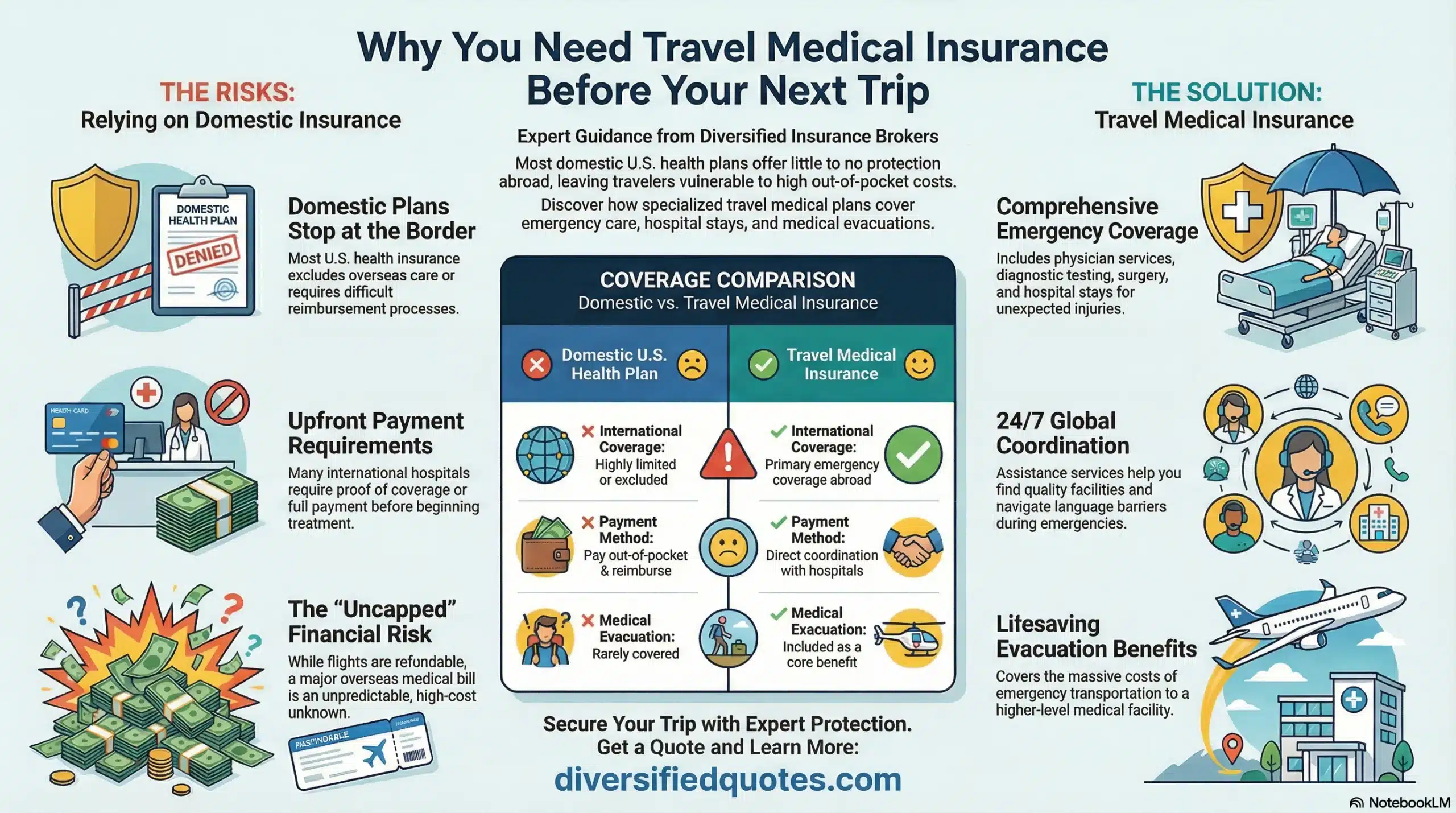
Humanitarian aid workers operate in some of the most challenging and unpredictable environments in the world — disaster-affected regions, conflict-adjacent zones, areas with collapsed healthcare infrastructure, and communities where the gap between medical need and available resources defines the work itself. The insurance coverage that protects aid workers in these environments cannot be a standard vacation-style travel plan pulled from a general comparison website. Standard travel insurance is typically built around leisure travel assumptions: defined destinations without travel advisories, functioning healthcare systems at the destination, no high-risk occupational duties, and limited duration trips with predictable return timelines. Humanitarian deployments break nearly every one of these assumptions, and the plan language that follows from those assumptions — exclusions for conflict zones, exclusions for duties classified as business activity, exclusions for regions under government travel advisories — can produce denial outcomes exactly when coverage is most needed. The foundational planning step for humanitarian aid workers is not finding the most affordable travel plan — it is finding a plan whose coverage language specifically accommodates the realities of aid deployment rather than one whose exclusions quietly eliminate coverage for exactly those situations. Our resource on high-risk travel insurance covers the broader landscape of coverage designed for elevated-risk environments, and our resource on travel medical insurance provides the foundational context for understanding how travel medical plans work as a category before examining the specific features humanitarian workers need.
Two coverage features that are essential for humanitarian deployments and frequently absent from standard travel plans deserve particular attention before any other evaluation begins. The first is security evacuation — the ability to extract a worker from a dangerous location due to political unrest, armed conflict, civil instability, or natural disaster without requiring a medical condition as the trigger. Most standard travel plans include medical evacuation (transport to a medical facility when local care is inadequate) but do not include security or political evacuation (extraction from a threatening environment when the danger is security-related rather than medical). For an aid worker in a region experiencing sudden political instability or escalating violence, the inability to initiate an extraction because the plan only covers medically-triggered evacuation is a critical coverage gap. The second essential feature is coverage that explicitly addresses high-risk or conflict-adjacent deployment environments rather than excluding them through destination-based or travel advisory-based language. A plan that denies claims for medical events in countries listed under government travel advisories effectively eliminates coverage for many of the regions where humanitarian aid is most needed. Identifying plans with explicit inclusion language for high-risk destinations — rather than assuming a travel plan that costs more must cover more — is the correct evaluation approach. Our resource on emergency medical evacuation insurance covers the evacuation benefit mechanics in depth, and our resource on international travel health coverage covers the international coverage landscape for deployments abroad.
For organizations — NGOs, nonprofits, faith-based humanitarian organizations, international development agencies — the coverage question extends beyond the individual worker to encompass the organization’s duty of care obligations, partner organization requirements, and administrative consistency across rotating deployment teams. Many international NGOs and partner organizations require workers and volunteers to carry minimum coverage levels before deployment — particularly for medical evacuation and security evacuation limits. Organizations that send workers into the field without confirming coverage adequacy may face both practical liability exposure when a medical or security event occurs and reputational consequences if a worker is left without adequate support during a crisis. Building a consistent organizational coverage framework — not relying on individual workers to independently research and purchase adequate coverage — is a risk management practice that protects both the workers and the organization. Our resource on cheap group travel insurance covers the group coverage structure, and our resource on emergency travel health insurance covers the emergency-focused coverage framework that most humanitarian deployments need as the core protection layer.
Request Humanitarian Deployment Coverage Options
Share your destination(s), deployment dates, role type, and whether your deployment involves remote or higher-risk environments. Individual and group coverage available for NGOs, nonprofits, and volunteer organizations.
Coverage Comparison — Standard Travel Medical vs. Humanitarian Deployment Plan
The table below compares standard travel medical coverage against the features humanitarian aid workers specifically need. The differences are not marginal — in several dimensions, a standard travel plan provides no meaningful protection for a humanitarian deployment, while a plan built for high-risk field work addresses the scenarios that matter most.
| Coverage Dimension | Standard Travel Medical Plan | Humanitarian Deployment Plan | Why It Matters for Aid Workers |
|---|---|---|---|
| Medical Evacuation | Typically included, but may have low limits or route restrictions; may not cover evacuation from conflict-adjacent areas | Should include high medical evacuation limits — typically $500,000 to $1,000,000 or unlimited — with a single assistance contact responsible for full coordination | Healthcare infrastructure in many deployment regions is inadequate for serious trauma, infectious disease, or surgical needs — evacuation to a capable facility can be the difference between adequate care and a preventable death |
| Security / Political Evacuation | Typically absent — most standard plans cover medical evacuation only; security extraction without a medical trigger is not a standard benefit | Essential for humanitarian deployments — coverage for extraction from a deployment region due to armed conflict, civil unrest, political instability, or natural disaster, without requiring a concurrent medical condition to qualify | Political or security emergencies can require extraction without any medical event — the worker who cannot be evacuated because their plan only covers medical triggers is left without recourse in a genuine security crisis |
| High-Risk / Conflict Zone Coverage | Often excluded — plan language may exclude countries under government travel advisories, sanctions, or classified as “war zones” or “conflict regions” | Explicitly includes coverage for high-risk deployment destinations — reads the plan language to confirm inclusion, not absence of exclusion | Humanitarian aid is disproportionately delivered in exactly the regions that standard plans exclude — a standard plan that excludes conflict-adjacent areas is functionally no coverage for many common deployment destinations |
| Occupational Duty Coverage | May exclude “business activities” — some plans classify humanitarian work, clinical care, logistics, or field operations as business/professional activities subject to exclusion | Covers injuries and illness arising from the actual duties of humanitarian deployment — field work, site visits, clinical support, logistics, and disaster response activities are covered, not excluded | An aid worker injured during distribution operations or field logistics who finds the claim denied because “business activity” exclusions apply has been protected by a plan built for leisure, not deployment |
| Emergency Medical Coverage Limits | Varies widely — may be $50,000 to $500,000; lower-limit plans may be inadequate for serious trauma or extended hospitalization in certain regions | Should be high — at least $100,000 per event, preferably higher; many humanitarian-focused plans carry $250,000 to $1,000,000 in medical expense coverage | Medical care costs in international facilities — particularly for trauma requiring air transport — can exceed standard travel plan limits quickly; adequate limits ensure coverage doesn’t run out mid-treatment |
| Mental Health Support | Typically absent or very limited — standard travel plans focus on physical medical events | Some specialized humanitarian plans include access to counseling, crisis support lines, and mental health resources for workers experiencing trauma-related symptoms during or after deployment | Secondary traumatic stress, acute trauma responses, and burnout are genuine occupational hazards for humanitarian workers — the absence of mental health support in coverage is a meaningful gap for workers in high-intensity environments |
| 24/7 Assistance and Crisis Coordination | Included in most travel plans — phone line for provider access and basic assistance | Should provide a single, experienced international assistance contact who can coordinate medical evacuation, security evacuation, provider access, and documentation support in high-complexity situations | In a field medical or security emergency, coordination quality determines speed and adequacy of response — a strong assistance provider who understands high-risk environments is operationally different from a standard call center |
Coverage features, limits, exclusions, and destination eligibility vary significantly by plan and carrier. This table reflects general patterns in the market and should not be relied upon as a substitute for reviewing specific plan documents before purchase. Verify in writing — not in marketing summaries — that your specific deployment destination, occupational duties, and required coverage features are explicitly included in the plan you select.
Medical Evacuation vs. Security Evacuation — Two Distinct and Essential Protections
The most important distinction in humanitarian deployment coverage that many aid workers and organizations do not fully understand before purchasing is the difference between medical evacuation and security evacuation. Medical evacuation — the transport of an injured or seriously ill person from a location with inadequate medical resources to a facility capable of providing appropriate care — is included in most quality travel plans and is the benefit most people think of when they consider evacuation coverage. It is triggered by a medical need. Security evacuation — the extraction of a person from a deployment location due to political unrest, armed conflict, civil instability, terrorism, or natural disaster — is triggered by a threat to personal safety rather than a medical condition. Many plans that include robust medical evacuation provide zero security evacuation coverage, because standard travel plans were not designed for deployment environments where security threats can materialize without any accompanying medical event.
For an aid worker deployed in a region experiencing sudden political escalation or conflict spillover, the absence of security evacuation coverage in their plan means that the extraction resources most plans provide — the assistance center, the logistics coordination, the financial coverage for transport — are not available unless the worker is also simultaneously injured or ill. This gap is not hypothetical. Humanitarian security incidents occur regularly in high-risk deployment regions, and workers who have medical evacuation coverage but no security evacuation benefit may find themselves in an extraction situation without any plan-based support. Identifying a plan that explicitly includes security or political evacuation — not just medical evacuation — is the critical differentiation for anyone deploying into regions with any meaningful security risk profile. Our resource on emergency medical evacuation insurance covers the medical evacuation benefit in detail; for security evacuation, the key evaluation is whether the plan language explicitly identifies political or security threats as covered triggers for evacuation coordination and financial support.
Why Standard Travel Plans Often Fail for Humanitarian Deployments
Standard travel insurance is engineered for leisure travelers — people visiting defined destinations with functioning healthcare infrastructure, no elevated security concerns, and clear return timelines. The risk assumptions built into standard plan pricing and coverage language do not accommodate the environments where humanitarian aid is delivered. Three specific exclusion mechanisms frequently eliminate coverage for aid workers who purchase standard plans without reviewing the fine print. The first is destination-based exclusions: most standard plans exclude countries or regions listed under government travel advisories at the highest warning levels, under economic sanctions, or categorized as active conflict zones. These exclusions silently eliminate coverage for many common humanitarian deployment locations without requiring any affirmative disclosure to the buyer at time of purchase. The second is occupational exclusion: some plans classify humanitarian fieldwork, clinical deployment, logistics operations, and similar activities as “business,” “professional,” or “work-related” activities subject to exclusions that apply to professional travelers rather than leisure travelers. The third is the absence of security evacuation — which, as discussed, means the plan’s evacuation benefit does not activate for the most acute security threats humanitarian workers face. Purchasing a standard plan for a humanitarian deployment without verifying that all three of these exclusion mechanisms do not apply is a significant coverage risk. Our resource on high-risk travel insurance covers how high-risk destination coverage differs from standard travel insurance structurally.
Short-Term Deployments vs. Extended Placements — Different Coverage Structures
The duration of a humanitarian deployment significantly affects which coverage structure is most appropriate. Short-term deployments — disaster relief missions lasting days to weeks, volunteer programs of a month or two, or periodic field visits to support ongoing programs — are typically well-served by travel medical insurance with the specific humanitarian features described: high medical and evacuation limits, security evacuation, high-risk destination inclusion, and occupational duty coverage. These deployments have defined start and end dates, and travel medical coverage tied to those dates provides appropriate short-duration protection. Extended placements — assignments of several months to a year or longer, long-term volunteer programs, or recurring deployment schedules where a worker spends the majority of their time in a foreign country — may require a different coverage structure. Workers who effectively reside in a deployment country for extended periods may need international health insurance or expat-style coverage rather than travel medical insurance, because travel medical is designed for temporary travel from a home country rather than for extended foreign residency. The distinction matters because long-term coverage provides access to routine care, specialist services, and ongoing prescription management that travel medical does not — important for workers managing chronic conditions during a long deployment. Our resources on international health insurance and international travel health coverage cover the longer-duration international coverage options for workers moving beyond the short-trip travel medical structure.
Individual Aid Workers vs. Organizational Group Coverage
Coverage for humanitarian aid workers can be purchased individually by each worker or organized at the group level by the deploying organization. Individual coverage is appropriate for independent volunteers, consultants deploying on personal arrangements, or workers whose organizations do not provide coverage and who must arrange their own protection. Individual plans can be tailored to the specific deployment destination and dates, and workers can select coverage features appropriate for their specific role and risk exposure. Organizational group coverage provides a consistent protection framework for all workers deployed under the organization’s umbrella — eliminating the gap risk that arises when some workers purchase adequate coverage independently and others do not. For NGOs, nonprofits, and humanitarian organizations with ongoing deployment programs, group coverage also reduces administrative burden: a single organizational plan covers the rotating roster rather than requiring each worker to independently research, purchase, and document their own coverage before every deployment. Many partner organizations and institutional funders also require workers to be covered under organizational plans with specific minimum coverage standards before they can deploy. Our resources on cheap group travel insurance and travel insurance for youth mission trips cover the group coverage structure in comparable deployment contexts that many humanitarian organizations find useful as a planning reference.
Mental Health Coverage — An Often-Overlooked Protection for Field Workers
The psychological toll of humanitarian fieldwork is a recognized occupational hazard that the aid sector has worked to address more seriously in recent years. Secondary traumatic stress (exposure to others’ trauma), acute stress responses following critical incidents, cumulative burnout from chronic high-pressure environments, and post-traumatic stress symptoms are all documented experiences for humanitarian workers deployed in crisis settings. Some specialized humanitarian travel plans now include access to mental health resources — counseling services, crisis support lines, and referral networks — as part of the coverage structure, recognizing that the psychological risks of field deployment are as real as the physical ones. Standard travel plans do not include these benefits, treating travel insurance as an exclusively physical medical coverage product. For organizations building comprehensive worker protection frameworks, confirming that the coverage structure includes at least some mental health support access — or making separate provision for it through employee assistance programs or organizational resources — is an increasingly important dimension of responsible deployment planning. Workers deploying independently should also evaluate whether the plan they purchase offers any mental health support resources as part of the assistance services, since the period of a crisis deployment and the period immediately following can be the highest-risk times for psychological impact. Our resource on disability insurance services covers the broader disability protection framework that some aid workers consider alongside travel coverage for longer-term income protection.
What Organizations Should Require Before Any Worker Deploys
For humanitarian organizations, nonprofits, and faith-based aid programs, the pre-deployment coverage verification process is as important as any logistical preparation. Workers should not be cleared for deployment without confirmed documentation showing that their travel coverage is in place, that the plan covers the specific destination(s) at the expected risk classification, that medical and security evacuation benefits are included with adequate limits, and that the occupational duties of the deployment are covered rather than excluded. Organizations should also ensure that every deployed worker — and every team lead or coordinator accompanying them — has the assistance line contact information for the coverage plan readily accessible before departure. Coordinating around the “who do you call first in an emergency” question before the deployment begins rather than during a crisis removes one of the most consequential sources of delay and confusion when a medical or security event occurs in the field. Organizations with repeated or ongoing deployment programs benefit from establishing a standard coverage protocol — a defined minimum coverage framework that all workers under the organization’s program carry — rather than leaving coverage decisions to individual workers whose understanding of the plan language may not match the organization’s risk management standards. Our resources on travel insurance for missionary groups, mission trip travel insurance, and travel insurance for church groups cover the organizational deployment planning context for faith-based programs with comparable coordination needs.
Common Mistakes Before and During Humanitarian Deployments
The most common coverage mistake humanitarian workers make is purchasing a plan based primarily on price or brand recognition without verifying that the plan’s exclusion language accommodates the actual deployment environment. A plan that costs more and carries a well-known name does not automatically cover high-risk destinations or security evacuation. The second common mistake is assuming that a plan’s medical evacuation benefit will function as security evacuation when needed — these are distinct benefits with distinct triggers, and a worker counting on medical evacuation to also cover security extraction may find neither available for a pure security incident without a concurrent medical event. The third common mistake is failing to confirm occupational duty coverage — purchasing a leisure-category travel plan and assuming it applies to the fieldwork activities of a humanitarian deployment. The fourth mistake is purchasing coverage without reading the destination exclusion list and discovering only at claim time that the deployment destination falls within an excluded category. The fifth is deploying without confirming the assistance line contact information and emergency procedure with every member of the team. These mistakes are entirely preventable through a methodical pre-deployment review — reading the actual plan documents, not the marketing summary, and confirming each key coverage feature in writing before departure. Our resource on is travel medical insurance expensive covers the cost context for evaluation, and our resource on short-term medical services covers the broader short-term health coverage options for workers evaluating the full range of available protection tools. For aid workers who also need longer-term income protection planning alongside deployment coverage, our resources on life insurance services and disability insurance services cover those adjacent planning needs that many humanitarian workers address in combination with travel coverage.
Talk With an Advisor Today
Choose how you’d like to connect—call or message us, then book a time that works for you.
Schedule here:
calendly.com/jason-dibcompanies/diversified-quotes
Licensed in all 50 states • Fiduciary, family-owned since 1980
FAQs: Travel Insurance for Humanitarian Aid Workers
Why isn’t a standard travel insurance plan sufficient for humanitarian deployments?
Standard travel insurance is built around leisure travel assumptions — defined destinations without travel advisories, functioning healthcare at the destination, and no elevated security or occupational risks. Humanitarian deployments break most of these assumptions. Standard plans frequently include destination-based exclusions that eliminate coverage for countries under government travel advisories or classified as conflict-affected. They may classify fieldwork, clinical operations, and logistics duties as “business activities” subject to exclusion. They typically do not include security or political evacuation. And their medical and evacuation coverage limits may be inadequate for the cost and complexity of emergencies in remote or conflict-adjacent regions. Reading the plan exclusion language before purchase — not just the summary of benefits — is the only way to confirm whether a plan actually covers a humanitarian deployment environment.
What is the difference between medical evacuation and security evacuation?
Medical evacuation is the transport of an injured or seriously ill person from a location with inadequate medical resources to a facility capable of providing appropriate care — triggered by a medical condition that cannot be adequately treated locally. Security evacuation (also called political or crisis evacuation) is the extraction of a person from a deployment location due to armed conflict, civil unrest, political instability, or natural disaster — triggered by a threat to personal safety without necessarily involving any medical condition. Most standard travel plans include only medical evacuation. For humanitarian workers deployed in regions with security risks, security evacuation coverage is an essential separate benefit that must be explicitly confirmed in the plan language, not assumed from the medical evacuation benefit.
Does travel insurance cover work done in conflict zones or war-affected areas?
Standard travel insurance typically does not — conflict zones, war-affected areas, and regions under government travel advisories at the highest warning levels are commonly listed as general exclusions in standard plan language. Specialized humanitarian or high-risk travel plans are specifically designed to cover deployments in these environments, though even specialized plans have limits — most plans exclude coverage for injuries sustained while actively participating in combat or military operations, and some plans exclude certain sanctioned regions. The key is identifying a plan whose destination eligibility explicitly includes the specific deployment location, confirmed in the plan documents rather than assumed from marketing language.
Can NGOs and nonprofits purchase group coverage for their deployed teams?
Yes — group coverage structures are available for organizations deploying teams of workers or volunteers. Organizational group coverage provides consistent protection across the entire deployed roster, eliminates the gap risk that occurs when individual workers purchase different levels of coverage independently, and simplifies administration for program coordinators. Many institutional funders and partner organizations require humanitarian workers to be covered under organizational plans with specific minimum coverage standards — including defined minimums for medical and security evacuation coverage — as a condition of deployment participation. Establishing a standard organizational coverage protocol reduces pre-deployment complexity and ensures all workers deploy with confirmed, consistent protection.
Is a short-term travel medical plan the right coverage for a long-term deployment?
Travel medical insurance is best suited for short-term deployments with defined start and end dates — disaster relief missions, short volunteer programs, periodic field visits. For extended placements lasting several months to a year or longer, international health insurance or expat-style coverage is often more appropriate because it provides access to routine care, specialist services, and ongoing prescription management that travel medical does not. Workers who effectively reside in a foreign country for an extended deployment need coverage designed for that duration rather than for temporary travel from a home country. The transition point varies by carrier and plan design, but workers planning deployments beyond a few months should evaluate both travel medical and international health insurance options before committing to a coverage structure.
Do humanitarian travel plans cover mental health or psychological support?
Some specialized humanitarian plans now include access to counseling services, crisis support lines, and mental health resources — recognizing that secondary trauma, acute stress responses, and burnout are genuine occupational hazards for workers in high-intensity field environments. Standard travel plans do not include these benefits. The availability of mental health support varies significantly by carrier and plan tier, and organizations building worker protection frameworks should specifically evaluate this dimension alongside the more commonly discussed medical and evacuation benefits. Workers deploying independently should ask about mental health support access when evaluating plan options, since this coverage is not prominently featured in most plan summaries even when it is available.
What coverage limits should humanitarian workers look for?
For humanitarian deployments, coverage limits should be evaluated against the realistic cost of medical events in the deployment region and the cost of evacuation from that region. As a general reference point, at least $100,000 in medical expense coverage per event and at least $250,000 to $500,000 in medical evacuation coverage are commonly cited starting points — with many organizations requiring higher limits for remote or high-risk environments. Security evacuation limits should be evaluated separately, as they may be subject to different sub-limits than medical evacuation. Many institutional funders and partner organizations specify minimum coverage requirements for affiliated workers — confirming whether the organization’s requirements apply and what minimums they specify is an important pre-purchase step for workers deploying under an organizational umbrella.
What should a humanitarian worker do before departing to ensure coverage is ready to use?
Before departure, every humanitarian worker should: confirm that their coverage plan explicitly includes the deployment destination at the correct risk classification; verify that medical and security evacuation benefits are both present with adequate limits; confirm that the occupational duties of the deployment (fieldwork, clinical operations, logistics, site visits) are covered rather than excluded as business activities; write down and physically carry the assistance line phone number and plan identification details separate from their phone; share the assistance line and plan information with a home contact who can relay it in an emergency; and confirm the same information with any team leaders or administrators traveling with the deployment. This pre-departure checklist takes less than an hour to complete and eliminates the most common sources of delay and confusion when a medical or security event occurs in the field.
About the Author:
Jason Stolz, CLTC, CRPC, DIA, CAA and Chief Underwriter at Diversified Insurance Brokers (NPN 20471358), is a senior insurance and retirement professional with more than 25 years of real-world experience helping individuals, families, and business owners protect their income, assets, and long-term financial stability. As a long-time partner of the nationally licensed independent agency Diversified Insurance Brokers, Jason provides trusted guidance across multiple specialties—including fixed and indexed annuities, long-term care planning, personal and business disability insurance, life insurance solutions, Group Health, Travel Medical and Evacuation Insurance, and short-term health coverage. Diversified Insurance Brokers maintains active contracts with over 100 highly rated insurance carriers, ensuring clients have access to a broad and competitive marketplace.
His practical, education-first approach has earned recognition in publications such as VoyageATL, and contributions from his agency featured in Kiplinger and GoBankingRates— highlighting his commitment to financial clarity and client-focused planning. Drawing on deep product knowledge and years of hands-on field experience, Jason helps clients evaluate carriers, compare strategies, and build retirement and protection plans that are both secure and cost-efficient. Visitors who want to explore current annuity rates and compare options across multiple insurers can also use this annuity quote and comparison tool.
Explore More Travel Medical Insurance Options: Browse our complete guide to Groups & Specialty Travel Insurance — covering church groups, missionaries, volunteers, students, expats, digital nomads & more.
Last Reviewed: June 4, 2026 |
Reviewed by: Jason Stolz, CLTC, CRPC, DIA, CAA
Chief Underwriter, Diversified Insurance Brokers, Inc. | NPN: 20471358 | Diversified Insurance Brokers, Inc. — Licensed in all 50 states
Fact Checked by: Tonia Pettitt, CMIP©
Medicare Specialist, Diversified Insurance Brokers, Inc. | NPN: 14374308 | Diversified Insurance Brokers, Inc. — Licensed in all 50 states
Did you find this content helpful? Leave us a Google review — it helps others find trustworthy guidance too.
Editorial Standards: Diversified Insurance Brokers maintains rigorous editorial standards to ensure accuracy, clarity, and independence in all content. Learn more about our editorial standards and commitment to transparency.
