
Travel Medical Insurance for Studying Abroad
Travel Medical Insurance for Studying Abroad

Jason Stolz CLTC, CRPC, DIA, CAA
Studying abroad is one of the most meaningful experiences a student can have — a period of genuine independence, cultural immersion, and personal growth that shapes academic and professional trajectories in ways that classroom education alone cannot replicate. But it is also one of the easiest times for families to underestimate medical risk in ways that create real financial and logistical problems when something goes wrong. The moment a student lives in another country — even for a single semester — healthcare becomes more complicated in ways that most families have never had to navigate before. Provider networks do not follow the student across international borders. Billing rules are different from what American families are accustomed to, and many clinics and hospitals in major international destinations require payment at the point of service before treatment proceeds. Even in countries with strong public healthcare systems, international students may not qualify for the same access as residents, may face registration delays, or may not have the same practical access to care that the system’s reputation might suggest. When something unexpected happens abroad, the challenge is rarely just “Where do we go?” — it is “How do we navigate a system we do not know, make appropriate care decisions under pressure, and avoid turning a medical event into a financial and logistical crisis that the family must manage from thousands of miles away?”
Travel medical insurance for studying abroad is designed to solve that problem by providing medical coverage for illness and injury while the student is outside their home country, reducing out-of-pocket financial exposure for unexpected medical events, and often including assistance services that make it faster and easier to locate appropriate care in an unfamiliar healthcare system. The right plan includes emergency medical evacuation — one of the most important and most frequently underestimated benefits for students studying far from home, particularly for students who are outside major medical hubs during fieldwork, weekend travel, or break periods. At Diversified Insurance Brokers, we help students, parents, and study abroad program coordinators compare options and choose coverage that fits the program length, destination, activity level, any pre-existing health considerations, and the coverage requirements of the host institution or sponsoring program. What is the primary reason people buy travel medical insurance covers the core risk calculation that drives the purchase decision for international travelers — a useful baseline before evaluating study abroad-specific coverage decisions.
Get Study Abroad Travel Medical Options
We’ll help you compare plans, confirm what’s covered, and align coverage with your school’s requirements and travel dates.
Why Travel Medical Insurance Matters for Study Abroad
When students travel and live abroad, the most common medical issues they encounter are not dramatic emergencies — they are everyday problems that still require care and can become more complicated and expensive in an international context than they would be at home. Food-borne illness, strep throat, a sprained ankle from hiking or a sports activity, minor infections from small cuts or insect bites that receive delayed treatment, allergic reactions to unfamiliar foods or environmental factors, a fever that starts minor and escalates to an urgent visit, and injury during a weekend trip or recreational activity — these are the events that most commonly send students to seek care abroad. Without coverage, these events are paid entirely out of pocket, and the total cost can be surprisingly high, especially in major international cities where private clinics charge non-resident rates, or in destinations where billing expectations for international patients differ significantly from what an American student would encounter domestically.
Then there are the serious events that families never plan for — appendicitis, a significant fracture, severe dehydration requiring intravenous treatment, pneumonia, a serious medication reaction, or hospitalization following an accident. These events happen every year to students studying abroad, and they are the primary reason emergency travel health insurance exists as a product category. The coverage is not insurance in the abstract — it is a practical mechanism for accessing appropriate care more quickly, reducing the financial disruption that a serious event causes, and avoiding the compounding crisis that occurs when a medical event in a foreign country becomes simultaneously a healthcare problem, a financial problem, and a communication and logistics problem for a family managing the situation from another continent. Many study abroad programs require proof of medical coverage that meets defined minimum standards, which means coverage is not always optional even for families who might otherwise choose to self-insure. For American students specifically, emergency travel medical insurance for US citizens covers the coverage structures most relevant for American students whose domestic health plans provide no meaningful international coverage. If you want a foundational overview of how these plans work as a product category, start with our overview of international travel health coverage, which covers the full range of protection options across different student program types and stay durations.
Study Abroad Coverage: Travel Medical vs. International Health Insurance
| Feature | Travel Medical Insurance | International Health Insurance | Best Fit for Study Abroad |
|---|---|---|---|
| Primary purpose | Emergency and urgent medical care during defined temporary travel period — illness, injury, evacuation | Comprehensive ongoing health coverage for individuals living abroad long-term — routine, preventive, specialist, and emergency care | Travel medical is typically the right fit for semester, year, or defined program lengths with clear return dates |
| Best duration fit | Days to approximately 12 months — designed for temporary international stays with defined start and end dates | One year or more of continuous international residence — designed for students pursuing full degree programs abroad or relocating long-term | Students on semester or year exchange programs use travel medical; students pursuing multi-year degrees abroad evaluate international health insurance |
| Routine care coverage | Limited — focused on illness and injury treatment rather than preventive, wellness, or routine check-up care | Included — covers routine visits, preventive care, chronic condition management, and specialist access as part of the comprehensive benefit design | Students needing routine care access abroad should evaluate whether travel medical limits are adequate or whether international health insurance better serves their ongoing needs |
| Emergency evacuation | Core benefit on most plans — covers medical transport to appropriate facilities and repatriation when local care is insufficient | Typically included — evacuation benefit as part of the comprehensive plan design | Evacuation limits and coordination quality matter equally in both product types — confirm before purchasing regardless of which product is selected |
| Pre-existing conditions | Generally excluded or limited to acute flare-up coverage for stable pre-existing conditions during a defined lookback window | More commonly covers chronic conditions — long-term international plans designed for ongoing care access are more likely to include ongoing condition management | Students with ongoing health conditions should evaluate pre-existing condition terms carefully — international health insurance may provide more appropriate coverage |
| Mental health coverage | Varies significantly — some plans include limited mental health benefits; others do not; check plan terms explicitly | More commonly included as part of comprehensive benefit design — typically aligned with the broader healthcare benefit structure | Mental health coverage is increasingly important for studying abroad — families should confirm whether this benefit is included regardless of which product is selected |
| Geographic scope | Typically worldwide or defined territory — confirm whether weekend travel and break travel outside the host country is covered | Typically worldwide coverage — designed for individuals living internationally who travel between countries regularly | Students who travel extensively during their program need geographic scope covering all planned and anticipated destinations, not just the host country |
| Cost | Lower premium — priced for a defined short-to-medium-term emergency protection need rather than comprehensive ongoing coverage | Higher premium — reflects broader benefit scope, routine care access, and longer-duration design | Travel medical is the most cost-efficient solution for most study abroad program lengths — international health insurance is warranted when the student’s needs genuinely require its broader benefit scope |
What Travel Medical Insurance for Studying Abroad Typically Covers
Most student travel medical plans focus on medical care tied to illness or injury that occurs while the student is abroad during the covered period. Core benefits commonly include eligible physician visits and urgent care treatment, emergency room services, inpatient hospital care including room and board, outpatient treatment and follow-up visits, diagnostic testing including laboratory work and imaging tied to a covered condition, and prescription medication related to a covered illness or injury event. Some plans also include limited follow-up care after an injury when it is medically necessary, and some provide additional support services like telemedicine access, translation assistance for medical appointments, or help locating English-speaking providers — services that can be enormously practical for students navigating a healthcare system in a second language under the stress of an unexpected medical event.
For most families, the most consequential single benefit in a student travel medical plan is emergency medical evacuation insurance. If adequate treatment for the student’s condition is not available locally — because the local hospital lacks the necessary surgical capability, the specialist needed is unavailable in the destination city, or the severity of the event exceeds what the local infrastructure can safely manage — evacuation coverage can help coordinate and pay for transportation to the nearest appropriate facility. That might mean moving the student to a major regional hospital, transferring to a city with better specialist availability, or in certain cases coordinating a medically supervised return to the home country. The coordination element matters as much as the financial element — evacuation is not simply a long-distance flight, it is a medically managed process that requires clinical handoffs, receiving facility acceptance, appropriate medical staff during transport, and logistics that most families cannot manage independently while simultaneously managing a family member’s medical emergency from another country. For students whose programs take them into environments where this risk is elevated — remote fieldwork locations, rural programs, programs with frequent multi-country travel — high-risk travel insurance and travel and medical insurance for high-risk travel cover the specialized coverage considerations that apply when standard travel medical plans may not be designed for the destination environment.
Key Items Students and Families Should Confirm Before Purchasing
Coverage territory is the first practical confirmation: if the student plans to travel outside the host country during weekend trips, holiday breaks, or travel with classmates during free program periods, the plan’s coverage territory must explicitly include those destinations. Some plans provide worldwide coverage outside the home country. Others have geographic restrictions that may apply to specific regions the student plans to visit. Confirming geographic scope before purchasing prevents coverage surprises at the worst possible time — which is why this should be a deliberate verification step rather than an assumption.
Policy dates should be matched to the full travel window — not just the official program dates. Students arrive before orientation begins and depart after the last class day, and coverage that starts on the first day of class and ends on the last program day leaves the student unprotected during travel days that carry their own health and accident risk. If the program is extended or the student decides to stay longer after the academic program concludes, confirming whether the plan can be extended without resetting terms or creating gaps is important for maintaining continuous protection. How to get travel medical insurance last minute covers the options available when coverage needs arise close to departure — a common scenario when study abroad program requirements are communicated late. How to get the best travel medical insurance rates covers the comparison methodology that produces the most appropriate and cost-efficient coverage for any given student profile, program length, and destination.
Pre-existing condition terms are the most frequently misunderstood aspect of travel medical plans: many plans limit or exclude coverage for conditions that existed before the trip, which does not mean students with health conditions should skip coverage — it means the specific definition of a pre-existing condition, any lookback period, and whether stable-condition rules provide coverage for acute flares must be reviewed before purchase rather than at claim time. Mental health coverage varies dramatically across student travel medical plans, and studying abroad can be emotionally and psychologically challenging in ways that make mental health benefit inclusion genuinely relevant — cultural adjustment, social isolation, academic pressure in an unfamiliar system, and distance from family support networks all create real mental health risk during extended international study that generic “travel” plans were not designed around.
Activity-related exclusions are another critical review area. Many students participate in recreational sports, hiking, biking, skiing, scooter use, and activities that increase injury probability while abroad — and some plans exclude injuries tied to specific activities unless a rider is purchased or an upgraded plan is selected. Students participating in programs that include outdoor adventure components, sports clinics, fieldwork in physically demanding environments, or travel in destinations where local transportation involves elevated accident risk should confirm that their planned activities are covered explicitly rather than discovering an exclusion after an injury occurs.
Why Medical Evacuation Matters More Than Most Families Realize
In a true emergency, families want the student treated quickly and appropriately. The challenge is that even in many developed countries with strong national healthcare reputations, access to specific specialists, advanced diagnostic imaging, or rapid surgical capacity varies significantly by city, region, and facility. Students on fieldwork programs, rural internships, or programs involving travel between multiple smaller cities are more likely to find themselves in a location where the ideal care is not immediately accessible. For students traveling frequently during their program, the risk of a serious event occurring while away from the program’s primary location — during weekend travel to neighboring countries, during breaks that take students to more remote destinations, during end-of-program travel before returning home — is real and compounds across the duration of an extended program.
Emergency medical evacuation coverage removes the financial barrier that would otherwise prevent a student from being moved to an appropriate level of care when what is available locally is not sufficient. It also provides the coordination infrastructure that allows the situation to be managed effectively when the family is thousands of miles away making decisions under emotional stress without institutional knowledge of local healthcare systems. The premium difference between a plan with strong evacuation coverage and coordination support versus one with minimal evacuation limits often represents a small fraction of the potential cost of a single serious evacuation event — which in many international destinations can reach tens of thousands of dollars before medical treatment costs are calculated.
How to Think About Cost Without Sacrificing Critical Protection
Students and families naturally want to keep costs down, and travel medical insurance for study abroad is a context where cost-conscious decisions are reasonable — but only when tradeoffs are made intelligently. A lower-cost plan can still provide strong protection when it is correctly structured for the destination and program length, with appropriate medical limits, meaningful evacuation benefits, and a deductible the family can comfortably absorb. The plans that create the most problems are those purchased primarily because they are the cheapest option without confirming that evacuation limits are adequate, that coverage territory includes all anticipated travel, and that planned activities are not excluded. For context on how pricing works across coverage levels and where cost reduction creates genuine gaps versus where it reduces features that are unlikely to matter in practice, how to get the best travel medical insurance rates provides the most practical comparison framework.
For programs coordinating coverage across a group of students traveling together under the same itinerary, travel medical insurance for large groups covers the structural and underwriting considerations for group plan designs that can simplify administration while maintaining consistent coverage for all enrolled students. Travel medical insurance for religious groups is relevant for study abroad programs operated by faith-based institutions with specific coverage coordination requirements. For students whose international program connects to longer-term expat living — graduates who stay abroad for work or post-graduate programs — international health insurance covers the transition from temporary student coverage to longer-term international medical protection. Emergency travel health insurance for foreign nationals covers coverage options for international exchange students coming to study in the US or traveling internationally from outside the US whose coverage needs differ from American students. Business travel accident insurance covers the accident-specific coverage relevant for students in work-study, internship, or cooperative education programs abroad where employer-level accident coverage may be a coordination consideration. Group medical insurance covers how coordinated group coverage approaches work for schools and program coordinators managing coverage for multiple students traveling together.
Related Travel Medical Pages
Keep exploring to compare coverage structures, evacuation planning, and longer-stay international medical options.
Related Planning Pages
These pages add helpful context for families and coordinators planning coverage for student groups and longer travel windows.
Talk With an Advisor Today
Choose how you’d like to connect—call or message us, then book a time that works for you.
Schedule here:
calendly.com/jason-dibcompanies/diversified-quotes
Licensed in all 50 states • Fiduciary, family-owned since 1980
Frequently Asked Questions: Travel Medical Insurance for Studying Abroad
Does my domestic health insurance cover my student while studying abroad?
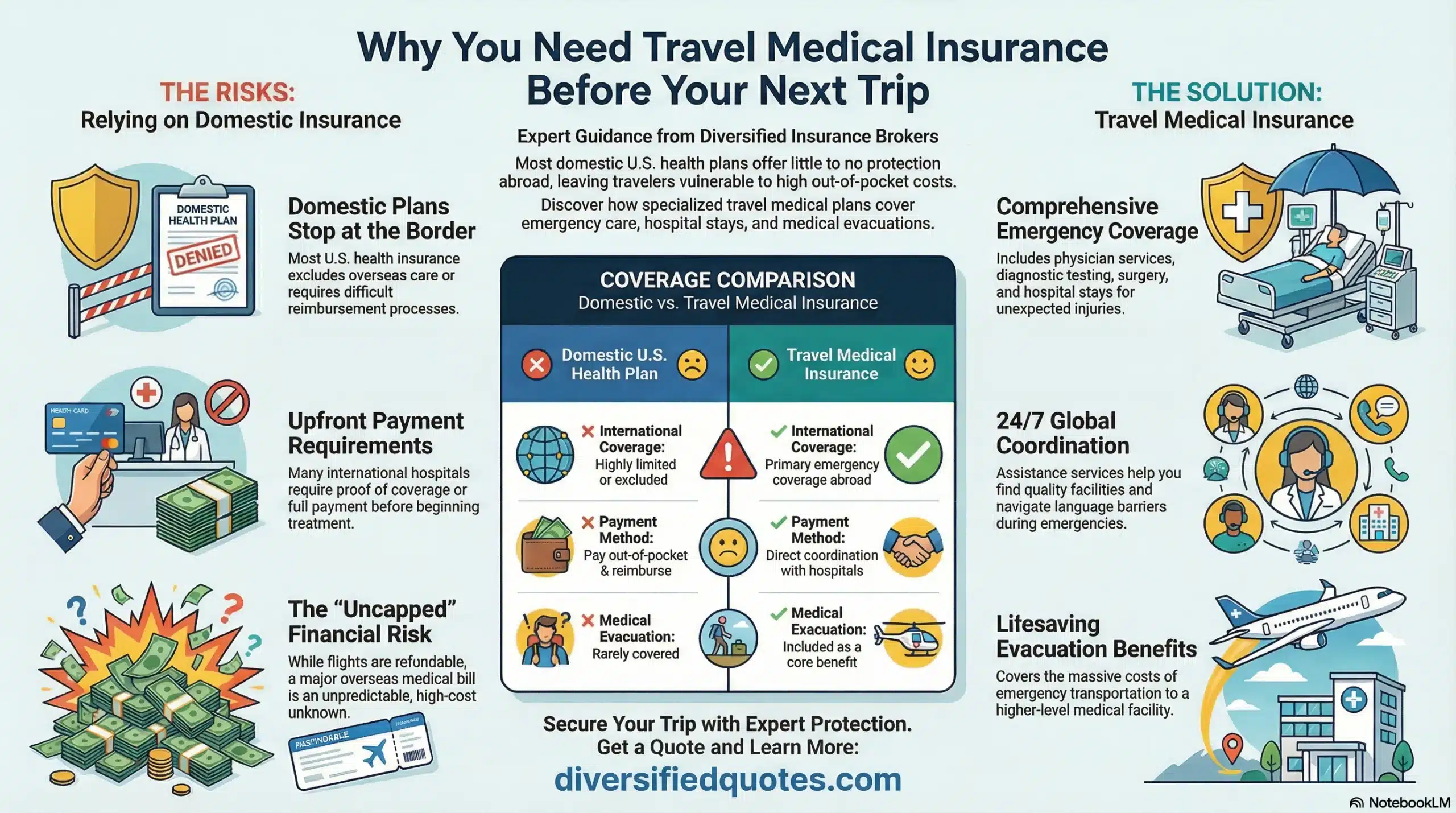
Most domestic US health plans provide little or no coverage for medical treatment received outside the United States. Plans that do offer some international benefit typically limit coverage to emergency events at high cost-sharing levels, require the student to pay upfront and submit a reimbursement claim afterward, and do not include the coordination assistance or evacuation benefits that make international medical events manageable. International providers frequently require payment at the point of service before treatment proceeds, which means a student without dedicated international travel medical coverage may face payment demands at a clinic or hospital without a practical mechanism to meet them. Travel medical insurance designed for international study is the practical protection layer that fills this gap.
What should I look for in a study abroad travel medical plan beyond basic medical coverage?
Beyond emergency medical benefits, the most important features to confirm for study abroad coverage are: emergency medical evacuation limits and whether the plan includes real-time coordination assistance rather than just financial reimbursement; geographic scope that covers weekend and break travel to countries outside the host country; policy date alignment with the full travel window including arrival, orientation, and post-program travel days; pre-existing condition terms including the lookback window and what stable-condition rules do or do not cover; mental health benefit inclusion and level; and activity coverage that aligns with what the student will actually do during the program — recreational sports, hiking, adventure activities, and local transportation that may be excluded under standard plan terms.
When should a student choose international health insurance instead of travel medical insurance for studying abroad?
Travel medical insurance is typically the right choice for students on semester, year-long, or defined exchange programs with clear return dates whose primary need is protection against unexpected illness, injury, and evacuation costs. International health insurance is more appropriate when the student is pursuing a full multi-year degree program abroad and will be living internationally for an extended period without a clear return date, when the student has ongoing health conditions that require routine or specialist care access rather than only emergency coverage, or when the destination’s healthcare system requires a more comprehensive coverage structure to access appropriate care consistently. A practical test: if the program has a defined end date and the student’s primary concern is unexpected medical events, travel medical is usually the correct category. If the student is effectively relocating internationally and needs ongoing health plan functionality, international health insurance is the better fit.
Can students with pre-existing health conditions get adequate travel medical coverage for studying abroad?
Yes — students with pre-existing conditions can and should obtain travel medical coverage, but confirming the specific pre-existing condition terms of any plan before purchasing is essential for having accurate expectations about what will and will not be covered during the trip. Many travel medical plans exclude ongoing treatment and care related to conditions that existed before the trip, while providing coverage for all new illnesses and injuries that arise during the program. Some plans offer limited acute-flare coverage for pre-existing conditions that were stable during a defined lookback period — typically 90 to 180 days without new treatment or medication changes. Students with significant ongoing health needs may find that international health insurance provides more appropriate coverage for their specific situation by including chronic condition management that travel medical plans do not offer.
Does travel medical insurance cover mental health needs while studying abroad?
Mental health coverage in travel medical plans varies significantly — some plans include meaningful mental health benefits as part of the standard design, others include very limited coverage, and some do not include it at all. Studying abroad can be emotionally and psychologically challenging in ways that increase the relevance of mental health coverage for many students: cultural adjustment, social isolation, academic pressure in an unfamiliar system, and distance from family support networks all create genuine mental health risk during extended international study. Because mental health benefit inclusion and depth vary so substantially across plans, this should be an explicit confirmation item rather than an assumed benefit. Families for whom mental health coverage is a priority should confirm it is explicitly included before purchasing rather than discovering the exclusion during a difficult moment abroad.
About the Author:
Jason Stolz, CLTC, CRPC, DIA, CAA and Chief Underwriter at Diversified Insurance Brokers (NPN 20471358), is a senior insurance and retirement professional with more than 25 years of real-world experience helping individuals, families, and business owners protect their income, assets, and long-term financial stability. As a long-time partner of the nationally licensed independent agency Diversified Insurance Brokers, Jason provides trusted guidance across multiple specialties—including fixed and indexed annuities, long-term care planning, personal and business disability insurance, life insurance solutions, Group Health, Travel Medical and Evacuation Insurance, and short-term health coverage. Diversified Insurance Brokers maintains active contracts with over 100 highly rated insurance carriers, ensuring clients have access to a broad and competitive marketplace.
His practical, education-first approach has earned recognition in publications such as VoyageATL, and contributions from his agency featured in Kiplinger and GoBankingRates— highlighting his commitment to financial clarity and client-focused planning. Drawing on deep product knowledge and years of hands-on field experience, Jason helps clients evaluate carriers, compare strategies, and build retirement and protection plans that are both secure and cost-efficient. Visitors who want to explore current annuity rates and compare options across multiple insurers can also use this annuity quote and comparison tool.
Explore More Travel Medical Insurance Options: Browse our complete guide to Groups & Specialty Travel Insurance — covering church groups, missionaries, volunteers, students, expats, digital nomads & more.
Last Reviewed: June 17, 2026 |
Reviewed by: Jason Stolz, CLTC, CRPC, DIA, CAA
Chief Underwriter, Diversified Insurance Brokers, Inc. | NPN: 20471358 | Diversified Insurance Brokers, Inc. — Licensed in all 50 states
Fact Checked by: Tonia Pettitt, CMIP©
Medicare Specialist, Diversified Insurance Brokers, Inc. | NPN: 14374308 | Diversified Insurance Brokers, Inc. — Licensed in all 50 states
Did you find this content helpful? Leave us a Google review — it helps others find trustworthy guidance too.
Editorial Standards: Diversified Insurance Brokers maintains rigorous editorial standards to ensure accuracy, clarity, and independence in all content. Learn more about our editorial standards and commitment to transparency.
