
Travel Medical and Evacuation from Vietnam
Travel Medical and Evacuation from Vietnam

Jason Stolz CLTC, CRPC, DIA, CAA
Travel medical and evacuation coverage for Vietnam is designed to solve two practical problems: paying for eligible emergency medical care while abroad, and coordinating the logistics of what happens next if you need a higher level of care, a long-distance transfer, or a medically supervised return home. Vietnam is a popular destination for multi-city tours, food-focused travel, beach trips, and extended stays — often with significant movement between regions and a mix of urban and rural environments within a single itinerary. That travel style creates a specific coverage need, because the risk in Vietnam is not that the destination is inherently dangerous — it is that unexpected health issues and logistical complexity can arise anywhere, and having an organized way to handle care, language barriers, transportation, and documentation makes a material difference in how manageable an unexpected event becomes. At Diversified Insurance Brokers, we help travelers compare plan designs so they can match coverage to the trip they are actually taking — whether that is a short vacation, a multi-week tour, a study-abroad itinerary, or a longer stay with frequent regional travel. The goal is avoiding both too little coverage that leaves meaningful gaps and paying for features that do not match the realistic risk profile of the specific trip.
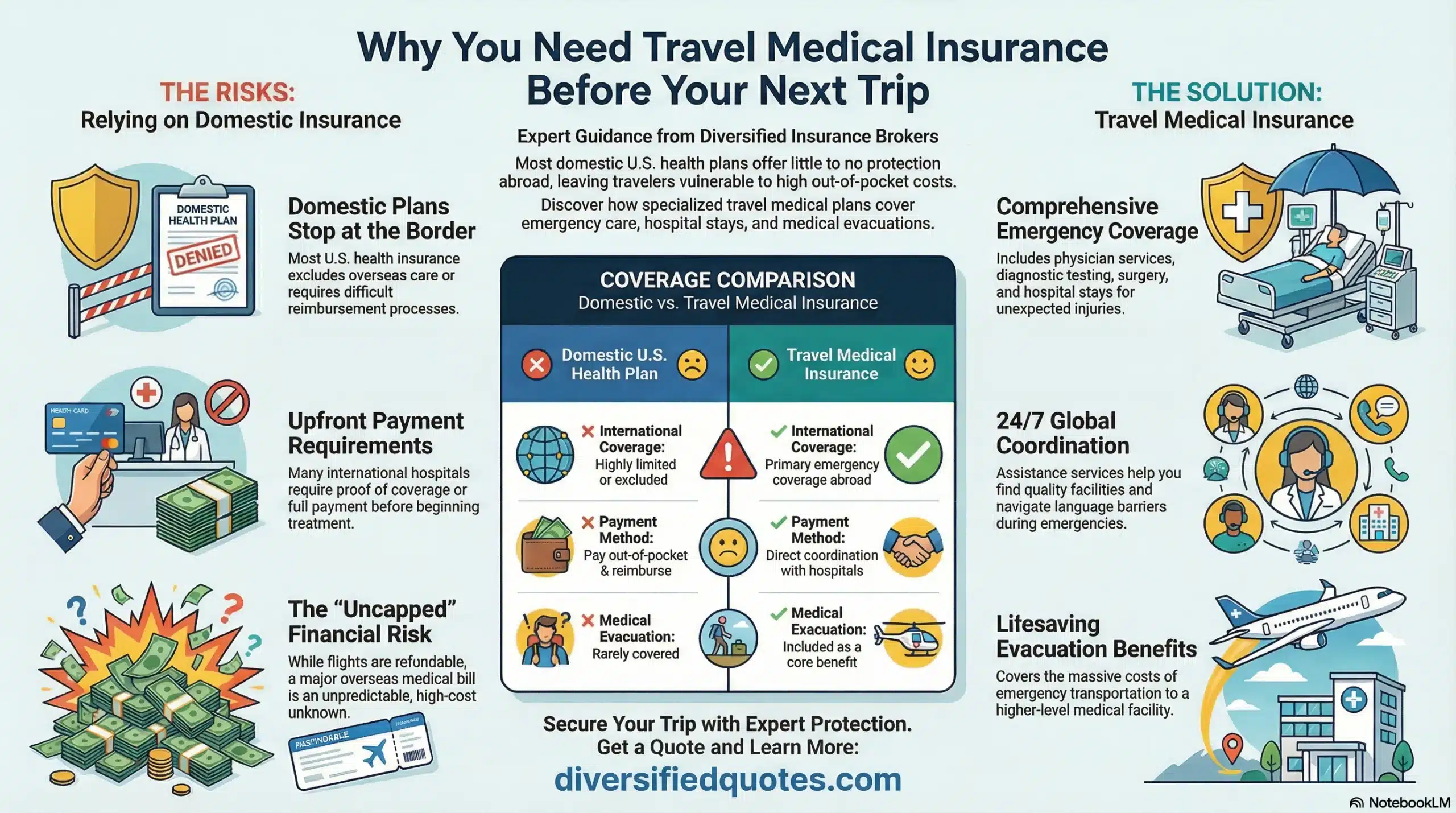
Many travelers assume their domestic health insurance will follow them internationally and provide meaningful protection abroad. In practice, most U.S. domestic health plans provide limited or no coverage for medical treatment received outside the United States. Even when some out-of-network international benefit exists, it typically does not solve the bigger practical problem: finding care quickly, coordinating everything when you are unfamiliar with the local system, navigating language differences, and managing the documentation trail that follows a major claim. A dedicated travel medical plan is built specifically for short-term international needs, with assistance services that help locate treatment, coordinate evacuation when necessary, and guide the process from initial care through resolution. What is the primary reason people buy travel medical insurance covers the core risk calculation that drives the coverage decision for international travelers — useful context before evaluating specific plan options for Vietnam. Emergency medical evacuation insurance covers how evacuation works in detail — what triggers it, how medical necessity is determined, why coordination matters as much as the financial limit, and what travelers should confirm before purchase.
Compare Travel Medical Options for Vietnam
If you want a plan that can cover eligible emergency care and help coordinate evacuation logistics, start here.
View Plans & PricingWhy Vietnam Trips Create Unique Coverage Needs
Vietnam travel frequently involves multiple cities and regions within a single itinerary — Hanoi to Ha Long Bay, Hoi An to Da Nang, Ho Chi Minh City to the Mekong Delta, plus day trips, overnight trains, and excursions that move travelers between environments with varying proximity to medical facilities. More movement creates more opportunities for small issues to become complicated ones: dehydration from heat and long walking days, food-related illness from water or street food exposure, respiratory infections from crowded transit and climate shifts between air-conditioned vehicles and outdoor environments, injuries from scooters or uneven walking surfaces, or simple timing problems like a fever the day before an internal flight that disrupts the rest of the itinerary. Even when the medical issue itself is clinically straightforward, the logistics are not — particularly when you are in an unfamiliar city, do not speak Vietnamese, and need to make rapid decisions about where to go and how to pay.
Coverage for Vietnam is typically evaluated in two layers. The first is emergency medical coverage, which addresses eligible expenses for urgent care visits, emergency room treatment, diagnostic testing, hospitalization, and other treatment costs that arise from unexpected illness or injury during the trip. The second is evacuation support, which coordinates transport to a better-equipped facility or arranges medically supervised transfer when local options are not sufficient for the patient’s condition. These two layers work together rather than independently — the medical benefit addresses costs at the initial point of care, while the evacuation benefit addresses the pathway to appropriate care when the initial point is insufficient. International travel health coverage covers the full range of international medical protection options and how they are structured for different trip types. High-risk travel insurance covers the coverage considerations for travelers whose Vietnam itinerary includes more remote destinations or higher-risk activities where standard plan designs may not be fully adequate. Travel and medical insurance for high-risk travel provides the deeper planning framework for travelers whose trip profiles create elevated coverage requirements beyond standard vacation travel.
Vietnam Travel Medical: Coverage Structure and Key Considerations
| Coverage Factor | Vietnam-Specific Context | What Adequate Coverage Provides | Common Gap Without Coverage |
|---|---|---|---|
| Emergency medical treatment | Major cities have international-standard hospitals and private clinics that provide high-quality care but charge international patient rates; outside major cities, quality and capability vary significantly | Pays eligible expenses for urgent care, ER treatment, diagnostics, hospitalization, and prescriptions; may include direct-pay coordination with international hospitals to avoid upfront payment demands | Full out-of-pocket costs at international hospitals that charge significantly higher rates than local facilities; upfront deposit demands before treatment proceeds |
| Evacuation coordination | International-standard hospitals are concentrated in Hanoi and Ho Chi Minh City — travelers in central Vietnam, rural areas, or smaller cities may be far from specialist care when an event occurs | 24/7 assistance team coordinates transport to the nearest appropriate facility — in Vietnam this may mean transfer to a major city, or in serious cases evacuation to Bangkok, Singapore, or another regional hub | Traveler or family independently arranging medical transport without institutional relationships, regional knowledge, or authority to negotiate receiving facility admission |
| Language and navigation support | English proficiency varies significantly at Vietnamese medical facilities — navigating admission, diagnosis communication, and billing in Vietnamese creates practical barriers during a medical emergency | Assistance team provides translation support, helps communicate with local providers, identifies appropriate facilities, and guides the traveler through the local healthcare navigation process | Traveler navigating a medical system in an unfamiliar language without support, risking miscommunication about symptoms, diagnosis, and treatment consent |
| Multi-city itinerary risk | Multiple transit legs, overnight transport options, and frequent movement between cities create more opportunities for health events and more complex logistics when they occur | Coverage that applies throughout the trip regardless of which city or region the event occurs in, with assistance team availability at any hour to manage events during transit or in unfamiliar locations | Health event occurring between cities — on a train, overnight bus, or during a day trip — with no clear access to the assistance infrastructure that would otherwise guide next steps |
| Pre-existing condition clarity | Pre-existing condition definitions and lookback periods vary by carrier — travelers with health history who purchase without reviewing these terms risk claim denial for the events most likely to affect them | Plans with clearly defined pre-existing condition terms reviewed before purchase; acute-flare coverage for stable conditions when stability requirements are met; full coverage for all new conditions arising during the trip | Claim denial for the health event most likely to affect the specific traveler, leaving them with full out-of-pocket costs for both treatment and any evacuation required |
Travel Medical vs. Evacuation Coverage: The Practical Difference
Travel medical coverage is about treatment. It addresses eligible medical expenses — urgent care visits, emergency room treatment, laboratory testing, diagnostic imaging, inpatient hospitalization, and prescription medications — that arise from sudden illness or injury during the covered trip period. When comparing travel medical plans, the key evaluation points are the benefit limits, how deductibles apply to different types of claims, what the plan defines as an eligible emergency, and how the claims process works when you pay out of pocket at an international facility.
Evacuation coverage is about transport and coordination. It activates when the best clinical outcome for the patient requires moving them — to the nearest appropriate facility capable of treating their condition, or home under medically supervised conditions when treatment is complete and repatriation is medically appropriate. In Vietnam, evacuation scenarios most commonly involve transfer from a smaller-city or rural facility to Hanoi or Ho Chi Minh City, or in more serious cases, air ambulance evacuation to Bangkok, Singapore, or another regional hub with higher specialty medical capability. The best plans include coordination services that go beyond transport arrangements — communication with the receiving facility, records transfer, logistics for travel companions when a medical event disrupts the entire group’s itinerary, and real-time guidance for the traveler and their family about what to expect and what to do next.
One detail that travelers frequently misunderstand: evacuation is not a benefit you can use because you would prefer to be treated at a different facility or because you want to return home sooner than your itinerary planned. Evacuation is tied to medical necessity, determined in coordination with treating physicians and the plan’s assistance team, and executed when the clinical determination is that appropriate care for the patient’s condition is not available at the current location. Understanding this distinction before departure — rather than discovering it during an emergency — prevents the most consequential misunderstanding travelers encounter about this coverage. How to get the best travel medical insurance rates covers the comparison methodology that produces the most appropriate and cost-efficient plan for a given destination and trip profile. Emergency travel health insurance for foreign nationals covers the coverage considerations for international visitors to Vietnam — or travelers whose citizenship creates different coverage needs than US-based travelers.
How to Choose Coverage Limits for Vietnam
The right coverage limits for a Vietnam trip depend on several factors specific to each traveler’s situation rather than a single universal recommendation. A healthy traveler on a short Vietnam vacation centered on major cities may prioritize a clean plan design with reasonable medical limits and straightforward claims handling. A traveler with known health history, a longer itinerary with significant time in more remote regions, or an activity plan that includes motorbike travel, trekking, or water activities may lean toward higher medical limits and stronger evacuation support because the realistic worst-case cost exposure is higher in those scenarios. The correct approach is to match the plan to the actual risk exposure: how long you are gone, how remote the itinerary takes you from major-city hospitals, what activities you will undertake, and how much financial exposure you want to protect against in a serious emergency.
Travelers at older ages benefit from reviewing coverage options specifically designed for age-based eligibility thresholds and the practical support needs that matter more as health complexity increases with age. Travel medical insurance for seniors covers which plan structures tend to be more practical when it comes to documentation, coordination support, and pre-existing condition provisions for older travelers. For travelers with flexible lifestyles — remote work arrangements, frequent international travel, or extended stays that may shift in duration — plan structure and coverage continuity matter more than headline premium because the risk of coverage gaps caused by shifting dates and locations is a realistic concern. Travel insurance for digital nomads covers the coverage continuity considerations and how to avoid the gaps that arise when short-term plans are purchased for trips whose length and structure change after initial planning. Travel medical insurance for studying abroad covers the specific requirements and coverage considerations for students on exchange programs, semester abroad itineraries, or academic travel that includes Vietnam as a destination — including the institutional requirements that many programs specify for minimum coverage levels.
Ready to Compare Plans for Vietnam?
Choose dates, compare options, and select a plan that fits your trip length and travel style.
Compare Plans NowWhat the Assistance Team Actually Does
When travelers think about travel insurance, they typically picture a reimbursement product — pay the bill, submit the claim, get some money back. In real-world travel medical emergencies, and especially in Vietnam where language barriers, unfamiliar facilities, and regional travel create practical navigation challenges, the assistance team’s operational role is often the most valuable component of the coverage package. The assistance team helps you identify appropriate care when you do not know which facility in an unfamiliar city is most capable of treating your condition. It helps coordinate payment arrangements so you can access care without producing the full cost upfront. It provides translation support so medical communication is accurate rather than improvised. It guides you through the documentation process so claims can be processed efficiently rather than reconstructed after the fact. And when the clinical situation requires evacuation, it initiates and coordinates that process rather than leaving the traveler or their family to manage it independently.
The most useful mental model for travel medical coverage in Vietnam is not “insurance that reimburses bills” but rather “benefits plus a navigation system for the situation.” The financial benefit matters because medical costs at international standard facilities in Vietnam are meaningful and because evacuation costs can be substantial. The navigation benefit matters because decisions during a medical emergency in an unfamiliar country under time pressure are more effective when made with professional institutional support rather than improvised under stress. Emergency travel health insurance covers the emergency-focused international medical coverage option for travelers whose primary concern is protection against unexpected events rather than comprehensive ongoing care access. International health insurance covers the longer-term alternative for travelers who will be in Vietnam for extended periods where a more comprehensive ongoing health plan is more appropriate than a short-term emergency-focused product. Travel medical insurance for large groups covers the structural considerations for tours, group programs, and organized travel to Vietnam where multiple travelers need consistent coverage and coordinated response capability in the event of a group member’s medical event.
Common Vietnam Scenarios Where Coverage Creates Practical Value
Stomach illness and dehydration are among the most common reasons travelers seek care in Vietnam. Travel changes routine in ways that increase gastrointestinal risk — food and water exposure, heat and physical exertion on long walking days, dietary changes from home, and the cumulative fatigue of a multi-city itinerary. Even mild illness can derail a trip if it requires IV fluids, prescription medication, diagnostic testing to rule out more serious infection, or simply a day of care before the traveler can safely board the next internal flight. Having coverage that addresses these clinically routine but logistically significant events creates meaningful practical value even when the scenario never escalates to hospitalization.
Respiratory infections are a consistent pattern for Vietnam travelers given crowded transit options, long-haul flights, air conditioning and outdoor temperature differentials, and the respiratory exposure that comes from high-traffic urban environments. A respiratory infection that starts as a minor inconvenience can require physician evaluation, prescription treatment, and in some cases short hospitalization when it progresses — all of which generate costs that accumulate quickly at international-standard private clinics. Injuries during transit, excursions, and everyday movement create a distinct category of care need in Vietnam: scooter accidents are common for travelers renting bikes in smaller cities, uneven sidewalks and wet surfaces create fall risks during rainy season, and day trips and trekking activities add physical injury exposure to the standard vacation risk profile. Imaging, orthopedic evaluation, and follow-up care after these events require structured coverage to manage efficiently. For travelers who will be in Vietnam for purposes beyond tourism, the coverage considerations expand further. Travel medical insurance for volunteer groups covers the coverage design considerations for organized service and volunteer travel programs operating in Vietnam. Travel insurance for humanitarian aid workers covers the specific coverage and assistance coordination requirements for travelers whose Vietnam work involves medically constrained environments where the assistance team’s operational capability matters even more than it does for standard tourism. Travel medical insurance for religious groups covers the considerations for faith-based group travel to Vietnam including how group coverage can be structured for coordinated organizational deployment.
Pre-Existing Conditions, Multi-Country Itineraries, and Claims Documentation
Pre-existing condition rules are among the most consequential and most misunderstood aspects of travel medical coverage for Vietnam and every other international destination. Different carriers define pre-existing conditions differently, and plans have varying lookback periods — the window before the trip during which a condition must have been stable without new treatment, diagnosis, or medication changes for acute-flare coverage provisions to apply. Travelers with meaningful medical history should review the specific pre-existing condition language of any plan they are evaluating and confirm exactly how their history interacts with those terms before purchasing, rather than discovering a consequential exclusion during a claim. The right plan for a traveler with complex health history may differ from the right plan for a healthy traveler even when the destination and trip length are identical — and that difference is worth understanding before departure rather than after.
Many Vietnam itineraries extend to neighboring destinations — regional stopovers, multi-country tours combining Vietnam with Thailand, Cambodia, Laos, or Indonesia, or repositioning flights through major hubs like Singapore or Bangkok. Most travel medical plans cover multi-country travel as long as coverage dates and geographic territory rules align with the full itinerary, but travelers should confirm this explicitly rather than assuming worldwide territory applies when it may not. Travelers building multi-stop itineraries that include Vietnam alongside other Southeast or East Asian destinations may find additional planning context in destination-specific pages for those countries. Claims handling becomes most efficient when documentation is treated as part of the process rather than an afterthought — itemized invoices, proof of payment, clinical notes from the treating facility, and any diagnostic reports should be obtained while you are still at the facility rather than reconstructed later. The most common claims frustration is not that coverage was absent but that the traveler did not collect the specific documentation the plan requires while they were still positioned to obtain it easily. Travel medical and evacuation from Australia, travel medical and evacuation from Spain, and travel medical and evacuation from Italy cover the coverage considerations for Western-standard destinations that are commonly paired with Vietnam on longer multi-country itineraries — useful reference points for understanding how coverage needs shift across different destination types within the same trip. Short-term and travel medical resource hub provides the comprehensive library of travel medical content for travelers who want to build a complete understanding of how these products work across different destination and trip-type contexts.
Get Covered Before You Depart
Lock in coverage dates that match your Vietnam itinerary and choose the plan features you actually need.
View Plans & ApplyRelated Travel Medical Pages
Use these to compare plan types, understand evacuation benefits, and match coverage to your travel style.
Related Destination Pages
If you are building a multi-stop itinerary, these pages help you compare destination-specific considerations.
Talk With an Advisor Today
Choose how you’d like to connect—call or message us, then book a time that works for you.
Schedule here:
calendly.com/jason-dibcompanies/diversified-quotes
Licensed in all 50 states • Fiduciary, family-owned since 1980
Frequently Asked Questions: Travel Medical and Evacuation Insurance for Vietnam
Does Vietnam have good hospitals? Do I still need travel medical insurance?
Vietnam’s major cities — Hanoi and Ho Chi Minh City — have international-standard private hospitals that provide high-quality care, and the quality of healthcare infrastructure continues to develop. However, quality varies significantly between major cities and smaller cities or rural areas, and even at high-quality private facilities, costs for international patients are substantial and often require upfront payment or payment guarantees before proceeding with care. Travel medical insurance addresses both the cost dimension and the practical navigation dimension — most travelers do not know which facility in an unfamiliar city is most appropriate for their specific condition, how to communicate effectively in Vietnamese during a medical emergency, or how to manage the administrative process at an international hospital. The coverage provides both the financial protection and the assistance infrastructure that makes navigating care in Vietnam practical rather than improvised.
If I need evacuation from Vietnam, where would I be taken?
Evacuation destinations from Vietnam depend on the patient’s clinical condition and the treatment capabilities required. Within Vietnam, evacuation commonly involves transfer from a smaller city or rural area to Hanoi or Ho Chi Minh City, which have the most capable medical facilities in the country. For conditions requiring specialty care beyond what is available in Vietnam — advanced cardiac surgery, complex neurological intervention, or other high-specialty needs — evacuation to Bangkok, Thailand or Singapore is most common, as both destinations have extensive specialty medical capability, established medical tourism infrastructure, and regular air connections from Vietnam’s major airports. The specific destination is determined by the patient’s clinical needs and available transport options, not by geographic proximity or patient preference.
Does my coverage work if I get sick on a day trip to Ha Long Bay or in a rural area?
Yes — travel medical coverage applies wherever the covered event occurs during the covered trip period, including on day trips, overnight excursions, and in rural or remote areas of Vietnam. The geographic scope of the coverage is defined by the policy’s covered territory — which for international travel plans typically covers worldwide destinations outside the home country — not by proximity to major city facilities. If you are in a location with limited immediate care options, contacting the assistance team early allows them to help you identify the nearest appropriate facility, coordinate transport if necessary, and manage the logistics of reaching appropriate care from a starting point that may not have ideal medical infrastructure.
What documentation should I collect if I receive medical care in Vietnam?
The most important documentation to collect at the time of care includes itemized invoices showing specific charges for each service provided, proof of payment for any amounts you pay out of pocket, any clinical notes or discharge summaries from treating physicians, diagnostic reports and imaging results tied to the covered event, and the name and address of the treating facility. Obtaining this documentation while you are still at the facility — or before you leave the city where you received care — is significantly easier than attempting to reconstruct it after moving on to the next destination or returning home. If you contact the assistance team during the event, they can advise you on exactly what documentation your specific plan will need for claims processing, which eliminates guessing and reduces the risk of missing a required item.
Can I get travel medical insurance for Vietnam if I am already there?
Some carriers offer coverage to travelers who are already in Vietnam, though options are more limited than purchasing before departure. Plans purchased after arrival may include waiting periods before coverage becomes effective, may exclude conditions that developed after the original departure date, and may carry higher premiums than pre-departure plans offering equivalent coverage. The most comprehensive options — including the broadest choice of plan designs, pre-existing condition waiver eligibility where applicable, and the lowest available premiums for a given benefit level — are available when purchased before leaving home. Travelers who find themselves in Vietnam without coverage should contact a travel insurance specialist promptly to understand what options remain available rather than assuming coverage cannot be obtained.
About the Author:
Jason Stolz, CLTC, CRPC, DIA, CAA and Chief Underwriter at Diversified Insurance Brokers (NPN 20471358), is a senior insurance and retirement professional with more than 25 years of real-world experience helping individuals, families, and business owners protect their income, assets, and long-term financial stability. As a long-time partner of the nationally licensed independent agency Diversified Insurance Brokers, Jason provides trusted guidance across multiple specialties—including fixed and indexed annuities, long-term care planning, personal and business disability insurance, life insurance solutions, Group Health, Travel Medical and Evacuation Insurance, and short-term health coverage. Diversified Insurance Brokers maintains active contracts with over 100 highly rated insurance carriers, ensuring clients have access to a broad and competitive marketplace.
His practical, education-first approach has earned recognition in publications such as VoyageATL, and contributions from his agency featured in Kiplinger and GoBankingRates— highlighting his commitment to financial clarity and client-focused planning. Drawing on deep product knowledge and years of hands-on field experience, Jason helps clients evaluate carriers, compare strategies, and build retirement and protection plans that are both secure and cost-efficient. Visitors who want to explore current annuity rates and compare options across multiple insurers can also use this annuity quote and comparison tool.
Explore More Travel Medical Insurance Options: Browse our complete guide to Europe, Asia & Pacific Travel Medical Insurance — covering medical evacuation coverage for Europe, Asia, Australia & Pacific destinations.
Last Reviewed: June 17, 2026 |
Reviewed by: Jason Stolz, CLTC, CRPC, DIA, CAA
Chief Underwriter, Diversified Insurance Brokers, Inc. | NPN: 20471358 | Diversified Insurance Brokers, Inc. — Licensed in all 50 states
Fact Checked by: Tonia Pettitt, CMIP©
Medicare Specialist, Diversified Insurance Brokers, Inc. | NPN: 14374308 | Diversified Insurance Brokers, Inc. — Licensed in all 50 states
Did you find this content helpful? Leave us a Google review — it helps others find trustworthy guidance too.
Editorial Standards: Diversified Insurance Brokers maintains rigorous editorial standards to ensure accuracy, clarity, and independence in all content. Learn more about our editorial standards and commitment to transparency.
