
Travel Medical and Evacuation from Senegal
Travel Medical and Evacuation from Senegal

Jason Stolz CLTC, CRPC, DIA, CAA
Senegal occupies a distinctive position on West Africa’s Atlantic coast as one of the region’s most politically stable and internationally connected countries, with Dakar functioning as a genuine regional hub for air travel, commerce, diplomacy, and humanitarian operations across francophone West Africa. That regional hub status means the country attracts an unusually diverse range of international travelers: tourists exploring the colonial architecture of Saint-Louis and the Île de Gorée slave memorial, beach travelers at Saly and Cap-Skirring, pilgrims attending the Magal de Touba — one of the world’s largest annual religious gatherings — business travelers working through Dakar’s commercial infrastructure, volunteers and NGO workers deployed across rural districts from Casamance to the Saloum Delta, and long-term expatriate residents connected to the international organization ecosystem that Dakar hosts as a regional center. Across all of these purposes, the travel-health planning question is the same: Senegal’s position as a regional hub means that Dakar has meaningfully better medical infrastructure than most of its neighbors — but that infrastructure still falls well short of what complex specialty care requires, and outside Dakar the gap between available care and required care for a serious medical event is significant and real. Travel medical and evacuation insurance from Senegal is the coverage framework designed to close that gap with financial protection and professional coordination rather than improvised response when an emergency occurs.
At Diversified Insurance Brokers, we help travelers match plan design to the real-world conditions of their specific Senegal itinerary — which can vary enormously between a five-day Dakar business trip and a three-month Casamance community development assignment. The same destination creates very different coverage priorities depending on where within Senegal the traveler will be, how long they will be there, what activities the itinerary involves, and how far they are from the best available care at any given point in the trip. Dakar’s private hospital sector — including the Clinique du Cap, Clinique de la Madeleine, and a number of specialist practices — provides meaningful emergency care capability compared to most of West Africa, but “better than neighbors” is not the same standard as “adequate for complex cardiac surgery, advanced neurological intervention, or sustained ICU management.” Outside Dakar, the infrastructure gap grows rapidly. Saint-Louis in the north has limited private clinic access. Casamance in the south, geographically separated from the rest of Senegal and historically affected by low-level conflict dynamics, has significantly constrained healthcare resources relative to its geographic isolation. The interior Sahel regions have sparse infrastructure. Emergency medical evacuation insurance covers the mechanics of evacuation coverage in detail. High-risk travel insurance covers specialized coverage options for destinations with elevated risk profiles. Travel and medical insurance for high-risk travel covers the broader planning framework for complex destinations where the care pathway and the assistance team’s operational capability are primary determinants of real-world protection value.
Protect Your Health While Visiting Senegal
Apply now for travel medical and emergency evacuation coverage before your trip to Senegal.
Why Travel Medical and Evacuation Coverage Matters in Senegal
The urban-rural gap in Senegal’s healthcare infrastructure is one of the most consequential factors for travel medical planning, and it is larger than most travelers from developed countries intuitively expect. Dakar’s private clinic sector handles routine emergencies and provides a reasonable first response for acute illness and injury — but the moment a condition requires advanced specialty intervention, complex surgical capability, sustained ICU monitoring, or specific specialist availability that is not consistently present, the practical response becomes a referral outside the country rather than a transfer to a higher-level Dakar facility. Senegal does not have the same density of specialty hospital infrastructure that major evacuation destination cities like Paris, Casablanca, or Accra provide, and for the most complex medical events, evacuation to those destinations is the care pathway. Outside Dakar, the picture changes more dramatically: Saint-Louis, Thiès, Ziguinchor, and the regional capitals have government hospitals and some private clinic access that provide basic stabilization and routine care, but limited capability for advanced diagnostics, complex surgery, or intensive monitoring. Rural areas in the Groundnut Basin, the Saloum Delta, the Ferlo pastoral region, and the Casamance forest zones may have small health posts and basic clinic access at best.
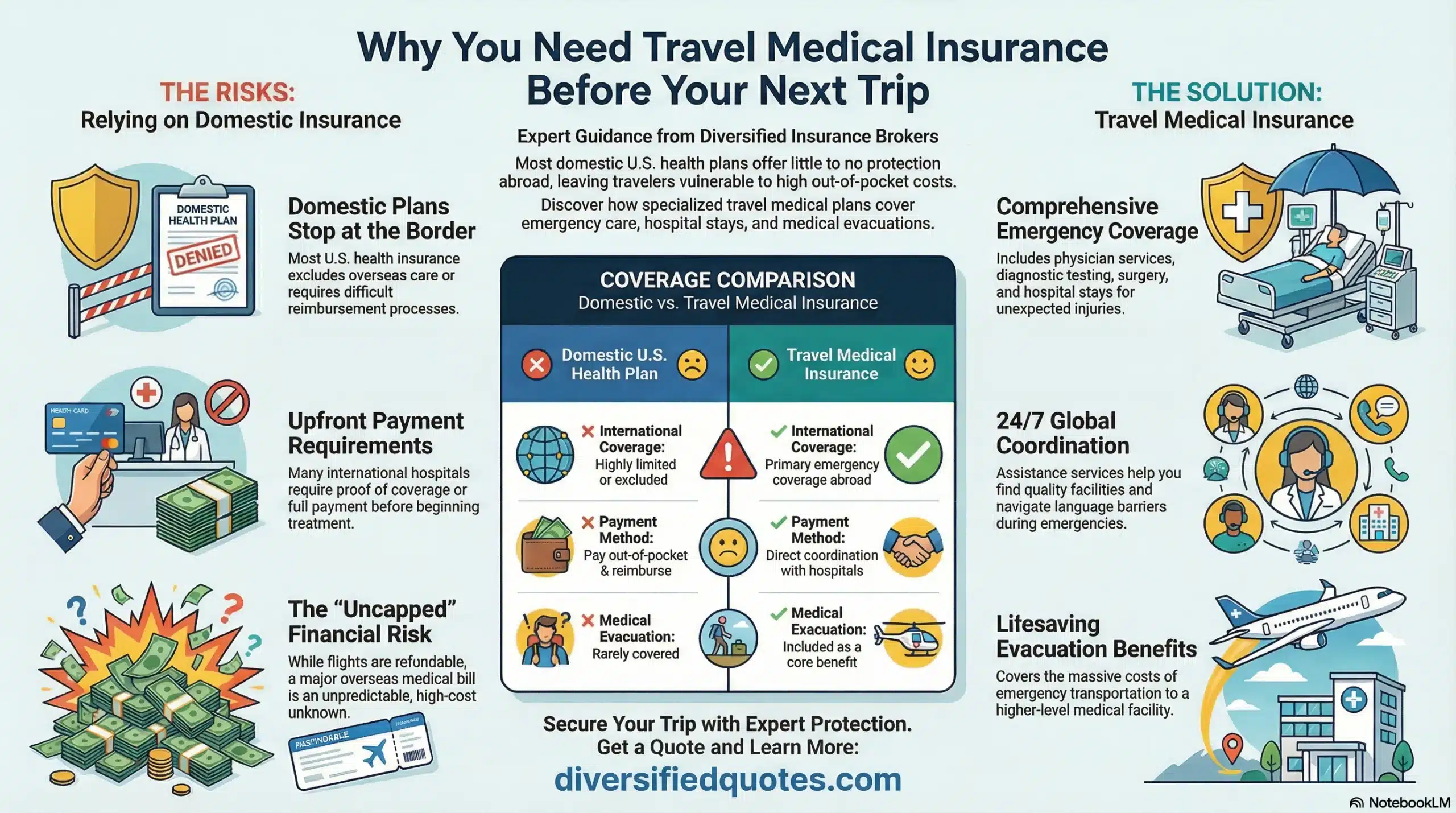
Evacuation costs in West Africa are meaningful and can be financially catastrophic without coverage in place. A medically supervised evacuation from Dakar to Paris, Casablanca, or Abidjan involving air ambulance transport, a medical crew, receiving facility coordination, and continuing care at the destination can reach $50,000 to $100,000 or more in a single serious event. From locations outside Dakar, the multi-leg evacuation — ground transport to Dakar, staging at the airport, international air transport — adds cost and time to the baseline. Beyond the financial dimension, the operational complexity of a medical evacuation that the traveler or their family must manage independently under time pressure is the more immediate practical concern: identifying the receiving facility, confirming acceptance, arranging transport, managing medical documentation in French at a time of stress, and making clinical routing decisions that require institutional knowledge most individuals do not have. The assistance team that accompanies a quality travel medical plan is the institutional infrastructure that manages that entire process. What is the primary reason people buy travel medical insurance covers the risk assessment framework that underlies coverage decisions for international travelers across different destination risk levels.
Senegal Travel Medical: Coverage Priorities by Itinerary
| Senegal Location / Traveler Type | Medical Access Reality | Most Important Coverage Priority | Primary Evacuation Destination |
|---|---|---|---|
| Dakar — business / tourism / short-stay | Best available private clinic access in Senegal; Clinique du Cap, Clinique de la Madeleine handle routine emergencies; limited for complex specialty care, advanced surgery, sustained ICU | Emergency medical limits for Dakar private care; evacuation coverage for events requiring specialty care outside Senegal; strong assistance team with French-language Dakar operational familiarity | Paris as primary for complex specialty care given historical French-Senegalese medical relationships; Casablanca for North Africa routing; Abidjan for some West African regional cases |
| Saint-Louis / northern Senegal | Regional hospital and limited private clinic access in Saint-Louis; near-desert Sahel environment northward; distance from Dakar specialty resources; proximity to Mauritania creates multi-country itinerary considerations | Evacuation coordination from Saint-Louis region to Dakar for intermediate care or directly to Paris for serious events; assistance team capability for French-language coordination in northern Senegal | Dakar as first staging point; Paris or Casablanca for specialty care depending on clinical requirements and transport availability |
| Casamance — tourism / NGO field work | Geographically separated from northern Senegal by The Gambia; Ziguinchor has regional hospital; limited specialty access; remote Cap-Skirring and forested zones have minimal healthcare infrastructure; historically affected by low-level conflict | Evacuation capability from Ziguinchor Airport or Cap-Skirring; assistance team familiar with Casamance geographic isolation logistics; higher evacuation limits appropriate for this region | Dakar via direct flight from Ziguinchor Airport as first stage; onward to Paris or Abidjan depending on specialty requirements |
| Saloum Delta / eco-tourism | Remote coastal wetland environment; limited clinic access in Fatick region; boat-based travel adds complexity to emergency logistics; distance from Dakar is manageable but road conditions vary | Coverage for boat and water activity-related incidents; evacuation coordination from remote coastal locations; assistance team with Saloum Delta logistics awareness | Ground or boat transport to nearest road access; then Dakar as staging point; onward evacuation based on condition and specialty requirement |
| Touba / Magal pilgrimage | Touba during Magal is one of the world’s largest mass gatherings — healthcare resources in the city are significantly strained during the event; crowd density creates injury and illness exposure; Touba is 3 hours from Dakar | Assistance team availability during major event healthcare strain; evacuation coordination from Touba region; crowd-related injury and illness coverage; emergency medical limits for hospitalization away from Dakar | Dakar as primary receiving point for serious events; specialist referral outside Senegal for conditions exceeding Dakar capability |
How Medical Evacuation Works From Senegal
Medical evacuation from Senegal operates through a structured sequence that the assistance team manages from the moment they are contacted — and early contact is one of the most important steps a traveler can take in a developing medical situation. Initial stabilization at the nearest available facility — whether a Dakar private clinic, a regional government hospital, or a small health post — precedes the assistance team’s clinical assessment of whether the patient’s condition can be adequately managed where they are or whether transfer to a higher-capability facility is medically indicated. For Dakar-based cases that require specialty care beyond what the city’s private clinics can provide, the most common evacuation destination is Paris, which has deep historical and institutional connections to Senegalese medical practice and a receiving hospital network with established evacuation protocols for West African cases. Casablanca is a closer alternative that handles some Senegal cases. Abidjan serves as the primary intra-regional West African referral destination for cases where the clinical requirement can be met regionally rather than requiring European evacuation.
For cases originating outside Dakar, the evacuation sequence often involves a first-stage transfer to Dakar — ground transport from Saint-Louis or Thiès, a direct flight from Ziguinchor Airport for Casamance cases, or coordinated transport from more remote areas — followed by staging at Dakar’s Léopold Sédar Senghor International Airport for the international transport segment. The assistance team manages the entire logistics chain: receiving facility identification and acceptance confirmation, transport arrangement across all segments, medical documentation preparation, French-language communication with treating facilities and receiving hospitals, and coordination with the patient’s employer, organization, or family throughout the process. The cost of a serious multi-leg Senegal evacuation can reach $40,000 to $90,000 or more depending on the specific routing and transport modality required, which is why evacuation limits of $250,000 or more are appropriate planning targets for Senegal travel rather than nominal minimum limits. Travel medical and evacuation from Ivory Coast covers Abidjan — the most common intra-regional evacuation destination from Senegal — and the medical infrastructure context of West Africa’s most developed regional medical hub. Travel medical and evacuation from Morocco covers Casablanca’s role as a North African evacuation hub and the medical infrastructure that handles cases from across West and North Africa. Travel medical and evacuation from Egypt covers another North African regional hub relevant for travelers whose Senegal itinerary is part of a broader Africa journey.
Health Risks, Pre-Existing Conditions, and Who Benefits Most
Senegal’s health risk profile for international travelers includes a meaningful range of tropical and environmental exposures that create realistic illness probability for anyone spending significant time in the country. Malaria is present throughout Senegal including in Dakar, though transmission rates vary significantly between the rainy season (July through October) and the dry season — travelers visiting during rainy season peak transmission face the highest malaria risk and should confirm that their travel medical plan covers malaria treatment including severe malaria complications. Travelers to Casamance and the Saloum Delta face higher malaria transmission rates than Dakar-based travelers. Yellow fever vaccination is required for entry, and hepatitis A, typhoid, and meningococcal vaccination are recommended depending on itinerary and activities. Gastrointestinal illness from food and water exposure is among the most common travel medical claims categories for Senegal travelers — dietary changes, unfamiliar preparation environments in local markets and street food settings, and the physical demands of travel all create GI risk that compounds in a hot climate. Heat illness during the dry season hot months of March through June can affect travelers unaccustomed to extreme temperatures, particularly those engaged in physically demanding outdoor activities.
Pre-existing condition terms require explicit review for Senegal travel — the same way they do for any complex destination — because the claim most likely to require evacuation for a traveler with medical history is also the claim most likely to trigger a pre-existing condition evaluation. Travelers with cardiac history, diabetes, asthma, or other chronic conditions should review the specific pre-existing condition language in the plan under consideration rather than assuming general coverage applies to their specific situation. For travelers whose Senegal assignment involves long-term stays or repeated travel, the comparison between a travel medical plan and a broader international health insurance structure is worth making explicitly. International health insurance covers the longer-term alternative for extended Senegal deployments. Travel medical insurance for large groups covers the structural considerations for organizations deploying multiple staff to Senegal simultaneously — relevant for NGOs, development organizations, and faith-based groups with ongoing Senegal programs. Travel medical insurance for religious groups covers the specific coverage considerations for faith-based group travel — important for Senegal given the significant religious travel context including proximity to Touba and Tivaouane pilgrimage sites. Travel medical and evacuation from Sierra Leone, travel medical and evacuation from Nigeria, and travel medical and evacuation from Niger cover the West African neighbors most commonly combined with Senegal in multi-country itineraries — useful for travelers and organizations managing coverage across multiple regional deployments simultaneously. Travel medical and evacuation from Angola, travel medical and evacuation from Burundi, and travel medical and evacuation from Congo cover other sub-Saharan African destinations where comparable coverage evaluation priorities apply. Travel medical and evacuation from Pakistan and travel medical and evacuation insurance for Afghanistan cover global comparison destinations where assistance team capability and evacuation limit adequacy are similarly the primary coverage determinants. How to get the best travel medical insurance rates covers the comparison methodology for identifying the most appropriate and cost-efficient plan for a given Senegal itinerary and traveler profile. International travel health coverage covers the full product category spectrum for travelers evaluating coverage options across different trip lengths and Senegal-specific deployment profiles. Travel medical and evacuation from Rwanda covers an East African destination often compared with Senegal for humanitarian deployment coverage evaluation.
Get Travel Medical and Evacuation Coverage for Senegal
Apply online in minutes and safeguard your health while in Senegal.
Related Travel Medical Pages
If you are comparing plan types or building a multi-country route, these pages help you line up coverage design with real-world medical access and evacuation needs.
Related Destination Pages
These destination pages help you compare how needs change based on infrastructure, distance to care, and travel logistics.
Talk With an Advisor Today
Choose how you’d like to connect—call or message us, then book a time that works for you.
Schedule here:
calendly.com/jason-dibcompanies/diversified-quotes
Licensed in all 50 states • Fiduciary, family-owned since 1980
Frequently Asked Questions: Travel Medical and Evacuation Insurance for Senegal
Where would a medical evacuation from Senegal typically go?
The primary evacuation destination for complex specialty cases from Senegal is Paris, France — which has deep historical and institutional connections to Senegalese medicine, established evacuation receiving protocols for West African cases, and extensive specialty hospital infrastructure. Casablanca, Morocco is a closer North African alternative with strong specialty hospital infrastructure and direct connections from Dakar. Abidjan, Ivory Coast is the primary intra-regional West African evacuation destination for cases where the clinical requirement can be met at a regional level rather than requiring European evacuation. The specific destination is determined by the patient’s clinical condition and the specialty capability required — the assistance team evaluates these factors and selects the receiving facility best suited to the patient’s needs given current transport options and logistics.
Is Dakar’s medical infrastructure adequate for serious emergencies, or will evacuation always be needed?
Dakar’s private clinic sector — including Clinique du Cap and Clinique de la Madeleine — handles a meaningful range of emergency situations including routine surgical cases, fracture management, acute infections, and many urgent care scenarios. For many serious but not highly complex events, Dakar’s private hospitals can provide appropriate stabilization and treatment. Evacuation becomes medically indicated when the condition requires specialty care that is not consistently available in Dakar: advanced cardiac intervention, complex neurosurgical procedures, sustained ICU monitoring for multi-organ events, specific oncological treatment, or advanced pediatric specialty care. The practical planning principle is that Dakar narrows the gap but does not eliminate it — having evacuation coverage ensures that the decision about whether to treat in Dakar or transfer is made based on clinical necessity rather than financial constraint.
How does coverage work for travel in Casamance versus the rest of Senegal?
Casamance creates specific coverage considerations because of its geographic isolation from northern Senegal — the region is separated from the rest of the country by The Gambia, meaning ground transport to Dakar requires either transiting through Gambia or taking a longer coastal road route. Direct flight connections between Ziguinchor and Dakar via Ziguinchor Airport provide air transport access that significantly reduces the effective distance for evacuation staging. From a medical access perspective, Ziguinchor has a regional hospital and some private clinic access, while rural Casamance areas and the Cap-Skirring beach zone have much more limited resources. Travelers to Casamance should confirm that their plan explicitly covers Casamance and that the assistance team has familiarity with Ziguinchor Airport logistics and the specific routing options available from the region.
Does travel medical insurance cover malaria in Senegal?
Yes — malaria is covered as an acute illness arising during the trip under standard travel medical plans, including severe malaria complications requiring hospitalization and intensive management. The practical concern is ensuring the plan does not contain specific exclusions for illnesses that were foreseeable given the destination — a provision that exists in some plans and matters significantly for Senegal travel where malaria is endemic. Travelers should also confirm that the evacuation benefit can activate for severe malaria cases where local treatment capability is insufficient, particularly for travelers outside Dakar in rural or coastal regions with limited clinic access. Travelers to Casamance during rainy season face the highest malaria transmission rates in Senegal and should plan coverage with this specific risk in mind.
What should I know about coverage for the Magal de Touba pilgrimage?
The Magal de Touba is one of the world’s largest annual mass gathering events, drawing several million pilgrims to Touba — a city approximately three hours from Dakar — in a compressed period. Healthcare infrastructure in Touba is significantly strained during the event relative to the extraordinary population surge, and the combination of crowd density, heat, physical exertion, and the general health exposure of mass gatherings creates elevated illness and injury probability. Travelers attending the Magal should plan for delayed emergency response times, limited immediate care access at the event site, and the practical reality that a serious medical event during the pilgrimage may require ground transport to Dakar for appropriate care. Having the assistance team’s number immediately accessible and engaging them early in any developing situation is especially important during a high-demand event period when healthcare resources are most constrained.
About the Author:
Jason Stolz, CLTC, CRPC, DIA, CAA and Chief Underwriter at Diversified Insurance Brokers (NPN 20471358), is a senior insurance and retirement professional with more than 25 years of real-world experience helping individuals, families, and business owners protect their income, assets, and long-term financial stability. As a long-time partner of the nationally licensed independent agency Diversified Insurance Brokers, Jason provides trusted guidance across multiple specialties—including fixed and indexed annuities, long-term care planning, personal and business disability insurance, life insurance solutions, Group Health, Travel Medical and Evacuation Insurance, and short-term health coverage. Diversified Insurance Brokers maintains active contracts with over 100 highly rated insurance carriers, ensuring clients have access to a broad and competitive marketplace.
His practical, education-first approach has earned recognition in publications such as VoyageATL, and contributions from his agency featured in Kiplinger and GoBankingRates— highlighting his commitment to financial clarity and client-focused planning. Drawing on deep product knowledge and years of hands-on field experience, Jason helps clients evaluate carriers, compare strategies, and build retirement and protection plans that are both secure and cost-efficient. Visitors who want to explore current annuity rates and compare options across multiple insurers can also use this annuity quote and comparison tool.
Explore More Travel Medical Insurance Options: Browse our complete guide to Africa & Middle East Travel Medical Insurance — covering medical evacuation coverage for Africa, Middle East & high risk destinations.
Last Reviewed: June 17, 2026 |
Reviewed by: Jason Stolz, CLTC, CRPC, DIA, CAA
Chief Underwriter, Diversified Insurance Brokers, Inc. | NPN: 20471358 | Diversified Insurance Brokers, Inc. — Licensed in all 50 states
Fact Checked by: Tonia Pettitt, CMIP©
Medicare Specialist, Diversified Insurance Brokers, Inc. | NPN: 14374308 | Diversified Insurance Brokers, Inc. — Licensed in all 50 states
Did you find this content helpful? Leave us a Google review — it helps others find trustworthy guidance too.
Editorial Standards: Diversified Insurance Brokers maintains rigorous editorial standards to ensure accuracy, clarity, and independence in all content. Learn more about our editorial standards and commitment to transparency.
