
Travel Medical and Evacuation from Ivory Coast
Travel Medical and Evacuation from Ivory Coast

Jason Stolz CLTC, CRPC, DIA, CAA
Ivory Coast — Côte d’Ivoire — is West Africa’s most economically dynamic country, a nation whose cocoa-and-coffee agricultural base made it one of the most prosperous countries in sub-Saharan Africa at independence and whose contemporary economy includes a growing financial services sector centered in Abidjan’s Plateau district, significant oil and gas production, an expanding manufacturing sector, and one of West Africa’s largest and most cosmopolitan urban populations. Abidjan is West Africa’s commercial capital in practice if not in political designation — the city’s port is the region’s most active, its financial infrastructure attracts francophone West African business operations, and its international diplomatic and NGO presence makes it a hub for the kind of extended professional stays, contractor assignments, family relocations, and organizational deployments that characterize a significant share of Ivory Coast’s international visitor population. For business travelers and contractors on Abidjan assignment, families living abroad, international students, field workers, NGO teams operating in Ivory Coast’s cocoa and agricultural regions, journalists, and tourists visiting the country’s Abidjan waterfront, Yamoussoukro’s Basilica of Our Lady of Peace, or the coastal towns and national parks of the country’s west, travel medical and evacuation insurance from Ivory Coast is the coverage infrastructure that ensures a serious medical event has a structured, coordinated response rather than an improvised one.
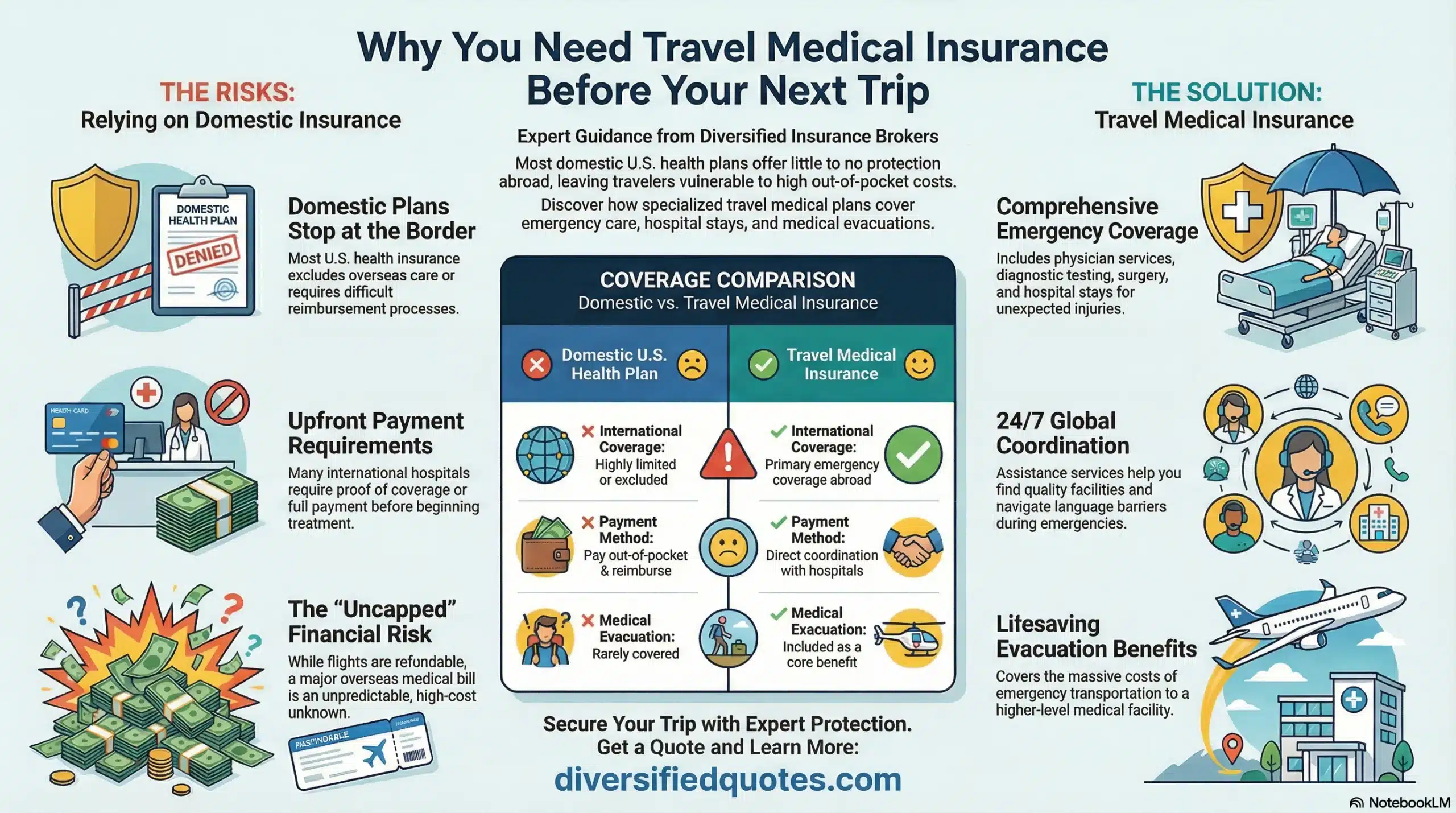
At Diversified Insurance Brokers, we help travelers compare international medical plans that include 24/7 assistance, practical hospital access, and clear evacuation terms — so if something goes wrong, you have a plan that responds quickly, organizes the logistics, and protects against the out-of-pocket costs that can accumulate fast in a serious international medical event. Understanding the right coverage structure for an Ivory Coast trip or assignment starts with understanding what type of plan matches the situation. For longer assignments and expatriate living, our guide to international health insurance covers the ongoing coverage structures appropriate for extended international residency. For shorter travel, our guide to travel medical insurance covers the emergency-focused short-term plan categories. For itineraries that include remote field work, higher-risk environments, or complex multi-country routing, travel and medical insurance for high-risk travel covers how plan design should reflect elevated risk profiles.
Get Travel Medical & Evacuation Coverage for Ivory Coast
Apply online in minutes, or call us if you want help choosing limits that match your trip length, destination mix, and exposure level.
If you’re traveling outside major metro areas or on assignment, build limits assuming evacuation is a real possibility — not a rare one.
Why Travelers in Ivory Coast Prioritize Medical and Evacuation Coverage
Ivory Coast has one of West Africa’s stronger private healthcare infrastructures — Abidjan’s private hospital and clinic sector, anchored by facilities including the Clinique Internationale Sainte Anne-Marie (CISAM), Polyclinique Sainte Marie, and the Centre Hospitalier Universitaire de Yopougon, provides emergency care and specialist access that functions as a genuine regional hub for francophone West Africa. That regional hub status is itself the key indicator of Ivory Coast’s medical reality: Abidjan is where patients from Mali, Burkina Faso, and Guinea are evacuated for higher-level care — which means that for travelers who are already in Ivory Coast, evacuation typically routes not to Abidjan from elsewhere but rather from Abidjan or from regional cities to Dakar or Accra for the specialty events that exceed Abidjan’s current capacity.
For travelers based in Abidjan, the practical coverage issues are similar to other major West African business hubs: financial exposure at private hospital rates that are meaningful for non-resident patients, point-of-service payment requirements that many Ivorian facilities apply to uninsured foreign visitors, the challenge of identifying which facility is most appropriate for a specific clinical situation, and the gap between Abidjan’s best private facilities and what complex specialty events — advanced cardiac surgery, complex neurosurgery, multi-system ICU management — actually require. For travelers who move beyond Abidjan — to the cocoa and agricultural regions of the interior, the western rainforests around Man and the Bété cultural zones, the coastal communities of San Pédro and Grand-Béréby, or the northern savanna regions near Korhogo — the medical access picture changes substantially and the evacuation probability for any serious event increases correspondingly. A serious medical event in San Pédro or in the cocoa regions around Daloa or Bouaké creates a logistics challenge whose difficulty is determined by the distance to Abidjan’s private hospital corridor — and by whether there is a coordinated response plan already in place or whether the response must be improvised. What is the primary reason people buy travel medical insurance covers the risk assessment framework underlying this planning decision for international travelers across different destination and exposure profiles.
Ivory Coast Travel Medical: Coverage Priorities by Itinerary and Traveler Type
| Ivory Coast Location / Traveler Type | Medical Access Reality | Most Critical Coverage Priority | Primary Evacuation Route |
|---|---|---|---|
| Abidjan — business / diplomatic / expat | CISAM, Polyclinique Sainte Marie, and CHU Yopougon handle many emergency scenarios; specialist depth variable; financial exposure at private rates significant; functions as regional evacuation receiving hub for Mali, Burkina Faso, Guinea | Financial protection for Abidjan private hospital billing; evacuation to Dakar or Accra for specialist events exceeding Abidjan capacity; assistance team familiar with Abidjan hospital network; direct billing coordination | Dakar as primary for francophone West Africa routing; Accra as strong anglophone alternative; Paris for highest-complexity cases given France-Ivory Coast historical connections |
| Cocoa / agricultural interior — Daloa / Bouaké | Regional hospitals in Bouaké and Daloa provide basic care; significantly limited specialty access; 300-400km from Abidjan; rural road conditions variable; cocoa sector contractors and NGO field workers most common traveler category | Evacuation to Abidjan for specialty events; work activity coverage confirmation; highest evacuation limits for interior locations; assistance team with Ivory Coast interior routing knowledge | Abidjan as primary staging; Dakar or Accra for specialty events requiring resources beyond Abidjan |
| Western regions — Man / rainforest areas | Man has basic hospital; remote rainforest areas have minimal medical infrastructure; 550km from Abidjan; mountainous terrain and difficult road access in some areas; tourism and NGO activity in the region | Maximum evacuation limits for western Ivory Coast; air transport capability from Man to Abidjan; assistance team familiarity with western Ivory Coast logistics | Man or local airstrip to Abidjan for staging; Dakar for specialty events |
| San Pédro / coastal southwest | San Pédro has basic medical infrastructure supporting port and agricultural operations; significant oil and timber sector presence; 370km from Abidjan; coastal and port-related incident risk | Evacuation from San Pédro to Abidjan; work activity coverage for port and maritime operations; oil sector-specific coverage considerations | Abidjan via road or air; Dakar or Accra for specialty events |
| NGO / humanitarian / mission teams | Field deployments across Ivory Coast’s rural and post-conflict regions with variable medical access; multi-region movement during deployments; organizational coverage coordination requirements | Group coverage for organizational deployments; pre-existing condition terms for field staff; maximum evacuation limits for remote deployment locations; organizational coordination capability | Abidjan as staging for all Ivory Coast regions; Dakar or Accra for international evacuation |
Medical Evacuation From Ivory Coast: How It Works and Where It Goes
Medical evacuation from Ivory Coast follows the structured sequence that characterizes professional evacuation management: initial stabilization at whatever facility is nearest and accessible, assistance team contact as early as possible in the developing situation, clinical and logistical assessment by the team in consultation with the treating provider, identification and acceptance confirmation at the appropriate receiving facility, transport arrangement, and continuous communication with the patient’s family, employer, or organization throughout. For cases originating in Abidjan, the evacuation decision turns on whether the specific specialty capability required is available in Abidjan’s private hospital sector — for events it can handle, Abidjan is the definitive treatment destination; for events exceeding that capacity, Dakar and Accra are the primary regional hubs. Dakar’s francophone institutional connection makes it the natural receiving hub for most francophone West Africa evacuations including from Ivory Coast — Senegal’s private hospitals including Clinique du Cap and Hôpital Principal de Dakar provide regional-level specialist care. Accra, Ghana is a strong anglophone alternative whose Korle Bu Teaching Hospital and international private clinic sector provide comparable specialty access. Paris remains an option for the most complex cases requiring European-level tertiary care given Ivory Coast’s French institutional connections.
For cases originating outside Abidjan — in the cocoa interior, the western rainforest regions, the northern savanna, or the coastal southwest — the evacuation sequence typically adds a stage: transport from the remote location to Abidjan as a staging point before the international evacuation leg if clinical urgency allows staging, or direct international routing from the nearest airport if it does not. Abidjan’s Félix-Houphouët-Boigny International Airport has direct connections to Paris, Dakar, Accra, Lagos, and other regional hubs, making it a functional international evacuation departure point for cases that can be staged through the capital. The assistance team’s judgment about whether a case should stage through Abidjan or route directly to an international hub from a regional Ivory Coast airport is one of the most operationally important decisions in the evacuation chain — and it is exactly the kind of real-time clinical and logistical assessment that requires experienced case managers rather than automated routing. For comparison context with the primary evacuation receiving hubs, our pages on travel medical and evacuation from Nigeria — Lagos functions alongside Abidjan as a West African regional medical hub — and travel medical and evacuation from Egypt — Cairo is a North African comparison hub — provide useful regional infrastructure context for travelers building multi-destination West and North Africa coverage.
Security Evacuation, Pre-Existing Conditions, and Who Needs Coverage
Security evacuation is distinct from medical evacuation in ways that matter practically for Ivory Coast — a country that experienced significant political and armed conflict in the early 2000s and again in 2010-2011, and whose post-conflict political stability, while genuine, creates a security evaluation context that some travelers need to factor into their coverage planning. Medical evacuation responds to clinical need. Security evacuation removes individuals from a location because the security situation creates personal danger independent of any medical condition. Standard travel medical plans cover medical evacuation and do not cover security evacuation. For corporate contractors on long-term Abidjan assignments, NGO workers operating in regions where post-conflict dynamics remain relevant, and journalists covering Ivory Coast’s political and economic development, the question of whether security evacuation coverage should supplement medical coverage requires explicit evaluation rather than assumption. The coverage planning framework for both categories is covered in our guide to travel and medical insurance for high-risk travel.
Pre-existing condition terms require the same explicit review for Ivory Coast travel that they require for any destination where serious medical events are more likely to require evacuation. The most financially consequential Ivory Coast scenarios — cardiac events, serious infections, complex trauma, neurological emergencies — are precisely the events most likely to have a pre-existing condition connection for travelers with any meaningful health history. Reviewing the specific plan’s pre-existing condition language before purchase, rather than assuming comprehensive coverage applies, is a foundational coverage evaluation step for any traveler with relevant medical history. For organizations deploying multiple staff to Ivory Coast, travel medical insurance for large groups covers the structural advantages of group plans for consistent coverage and coordinated organizational response. For comparison context across the West African region where Ivory Coast frequently serves as an evacuation hub, our pages on travel medical and evacuation from Sierra Leone, travel medical and evacuation from Niger, and travel medical and evacuation from Morocco cover West and North African destinations whose travelers frequently transit Abidjan as both an origin and evacuation hub. How to get the best travel medical insurance rates covers the comparison methodology for identifying the most appropriate and cost-efficient plan for a given Ivory Coast itinerary and exposure profile.
Get Covered Before You Travel
Apply online now for Ivory Coast travel medical and evacuation coverage, or call if you want help selecting limits that match your itinerary.
Coverage and evacuation authorization rules vary by policy. In an emergency, contact the plan’s assistance center as early as possible.
Related Travel Medical Pages
If you are comparing plan types or building a multi-country route, these pages help you match coverage design to real-world medical access and evacuation needs.
Related Destination Pages
Use these destination pages to compare how coverage needs change with infrastructure, distance to care, and evacuation logistics.
Talk With an Advisor Today
Choose how you’d like to connect—call or message us, then book a time that works for you.
Schedule here:
calendly.com/jason-dibcompanies/diversified-quotes
Licensed in all 50 states • Fiduciary, family-owned since 1980
Frequently Asked Questions: Travel Medical and Evacuation Insurance for Ivory Coast
Where would a medical evacuation from Ivory Coast typically go?
For events that exceed Abidjan’s private hospital capacity, Dakar, Senegal is the primary evacuation destination for most Ivory Coast cases — Félix-Houphouët-Boigny International Airport has direct connections to Dakar, and Senegal’s private hospital sector including Clinique du Cap provides francophone West African regional specialist care. Accra, Ghana is a strong secondary destination for cases where the anglophone routing or Ghanaian hospital infrastructure provides specific clinical advantages. Paris is the destination for highest-complexity cases requiring European tertiary care, given Ivory Coast’s historical institutional connections with France. For cases originating outside Abidjan in the interior, western regions, or coastal southwest, the evacuation chain typically includes an initial stage to Abidjan before the international leg unless clinical urgency makes direct international routing more appropriate. The assistance team’s real-time assessment of clinical condition and available transport determines the specific routing for each case.
What health risks are most relevant for travelers and expats in Ivory Coast?
Malaria is endemic across Ivory Coast including in Abidjan, and severe malaria — particularly cerebral malaria — is a genuine life-threatening emergency requiring immediate intensive management. Yellow fever vaccination is required for entry. Typhoid, hepatitis A, and waterborne gastrointestinal illness from food and water exposure are consistent risks throughout the country. In Ivory Coast’s tropical environment, skin and wound infections that escalate without appropriate antibiotic access and respiratory infections in the humid climate are recurring travel health concerns. Road traffic accidents are a significant injury risk on Ivory Coast’s road network given traffic conditions in Abidjan and road quality variability on routes between cities. For travelers in the cocoa and agricultural interior, occupational exposure risks depend on the specific work activity and environment. For travelers visiting Man and the western mountainous regions, physical injury from hiking and terrain navigation adds an adventure activity risk component.
What coverage limits should I carry for Ivory Coast travel or assignment?
Emergency medical limits of $100,000 or more are a reasonable baseline for Ivory Coast travel, reflecting inpatient care costs at Abidjan’s private hospitals for a serious event plus continuing treatment at the Dakar or Accra receiving facility after evacuation. For evacuation and repatriation, limits of $250,000 or more are commonly recommended because a serious Ivory Coast evacuation — particularly from the interior or western regions through Abidjan and then internationally — can accumulate $40,000 to $80,000 or more in transport costs before hospital treatment costs begin. For travelers on assignment in the cocoa interior, the oil sector in San Pédro, or NGO deployments in the western or northern regions, the higher end of those ranges is more appropriate because logistics complexity and distance from Abidjan’s airport add cost and time to the evacuation chain. Building limits that treat evacuation as a realistic scenario rather than a remote contingency is the right approach for any Ivory Coast assignment outside Abidjan itself.
Is Abidjan’s role as a regional medical hub relevant to my own coverage planning?
Yes — in a specific way that is easy to misunderstand. Abidjan functions as a regional evacuation receiving hub for patients from Mali, Burkina Faso, and Guinea, which demonstrates that Abidjan’s best private facilities provide meaningful care by sub-regional West African standards. But “better than Mali’s options” and “sufficient for your most serious medical event” are different standards. Travelers in Ivory Coast should understand that Abidjan’s CISAM and Polyclinique Sainte Marie handle many acute events effectively, while events requiring the highest-complexity specialty care — advanced cardiac surgery, complex neurosurgery, specific oncological treatments — still route to Dakar, Accra, or Paris even for Abidjan-based travelers. Coverage planning should address the full evacuation chain — from wherever the event occurs to Abidjan, and from Abidjan to the international hub if needed — rather than treating Abidjan’s hospital availability as eliminating the evacuation risk entirely. The regional hub status is context, not a guarantee that Abidjan can definitively treat every serious event a traveler might experience.
How does coverage for Ivory Coast compare to coverage for neighboring Mali or Liberia?
Ivory Coast occupies a meaningfully different position in the West African medical infrastructure spectrum than Mali or Liberia. Abidjan’s private hospital sector is the most developed in francophone West Africa, making it a receiving hub rather than only an origin for evacuations — a structural difference that gives Ivory Coast-based travelers access to better local care than their counterparts in Bamako or Monrovia. The evacuation probability for a serious event in Abidjan is lower than for the same event in those cities. That said, Ivory Coast’s interior regions — the cocoa belt, the western rainforest, the northern savanna — face medical access challenges comparable to rural Mali or Liberia given distance from Abidjan and limited regional infrastructure. The coverage evaluation priority shifts based on where specifically in Ivory Coast the traveler is spending their time: Abidjan-concentrated itineraries have a coverage profile closer to Ghana or Senegal; interior or western Ivory Coast itineraries have a coverage profile closer to Mali or Sierra Leone. For context on the two most directly comparable neighboring destinations, our pages on travel medical and evacuation from Mali and travel medical and evacuation from Liberia cover the specific infrastructure and evacuation routing contexts for each country.
What is the right sequence when a medical emergency happens in Ivory Coast?
The sequence that produces the best outcomes consistently: seek immediate care at the nearest available facility first — do not delay treatment for insurance logistics. Contact the plan’s 24/7 assistance team as early as possible after initial stabilization is underway — not after the situation has fully escalated and not after transport has been independently arranged. Most plans require evacuation to be coordinated through the assistance provider for the benefit to apply, so self-arranged transport without prior authorization can create coverage applicability issues even when the underlying medical need was legitimate. Early assistance team contact gives the team the maximum window to evaluate clinical options, identify the most appropriate receiving facility before evacuation becomes urgent, and initiate the administrative steps that keep the claim on track. Store the assistance team’s contact offline — in phone contacts and on a physical card with the passport — and share it with travel companions, organizational coordinators, or the mission team leader before the situation where it is needed.
About the Author:
Jason Stolz, CLTC, CRPC, DIA, CAA and Chief Underwriter at Diversified Insurance Brokers (NPN 20471358), is a senior insurance and retirement professional with more than 25 years of real-world experience helping individuals, families, and business owners protect their income, assets, and long-term financial stability. As a long-time partner of the nationally licensed independent agency Diversified Insurance Brokers, Jason provides trusted guidance across multiple specialties—including fixed and indexed annuities, long-term care planning, personal and business disability insurance, life insurance solutions, Group Health, Travel Medical and Evacuation Insurance, and short-term health coverage. Diversified Insurance Brokers maintains active contracts with over 100 highly rated insurance carriers, ensuring clients have access to a broad and competitive marketplace.
His practical, education-first approach has earned recognition in publications such as VoyageATL, and contributions from his agency featured in Kiplinger and GoBankingRates— highlighting his commitment to financial clarity and client-focused planning. Drawing on deep product knowledge and years of hands-on field experience, Jason helps clients evaluate carriers, compare strategies, and build retirement and protection plans that are both secure and cost-efficient. Visitors who want to explore current annuity rates and compare options across multiple insurers can also use this annuity quote and comparison tool.
Explore More Travel Medical Insurance Options: Browse our complete guide to Africa & Middle East Travel Medical Insurance — covering medical evacuation coverage for Africa, Middle East & high risk destinations.
Last Reviewed: June 18, 2026 |
Reviewed by: Jason Stolz, CLTC, CRPC, DIA, CAA
Chief Underwriter, Diversified Insurance Brokers, Inc. | NPN: 20471358 | Diversified Insurance Brokers, Inc. — Licensed in all 50 states
Fact Checked by: Tonia Pettitt, CMIP©
Medicare Specialist, Diversified Insurance Brokers, Inc. | NPN: 14374308 | Diversified Insurance Brokers, Inc. — Licensed in all 50 states
Did you find this content helpful? Leave us a Google review — it helps others find trustworthy guidance too.
Editorial Standards: Diversified Insurance Brokers maintains rigorous editorial standards to ensure accuracy, clarity, and independence in all content. Learn more about our editorial standards and commitment to transparency.
