
Travel Medical and Evacuation from Liberia
Travel Medical and Evacuation from Liberia

Jason Stolz CLTC, CRPC, DIA, CAA
Liberia is one of West Africa’s most resilient countries — a nation shaped by extraordinary historical experience, from its founding as a settlement for freed American slaves in the nineteenth century to its recovery from one of the worst Ebola outbreaks in recorded history during 2014–2016, which devastated a healthcare system that was already among the region’s least developed. That recovery context is essential for understanding the current medical landscape that international travelers, contractors, NGO workers, missionaries, and expatriate families encounter: Liberia’s healthcare infrastructure is still rebuilding, the gains made are real but fragile, and the gap between what is available at the best local facilities and what a serious medical emergency may require remains significant for most traveler categories. If you are traveling to Liberia for work, volunteering, family visits, mission trips, or a long-term assignment, having travel medical and evacuation insurance from Liberia in place before you arrive is one of the most consequential preparations the trip requires — not because every trip results in a medical crisis, but because the cost and logistical complexity of managing a serious event without coverage can be catastrophic in ways that are entirely preventable with the right plan.
At Diversified Insurance Brokers, we help individuals, families, and organizations compare international medical options built for real-world emergencies — plans whose primary value is not in reimbursing minor costs after the fact but in providing the coverage, coordination, and logistics infrastructure that prevent a medical emergency from compounding into a financial and operational crisis. For Liberia specifically, where the evacuation pathway to Abidjan or Accra is the realistic plan for serious events that exceed local care capability, the assistance team behind the plan and the evacuation limits in the policy are at least as important as the stated emergency medical benefit maximum. To understand the differences between short-term travel medical plans, longer-stay international medical coverage, and evacuation-focused protection, our guides to travel medical insurance, international health insurance, and emergency medical evacuation insurance lay out the distinctions clearly. If your Liberia itinerary involves remote county travel, high-risk work environments, or rural assignments, our guide to high-risk travel insurance covers how plan design should scale with destination risk profile.
Travel Medical & Evacuation Coverage for Liberia
Apply online for travel medical insurance that includes emergency care and evacuation coordination for travel and extended stays.
Why Travel Medical Coverage Matters More in Liberia Than Most Travelers Expect
Liberia’s healthcare landscape has improved meaningfully since the Ebola crisis, with international investment and institutional rebuilding efforts producing gains in facility capacity and workforce capability. The John F. Kennedy Medical Center in Monrovia, several private clinics including Doctors Without Borders facilities during operational periods, and the growing private health sector in and around the capital provide a baseline of emergency care access that was more limited just a decade ago. But the standard for what the system can reliably provide in a serious emergency — advanced cardiac intervention, complex neurosurgery, sustained multi-system ICU management, advanced diagnostic imaging with specialist interpretation, orthopedic surgical capability for complex fractures — remains below what most serious medical events require, and the regional variation in care access between Monrovia and Liberia’s rural counties is dramatic. Nimba County in the northeast, Lofa County in the northwest, the rubber plantation and mining regions of Bong and Grand Bassa counties, and the coastal county of Maryland with its Tubman University medical infrastructure — all have significantly constrained healthcare resources relative to what a serious medical emergency typically demands.
The practical implication is that even a traveler who stays in Monrovia throughout their trip faces a meaningful probability that a serious cardiac event, significant trauma, severe infection requiring specialist management, or neurological emergency will exceed what the best available Monrovia facility can provide. And for travelers who move into Liberia’s counties — for rubber sector work, mining operations, NGO field deployments, mission community programs, or county-level government projects — the distance from meaningful specialist care grows rapidly and makes evacuation the realistic plan for any serious event rather than an unlikely contingency. Abidjan is the primary evacuation destination for most Liberia cases — direct air connections from Roberts International Airport near Monrovia, the best private hospital infrastructure in francophone West Africa, and established Liberia evacuation receiving protocols make Abidjan the practical standard. Accra, Ghana is a strong secondary destination given its own well-developed international hospital sector and direct air access. What is the primary reason people buy travel medical insurance covers the risk assessment framework that underlies this planning decision for international travelers across different destination types.
Liberia Travel Medical: Coverage Priorities by Itinerary and Traveler Type
| Liberia Region / Traveler Type | Medical Access Reality | Most Critical Coverage Priority | Primary Evacuation Route |
|---|---|---|---|
| Monrovia — business / diplomatic / short-stay | JFK Medical Center and private clinics handle basic emergencies; limited for complex specialty events; best available care in Liberia still insufficient for serious cardiac, neurosurgical, or multi-system ICU events | Emergency medical limits for Monrovia private care; high evacuation limits for specialty events; assistance team familiar with Monrovia airport evacuation logistics from Roberts International | Abidjan as primary — direct flights from Roberts International; Accra as secondary; London for highest-complexity cases given historical Liberian-British connections |
| Nimba / rubber sector / mining counties | County hospitals provide basic stabilization; significant distance from Monrovia; mining and rubber operations may have company medical facilities; road conditions variable especially during rains | Highest evacuation limits; air transport from county airstrips to Monrovia staging; assistance team with Liberia county logistics knowledge; work activity coverage confirmation | Ground or air to Monrovia for staging; Abidjan or Accra for specialist care via Roberts International |
| NGO / mission / volunteer — rural deployments | Rural community programs often in areas with health post-level care only; extended deployments increase cumulative illness probability; malaria and waterborne illness exposure highest in rural settings | Group coverage for organizational deployments; pre-existing condition terms for field staff; tropical disease coverage confirmed; evacuation from rural areas requiring multi-stage transport to Monrovia | Ground transport to Monrovia for staging; Abidjan as primary international hub; Accra as secondary |
| Families / expats — extended stay | Children and older family members have different risk profiles; cumulative medical probability increases substantially over longer stay periods; routine events become complex when specialty care is unavailable locally | Coverage structure appropriate for extended stay duration; pediatric and senior coverage confirmation; pre-existing condition terms for family members; evacuation logistics for dependents | Abidjan as primary for most family medical events; Accra as secondary; repatriation to US for highest-complexity events after stabilization |
What the Coverage Actually Does: Treatment, Evacuation, and Assistance
Travel medical coverage for Liberia is designed for the three categories of financial and logistical exposure that a serious international emergency creates. Emergency medical benefits address the treatment cost component — eligible emergency room visits, hospital admission and inpatient care, physician and specialist fees, diagnostic testing, imaging, emergency surgical procedures, and medically necessary prescriptions. In Liberia, where private facilities charge rates that are meaningful for non-resident patients, and where the best available care for a serious event may involve a combination of local stabilization and specialist consultation before a transfer decision is made, these benefits prevent the accumulating treatment cost from creating immediate financial pressure on top of the medical stress.
Medical evacuation benefits address the escalation component — the coordinated, medically supervised transport from the location of initial care to the nearest facility capable of delivering the level of care the patient’s condition requires. For Liberia, that facility is typically in Abidjan or Accra, and the logistics involve ground ambulance to Roberts International Airport, air transport to the receiving city, and coordination of receiving facility acceptance and preparation. The assistance team manages all of these logistics simultaneously rather than sequentially — identifying the receiving facility, confirming acceptance, arranging the transport chain, managing medical documentation and border clearance, and communicating with the patient’s family, employer, or organization throughout. The 24/7 assistance service is the operational infrastructure that makes the evacuation achievable rather than improvised. As our guide to emergency medical evacuation insurance explains, evacuation must typically be coordinated through the assistance provider to be covered — which means the assistance team is not a support feature but a coverage requirement. Travel medical and evacuation from Ivory Coast covers Abidjan — the primary evacuation destination for most Liberia cases — and the medical infrastructure context travelers should understand about the receiving environment. Travel medical and evacuation from Nigeria covers the largest West African medical market and a useful regional comparison for understanding evacuation infrastructure across the sub-region.
Health Risks, Pre-Existing Conditions, and Who Needs Coverage
Liberia’s tropical environment creates specific health exposures that travelers must plan around explicitly. Malaria is endemic across Liberia including in Monrovia, and severe malaria — particularly cerebral malaria — is a genuine life-threatening emergency that requires immediate intensive management. The 2014–2016 Ebola outbreak fundamentally changed international awareness of Liberia’s infectious disease risk profile; while Ebola is not a current active threat, the experience underscored that Liberia’s disease environment can produce serious emerging health events. Typhoid, hepatitis A, and waterborne gastrointestinal illness from food and water exposure are consistent travel health risks throughout the country. Respiratory infections in the humid tropical climate, skin and wound infections that escalate without appropriate antibiotic treatment access, and heat illness during periods of extreme humidity all create travel medical claim scenarios. Road traffic accidents on Liberia’s road network — which includes paved urban roads in Monrovia and significantly more challenging rural routes, particularly during the rainy season when laterite roads become difficult to traverse — are a consistent injury risk especially for travelers making county-level overland journeys.
Pre-existing condition terms require explicit review for Liberia travel because the events most likely to require evacuation are also most likely to have a pre-existing condition connection for travelers with health history. A cardiac event during Liberia’s physically demanding environment for travelers with managed hypertension; a respiratory crisis in a traveler with controlled asthma during rainy season humidity and mold exposure; a diabetic emergency in a traveler whose insulin management is disrupted by the food environment and physical demands — all represent scenarios where coverage eligibility turns on the specific pre-existing condition language in the specific plan. For organizations deploying staff to Liberia, travel medical insurance for large groups covers the consistency and coordination advantages that group plans provide over individually managed policies. Faith-based mission organizations — one of the most significant categories of Liberia international visitor — benefit from travel medical insurance for religious groups, which covers the specific group travel coordination considerations for organized faith-based programs. For comparison across the broader West Africa region, travel medical and evacuation from Sierra Leone covers the neighboring destination with the most comparable infrastructure profile and evacuation routing context — sharing Liberia’s post-Ebola healthcare rebuilding trajectory and similar Dakar/Abidjan evacuation corridor dynamics. How to get the best travel medical insurance rates covers the comparison methodology for identifying the most appropriate and cost-efficient plan for a given Liberia itinerary and traveler profile.
Get Covered Before You Travel
Apply online now to secure travel medical and evacuation coverage for Liberia.
Related Travel Medical Pages
If you are comparing plan types or building a multi-country route, these pages help you line up coverage design with real-world medical access and evacuation needs.
Related Destination Pages
These destination pages help you compare how needs change based on infrastructure, distance to care, and travel logistics.
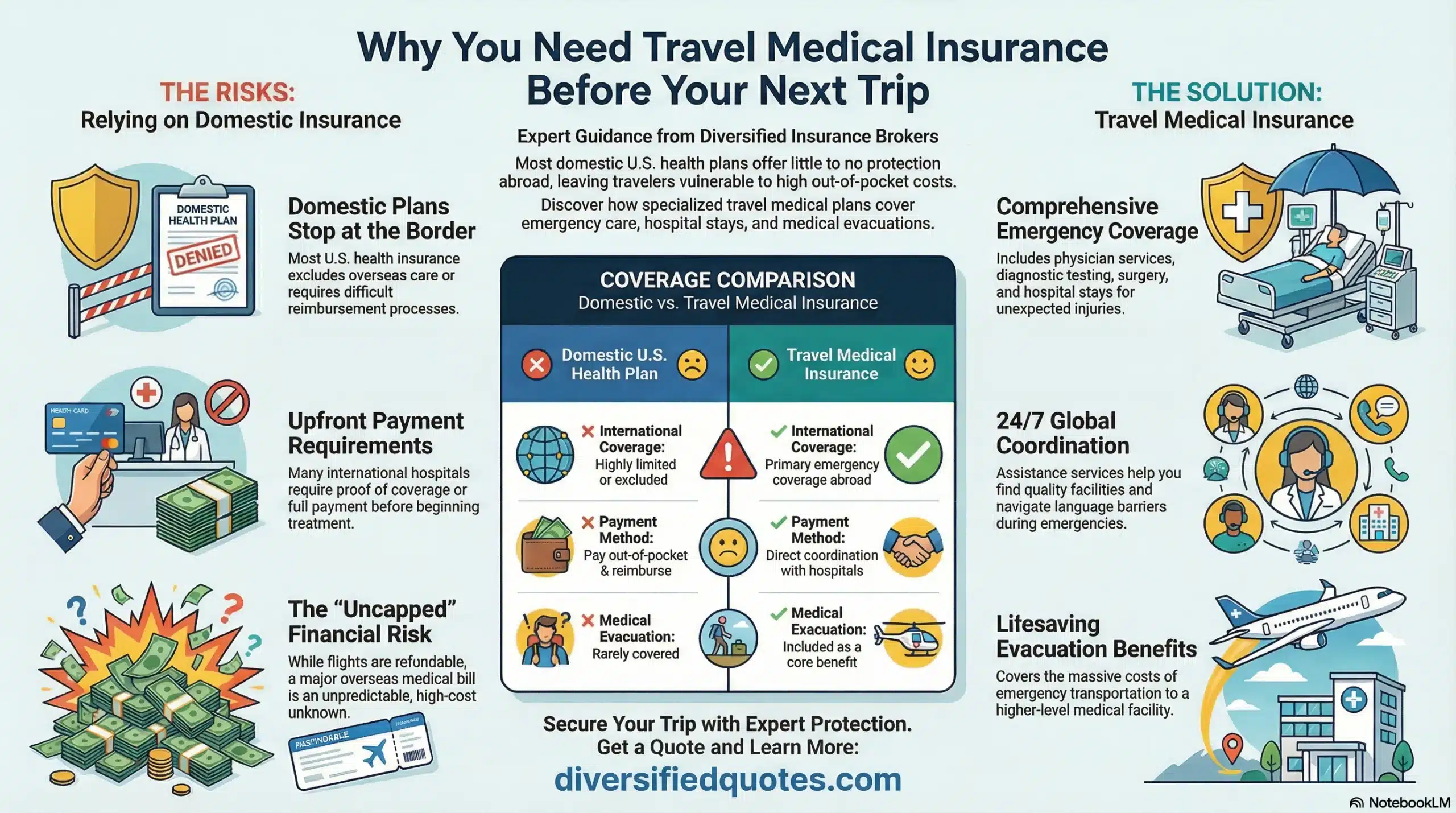
Talk With an Advisor Today
Choose how you’d like to connect—call or message us, then book a time that works for you.
Schedule here:
calendly.com/jason-dibcompanies/diversified-quotes
Licensed in all 50 states • Fiduciary, family-owned since 1980
Frequently Asked Questions: Travel Medical and Evacuation Insurance for Liberia
Where would a medical evacuation from Liberia typically go?
Abidjan, Ivory Coast is the primary evacuation destination for most Liberia cases — it has the strongest private hospital infrastructure in francophone West Africa, direct air connections from Roberts International Airport near Monrovia, and established Liberia evacuation receiving protocols. Accra, Ghana is a strong secondary destination with its own well-developed international private hospital sector including Nyaho Medical Centre and Korle Bu Teaching Hospital, and direct air access from Liberia. For the highest-complexity cases requiring care beyond what West African regional hubs provide, London and other European destinations are possible given Liberia’s English-speaking and historical connections — though these require longer transport and are typically reserved for cases where regional capability is genuinely insufficient. The specific destination always depends on the patient’s clinical condition and the specialty capability required, determined by the assistance team in real time based on current clinical information and logistics.
Does travel medical insurance cover malaria and other tropical diseases in Liberia?
Yes — malaria is covered as an acute illness arising during the trip under standard travel medical plans, including severe malaria complications requiring hospitalization and intensive management. The practical concerns for Liberia are twofold: first, confirming that the specific plan does not contain exclusions for illnesses foreseeable given the destination — a provision that exists in some plans and matters significantly for Liberia where malaria is endemic across the country including in Monrovia. Second, recognizing that severe or cerebral malaria in Liberia may exceed the capability of the nearest local facility, creating an evacuation need on top of a treatment cost need. The coverage for the treatment is most effective when paired with an evacuation benefit that can activate if local care is inadequate for the severity of the case. Pre-travel vaccination requirements should also be confirmed — yellow fever vaccination is required for Liberia entry, and hepatitis A, typhoid, and other vaccinations are recommended depending on itinerary.
What coverage limits should I carry for Liberia travel?
Emergency medical limits of $100,000 or more are a reasonable baseline, reflecting the realistic cost of inpatient care at Monrovia’s private facilities plus continuing treatment at the Abidjan or Accra receiving facility after evacuation. For evacuation and repatriation, limits of $250,000 or more are commonly recommended because a Liberia evacuation involving air transport, medical staffing, and receiving facility coordination can reach $30,000 to $80,000 or more depending on the patient’s location within Liberia and the transport modality required. Travelers in the rubber plantation regions of Grand Bassa or Bong counties, the mining regions of Nimba County, or NGO field deployments in rural Lofa or Sinoe counties should target higher evacuation limits because the multi-stage transport from those locations to Roberts International Airport adds cost and complexity before the international evacuation segment even begins. As our guide to emergency medical evacuation insurance explains, the evacuation limit is often the most consequential figure to examine carefully for destinations where evacuation is a realistic scenario.
How do pre-existing conditions affect my coverage in Liberia?
Pre-existing condition terms vary significantly between travel medical plans and require explicit review before purchasing coverage for Liberia travel. Some plans exclude pre-existing conditions entirely from coverage. Some offer limited coverage for acute flare-ups — sudden, unexpected worsening of a stable condition — if the condition was not actively changing during a defined lookback period with no new treatment, medication adjustment, or symptoms requiring evaluation. Some plans offer pre-existing condition waivers when the policy is purchased within a specified window after the initial trip commitment. For travelers with cardiac history, pulmonary conditions, diabetes, or other chronic conditions whose potential acute presentations in Liberia’s environment could plausibly require evacuation, reviewing the specific plan’s pre-existing condition language — not relying on general descriptions — is a foundational coverage evaluation step. Discovering a coverage gap when a claim is already in progress is both preventable and consequential in a way that makes pre-purchase review genuinely important.
How should my organization structure coverage for a team deployed to Liberia?
Organizations deploying multiple staff to Liberia simultaneously — NGOs, mission organizations, mining and infrastructure contractors, development project teams — benefit significantly from group travel medical plans that provide consistent coverage across the full roster rather than managing individual policies that may have inconsistent terms, benefit levels, and assistance team relationships. Group plans simplify enrollment administration, ensure all deployed staff have equivalent evacuation limits appropriate for Liberia’s logistics, and facilitate coordinated organizational response when a staff medical event requires institutional-level communication. Organizations should confirm the group plan covers all Liberia locations where staff may be deployed including rural counties, that evacuation limits are adequate for the most remote deployment locations, and that the assistance team has operational West Africa experience. Staff with significant pre-existing medical conditions should review their individual eligibility under the group plan’s pre-existing condition terms before deployment — group plan provisions may treat some individuals differently than others.
What is the right call sequence in a Liberia medical emergency?
The correct sequence in a serious Liberia medical emergency is: seek immediate care at the nearest available facility first — do not delay care to manage insurance logistics — then contact the plan’s 24/7 assistance team as early as possible after initial stabilization is underway. Early assistance team contact is critical because most plans require that evacuation be coordinated or authorized through the assistance provider for the evacuation benefit to apply. Self-arranged transport without prior assistance team authorization may result in the evacuation benefit not covering the cost — even when the underlying medical need was legitimate. The assistance team uses the early contact window to evaluate the developing situation, identify appropriate receiving facilities before evacuation becomes urgent, and initiate the administrative steps that keep the claim on track. Having the assistance team’s contact number stored offline — in phone contacts not requiring internet, on a physical card with the passport, and shared with team leaders or organizational coordinators — before departure ensures that the correct call can be made quickly when it matters.
Is travel medical coverage for Liberia different from what I’d need for Sierra Leone or Ivory Coast?
The core coverage structure is the same — emergency medical treatment plus evacuation — but each of these three West African destinations has a different medical infrastructure profile that affects which coverage features matter most. Liberia’s post-Ebola rebuilding trajectory means its healthcare system is more fragile than Ivory Coast’s but comparable to Sierra Leone’s in terms of rural-urban access disparities. Ivory Coast is one of the primary evacuation destinations from both Liberia and Sierra Leone, which means understanding Abidjan’s receiving capacity is important for all three countries. Sierra Leone’s Lungi Airport ferry crossing creates a specific evacuation logistics complexity that Liberia’s Roberts International Airport does not share. For detailed context on the two most directly comparable destinations, our pages on travel medical and evacuation from Sierra Leone and travel medical and evacuation from Ivory Coast cover the specific medical infrastructure and evacuation routing context for both countries.
About the Author:
Jason Stolz, CLTC, CRPC, DIA, CAA and Chief Underwriter at Diversified Insurance Brokers (NPN 20471358), is a senior insurance and retirement professional with more than 25 years of real-world experience helping individuals, families, and business owners protect their income, assets, and long-term financial stability. As a long-time partner of the nationally licensed independent agency Diversified Insurance Brokers, Jason provides trusted guidance across multiple specialties—including fixed and indexed annuities, long-term care planning, personal and business disability insurance, life insurance solutions, Group Health, Travel Medical and Evacuation Insurance, and short-term health coverage. Diversified Insurance Brokers maintains active contracts with over 100 highly rated insurance carriers, ensuring clients have access to a broad and competitive marketplace.
His practical, education-first approach has earned recognition in publications such as VoyageATL, and contributions from his agency featured in Kiplinger and GoBankingRates— highlighting his commitment to financial clarity and client-focused planning. Drawing on deep product knowledge and years of hands-on field experience, Jason helps clients evaluate carriers, compare strategies, and build retirement and protection plans that are both secure and cost-efficient. Visitors who want to explore current annuity rates and compare options across multiple insurers can also use this annuity quote and comparison tool.
Explore More Travel Medical Insurance Options: Browse our complete guide to Africa & Middle East Travel Medical Insurance — covering medical evacuation coverage for Africa, Middle East & high risk destinations.
Last Reviewed: June 18, 2026 |
Reviewed by: Jason Stolz, CLTC, CRPC, DIA, CAA
Chief Underwriter, Diversified Insurance Brokers, Inc. | NPN: 20471358 | Diversified Insurance Brokers, Inc. — Licensed in all 50 states
Fact Checked by: Tonia Pettitt, CMIP©
Medicare Specialist, Diversified Insurance Brokers, Inc. | NPN: 14374308 | Diversified Insurance Brokers, Inc. — Licensed in all 50 states
Did you find this content helpful? Leave us a Google review — it helps others find trustworthy guidance too.
Editorial Standards: Diversified Insurance Brokers maintains rigorous editorial standards to ensure accuracy, clarity, and independence in all content. Learn more about our editorial standards and commitment to transparency.
