
Travel Medical and Evacuation from Chad
Travel Medical and Evacuation from Chad

Jason Stolz CLTC, CRPC, DIA, CAA
Travel medical and evacuation insurance from Chad is built for the realities of travel and work in a destination where medical capabilities vary sharply by region, and where the “right” treatment plan for a serious illness or injury consistently involves transportation to a different city or a different country. Chad is a landlocked Sahel nation of approximately 17 million people stretching from the Sahara Desert in the north to the Sudan-adjacent Sahel in the east, the Lake Chad basin in the west, and the relatively more humid south where Moundou and Sarh anchor the country’s most agriculturally productive zones. N’Djamena, the capital, sits on the Chari River at the Cameroonian border — a city of 1.5+ million where the country’s most capable medical infrastructure concentrates, but where “most capable” must be understood in regional context: the best N’Djamena facilities provide initial stabilization, basic surgery, and emergency care, but the specialist depth for cardiology, neurosurgery, complex trauma, and advanced critical care that a serious medical event may require is not consistently available. For travelers outside N’Djamena — in Abéché near the Sudan border, in Moundou or Sarh in the south, in the petroleum production zones around Doba, or anywhere in the Lake Chad basin or Saharan north — the gap between available care and appropriate care grows rapidly with distance from the capital, and the planning framework must assume that a serious event means evacuation rather than local definitive treatment.
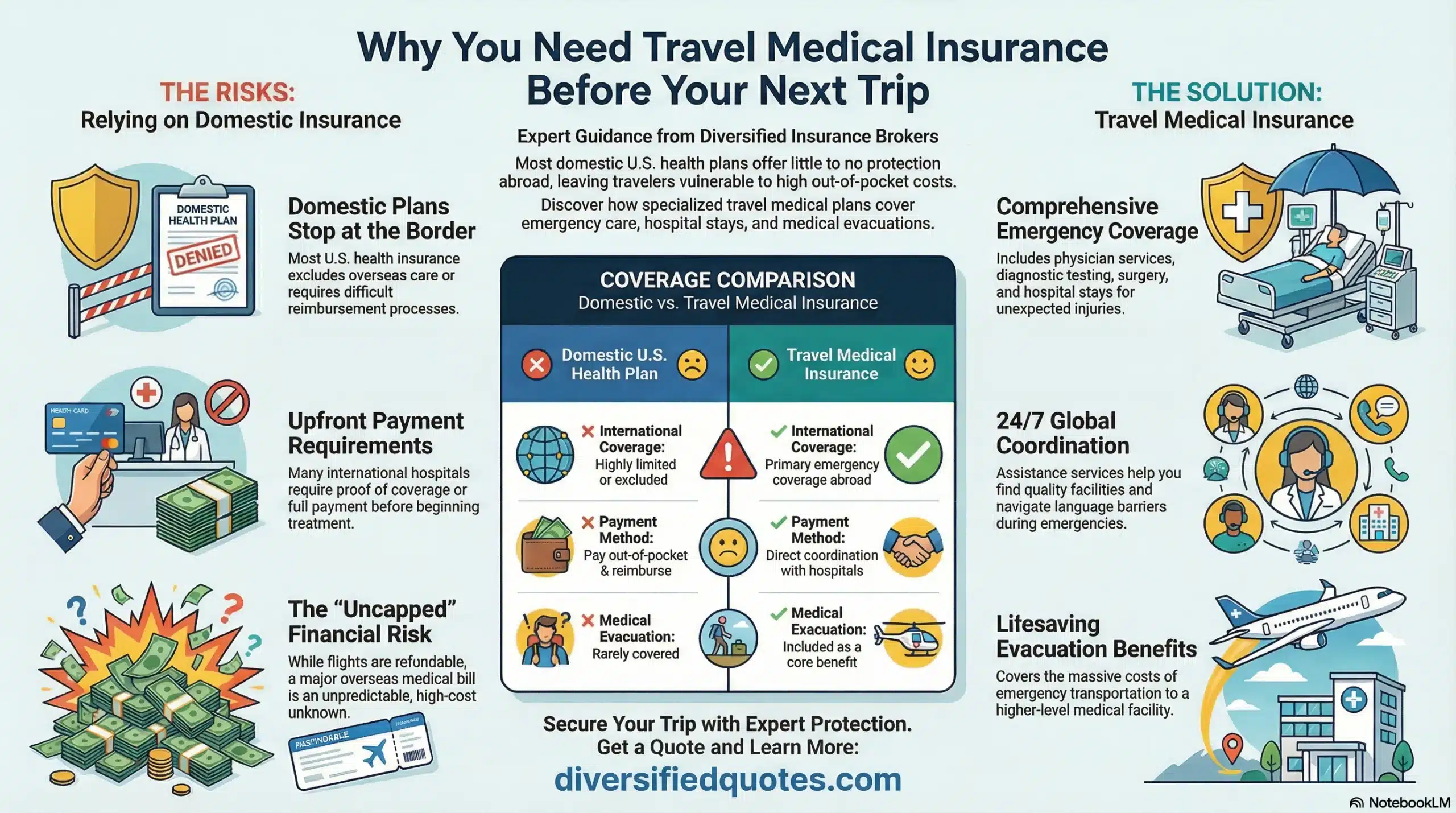
At Diversified Insurance Brokers, we help travelers, contractors, NGO teams, journalists, researchers, and families secure coverage that focuses on the two things that matter most in high-friction medical environments: emergency treatment benefits adequate for in-country stabilization costs, and an assistance team with demonstrated Chad operational experience that can coordinate evacuation when it is medically necessary rather than improvised under emergency conditions. The foundational understanding of what these plans are designed to do is covered at travel medical insurance, and the specific mechanics of evacuation authorization, receiving facility coordination, and transport logistics that determine whether an evacuation benefit is actually usable in Chad’s environment are covered at emergency medical evacuation insurance.
Get Travel Medical & Evacuation Coverage for Chad
Apply online in minutes. If you’re traveling into remote regions or on assignment, choose limits that assume evacuation is a realistic scenario, not a rare one.
Tip: If you’re on contract work, aid work, or extended residence, prioritize stronger evacuation benefits and a clear assistance process that coordinates transfers.
Chad’s Medical Geography: N’Djamena, the Regions, and the Evacuation Imperative
N’Djamena concentrates the best available medical infrastructure in Chad. Hôpital de la Liberté — the national referral hospital — provides emergency care, basic surgical capability, and inpatient services under significant resource constraints that reflect both the country’s economic reality and the impact of decades of conflict and political instability on institutional development. The private clinic sector in N’Djamena, including facilities that serve the diplomatic community and international NGO presence, provides better access for international patients than the national hospital but similarly faces specialist depth limitations for complex events. The city’s most immediate geographic advantage for evacuation is its location on the Cameroon border: Maroua and Garoua in northern Cameroon are accessible and provide a stepping-stone toward Yaoundé and Douala, where Cameroon’s better-equipped private hospital sector and international air connections create a natural first evacuation tier for N’Djamena cases. N’Djamena International Airport also supports direct connections to Paris via Air France and to regional hubs including Addis Ababa, making it the logistical foundation for all Chad evacuation planning regardless of where in the country the event originates.
The rest of Chad — geographically enormous at 1.28 million square kilometers, roughly twice the size of Texas — presents a medical infrastructure environment that steps down rapidly as distance from N’Djamena increases. Moundou in the south, Chad’s second city and center of the cotton and brewing industries, has a regional hospital but with very limited specialist capability. Sarh in the southeast has district hospital infrastructure appropriate for stabilization and basic emergency care. Abéché in the east — the historical center of the Sultanate of Wadai and now a hub for eastern Chad’s humanitarian operations near the Darfur border — has hospital infrastructure that serves a large displaced population but with resources stretched far beyond routine capacity. The petroleum production zone around Doba in southern Chad has benefited from oil sector investment in worker health infrastructure, but the specific facilities available to international workers vary by company contract and operational setup. The Lake Chad basin in the west, the Tibesti mountains in the far north, the Saharan regions of Borkou and Ennedi — all of these create medical environments where the nearest clinic of any kind may be hours away by vehicle and the nearest meaningful hospital is a full day or more from the event location. The security context further complicates access in several of these regions: the Lake Chad basin has experienced Boko Haram-related insecurity, the eastern regions adjacent to Sudan carry conflict spillover risk, and the northern desert zones present security considerations for travelers outside established corridors. For travelers comparing Chad’s planning environment to neighboring Sahel and Saharan destinations, the pages on travel medical and evacuation from Niger, travel medical and evacuation from Libya, and travel medical and evacuation from Algeria cover the directly adjacent regional environments.
Chad Travel Medical: Coverage Priorities by Location and Traveler Type
| Chad Location / Traveler Type | Medical Access Reality | Key Coverage Priority | Primary Evacuation Route |
|---|---|---|---|
| N’Djamena — diplomatic / UN / NGO / business | Hôpital de la Liberté and NGO-supported private clinics provide best available Chad care; significant specialist depth gaps for cardiac, neurological, and complex trauma events; Cameroon border proximity creates Maroua-Yaoundé staging option; N’Djamena Airport serves Paris, Addis Ababa, and regional connections | Evacuation limits adequate for Yaoundé/Douala or Paris routing; assistance team with N’Djamena operational familiarity; payment guarantee capability for local clinic deposits; war exclusion review for travelers with eastern or northern Chad movement | Cameroon (Yaoundé/Douala) as primary regional hub via border proximity or N’Djamena Airport; Paris direct via Air France for European routing; Addis Ababa for East Africa-connected itineraries |
| Moundou / Sarh — southern Chad | Regional hospitals provide stabilization and basic emergency care; specialist depth very limited; 500+ km from N’Djamena by road; Central African Republic border proximity creates some access variation; cotton and agricultural sector creates occupational health risk | Evacuation limits covering N’Djamena staging plus Cameroon or Paris international routing; assistance team familiarity with southern Chad logistics; road accident coverage on N’Djamena-Moundou highway; malaria prophylaxis coverage | Air or ground to N’Djamena for staging; N’Djamena to Yaoundé or Paris for international specialist care; southern Chad chain adds approximately 2–3 transport legs before definitive care |
| Abéché / eastern Chad — humanitarian / research | Hospital infrastructure serving displaced population with stretched resources; proximity to Darfur creates ongoing security context requiring dual medical and security coverage evaluation; UNHCR and MSF operational presence creates some parallel medical infrastructure for humanitarian workers; 900+ km from N’Djamena | Maximum evacuation limits; security evacuation assessed separately from medical; war exclusion language review; assistance team with eastern Chad conflict-adjacent operational experience; satellite communication essential | Air charter from Abéché Airport to N’Djamena; N’Djamena to Addis Ababa or Paris for international specialist care; Sudan routing via Khartoum historically available but current Sudan conflict makes this corridor unreliable |
| Doba / petroleum zone — oil sector contractors | Oil company medical facilities serve the international workforce population under specific company contracts; quality and access varies significantly by operator; southern Chad location creates proximity to Cameroon pipeline corridor and Ngaoundéré routing; occupational injury risk in petroleum production environment | Individual coverage complementing or replacing company medical as appropriate; occupational injury coverage for petroleum work environments; group coverage for company deployments; Cameroon pipeline corridor evacuation routing pre-established | Cameroon pipeline corridor to Ngaoundéré or Douala for regional care; N’Djamena for cases where Chad capital staging is faster; Paris via Douala for European routing |
| Lake Chad basin / Saharan north — remote / expedition | Minimal to nonexistent medical infrastructure; Lake Chad basin carries Boko Haram-related security risk requiring dual coverage evaluation; Tibesti and Saharan regions have no medical infrastructure and extreme isolation; heat stroke and dehydration life-threatening without rapid response; days from any meaningful hospital | Maximum evacuation limits; satellite communication mandatory; security evacuation coverage for Lake Chad basin separately evaluated; assistance team pre-briefed on specific route before departure; expedition medical kit as essential complement | Air charter from nearest accessible airstrip to N’Djamena; N’Djamena international routing to Yaoundé or Paris; the most complex evacuation chain in Chad — pre-established protocols before departure are the only viable approach |
The Cameroon Corridor, Security Complexity, and Why Chad Requires the Most Deliberate Pre-Travel Planning
Chad’s evacuation geography is defined by one geographic advantage and one persistent planning complication. The advantage is the Cameroon border: N’Djamena sits on the Chari River immediately adjacent to Cameroon, and Cameroon’s road network through Maroua and Garoua connects to Yaoundé and Douala — where Polyclinique de l’Essos, Centre Médical de la Caisse, and the Douala General Hospital private sector provide Central Africa-standard care with international air connections that include Air France’s direct Douala-Paris route. This Cameroon corridor functions as Chad’s most important regional evacuation pathway, and an assistance team’s familiarity with it — including which specific Yaoundé and Douala facilities have the specialist capability required for specific event types, which air charter operators service the N’Djamena-Yaoundé route, and how cross-border transport authorization is managed — is a meaningful differentiator between plans that work in Chad and plans that look adequate in a policy document. The pages on travel medical and evacuation from Nigeria, travel medical and evacuation from Egypt, and travel medical and evacuation from Burundi cover regional destinations where the same Cameroon-West Africa-East Africa hub network serves as the evacuation infrastructure, providing useful calibration context for Chad’s position in that regional system.
The persistent complication is Chad’s security context. The country borders six nations — Libya, Sudan, the Central African Republic, Cameroon, Nigeria, and Niger — and the instability in several of those neighbors has created security spillover effects that affect specific Chad regions. The eastern provinces adjacent to Sudan’s Darfur region carry conflict proximity risk. The Lake Chad basin’s Nigerian Boko Haram activity has periodically extended into Chadian territory around Lake Chad and Lac province. The northern desert regions have historically served as corridors for trans-Saharan movement of armed groups, weapons, and migrants in ways that create security risk for travelers without established local knowledge and support networks. For travelers in these specific regions, the dual coverage evaluation — medical evacuation for clinically triggered events, security evacuation for threat-triggered removal — is not a theoretical consideration but a practical operational requirement. Standard travel medical plans do not include security evacuation, and war and civil unrest exclusion language in the specific plan must be reviewed explicitly for the traveler’s actual deployment area rather than assumed to apply uniformly or not at all. For the high-risk travel framework that applies specifically to Chad’s security-medical intersection, high-risk travel insurance and travel and medical insurance for high-risk travel cover the specialized product categories designed for environments where both risk profiles must be addressed simultaneously. For extended Chad assignments — NGO deployments, petroleum contractor rotations, research fellowships — international health insurance provides the structural alternative to short-term travel plans with year-over-year coverage continuity, broader outpatient access, and R&R travel coverage that accumulate in importance over multi-month or multi-year Chad operations. For the northern Sahel and North Africa regional context that completes Chad’s geographic coverage picture, the pages on travel medical and evacuation from Morocco and travel medical and evacuation from Algeria cover the northern regional environment.
Choose the Right Coverage Type for Your Trip Length
If you’re traveling short-term, the major medical travel option can be a strong fit. If you’re staying longer or want broader international medical structure, consider the international medical option.
Apply for Coverage for Chad
Choose the option that best matches your travel length and the level of emergency protection you want in place.
Note: Coverage terms, exclusions, and evacuation authorization rules vary by policy. Follow the insurer’s assistance process during emergencies.
Related Travel Medical Pages
If you are comparing destinations or plan types, these pages help you match coverage design to real-world medical access and evacuation needs.
Related Destination Pages
Use these destination pages to compare how coverage needs change with infrastructure, distance to care, and evacuation routing.
Talk With an Advisor Today
Choose how you’d like to connect—call or message us, then book a time that works for you.
Schedule here:
calendly.com/jason-dibcompanies/diversified-quotes
Licensed in all 50 states • Fiduciary, family-owned since 1980
Frequently Asked Questions: Travel Medical and Evacuation Insurance for Chad
What medical facilities are available in Chad for international travelers?
N’Djamena has the best available medical infrastructure in Chad, anchored by Hôpital de la Liberté (the national referral hospital) and a small private clinic sector that serves the diplomatic community, UN agencies, and the large international NGO presence in the capital. The private clinics provide better initial access for international patients than the national hospital, but all N’Djamena facilities face significant specialist depth limitations — cardiology, neurosurgery, complex trauma surgery, and advanced critical care are not consistently available at the standards a serious emergency may require. MSF (Médecins Sans Frontières) and other humanitarian medical organizations operate in Chad and maintain facilities in some regional areas, but their access policies are primarily oriented toward the Chadian population rather than international travelers. Outside N’Djamena, regional hospitals in Moundou, Sarh, and Abéché provide stabilization and basic emergency care but are not capable of definitive specialist treatment for most serious events. The Lake Chad basin, Saharan north, and Tibesti region have minimal to no medical infrastructure. The practical planning framework for Chad is to treat N’Djamena private clinics as stabilization facilities and the Cameroon corridor as the route to actual specialist care for most serious events.
Where would a medical evacuation from Chad typically go?
The primary international evacuation destination for most Chad cases is Cameroon — specifically Yaoundé or Douala, which are accessible via N’Djamena International Airport and provide Central Africa-standard private hospital care with international air connections. Douala’s direct Air France connection to Paris makes it a natural two-leg evacuation chain for cases requiring European specialist care: N’Djamena to Douala, then Douala to Paris. Addis Ababa serves some Chad evacuation cases via Ethiopian Airlines’ N’Djamena connection, particularly for cases with East Africa routing preference or specific Ethiopian specialist capability requirements. Paris via direct Air France N’Djamena connection is available for some cases where the direct European routing is clinically or logistically preferable to the Cameroon staging option. For southern Chad cases near the Cameroon border — Moundou, Doba, Sarh — the ground or air route into northern Cameroon (Maroua, Garoua) provides a shorter first leg before onward routing to Yaoundé or Douala. For eastern Chad cases in Abéché, the historical Khartoum routing via Sudan is currently unreliable due to Sudan’s active civil conflict; N’Djamena staging via air charter from Abéché Airport is the more reliable current pathway.
What coverage limits should I carry for Chad travel?
Emergency medical limits of $100,000 or more are appropriate for Chad, reflecting in-country stabilization costs plus initial treatment costs at the Cameroon or Paris receiving facility after evacuation. For evacuation and repatriation, limits of $250,000 to $500,000 or more are strongly recommended — the Chad evacuation chain consistently involves multiple transport segments that accumulate significant cost before definitive specialist care begins. For cases originating outside N’Djamena, the chain adds an additional leg (regional location to N’Djamena, then N’Djamena to Cameroon, then potentially Cameroon to Paris) with associated transport costs at each segment. For Lake Chad basin, Saharan north, and eastern Chad deployments, the upper end of those ranges reflects the additional logistical complexity and cost of air charter from locations with limited airstrip infrastructure. The planning principle for all Chad itineraries is to select limits that treat evacuation as the expected response to serious events — not an exceptional scenario — and to match those limits to the most demanding location on the itinerary rather than the most accessible.
What specific health risks should Chad travelers and workers prepare for?
Malaria is hyperendemic across Chad’s southern, central, and Lake Chad regions with year-round transmission — severe malaria can progress rapidly to cerebral malaria requiring ICU-level management that is not reliably available in most Chad locations, making prophylaxis adherence and early treatment initiation critical. Meningococcal meningitis is endemic in the Sahel meningitis belt that runs through Chad — vaccination is a standard pre-travel requirement. Typhoid, hepatitis A and B, cholera in flood and displacement-adjacent areas, and schistosomiasis from fresh water contact in the Lake Chad basin are all relevant travel health risks requiring vaccination and behavioral precautions. Heat stroke and severe dehydration are life-threatening risks during Chad’s extreme hot season (March–May) when temperatures regularly exceed 45°C in the Saharan north — conditions where the absence of nearby medical care creates immediate life risk for travelers experiencing heat emergencies. Road traffic accidents on Chad’s road network, which includes many unpaved or poorly maintained routes, are a consistent injury risk. In the petroleum zone, occupational injury risk from industrial work environments is relevant. In eastern and Lake Chad regions, landmine and explosive remnants of war risk exists in specific corridors and requires local guidance before any off-road movement.
How does Chad’s security situation affect travel medical coverage?
Chad’s security context creates the same dual coverage requirement that applies across the Sahel: medical evacuation for clinically triggered events (physician-certified need for care not available locally), and security evacuation for threat-triggered removal (armed group activity, civil unrest), which are separate benefits responding to separate triggers. For travelers in eastern Chad near Darfur, the Lake Chad basin, and northern desert routes, both coverage categories must be evaluated explicitly before departure. Standard travel medical plans do not include security evacuation — a dedicated standalone security evacuation product or political risk coverage must be purchased separately for travelers in conflict-adjacent areas. War and civil unrest exclusion language in the specific travel medical plan must be reviewed for the actual deployment area, because some plans exclude medical event coverage in conflict zones while others cover civilian travelers not directly participating in hostilities. Do not assume the exclusion does or does not apply — confirm with the carrier. For most travelers in N’Djamena and Moundou in the current operating environment, the security context does not create the same dual coverage imperative as the eastern and northern regions, but this assessment can change with the security situation and should be verified against current travel advisories before departure.
What is the correct emergency response sequence for a serious medical event in Chad?
Seek immediate care at the best available facility for your location — N’Djamena private clinic sector for capital cases, regional hospital for stabilization in Moundou or Sarh, organizational medical unit if available for NGO and contractor deployments. Contact the plan’s 24/7 assistance team as early as possible after initial stabilization — for remote Chad locations (Lake Chad basin, Saharan north, Abéché region), initiate the call simultaneously with accessing any available local care rather than waiting for stabilization, because air charter arrangement from locations with limited airstrip infrastructure requires the maximum possible lead time. Most plans require evacuation to be coordinated through the assistance team for the full benefit to apply — independently arranged transport without authorization creates reimbursement risk regardless of the legitimacy of the medical need. Store the assistance contact number offline in phone contacts and on a physical card with the passport. For Saharan, Lake Chad, and eastern Chad itineraries, carry satellite communication capability — cellular coverage is absent or unreliable across large portions of Chad’s territory, and the assistance team contact that authorization requires cannot be made without independent communication capability in those areas. Brief a designated emergency contact outside Chad with the policy number and assistance team contact before departing N’Djamena for any remote itinerary.
About the Author:
Jason Stolz, CLTC, CRPC, DIA, CAA and Chief Underwriter at Diversified Insurance Brokers (NPN 20471358), is a senior insurance and retirement professional with more than 25 years of real-world experience helping individuals, families, and business owners protect their income, assets, and long-term financial stability. As a long-time partner of the nationally licensed independent agency Diversified Insurance Brokers, Jason provides trusted guidance across multiple specialties—including fixed and indexed annuities, long-term care planning, personal and business disability insurance, life insurance solutions, Group Health, Travel Medical and Evacuation Insurance, and short-term health coverage. Diversified Insurance Brokers maintains active contracts with over 100 highly rated insurance carriers, ensuring clients have access to a broad and competitive marketplace.
His practical, education-first approach has earned recognition in publications such as VoyageATL, and contributions from his agency featured in Kiplinger and GoBankingRates— highlighting his commitment to financial clarity and client-focused planning. Drawing on deep product knowledge and years of hands-on field experience, Jason helps clients evaluate carriers, compare strategies, and build retirement and protection plans that are both secure and cost-efficient. Visitors who want to explore current annuity rates and compare options across multiple insurers can also use this annuity quote and comparison tool.
Explore More Travel Medical Insurance Options: Browse our complete guide to Africa & Middle East Travel Medical Insurance — covering medical evacuation coverage for Africa, Middle East & high risk destinations.
Last Reviewed: June 18, 2026 |
Reviewed by: Jason Stolz, CLTC, CRPC, DIA, CAA
Chief Underwriter, Diversified Insurance Brokers, Inc. | NPN: 20471358 | Diversified Insurance Brokers, Inc. — Licensed in all 50 states
Fact Checked by: Tonia Pettitt, CMIP©
Medicare Specialist, Diversified Insurance Brokers, Inc. | NPN: 14374308 | Diversified Insurance Brokers, Inc. — Licensed in all 50 states
Did you find this content helpful? Leave us a Google review — it helps others find trustworthy guidance too.
Editorial Standards: Diversified Insurance Brokers maintains rigorous editorial standards to ensure accuracy, clarity, and independence in all content. Learn more about our editorial standards and commitment to transparency.
