
Travel Medical and Evacuation from Colombia
Travel Medical and Evacuation from Colombia

Jason Stolz CLTC, CRPC, DIA, CAA
For travelers and families spending time in Colombia, having travel medical and evacuation insurance is one of the most practical decisions you can make before departure. Colombia has become one of Latin America’s most popular destinations for tourism, digital nomads, students, business travel, and long-term expat residence — a country where Bogotá’s sophisticated private hospital network, Medellín’s world-class clinic infrastructure, and Cartagena’s resort-adjacent medical facilities can handle most routine emergencies with genuine competence. But Colombia is also a country of extraordinary geographic diversity — the Andes cordillera splitting the country into three distinct mountain ranges, the Amazon basin covering a third of its territory, two coastlines on opposite oceans, and a coffee-growing middle zone of spectacular highland terrain — and the moment a traveler moves outside the major metro corridors into mountainous, jungle, coastal, or rural regions, the gap between available care and appropriate care can become decisive. A serious medical event in the Eje Cafetero highlands, the Pacific coast near Nuquí, the Guajira peninsula, or the Amazon jungle near Leticia creates a fundamentally different coverage planning problem than the same event in Bogotá’s Zona Rosa, and the plan that protects you adequately in one context may leave you genuinely exposed in the other.
At Diversified Insurance Brokers, we help travelers, digital nomads, students, expats, mission teams, and business travelers compare plans built for medical-first protection. The goal is not to cover inconveniences — missed flights, delayed luggage, or minor clinic visits. The goal is to protect you from high-cost
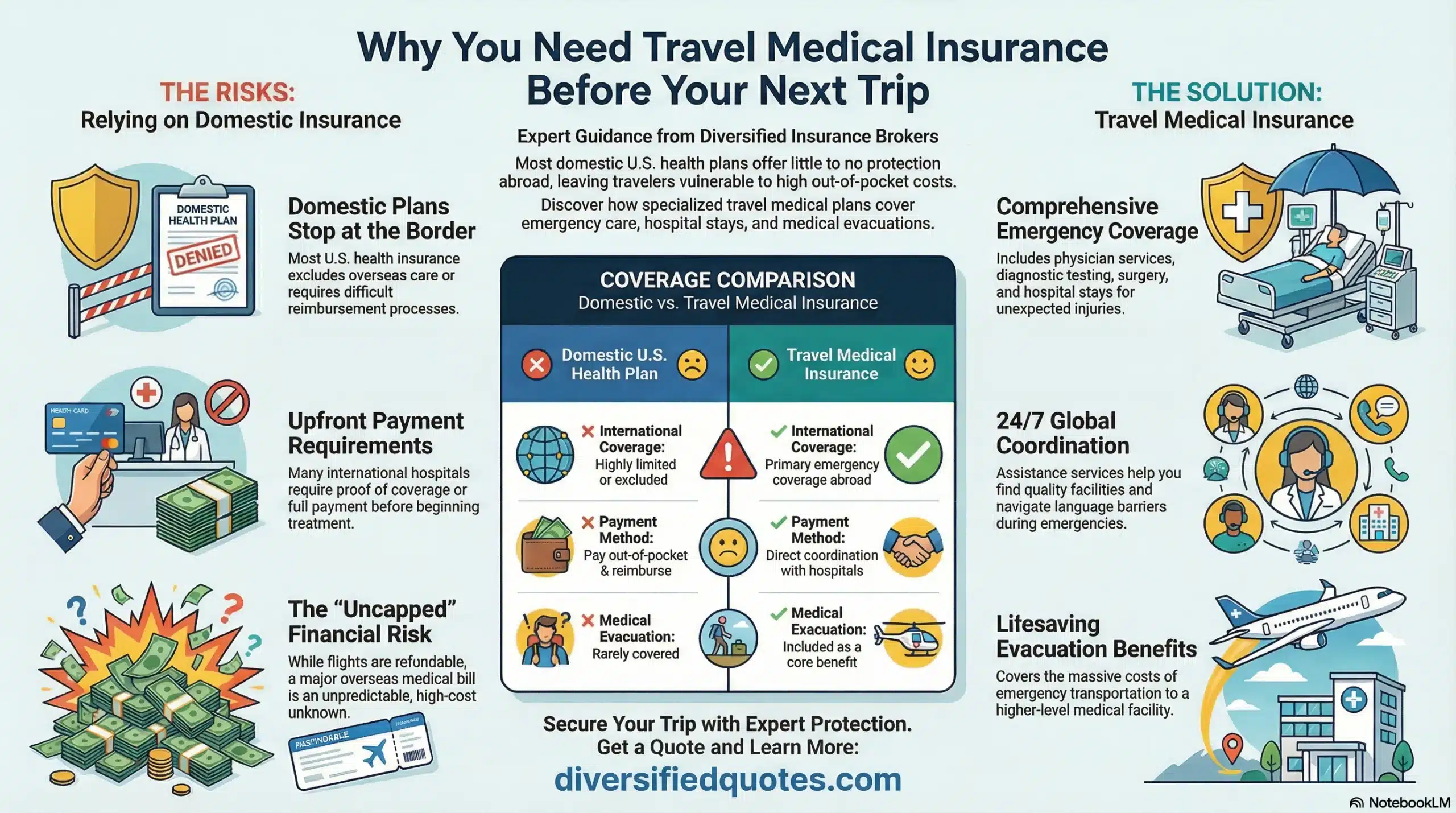
emergencies: hospitalization, surgery, specialist consultations, emergency diagnostics, coordinated evacuation, and the chain of logistics that unfolds when a serious event requires a higher level of care than what is locally accessible. Many travelers assume “travel insurance” automatically includes meaningful medical coverage and evacuation. In reality, many bundled travel packages concentrate benefits in trip cancellation and baggage disruption, with medical limits that can be inadequate for a real emergency requiring hospitalization and potential transport. For travelers comparing coverage across destinations where local medical access varies similarly, the page on travel medical and evacuation from Algeria illustrates how limits and evacuation rules become more consequential when regional care access is uneven — a pattern that applies directly to Colombia’s geographic diversity.
Travel Medical & Evacuation Coverage for Colombia
Apply online for travel medical coverage that includes strong emergency treatment benefits and coordinated evacuation support.
Colombia’s Medical Geography: What Changes When You Leave the Cities
Colombia’s major cities have private hospital infrastructure that competes meaningfully with what travelers would find in comparable Latin American capitals. In Bogotá, Fundación Santa Fe de Bogotá, Clínica del Country, Hospital Universitario Fundación Santa Fe, and Clínica Colombia represent world-class private care — cardiology, neurology, orthopedic surgery, oncology, and critical care at levels that make international evacuation medically unnecessary for most event types that occur within the capital. The altitude matters — Bogotá sits at 2,600 meters above sea level, and visitors arriving from sea level can experience acute mountain sickness symptoms ranging from headache and fatigue to the rarer but serious high-altitude pulmonary or cerebral edema, making the cardiovascular context of Bogotá care different from a sea-level city of comparable hospital infrastructure. Medellín at 1,495 meters has outstanding private hospital capability including Clínica Las Américas, Hospital Pablo Tobón Uribe, and Clínica El Rosario — it has attracted significant medical tourism precisely because its private care quality combined with cost creates favorable outcomes for Colombian-standard procedures. Cartagena has clinic infrastructure serving the luxury tourism and cruise market. Cali has a strong private hospital sector. Barranquilla’s Clínica General del Norte serves the northern coast.
South of these cities, the picture changes rapidly and meaningfully. The Eje Cafetero — the coffee triangle of Armenia, Manizales, and Pereira — has regional hospital infrastructure appropriate for stabilization and routine emergencies but with specialist depth that falls short of what complex cardiac, neurological, or trauma events may require. The Pacific coast, including the biodiversity hotspots of Nuquí and the Chocó department, has minimal medical infrastructure in rural areas and no road connection to the rest of Colombia — transport to the nearest capable hospital requires a small aircraft or boat to Quibdó, followed by further transport to Medellín or Bogotá. The Llanos Orientales — Colombia’s eastern plains bordering Venezuela — have provincial hospitals in Villavicencio but sparse infrastructure beyond the capital of Meta department. The Amazon region around Leticia is 1,600 kilometers from Bogotá by air with no road connection, has a basic hospital serving the tri-border area, and represents one of the most medically remote accessible destinations in South America. A serious medical event in any of these locations creates a multi-leg evacuation chain whose logistics and cost bear no resemblance to the same event occurring in Bogotá.
Colombia Travel Medical: Coverage Priorities by Location and Traveler Type
| Colombia Location / Traveler Type | Medical Access Reality | Key Coverage Priority | Evacuation Scenario |
|---|---|---|---|
| Bogotá — business / diplomatic / long-stay | Fundación Santa Fe, Clínica del Country, strong private hospital network; altitude at 2,600m creates AMS and cardiovascular considerations for arrivals from sea level; private billing applies as uninsured international patient; direct international flights to Miami, New York, and major hubs | Financial protection against Colombian private hospital billing; altitude-related cardiovascular event coverage; assistance team facility guidance; direct billing or payment guarantee support | Within-Colombia specialist transfer for most events; Miami or Panama City for cases requiring U.S. or regional specialist care exceeding Colombian capability; repatriation to U.S. for prolonged recovery |
| Medellín — tourism / digital nomad / extended stay | Clínica Las Américas, Hospital Pablo Tobón Uribe — outstanding private hospital capability; popular digital nomad base with high expat concentration; city’s steep terrain, motorbike traffic, and cable car tourism create road accident and fall risk; 1,495m altitude milder than Bogotá | Extended-stay plan structure for multi-month nomad stays; motorbike and ride-hailing activity coverage; pre-existing condition terms reviewed for long-term residents; outpatient continuity for non-emergency care over weeks and months | Within-Medellín for most events given strong hospital infrastructure; Bogotá for highest-complexity subspecialty events; Miami or Panama City for cases requiring North American specialist care |
| Cartagena / Caribbean coast — tourism / cruise | Clínica Blas de Lezo and private clinic sector serves the tourism and cruise market; heat and humidity create dehydration and heat illness risk particularly in the walled city during peak summer; water sports create drowning and trauma risk; cruise ship medical care limited — serious events require disembarkation | Heat illness and dehydration coverage; water sports activity coverage confirmation; cruise disembarkation medical event coordination; coverage for road accident during island excursions | Cartagena clinic for initial care; Bogotá or Medellín for complex events requiring specialist depth; Barranquilla as closer regional alternative; Miami routing for cases requiring U.S. care via direct flights |
| Eje Cafetero — coffee region rural touring | Armenia, Manizales, and Pereira have regional hospitals; physically active itinerary including jeep tours, coffee farm hikes, zipline, and paragliding creates injury risk; 3–5 hours from Bogotá or Medellín; mountain roads create road accident exposure; Salento and Cocora Valley require further rural travel | Activity coverage confirmation for adventure tourism including zipline and paragliding; road accident coverage on mountain roads; evacuation limits adequate for Medellín or Bogotá staging before international routing if needed | Regional hospital in Armenia or Pereira for initial stabilization; Medellín or Bogotá for specialist care requiring ICU or surgery; international routing via El Dorado or José María Córdova airports |
| Pacific coast — Nuquí / Chocó / eco-tourism | No road connection to rest of Colombia; air or boat transport to Quibdó required for any serious event; Quibdó has limited hospital capability; second transport leg to Medellín required for specialist care; whale watching and surfing create marine trauma risk; one of Colombia’s most medically remote accessible areas | Maximum evacuation limits; air charter as only viable response for serious events; satellite communication essential; assistance team pre-briefed on Pacific coast itinerary and transport chain before departure | Small aircraft to Quibdó for initial staging; commercial or charter to Medellín for specialist care; multi-leg chain with no road option — pre-established assistance team protocols before traveling to the coast are non-optional |
| Amazon / Leticia — research / NGO / adventure | Leticia has basic hospital serving the tri-border area (Colombia/Peru/Brazil); 1,600km from Bogotá by air with no road connection; malaria endemic below 1,500m; dengue and Zika present; serious events require air charter to Leticia staging followed by flight to Bogotá; remotest accessible destination in Colombia | Maximum evacuation limits; malaria prophylaxis and treatment coverage; air charter evacuation as primary serious event response; satellite communication plan before jungle departure; assistance team pre-engagement essential | Air to Leticia for staging; Leticia to Bogotá; Bogotá international routing to Miami or Panama City — full chain can involve 2–3 transport legs and 12–24 hours from remote location to specialist care |
Evacuation, Authorization, and Why the Process Matters as Much as the Limit
In Colombia’s geographic context, evacuation is not a theoretical benefit — it is the realistic primary response for serious events occurring outside the major metro corridors, and even within those corridors it represents the correct clinical decision when specialist care requirements exceed what the initial facility can provide. The evacuation benefit’s dollar limit matters, but two other elements matter as much or more for Colombia travel: the assistance team’s Colombia-specific operational experience, and the authorization process the plan requires. Most travel medical plans require that evacuation be coordinated through the plan’s assistance provider for the full benefit to apply — self-arranged transport without prior authorization, however urgently it seems necessary at the time, can create reimbursement disputes that are entirely avoidable when the authorization call happens first. In Colombia’s specific context, the assistance team’s knowledge of which Medellín or Bogotá hospital is most appropriate for a specific event type, which regional hospitals can provide adequate initial stabilization, and which air charter operators serve the Pacific coast and Amazon routes is the operational knowledge that determines outcome speed for events in remote locations. The mechanics of how authorization works, what “nearest adequate facility” means in practice, and why evacuation limits should reflect realistic transport cost structures rather than marketing minimums are covered in depth at emergency medical evacuation insurance. For travelers comparing Colombia’s risk profile to other Latin American destinations where geography similarly creates remote-region coverage planning challenges, the pages on travel medical and evacuation from Cuba, travel medical and evacuation from Nigeria, and travel medical and evacuation from Angola provide calibration context for how evacuation costs scale with distance from major airports and specialist care centers. For the specific high-risk travel framework that applies to remote Colombia travel, high-risk travel insurance covers how plan design should adapt for traveler profiles that include remote routing, extended jungle or coastal itineraries, or security-adjacent work. For travelers planning extended Colombia stays that exceed the typical short-trip travel plan structure, international health insurance provides the structural comparison between trip-based and residence-based coverage approaches. For the regional comparison context of North African destinations with comparable care access variability, travel medical and evacuation from Morocco covers a useful parallel. For Colombia as a destination combined with Sub-Saharan Africa on a multi-continental itinerary, the pages on travel medical and evacuation from Burundi and travel medical and evacuation from Egypt cover the most relevant regional comparison environments.
Get Covered Before You Travel to Colombia
Apply online in minutes to secure travel medical coverage with evacuation support for Colombia.
Related Travel Medical Pages
If you are comparing plan types, limits, or how evacuation works, these pages help you align coverage design with real-world emergency needs.
Talk With an Advisor Today
Choose how you’d like to connect—call or message us, then book a time that works for you.
Schedule here:
calendly.com/jason-dibcompanies/diversified-quotes
Licensed in all 50 states • Fiduciary, family-owned since 1980
Frequently Asked Questions: Travel Medical and Evacuation Insurance for Colombia
How good are Colombia’s hospitals for international patients?
Colombia’s major city private hospitals compete meaningfully with institutions in developed Latin American markets. In Bogotá, Fundación Santa Fe de Bogotá has Joint Commission International accreditation and provides cardiology, oncology, neurology, and critical care at a standard that makes it a genuine medical tourism destination. Clínica del Country and other major Bogotá private hospitals have robust specialist rosters. In Medellín, Clínica Las Américas and Hospital Pablo Tobón Uribe attract medical tourism from across the Americas for elective procedures at a fraction of U.S. costs. These institutions are genuinely capable for most events that occur in the major cities. The coverage planning question for Colombia is not the quality of Bogotá or Medellín private care — it is what happens when a serious event occurs in the Eje Cafetero, the Pacific coast, the Llanos, or the Amazon, where the nearest hospital of comparable capability may be several hours away by road or air. For those locations, evacuation to Bogotá or Medellín is the correct clinical first step, and the ability to execute that transfer quickly and correctly is what the assistance team and evacuation benefit are designed to provide.
What are the most common medical events for travelers in Colombia?
Gastrointestinal illness from food and water exposure is the most common travel health event in Colombia — travelers in Bogotá, Medellín, and Cartagena encounter food environments where pathogen exposure is consistent, and severe cases can require IV fluid replacement and monitoring. Road traffic accidents are a significant and consistent injury risk across all traveler categories in Colombia — inter-city highway travel, Medellín’s urban motorbike density, and rural mountain road conditions all contribute to accident rates that experienced Latin America travelers consistently note. Falls on Bogotá’s uneven pavements and Medellín’s steep hillside terrain create ankle injuries, wrist fractures, and head injuries for active travelers. Altitude sickness affects a meaningful proportion of visitors arriving in Bogotá from sea level — most cases are mild but some require medical monitoring. Dengue fever is transmitted year-round in low-altitude areas including Cartagena, Medellín’s warmer neighborhoods, and the Amazon basin. Malaria is present in the Pacific coast, Llanos, and Amazon below 1,500 meters and requires prophylaxis for travelers to those regions. Adventure tourism injuries — from paragliding near Rionegro, zipline in the coffee region, motorcycle touring, and hiking — create orthopedic presentations that require specialist evaluation not always available at the nearest local facility.
What coverage limits should I carry for Colombia travel?
For city-concentrated travel in Bogotá, Medellín, or Cartagena, emergency medical limits of $50,000 to $100,000 with evacuation coverage of $150,000 or more provide meaningful protection against the most common serious events, given the quality of available private hospital care in those cities. For itineraries that extend to the Eje Cafetero, Pacific coast, Llanos, or Amazon, evacuation limits of $250,000 or more better reflect the realistic cost of the multi-leg transport chains that serious events in those locations require — air charter from the Pacific coast or Amazon to a staging airport, commercial or charter to Medellín or Bogotá, and potentially international routing to Miami or Panama City for events requiring subspecialty care. Digital nomads and extended-stay travelers should select limits appropriate for their full residency duration rather than a short tourist trip, given the higher cumulative medical probability over months in-country. The practical planning framework: select limits that treat evacuation as the expected response to serious events in remote Colombia locations — not a theoretical contingency — and match the evacuation limit to the most demanding location on the itinerary rather than the most accessible one.
I’m a digital nomad staying in Medellín for 3 months. What plan structure is best?
A three-month Medellín stay sits at the boundary between short-term travel medical insurance and international health insurance, and the right choice depends on how you will actually use the coverage. Short-term travel medical plans are designed for defined trip windows and typically cover emergency and urgent care well but may have restrictions on outpatient continuity and prescription management over multi-month stays. International health insurance provides year-round coverage with broader outpatient access, better prescription continuity, and coverage that functions for the day-to-day medical needs that accumulate over three months of daily life — the GP visit for a respiratory infection, the follow-up for a skin condition, the prescription renewal — alongside the emergency and evacuation coverage that both product types include. For a three-month stay with an active lifestyle in Medellín — motorbike or scooter use, hiking in El Poblado’s surrounding hills, adventure tourism on weekends — confirming that the plan’s activity definitions cover your actual activities is a critical pre-purchase step. Pre-existing condition terms become more important for extended stays because the probability of a pre-existing condition creating a relevant medical event over three months is meaningfully higher than over two weeks.
Does Colombia’s security situation affect my travel medical coverage?
Colombia’s security situation has improved dramatically over the past two decades, and most international travelers in major tourist corridors — Bogotá, Medellín, Cartagena, the coffee region — operate in environments where the security risk to international visitors has declined substantially. However, some regions of Colombia retain conflict-related security risk, particularly in border areas, certain rural departments, and zones where armed group activity persists. The coverage planning question that this creates has two parts. First, war and civil unrest exclusion language in the specific travel medical plan should be reviewed for travelers whose itinerary includes regions where armed conflict is active — some plans exclude injuries resulting from civil disorder while others cover civilian travelers without direct participation. Second, security evacuation is a categorically different benefit from medical evacuation and is not included in standard travel medical plans — for contractors, journalists, or NGO workers operating in conflict-adjacent areas, separate security evacuation coverage requires independent evaluation alongside the medical plan. Most Colombia tourists and digital nomads in major cities do not need security evacuation coverage — but travelers whose work or itinerary creates genuine security exposure alongside medical exposure should address both coverage categories explicitly before departure.
Where would a medical evacuation from Colombia typically go?
For most serious events in Colombia, the evacuation routing depends on where the event occurs and what specialist capability is required. Events within Bogotá or Medellín that exceed the initial facility’s capability typically route to a higher-level hospital within the same city or to the other major city rather than internationally. For events in regional Colombia — the coffee region, Caribbean coast, Pacific coast, Llanos, or Amazon — the evacuation chain typically runs to Bogotá or Medellín as a staging destination for stabilization before international routing if needed. For events requiring international specialist care beyond Colombian capability — advanced neurosurgical cases, complex cardiac interventions, certain oncological situations — Miami is the primary U.S. destination given direct flight connections from Bogotá’s El Dorado International Airport, with Bogotá-Miami running approximately 3.5 hours. Panama City is a secondary option with similar routing logic. The assistance team’s real-time assessment of clinical condition, required specialist capability, and available transport determines whether the evacuation stays within Colombia, routes to Miami or Panama City, or requires different routing for specific clinical requirements.
What is the correct emergency response sequence for a serious event in Colombia?
Seek immediate care at the best available facility for your location — in Bogotá or Medellín, that means the nearest capable private hospital; in regional Colombia, the nearest clinic or hospital for initial stabilization while simultaneously initiating the assistance team call. Contact the plan’s 24/7 assistance team as early as possible — for events in remote locations (Pacific coast, Amazon, Llanos), initiate the call as early as the initial care is accessed rather than waiting for the situation to fully stabilize, because air charter arrangement from remote Colombian locations requires maximum lead time. Most plans require evacuation to be coordinated through the assistance team for the benefit to apply — self-arranged transport without prior authorization creates reimbursement risk even when the medical need is legitimate. For events at altitude in Bogotá, be explicit with the treating physicians and the assistance team about altitude as a factor, because high-altitude pulmonary or cerebral edema requires specific management protocols that differ from sea-level presentations. Store the assistance contact offline — in phone contacts and on a physical card with the passport — and share it with a travel companion and home contact before departure. For Amazon and Pacific coast itineraries specifically, carry satellite communication capability because cellular coverage is absent from many of the areas where the assistance call is most critically needed.
About the Author:
Jason Stolz, CLTC, CRPC, DIA, CAA and Chief Underwriter at Diversified Insurance Brokers (NPN 20471358), is a senior insurance and retirement professional with more than 25 years of real-world experience helping individuals, families, and business owners protect their income, assets, and long-term financial stability. As a long-time partner of the nationally licensed independent agency Diversified Insurance Brokers, Jason provides trusted guidance across multiple specialties—including fixed and indexed annuities, long-term care planning, personal and business disability insurance, life insurance solutions, Group Health, Travel Medical and Evacuation Insurance, and short-term health coverage. Diversified Insurance Brokers maintains active contracts with over 100 highly rated insurance carriers, ensuring clients have access to a broad and competitive marketplace.
His practical, education-first approach has earned recognition in publications such as VoyageATL, and contributions from his agency featured in Kiplinger and GoBankingRates— highlighting his commitment to financial clarity and client-focused planning. Drawing on deep product knowledge and years of hands-on field experience, Jason helps clients evaluate carriers, compare strategies, and build retirement and protection plans that are both secure and cost-efficient. Visitors who want to explore current annuity rates and compare options across multiple insurers can also use this annuity quote and comparison tool.
Explore More Travel Medical Insurance Options: Browse our complete guide to Europe, Asia & Pacific Travel Medical Insurance — covering medical evacuation coverage for Europe, Asia, Australia & Pacific destinations.
Last Reviewed: August 28, 2026 |
Reviewed by: Jason Stolz, CLTC, CRPC, DIA, CAA
Chief Underwriter, Diversified Insurance Brokers, Inc. | NPN: 20471358 | Diversified Insurance Brokers, Inc. — Licensed in all 50 states
Fact Checked by: Tonia Pettitt, CMIP©
Medicare Specialist, Diversified Insurance Brokers, Inc. | NPN: 14374308 | Diversified Insurance Brokers, Inc. — Licensed in all 50 states
Did you find this content helpful? Leave us a Google review — it helps others find trustworthy guidance too.
Editorial Standards: Diversified Insurance Brokers maintains rigorous editorial standards to ensure accuracy, clarity, and independence in all content. Learn more about our editorial standards and commitment to transparency.
