
Travel Medical and Evacuation from Central African Republic
Travel Medical and Evacuation from Central African Republic

Jason Stolz CLTC, CRPC, DIA, CAA
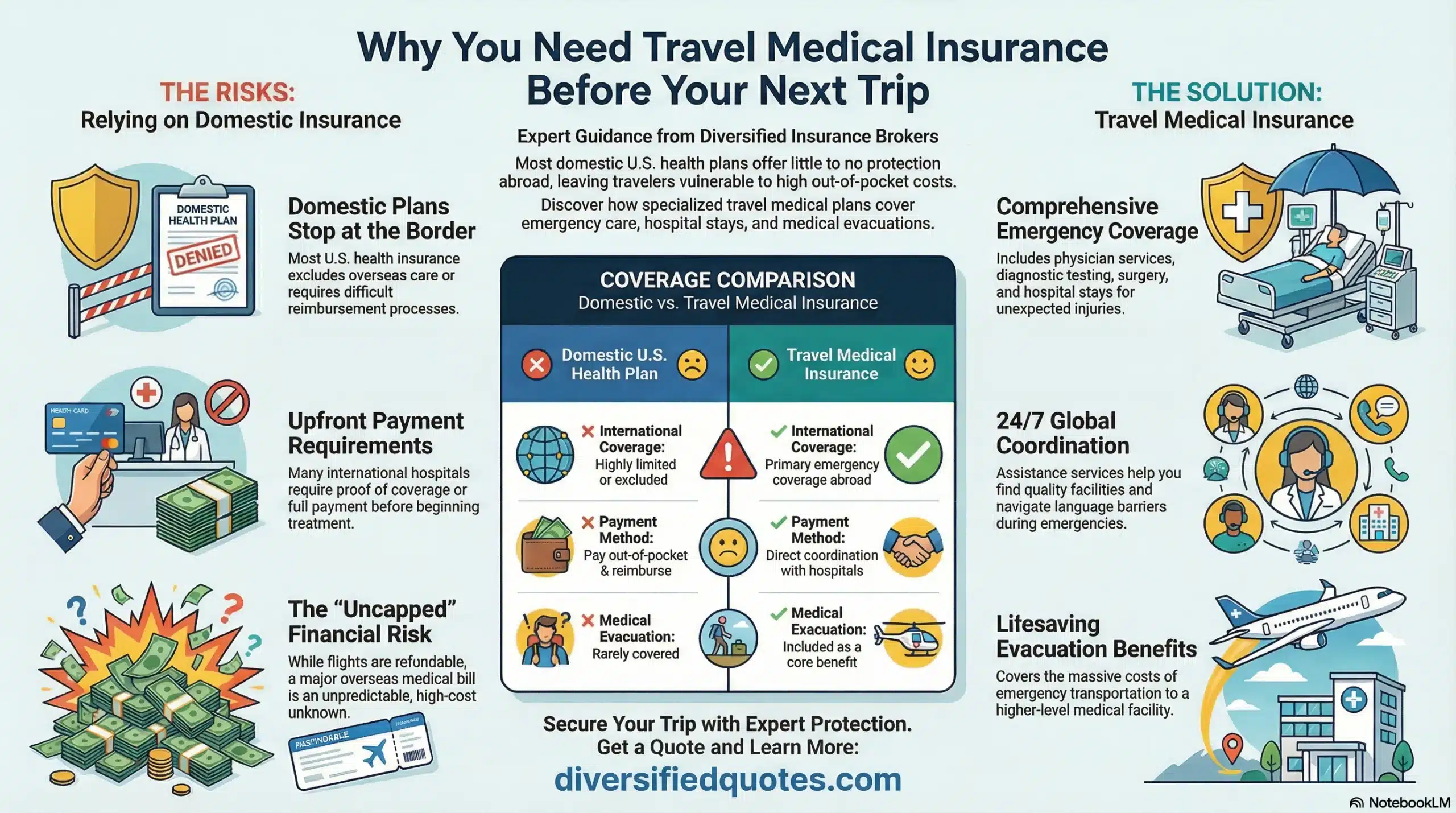
Travel medical and evacuation insurance from the Central African Republic is one of the most important protections you can put in place before you travel, work, or live in the region. In many parts of the Central African Republic, healthcare access can be limited, specialist care may be unavailable outside major population centers, and emergency transportation can be difficult to coordinate quickly without the right coverage and assistance support. When a medical emergency happens overseas, the cost isn’t only the hospital bill — it’s also the logistics of getting to the right facility fast, which can become an even larger financial risk than the treatment itself. Travel medical and evacuation coverage from Central African Republic is built for exactly that scenario: serious emergencies in environments where local resources alone are not enough to protect you.
At Diversified Insurance Brokers, we help travelers and expatriates secure international plans built for real-world emergencies, including high-cost hospitalization, emergency surgeries, and medical evacuation services that can transport you to a facility capable of treating your condition. These travel medical and evacuation plans are designed to work when your destination is remote, medical systems are under-resourced, or you want the confidence of knowing there is a coordinated team available when every minute matters. If you’re comparing destination-based coverage options, it also helps to review our broader guidance on travel medical insurance so you understand how medical limits, deductibles, and evacuation terms work together before comparing plans for the Central African Republic specifically.
Secure Travel Medical and Evacuation Coverage
Get international medical coverage options designed for emergencies, hospitalization, and evacuation support from the Central African Republic.
Questions? Call 800-533-5969
Why Travel Medical and Evacuation Insurance Matters in the Central African Republic
The Central African Republic is a destination where being prepared is not just smart — it is essential. Travel medical and evacuation coverage matters here because even if you are traveling to a main population center, emergency medical situations do not always happen near the best hospital, and local response times can vary dramatically. The real risk is that a routine medical event at home can become a complicated, expensive, and time-sensitive situation abroad when you need diagnostics, advanced medications, surgical support, or intensive care that is not locally available. In a higher-risk travel environment, the purpose of travel medical insurance is not to cover small inconveniences — it is designed for major events, serious accidents, sudden illness, and unexpected infections that can’t be delayed.
The purpose of evacuation coverage in a destination like the Central African Republic is even more critical: it is what connects you to a higher level of care when the facility you are in cannot treat you safely, quickly, or completely. Many travelers underestimate how fast costs can escalate — emergency room stabilization, imaging, lab work, and inpatient monitoring can add up quickly, and if a transfer is needed to another city or another country, expenses can multiply rapidly. This is why many travelers also explore emergency medical evacuation insurance as a standalone concept before selecting a plan that combines both travel medical and evacuation benefits in one integrated design.
| CAR Location / Traveler Type | Medical Access Reality | Key Coverage Priority | Primary Evacuation Route |
|---|---|---|---|
| Bangui — diplomatic / UN / NGO / humanitarian | Hôpital de l’Amitié (Friendship Hospital) and Complexe Pédiatrique provide the best available CAR care; MSF and ICRC maintain Bangui medical presence serving the humanitarian population; specialist depth severely limited for cardiac, neurological, and advanced trauma events; cash payment environment; Bangui M’Poko International Airport provides Yaoundé, Douala, Paris, and regional connections | Maximum evacuation limits; war and civil unrest exclusion explicitly reviewed with carrier before purchase — active armed group presence across CAR makes this non-negotiable; security evacuation as separate product; assistance team with CAR operational experience including MINUSCA environment awareness; payment guarantee capability | Yaoundé or Douala (Cameroon) as primary regional hub — direct Air France Douala-Paris connection creates two-leg European chain; Paris direct via Air France Bangui connection for some cases; Nairobi as alternative for East Africa-connected itineraries |
| Berbérati / Bouar — western CAR | Prefectural hospitals with very limited capability; Berbérati has a functional airstrip making it one of the more logistically accessible secondary cities for evacuation; proximity to Cameroon border creates cross-border ground transport option to Bertoua or Yaoundé for some events; MSF has operated in this corridor intermittently | Evacuation limits covering Bangui staging plus Yaoundé or Douala international routing; war exclusion review essential — western CAR has experienced armed group activity; assistance team knowledge of Berbérati airstrip accessibility and Cameroon border crossing logistics | Airstrip to Bangui for staging; Bangui to Yaoundé or Douala for regional care; Cameroon ground border crossing as alternative first leg for some western CAR locations; multi-leg chain requires pre-established assistance team protocols |
| Bambari / Bria — eastern / central CAR | Among the most conflict-affected areas in CAR; MSF has maintained presence in Bambari given conflict-driven medical needs; Bria has experienced repeated cycles of armed group control and displacement; extremely limited functional medical infrastructure outside humanitarian organization facilities; armed group presence creates active security risk requiring dual coverage evaluation | Security evacuation as mandatory parallel product — not optional for eastern CAR deployment; maximum medical evacuation limits; war exclusion review non-negotiable; satellite communication essential; assistance team pre-briefed on specific eastern CAR operational context before any field movement; MINUSCA coordination protocols understood | Air charter from nearest accessible airstrip (MINUSCA flight coordination may be required in some scenarios) to Bangui; Bangui international routing to Yaoundé or Paris; eastern CAR evacuation is among the most logistically complex on the African continent |
| Mining / extractive sector — Sangha / Lobaye regions | Southwestern CAR’s timber and mining zones have company-specific medical arrangements that vary significantly by operator; Sangha River corridor provides water transport access to Congo-Brazzaville border; Nola and Bayanga areas serve as bases for conservation and ecotourism with minimal medical infrastructure; occupational injury risk in forestry and mining environments | Individual coverage complementing or replacing company medical; occupational injury coverage for mining and forestry work environments; Congo-Brazzaville border crossing logistics pre-established as alternative evacuation option; satellite communication for remote southwestern CAR locations | Sangha River to Ouesso (Republic of Congo) as alternative southern exit; Bangui via air charter for most serious events; Yaoundé or Douala via Bangui staging for international specialist care |
| Conservation / wildlife / research — Dzanga-Sangha | Dzanga-Sangha Special Reserve in extreme southwestern CAR is one of Africa’s premier lowland gorilla and forest elephant research sites; WWF and international conservation organizations maintain a permanent presence; nearest functional hospital is Bayanga clinic (very limited) or Bangui (approximately 700 km); river and forest travel creates injury, waterborne disease, and wildlife contact risk | Maximum evacuation limits; wildlife contact and animal attack coverage confirmation; waterborne disease treatment coverage; expedition medical kit as essential complement to coverage; satellite communication mandatory; assistance team pre-engagement with specific Dzanga-Sangha itinerary and established contact schedule | Air charter from Bayanga airstrip or Nola to Bangui; Bangui to Yaoundé or Paris for international care; one of the most remote evacuation scenarios accessible to conservation travelers on the African continent — pre-established protocols before entering the reserve are the only viable approach |
What Travel Medical Coverage Typically Helps Pay For
Travel medical insurance for the Central African Republic is designed to help pay for unexpected healthcare expenses outside your home country. In this region, many facilities may require proof of payment or upfront payment arrangements before providing high-level treatment — making a plan with a global assistance team valuable not just for financing care but for coordinating it. Depending on the plan and benefits selected, travel medical coverage can help with hospitalization, emergency physician services, outpatient treatment, emergency imaging and diagnostics, prescription medications related to the event, ambulance transport, and medically necessary follow-up care while still abroad. Coverage may also include dental emergency benefits when the issue results from an accident.
For travel medical coverage from the Central African Republic, one of the most important factors is whether the plan has a high enough medical maximum to realistically cover the type of emergency you want protected. A low-limit plan can provide a false sense of security if the medical maximum is exhausted by a short hospital stay or a single significant procedure. We typically recommend higher benefit levels for destinations where evacuation is a realistic possibility, because the combined cost of treatment and transport can be substantially higher than travelers expect when they are comparing plan options at home.
Medical Evacuation from the Central African Republic: The Coverage That Changes Everything
Medical evacuation coverage can be the difference between receiving basic stabilization care locally and receiving specialized treatment at a facility that can actually resolve the emergency. In many high-risk travel destinations including the Central African Republic, evacuation is not a luxury — it is the bridge to real care. When local resources are limited, the most medically appropriate next step may be a transfer to another country that has advanced trauma, cardiology, neurology, surgical, or ICU capabilities. Travel medical and evacuation from the Central African Republic must be planned for in advance because activating it during an emergency requires a coordinated team response, not last-minute provider searches.
Evacuation from the Central African Republic is expensive because it is operationally complex. It may involve medical staffing, aircraft coordination, equipment, flight clearance, secure routing, coordination with receiving hospitals, and rapid documentation. A properly structured travel medical and evacuation plan should provide coordinated support — not just a reimbursement promise after the event. This distinction matters enormously in practice. When the assistance team is involved early, it can reduce delays, lower complications, and help ensure the patient is transferred to the right facility for the specific medical need rather than simply the nearest available one.
What Makes Travel to the Central African Republic Higher Risk
High-risk travel is not only about personal health — it is about the environment. Travel medical and evacuation from the Central African Republic carries elevated risk because the destination involves limited medical infrastructure, inconsistent emergency response capability, remote travel routes in many areas, language barriers, limited access to stable ground transportation, and conditions that can create delays in reaching care. In these conditions, even a healthy traveler faces higher medical exposure simply because basic problems become harder to solve quickly. A common concern for travelers seeking travel medical and evacuation coverage from the Central African Republic is the ability to access advanced diagnostics or specialist evaluation in a timely way if something serious happens — and that concern is well-founded given the regional infrastructure realities.
Some travelers also need protection for extended time abroad, and that is where plans designed for longer stays become more appropriate than short trip-only designs. If your travel or residence plan includes multiple international stops, you may benefit from exploring international health insurance options structured for longer duration and more consistent medical access abroad. For group travel such as mission work or NGO deployments to the Central African Republic, our resource on cheap group travel insurance provides a framework for coordinating travel medical and evacuation coverage across a team.
Pre-Existing Conditions and Travel Medical Coverage from the Central African Republic
Pre-existing condition coverage is one of the most misunderstood aspects of travel medical and evacuation insurance. Some plans exclude pre-existing conditions entirely. Some offer limited coverage for what the policy defines as an acute onset event. Others offer broader coverage depending on underwriting, plan structure, and the timing of purchase relative to the trip. The details matter for travel medical and evacuation from the Central African Republic because the wrong assumption can cause a denial when a traveler needs help the most — and in a destination with limited local resources, that denial is not just a financial problem but a care coordination problem.
If you have ongoing medications, chronic conditions, past surgeries, or prior diagnoses, it is important to understand exactly how the travel medical plan treats that history before purchasing. This is one of the most valuable reasons to work with an advisor: we can help you compare wording and benefits so you are not relying on guesswork when selecting travel medical and evacuation coverage from the Central African Republic. Even if your medical history is clean, travelers in this region sometimes experience unexpected infections, injuries, or complications from environmental conditions — which a travel medical plan focused on emergency treatment can address effectively regardless of pre-existing history.
What to Look for in a Travel Medical and Evacuation Policy Before You Buy
Before selecting a travel medical and evacuation plan for the Central African Republic, it is important to confirm how the policy defines a covered emergency, how evacuation is triggered, what approval requirements exist, and whether evacuation is provided as a coordinated service or only as a reimbursement-only benefit. In higher-risk destinations, coordination is often the difference between smooth execution and chaos. It is also important to confirm how the plan handles hospital admission requirements, whether direct billing networks are available in the region, and what documents may be needed in a claim scenario.
A critical distinction when selecting travel medical and evacuation coverage from the Central African Republic is whether the plan is primarily travel insurance with limited medical coverage, or a true travel medical policy built for emergencies. Many travelers mistakenly buy basic travel insurance because it is heavily marketed — but those plans may focus on trip cancellation, baggage loss, and delays while offering lower medical limits. If your priority is medical stability and evacuation access, you want a policy that is medical-first. For travelers who are price-sensitive but still want meaningful protection, comparing options through our general cheap travel insurance resource can help while keeping in mind that the cheapest plan is not the safest plan when travel conditions are higher risk.
Why Work With Diversified Insurance Brokers for Travel Medical and Evacuation
When travel is to a high-risk destination like the Central African Republic, the wrong coverage can be almost as dangerous as having no coverage at all. The goal is not simply to have a travel medical and evacuation policy — it is to have the right type of protection that will actually respond when a serious medical event happens in a challenging environment. At Diversified Insurance Brokers, we help travelers select coverage based on real-world risk and how the plan works in practice, not just how it looks on a quote screen. Our role is to help you choose a travel medical and evacuation plan that matches your timeline, your destination profile, and your risk tolerance — especially when evacuation and coordinated support could be required.
The most important rule with travel medical and evacuation coverage from the Central African Republic is simple: you have to secure it before you need it. Once a medical emergency happens overseas, coverage gaps cannot be fixed retroactively. When your plan is in place, you gain access not only to financial protection but to global support resources that can help coordinate care, guide you to appropriate facilities, and manage emergency transportation when needed. Apply before you travel — and treat travel medical and evacuation coverage from the Central African Republic as a proactive step, not a last-minute purchase.
Apply Before You Travel
Secure travel medical and evacuation coverage for the Central African Republic before you depart.
Financial Protection Essentials
Travel medical and evacuation is one layer of a complete protection strategy. Explore these related coverage areas.
Related Travel Medical & Evacuation Pages
Talk With an Advisor Today
Choose how you’d like to connect—call or message us, then book a time that works for you.
Schedule here:
calendly.com/jason-dibcompanies/diversified-quotes
Licensed in all 50 states • Fiduciary, family-owned since 1980
Travel Medical and Evacuation from Central African Republic — FAQs
Travel medical and evacuation insurance is designed to cover the two biggest financial and logistical risks of a serious medical event abroad: the cost of treatment and the cost of getting to appropriate treatment. On the medical side, most plans cover emergency hospitalization, physician and specialist services, emergency surgery, diagnostic imaging and lab work, prescription medications related to the covered event, ambulance transport, and medically necessary follow-up care while still outside your home country. Some plans also include emergency dental coverage when the issue results from an accident. Coverage limits, deductibles, and specific benefit definitions vary by plan and carrier, which is why comparing plan documents rather than marketing summaries is essential before selecting coverage for a destination like the Central African Republic.
On the evacuation side, most travel medical and evacuation plans cover the cost of medically necessary transport from the location of the emergency to the nearest facility capable of providing appropriate treatment — which may be in a different city, a different country, or even a return to your home country depending on the medical situation and the plan’s repatriation provisions. In the Central African Republic, evacuation coverage is particularly critical because the gap between what is locally available and what may be medically necessary can be very significant, and the logistics of arranging emergency air transport without a coordinated assistance team are both complicated and expensive. Coordination — not just reimbursement — is what makes evacuation coverage functional in practice rather than theoretical.
Evacuation coverage from the Central African Republic is especially important because the gap between locally available medical care and the level of care that may be required for a serious emergency can be substantial. Many areas of the Central African Republic have limited hospital infrastructure, restricted specialist availability, and inconsistent access to advanced diagnostics, surgical capabilities, or intensive care units. When those limitations become relevant — in a trauma, cardiac, neurological, or infectious disease emergency — the ability to move a patient to a higher-level facility is not a comfort measure, it is often the difference between an appropriate medical outcome and a preventable one.
Evacuation from the Central African Republic is also logistically demanding in ways that make it essential to have a coordinated assistance team rather than attempting to arrange transport independently. Air ambulance coordination, medical staffing during transport, securing appropriate receiving facilities, managing international documentation, and ensuring continuity of care across the evacuation are all components that require professional coordination to execute properly and quickly. Without travel medical and evacuation coverage that includes active coordination support, a traveler or their family may be attempting to manage these logistics — often under significant emotional pressure and in a foreign healthcare and regulatory environment — at precisely the moment when they least have the capacity to do so effectively.
No — while travel medical and evacuation coverage from the Central African Republic is commonly purchased by contractors, NGO workers, journalists, humanitarian aid workers, and mission teams, it is equally valuable for standard travelers because serious medical events can and do happen unexpectedly to healthy people regardless of the purpose of their travel. An accident, a sudden illness, an infection, or an unexpected acute event does not discriminate based on whether the traveler is on a work assignment or a personal visit. The logistical and financial challenges of managing that event in a resource-limited destination are the same regardless of the traveler’s professional category.
The practical value of travel medical and evacuation coverage is proportional to the gap between what is locally available and what the traveler may need — and in the Central African Republic, that gap is significant enough that virtually any traveler benefits meaningfully from having proper coverage in place. The travelers most likely to regret not having travel medical and evacuation coverage are not the ones who expected something to go wrong — they are the ones who assumed nothing would happen and discovered how quickly costs and logistics can escalate when they do.
Coverage for pre-existing conditions in travel medical and evacuation insurance varies significantly by plan and carrier. Some plans exclude all pre-existing conditions entirely — meaning any emergency related to a condition that existed before the policy effective date would not be covered. Some plans offer limited coverage for what they define as an acute onset event: a sudden, unexpected manifestation of a pre-existing condition that requires immediate emergency treatment and that the traveler had no reason to anticipate. A limited number of plans offer broader pre-existing condition coverage depending on underwriting, application timing, and plan structure.
For travelers with pre-existing medical conditions planning travel to the Central African Republic, confirming the exact treatment of that history in the plan being considered is essential — not an optional step. The specific wording of pre-existing condition exclusions and acute onset provisions can determine whether a major medical event is covered or excluded, and in a destination where treatment options are limited and evacuation may be required, an excluded event creates both a financial and a care coordination crisis simultaneously. Working with an advisor who can compare plan wording side by side for your specific health history is the most reliable way to ensure that your travel medical and evacuation coverage for the Central African Republic will respond the way you expect it to.
When a medical emergency requires evacuation from the Central African Republic, the process begins with contacting the insurer’s global assistance team — either directly by the traveler, by a companion, or by the treating facility. This initial contact is critical because it activates the coordination process. The assistance team evaluates the medical situation, identifies the appropriate level of care needed, determines the most appropriate receiving facility based on the nature of the emergency and the medical resources required, and begins coordinating transport. In genuine emergencies, this process can begin moving very quickly, which is why having the plan’s emergency contact information readily accessible before travel begins is an important preparation step.
The assistance team’s role goes beyond simply arranging transportation — they coordinate with the treating facility, ensure appropriate medical staffing for the transport, manage documentation and regulatory requirements for international medical movement, and facilitate communication between the sending facility, the transport team, and the receiving facility. This coordination function is what separates a properly structured travel medical and evacuation plan from a reimbursement-only arrangement where the traveler bears the logistical burden themselves. Most plans require pre-authorization for non-emergency evacuation and encourage contact as early as possible in any situation that might develop into an evacuation scenario, because early involvement allows the assistance team to manage the situation proactively rather than reactively.
Some travel medical and evacuation policies allow repatriation to your home country when medically appropriate, while others cover evacuation only to the nearest facility capable of providing appropriate treatment — which may or may not be in your home country depending on geography, the nature of the medical emergency, and the capabilities of regional facilities. The distinction between “nearest adequate facility” and “home country repatriation” can be significant in practice, and understanding which standard applies in the specific plan you are considering is an important part of the plan selection process for travel to the Central African Republic.
Home country repatriation is typically available when the medical situation has stabilized enough that the primary clinical need is for ongoing care rather than acute intervention, and when transport to the home country is medically appropriate and logistically feasible. Some plans include repatriation of remains as a benefit in the event of death abroad, which is a separate benefit from medical evacuation. For travelers with strong preferences about where they want to receive ongoing care following a medical evacuation — particularly those with established specialist relationships or ongoing chronic condition management at home — confirming the repatriation provisions of any travel medical and evacuation plan before purchase is essential.
Common exclusions in travel medical and evacuation insurance include non-emergency care and elective treatment, routine medical care that could have been anticipated before travel, injuries resulting from activities specifically excluded by the plan such as certain adventure sports or professional activities, care sought without required pre-authorization for non-emergency services, and limitations related to conflict zones or acts of political violence depending on the specific carrier and plan language. Exclusions for pre-existing conditions are also common, as discussed elsewhere in these FAQs, and the scope of those exclusions varies significantly across carriers and plan types.
For travel to the Central African Republic specifically, it is worth carefully reviewing any conflict zone exclusions or political violence exclusions in the plan being considered, since regional conditions can be variable. Some carriers have specific carve-outs or limitations for destinations with active travel advisories at certain levels, and understanding how the plan treats the destination’s advisory status before purchasing is important. Some plans may exclude coverage for injuries or illnesses resulting from the specific conditions that create the elevated travel advisory rather than excluding the destination entirely. Reading the exclusions section of any travel medical and evacuation plan — not just the benefits summary — is the most reliable way to understand what the policy will and will not cover before you need to rely on it.
Emergency medical evacuation costs vary based on the nature of the medical emergency, the distance and routing required, the level of medical staffing needed during transport, and the availability of appropriate aircraft and receiving facilities. In general, international air ambulance evacuation can cost anywhere from tens of thousands of dollars for shorter regional transport to well over $100,000 for intercontinental medical transport requiring intensive care-level staffing and specialized equipment. For evacuation from the Central African Republic to a regional hub with more advanced medical capabilities, even a relatively straightforward medical transport can produce costs that most travelers would not be prepared to absorb out of pocket.
Beyond the direct transport cost, a traveler without travel medical and evacuation coverage also bears the logistical burden of identifying an appropriate air ambulance provider, arranging payment or financial guarantees, selecting a receiving facility, and coordinating all of the moving parts of an international medical evacuation — typically while also managing the emotional stress of the medical emergency itself. The combination of the financial exposure and the logistical burden is what makes travel medical and evacuation coverage particularly valuable for destinations like the Central African Republic, where the probability of evacuation being needed in a serious emergency is meaningfully higher than in destinations with more developed medical infrastructure.
Travel medical and evacuation coverage for the Central African Republic should be purchased before you depart — ideally as early as possible after your travel plans are confirmed. Purchasing early can preserve access to time-sensitive benefit features in some plans, such as pre-existing condition coverage provisions that may require purchase within a defined window from the initial trip deposit. Waiting until the last minute before departure can limit options, particularly if coverage needs to be reviewed carefully against your specific health history or if the plan selection process requires comparing multiple options.
Once you have identified appropriate coverage, the application process is typically straightforward and can be completed online in a short period of time. After approval and payment, you receive policy documentation including the plan’s emergency contact information, which should be saved in an easily accessible location — and shared with a trusted contact at home — before you travel. The most important rule is that you must have coverage in place before an emergency occurs. Travel medical and evacuation coverage cannot be purchased after an event has begun, and gaps cannot be remedied retroactively once a medical situation is already developing. Treating the purchase of travel medical and evacuation coverage from the Central African Republic as a mandatory pre-departure step — not an optional add-on to consider once you arrive — is the mindset that ensures the coverage is actually available when you need it most.
About the Author:
Jason Stolz, CLTC, CRPC, DIA, CAA and Chief Underwriter at Diversified Insurance Brokers (NPN 20471358), is a senior insurance and retirement professional with more than 25 years of real-world experience helping individuals, families, and business owners protect their income, assets, and long-term financial stability. As a long-time partner of the nationally licensed independent agency Diversified Insurance Brokers, Jason provides trusted guidance across multiple specialties—including fixed and indexed annuities, long-term care planning, personal and business disability insurance, life insurance solutions, Group Health, Travel Medical and Evacuation Insurance, and short-term health coverage. Diversified Insurance Brokers maintains active contracts with over 100 highly rated insurance carriers, ensuring clients have access to a broad and competitive marketplace.
His practical, education-first approach has earned recognition in publications such as VoyageATL, and contributions from his agency featured in Kiplinger and GoBankingRates— highlighting his commitment to financial clarity and client-focused planning. Drawing on deep product knowledge and years of hands-on field experience, Jason helps clients evaluate carriers, compare strategies, and build retirement and protection plans that are both secure and cost-efficient. Visitors who want to explore current annuity rates and compare options across multiple insurers can also use this annuity quote and comparison tool.
Explore More Travel Medical Insurance Options: Browse our complete guide to Africa & Middle East Travel Medical Insurance — covering medical evacuation coverage for Africa, Middle East & high risk destinations.
Last Reviewed: June 19, 2026 |
Reviewed by: Jason Stolz, CLTC, CRPC, DIA, CAA
Chief Underwriter, Diversified Insurance Brokers, Inc. | NPN: 20471358 | Diversified Insurance Brokers, Inc. — Licensed in all 50 states
Fact Checked by: Tonia Pettitt, CMIP©
Medicare Specialist, Diversified Insurance Brokers, Inc. | NPN: 14374308 | Diversified Insurance Brokers, Inc. — Licensed in all 50 states
Did you find this content helpful? Leave us a Google review — it helps others find trustworthy guidance too.
Editorial Standards: Diversified Insurance Brokers maintains rigorous editorial standards to ensure accuracy, clarity, and independence in all content. Learn more about our editorial standards and commitment to transparency.
