
Travel Medical and Evacuation from Kenya
Travel Medical and Evacuation from Kenya

Jason Stolz CLTC, CRPC, DIA, CAA
Kenya is one of Africa’s most iconic travel destinations and one of the continent’s most economically significant countries — a nation where the Maasai Mara’s wildebeest migration, Amboseli’s elephant herds beneath Kilimanjaro, the ancient Swahili port culture of Mombasa, the Great Rift Valley’s dramatic geology, and Nairobi’s position as East Africa’s premier business and diplomatic hub combine to create a traveler experience that spans luxury safari tourism, serious wildlife research, NGO and development work, diplomatic operations, and regional business travel across dozens of sectors. Kenya’s geographic diversity — from equatorial highland plateaus to coastal lowlands to semi-arid savanna — is precisely what makes it remarkable and precisely what makes medical planning consequential. A traveler who spends their entire Kenya trip in Nairobi has a fundamentally different medical risk profile than a traveler who moves through the Maasai Mara, camps in the Rift Valley, explores the coastal regions of Mombasa or Lamu, or works in the agricultural regions of the western highlands or the Turkana basin in the north. Travel medical and evacuation insurance from Kenya is the coverage infrastructure that ensures a serious medical event anywhere on that geographic spectrum has a structured, coordinated response pathway — regardless of how far the traveler is from Nairobi’s private hospital corridor when the event occurs.
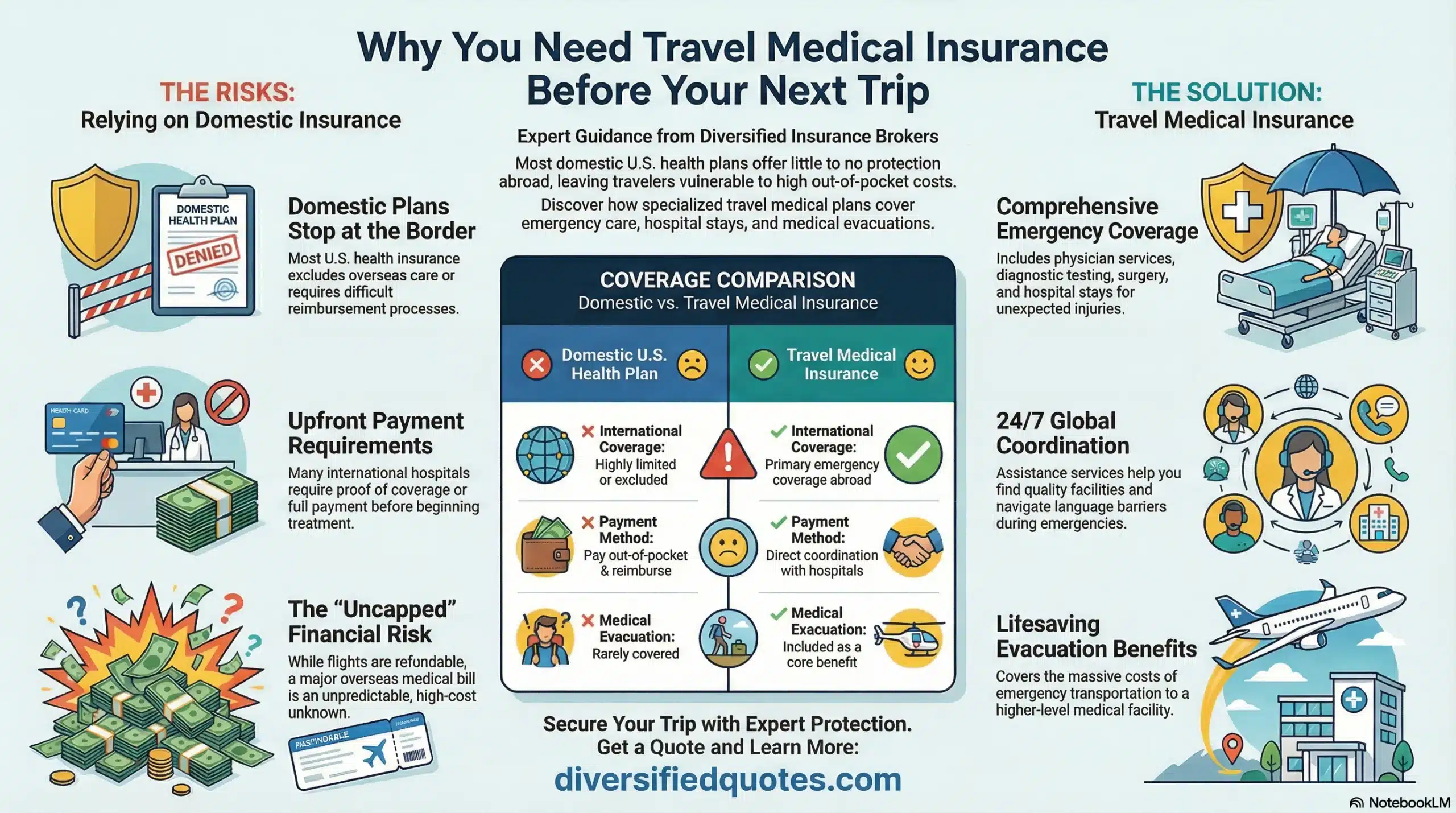
At Diversified Insurance Brokers, we help travelers, families, students, and professionals compare travel medical plans built for real emergencies — plans whose practical value is demonstrated not in the routine moments but in the urgent ones, when a decision must be made quickly about where to go and how to get there safely. Kenya’s private hospital sector in Nairobi is genuinely strong by regional East African standards — the Aga Khan University Hospital, Nairobi Hospital, MP Shah Hospital, and Karen Hospital provide specialty care that makes Nairobi one of the continent’s most capable medical hubs. The Aga Khan in particular has world-class cardiac, oncological, and neurosurgical capability that makes it a regional evacuation receiving destination for patients from across East and Central Africa. But Nairobi’s hospitals are hours away from most of Kenya’s safari regions, coastal areas, and interior travel routes — and the medical challenge for most serious Kenya travel emergencies is not the quality of the nearest Nairobi facility but the time, distance, and logistics required to reach it. To understand how travel medical plans are structured and what they actually cover, our guide to travel medical insurance explains the fundamentals. For the specific mechanics of how evacuation decisions are made, authorized, and coordinated, our guide to emergency medical evacuation insurance covers the process in detail. For travelers on extended Kenya assignments or expat stays who need ongoing coverage rather than short-trip emergency protection, international health insurance covers the longer-term structure.
Travel Medical & Evacuation Coverage for Kenya
Apply online for travel medical insurance that includes emergency care and evacuation coordination for Kenya travel and extended stays.
Why Travel Medical Coverage Matters More in Kenya Than Travelers Expect
The case for travel medical and evacuation coverage in Kenya is fundamentally about distance and time — the two variables that determine whether a serious medical event has a manageable outcome or a catastrophic one. Nairobi’s private hospital corridor is genuinely excellent, and travelers who stay within the capital have access to care that is comparable to private hospital standards in many developed countries. The challenge is that most Kenya itineraries take travelers well beyond that corridor. The Maasai Mara is approximately 270 kilometers from Nairobi by road — a five to six hour drive under typical conditions, and significantly longer under adverse weather or road conditions. Amboseli is approximately 240 kilometers away. The Samburu National Reserve is 320 kilometers north. Mombasa’s coastal region is 500 kilometers from Nairobi. Lamu, the historic island town at the northern coast, is nearly 700 kilometers distant. A traveler who experiences a serious trauma injury from a safari vehicle incident in the Maasai Mara, a severe allergic reaction during a Samburu bush walk, a cardiac event at altitude in the Aberdare highlands, or a complex infection during coastal travel in Mombasa faces a logistics challenge whose difficulty is determined by the distance to Nairobi — and by whether there is already a coordinated response plan in place or whether the response must be improvised under emergency conditions.
Kenya is also home to AMREF Health Africa, which operates the Flying Doctors Service — the iconic East African air ambulance and aeromedical transport service that has operated across East Africa for decades and that forms the backbone of aeromedical evacuation in the region. Travelers who have purchased travel medical and evacuation coverage from a plan whose assistance team works with AMREF’s Flying Doctors network have access to one of the continent’s most experienced aeromedical transport providers operating out of Wilson Airport in Nairobi. The practical benefit is straightforward: a serious event in the Maasai Mara can be responded to with a Flying Doctors fixed-wing or helicopter dispatch, stabilization at the scene or nearest clinic, and transport to Nairobi’s Aga Khan or Nairobi Hospital within a timeline that dramatically improves the clinical outcome versus an improvised overland response. That is the tangible, real-world value of having Kenya evacuation coverage in place before the event occurs. What is the primary reason people buy travel medical insurance covers the risk assessment framework that underlies this planning decision for international travelers in destinations where distance to care is the primary variable.
Kenya Travel Medical: Coverage Priorities by Itinerary Type and Traveler Category
| Kenya Itinerary / Traveler Type | Medical Access Reality | Most Critical Coverage Priority | Primary Evacuation Route |
|---|---|---|---|
| Nairobi — business / diplomatic | Aga Khan University Hospital, Nairobi Hospital, MP Shah — strong private hospital access; meaningful specialty depth; financial exposure at private pay rates significant; most events manageable locally | Emergency medical limits for Nairobi private hospital billing; evacuation to Mumbai or London for highest-complexity events exceeding local specialty capability; direct billing assistance | Aga Khan Nairobi for most events; Mumbai or London for complex specialty cases requiring capability beyond Kenya’s private sector |
| Maasai Mara / Amboseli / safari regions | Lodge-based first aid; basic clinic at nearest town; 4-6 hours overland from Nairobi; AMREF Flying Doctors aeromedical response available; wildlife accident, heat, and vehicle injury risk | AMREF-compatible aeromedical evacuation to Nairobi; air ambulance or fixed-wing for serious events; assistance team with Kenya safari region logistics familiarity; activity coverage for safari excursions | AMREF Flying Doctors from Wilson Airport to Maasai Mara airstrips; Nairobi private hospital as primary receiving facility; international evacuation from Nairobi if needed |
| Mombasa / Lamu / coastal Kenya | Mombasa Hospital and Aga Khan Mombasa provide coastal care; limited specialist depth; Lamu extremely remote; water sports, heat, and tropical illness exposure; 500-700km from Nairobi | Coastal evacuation to Nairobi for specialty events; water activity coverage confirmation; tropical disease coverage; AMREF coastal Kenya routing knowledge | Air transport from Mombasa or Lamu to Nairobi; Nairobi private hospital for specialist events; international evacuation from JKIA if needed |
| NGO / humanitarian / field work | Field deployments in Turkana, Marsabit, Garissa, or other remote counties have minimal local medical infrastructure; long distances from Nairobi; extended deployments increase cumulative illness probability | Maximum evacuation limits; group coverage for organizational deployments; pre-existing condition terms for field staff; assistance team with Kenya remote county aeromedical routing knowledge | AMREF or charter to nearest airstrip; Nairobi for staging; international evacuation if Nairobi care is insufficient for the event |
| Students / volunteers / extended stay | University programs in Nairobi have some campus health access; rural volunteer programs have minimal local care; extended stays increase cumulative medical probability; medication resupply variable outside Nairobi | Coverage structure appropriate for stay duration; pre-existing condition review; evacuation clarity for remote program locations; medication supply planning for extended stays | Program-location dependent; Nairobi as hub for most cases; international evacuation from JKIA for serious events |
Health Risks, Pre-Existing Conditions, and Coverage Structure
Kenya’s health risk profile for international travelers encompasses the full range of tropical and sub-tropical exposures alongside the specific injury and environmental risks created by safari travel and Kenya’s geographic diversity. Malaria is present across Kenya’s coastal regions, Rift Valley, and most areas outside Nairobi above the malaria transmission altitude line, with highest transmission during the two rainy seasons. Travelers on safari and coastal routes are in the highest exposure areas, and severe malaria — particularly cerebral malaria — is a genuine life-threatening emergency that requires immediate intensive management. Typhoid, hepatitis A, and waterborne gastrointestinal illness are consistent risks from food and water exposure. Yellow fever vaccination is required for some Kenya entry scenarios depending on the traveler’s prior itinerary. Rabies risk is genuine for travelers with potential wildlife contact, particularly in safari environments where contact with smaller mammals can occur. Road traffic accidents are one of Kenya’s most significant travel health risks — Kenya’s road accident rate is high, road conditions outside Nairobi vary considerably, and overland travel between safari regions involves long drives that create sustained accident exposure. For adventure and active travelers, dehydration and heat illness in Kenya’s hot savanna regions, altitude illness for travelers approaching Mount Kenya or the Aberdare highlands, and activity-specific injuries from horseback safaris, mountain biking, and water sports all create specific coverage considerations.
Pre-existing condition terms require explicit review for Kenya travel — particularly for safari and remote itinerary travelers where any serious event is more likely to require aeromedical evacuation. The most financially consequential Kenya medical events — cardiac events during physical activity, trauma injuries from safari vehicles or road accidents, severe malaria in travelers with underlying conditions, dehydration crises in travelers with renal or cardiac history — are precisely the scenarios most likely to have a pre-existing condition connection for travelers in their 50s, 60s, and beyond who make up a significant portion of Kenya’s safari tourism market. For organizations deploying multiple staff, travel medical insurance for large groups covers the structural advantages of group plans over individually managed policies for Kenya deployments. Faith-based mission organizations and volunteer groups in Kenya benefit from travel medical insurance for religious groups, covering specific group coordination considerations. For comparison context across the broader East and Central African region where Kenya-based travelers commonly extend their itineraries, our pages on travel medical and evacuation from Burundi, travel medical and evacuation from Congo, and travel medical and evacuation from Angola cover neighboring destinations with comparable or more demanding coverage evaluation requirements. Our guide to travel and medical insurance for high-risk travel covers the framework for evaluating coverage when Kenya is combined with higher-risk regional destinations. How to get the best travel medical insurance rates covers the comparison methodology for identifying the most appropriate and cost-efficient plan for a given Kenya itinerary and traveler profile.
Get Covered Before You Travel
Apply online now to secure travel medical and evacuation coverage for Kenya.
Related Travel Medical Pages
If you are comparing plan types or building a multi-country route, these pages help you line up coverage design with real-world medical access and evacuation needs.
Related Destination Pages
These destination pages help you compare how needs change based on infrastructure, distance to care, and travel logistics.
Travel Medical and Evacuation from Congo
Travel Medical and Evacuation from Angola
Travel Medical and Evacuation from Ivory Coast
Travel Medical and Evacuation from DR Congo
Travel Medical and Evacuation from Chad
Travel Medical and Evacuation from Central African Republic
Talk With an Advisor Today
Choose how you’d like to connect—call or message us, then book a time that works for you.
Schedule here:
calendly.com/jason-dibcompanies/diversified-quotes
Licensed in all 50 states • Fiduciary, family-owned since 1980
Frequently Asked Questions: Travel Medical and Evacuation Insurance for Kenya
How does aeromedical evacuation actually work from a Kenya safari region?
AMREF Health Africa’s Flying Doctors Service, operating out of Wilson Airport in Nairobi, is the primary aeromedical transport provider for East Africa and the one most assistance teams working Kenya evacuations coordinate with. When a serious event occurs in the Maasai Mara, Amboseli, Samburu, or another safari region, the sequence typically runs: initial care at the nearest available clinic or lodge first-aid station, simultaneous assistance team contact by the camp manager, guide, or companion, clinical assessment by the assistance team’s medical staff in coordination with the treating provider, AMREF dispatch from Wilson Airport to the nearest landing strip in the safari region, stabilization and patient preparation for air transport, and reception at Aga Khan University Hospital or Nairobi Hospital as the standard receiving facility. Turnaround times from Wilson Airport to the Maasai Mara are approximately 45 minutes by fixed-wing aircraft — a timeline that is genuinely life-saving for serious trauma, cardiac events, and other time-sensitive conditions that would take six hours to reach Nairobi by road. The assistance team manages the authorization, communication, and billing coordination throughout so the camp team and patient’s companions can focus entirely on the patient.
What are the most common serious medical events for Kenya safari travelers?
Safari vehicle accidents and falls are the most common serious trauma scenarios in Kenya’s wildlife regions — game drive vehicles traverse rough terrain and river crossings, and rollovers, sudden stops, and falls from elevated viewing platforms occur with enough frequency that every safari operator has emergency protocols. Cardiac events during physically active travel are a consistent risk for older safari travelers — the combination of heat, altitude change, physical activity, and excitement creates real cardiac stress for travelers with underlying risk. Severe dehydration and heat illness in the hot savanna environment during Kenya’s dry seasons progress faster than travelers accustomed to temperate climates expect. Allergic reactions, including anaphylaxis, can be triggered by insect stings, food exposures, and plant contact in the bush environment where access to emergency epinephrine may be limited. Malaria requiring hospitalization is a genuine risk for travelers who did not complete prophylaxis or whose prophylaxis was not fully effective, particularly after coastal and Rift Valley exposure. Road accidents on the overland routes between safari regions are one of the highest-probability serious injury scenarios for Kenya travelers whose itinerary includes long drives between parks.
Does Nairobi’s hospital infrastructure mean I don’t need international evacuation coverage?
Nairobi’s private hospital sector — particularly the Aga Khan University Hospital — is genuinely strong by African standards and can handle a very wide range of serious medical events including cardiac surgery, complex trauma, advanced oncology, and neurosurgery. For many serious events, Nairobi is not just a staging point but the definitive treatment destination. That said, coverage planning for Kenya should include international evacuation for two reasons. First, some highly specialized procedures — specific subspecialty surgeries, advanced interventional radiology, certain complex oncological treatments — may still be most appropriately handled in Mumbai, London, or another international hub for some patient populations. Second, if your trip includes time outside Nairobi in safari regions, the coastal areas, or remote field deployment, evacuation coverage activates before you reach Nairobi — the AMREF aeromedical dispatch from Wilson Airport to your remote location is part of the evacuation chain, and that transport must be covered alongside any subsequent Nairobi hospital care. Our guide to emergency medical evacuation insurance covers how these multi-segment evacuation chains are coordinated and covered.
What coverage limits should I carry for Kenya travel?
Emergency medical limits of $100,000 or more are a reasonable baseline for Kenya travel, reflecting inpatient care costs at Nairobi’s Aga Khan or Nairobi Hospital for a serious event plus any continuing treatment after evacuation. For evacuation and repatriation, limits of $250,000 or more are commonly recommended — a AMREF Flying Doctors dispatch from the Maasai Mara plus Nairobi hospitalization plus international evacuation to Mumbai or London for a complex event can accumulate $50,000 to $100,000 or more in transport costs alone. For safari travelers in remote regions, the full evacuation chain from safari location to receiving Nairobi hospital to potential international hospital creates a multi-leg cost exposure that makes higher limits the more conservative choice. For NGO and field workers in Kenya’s most remote northern counties — Turkana, Marsabit, Wajir — even higher evacuation limits are appropriate given the additional transport segments required to reach Nairobi from those distances. Older travelers with cardiac or other chronic condition history should evaluate limits in light of the realistic scenario their specific health profile creates, not just the average traveler’s exposure.
Does safari activity and wildlife proximity affect my coverage?
Standard safari game drives in enclosed vehicles are covered under most travel medical plans without any special provision or rider. However, several Kenya safari activities exist in a more ambiguous coverage zone that requires explicit plan review: walking safaris where travelers move on foot in wildlife areas, horseback safaris, mountain biking excursions, hot air ballooning over the Mara, and swimming or water activities in freshwater lakes and rivers. Some plans have exclusions for activities defined as hazardous or adventurous that could encompass some of these. The practical approach is to list the specific activities your Kenya itinerary includes and confirm with the plan’s terms — or with a broker who can review the specific policy language — that each is covered before departure. This is most important for walking safaris and horseback safari activities, which involve meaningful physical risk from wildlife proximity and terrain that standard exclusion language sometimes captures. For travelers whose Kenya itinerary is heavily adventure-activity focused, our guide to high-risk travel insurance covers how activity coverage is structured in plans designed for active and adventure travel profiles.
Should I get short-term travel medical coverage or international health insurance for an extended Kenya stay?
For stays of a few weeks or less — the majority of tourist, safari, and short business visit scenarios — short-term travel medical insurance is the most practical and cost-appropriate individual coverage choice. For stays of several months or longer — students at Kenyan universities, NGO and development workers on multi-month deployments, expat families on longer assignments — the comparison with international health insurance becomes more meaningful. International health insurance provides coverage continuity across multiple years, better outpatient coverage for day-to-day medical needs beyond emergency events, better structure for ongoing medication management and chronic condition monitoring, and in some plans coverage that applies during home leave and R&R travel. For multi-year Nairobi expat assignments where the traveler will build a genuine ongoing medical relationship with Aga Khan or another Nairobi private hospital, international health insurance creates the coverage continuity that annual travel medical renewals cannot replicate. Our guide to international health insurance covers how to evaluate which structure fits a given Kenya stay duration and residency profile.
How should I prepare before leaving for Kenya to ensure my coverage works when I need it?
The preparation steps that most improve emergency outcomes in Kenya: store the assistance team’s 24/7 contact in phone contacts, on a physical card kept with the passport, and shared with both the safari camp manager or guide and a home contact who can call from outside Kenya if communication becomes unavailable. Share the policy number and assistance contact with whoever will be your primary companion at each stage of the Kenya itinerary — the safari guide who would initiate the AMREF call in a Mara emergency, the NGO camp manager who would coordinate evacuation for a field worker, the host family member who would call if a family event occurs. For safari travel, confirm whether the specific camp or lodge you are staying at has a landing strip available for AMREF aircraft and approximately how long AMREF response typically takes from Wilson Airport to that location — understanding the timeline before you need it removes a variable during the emergency itself. Carry prescription medications in original packaging with a physical list of drugs, dosages, and prescribing diagnoses, including any epinephrine auto-injectors for travelers with known severe allergies who may have insect or food exposure risk in the bush environment.
About the Author:
Jason Stolz, CLTC, CRPC, DIA, CAA and Chief Underwriter at Diversified Insurance Brokers (NPN 20471358), is a senior insurance and retirement professional with more than 25 years of real-world experience helping individuals, families, and business owners protect their income, assets, and long-term financial stability. As a long-time partner of the nationally licensed independent agency Diversified Insurance Brokers, Jason provides trusted guidance across multiple specialties—including fixed and indexed annuities, long-term care planning, personal and business disability insurance, life insurance solutions, Group Health, Travel Medical and Evacuation Insurance, and short-term health coverage. Diversified Insurance Brokers maintains active contracts with over 100 highly rated insurance carriers, ensuring clients have access to a broad and competitive marketplace.
His practical, education-first approach has earned recognition in publications such as VoyageATL, and contributions from his agency featured in Kiplinger and GoBankingRates— highlighting his commitment to financial clarity and client-focused planning. Drawing on deep product knowledge and years of hands-on field experience, Jason helps clients evaluate carriers, compare strategies, and build retirement and protection plans that are both secure and cost-efficient. Visitors who want to explore current annuity rates and compare options across multiple insurers can also use this annuity quote and comparison tool.
Explore More Travel Medical Insurance Options: Browse our complete guide to Africa & Middle East Travel Medical Insurance — covering medical evacuation coverage for Africa, Middle East & high risk destinations.
Last Reviewed: June 18, 2026 |
Reviewed by: Jason Stolz, CLTC, CRPC, DIA, CAA
Chief Underwriter, Diversified Insurance Brokers, Inc. | NPN: 20471358 | Diversified Insurance Brokers, Inc. — Licensed in all 50 states
Fact Checked by: Tonia Pettitt, CMIP©
Medicare Specialist, Diversified Insurance Brokers, Inc. | NPN: 14374308 | Diversified Insurance Brokers, Inc. — Licensed in all 50 states
Did you find this content helpful? Leave us a Google review — it helps others find trustworthy guidance too.
Editorial Standards: Diversified Insurance Brokers maintains rigorous editorial standards to ensure accuracy, clarity, and independence in all content. Learn more about our editorial standards and commitment to transparency.
