
Travel Medical and Evacuation from Spain
Travel Medical and Evacuation from Spain

Jason Stolz CLTC, CRPC, DIA, CAA
Traveling to Spain is usually one of the most rewarding international experiences an American traveler can have — world-class cities, a food culture that draws visitors from every continent, coastlines that range from the rugged Basque Country to the warm Mediterranean shores of Andalusia, and an infrastructure built around tourism that makes navigation genuinely accessible. But medical surprises do not schedule themselves around good travel planning, and Spain creates specific conditions where unexpected medical events can become logistically and financially complicated for American visitors who are not carrying the right coverage. A stomach illness that escalates to serious dehydration, a slip on the wet stone steps of a Barcelona Gothic Quarter staircase, a scooter accident on Mallorca’s coast roads, or a sudden cardiac episode in a city where the traveler does not speak Spanish and does not know the healthcare system — these are the events that turn a great trip into a crisis, and travel medical and evacuation coverage from Spain is built specifically to prevent the medical event from becoming a financial and logistical one on top of everything else.
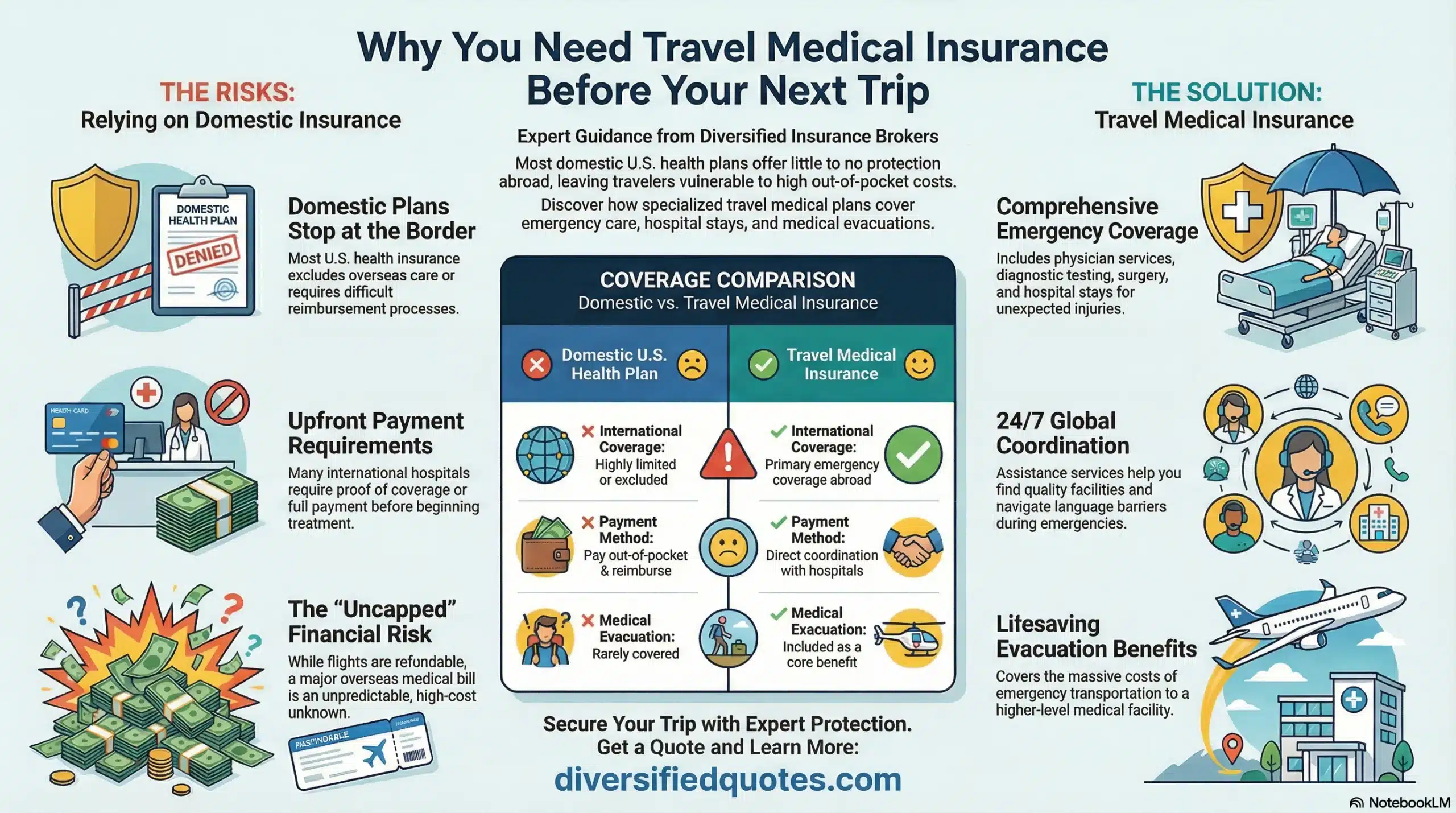
At Diversified Insurance Brokers, we help travelers compare plans that cover emergency medical treatment in Spain and plans that also include meaningful evacuation coordination — because those address two genuinely different problems. A plan that pays for an ER visit in Madrid may leave you fully exposed if you need specialist transfer to a higher-capability facility, supervised transport between the Canary Islands and the mainland, or a medically escorted return home. The goal is coverage that matches how you actually travel: your length of stay, the activities planned, your age and health profile, and whether Spain is your sole destination or one stop in a broader European itinerary. What is the primary reason people buy travel medical insurance covers the risk assessment framework that helps travelers understand why international medical coverage differs fundamentally from domestic health insurance and what it is specifically designed to protect. Emergency medical evacuation insurance covers the mechanics of evacuation coverage — what triggers it, how medical necessity is determined, and why the assistance team’s coordination capability matters as much as the financial limit. International travel health coverage covers the full range of international medical protection structures for travelers comparing different coverage types across different trip lengths and destinations.
Get a Travel Medical Plan for Spain
Choose coverage for emergency medical care, evacuation, and trip length — then enroll online.
What Travel Medical and Evacuation Coverage Actually Includes
Most travelers think of coverage as a single undifferentiated product called “trip insurance,” but the protections that matter for Spain travel fall into three distinct functional categories. The first is emergency medical treatment — physician consultations, urgent care visits, emergency room treatment, diagnostic testing including laboratory work and imaging, inpatient hospitalization when medically necessary, surgical procedures, and prescription medications related to a covered illness or injury event. The second is medical evacuation and transport — coordinating and paying for movement to the nearest appropriate facility when the local option is inadequate for the patient’s condition, arranging medically supervised transport between facilities, or managing a medically escorted return home when the patient is stable for travel but still requires medical support. The third is assistance services — the operational infrastructure that helps locate the right facility, coordinate payment arrangements, provide translation support, guide the documentation process, and manage the chain of decisions that arise when a medical event escalates beyond a routine clinic visit into something more complex.
Understanding that these three components work together rather than independently is important for evaluating what a plan actually delivers in practice. A plan can have high stated medical limits while having weak evacuation language, or can have strong evacuation benefits while providing poor assistance coordination — and either gap can determine whether the coverage functions as expected when it is needed. Travel medical coverage is also specifically not designed as a substitute for long-term international health insurance for extended expatriate living, as a coverage for routine checkups or preventive care, or as a benefit for planned procedures booked before departure. Its purpose is unexpected acute events that arise during a defined trip period — and for Spain travel, those events are more common and more consequential than most travelers anticipate before the trip.
Spain Travel: Coverage Priorities by Trip Type
| Trip Type | Spain-Specific Risk Profile | Most Important Coverage Feature | Key Planning Consideration |
|---|---|---|---|
| Madrid / Barcelona city travel | High daily walking on uneven historic surfaces; crowded transit; respiratory illness exposure; falls on wet stone and tile common in rainy season; private clinic billing at international patient rates | Financial protection and assistance navigation for private patient billing at Spanish hospitals; assistance team guidance for finding the right facility for the specific situation | Madrid and Barcelona have excellent hospitals including Hospital La Paz, Clínica Quirón, and Hospital Clinic — the issue is private patient billing and administrative navigation as a non-Spanish-speaking tourist |
| Balearic and Canary Islands | Island geography creates transport complexity; Mallorca, Ibiza, Formentera, and the Canary Islands have hospital infrastructure but limited specialty depth; serious events may require mainland transfer | Evacuation coordination from island locations to mainland Spain or home country; assistance team familiar with Spanish island medical logistics and inter-island transport options | A cardiac event or serious injury on a smaller island like Formentera or La Gomera creates a genuine transfer requirement — evacuation coverage is not theoretical for island travel in Spain |
| Camino de Santiago | Strenuous multi-week walking across rural northern Spain; physical overexertion, stress fractures, blisters becoming infected, dehydration, and cardiovascular events from sustained physical effort in varying weather | Coverage for orthopedic injuries, infection treatment, and cardiac events; evacuation from rural Camino route stages where the nearest appropriate hospital may be in Burgos, Logroño, or Santiago | Confirm activity coverage explicitly — sustained long-distance trekking may have specific plan language; evacuation from rural route stages requires assistance team coordination familiar with northern Spain logistics |
| Multi-country European itinerary | Spain as one stop among France, Portugal, Italy, Morocco, or other destinations; varying healthcare systems and billing structures; coverage must follow the itinerary as it moves between countries | Geographic territory coverage explicitly including all planned destinations; consistent emergency medical and evacuation benefits across all itinerary countries; assistance team availability for any destination | Confirm the plan’s covered territory includes all countries on the itinerary — coverage framed around a named single destination may not automatically extend to adjacent countries visited during the same trip |
| Study abroad / semester programs | Longer exposure period increases cumulative medical probability; Spanish universities in Madrid, Barcelona, Seville, and Granada often have specific insurance requirements; students travel within Europe during program breaks | Policy dates covering the full semester including travel days and holiday periods; extendability provisions; coverage that follows the student across European destinations visited during program breaks | A plan appropriate for a two-week vacation may be inadequate for a semester — the longer time horizon changes coverage requirements and institutional compliance considerations significantly |
Why Spain Creates a Different Risk Profile Than Domestic Travel
Spain’s reputation as a safe, well-organized, and medically advanced European country leads many American travelers to underestimate the specific ways that their risk profile changes from the moment they leave the United States. The Spanish healthcare system is genuinely excellent — but it is designed for Spanish residents and EU citizens, not for American tourists accessing it as private patients. Spain’s public healthcare (la sanidad pública) is funded through the Spanish national insurance system and is not free for non-resident foreign nationals who are not EU citizens. Tourists typically access either the public emergency system, which can be accessed in genuine emergencies but involves the administrative complexity of a non-resident patient, or private hospitals and clinics, which charge private patient rates that are meaningful even by European standards. Either path involves billing processes, documentation requirements, and potential upfront payment expectations that are materially different from what American travelers experience domestically with their primary health insurance.
Spain’s geography also creates specific regional coverage needs that a traveler planning a standard capital city trip may not fully anticipate. The Balearic Islands — Mallorca, Ibiza, Menorca, and Formentera — are among Europe’s most visited tourist destinations, and the smaller islands in particular have hospital infrastructure that is adequate for routine emergencies but limited for complex specialty cases. A serious cardiac event, a significant traumatic injury, or a neurological emergency on a smaller island like Formentera or the smaller Canary Islands creates an immediate transfer requirement to the mainland or to a larger island with appropriate specialty capability. The Camino de Santiago — one of the world’s most popular long-distance walking routes, traversing rural northern Spain from the Pyrenees or Seville to Santiago de Compostela — creates a sustained physical injury risk across weeks of strenuous daily hiking through towns and rural areas where the nearest appropriate hospital for an orthopedic or cardiac event may be in a city several hours away. Rural Andalusia, the Pyrenean ski areas of Aragon and Catalonia, and the coastal regions of Galicia all create specific access scenarios where the right level of care requires transport rather than simply using the nearest clinic. High-risk travel insurance covers the coverage considerations for travelers whose Spain itinerary includes activities or environments that create elevated risk profiles beyond standard city tourism. How to get the best travel medical insurance rates covers the comparison methodology for identifying the most appropriate and cost-efficient plan for a given Spain itinerary and traveler profile.
Medical Evacuation in Spain: Island Geography, Specialist Transfer, and Tail Risk
Most travelers think of medical evacuation as a dramatic scenario reserved for conflict zones and remote expeditions — and that mental model leads many Spain travelers to decline evacuation coverage as unnecessary for a “safe” destination. The practical reality of evacuation in Spain is less dramatic but more common than that framing suggests, and the financial exposure from an uncovered Spain evacuation can be significant. Evacuation from Spain is typically not about escaping inadequate healthcare — it is about matching the patient’s specific clinical needs to the facility with the appropriate capability for those needs, which in many Spain scenarios means moving between locations rather than leaving the country.
Island transfer is the most common real-world evacuation scenario for Spain travelers. A traveler on Formentera who experiences a serious cardiac event needs to reach Ibiza or Palma for appropriate cardiac care, and that transfer involves water or air transport coordination that the assistance team manages as a medical logistics process rather than a commercial travel booking. A traveler on Gran Canaria with a neurological emergency may need transport to the mainland for neurosurgical capability not available on the island. Camino de Santiago travelers face rural-to-urban transfer scenarios where a serious injury or cardiac event in a small Rioja or Meseta town requires coordinated transport to a major hospital in Burgos, Logroño, or Valladolid. Ski injuries in the Pyrenean resorts of Baqueira, Formigal, or La Molina may require specialist orthopedic transfer to Barcelona or Zaragoza when the mountain clinic’s capability is insufficient for the specific injury. In all of these scenarios, the value of evacuation coverage is the coordination infrastructure — the assistance team that manages the logistics, confirms receiving facility acceptance, arranges appropriate transport, and removes the decision-making burden from a traveler or family who is simultaneously managing a medical crisis. Travel medical and evacuation from Italy, travel medical and evacuation from England, and travel medical and evacuation from Sweden cover other major European destinations with comparable private-patient billing dynamics and island or remote geography evacuation considerations — useful comparison context for travelers building multi-country European itineraries.
Pre-Existing Conditions, Older Travelers, and Students: Coverage That Fits the Profile
Pre-existing condition terms are the aspect of travel medical coverage that most frequently produces confusion and surprise at claim time, and Spain travel is not exempt from this dynamic. Every plan defines pre-existing conditions through its own specific language — the lookback period during which prior treatment, diagnosis, or medication change creates a pre-existing condition determination, whether stability provisions allow acute-flare coverage for conditions that were medically stable before departure, and whether timing rules tied to initial trip deposit create waiver eligibility for pre-existing condition coverage. The most consequential real-world Spain scenarios are not rare diseases — they are common conditions that become urgent during travel: a cardiac event in a traveler with managed hypertension, a respiratory crisis in a traveler with controlled asthma, a blood sugar emergency in a traveler with managed diabetes, or a significant GI event in a traveler with known inflammatory bowel condition. Whether these events are covered depends entirely on the specific pre-existing condition language in the specific plan under evaluation, not on general descriptions of coverage.
Older travelers benefit from intentional coverage selection rather than default choices. Spain is genuinely one of the best European destinations for retirees — walkable cities, excellent food culture, magnificent art and architecture, and a pace of travel that accommodates thoughtful exploration — but the probability of needing diagnostic workup, specialist consultation, or a short hospital stay increases with age, and the financial consequence of an inpatient event at a Spanish private hospital as a non-resident patient is meaningful. Travel medical insurance for seniors covers the plan evaluation framework specifically relevant for older travelers, including how to assess deductibles, medical maximums, pre-existing condition terms, and evacuation limits in the context of how medical events actually unfold for travelers in their 60s and beyond. Students on semester abroad programs at the University of Salamanca, Universidad Complutense in Madrid, the Universitat de Barcelona, or any of Spain’s many international programs face a different coverage requirement than a two-week vacation traveler: longer time horizons, European break travel that extends the covered geography, and institutional requirements that may specify minimum benefit levels. Travel medical insurance for studying abroad covers the specific plan evaluation framework for study abroad programs — including institutional compliance, coverage continuity during holiday travel, and how semester-length exposure changes what the right plan looks like compared to short-trip coverage. Travel medical insurance for volunteer groups covers the specific considerations for organized service and volunteer travel to Spain — where group coordination, physical activity, and rural access can create coverage priorities beyond standard tourism. Travel insurance for youth mission trips covers the specific considerations for faith-based youth group travel to Spain.
How Claims Work and Common Spain Medical Scenarios
Travel medical claims in Spain are far more manageable when treated as part of the trip process rather than as a post-event administrative burden. The documentation that supports a successful claim — itemized invoices from the treating facility showing each service and cost, proof of payment, clinical notes or a discharge summary, and diagnostic reports — is available and obtainable from Spanish hospitals and private clinics at the time of treatment. The travelers who face the most difficulty at claim time are those who leave the facility without collecting that documentation and attempt to reconstruct it weeks later from a different country. The practical rule is simple: collect every document before leaving the facility, photograph everything that cannot be kept physically, and save the assistance team’s guidance about what the specific plan requires for the specific event.
The most common Spain travel medical claims are not dramatic emergencies — they are the travel illnesses and injuries that are genuinely more likely abroad than at home and genuinely expensive when they require professional care as a private patient. Gastrointestinal illness is among the most consistent travel medical claims categories in Spain: dietary changes, different food preparation standards in local markets and tapas bars, increased alcohol consumption during vacation, and the physical fatigue of extended walking days all create GI vulnerability. Falls on Spain’s historic stone surfaces — the uneven medieval cobblestone in Toledo, the steep wet steps of Seville’s cathedral, the slick tile in any number of traditional Spanish buildings — create fracture and soft tissue injury claims that require imaging, orthopedic evaluation, and follow-up care. Respiratory illness from the combination of air travel, climate change between northern and southern Spain, and the exposure levels of crowded tourist sites creates urgent care needs that are inconvenient and meaningful in cost. Water sports, scooter rental, hiking in the Sierra Nevada or Picos de Europa, and cycling on Mallorca all create injury risk profiles beyond standard city tourism. Travel medical and evacuation from Morocco covers the destination most commonly paired with a Spain trip for travelers doing a southern Spain and North Africa combination — important for confirming that coverage territory includes the Moroccan leg of that itinerary. Travel medical and evacuation from Cuba, travel medical and evacuation from Colombia, and travel medical and evacuation from Australia cover other popular destinations for travelers who include Spain in a broader multi-continent itinerary and need consistent coverage across the full trip geography. Emergency travel health insurance covers the emergency-focused international medical coverage option for travelers whose primary concern is acute event protection for a defined Spain trip period. Emergency travel health insurance for foreign nationals covers coverage options for international visitors — relevant for Spanish travelers visiting the US and for European travelers visiting Spain from other EU countries who want to understand their coverage options as non-residents.
Ready to Lock In Spain Coverage?
Enroll online and travel with a plan that can handle emergencies and evacuation needs.
Related Travel Medical Pages
Explore plan types, trip scenarios, and coverage structures that commonly apply to Spain travel.
Related Destination Pages
If you are building a multi-country itinerary, these destination guides help you compare requirements and plan design.
Talk With an Advisor Today
Choose how you’d like to connect—call or message us, then book a time that works for you.
Schedule here:
calendly.com/jason-dibcompanies/diversified-quotes
Licensed in all 50 states • Fiduciary, family-owned since 1980
Frequently Asked Questions: Travel Medical and Evacuation Insurance for Spain
Does Spain’s public healthcare system cover visiting American tourists?
Spain’s public healthcare system covers Spanish residents and, for emergency care, EU citizens with a European Health Insurance Card. American tourists are not covered by the Spanish public system and are treated as private patients when accessing medical services in Spain. Private patient billing at Spanish hospitals and clinics covers the full cost of treatment without the subsidies available to residents and EU citizens. While Spanish private healthcare is generally less expensive than comparable care in the United States, a single emergency room visit with imaging, specialist consultation, and an overnight observation stay can still generate costs that make travel medical coverage look very cost-efficient in comparison — and the administrative complexity of navigating the Spanish healthcare system as a non-Spanish-speaking private patient without coverage can add significant friction to an already stressful situation.
Is medical evacuation relevant for travel in Spain, or is it mainly for developing countries?
Evacuation is genuinely relevant for Spain travel, particularly for travelers visiting the Balearic Islands, Canary Islands, rural regions, or mountain areas where island geography or distance from major specialty hospitals creates real transfer requirements. A serious cardiac event on Formentera, a neurological emergency on a smaller Canary Island, or a severe ski injury at a Pyrenean resort may require coordinated medical transport to a mainland Spanish hospital or a larger island facility with appropriate specialty capability. Evacuation in Spain is rarely about the absence of healthcare — it is about matching the patient’s specific clinical needs to the facility with the appropriate capability, which in these geographic scenarios involves coordinated transport that the assistance team manages rather than the traveler arranging independently under emergency conditions.
My trip includes Spain and Morocco. Does my travel medical plan cover both countries?
Most international travel medical plans provide worldwide coverage outside the traveler’s home country, which would include both Spain and Morocco within the same plan. However, the specific geographic territory should be confirmed explicitly in the plan terms before purchase — some plans have regional exclusions or require separate coverage for North African destinations. The Spain-Morocco combination is common for travelers doing southern Spain alongside a ferry crossing to Morocco for a portion of the trip, and coverage that follows the full itinerary seamlessly is achievable with the right plan selection. The assistance team’s coverage for Morocco — including provider networks in Marrakech, Casablanca, and Rabat — should also be confirmed, as the assistance infrastructure matters for Morocco travel in ways that differ from the Spain portion of the itinerary.
I have a managed chronic condition. Can I still get travel medical coverage for Spain?
Yes — travelers with managed chronic conditions can and should obtain travel medical coverage for Spain, but reviewing the specific pre-existing condition language of any plan under consideration before purchasing is essential for having accurate coverage expectations. Many travel medical plans define a pre-existing condition through a lookback period during which prior treatment, medication change, or medical advice occurred. Plans with stability provisions may offer acute-flare coverage for conditions that were stable during the lookback period — meaning no new treatment, medication change, or new symptoms requiring evaluation. Some plans also offer pre-existing condition waivers when coverage is purchased within a defined window after the initial trip deposit. Understanding which category applies to your specific medical history before purchasing prevents the most common and consequential surprise at claim time.
What documentation should I collect if I need medical care in Spain?
Spanish hospitals and private clinics can readily produce the documentation needed for a travel medical claim, but obtaining it while still at the facility is significantly easier than attempting to collect it afterward. The documentation that supports a successful claim includes an itemized invoice from the treating facility showing each service and its cost, proof of payment for any amounts paid out of pocket, clinical notes or a discharge summary from the treating physician, laboratory and imaging reports tied to the covered event, and prescription documentation for any medications dispensed. Request these documents before leaving the facility — they can be prepared at the time of discharge and may require an additional request specifically for itemized billing rather than a general receipt. If you contact the assistance team during the event, they can advise on exactly what documentation your specific plan requires, which eliminates guessing and reduces the risk of a missing item that complicates the claim.
About the Author:
Jason Stolz, CLTC, CRPC, DIA, CAA and Chief Underwriter at Diversified Insurance Brokers (NPN 20471358), is a senior insurance and retirement professional with more than 25 years of real-world experience helping individuals, families, and business owners protect their income, assets, and long-term financial stability. As a long-time partner of the nationally licensed independent agency Diversified Insurance Brokers, Jason provides trusted guidance across multiple specialties—including fixed and indexed annuities, long-term care planning, personal and business disability insurance, life insurance solutions, Group Health, Travel Medical and Evacuation Insurance, and short-term health coverage. Diversified Insurance Brokers maintains active contracts with over 100 highly rated insurance carriers, ensuring clients have access to a broad and competitive marketplace.
His practical, education-first approach has earned recognition in publications such as VoyageATL, and contributions from his agency featured in Kiplinger and GoBankingRates— highlighting his commitment to financial clarity and client-focused planning. Drawing on deep product knowledge and years of hands-on field experience, Jason helps clients evaluate carriers, compare strategies, and build retirement and protection plans that are both secure and cost-efficient. Visitors who want to explore current annuity rates and compare options across multiple insurers can also use this annuity quote and comparison tool.
Explore More Travel Medical Insurance Options: Browse our complete guide to Europe, Asia & Pacific Travel Medical Insurance — covering medical evacuation coverage for Europe, Asia, Australia & Pacific destinations.
Last Reviewed: June 17, 2026 |
Reviewed by: Jason Stolz, CLTC, CRPC, DIA, CAA
Chief Underwriter, Diversified Insurance Brokers, Inc. | NPN: 20471358 | Diversified Insurance Brokers, Inc. — Licensed in all 50 states
Fact Checked by: Tonia Pettitt, CMIP©
Medicare Specialist, Diversified Insurance Brokers, Inc. | NPN: 14374308 | Diversified Insurance Brokers, Inc. — Licensed in all 50 states
Did you find this content helpful? Leave us a Google review — it helps others find trustworthy guidance too.
Editorial Standards: Diversified Insurance Brokers maintains rigorous editorial standards to ensure accuracy, clarity, and independence in all content. Learn more about our editorial standards and commitment to transparency.
