
Travel Medical and Evacuation from Sweden
Travel Medical and Evacuation from Sweden

Jason Stolz CLTC, CRPC, DIA, CAA
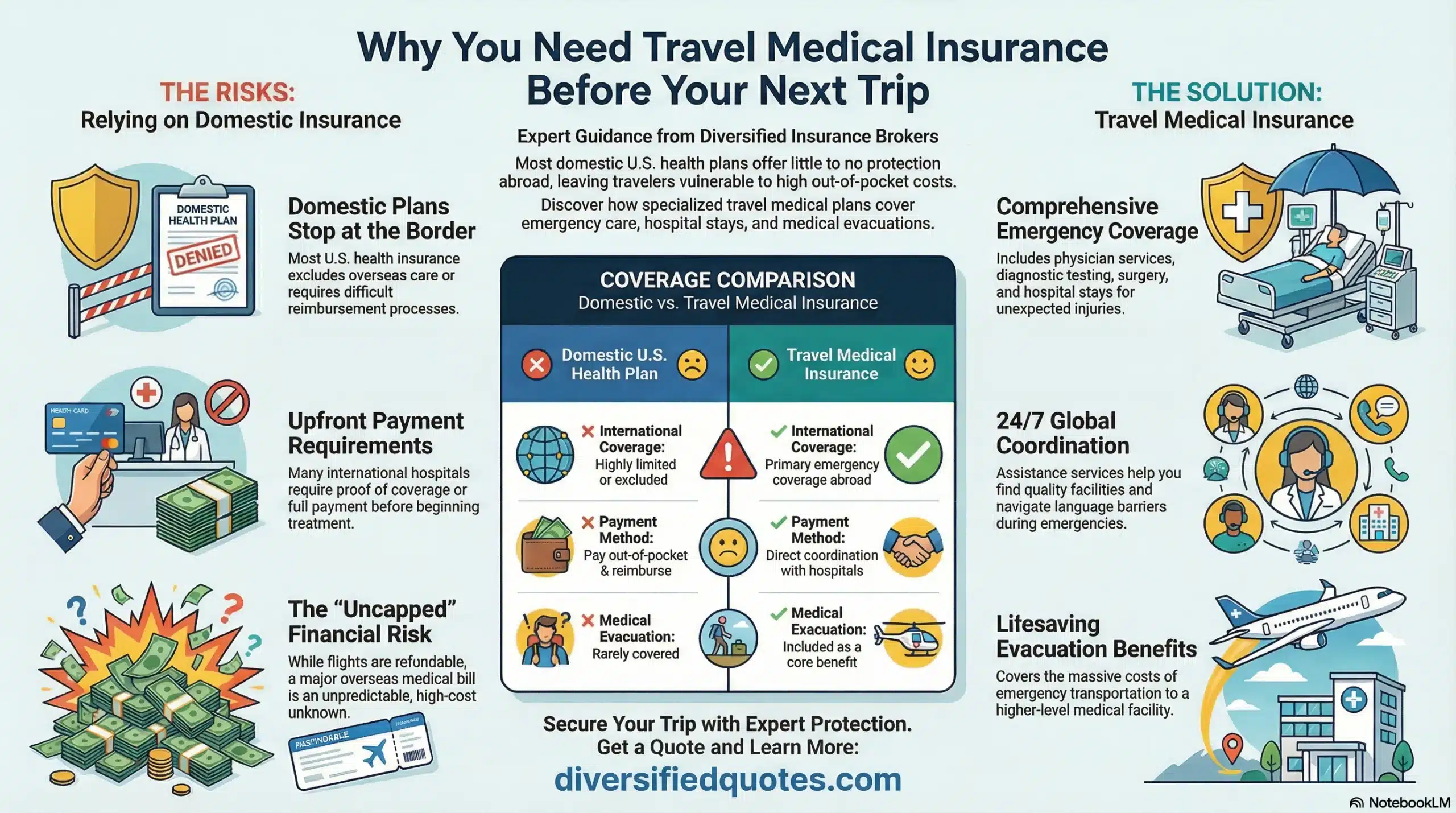
Sweden occupies a specific and often underestimated place in travel medical planning — it is a country with genuinely excellent healthcare infrastructure, a highly educated medical workforce, world-class university hospitals like Karolinska in Stockholm and Sahlgrenska in Gothenburg, and a public health system that consistently ranks among the best in the world. And yet the travelers who discover they needed more than they had are not the ones who flew to conflict zones — they are the ones who assumed that Sweden’s excellent healthcare system automatically solved their problem as an American traveler. It does not. Sweden’s healthcare system is designed for Swedish residents, funded by Swedish taxes, and operates on Swedish administrative processes. As a visiting American, you are outside that system, and the financial, administrative, and logistical reality of accessing care as a foreign national in Sweden is materially different from what a Swedish resident experiences. Travel medical and evacuation insurance from Sweden is what bridges that gap — providing financial protection against unexpected treatment costs, assistance services that help you navigate an unfamiliar system under pressure, and evacuation coordination when the care you need is not where you currently are.
Sweden also functions as a gateway and hub for broader Scandinavian and Nordic travel. Many trips that include Stockholm also include ferry connections to Finland or Estonia, train journeys to Oslo or Copenhagen, flights to Lapland or northern Norway for the Northern Lights, island-hopping in the Stockholm and Gothenburg archipelagos, and ski destinations in Åre or Sälen. An itinerary that starts in Sweden rarely stays only in Sweden, and the coverage you carry needs to follow the itinerary as it evolves rather than applying only to the named departure country. A plan designed for international travel that includes Sweden as one destination within a broader Nordic or European trip provides the consistent protection that a narrowly framed plan may not. Emergency medical evacuation insurance covers the mechanics of evacuation coordination in detail — what triggers it, how decisions are made, and what travelers should confirm before purchase. Emergency travel health insurance covers the emergency-focused international medical coverage option for travelers whose primary need is protection against unexpected events rather than comprehensive ongoing care access. International travel health coverage covers the full range of international medical protection options across different trip lengths and coverage structures.
Get Travel Medical + Evacuation Coverage for Sweden
Choose your dates and traveler details to view plan options designed for international medical care and evacuation support.
View Plans & PricingWhy Sweden Trips Can Still Create Expensive Medical Problems
The assumption that Sweden’s strong healthcare infrastructure eliminates the need for travel medical coverage reflects a misunderstanding of how the Swedish health system works for foreign visitors. Sweden’s universal healthcare system provides subsidized care to Swedish residents and EU citizens with an EHIC card — neither of which applies to an American traveler. As a non-EU visitor, you are accessing Sweden’s healthcare as a private patient, which means you pay private rates for treatment, and those rates at Swedish hospitals and private clinics are not trivial. Emergency room visits, diagnostic imaging, specialist consultations, and inpatient hospital stays all generate costs that are charged at private patient rates, and Swedish hospitals typically require payment from non-resident patients either upfront or with a clear payment guarantee before proceeding with non-emergency services. A single ER visit involving imaging, blood work, and a short observation stay can generate a bill that makes travel medical coverage look extremely cost-efficient in retrospect.
The second category of expensive surprise in Sweden is administrative friction — the gap between knowing that excellent care exists and being able to access it efficiently as a foreign traveler who does not speak Swedish, does not know the local healthcare navigation system, and may be making decisions while sick, injured, or managing a companion who is in distress. Travel medical coverage addresses this through the assistance services that accompany quality plans: help identifying the appropriate facility for the specific situation, guidance on what documentation to collect, translation support for clinical communication, and coordination of the administrative process in ways that a traveler navigating independently under stress cannot easily replicate. Sweden’s healthcare system uses a triage and prioritization approach that is rational and effective for Swedish residents who understand it and know how to navigate it — it can be disorienting for foreign visitors who are accustomed to American healthcare administrative processes and who may underestimate the practical barriers to efficient access as a non-Swedish speaker. What is the primary reason people buy travel medical insurance covers the risk assessment framework that underlies the coverage decision for international travelers across different destination types — including destinations with strong healthcare systems where the risk is administrative and financial rather than infrastructure-driven.
Sweden Travel: Coverage Priorities by Trip Type
| Trip Type | Sweden-Specific Risk Profile | Most Important Coverage Feature | Key Planning Consideration |
|---|---|---|---|
| Stockholm / city travel | High daily step counts on cobblestone and uneven historic streets; ferry and archipelago transit; respiratory illness in cold weather; slip and fall risk in winter conditions | Financial protection and assistance services for private patient billing at Stockholm hospitals and clinics; help navigating Swedish healthcare administrative processes as a non-Swedish speaker | Stockholm has excellent hospitals including Karolinska and St. Göran — the issue is not care quality but private patient billing and administrative navigation for foreign visitors |
| Lapland / northern Sweden | Remote Arctic environment; extreme cold weather; dog sledding, snowmobile, ice fishing, and outdoor adventure activities; significant distance from advanced care in Kiruna, Gällivare, or Jokkmokk areas | Evacuation coordination to Umeå or Stockholm for specialty care; cold injury and trauma coverage; assistance team available for remote area coordination where direct hospital contact is not straightforward | Northern Lapland is genuinely remote — the nearest hospital with meaningful specialty capability may be several hours away; evacuation limits and assistance team quality matter more here than for city travel |
| Skiing — Åre, Sälen, Riksgränsen | High physical injury risk from skiing and snowboarding; mountain environments with cold exposure; significant fracture and head injury risk; proximity to Norwegian border creates multi-country itinerary considerations | Strong emergency medical limits for orthopedic care and imaging; evacuation coordination if specialty surgical care requires transfer; coverage that follows the traveler across the Norwegian or Finnish border for adjacent ski areas | Confirm activity coverage explicitly — some plans exclude injuries from specific activities unless upgraded; skiing and snowboarding are commonly listed activity inclusions or exclusions depending on plan design |
| Multi-country Nordic itinerary | Sweden as one stop among Norway, Denmark, Finland, Iceland, or Estonia; ferry crossings; rail travel between capitals; varying healthcare systems and billing structures across countries | Geographic territory coverage that explicitly includes all planned destinations; consistent coverage as the itinerary moves between countries; assistance team familiar with Nordic and Baltic healthcare systems | Confirm the plan’s covered territory includes all countries on the itinerary — coverage framed around a single named destination may not automatically extend to adjacent countries visited during the same trip |
| Extended stay / study / work | Longer exposure period increases cumulative medical probability; Swedish universities and employers may have specific insurance requirements; higher likelihood of needing ongoing follow-up care or prescription management | Policy dates that cover the full extended stay; extendability provisions if the stay lengthens; pre-existing condition terms appropriate for the traveler’s health profile; compliance with institutional requirements | Long-stay travelers should evaluate whether a short-term travel medical plan or an international health insurance plan is more appropriate for the duration and care access requirements of the specific assignment |
What Medical Evacuation Means for Sweden Travel
Medical evacuation in Sweden is a different conversation than medical evacuation from high-risk destinations like Afghanistan or Yemen, but it is not an irrelevant one — and the travelers who discover that are usually the ones whose itinerary took them to northern Sweden, the remote archipelago islands, or ski areas in winter conditions. For Stockholm, Gothenburg, and Malmö, the realistic evacuation scenario is a specialist transfer from a regional hospital to a higher-capability facility for a specific condition — the kind of scenario where evacuation coordination is about optimizing the care pathway rather than escaping inadequate infrastructure. For Lapland, Riksgränsen, or the far north, evacuation becomes more practically significant: the nearest hospital with meaningful surgical and intensive care capability may be in Umeå or Sundsvall, hours away, and in extreme northern Lapland the nearest comprehensive hospital is across the Finnish or Norwegian border.
For ski travelers at Åre or Sälen, the combination of high injury risk from the activities themselves and the mountain environment creates evacuation relevance even though Sweden overall has strong healthcare. A serious knee or hip fracture, a significant head injury from a fall, or a spinal concern from a ski collision may require transfer to a major orthopedic center or neurosurgical unit that is not at the ski resort’s local clinic. The evacuation benefit’s value in these scenarios is less about the absolute cost — which is lower than evacuating from a remote developing country — and more about the coordination support that transforms a stressful mid-trip medical decision into a managed process with professional guidance. The assistance team identifies the appropriate receiving facility, coordinates the transport, and removes the decision-making burden from a traveler or family member who is simultaneously dealing with the medical event itself. Travel medical and evacuation from Canada and travel medical and evacuation from Australia cover other high-infrastructure destinations where the evacuation value proposition is similarly about coordination and cost control rather than escaping inadequate local care — useful comparison context for travelers evaluating coverage across multiple developed-country destinations.
Pre-Existing Conditions, Seniors, and the Coverage Details That Matter Most
Pre-existing conditions are the aspect of travel medical coverage that most frequently produces unpleasant surprises at claim time — and Sweden travel is not exempt from this dynamic simply because the destination has excellent healthcare. Every travel medical plan defines pre-existing conditions through its own specific language, and the definition controls what is eligible for coverage in ways that marketing descriptions rarely fully capture. The most consequential real-world scenario in Sweden is not a rare disease — it is a common condition that becomes urgent during travel: a cardiac symptom requiring ECG and cardiology evaluation, an asthma flare requiring bronchodilator therapy and monitoring, a blood pressure crisis requiring emergency intervention, or a complication from diabetes that requires immediate hospitalization. These events happen to travelers in Sweden and every other destination, and whether they are covered depends entirely on how the specific plan defines a pre-existing condition, what the lookback period is, and whether any stability provisions allow acute-flare coverage for conditions that were medically stable before departure.
Travelers at older ages have a higher baseline probability of encountering these scenarios — not because Sweden is dangerous, but because the cumulative medical probability of a cardiac event, a fall with fracture, or an acute illness requiring diagnostic workup and hospitalization increases with age, and the consequences in terms of treatment cost and logistical complexity are higher than for younger travelers even when the medical outcome is ultimately uncomplicated. Travel medical insurance for seniors covers the specific plan evaluation framework for older travelers — which features matter most, how to evaluate pre-existing condition terms, and how to match coverage to the realistic risk profile of a traveler in their 60s, 70s, or beyond who is visiting Sweden for an extended Nordic trip. Travel medical insurance for studying abroad covers the specific requirements and considerations for students on exchange programs or semester abroad itineraries at Swedish universities including Uppsala, Lund, Stockholm University, and Chalmers — where institutional requirements and coverage continuity during travel breaks are important planning considerations. How to get the best travel medical insurance rates covers the comparison methodology that identifies the most appropriate and cost-efficient plan for a given traveler profile, trip length, and destination combination.
Sweden Travel Scenarios Where Coverage Becomes Practically Valuable
City travel in Stockholm, Gothenburg, and Malmö creates the most common coverage use cases — and they are consistently the scenarios travelers underestimate before the trip and remember afterward. Stockholm’s historic neighborhoods involve extensive walking on cobblestone streets, uneven surfaces, and waterfront areas where slips and falls are a genuine risk particularly in winter when ice and wet stone surfaces are common. A fall on the Gamla Stan cobblestones or the steps of Djurgården can produce a fracture, a head injury, or a significant soft tissue injury that requires imaging, orthopedic evaluation, and possibly inpatient admission for monitoring. At Karolinska or St. Göran in Stockholm, that treatment is genuinely excellent — but the bill for a non-resident private patient accessing that treatment is also genuinely significant, and the assistance team’s ability to guide the traveler to the appropriate emergency facility and help coordinate the administrative process is valuable even when the clinical outcome is entirely routine.
Winter travel, whether in Stockholm for Christmas markets or in Lapland for Arctic experiences, adds cold-weather injury and illness risks that are specific to the Swedish climate. Hypothermia risk in extreme northern temperatures, frostbite during outdoor excursions in Lapland, respiratory illness from cold air exposure combined with international travel fatigue, and the general elevated injury risk of navigating icy surfaces with luggage or during outdoor activities all create coverage use cases that are distinctly Swedish. For travelers in Lapland specifically — where activities including reindeer safaris, Northern Lights photography excursions, ice hotel stays, and wilderness dog sledding are the primary draws — the remote nature of the environment means that a meaningful injury could require helicopter or fixed-wing air transport to the nearest appropriate hospital, and having that evacuation capability coordinated through a travel medical plan is not a theoretical consideration. Travel medical and evacuation from England, travel medical and evacuation from Spain, and travel medical and evacuation from Italy cover other major European destinations frequently combined with Sweden on multi-country Nordic and European itineraries — useful comparative planning context for travelers who want consistent coverage across their full trip geography. Travel medical and evacuation from Colombia and travel medical and evacuation from Vietnam cover popular warm-weather destinations that are sometimes paired with a Swedish summer trip as part of an extended multi-continent itinerary.
How Claims Work and Why Assistance Services Matter
Claims outcomes for Sweden travel medical coverage are heavily determined by documentation quality and by whether the traveler engaged the assistance team at the right point in the care sequence. When you receive care in Sweden as a non-resident private patient and pay out of pocket, the documentation that supports a successful reimbursement claim includes an itemized invoice from the treating facility showing each service and its cost, proof of payment, clinical notes or a discharge summary from the treating physician, and laboratory and imaging reports if those were part of the care. Swedish hospitals can produce this documentation readily, but the time to obtain it is while you are still at the facility — not after you have discharged, moved on to the next destination, and are trying to reconstruct what happened from a memory of a stressful day.
The assistance team adds value in the claims process by advising in real time on what documentation the specific plan requires, whether the treatment qualifies under the plan’s eligible emergency definitions, and how to submit the claim efficiently after the trip. For non-emergency situations where you have time to contact the assistance team before seeking care, their guidance on which facility to use — whether the nearest hospital, a specific private clinic network, or a particular specialist practice — can also affect the claims outcome by ensuring care is received at a facility and in a format that aligns with the plan’s covered provider requirements. For Sweden trips that include ancillary travel disruption costs — lodging near a hospital when recovery extends the stay, transportation costs for a companion supporting a hospitalized traveler, or pet boarding costs that accumulated during an unexpectedly extended medical stay — understanding what the plan does and does not include for those practical logistical expenses helps set accurate expectations before the trip. Travel lodging and pet care benefits explained covers those ancillary benefit categories in detail. Emergency travel health insurance for foreign nationals covers the specific coverage structures for international visitors — relevant for Swedish travelers visiting the US and for non-US travelers visiting Sweden who are evaluating coverage options.
Who Benefits Most From Sweden Travel Medical Coverage
Most travelers benefit from Sweden travel medical coverage, but the value is strongest for specific traveler profiles whose combination of trip structure, health history, and activity plans creates meaningful financial exposure in scenarios that are genuinely possible rather than merely theoretical. Families traveling with children benefit from coverage that reduces out-of-pocket exposure from the pediatric urgent care visits, ear infections, respiratory illnesses, and activity-related minor injuries that occur frequently when children are traveling through unfamiliar environments under schedule pressure — events that are medically minor but administratively complicated and financially meaningful when they occur in a foreign country where private patient billing applies. Travelers over age 60 benefit from coverage with meaningful medical limits, clear pre-existing condition terms, and strong assistance services because the probability of needing a diagnostic workup, a short hospital stay, or a specialist consultation during a longer Nordic trip is higher than for younger travelers, and the financial and logistical consequences of navigating that as a private patient at a Swedish hospital without coverage or assistance support are more significant.
Business travelers and extended-stay travelers in Sweden — including those attending conferences, visiting clients, or spending extended time in Stockholm on work assignments — benefit from the consistency and coordination support that travel medical coverage provides when the trip is complex and time matters more than it does on vacation. Having the assistance team available for an urgent medical situation that occurs during a business schedule eliminates the decision-making burden of figuring out where to go and how to navigate the Swedish system while simultaneously managing professional obligations. Volunteer travelers, mission groups, and organized group travel to Sweden — which is less common than to many other destinations but does occur for mission-focused programs, student service trips, and youth exchanges — benefit from coverage that addresses the coordination complexity of a group medical event where multiple travelers may need assistance simultaneously. Travel medical insurance for volunteer groups covers the structural considerations for organized service and volunteer travel coverage. Travel insurance for missionary groups covers the faith-based group travel context for organized group programs that include Sweden as a destination. Travel medical for youth sports trips covers the specific coverage considerations for youth athletic programs traveling to Sweden for competitions, tournaments, or sports exchanges — a meaningful category given Sweden’s strong sporting culture and the frequency of international youth athletic travel to Scandinavian countries.
Ready to Protect Your Sweden Trip?
Lock in travel medical and evacuation protection for your dates, then travel with a plan that’s built for emergencies abroad.
Get Covered NowRelated Travel Medical Pages
If you are comparing plan features, these pages help you dial in coverage choices, eligibility, and trip scenarios.
Related Destination Pages
If you travel to multiple countries, compare destination-specific guidance and planning considerations.
Talk With an Advisor Today
Choose how you’d like to connect—call or message us, then book a time that works for you.
Schedule here:
calendly.com/jason-dibcompanies/diversified-quotes
Licensed in all 50 states • Fiduciary, family-owned since 1980
Frequently Asked Questions: Travel Medical and Evacuation Insurance for Sweden
Does Sweden’s free healthcare system cover visiting American travelers?
No — Sweden’s publicly funded healthcare system covers Swedish residents and, for emergency care, EU citizens with a European Health Insurance Card. American travelers do not qualify for subsidized Swedish healthcare and are treated as private patients when accessing medical services. Private patient billing at Swedish hospitals and clinics covers the full cost of treatment without the subsidies that Swedish residents receive, and Swedish healthcare providers typically require payment or a payment guarantee from non-resident patients before proceeding with non-emergency services. The costs for emergency room visits, diagnostic imaging, specialist consultations, and inpatient care as a private patient in Sweden are meaningful — a single ER admission with imaging and overnight observation can generate a bill of several thousand euros or more. Travel medical coverage is what provides both the financial protection against those costs and the assistance services that help an American traveler navigate the Swedish healthcare system efficiently.
Does my U.S. health plan cover me in Sweden?
Most U.S. domestic health plans provide limited or no coverage for medical treatment received outside the United States. Plans that do include some international benefit typically limit coverage to emergency events, require upfront payment at the international facility and reimbursement submission afterward, and do not include coordinated assistance services, evacuation coordination, or direct-pay arrangements with Swedish providers. Even when some reimbursement is available, the practical experience of accessing Swedish healthcare as a private patient without coverage — making upfront payment, collecting the right documentation, and submitting a foreign-language claim — is significantly more difficult than what travel medical coverage provides. Credit card travel benefits, while useful for some trip interruption scenarios, typically do not provide meaningful emergency medical coverage or evacuation coordination.
Is medical evacuation relevant for Sweden travel, or is it mainly for developing countries?
Evacuation is relevant for Sweden travel, though the scenarios differ from those in destinations with limited medical infrastructure. For travelers in major Swedish cities, evacuation is most relevant as a specialist transfer — moving from a regional hospital to a facility with specific specialty capability for a particular condition. For travelers in Lapland, remote northern Sweden, or the outer archipelago islands, evacuation is more practically significant because the distance from advanced care can be substantial and helicopter or fixed-wing transport may be the only realistic way to reach appropriate treatment quickly. For ski travelers at Åre or Sälen, the combination of high injury risk and mountain environment creates real evacuation scenarios. The evacuation benefit’s primary value in Sweden is often the coordination infrastructure — an organized, professionally managed process replacing an improvised attempt to arrange complex transport under the stress of a medical emergency.
My Sweden trip also includes Norway, Denmark, and Finland. Does travel medical coverage follow me across all those countries?
Most international travel medical plans provide coverage worldwide outside the home country — meaning coverage follows you regardless of which country within the itinerary you are in when a medical event occurs. However, the specific geographic territory should be confirmed explicitly in the plan terms before purchase rather than assumed. Some plans have regional restrictions that exclude specific countries or regions from coverage. For a Nordic itinerary that includes Norway, Denmark, Finland, Estonia, and Iceland alongside Sweden, confirming that all planned countries are within the plan’s covered territory ensures there are no gaps as the itinerary moves between countries. It also ensures that the assistance team can coordinate care in any of those countries rather than only in the primary named destination.
Are skiing and winter outdoor activities covered under standard travel medical plans for Sweden?
Coverage for skiing and winter outdoor activities varies by plan design — some plans include skiing and recreational snowboarding as standard covered activities, while others exclude them unless an activity rider or upgraded plan design is selected. The specific activity coverage terms should be confirmed explicitly before purchasing any plan for a Sweden trip that includes skiing at Åre, Sälen, Riksgränsen, or other Swedish mountain destinations. Beyond skiing, activities like snowmobile excursions, dog sledding, ice climbing, and wilderness trekking in Lapland may also have specific inclusion or exclusion language in different plan designs. Confirming that the specific planned activities are covered under the specific plan under consideration — not assumed based on general descriptions — is one of the most important pre-purchase steps for active Sweden travelers.
About the Author:
Jason Stolz, CLTC, CRPC, DIA, CAA and Chief Underwriter at Diversified Insurance Brokers (NPN 20471358), is a senior insurance and retirement professional with more than 25 years of real-world experience helping individuals, families, and business owners protect their income, assets, and long-term financial stability. As a long-time partner of the nationally licensed independent agency Diversified Insurance Brokers, Jason provides trusted guidance across multiple specialties—including fixed and indexed annuities, long-term care planning, personal and business disability insurance, life insurance solutions, Group Health, Travel Medical and Evacuation Insurance, and short-term health coverage. Diversified Insurance Brokers maintains active contracts with over 100 highly rated insurance carriers, ensuring clients have access to a broad and competitive marketplace.
His practical, education-first approach has earned recognition in publications such as VoyageATL, and contributions from his agency featured in Kiplinger and GoBankingRates— highlighting his commitment to financial clarity and client-focused planning. Drawing on deep product knowledge and years of hands-on field experience, Jason helps clients evaluate carriers, compare strategies, and build retirement and protection plans that are both secure and cost-efficient. Visitors who want to explore current annuity rates and compare options across multiple insurers can also use this annuity quote and comparison tool.
Explore More Travel Medical Insurance Options: Browse our complete guide to Europe, Asia & Pacific Travel Medical Insurance — covering medical evacuation coverage for Europe, Asia, Australia & Pacific destinations.
Last Reviewed: June 17, 2026 |
Reviewed by: Jason Stolz, CLTC, CRPC, DIA, CAA
Chief Underwriter, Diversified Insurance Brokers, Inc. | NPN: 20471358 | Diversified Insurance Brokers, Inc. — Licensed in all 50 states
Fact Checked by: Tonia Pettitt, CMIP©
Medicare Specialist, Diversified Insurance Brokers, Inc. | NPN: 14374308 | Diversified Insurance Brokers, Inc. — Licensed in all 50 states
Did you find this content helpful? Leave us a Google review — it helps others find trustworthy guidance too.
Editorial Standards: Diversified Insurance Brokers maintains rigorous editorial standards to ensure accuracy, clarity, and independence in all content. Learn more about our editorial standards and commitment to transparency.
