
Travel Medical and Evacuation from England
Travel Medical and Evacuation from England

Jason Stolz CLTC, CRPC, DIA, CAA
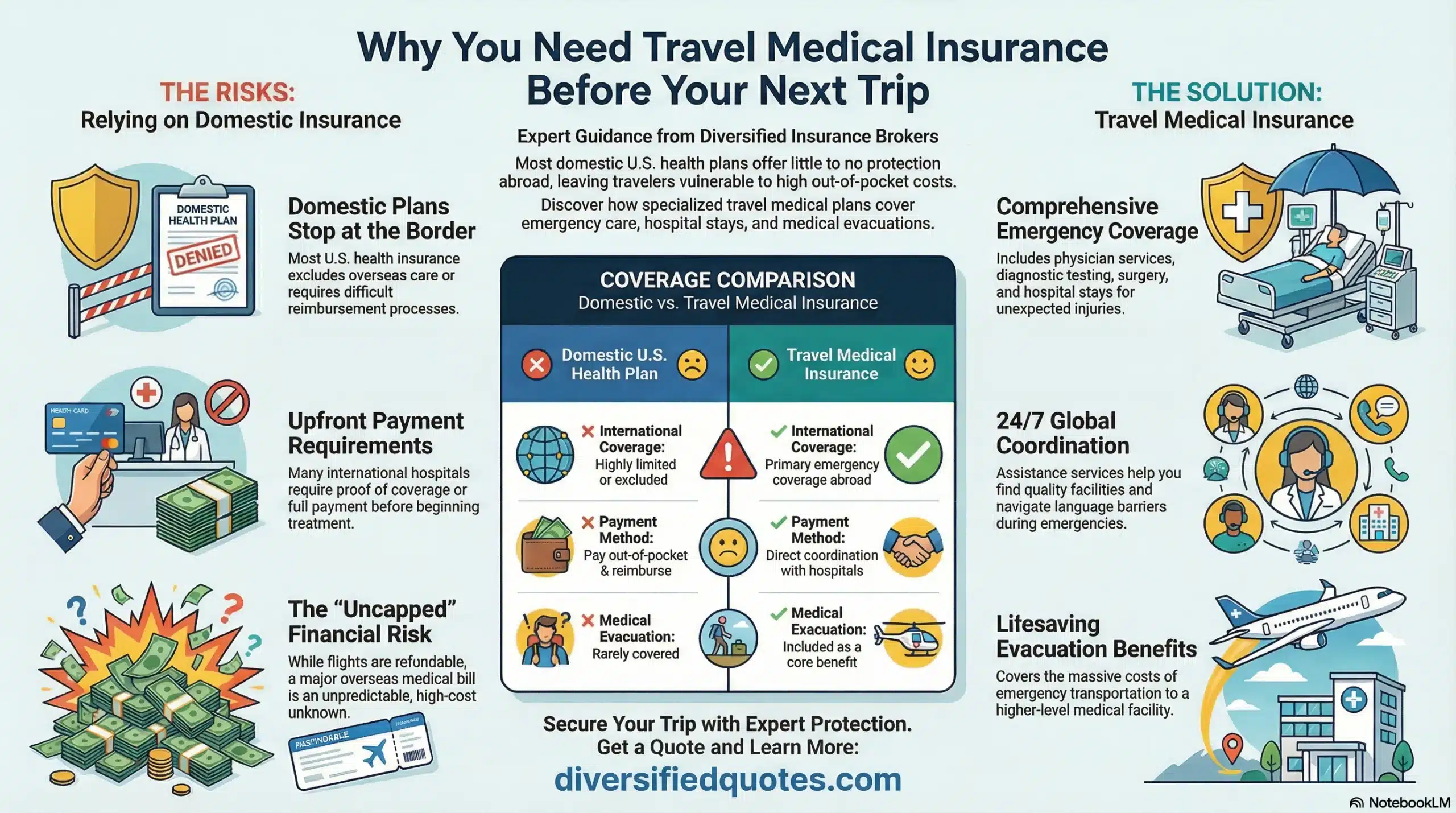
Travel medical and evacuation coverage from England is one of those purchases that feels optional until the moment it is not. England is a traditional, well-developed destination with world-class hospitals and reliable infrastructure — yet medical bills for visitors can still be substantial, emergency transport can be complicated, and a serious incident can turn a straightforward trip into a logistics and cost crisis that takes months to resolve. The National Health Service, while excellent for UK residents, has charged overseas visitors for non-emergency treatment since 2015, and the visitor cost-recovery rules have expanded over time to include a broader range of services than most U.S. travelers anticipate. What feels like “basically the same as home” from a destination familiarity standpoint can produce a very different financial experience at the hospital billing desk — and that gap is precisely what travel medical and evacuation insurance is designed to close. It pays for eligible emergency treatment while you are abroad, coordinates care with a 24/7 assistance team, and provides the evacuation and repatriation benefits that handle transport logistics when a physician recommends a higher level of care or medically supervised return home.
At Diversified Insurance Brokers, we build travel medical recommendations around clarity and outcomes: what the plan actually covers, how evacuation works in real life, and how to avoid the common gaps that cause travelers to assume they are protected when they are not. England trips tend to underinsure because the destination feels familiar — but familiarity does not prevent a fall on wet Tube station steps, an appendicitis diagnosis in London, a severe asthma flare triggered by a winter respiratory virus, or a bicycle accident in the Cotswolds from creating immediate medical needs, urgent coordination requirements, and bills that a domestic plan does not adequately address. For travelers who want to understand how international travel health coverage differs structurally from domestic insurance and why that difference matters for England specifically, that overview covers the core framework before the England-specific details here become most useful.
Get Travel Medical + Evacuation Options for England
Compare plans built for UK travel — medical coverage, evacuation support, and flexible deductibles.
Why England Travel Creates Real Financial Exposure Despite Strong Healthcare
England’s National Health Service is one of the most capable public health systems in the world for the people it covers — but U.S. visitors are not in that category. The NHS overseas visitor charging regime requires most non-UK residents to pay for non-emergency NHS treatment at 150% of the NHS tariff cost, and emergency treatment — while provided immediately regardless of ability to pay — generates invoices that are subsequently pursued from overseas visitors. A hospital admission for a cardiac event at King’s College Hospital London, an orthopedic surgical case at the Royal London following a cycling accident, or a monitored ICU stay following a serious respiratory event at any major NHS trust generates bills calculated at 150% of NHS cost — which can reach tens of thousands of pounds for complex or extended presentations. Private hospital care in London, which many travelers seek for faster access and English-language administrative support, carries even higher per-diem rates. The administrative friction of NHS overseas visitor billing — which can involve communication from NHS debt recovery teams months after the traveler has returned home — is a genuine and frequently unpleasant post-trip experience for U.S. travelers who visited England without adequate coverage in place.
The second dimension of England’s coverage exposure is geographic. London’s major teaching hospitals — King’s College, the Royal London, University College London Hospital, St. Thomas’, and the Royal Free — provide exceptionally capable specialist care. But England is also a country whose most beloved travel experiences are deliberately non-urban: the Cotswolds’ rolling limestone villages, the Lake District’s fells and tarns, North Yorkshire’s moors and medieval city of York, Bath’s Georgian architecture and Roman baths, the Cornish coast, the Scottish border country. Travelers on these itineraries are often an hour or more from a major hospital center, and the specific activities they undertake — hiking, cycling, horse riding, coastal walking — create injury scenarios where the distance to appropriate care matters. A walker with a serious knee injury on a remote Lake District fell, a cyclist with a head injury on a Cotswolds country lane, or a horse rider with spinal symptoms on a Yorkshire trail faces a care access problem that a 24/7 assistance team can navigate far more efficiently than an uninsured visitor trying to navigate the NHS 111 system from an unfamiliar location under stress. For travelers comparing England’s care environment to other Western European destinations where the same private-patient billing dynamic applies, the pages on travel medical and evacuation from Italy, travel medical and evacuation from Spain, and travel medical and evacuation from Sweden cover how the coverage priorities shift across similar but distinct European healthcare environments.
England Travel Medical: Coverage Priorities by Itinerary and Traveler Type
| England Itinerary / Traveler Type | Practical Medical Consideration | Key Coverage Priority | Evacuation Scenario |
|---|---|---|---|
| London — tourism / business / culture | World-class teaching hospitals accessible; NHS 150% overseas visitor tariff applies; walking-intensive London itineraries create fall risk on Tube stairs, uneven pavements, and crowded station environments; winter respiratory illness season concentrated in urban environments | Financial protection against NHS overseas visitor billing; direct billing or payment guarantee support; assistance team guidance for NHS vs. private facility decision; documentation collection from first care contact | Medically supervised repatriation to U.S. when recovery makes home-country follow-up appropriate; intra-England transfer for subspecialty events if initial facility lacks required specialist |
| Cotswolds / Lake District / Yorkshire Dales — rural touring | 30–90 minutes from major hospital centers in most rural England locations; hiking, cycling, and horse riding create orthopedic and head injury risk; wet weather increases fall probability year-round; ambulance response times in remote areas longer than urban England | Assistance team routing knowledge for rural England; activity coverage confirmation for hiking and cycling; orthopedic imaging and surgical cost protection; coverage that functions in villages and rural areas not just London | Ground transport to nearest regional hospital (Cheltenham, Carlisle, Harrogate) for initial stabilization; transfer to Birmingham, Manchester, or Leeds for complex specialist events; repatriation from London Heathrow after stabilization |
| Bath / Cornwall / coastal England | Regional hospitals in Bath, Truro, and Plymouth serve southwest England; Cornish peninsula creates distance from major hospital centers; coastal walking and water activities create injury and cold water exposure risk; summer tourist volume concentrates demand on regional NHS services | Coverage for coastal activity injuries; assistance team knowledge of southwest England care access; water sports activity coverage confirmation for open water swimming and surfing at Cornish beaches | Royal Cornwall Hospital Truro for initial stabilization; Bristol or Plymouth for complex events; repatriation from Bristol or London airports for transatlantic cases |
| Senior travelers / 65+ | Walking-intensive England itineraries create cardiovascular and fall risk for older travelers; cobblestones and uneven historic pavements in York, Bath, and Oxford create ankle and fall injury exposure; minor events more likely to require extended observation and specialist consult; pre-existing condition prevalence higher | Higher emergency medical limits for extended observation and specialist costs at NHS or private facilities; pre-existing condition language explicit review; lower deductible for travelers likely to use the plan for outpatient visits; real-time assistance coordination | Medically supervised repatriation when recovery makes home-country follow-up with familiar providers medically appropriate; family coordination support when U.S. family manages logistics remotely |
| Students / university exchange — Oxford, Cambridge, London | Semester or longer stays accumulate medical probability beyond short-trip exposure; some English universities require international students to pay NHS surcharge as part of visa process, but this does not eliminate all coverage gaps; prescription management and outpatient continuity across multi-month stay | Coverage duration appropriate for full semester or academic year; outpatient access for non-emergency needs; prescription coordination; mental health benefit availability; interaction between NHS surcharge and travel plan terms reviewed before enrollment | Repatriation for serious events requiring home-country specialist follow-up; coverage continuity across academic breaks and travel outside England during the program year |
| England plus Scotland / Ireland / multi-country Europe | Eurostar and short-haul flights create fluid multi-country itineraries where medical events can occur in any country; healthcare billing structures differ between England, Scotland, Ireland, France, and other destinations on the route; policy territory and dates must match full itinerary | Geographic territory confirmation covering all countries before purchase; consistent benefit levels regardless of which country the medical event occurs in; assistance team with multi-country European coordination capability | Repatriation routed from whichever country the traveler is in at time of serious event; assistance team manages cross-border coordination regardless of event location |
What Travel Medical Plans Cover and How the Claims Process Works in England
Travel medical plans for England address unexpected medical needs during the trip — emergency room treatment at an NHS trust or private hospital, hospital admission and inpatient care, outpatient physician visits and specialist consultations triggered by a covered event, diagnostics including X-rays, MRI, and CT scans, emergency procedures, and prescription medications related to a covered illness or injury. The practical value in England’s care environment is the combination of financial protection against NHS overseas visitor billing and the real-time coordination support that helps a traveler navigate from symptom to appropriate care to proper documentation efficiently. England’s NHS 111 telephone triage system routes callers to appropriate care levels — GP, urgent treatment center, emergency department, or ambulance — but a traveler who does not understand the UK care pathway structure can waste significant time and create documentation gaps by presenting at the wrong care level. An assistance team that can guide those initial care decisions, direct the traveler to the most appropriate facility for their specific condition, and begin claim coordination from the first contact produces meaningfully better outcomes than a traveler improvising under stress. The emergency medical evacuation benefit component adds the transport coordination layer — medically supervised transfer to a higher-capability facility, or repatriation to the United States when that is the medically appropriate next step.
Documentation habits that produce smooth England travel medical claims: request itemized billing statements from any NHS trust or private facility before leaving, collect receipts for out-of-pocket payments, preserve discharge summaries and clinical notes in digital form, and record the treating provider’s name and facility contact. NHS administrative staff are generally efficient and English-speaking, making documentation collection less difficult than in many other international destinations — but the habit of collecting documents before leaving the facility remains important for travelers on high-mobility itineraries. For travelers combining England with Australia or Canada — two of the most common long-haul additions to an England anchor trip — the pages on travel medical and evacuation from Australia and travel medical and evacuation from Canada cover how coverage priorities shift across those environments. For travelers combining England with Cuba or Egypt as part of a broader itinerary, the pages on travel medical and evacuation from Cuba and travel medical and evacuation from Egypt illustrate how the same underlying coverage framework applies across very different infrastructure environments. For mixed-citizenship family groups where some members travel from countries other than the United States, emergency travel health insurance for foreign nationals covers the specific considerations that apply when domestic coverage rules differ across travelers in the same group. The short-term and travel medical resource library covers the full spectrum of plan types for different England traveler profiles.
Compare Plans Side-by-Side Before You Travel
If your trip includes multiple cities, older travelers, or any health concerns, compare medical limits and evacuation terms now — not after departure.
Benefit Limits, Deductibles, Pre-Existing Conditions, and Evacuation Planning
Selecting the right benefit limits for England travel starts with the itinerary and traveler profile rather than the minimum available premium. For healthy travelers under 50 on a short London city visit, emergency medical limits of $50,000 with evacuation coverage of $150,000 or more provide meaningful protection against the most common events. For travelers over 65, those with any meaningful medical history, those on active rural itineraries including hiking in the Lake District or cycling in the Cotswolds, or those combining England with multiple other European or long-haul destinations over several weeks, medical limits of $100,000 or more and evacuation limits of $250,000 or more are more appropriate. Medically supervised repatriation from England to the United States involves transatlantic transport logistics that accumulate significantly in cost regardless of England’s excellent care environment. Deductible selection should reflect actual comfort with first-dollar costs: lower for travelers who want the plan to respond to outpatient visits and urgent care without financial hesitation; higher for those primarily seeking protection against catastrophic events at reduced premium cost.
Pre-existing conditions are the most consequential plan detail for England travelers with any health history. The events most likely to generate expensive NHS overseas visitor billing or private hospital admission are often those with pre-existing condition connections: cardiac events during the physical demands of England touring, respiratory crises during the UK’s prolonged winter respiratory illness season, joint injuries with underlying orthopedic history on England’s walking-intensive itineraries, and diabetic complications under the dietary changes of international travel. Confirming how the specific plan’s pre-existing condition language applies to the specific traveler’s health profile before purchase — rather than assuming based on general descriptions — is the most important pre-purchase step for any traveler with health history. For travelers planning to extend their England trip with side trips to France, Germany, or Ireland, the pages on travel medical and evacuation from France and travel medical and evacuation from Germany cover how private-patient billing exposure applies across the Channel with the same underlying need for coordinated travel medical protection.
Ready to Choose Your England Travel Coverage?
Lock in medical and evacuation protection that fits your trip length, age, and budget.
Related Travel Medical Pages
Explore plan structures, who they are best for, and how medical and evacuation benefits typically work.
Related Destination Pages
If you are comparing multiple trips, these destination pages show how travel medical and evacuation planning changes by itinerary.
Talk With an Advisor Today
Choose how you’d like to connect—call or message us, then book a time that works for you.
Schedule here:
calendly.com/jason-dibcompanies/diversified-quotes
Licensed in all 50 states • Fiduciary, family-owned since 1980
Frequently Asked Questions: Travel Medical and Evacuation Insurance for England
Do I really need travel medical insurance for England when the NHS is so good?
The NHS is genuinely excellent — for UK residents and EU nationals with EHIC coverage. U.S. travelers are overseas visitors, and since 2015 the NHS has charged overseas visitors for non-emergency treatment at 150% of the NHS tariff cost. Emergency treatment is provided immediately regardless of ability to pay, but the resulting bill is pursued from overseas visitors afterward. A hospital admission for a cardiac event, orthopedic surgery after a cycling accident, or monitored inpatient care for a serious respiratory event at a major NHS trust generates bills calculated at 150% of NHS cost — which can reach tens of thousands of pounds for complex or extended presentations. Private hospital care in London, which many travelers prefer for faster access and clearer billing, carries higher per-diem rates still. Most U.S. domestic health insurance plans provide limited or no useful coverage for NHS-billed treatment, Medicare does not cover international care, and credit card travel benefits vary widely in actual utility for real medical events. Travel medical insurance closes the billing gap and provides the coordination support that makes England’s excellent care genuinely accessible without the financial exposure of self-pay overseas visitor billing.
What are the most common medical events for U.S. travelers in England?
Falls are among the most frequent acute injury presentations for U.S. travelers in England — London’s Tube stairs, wet pavement outside stations, uneven historic cobblestones in York, Oxford, and Bath, and crowded pedestrian environments all create genuine slip and fall risk that produces ankle injuries, wrist fractures from breaking falls, and occasional head injuries requiring imaging and emergency evaluation. Respiratory infections are a consistent and high-volume claim category during England’s prolonged autumn and winter respiratory season — the UK’s damp climate and dense urban environments accelerate the spread of respiratory illness in ways that affect travelers whose immune systems are not acclimated. Cycling accidents in the Cotswolds and Lake District, hiking injuries on remote fells and coastal paths, appendicitis and other acute abdominal events, dental emergencies, and cardiovascular presentations during the physical demands of high-mobility city touring for older travelers are all recurring England travel health scenarios. Prescription medication management problems — when familiar U.S. branded medications are sold under different names in the UK or require a local GP prescription for dispensing — also create urgent care needs that assistance teams can help navigate more efficiently than unassisted travelers.
What coverage limits should I carry for an England trip?
For healthy travelers under 50 on a short London city visit, emergency medical limits of $50,000 with evacuation coverage of $150,000 or more provide meaningful protection against the most common England events. For travelers over 65, those with any health history, those on active itineraries that include hiking in the Lake District or cycling in the Cotswolds, or those combining England with multiple other European or long-haul destinations, medical limits of $100,000 or more and evacuation limits of $250,000 or more are more appropriate. Medically supervised repatriation from England to the United States — when indicated after prolonged hospitalization or a serious event requiring home-country follow-up — involves transatlantic transport logistics that accumulate significantly in cost regardless of England’s strong care environment. Deductibles should reflect your actual comfort with first-dollar costs — lower for travelers who want the plan to function for outpatient visits without hesitation, higher for those primarily seeking catastrophic protection at reduced premium.
My England trip also includes Scotland, Ireland, and France. Does one plan cover all four?
Most international travel medical plans designed for UK and Western European travel provide coverage across England, Scotland, Ireland, and France when policy dates cover the full travel period and all countries are within the plan’s geographic territory. Verify all four countries are explicitly within the covered territory or that the plan covers the UK and Europe broadly; ensure policy dates span the complete itinerary including transit days and any buffer for flight changes; and confirm whether premium calculation requires listing all destination countries or only the primary destination. A medical event can occur in any country on the route — the ability to contact one assistance team that coordinates care regardless of which country you are in when the event occurs is as practically valuable as consistent benefit levels across all four destinations. The specific coverage context for France is covered on the travel medical and evacuation from France page, which covers French private-patient billing and care access considerations that differ from England’s NHS environment despite their geographic proximity.
How does evacuation coverage work from England specifically?
Medical evacuation from England is operationally straightforward compared to most international destinations — London Heathrow, Gatwick, Manchester, and other major UK airports provide direct transatlantic connections, and England’s NHS and private hospital systems can stabilize most serious events to the point where commercial medical escort repatriation is appropriate rather than requiring a dedicated air ambulance. The assistance team’s role is to coordinate the clinical assessment with the treating physician to determine medical necessity, identify the appropriate transport modality, arrange U.S. receiving facility coordination, manage authorization documentation, and communicate with the patient’s family throughout. The most common England evacuation scenarios are: a patient in a rural location needing transfer to the nearest major city hospital for specialist care; a complex clinical event where a London teaching hospital subspecialty team is required; and a stabilized patient whose ongoing treatment needs are better served by home-country providers — particularly for chronic disease management and long-term rehabilitation that is most effectively continued in the U.S. where the patient’s medical records and long-term care team are located. Authorization is operationally important — most plans require evacuation to be coordinated through the assistance team for the benefit to apply. Contacting the assistance team before arranging any transport produces the best outcome regardless of how urgent the situation feels at the moment.
I’m studying at Oxford for a semester. Do I still need travel medical insurance?
Yes, and the specific coverage considerations for a semester-length Oxford or Cambridge study program are meaningfully different from a short tourist trip. Some international students at UK universities pay an Immigration Health Surcharge as part of their visa application, which provides access to NHS services — but the surcharge does not provide the outpatient continuity, prescription management support, mental health benefit access, or evacuation coverage that a dedicated travel medical plan provides. A semester-length stay accumulates medical probability well beyond a short trip — the longer you are in England, the higher the likelihood that at least one meaningful medical event occurs requiring care. Prescription medication continuity across a UK pharmacy system where U.S. branded medications may be marketed under different names or require a local GP prescription creates a practical access challenge that an assistance team can help navigate. And for serious events requiring home-country specialist follow-up — a serious injury or illness that is better continued under the patient’s U.S. care team — evacuation coverage provides the transport benefit that makes returning home medically rather than commercially safe. The travel medical insurance for studying abroad page covers the full framework for evaluating which plan features matter most for semester and academic-year programs specifically.
What should I do if I need medical care in England during my trip?
The UK care pathway has three main entry points that a traveler should understand before needing to use them. For non-emergency urgent care, NHS urgent treatment centers (UTCs) provide same-day treatment for conditions that need same-day care but are not immediately life-threatening — the equivalent of a U.S. urgent care clinic. For advice on what level of care is appropriate, NHS 111 is a 24/7 telephone triage service that assesses symptoms and directs the caller to the right care level including GP appointment, UTC, emergency department, or ambulance dispatch. For genuine emergencies, call 999 for ambulance or go directly to an NHS emergency department — care is provided immediately regardless of insurance or payment status. As soon as the immediate care situation is stabilized and it is feasible to do so, contact the plan’s 24/7 assistance team. They can confirm care coordination, begin the authorization process for any evacuation that may be indicated, help with facility communication, and start documenting the claim from the beginning. Collect itemized billing statements, payment receipts, and discharge documentation from every care encounter before leaving the facility — this documentation is the foundation of any subsequent claim and is much harder to obtain after returning to the U.S.
About the Author:
Jason Stolz, CLTC, CRPC, DIA, CAA and Chief Underwriter at Diversified Insurance Brokers (NPN 20471358), is a senior insurance and retirement professional with more than 25 years of real-world experience helping individuals, families, and business owners protect their income, assets, and long-term financial stability. As a long-time partner of the nationally licensed independent agency Diversified Insurance Brokers, Jason provides trusted guidance across multiple specialties—including fixed and indexed annuities, long-term care planning, personal and business disability insurance, life insurance solutions, Group Health, Travel Medical and Evacuation Insurance, and short-term health coverage. Diversified Insurance Brokers maintains active contracts with over 100 highly rated insurance carriers, ensuring clients have access to a broad and competitive marketplace.
His practical, education-first approach has earned recognition in publications such as VoyageATL, and contributions from his agency featured in Kiplinger and GoBankingRates— highlighting his commitment to financial clarity and client-focused planning. Drawing on deep product knowledge and years of hands-on field experience, Jason helps clients evaluate carriers, compare strategies, and build retirement and protection plans that are both secure and cost-efficient. Visitors who want to explore current annuity rates and compare options across multiple insurers can also use this annuity quote and comparison tool.
Explore More Travel Medical Insurance Options: Browse our complete guide to Europe, Asia & Pacific Travel Medical Insurance — covering medical evacuation coverage for Europe, Asia, Australia & Pacific destinations.
Last Reviewed: June 18, 2026 |
Reviewed by: Jason Stolz, CLTC, CRPC, DIA, CAA
Chief Underwriter, Diversified Insurance Brokers, Inc. | NPN: 20471358 | Diversified Insurance Brokers, Inc. — Licensed in all 50 states
Fact Checked by: Tonia Pettitt, CMIP©
Medicare Specialist, Diversified Insurance Brokers, Inc. | NPN: 14374308 | Diversified Insurance Brokers, Inc. — Licensed in all 50 states
Did you find this content helpful? Leave us a Google review — it helps others find trustworthy guidance too.
Editorial Standards: Diversified Insurance Brokers maintains rigorous editorial standards to ensure accuracy, clarity, and independence in all content. Learn more about our editorial standards and commitment to transparency.
