
Travel Medical and Evacuation Insurance for Isreal
Travel Medical and Evacuation Insurance for Isreal

Jason Stolz CLTC, CRPC, DIA, CAA
Travel medical and evacuation insurance for Israel is essential when traveling to a region where medical standards are high but geopolitical risk, regional instability, and rapid security shifts can complicate logistics during a serious medical emergency. Even in countries with advanced hospitals and highly trained physicians, the real question during a major medical event is not simply whether care is available but whether you can access the right level of care quickly and whether there is a coordinated plan in place if circumstances change around you. Israel has a sophisticated and well-resourced healthcare system with hospitals in major urban centers that are capable of handling complex injuries and illnesses. However, travelers may face language barriers in clinical settings, regional travel disruptions during security escalations, deposit requirements at international hospitals, restricted mobility during volatile periods, or challenges coordinating specialist care when the healthcare system is under strain from concurrent emergencies. Travel medical insurance reduces financial exposure from unexpected illness or injury. Emergency evacuation coverage adds the critical additional layer of coordinated medically necessary transport when your condition or the surrounding situation requires transfer to the nearest appropriate facility.
This page focuses specifically on medical coverage and medically necessary evacuation — not on non-medical security extraction or political evacuation services, which are separate products serving a different purpose. Medical evacuation requires physician certification of medical necessity and is coordinated by the plan’s 24/7 assistance provider, which manages the logistics of transport, receiving facility acceptance, documentation, and clinical handoff. Understanding the distinction between what medical evacuation covers and what it does not covers allows travelers to make informed decisions about the complete protection package their specific itinerary and risk tolerance require. Emergency medical evacuation insurance covers the mechanics of evacuation coverage in detail — including how evacuation decisions are made, what triggers activation, and what travelers should confirm about limits before purchase. Travel and medical insurance for high-risk travel covers the broader coverage design considerations for destinations where geopolitical complexity elevates the planning requirements beyond standard vacation travel. High-risk travel insurance covers the specialized coverage options for destinations where political stability, regional security, or infrastructure limitations create elevated risk profiles that standard travel plans may not adequately address.
Secure Travel Medical & Evacuation Coverage for Israel
Apply online before departure to protect yourself with emergency medical and evacuation support.
Why Travel Medical Coverage Matters in Israel
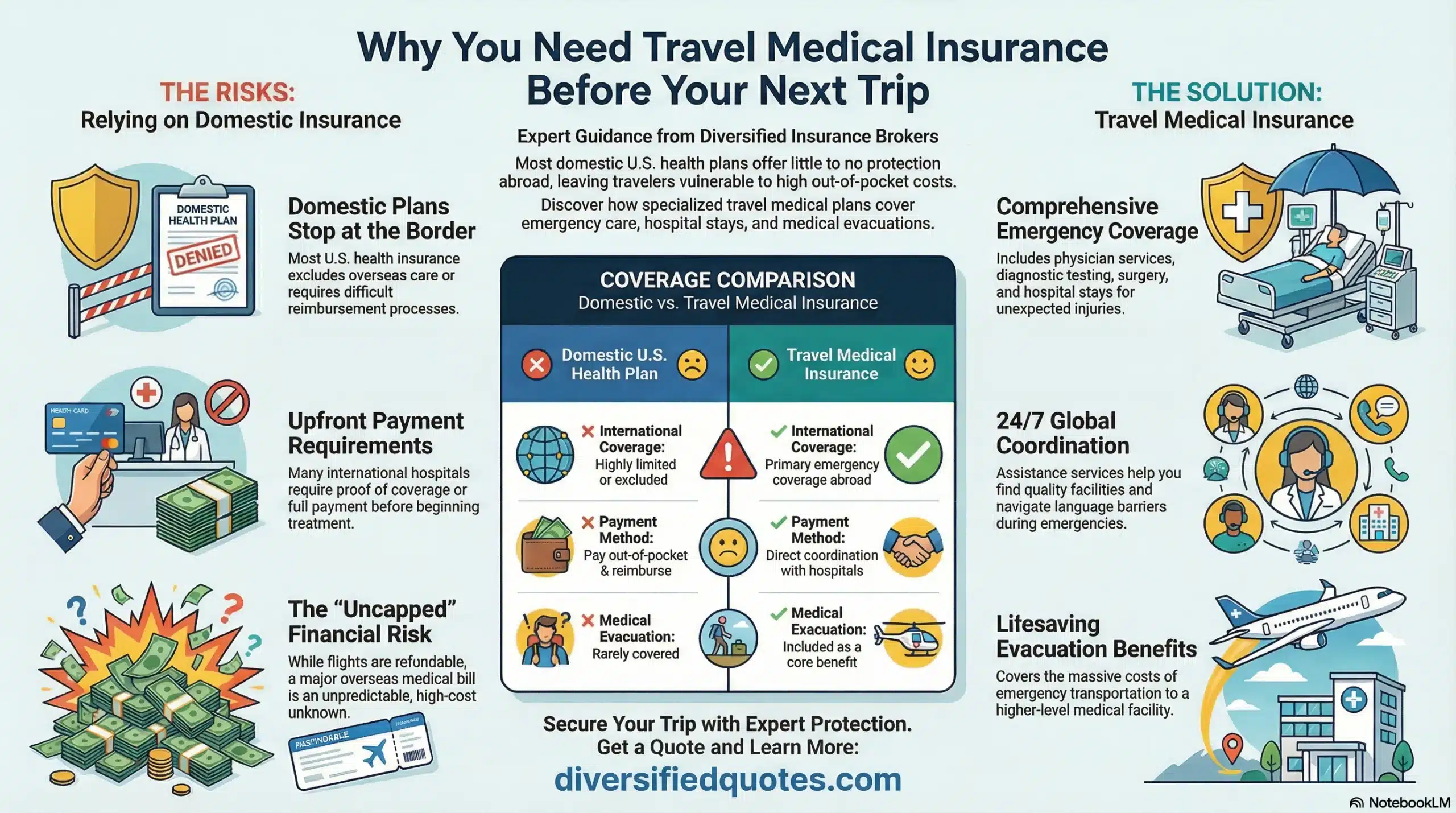
Many U.S. travelers assume their domestic health insurance will cover them overseas in the same way it covers them at home — and that assumption is almost universally incorrect. Most domestic U.S. health plans provide limited or no international benefits for medical treatment received outside the United States. When reimbursement is technically possible, the practical reality of obtaining it often involves paying out of pocket at the international facility, collecting extensive documentation, submitting a foreign-language claim, and waiting for a reimbursement that may cover only a portion of the actual cost at the carrier’s determination of reasonable charges. Coordination of care, assistance with locating providers, direct-pay arrangements with hospitals, and evacuation logistics are rarely included in domestic plan international benefit provisions even when those provisions exist.
In Israel, major cities including Tel Aviv, Jerusalem, and Haifa have advanced hospital systems and specialists who are trained to international standards. However, unexpected illness or injury may require rapid evaluation, diagnostic imaging, hospitalization, or surgical intervention — all of which generate costs that accumulate quickly and that international hospitals frequently require to be addressed through deposits or guarantees of payment before proceeding with care. Travel medical insurance helps pay eligible emergency expenses and ensures you are not forced to rely solely on out-of-pocket payment, personal credit, or the goodwill of a hospital administration during a crisis. If your itinerary includes travel near border regions, participation in archaeological or research fieldwork in remote areas, extended stays, or movement through areas with variable security status, coverage becomes especially important because the probability of a logistically complicated emergency increases with the complexity of the travel environment. What is the primary reason people buy travel medical insurance covers the core risk calculation that drives the coverage decision for international travelers across different destination types and trip profiles.
Israel Travel Medical: Key Coverage Considerations
| Coverage Factor | Israel-Specific Context | What Adequate Coverage Provides | Risk of Inadequate Coverage |
|---|---|---|---|
| Emergency medical treatment | Advanced hospitals available in major cities; deposit or guarantee of payment commonly required at international hospitals before treatment proceeds | Direct payment coordination with the hospital, coverage of physician visits, diagnostics, hospitalization, surgery, and emergency room treatment | Large out-of-pocket expenses, payment demands before care, delays in treatment while financial arrangements are being negotiated |
| Medical evacuation | Regional instability can complicate standard transport routes; evacuation to Cyprus, Greece, or another regional hub may be required when local care is insufficient or conditions prevent safe transfer within Israel | Coordinated medical transport — ground ambulance, air ambulance, or commercial medical escort — to the nearest appropriate facility based on the patient’s clinical needs | Air ambulance costs that can reach $50,000–$100,000+ with no coverage; family unable to arrange transport independently during an active security situation |
| Security-related care access | Security escalations can restrict movement between regions, close roads and airports, and strain hospital systems simultaneously — affecting the logistics of accessing care | 24/7 assistance team that actively coordinates care access logistics, communicates with providers, and manages the situation in real time rather than leaving the traveler to navigate independently | Traveler and family attempting to coordinate emergency care logistics independently during a high-stress security event with no institutional support |
| Pre-existing conditions | Travel medical plans typically exclude pre-existing conditions unless specific waiver conditions are met — critical in a destination where emergency care access for a flare-up may be urgent | Acute-flare coverage for stable pre-existing conditions under plans with stability clauses; full new-condition coverage throughout the trip period | Claim denial for care related to any condition with prior medical history, leaving the traveler with no coverage for the medical event that most required treatment |
| Repatriation | Medical repatriation to the home country is distinct from evacuation to the nearest appropriate facility — requires separate plan provisions and physician certification | Plans with repatriation provisions cover medically supervised return to the home country when the patient’s clinical status allows transport and local treatment has been completed or is not available | Patient stabilized in Israel or an intermediate facility with no coverage for the final supervised transport home — a cost families must fund independently |
How Medical Evacuation Works
Medical evacuation is not simply a flight home, and understanding what it actually involves is essential for evaluating whether a plan’s evacuation benefit is adequate for travel to Israel. When a serious illness or injury occurs, the first step is stabilization at the nearest appropriate facility — whether that is a hospital in the city where the event occurred or the closest available facility depending on location within the country. If treating physicians determine that the patient’s condition requires a higher level of care or specialized treatment that is not available locally, the plan’s 24/7 assistance team evaluates the clinical situation, identifies receiving facilities capable of providing the required care, confirms receiving facility acceptance, and coordinates the logistics of the transfer. The transfer may involve ground ambulance, air ambulance with medical staff aboard, or a commercial flight with a medical escort depending on the patient’s stability and the distance involved. Decisions about evacuation modality are based entirely on medical necessity as certified by the attending physician — not on patient preference, family request, or convenience.
For travel to Israel, the regional geography creates specific evacuation scenarios that travelers should understand before departure. If a patient requires care beyond what is available at the treating facility and conditions within Israel do not permit safe internal transfer, evacuation may be to Cyprus, Greece, Jordan, or another regional location with appropriate specialty capability. The assistance team manages receiving facility arrangements, documentation, and clinical handoffs in these scenarios — which is precisely why the quality of the assistance team behind a plan matters as much as the financial limits on the policy itself. A plan with high dollar limits but weak coordination infrastructure provides less real protection than a plan with strong operational assistance capability even if the financial limits are more modest. Travel medical and evacuation from Egypt and travel medical and evacuation from Lebanon cover evacuation planning considerations for neighboring regional destinations where similar dynamics apply — useful context for travelers whose itineraries may extend across multiple Middle Eastern countries. Travel medical and evacuation from Syria covers the most complex evacuation environment in the immediate region and illustrates how evacuation infrastructure challenges scale across different destination risk levels. Travel medical and evacuation from Jordan covers a destination that shares the regional context of Israel travel and is commonly included on itineraries that also include Israel.
What Travel Medical Insurance Typically Covers
Travel medical insurance is designed for sudden and unexpected medical events that occur during the covered trip period — not for planned medical treatment, routine care, or conditions that existed before the trip began. Eligible expenses typically covered under travel medical plans include emergency physician visits and urgent care treatment, diagnostic testing including X-rays, imaging, and laboratory work tied to a covered medical event, inpatient hospitalization including room and board and nursing care, surgical procedures when medically necessary, emergency room treatment and stabilization, ambulance services to the treating facility, and prescription medications related to a covered condition. The scope is centered on emergency and urgent medical care rather than the comprehensive benefit design of a domestic health plan — which is appropriate for the temporary international travel context these plans serve. For travelers who need broader ongoing healthcare access because they are living internationally for extended periods rather than traveling temporarily, international health insurance and international travel health coverage cover the product categories designed for that longer-term international healthcare need.
Travelers who focus primarily on minimizing premium cost when selecting coverage often underestimate the difference between plans with meaningful medical limits and those with limits that are technically above zero but inadequate for a serious event in a high-cost destination. Israel’s urban hospitals provide care at costs comparable to Western European facilities, which means a single inpatient event involving hospitalization and surgery can generate bills that exceed the limits of bare-minimum coverage quickly. The goal of selecting a plan is protection that actually absorbs the financial consequence of a serious emergency — not nominal compliance with a requirement to have coverage. How to get the best travel medical insurance rates covers the comparison methodology that produces the most appropriate coverage for any given destination, trip length, and traveler profile without sacrificing essential protections to achieve a lower premium. Travel medical and evacuation from Italy and travel medical and evacuation from Spain cover comparable high-quality European healthcare destinations where similar cost dynamics apply — useful reference points for travelers comparing coverage across regional itineraries.
Who Should Consider Coverage for Israel
Travel medical and evacuation insurance for Israel is relevant across a broad range of traveler types whose reasons for visiting range from business to religious heritage to family connection to academic research. Business travelers attending meetings, conferences, or commercial negotiations in Tel Aviv or Jerusalem face the same medical risk as any other international traveler, with the added consideration that an unplanned hospitalization creates both health and professional disruption that coverage can help manage more effectively. Religious and heritage tour participants — among the most frequent categories of American visitor to Israel — often travel in organized groups with defined itineraries that take them to multiple sites across the country, creating logistical complexity if a medical event requires individual attention while the group continues its program. Students and participants in academic programs, archaeological excavations, or research projects may be working in less urbanized environments where the proximity to advanced hospital care is lower than in major cities, increasing the practical importance of evacuation coverage alongside routine medical coverage.
Journalists, contractors, and security professionals working in Israel face an elevated risk profile that makes comprehensive coverage especially important — both because their work may take them to areas with higher security risk and because their professional obligations may make it more difficult to immediately exit a situation where a medical event occurs. Extended-stay visitors and travelers visiting family for prolonged periods face the accumulating medical probability that comes with longer time abroad — the longer the stay, the greater the statistical likelihood of an event requiring medical attention. Group leaders organizing travel for any of these categories should consider how evacuation planning scales when multiple travelers are involved. Travel medical insurance for large groups covers the structural and underwriting considerations for group plans when roster size affects the coverage and coordination approach. Travel medical insurance for religious groups covers the specific considerations for faith-based group travel — a major category for Israel visitors. Mission trip travel insurance covers the mission travel context where Israel is occasionally a destination and where group coordination during a medical event requires clear pre-established protocols.
Put Emergency Medical Protection in Place
Secure travel medical and evacuation insurance before you depart for Israel.
Pre-Existing Conditions and Preparation Before Departure
Pre-existing conditions are one of the most important and most frequently misunderstood aspects of travel medical insurance planning, and they require careful attention before traveling to any destination — including Israel, where the urgency of a medical event combined with regional logistics can make the consequences of a coverage gap especially significant. Most travel medical plans exclude coverage for conditions that existed before the trip began, defining a pre-existing condition through a lookback period during which the condition was present, diagnosed, treated, or medically advised. Some plans offer waivers that eliminate or limit pre-existing condition exclusions when coverage is purchased within a defined window after the initial trip deposit — typically 10 to 21 days after making the first non-refundable trip payment. Understanding whether a specific plan’s pre-existing condition terms apply to your medical history, and what the waiver requirements are if you want to pursue one, is essential before purchasing coverage rather than at claim time.
Practical preparation before departure should include reviewing all prescription medication needs and confirming that sufficient supply is available for the full trip duration plus a reasonable buffer for delay, confirming the policy’s effective dates align with the full travel window including arrival and departure days, saving the assistance provider’s 24/7 contact information in a place accessible without internet access, and sharing policy information with a trusted emergency contact at home who can assist with coordination if the traveler is incapacitated. Travelers with chronic conditions should confirm how the plan defines stability for pre-existing condition waiver purposes and whether their condition meets that standard during the applicable lookback period. Travel medical and evacuation from Morocco and Travel medical and evacuation from Algeria cover regional destinations with similar planning considerations — useful context for travelers whose itineraries extend across the broader Middle East and North Africa region alongside or following a visit to Israel.
Common Misunderstandings About Evacuation Coverage
The most common misunderstanding about medical evacuation coverage is that it means immediate transport home to the United States. In reality, medical evacuation coverage transports the patient to the nearest appropriate medical facility capable of treating their condition — which may be another hospital within Israel, a facility in a neighboring country, or a regional hub depending on the patient’s clinical status and the treatment capabilities of available facilities. Repatriation — the medically supervised return to the home country once treatment is complete or stable ongoing care is available — is a separate benefit that may or may not be included in a given plan and should be confirmed explicitly before purchase. The distinction matters practically because a traveler who is evacuated to a facility in Cyprus for cardiac surgery and then wants to return home will need a separate repatriation benefit to cover that supervised transport, or will need to fund it independently once the acute treatment phase is complete.
A second common misunderstanding is that Israel’s strong medical infrastructure makes evacuation coverage unnecessary. Medical infrastructure quality determines the quality of care available at the point of treatment — it does not determine whether that care is accessible given the traveler’s location, condition, and the surrounding circumstances at the time of the event. An event that occurs in a rural area, in a remote archaeological site, or during a period of regional security escalation may require evacuation regardless of how capable Israel’s urban hospital system is, because the traveler is not in an urban hospital when the event occurs. The logistics of getting to appropriate care — not the quality of that care once reached — is what evacuation coverage addresses. Travel medical and evacuation from Iran and Travel medical and evacuation from Yemen cover the most complex evacuation environments in the broader region and provide useful contrast for understanding how evacuation challenges scale across different destination risk levels. Travel medical and evacuation from Australia covers a high-infrastructure destination where evacuation remains relevant due to geography and remote location risk — a useful parallel for understanding why infrastructure quality alone does not eliminate evacuation coverage value.
Get Covered Before You Travel
Apply online in minutes to secure travel medical and evacuation coverage for Israel.
Related Travel Medical Pages
Compare benefit structures, evacuation coordination, and travel planning considerations.
Additional Destination Planning
Review planning considerations across varying geopolitical environments.
Talk With an Advisor Today
Choose how you’d like to connect—call or message us, then book a time that works for you.
Schedule here:
calendly.com/jason-dibcompanies/diversified-quotes
Licensed in all 50 states • Fiduciary, family-owned since 1980
Frequently Asked Questions: Travel Medical and Evacuation Insurance for Israel
Does my U.S. health insurance cover me in Israel?
Most U.S. domestic health plans provide limited or no coverage for medical treatment received outside the United States. Plans that do offer some international benefit typically limit coverage to emergency events, require upfront payment at the international facility, and provide reimbursement rather than direct payment coordination. They do not include evacuation coordination, assistance with locating appropriate providers, or real-time support during a medical emergency. Travel medical insurance specifically designed for international travel fills this gap by providing direct-pay access to international providers, coordination assistance, and evacuation coverage that domestic plans do not include.
If Israel has strong hospitals, why do I still need evacuation coverage?
Israel’s urban hospital system is advanced and capable — but the quality of care available at a major urban hospital does not determine whether you can access that care given your location and circumstances at the time of a medical event. A medical event in a rural area, a remote archaeological site, or during a period of regional security escalation may require evacuation to reach appropriate care regardless of how capable the hospital is once you get there. Security situations can also disrupt standard transportation routes, restrict airport access, or strain hospital systems simultaneously — all of which affect the logistics of care access rather than the quality of care itself. Evacuation coverage ensures that getting to the right level of care is a coordinated process with institutional support rather than an improvised crisis.
Does medical evacuation mean I will be flown directly home to the United States?
No — medical evacuation transports you to the nearest appropriate medical facility capable of treating your condition, which may be another hospital within Israel, a facility in a neighboring country, or a regional hub. It is not automatically transport home to the United States. Repatriation — the medically supervised return to your home country once acute treatment is complete — is a separate benefit that requires its own plan provisions and should be confirmed explicitly before purchase. The distinction matters because a traveler who is evacuated to a facility in Cyprus or Greece for specialist care and then wants to return home will need repatriation coverage or must fund that final transport independently.
What are the most important things to confirm before purchasing travel medical insurance for Israel?
The most important confirmations before purchasing are: whether the plan includes Israel in its covered geographic territory and whether any regional security-related exclusions apply; whether evacuation limits are adequate for the realistic cost of air ambulance transport from the Middle East region; whether pre-existing condition exclusions apply to your medical history and whether a waiver is available if you purchase within the required window; whether repatriation to the home country is included or is a separate provision; whether the plan includes real-time 24/7 coordination assistance rather than reimbursement-only coverage; and whether policy dates align with the full travel window including arrival and departure days.
Is travel medical insurance available if I am already in Israel?
Some carriers offer coverage to travelers who are already abroad, though options may be more limited than purchasing before departure. Plans purchased after arrival may have waiting periods before coverage becomes effective, may exclude conditions that developed between departure and the purchase date, or may carry higher premiums than pre-departure plans for the same coverage level. The most comprehensive coverage options — including pre-existing condition waivers and the broadest choice of plan designs — are available when coverage is purchased before leaving home. Travelers who find themselves abroad without coverage should contact a travel insurance specialist promptly to understand what options remain available for their specific situation and location.
About the Author:
Jason Stolz, CLTC, CRPC, DIA, CAA and Chief Underwriter at Diversified Insurance Brokers (NPN 20471358), is a senior insurance and retirement professional with more than 25 years of real-world experience helping individuals, families, and business owners protect their income, assets, and long-term financial stability. As a long-time partner of the nationally licensed independent agency Diversified Insurance Brokers, Jason provides trusted guidance across multiple specialties—including fixed and indexed annuities, long-term care planning, personal and business disability insurance, life insurance solutions, Group Health, Travel Medical and Evacuation Insurance, and short-term health coverage. Diversified Insurance Brokers maintains active contracts with over 100 highly rated insurance carriers, ensuring clients have access to a broad and competitive marketplace.
His practical, education-first approach has earned recognition in publications such as VoyageATL, and contributions from his agency featured in Kiplinger and GoBankingRates— highlighting his commitment to financial clarity and client-focused planning. Drawing on deep product knowledge and years of hands-on field experience, Jason helps clients evaluate carriers, compare strategies, and build retirement and protection plans that are both secure and cost-efficient. Visitors who want to explore current annuity rates and compare options across multiple insurers can also use this annuity quote and comparison tool.
Explore More Travel Medical Insurance Options: Browse our complete guide to Africa & Middle East Travel Medical Insurance — covering medical evacuation coverage for Africa, Middle East & high risk destinations.
Last Reviewed: June 17, 2026 |
Reviewed by: Jason Stolz, CLTC, CRPC, DIA, CAA
Chief Underwriter, Diversified Insurance Brokers, Inc. | NPN: 20471358 | Diversified Insurance Brokers, Inc. — Licensed in all 50 states
Fact Checked by: Tonia Pettitt, CMIP©
Medicare Specialist, Diversified Insurance Brokers, Inc. | NPN: 14374308 | Diversified Insurance Brokers, Inc. — Licensed in all 50 states
Did you find this content helpful? Leave us a Google review — it helps others find trustworthy guidance too.
Editorial Standards: Diversified Insurance Brokers maintains rigorous editorial standards to ensure accuracy, clarity, and independence in all content. Learn more about our editorial standards and commitment to transparency.
